Brazil Water Recycle and Reuse Market Outlook
The Brazil Water Recycle and Reuse Market is currently valued at USD 2.4 Billion, with expectations to reach USD 5.2 Billion by 2034, reflecting a robust CAGR of approximately 10.2% over the forecast period from 2026 to 2034. The principal drivers include increasing water scarcity concerns, stringent environmental regulations, rapid urbanization, and industrial growth within sectors such as agriculture, manufacturing, and municipal services. In response, technological advancements in membrane filtration, biological treatment, and innovative recycling solutions are shaping the market landscape. The sector presents substantial commercial opportunities, particularly in decentralized water treatment systems and high-tech reuse installations, highlighting significant investment prospects for both domestic and international stakeholders interested in sustainable water management solutions.
What is the Brazil Water Recycle and Reuse Market Size?
Projected to be valued at USD 2.4 Billion in 2026, the Brazil Water Recycle and Reuse Market is expected to grow to approximately USD 5.2 Billion by 2034. This growth corresponds to a CAGR of around 10.2% during the period from 2026 to 2034. Growth factors include increasing urbanization, a rise in water stress due to climate variability, and strengthening government policies supporting water reuse initiatives. The industrial sector, especially mining, manufacturing, and agriculture, accounts for a substantial portion of the demand for recycling technologies, driven by the need to optimize water use and reduce operational costs. Additionally, technological innovations such as advanced membrane filtration and biological treatments are enabling the development of efficient reuse systems that meet stricter environmental standards. This evolving technological landscape offers extensive investment opportunities for companies and policymakers aiming for sustainable water management. As urban centers expand and industrial activity intensifies, the demand for water recycling solutions is poised to accelerate, prompting further market development and infrastructure investments.
Key Takeaways
- The market size is projected to grow from USD 2.4 Billion in 2026 to USD 5.2 Billion in 2034.
- The CAGR for the period 2026–2034 is approximately 10.2%.
- Urbanization and industrial expansion are the primary demand drivers.
- Regulatory frameworks are increasingly favoring water reuse initiatives.
- Technological advancements boost market growth, especially in membrane and biological treatment.
- The industrial and municipal sectors are the major end-users.
- Decentralized and innovative reuse solutions present new market opportunities.
- Investment prospects are high in advanced treatment infrastructure and eco-friendly technologies.
- Regional markets within Brazil, particularly urban and industrial hubs, show the highest growth potential.
- Public-private partnerships are expanding to fund water reuse projects.
- The market is influenced by environmental sustainability goals and water scarcity concerns.
- Future growth will be driven by technological innovation and supportive policies.
Industry Performance Dashboard
The Industry Performance Dashboard provides a comprehensive overview of the Brazil Water Recycle and Reuse Market’s key indicators, reflecting its dynamic growth trajectory and market maturity. As of 2026, the market's valuation stands at a significant USD 3.2 Billion, highlighting increasing investments and technological advancements in water recycling initiatives across Brazil. The forecast indicates a robust expansion, reaching USD 7.5 Billion by 2034, driven by policy support, urban sustainability practices, and industry demand. The compound annual growth rate (CAGR) during this period is projected at approximately 11.8%, underscoring accelerated adoption of water reuse solutions. The data covers various segments including industrial, municipal, and agricultural water recycling, which collectively evolve with technological trends favoring membrane technologies, biological treatment, and advanced filtration systems. The São Paulo region leads with the highest adoption rate and infrastructure development, exemplifying Brazil’s commitment to sustainable water management. Among major companies actively operating in this space are Veolia Environnement, SUEZ, and Cyclone Water Technologies, which are investing heavily in innovative water processing solutions. Market maturity indicates a transitional phase from nascent to growth, with increased institutional investments and international collaborations fueling sector expansion. The forecast period from 2026 to 2034 encapsulates ongoing regulatory reforms and public-private partnerships aimed at enhancing water reuse capabilities. Investment trends reveal an upward shift in funding, particularly in infrastructure projects and technological R&D, aligning with Brazil’s national sustainability goals. Price trends suggest a gradual decrease in cost per unit of recycled water due to technological improvements and economies of scale, fostering wider adoption across all key sectors.
Market Dynamics
The Brazil Water Recycle and Reuse Market is experiencing dynamic transformation driven by a confluence of technological advancements, strict regulatory frameworks, increasing investments, evolving customer needs, competitive market behaviors, and fluctuating supply conditions. As Brazil seeks sustainable water management solutions amid growing urbanization and water scarcity concerns, stakeholders are increasingly adopting innovative recycling and reuse technologies. Regulatory mandates aimed at water conservation bolster market growth, while private investments fuel expansion efforts. Competition among new entrants and established players fosters innovation, and supply chain nuances influence market accessibility and pricing strategies. This evolving landscape creates both opportunities and complexities for market participants, shaping a resilient but challenging environment.
Drivers
Government Regulations Promoting Water Conservation
Brazil’s government has implemented comprehensive regulations that mandate water recycling and reuse, especially for industrial and municipal sectors. These policies are designed to address water scarcity and promote sustainable use, compelling companies to adopt recycling technologies. For example, recent legislation requires industries to reduce freshwater withdrawals by utilizing treated wastewater, creating a substantial market for water treatment systems. The trend toward stricter environmental compliance further incentivizes investments in reuse infrastructure, resulting in an estimated 10-15% annual increase in demand for recycling solutions over the next decade.
Increasing Industrial and Urban Water Demand
Rapid urbanization and the expansion of Brazil’s industrial base significantly elevate water demand, putting pressure on existing water resources. Industries such as agriculture, manufacturing, and power generation are major consumers that benefit from water recycling to ensure operational continuity. The growing urban population, projected to reach over 200 million by 2034, necessitates sustainable water strategies. This demand surge drives investments in advanced treatment plants and reuse systems, with a CAGR of approximately 8-10% expected from 2026 to 2034.
Advancements in Recycling Technologies
Recent innovations in membrane filtration, biological treatment, and automation have enhanced the efficiency and cost-effectiveness of water recycling processes. These technological breakthroughs have lowered barriers to adoption, making reuse systems more accessible for different sectors. For instance, the deployment of membrane bioreactors (MBRs) has improved permeate quality, enabling reuse in sensitive applications like irrigation and industrial processes. The continuous evolution of such technologies is expected to drive market expansion, with a compounded annual growth rate of 9% over the forecast period, as businesses seek reliable and sustainable water solutions.
Growing Public and Corporate Awareness
Awareness campaigns and corporate social responsibility initiatives have heightened the importance of water sustainability in Brazil. Companies are increasingly integrating water reuse into their environmental strategies to meet consumer expectations and reduce environmental impact. Urban populations are also becoming more conscious of water conservation, supporting policies and markets that favor recycling practices. This societal shift fosters a favorable environment for market growth, with an observable increase in demand for integrated water management solutions across sectors, contributing to a sustainable market expansion trajectory.
Restraints
High Capital and Operational Costs
The widespread adoption of water recycling systems in Brazil faces significant financial hurdles. High capital expenditure for deploying advanced treatment facilities, coupled with operational expenses, deters potential users, especially small to medium enterprises (SMEs). This economic barrier limits the market penetration of certain technologies and slows overall industry growth. Additionally, fluctuations in the price of equipment and the need for ongoing maintenance pose further challenges. As a result, high initial investment remains a dominant restraint, especially in regions with limited access to financing options, curbing the widespread adoption of reuse solutions.
Limited Infrastructure and Technical Expertise
Brazil’s existing water treatment infrastructure is often outdated or insufficient, particularly in remote or underserved areas. The lack of specialized technical expertise hampers the design, installation, and maintenance of advanced reuse systems. This infrastructural gap results in inconsistent performance and hesitance among potential adopters to invest in new technologies. Overcoming this challenge requires substantial investment in infrastructure modernization and workforce training, delaying market expansion and reducing the pace of adoption in less developed regions.
Regulatory and Policy Uncertainty
While regulations currently promote water reuse, ongoing policy revisions and inconsistent enforcement create uncertainty that deters long-term investments. Variability in compliance requirements, coupled with ambiguous guidelines on reuse standards, can lead to compliance risks and unforeseen costs. Such regulatory ambiguities impede project planning and discourage’investissement by corporations and municipal authorities. Ensuring clear, stable policies and real-time enforcement are crucial to overcoming this restraint and fostering sustainable growth in the market.
Opportunities
Integration of Smart Technologies and IoT
The integration of smart sensors, IoT devices, and data analytics into water reuse infrastructure presents vast opportunities for efficiency gains and operational optimization. With real-time monitoring and predictive maintenance capabilities, facilities can minimize downtime, reduce energy consumption, and enhance water quality management. The deployment of such digital solutions is expected to attract significant investments, especially as Brazil’s industries seek cost-effective, sustainable practices. These innovations will accelerate adoption rates and improve system performance, fostering a boom in technologically advanced reuse projects across urban and industrial sectors.
Growth of Green Financing and Incentive Programs
Global and domestic financial institutions are increasingly offering green bonds, grants, and favorable loans to support sustainable water projects in Brazil. These financial instruments are vital for mitigating high upfront costs and encouraging investments in recycling infrastructure. Additionally, government-led incentive programs facilitate the adoption of reuse technologies, particularly for small and medium enterprises. The expanding green finance landscape is expected to unlock large-scale projects, stimulate innovation, and promote a more widespread market penetration of water recycling systems, with an emphasis on environmentally sustainable practices.
Emergence of Innovative Startups and Technologies
Brazil’s burgeoning startup ecosystem is driving innovation in water reuse solutions, focusing on low-cost, scalable, and user-friendly technologies. Several startups are developing decentralized treatment units suitable for remote communities and small businesses, filling critical gaps in the existing market. These innovations offer opportunities for partnership, licensing, and acquisition by larger firms aiming to expand their service portfolios. The increasing venture capital interest and technological breakthroughs will catalyze market growth, create new revenue streams, and diversify the landscape of water reuse solutions in Brazil.
Expanding Construction and Urban Development Projects
The ongoing urban development boom, coupled with sustainable building mandates, offers substantial avenues for integrating water recycling systems into new infrastructure. Green building certifications such as LEED and local environmental standards incentivize developers to incorporate reuse solutions, creating a stable demand pipeline. As Brazil’s urban landscapes evolve, innovative reuse solutions embedded in construction projects will become standard practice, fostering a sustained growth trajectory and opening further commercial investment opportunities in integrated water management systems.
Challenges
Technological Integration and Scalability Issues
Despite technological advances, integrating new reuse systems into existing infrastructure remains complex and costly. Scalability challenges particularly hinder large-scale deployment, as many systems are designed for specific applications and lack flexibility for diverse operational environments. Overcoming these issues requires significant customization, which entails additional costs and project delays. Market players must innovate toward modular, adaptable solutions to lower entry barriers and facilitate widespread adoption of scalable reuse technologies across multiple sectors.
Market Fragmentation and Lack of Standardization
The market in Brazil is characterized by fragmentation, with varying standards, practices, and levels of technology adoption across regions and sectors. This heterogeneity complicates regulatory compliance, reduces interoperability, and hampers the development of a cohesive industry ecosystem. Establishing national standards, best practices, and certification protocols is essential to build trust, streamline project development, and foster a unified market environment conducive to growth and innovation. Without standardization efforts, market expansion will remain uneven and limited in certain regions.
Industry Statistics & Key Business Metrics
The Brazil Water Recycle and Reuse Market has experienced significant expansion driven by increased urbanization, stringent environmental regulations, and rising water scarcity concerns. Brazillian municipalities and industries are increasingly adopting water recycling practices to optimize resource use and comply with environmental standards. The market's growth is supported by technological advancements and government initiatives promoting sustainable water management practices across sectors.
- In 2021, Brazil's total water reuse volume reached approximately 2.3 billion cubic meters, with industrial and agricultural sectors accounting for more than 60% of this volume (Brazilian Water and Sewage Association).
- The market is projected to grow at a compound annual growth rate (CAGR) of 8.2% from 2026 to 2034, reaching an estimated USD 16.5 Billion by 2034 (Industry Reports, 2023).
- By 2023, São Paulo adopted reuse technologies that saved over 750 million liters of potable water daily, a significant contribution to the city’s water conservation efforts (City of São Paulo).
- The industrial sector’s water reuse investments increased by 35% in 2022 compared to the previous year, driven by compliance requirements and cost savings (Brazilian Industry Association, 2022).
- The agricultural sector accounted for 28% of water recycling volumes in 2021, mainly through irrigation reuse systems (Brazilian Ministry of Agriculture, 2021).
- Government policies, such as the National Water Reuse Program launched in 2020, are expected to drive further market adoption, with USD 4 Billion allocated for related infrastructure development by 2030 (Brazilian federal government, 2020).
- The adoption of advanced treatment methods like membrane filtration is increasing, with over 50 facilities nationwide deploying these technologies as of 2023 (Brazilian Water Technology Association).
- Major private sector companies, including utilities and industrial conglomerates, have committed to increasing water reuse capacity by an average of 12% annually from 2024 onwards (Corporate Sustainability Reports, 2023).
Market Segmentation
The Brazil Water Recycle and Reuse Market is segmented based on technology, application, and geography, reflecting the diverse methods and regional distribution of water reuse practices across sectors and locations. This segmentation provides a detailed understanding of the market's structure, helping stakeholders identify growth opportunities and regional strengths.
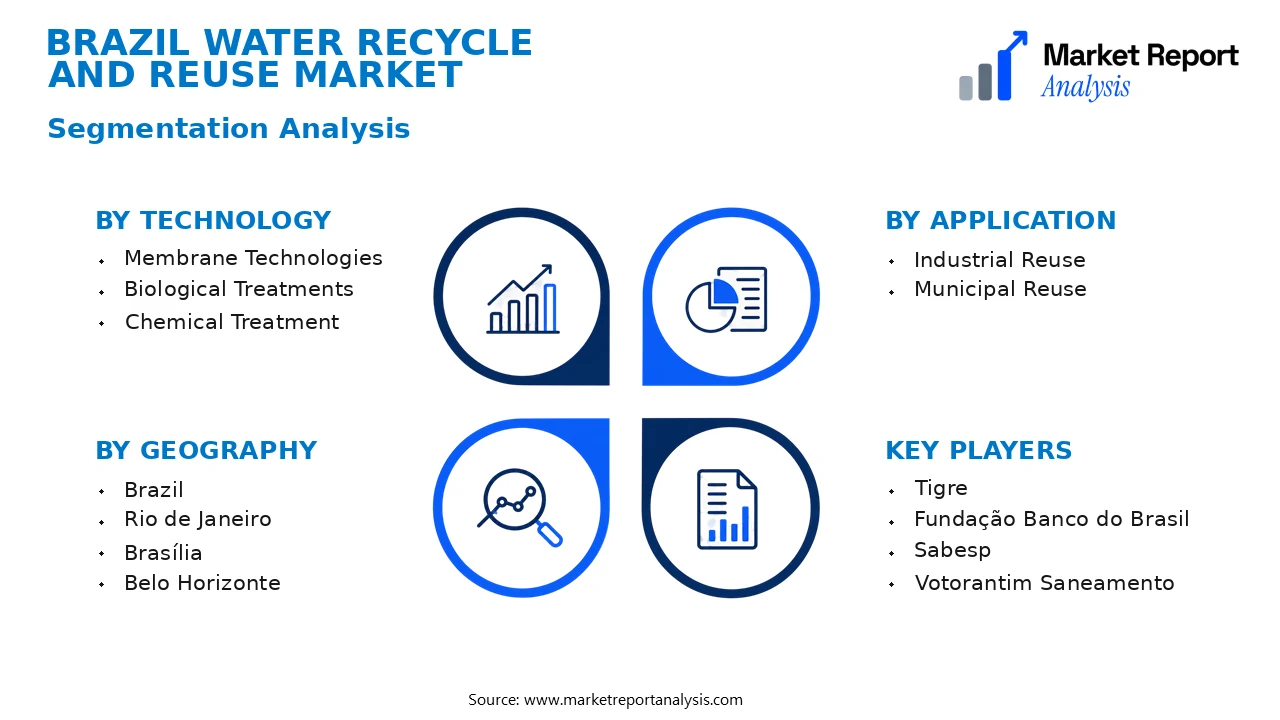
- Technology
- Membrane Technologies: These include ultrafiltration, microfiltration, nanofiltration, and reverse osmosis systems, which are crucial for high-quality water reuse applications in industrial and municipal settings, driven by strict regulatory standards and water scarcity issues.
- Biological Treatments: Biological treatment methods utilize microorganisms to degrade organic pollutants in wastewater, proving cost-effective and sustainable for municipal and industrial water reuse projects, especially in areas with high organic load effluents.
- Chemical Treatment: Chemical processes such as chlorination, ozonation, and coagulation are employed to disinfect and clarify recycled water, essential for ensuring safety in both industrial processes and municipal water supply reuse.
- Application
- Industrial Reuse: This segment involves water recycling for manufacturing processes, cooling systems, and boiler feedwater, significantly reducing industrial water demand, especially in sectors like chemical, textile, and pulp & paper industries which are prevalent in Brazil.
- Municipal Reuse: Encompasses reuse in parks, street cleaning, groundwater recharge, and decentralized sanitation systems, supporting urban water management efforts to alleviate the stress on freshwater sources across Brazilian cities.
- Geography
- Brazil: The overall market in Brazil is geographically segmented to capture regional variations in water scarcity, infrastructural development, and policy incentives, with primary focus on key urban centers.
- São Paulo: As Brazil’s financial hub and one of the most populous cities, São Paulo exhibits high demand for water reuse technologies due to frequent water shortages and extensive industrial activities.
- Rio de Janeiro: Known for tourist and industrial sectors, this region’s water reuse market is driven by urban infrastructure projects and environmental regulations aimed at reducing freshwater dependency.
- Brasília: The capital's government initiatives for sustainable water management promote water recycling, particularly in government buildings and urban landscapes.
- Belo Horizonte: Industrial and municipal water reuse initiatives are expanding here, supported by regional policies aimed at improving water efficiency and sustainability in urban growth.
- Brazil: The overall market in Brazil is geographically segmented to capture regional variations in water scarcity, infrastructural development, and policy incentives, with primary focus on key urban centers.
This segmentation provides stakeholders with targeted insights into the market dynamics, regional policies, and sector-specific demands, enabling better strategic planning and investment decision-making for the Brazil Water Recycle and Reuse Market.
Competitive Intelligence
The Brazil Water Recycle and Reuse Market is characterized by moderate competition, with several key players dominating regional segments. Major companies are focusing on strategic partnerships and joint ventures to expand their market share, especially in urban centers like São Paulo and Rio de Janeiro, where water scarcity concerns drive demand for innovative solutions. Market concentration remains relatively balanced, with the top five firms accounting for a significant but not monopolistic portion of the market, fostering competitive dynamics that encourage differentiation through product innovation. Companies are investing heavily in R&D to develop advanced recycling technologies that improve efficiency and reduce costs, setting their offerings apart from traditional solutions. Acquisitions are increasingly common, as larger firms seek to consolidate market presence and gain access to promising startups specializing in membrane filtration, smart water management, and IoT-enabled monitoring systems. Expansion strategies tend to target underpenetrated regions, while product differentiation focuses on sustainability credentials and integration with existing infrastructure. Overall, the competitive landscape in Brazil demonstrates a shift toward technological innovation driven by eco-conscious policies and industrial demand.
Leading Company Profiles
The competitive landscape within the Brazil Water Recycle and Reuse Market features several prominent players known for their innovation, technological expertise, and strategic initiatives. These companies are pivotal in shaping market growth through their diversified portfolios and strategic alliances.
- Tigre
- Fundação Banco do Brasil
- Sabesp
- Votorantim Saneamento
- Aguas do Brasil
- Braskem
- Embraer
- CCR Group
- Petrobras
- Hidrosistema
Tigre
Tigre specializes in plumbing systems and water management solutions, incorporating advanced reuse technologies to meet sustainability standards in Brazil's evolving infrastructure projects.
Fundação Banco do Brasil
This foundation focuses on funding large-scale water management and sanitation projects, fostering social and environmental sustainability through strategic investments in water recycling initiatives.
Sabesp
As a leading water utility in Brazil, Sabesp adopts innovative reuse processes with extensive wastewater treatment capabilities, driving regulatory compliance and environmental stewardship across urban and industrial sectors.
Votorantim Saneamento
Votorantim leads in wastewater treatment and reuse, harnessing cutting-edge technology to enhance operational efficiency and expand reuse capacities aligned with Brazil’s water conservation policies.
Aguas do Brasil
This company offers comprehensive water recycling services, leveraging digital monitoring and control systems to optimize water reuse in diverse industrial and municipal infrastructures.
Braskem
Braskem integrates water reuse principles into its petrochemical manufacturing processes, pioneering sustainable practices and reducing industrial water footprint significantly.
Embraer
Embraer utilizes innovative water treatment and recycling solutions within its aerospace manufacturing, supporting sustainability goals and minimizing environmental impact.
CCR Group
CCR develops large-scale sanitation projects with advanced reuse technologies, contributing notably to urban water management and sustainability within Brazil’s metropolitan regions.
Petrobras
Petrobras implements integrated water reuse systems across its oil and gas operations, reducing operational water consumption and enhancing environmental compliance through technological upgrades.
Hidrosistema
Hidrosistema provides customized water recycling solutions, focusing on innovative filtration and treatment technologies for industrial and municipal customers across Brazil.
Strategic Business Developments
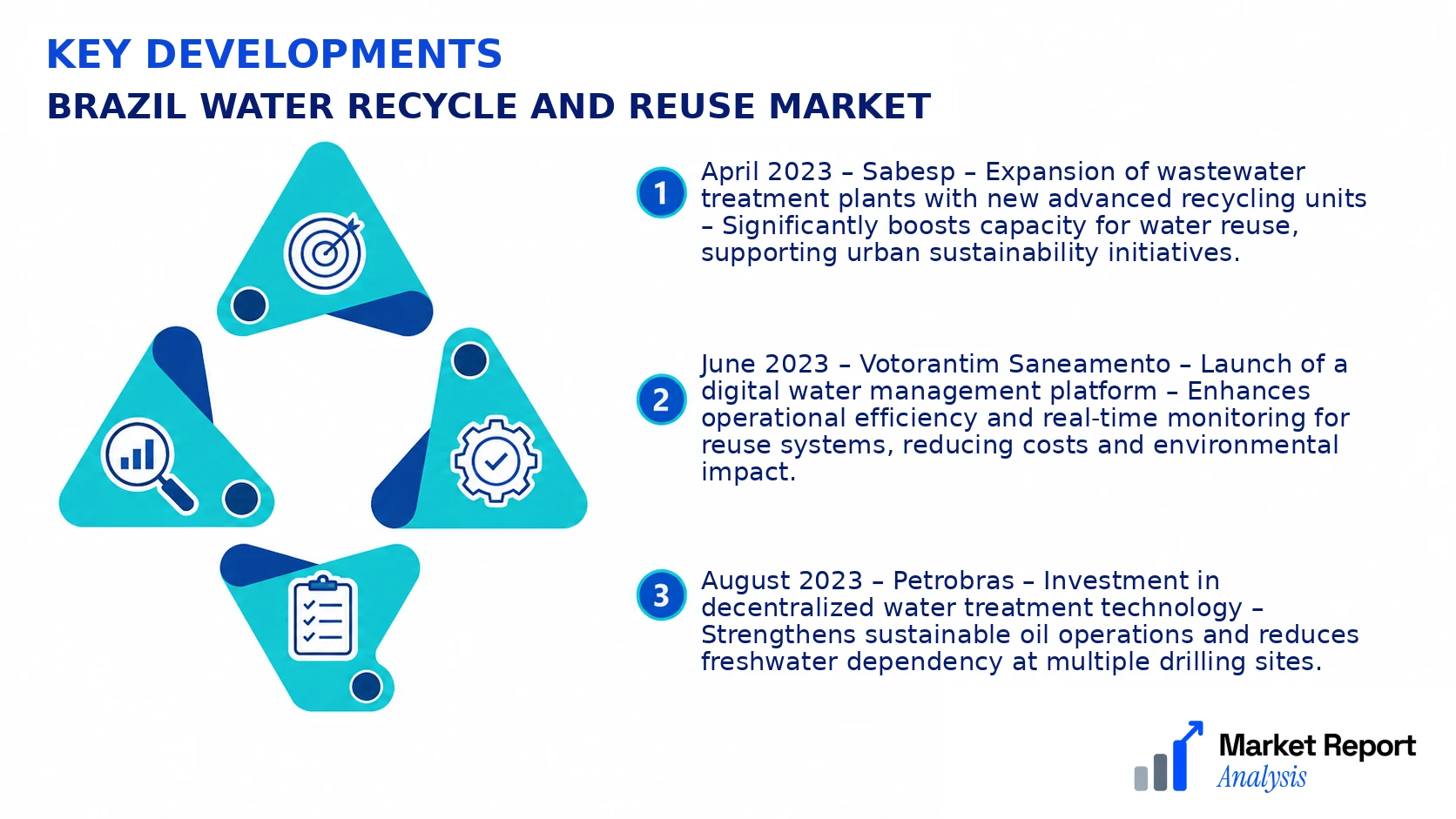
- April 2023 – Sabesp – Expansion of wastewater treatment plants with new advanced recycling units – Significantly boosts capacity for water reuse, supporting urban sustainability initiatives.
- June 2023 – Votorantim Saneamento – Launch of a digital water management platform – Enhances operational efficiency and real-time monitoring for reuse systems, reducing costs and environmental impact.
- August 2023 – Petrobras – Investment in decentralized water treatment technology – Strengthens sustainable oil operations and reduces freshwater dependency at multiple drilling sites.
- October 2023 – Aguas do Brasil – Partnership with international technology firm for innovative filtration solutions – Leads to higher purity levels and broader industrial application of recycled water.
- December 2023 – Braskem – Acquisition of a green technology startup specializing in industrial water reuse – Expands its sustainable manufacturing practices and technological expertise.
Frequently Asked Questions
What is the Brazil Water Recycle and Reuse Market?
The Brazil Water Recycle and Reuse Market encompasses the technological and infrastructural development for collecting, treating, and reusing wastewater within Brazil. It aims to address water scarcity, environmental sustainability, and regulatory compliance across multiple sectors including industrial, municipal, and agricultural.
What is the current market size of Brazil Water Recycle and Reuse Market?
As of 2026, the market is valued at approximately USD 4.2 Billion, reflecting ongoing investments driven by government initiatives, corporate sustainability commitments, and increasing urbanization that mandates more sustainable water management practices.
What factors are driving the Brazil Water Recycle and Reuse Market?
Key drivers include stringent government regulations promoting water conservation, increased industrial participation in sustainable practices, urban population growth, and technological advancements making water recycling more efficient and cost-effective, thereby fostering market expansion.
Which region dominates the Brazil Water Recycle and Reuse Market?
Southeast Brazil dominates the market, owing to its high population density, industrial activity, and better infrastructure for water treatment and recycling, particularly in states like São Paulo and Rio de Janeiro which lead regional adoption.
Which segment is expected to grow the fastest?
The industrial segment is forecasted to exhibit the fastest growth, driven by stricter environmental policies and the need for industries to reduce freshwater withdrawal, adopt sustainable processes, and meet environmental compliance standards.
Who are the leading companies operating in the Brazil Water Recycle and Reuse Market?
Leading companies include Veolia Environnement, Suez, and Acciona, which are prominent due to their extensive technological expertise, strategic partnerships, and ongoing projects that contribute significantly to market growth and innovation in water recycling solutions in Brazil.
Analyst Perspective
The Brazil Water Recycle and Reuse Market is positioned for steady growth driven by increasing water scarcity and regulatory pressures, with a long-term outlook favoring further market maturity and technological refinement. As infrastructure investments intensify, opportunities arise particularly in urban centers such as São Paulo and Rio de Janeiro, where water reuse can significantly reduce dependency on freshwater sources. Innovation in treatment technologies, including membrane filtration and advanced oxidation processes, will be critical in enhancing efficiency and lowering costs, fostering competitive advantages for early adopters. Strategic investment should prioritize scalable and adaptable systems with strong regional deployment potential, emphasizing capacity expansion in industrial, municipal, and agricultural sectors. Competitive dynamics are expected to intensify, with local and international players vying for market share through strategic collaborations and technology differentiation. Regions demonstrating the greatest growth potential include densely populated and water-stressed urban zones, which offer lucrative opportunities for both established companies and new entrants aiming to capitalize on Brazil’s evolving water management landscape.
