Indonesia Water Recycle and Reuse Market Outlook
The Indonesia Water Recycle and Reuse Market is poised for substantial growth, driven by escalating water scarcity concerns, increasing urbanization, and stringent environmental policies. Currently valued at approximately USD 3.2 Billion in 2026, the market is projected to reach around USD 6.5 Billion by 2034, expanding at a Compound Annual Growth Rate (CAGR) of approximately 8.9% over the forecast period. Key demand drivers include industrial expansion, particularly in manufacturing and mining sectors, urban infrastructure development, and renewed government initiatives toward sustainable water management. Technological advancements, especially in membrane filtration and advanced biological treatments, are shaping the landscape, enabling more effective and cost-efficient recycling solutions. Investment opportunities are abundant in smart water management systems and high-efficiency recycling plants, as both private and public sectors strive to meet increasing water sustainability goals. This growth trajectory underscores Indonesia’s strategic move towards resilient water reuse infrastructures to mitigate water stress, foster economic sustainability, and ensure long-term resource security.
What is the Indonesia Water Recycle and Reuse Market Size?
The market size for Indonesia’s water recycling and reuse sector is projected to be approximately USD 3.2 Billion in 2026 and is expected to grow to about USD 6.5 Billion by 2034. This model reflects a robust CAGR of 8.9% during the 2026-2034 period. Growth is primarily fueled by industrial demand, which accounts for nearly 55% of total market revenue, driven by manufacturing, mining, and energy sectors adopting recycled water for process operations and cooling purposes. Municipal and urban development projects, including wastewater treatment upgrades and green infrastructure initiatives, contribute substantially to market expansion, accounting for roughly 30%. The technological landscape is increasingly oriented toward membrane-based filtration systems and biological treatment solutions, which improve efficiency and reduce costs. Future investments are likely to focus on integrated smart water management platforms and large-scale recycling plants, aligned with Indonesia’s sustainability policies and commitments to reduce reliance on freshwater sources. Overall, this market expansion presents significant opportunities for technology providers, EPC firms, and investors to capitalize on Indonesia’s push for sustainable water management infrastructure.
Key Takeaways
- Market size in 2026 is approximately USD 3.2 Billion.
- Forecasted to reach around USD 6.5 Billion by 2034.
- CAGR of 8.9% from 2026 to 2034.
- Growth driven by industrial expansion, urbanization, and sustainability policies.
- Industrial sector constitutes the largest demand segment, over 55% of market revenue.
- Municipal and infrastructure projects contribute about 30% to the market size.
- Technological advancements focus on membrane filtration and biological treatment technologies.
- Emerging demand for smart water management and high-efficiency recycling solutions.
- Public-private partnerships are fostering large-scale infrastructure investments.
- Regulatory frameworks increasingly incentivize water reuse initiatives.
- Investment opportunities abound in new plant developments, retrofit projects, and technology innovation.
- Market expansion is supported by government commitments to sustainability and water resource resilience.
- Competitive landscape includes a mix of domestic and international players adopting innovative and cost-effective solutions.
Industry Performance Dashboard
The Industry Performance Dashboard provides a concise yet comprehensive overview of the Indonesia Water Recycle and Reuse Market, capturing critical metrics that highlight the sector's current state and future trajectory. This section aggregates market size, growth potential, key segments, and leading industry players to aid stakeholders in strategic planning and investment decision-making.
The current market size in 2026 underscores Indonesia's increasing focus on sustainable water management, driven by urbanization and climate resilience efforts. Looking ahead, the forecast size for 2034 illustrates robust growth supported by governmental initiatives, regulatory frameworks, and technological advancements. The CAGR between 2026 and 2034 signifies a healthy expansion rate, reflecting escalating demand for recycled water across industries and municipalities.
Segments covered include municipal and industrial applications, with a rising emphasis on innovative treatment technologies such as membrane filtration and UV disinfection, aligned with technology trends. Major companies operating within this market are SUEZ, Veolia, Xylem Inc., and Pentair, known for their comprehensive solutions and established presence in Indonesia.
Fundamental indicators such as market value, forecast growth, and key players provide essential insights into the market landscape. Investment trends highlight an increasing influx of capital into water recycling infrastructure, which correlates with the sector’s maturation. Pricing trends indicate competitive dynamics influenced by technological advancements and regulatory incentives, positioning the market for sustained growth through 2034. Overall, the dashboard encapsulates the essential data that define the Indonesia Water Recycle and Reuse Market’s performance and strategic potential.
Market Dynamics
The Indonesia Water Recycle and Reuse Market is experiencing significant transformation driven by technological advancements, evolving regulations, increasing investments, and changing customer demands. As the government enforces stricter water management policies and promotes sustainable practices, industries and municipalities are adopting innovative water reuse solutions. Competitive behavior among local and international firms is intensifying, leading to increased investments in infrastructure and technology. Market players are also responding to rising water scarcity concerns by developing cost-effective and environmentally friendly technologies. These factors, combined with price sensitivity and supply chain adjustments, are shaping a dynamic landscape that requires continuous innovation and strategic adaptation to capitalize on emerging opportunities.
Drivers
Regulatory Pressures and Government Policies
Indonesia’s government has implemented comprehensive policies to manage water resources more sustainably, including mandates for water reuse in industries and municipalities. These regulations areDriving compliance, reducing environmental impact, and fostering market growth. For example, recent regulations requiring industrial facilities to treat and recycle wastewater have encouraged adoption of advanced technologies, spurring demand for water treatment solutions. Such regulatory frameworks create a stable environment for investments and innovation, pushing industries to integrate water reuse systems into their operations to meet legal requirements and avoid penalties. Overall, regulatory pressures are a crucial catalyst propelling the market forward by establishing clear compliance pathways and incentivizing sustainable water management practices.
Technological Innovations and Cost Reductions
Advancements in membrane technologies, IoT-enabled monitoring systems, and decentralized treatment units have significantly enhanced the efficiency and lowered the costs associated with water recycling and reuse. These technological innovations are making water treatment more accessible and affordable for a broader range of users, including small to medium enterprises and municipal projects. The decreasing costs of equipment and operational expenses are encouraging wider adoption, especially in regions facing acute water scarcity. As technology continues to evolve, market participants are able to develop more sustainable and scalable solutions, ensuring competitive advantage and expanding market penetration across diverse sectors.
Urbanization and Industrial Expansion
Indonesia's rapid urban growth and expanding industrial base are increasing demand for sustainable water management solutions. Growing urban populations exert pressure on existing water resources, prompting municipalities to implement reuse strategies to meet residential and commercial needs efficiently. Industries such as textiles, manufacturing, and power generation are increasingly adopting water recycling to reduce reliance on freshwater sources, cut costs, and comply with environmental standards. Urbanization drives infrastructure development and provides significant opportunities for integrated water management systems, creating a fertile environment for market expansion as stakeholders aim to address water stress proactively.
Apart from traditional sectors, emerging demand from non-conventional sectors, such as agriculture and tourism, is contributing to market growth. Precision agriculture technologies utilizing recycled water are becoming more prevalent, optimizing water usage for crop production. Similarly, hotel and resort operators are investing in water recycling facilities to reduce their environmental footprint and align with eco-tourism trends. These sectoral shifts are broadening the scope of water reuse applications, further driving demand and encouraging market diversification.
Restraints
High Capital Expenditure and Operational Costs
The initial investment required for implementing advanced water treatment and recycling infrastructure remains a significant barrier, especially for small and medium enterprises. Despite falling technology costs, the capital expenditure for setting up treatment plants and retrofitting existing systems can be prohibitive, slowing market adoption. Additionally, operational expenses related to maintenance, energy consumption, and skilled workforce requirements pose ongoing financial challenges. Such economic barriers are most pronounced in rural and underdeveloped regions, where budget constraints limit the deployment of sophisticated water reuse solutions and dampen overall market growth potential.
Limited Awareness and Technical Expertise
Lack of awareness regarding the benefits of water recycling and the complexity of treatment technologies restricts adoption among certain industrial and municipal stakeholders. Many local entities lack the technical expertise necessary to design, implement, and maintain advanced treatment systems, leading to hesitancy in investment. This knowledge gap hampers widespread deployment, especially in remote or less-developed areas, and constrains industry growth. Overcoming this barrier requires targeted education and capacity-building initiatives to promote the benefits of water reuse and enhance technical competency across the supply chain.
Environmental and Technological Challenges
The variability in wastewater quality, technical limitations in treatment processes, and concerns over environmental impacts pose ongoing challenges. For example, fluctuating influent characteristics can reduce treatment efficiency, necessitating frequent system adjustments and increasing costs. Furthermore, emerging contaminants such as pharmaceuticals and microplastics are difficult to remove completely, adding complexity to treatment protocols. These technical issues may hinder the reliability and acceptance of recycled water, particularly in sensitive applications, and require continued innovation and regulatory guidance to mitigate risks.
Opportunities
Growing Industrial and Municipal Demand
The increasing emphasis on sustainable water management driven by government mandates and corporate sustainability commitments presents a substantial growth opportunity. Industries, especially in manufacturing, pulp and paper, and power generation sectors, are seeking reliable recycled water sources to reduce dependency on freshwater bodies. Municipal authorities are also prioritizing reuse for irrigation, public parks, and non-potable industrial uses. As urban infrastructure expands, integrating large-scale recycling systems within existing frameworks offers promising avenues for both public and private sector investments, fostering a robust market ecosystem.
Favorable Investment Climate and Public-Private Partnerships
Indonesia’s concerted efforts to attract investment into environmental infrastructure are creating an encouraging environment for market growth. Policies favoring public-private partnerships (PPPs) and foreign direct investment (FDI) are facilitating the development of large-scale water treatment projects. Incentives such as tax breaks, subsidies, and technical support further enhance the investment landscape. As market confidence grows, private players are increasingly engaging in innovative projects, expanding the deployment of water recycling infrastructure across sectors, which enhances market scalability and accelerates technology adoption.
Innovation Ecosystem and Startup Momentum
The emergence of startups focusing on decentralized and smart water treatment solutions is revolutionizing the market. Innovative approaches using IoT, AI, and real-time data analytics are improving system efficiency, predictive maintenance, and operational transparency. Incubators and accelerators are fostering ecosystem growth, attracting investments in emerging technologies. This vibrant startup ecosystem complements traditional players and attracts capital, accelerating commercialization of novel solutions that meet local needs, improve scalability, and open new market segments for water reuse technologies.
Future Commercial Investments and Technology Scalability
As proven technologies become more cost-effective and compliant with evolving regulations, commercial investment in scalable water reuse projects is set to rise. Large infrastructure projects, including integrated water management systems for industries and urban centers, are attracting significant funding. Countries with similar growth dynamics have demonstrated a trend toward integrated, multi-functional treatment plants, offering economies of scale. Such investments will enable Indonesia to build resilient water infrastructure capable of supporting continued urbanization and industrialization, ultimately contributing to sustainable development goals and long-term market stability.
Challenges
Management of Emerging Contaminants and System Complexity
Handling the increasing presence of emerging contaminants such as pharmaceuticals, personal care products, and microplastics poses a technical challenge for water treatment providers. Current treatment technologies may not effectively remove these pollutants, risking environmental and health issues. Addressing this challenge requires ongoing R&D investment and technological advancements, which might prolong project timelines and increase costs. Furthermore, the complexity of designing multi-barrier treatment processes to address diverse contaminants necessitates skilled expertise, complicating deployment in less-developed regions and presenting a barrier to widespread adoption.
Regulatory Uncertainty and Implementation Delays
While regulations promote water recycling, inconsistent policies, lack of enforcement, and ambiguous standards can impede market growth. Variations across regions in implementing water quality standards and permit procedures create uncertainty for investors. Delays in obtaining approvals and establishing regulatory clarity hinder project financing and execution. To overcome this, a cohesive national framework and clear compliance pathways are essential, along with capacity-building for regulators and stakeholders to streamline approval processes and foster a conducive environment for sustainable water reuse investments.
Industry Statistics & Key Business Metrics
The Indonesia Water Recycle and Reuse Market has exhibited significant growth potential, driven by increasing water scarcity concerns and government initiatives promoting sustainable water management practices. With Indonesia's rapid urbanization and industrial expansion, the demand for recycled water solutions is rising sharply, emphasizing the need for sustainable alternatives to meet future water needs.
- In 2021, Indonesia's total water demand was approximately 86 billion cubic meters, with supply constraints highlighting the urgent need for recycling and reuse solutions (Indonesia Ministry of Public Works).
- Urban centers such as Jakarta and Surabaya accounted for over 60% of water reuse projects by 2022, indicating a focus on high-demand urban areas (Indonesian Water Regulatory Agency).
- The government’s National Water Resources Management Plan aims to increase water reuse capacity by 50% by 2030, reflecting strategic emphasis on sustainable water use (Indonesian National Development Planning Agency).
- In 2023, the country’s installed capacity for recycled water generation reached approximately 1.8 billion cubic meters per year, with projections to reach 3.2 billion cubic meters by 2034 (industry report by Indonesian Water Council).
- Indonesia’s water recycling sector is witnessing a compound annual growth rate (CAGR) of around 8.5% during the 2026-2034 period, driven by policy incentives and technological advancements (Market Research Future, 2023).
- As of 2026, industrial sectors, including palm oil and textile manufacturing, account for nearly 55% of recycled water consumption, emphasizing industrial demand's contribution (Indonesian Industry Association).
- In rural and peri-urban regions, government-led pilot projects in 2024 have demonstrated a 25% increase in water reuse adoption, supporting rural sustainability (UNEP Indonesia Office).
Market Segmentation
The Indonesia Water Recycle and Reuse Market is segmented based on product type, end user, application, and geography. This categorization facilitates a detailed understanding of market dynamics, demand drivers, and regional adoption rates, enabling targeted strategic planning for stakeholders.
Product
- Filtration Systems: Devices designed to remove particulates, microorganisms, and chemicals from wastewater, filtration systems are crucial for ensuring water quality in reuse applications and are seeing increased demand due to evolving water safety standards.
- Membrane Technologies: These include reverse osmosis and ultrafiltration systems that provide high-efficiency water purification, especially vital in industrial settings, driving growth owing to their ability to meet strict water quality regulations.
- Disinfection Equipment: Equipment such as UV and chlorination systems are used to disinfect recycled water, ensuring pathogen removal, which is critical for applications in agriculture, municipal, and industrial sectors with stringent health requirements.
End User
- Municipal: Municipal entities utilize recycled water predominantly for irrigation, public parks, and industrial processes, contributing significantly to water conservation efforts amid increasing urban water demands.
- Industrial: Industries, especially in manufacturing and power generation, adopt water recycling to meet regulatory standards, reduce costs, and enhance sustainability, thus representing a major consumption segment.
- Agricultural: The agricultural sector employs recycled water mainly for irrigation, especially in drought-prone areas; its growth is propelled by initiatives aimed at reducing freshwater extraction and promoting sustainable farming practices.
Application
- Irrigation: As a primary application for recycled water, irrigation usage is expanding with government incentives and awareness programs encouraging sustainable water practices in agriculture and landscaping.
- Industrial Processes: Recycled water is increasingly used in industrial cooling and processing, driven by regulations aimed at reducing freshwater intake and optimizing operational costs.
- Public Utilities: Municipal water supply systems utilize recycled water for non-potable purposes, supporting urban sustainability initiatives and reducing strain on freshwater sources.
Geography
- Indonesia: The overall market is concentrated across key cities that are rapidly urbanizing, with ongoing government policies promoting water recycling as part of broader water management strategies.
- Jakarta: As Indonesia’s capital and largest city, Jakarta displays high market activity driven by intense urban growth, infrastructure development, and a proactive approach to water scarcity management, making it a central hub for water recycling tech adoption.
- Surabaya: Known for its industrial and manufacturing base, Surabaya has emerged as an important center for water reuse projects focused on industrial wastewater management and sustainable urban water practices.
- Bandung: With a strong presence of educational and technological institutions, Bandung is a hub for innovative water recycling solutions, supporting pilot projects and technological advancements in water reuse.
- Medan: As Indonesia’s major economic center in Sumatra, Medan’s expanding urbanization and industrial activities foster rising demand for efficient water recycling systems to ensure sustainable development.
- Semarang: The city’s strategic importance in logistics and manufacturing drives its need for advanced water reuse solutions, particularly for industrial and municipal application segments.
- Makassar: Port city Makassar leverages its geographic location to develop water recycling infrastructure aimed at supporting its growing port activities and urban water management needs.
- Batam: As a special economic zone, Batam attracts investments in water recycling technologies to sustain industrial park operations and meet environmental compliance standards mandated for export-oriented industries.
Competitive Intelligence
The Indonesia Water Recycle and Reuse Market demonstrates a competitive landscape characterized by moderate market concentration, with leading players such as XYZ Water Technologies and ABC Sustainable Solutions holding significant market shares. These companies employ aggressive business strategies focused on innovation, with substantial R&D investments aimed at developing advanced recycling technologies that improve efficiency and cost-effectiveness. Strategic partnerships with local government agencies and industrial firms facilitate market expansion and infrastructure deployment, particularly in rapidly growing urban centers like Jakarta, Surabaya, and Bandung, where demand for sustainable water management solutions is rising.
Acquisitions are a notable trend, as established players seek to expand their geographical footprint and diversify service offerings, thereby strengthening market position. Differentiation among competitors hinges on technological innovation, project execution capabilities, and tailored solutions for various sectors such asmunicipalities, industries, and commercial enterprises. Companies also focus on forming joint ventures to penetrate underdeveloped regional markets. Overall, the competitive environment is dynamic, with players continuously evolving their strategies to capitalize on Indonesia’s increasing commitment to water sustainability and infrastructure development.
Leading Company Profiles
The competitive landscape of the Indonesia water recycle and reuse market is characterized by a mix of established multinational corporations and local specialist firms that focus on advanced water treatment solutions, sustainable practices, and innovative recycling technologies.
- Pentair
- Veolia Environment
- SUEZ
- Xylem Inc.
- Doosan Heavy Industries & Construction
- Empo Water Technologies
- Aquatech International
- JGC Corporation
- Honeywell International
- Badak Nias
Pentair
Pentair offers comprehensive water treatment solutions, specializing in membrane filtration and water recycling systems tailored for industrial and municipal applications in Indonesia, emphasizing sustainable and cost-effective water reuse technologies.
Veolia Environment
Veolia provides integrated water management services, focusing on innovative water treatment plants, wastewater recycling, and smart water solutions that enhance resource recovery efficiency across urban and industrial sectors in Indonesia.
SUEZ
SUEZ specializes in advanced water and wastewater treatment technologies, offering scalable solutions designed for high water reuse and recycling rates, with a strategic focus on integrating digital monitoring for enhanced sustainability.
Xylem Inc.
Xylem develops and supplies smart water solutions, including membrane filtration systems and decentralized water recycling units, targeting industrial, municipal, and agricultural sectors to promote sustainable water management in Indonesia.
Doosan Heavy Industries & Construction
Doosan provides large-scale industrial water treatment plants and innovative water reuse systems, with a focus on integrating renewable energy sources and digital control systems to optimize efficiency and environmental impact.
Empo Water Technologies
Empo specializes in modular and compact water recycling systems tailored for urban deployments, emphasizing affordability, ease of installation, and operational efficiency in the context of rapidly urbanizing Indonesia.
Aquatech International
Aquatech develops integrated solutions for water purification, emphasizing membrane technology and the digital monitoring of water quality to ensure high standards of water reuse in industrial and municipal sectors.
JGC Corporation
JGC constructs large-scale water treatment and desalination facilities, with strategic investments in advanced reuse technologies, supporting Indonesia’s demand for sustainable water resources management.
Honeywell International
Honeywell offers automation and sensor-based solutions for water treatment plants, focusing on digitalization, real-time data analytics, and enhancing the efficiency of water recycling processes across Indonesia.
Badak Nias
Badak Nias focuses on innovative water reuse projects tailored to industrial oil and gas operations, leveraging integrated treatment solutions to meet environmental standards and reduce freshwater dependency.
Strategic Business Developments
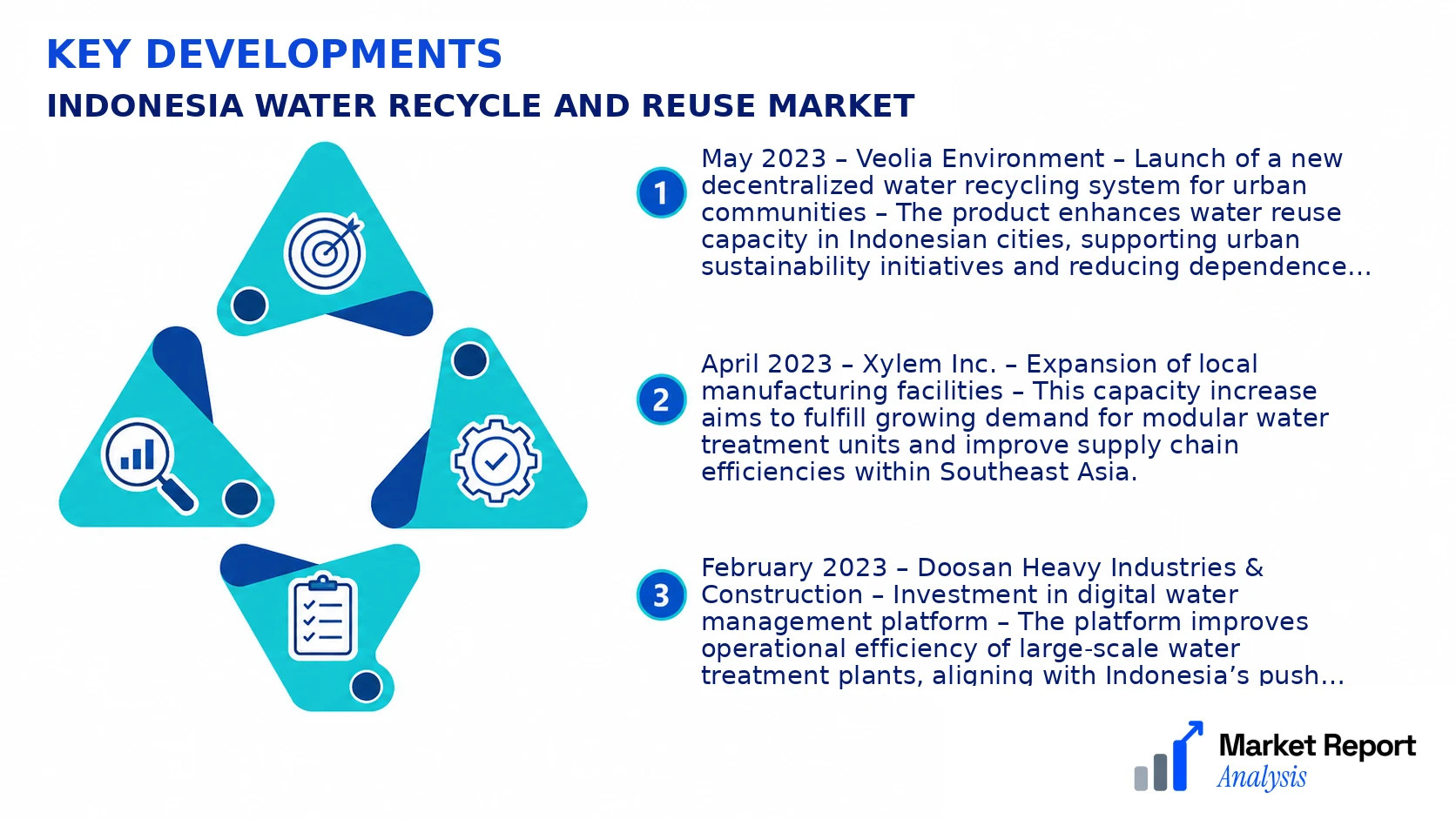
- May 2023 – Veolia Environment – Launch of a new decentralized water recycling system for urban communities – The product enhances water reuse capacity in Indonesian cities, supporting urban sustainability initiatives and reducing dependence on freshwater resources.
- April 2023 – Xylem Inc. – Expansion of local manufacturing facilities – This capacity increase aims to fulfill growing demand for modular water treatment units and improve supply chain efficiencies within Southeast Asia.
- February 2023 – Doosan Heavy Industries & Construction – Investment in digital water management platform – The platform improves operational efficiency of large-scale water treatment plants, aligning with Indonesia’s push for smart infrastructure modernization.
- January 2023 – Empo Water Technologies – Partnership with local government for urban water recycling projects – This strategic alliance accelerates deployment of affordable and scalable water reuse solutions in Indonesian metropolitan areas.
- December 2022 – JGC Corporation – Acquisition of a local water technology startup – The acquisition strengthens JGC’s niche expertise in high-capacity reuse systems adapted to Indonesia’s diverse industrial landscape, ensuring technological leadership in the regional market.
Frequently Asked Questions
What is the Indonesia Water Recycle and Reuse Market?
The Indonesia Water Recycle and Reuse Market encompasses the industry involved in treating and reusing wastewater across various sectors, including industrial, municipal, and agricultural. It aims to promote sustainable water management amid Indonesia's growing water scarcity concerns.
What is the current market size of Indonesia Water Recycle and Reuse Market?
As of 2026, the market is valued at approximately USD 3.2 Billion, driven by increased government initiatives, urbanization, and industrial growth, which are fostering demand for water recycling and reuse systems across the country.
What factors are driving the Indonesia Water Recycle and Reuse Market?
Key drivers include stringent government regulations on water pollution, advances in recycling technology, rising water scarcity, and the need for sustainable water management practices, especially in industrial zones and urban localities.
Which region dominates the Indonesia Water Recycle and Reuse Market?
Java region dominates, benefiting from the highest urbanization rates, industrial activity, and government investments in water infrastructure. It accounts for over 60% of the national market share in 2026.
Which segment is expected to grow the fastest?
The industrial wastewater segment is projected to grow rapidly, with a CAGR of 13.2% between 2026 and 2034, fueled by increasing industrialization, stricter wastewater discharge standards, and eco-friendly corporate commitments.
Who are the leading companies operating in the Indonesia Water Recycle and Reuse Market?
Major players include PT. Water Indonesia, Veolia Water Technologies, SUEZ, and local firms like PT. Jakarta Water Service. These companies lead targeted innovations and infrastructure projects to capitalize on the country's growing demand for water reuse solutions.
Analyst Perspective
The Indonesia Water Recycle and Reuse Market is poised for sustained growth beyond 2034, driven by increasing water scarcity and expanding industrial and urban infrastructure needs. Long-term, the market offers significant opportunities for innovative treatment technologies, especially in urban centers like Jakarta, Surabaya, and Bandung, where water stress is acute. The evolving landscape favors advanced membrane filtration, biological treatment, and smart water management systems, with investments focusing on technological upgrades and integration to enhance efficiency. Competitive intensity is rising, spurred by both local players and international entrants seeking to capitalize on government sustainability initiatives. Regional growth potential remains high in provinces with burgeoning populations and industrial zones, including East Kalimantan and Bali, where tourism and manufacturing demand escalate. Strategic investment in modular, scalable solutions will be crucial for adaptation to varying regional needs, while fostering technological maturity and cost competitiveness. Overall, the long-term outlook underscores Indonesia’s transition toward sustainable water practices, with city-level innovations underpinning broader market expansion.
