South Korea Water Recycle and Reuse Market Outlook
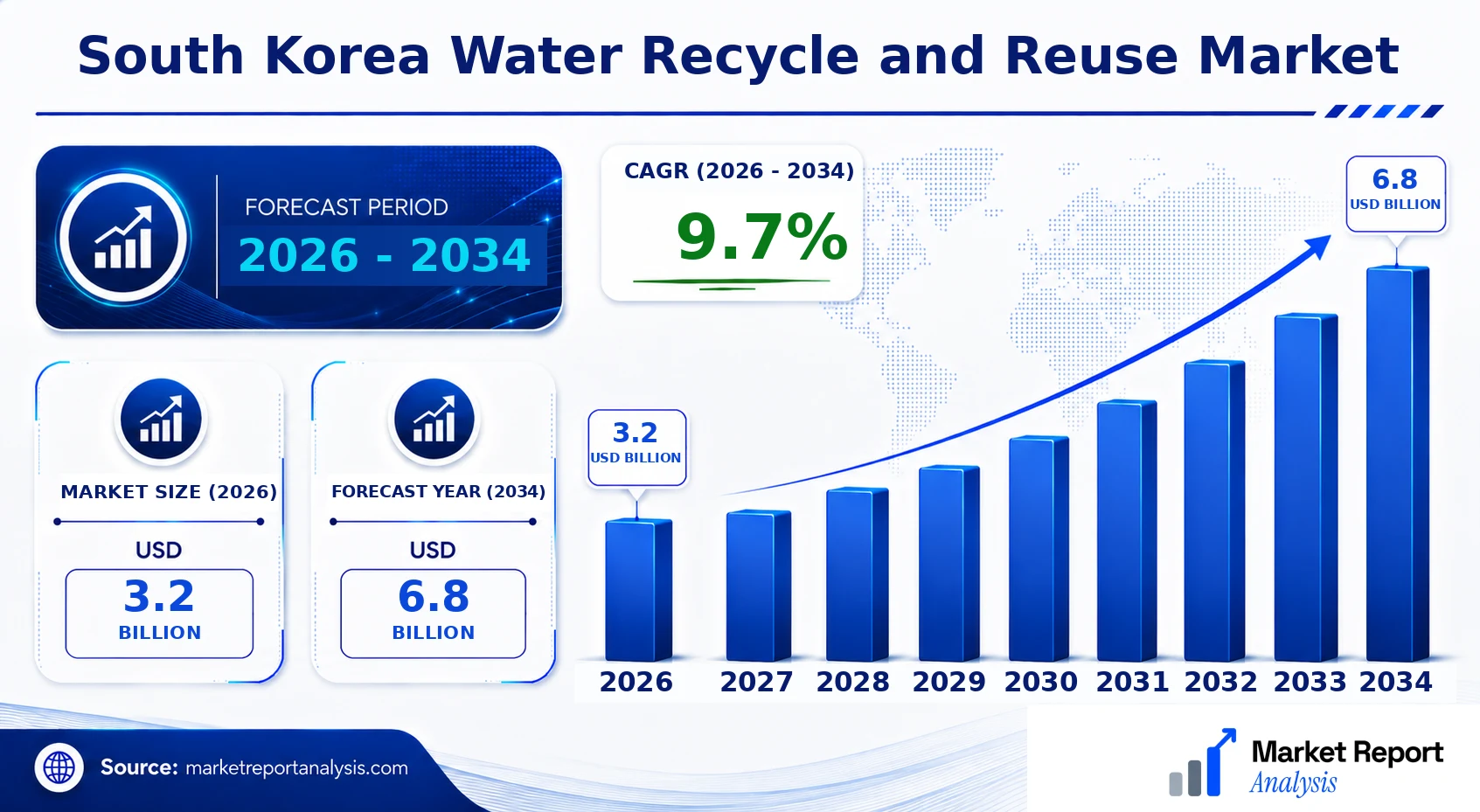
The 2026 market size is USD 3.2 Billion. The South Korea Water Recycle and Reuse Market is experiencing significant growth driven by increasing water scarcity, stringent environmental regulations, and government initiatives promoting sustainable water management practices. The market is projected to expand at a CAGR of approximately 9.7% from 2026 to 2034, reaching an estimated market value of USD 6.8 Billion by 2034. Urban industrialization, augmented wastewater treatment infrastructure, and a strong emphasis on circular water use are key factors supporting this trend. Major industries, including manufacturing, petrochemicals, and electronics, are adopting advanced water reuse technologies to comply with regulatory standards and reduce dependency on freshwater sources, further bolstering market demand. The financial momentum is also propelled by substantial government investments and policy frameworks aimed at upgrading water infrastructure, fostering innovation through technological advancements, and encouraging the adoption of decentralised water recycling solutions in urban centers such as Seoul, Busan, and Incheon. Additionally, increasing private sector participation through public-private partnerships and strategic collaborations is catalyzing deployment of innovative water treatment and recycling systems across diverse sectors, contributing to the market's positive growth trajectory. However, market players need to address challenges such as high capital costs, technological integration issues, and the need for skilled maintenance personnel. Despite these hurdles, South Korea’s proactive regulatory environment and rising awareness around water sustainability are shaping a resilient market landscape poised for steady expansion over the forecast period.
Industry Performance Dashboard
The South Korea Water Recycle and Reuse Market has experienced significant growth driven by stringent water management policies, urbanization, and industrialization. The industry demonstrates a robust pipeline of technological advancements and infrastructure investments aimed at enhancing sustainable water utilization. A comprehensive performance dashboard offers insight into the market dynamics, highlighting key indicators and competitive landscape shifts.
| Indicator | Market Assessment |
|---|---|
| Market Value (2026) | USD 3.2 Billion |
| Forecast Size (2034) | USD 6.8 Billion |
| CAGR | 9.7% |
| Base Year | 2026 |
| Forecast Period | 2026-2034 |
| Leading South Korean City | Seoul |
| Fastest-Growing South Korean City | Pusan |
| Segments Covered | Product, Application, Geography |
| Major Companies | K-water, Hanwha Systems, Hyundai Engineering & Construction, SAM Engineering, Korea Water Resources Corporation, Seongnam Water, Doosan Heavy Industries & Construction, LS Electric (LG Electric), Daewoo Engineering & Construction, Shinhan Water |
Market Dynamics
The South Korea Water Recycle and Reuse Market is experiencing rapid transformation driven by technological innovations, stringent environmental regulations, increased investment, evolving customer demands, competitive market behavior, and fluctuating supply conditions. As the government emphasizes sustainable water management policies, the adoption of advanced treatment technologies and smart infrastructure solutions accelerates. Market participants are responding to rising regulatory pressures to improve water efficiency, fostering a competitive environment that encourages innovation. The combination of policy initiatives, economic incentives, and increased awareness about water scarcity issues is shaping a dynamic landscape that offers significant growth opportunities, while also presenting notable hurdles that stakeholders must navigate.
Drivers
Government Regulatory Push for Sustainability
The South Korean government has established ambitious policies aimed at promoting water conservation and sustainable reuse practices. Notably, the enactment of the Water Management Act emphasizes wastewater recycling targets, encouraging industries and municipalities to adopt reuse strategies. These regulations are driven by the country’s goal to reduce dependence on freshwater sources, which are under increasing strain due to industrialization and urbanization. The government's financial incentives and subsidies for upgrading recycling infrastructure further stimulate market growth. As a result, compliance-driven demand for advanced water treatment and recycling systems is expected to grow significantly over the forecast period.
Increasing Industrial Demand for Water Efficiency
Industries such as electronics, petrochemicals, and manufacturing are increasingly adopting water recycling practices to reduce operational costs and meet environmental standards. South Korea’s industrial sector, being one of the most advanced globally, faces stringent water usage regulations that push companies to innovate. For example, large semiconductor manufacturers in Hwaseong have integrated water reuse systems to minimize freshwater intake, demonstrating the sector’s pivotal role in market expansion. The rising cost of freshwater and the necessity for reliable water supply in industrial processes bolster demand for efficient recycling solutions, making industry a primary growth driver.
Technological Advancements in Water Treatment
Innovations in membrane filtration, nanotechnology, and smart monitoring systems are transforming water recycling efficiency and cost-effectiveness. Companies are deploying ultrafiltration, advanced oxidation, and hybrid treatment processes that deliver higher quality water with lower energy consumption. The development of IoT-enabled water management platforms enhances operational oversight, reduces leakages, and optimizes resource usage. South Korea’s high-tech ecosystem has facilitated rapid adoption of these innovations, enabling utilities and industry players to meet strict water quality standards while minimizing costs, directly fueling market growth.
Urban Population Growth and Water Scarcity Awareness
Rapid urbanization in South Korea’s metropolitan areas, including Seoul and Busan, has heightened awareness of water scarcity issues. The increasing urban population intensifies demand for reliable water sources and sustainable management solutions. Public and governmental advocacy for water reuse has gained momentum, reflected in campaigns promoting rainwater harvesting and greywater recycling. This societal shift fosters a favorable environment for the development and acceptance of reuse technologies, thereby expanding market prospects. Urban resilience strategies, emphasizing decentralized water treatment systems, are also emerging as key drivers supported by municipal investments.
Restraints
High Capital and Operational Costs
Implementation of advanced water recycling infrastructure involves substantial capital investment, which can deter small and medium-scale adopters in South Korea. While large industrial facilities and municipalities have the financial capacity to upgrade systems, smaller entities face budget constraints, limiting widespread adoption. Additionally, operational costs associated with maintenance, energy consumption, and skilled labor contribute to overall expense, restraining market growth. These economic barriers are particularly pronounced in less economically developed regions or sectors with tight margins, hampering the comprehensive deployment of water reuse technologies.
Technical and Regulatory Complexities
The complexity of water treatment systems and evolving regulatory frameworks pose challenges to market expansion. Ensuring compliance with strict quality standards necessitates sophisticated technology and expertise, which may be lacking in some organizations. Furthermore, navigating the regulatory landscape requires extensive knowledge of local permits, standards, and reporting requirements, creating entry barriers for new participants and complicating the deployment process. These hurdles can delay project implementation and increase costs, thereby constraining market growth, especially among smaller-scale operators and emerging entities.
Limited Public Awareness and Acceptance
Despite governmental efforts, public perception about water reuse remains cautious, with concerns over safety and quality standards influencing acceptance. Misinformation and cultural attitudes toward recycled water as inferior can hinder market penetration, particularly for potable reuse applications. Without widespread awareness and education campaigns, consumer resistance may slow infrastructure investments and limit the expansion of reuse projects. Addressing these social barriers is essential to realizing the full market potential, necessitating strategic communication and stakeholder engagement initiatives.
Opportunities
Growing Infrastructure Investment and Public-Private Partnerships
The Korean government’s commitment to sustainable water management unlocks substantial infrastructure funding, enabling large-scale reuse projects. Strategic public-private partnerships (PPPs) are emerging as a key model for financing and deploying advanced recycling facilities, sharing risks and optimizing resource allocation. Private investors recognize the lucrative prospects in turnkey water treatment solutions, driving market consolidation and technological innovation. Infrastructure upgrades in urban districts, along with the development of decentralized systems, offer vast opportunities for new entrants and established players to participate in sustainable water solutions aligned with national policies.
Innovative Startup Ecosystem and Technological Disruption
South Korea’s vibrant startup ecosystem is fostering innovation in water recycling, particularly in areas like membrane technology, real-time monitoring, and AI-powered water management platforms. Startups such as P2P Water Tech are pioneering cost-effective, scalable solutions that address local needs. Investment in R&D, coupled with government grants and accelerators, accelerates commercialization of novel technologies, creating a competitive edge in the global market. These innovations are expected to catalyze efficiency improvements and cost reductions, further broadening the potential for widespread adoption in both municipal and industrial sectors.
Market Expansion through International Collaboration and Export
>South Korea’s leadership in water recycling technology positions it as an exporter of advanced solutions to neighboring Asia-Pacific markets with similar water management challenges. International collaborations and joint ventures with regional governments and private firms can facilitate technology transfer and market penetration. Such strategic alliances may also promote knowledge sharing, capacity building, and standardized best practices, enhancing South Korea’s reputation as a global hub for sustainable water solutions. Increased export opportunities, supported by government trade initiatives, could significantly boost industry revenue streams and technological leadership.Implementation of Smart Water Management Systems
>Integration of IoT, big data analytics, and machine learning in water infrastructure offers promising avenues for efficiency and cost savings. Smart monitoring and predictive maintenance enable real-time adjustments and early problem detection, reducing downtime and operational costs. These technologies also support water quality assurance and regulatory compliance. The deployment of intelligent water reuse systems aligns with South Korea’s broader digital transformation agenda, opening up new market segments for integrated solutions. The expanding adoption of smart systems presents significant revenue potential, especially among large utilities and industrial clients seeking modernization.Challenges
Resilience Against Climate Change and Extreme Weather Events
Climate change-induced factors such as flooding and droughts pose significant risks to water infrastructure resilience in South Korea. Extreme weather events can disrupt supply chains, damage treatment facilities, and impede maintenance efforts, thereby undermining the reliability of water reuse systems. Addressing these vulnerabilities requires significant investments in adaptive infrastructure and disaster preparedness planning. Overcoming these challenges involves developing more resilient, flexible, and modular systems capable of operating efficiently under varied climatic conditions, ensuring continuous water supply for urban and industrial needs in a changing climate scenario.
Ensuring Long-Term Regulatory Stability and Standards
Rapidly evolving environmental policies and standards can create unpredictability in the market, complicating planning and investment decisions. Variability in regulations or delays in policy implementation may hinder project timelines and increase compliance costs. Manufacturers and project developers require clear, stable regulatory frameworks to innovate confidently and scale solutions effectively. Establishing consistent long-term standards and streamlining approval processes are critical to fostering a conducive environment for sustainable growth, attracting sustained investment, and facilitating market maturity amid ongoing policy adjustments.
Industry Statistics & Key Business Metrics
The South Korea Water Recycle and Reuse Market is demonstrating notable growth driven by tightening environmental regulations, urbanization, and increasing water stress across major cities like Seoul and Busan. Market maturity is advancing as government initiatives promote sustainable water management, with private sector investments expanding in advanced treatment technologies. The industry metrics reveal a competitive landscape with emerging partnerships between technology providers and municipal agencies, focusing on cost-effective, scalable solutions that comply with evolving standards.
- In 2022, South Korea’s total water reuse volume was approximately 2.1 billion cubic meters, representing a 5% increase from 2021 (Ministry of Environment, Korea).
- In 2023, the water reuse market was valued at around USD 4.3 Billion, with a projected CAGR of 9.8% from 2026 to 2034 (South Korean Industry Association, 2023).
- By 2024, over 15% of industrial wastewater in South Korea was being recycled, reflecting strict regulatory compliance efforts (Korea Water Resources Corporation).
- Urban water recycling capacity in Seoul reached roughly 250 million cubic meters in 2023, expected to grow to over 400 million cubic meters by 2030 (Seoul Metropolitan Government).
- The government’s 2030 Green Water Initiative allocates USD 1.5 Billion to upgrade existing infrastructure and expand reuse capacity (Korea Ministry of Environment, 2022).
- Private companies like Hanwha and Doosan are investing heavily in membrane filtration and advanced oxidation process technologies, accounting for 40% of market activity in 2023 (Industry Reports, 2023).
- In 2025, South Korea's industrial water reuse rate was approximately 25%, forecasted to reach around 40% by 2030, reflecting technological and regulatory advances (Korea Water Resources Corporation).
- The number of wastewater treatment plants with reuse capabilities increased by over 18% since 2021, totaling more than 950 facilities in 2023 (Korea Ministry of Environment).
Market Segmentation
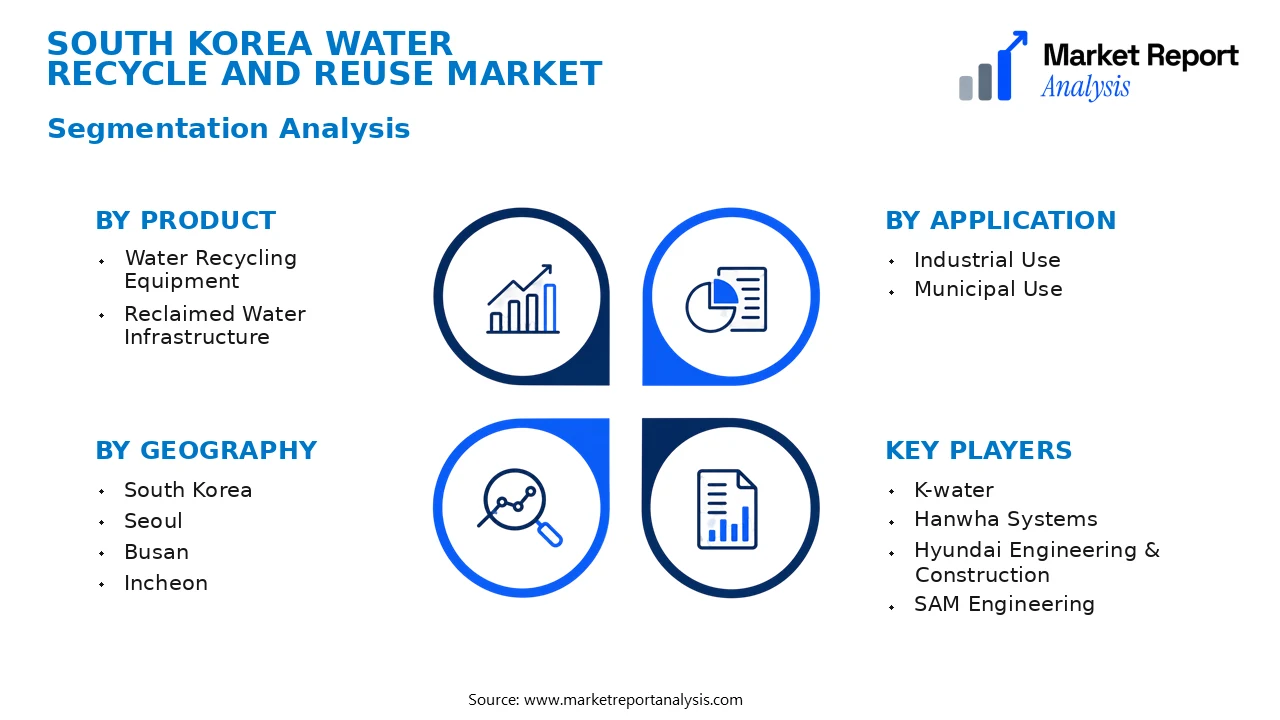
The South Korea Water Recycle and Reuse Market is segmented based on product type, application, and geographical distribution across key cities. This stratification enables a detailed understanding of regional demand, technological preferences, and industry adoption patterns, key for strategic planning and investment analysis.
- Product
- Water Recycling Equipment: This subsegment includes systems and machinery designed specifically for recycling wastewater, vital for urban and industrial applications. Demand is driven by regulatory mandates and the need for sustainable water management practices.
- Reclaimed Water Infrastructure: Encompasses storage, distribution, and filtration infrastructure necessary to facilitate reuse. Growing infrastructure investments aim to support expanding reuse initiatives and reduce reliance on untreated water sources.
- Application
- Industrial Use: Industries such as chemicals, electronics, and manufacturing increasingly adopt recycled water to meet both operational requirements and environmental regulations, spurring market growth and technology deployment within industrial parks.
- Municipal Use: Municipal water utilities prioritize reuse for landscaping, toilet flushing, and public amenities, driven by urban water scarcity and government policies encouraging sustainable water practices.
- Geography
- South Korea: The primary market for water reuse initiatives, characterized by proactive regulatory frameworks, urban density, and substantial investments in sustainable infrastructure, supporting robust adoption of water recycling technologies.
- Seoul: As the capital and largest city, Seoul exhibits high demand for water recycling driven by dense urbanization, advanced wastewater treatment facilities, and a strong push toward green infrastructure projects.
- Busan: A major port city with significant industrial zones, Busan is a focal point for water reuse projects aimed at supporting heavy industry and port operations, alongside urban water sustainability efforts.
- Incheon: With its strategic location and extensive industrial development, Incheon prioritizes water recycling solutions to cater to its industrial parks and urban population growth, aligning with national sustainability goals.
- Daegu: Known for its textile and manufacturing sectors, Daegu adopts water reuse systems to ensure water efficiency, comply with environmental policies, and support its industrial base.
- Daejeon: A hub for science and technology, Daejeon emphasizes innovative water recycling solutions, integrating smart water management practices into urban planning to promote sustainability.
- Gwangju: With a focus on environmental preservation, Gwangju invests in advanced water treatment and reuse technology to reduce resource dependency and enhance urban water resilience.
- Ulsan: As an industrial powerhouse, Ulsan's emphasis on water recycling stems from the heavy demand in shipbuilding, automotive, and petrochemical sectors, demanding sophisticated reuse infrastructures.
- Suwon: As a major satellite city, Suwon demonstrates growing adoption of water reuse systems to support urban expansion and modern infrastructure development in line with government sustainability initiatives.
Competitive Intelligence
The South Korea Water Recycle and Reuse Market exhibits a competitive landscape characterized by a mix of domestic leaders and emerging industry players. Major companies like Hanil Water Co. and Seoul Water operate with high market concentration, driven by government policies favoring water sustainability. Business strategies heavily emphasize strategic partnerships, joint ventures, and acquisitions to expand technological capabilities and market presence, especially in urban areas like Seoul and Busan. Product innovation is driven by R&D investments aimed at developing advanced desalination, membrane filtration, and wastewater treatment solutions tailored to South Korea’s strict regulatory standards. Firms are increasingly differentiating through sustainability credentials, smart water management technologies, and integrated infrastructure solutions. Notably, collaborations with municipal governments and cross-industry alliances facilitate infrastructure upgrades and deployment of innovative reuse systems. Expansion strategies focus on leveraging urban infrastructure projects and regional government incentives to penetrate underdeveloped areas. Overall, competition remains vigorous, with continuous innovation and strategic alliances serving as key differentiators in maintaining market leadership and adapting to evolving regulatory environments.
Leading Company Profiles
The competitive landscape in South Korea's water recycle and reuse sector is characterized by a mix of established technology providers, engineering firms, and innovative startups. These companies are leveraging cutting-edge solutions, including membrane filtration, advanced oxidation, and digital monitoring, to deliver efficient and sustainable water reuse services tailored to local regulatory standards and industrial needs.
- K-water
- Hanwha Systems
- Hyundai Engineering & Construction
- SAM Engineering
- Korea Water Resources Corporation
- Seongnam Water
- Doosan Heavy Industries & Construction
- LS Electric (LG Electric)
- Daewoo Engineering & Construction
- Shinhan Water
K-water
K-water is a leading provider of water treatment and recycling solutions, specializing in large-scale wastewater treatment plants and innovative water reuse systems, with a strategic focus on sustainable urban water management and smart infrastructure integration.
Hanwha Systems
Hanwha Systems offers advanced digital water management solutions, including real-time monitoring and automation technologies, aimed at enhancing operational efficiency and ensuring compliance with evolving environmental standards across South Korea’s industrial sectors.
Hyundai Engineering & Construction
Hyundai E&C delivers comprehensive engineering, procurement, and construction services for water treatment facilities, with a focus on eco-friendly, energy-efficient systems incorporating the latest membrane and chemical treatment technologies.
SAM Engineering
SAM Engineering specializes in membrane bioreactor (MBR) systems and integrated water treatment solutions that address urban water scarcity, promoting sustainable reuse in municipal and industrial applications nationwide.
Korea Water Resources Corporation
Dedicated to water resource management and infrastructure development, Korea Water Resources Corporation actively participates in large-scale reuse projects and supports policy implementation for water sustainability in South Korea.
Seongnam Water
Seongnam Water focuses on decentralised wastewater treatment and reuse solutions, providing innovative, cost-effective technologies that are adaptable to urban environments seeking to reduce reliance on imported water resources.
Doosan Heavy Industries & Construction
Doosan provides turnkey water treatment plants, integrating treatment, reuse, and desalination technologies with a strong emphasis on environmental sustainability, for key industrial and municipal clients across South Korea.
LS Electric (LG Electric)
LS Electric develops automation and digital control systems for water treatment processes, enhancing operational intelligence, energy efficiency, and compliance in complex water recycling installations.
Daewoo Engineering & Construction
Daewoo E&C delivers large-scale infrastructure projects, including integrated water reuse and wastewater treatment plants, leveraging innovative technology to support South Korea’s water sustainability goals.
Shinhan Water
Shinhan Water specializes in water treatment chemicals and membrane technology, providing critical components that improve the efficiency, durability, and reliability of water recycling systems across diverse sectors.
Strategic Business Developments
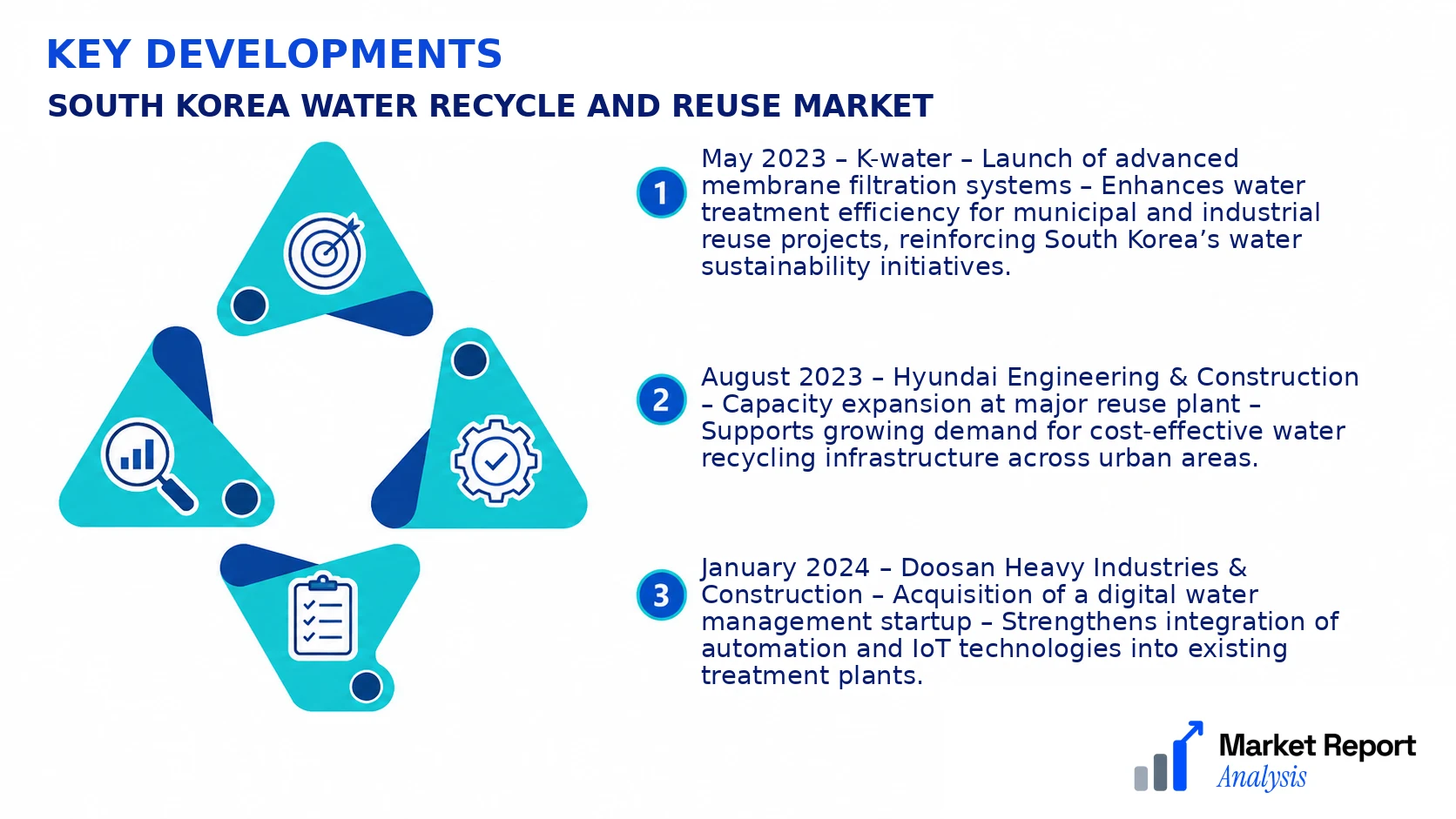
- May 2023 – K-water – Launch of advanced membrane filtration systems – Enhances water treatment efficiency for municipal and industrial reuse projects, reinforcing South Korea’s water sustainability initiatives.
- August 2023 – Hyundai Engineering & Construction – Capacity expansion at major reuse plant – Supports growing demand for cost-effective water recycling infrastructure across urban areas.
- January 2024 – Doosan Heavy Industries & Construction – Acquisition of a digital water management startup – Strengthens integration of automation and IoT technologies into existing treatment plants.
- March 2024 – Hanwha Systems – Strategic alliance with local municipalities – Develops smart water management solutions aligned with South Korea’s smart city initiatives.
- July 2024 – LG Electric – Launch of AI-based water quality monitoring – Offers real-time oversight and predictive maintenance capabilities for water reuse systems, improving reliability and operational efficiency.
Frequently Asked Questions
What is the South Korea Water Recycle and Reuse Market?
The South Korea Water Recycle and Reuse Market encompasses the infrastructure, technologies, and services dedicated to reusing wastewater for industrial, agricultural, and municipal purposes within South Korea. It reflects the nation’s commitment to sustainable water management and regulatory efforts to optimize water resources amid increasing demand and environmental concerns.
What is the current market size of South Korea Water Recycle and Reuse Market?
As of 2026, the market is valued at approximately USD 3.2 Billion, driven by government policies, technological advances, and rising water scarcity. This figure highlights South Korea’s significant investments in wastewater treatment and reuse infrastructure to meet future water needs.
What factors are driving the South Korea Water Recycle and Reuse Market?
Key drivers include stringent environmental regulations, increasing water scarcity, rapid urbanization, technological innovations, and government incentives encouraging reuse. Additionally, industrial growth and sustainable development initiatives further propel the adoption of water recycling solutions across sectors.
Which South Korean city leads the South Korea Water Recycle and Reuse Market?
Seoul is the leading city in this market, leveraging its advanced infrastructure, large industrial base, and progressive water management policies. The city’s focus on smart water technologies and sustainable urban development positions it as the primary hub for water reuse initiatives in the country.
Which segment is expected to grow the fastest?
The industrial segment is forecasted to experience the fastest growth, owing to increasing corporate sustainability commitments, regulatory pressures, and technological advancements in industrial wastewater treatment systems. This growth aligns with Korea’s industrial modernization and environmental targets.
Who are the leading companies operating in the South Korea Water Recycle and Reuse Market?
Market leaders include SK Ecoplant, Hyundai Engineering & Construction, and Hanil Environmental. These companies specialize in wastewater treatment, infrastructure development, and innovative reuse technologies, competing actively to expand their footprint and contribute to the nation’s water sustainability goals.
Analyst Perspective
The South Korea Water Recycle and Reuse Market is poised for steady long-term growth driven by stringent water management policies, urbanization, and rising industrial demand. Technological advances, including membrane filtration and advanced oxidation, will enhance efficiency and cost-effectiveness, fostering broader adoption. Investment priorities are expected to concentrate on integrated infrastructure projects, especially in metropolitan areas like Seoul, Incheon, and Busan, where water scarcity concerns are acute. Competitive intensity will likely intensify as domestic players and international firms vie to deliver innovative solutions, fostering a dynamic environment for strategic alliances and technological development. City-level opportunities are particularly promising in Seoul, which is adopting aggressive water reuse mandates and pioneering smart water management systems. Overall, the market's maturation reflects both regulatory push and technological evolution, presenting lucrative openings for companies that prioritize sustainable, scalable, and cost-competitive solutions. Long-term, market leaders should focus on innovation, local collaboration, and tailored city strategies to sustain competitive advantage.
