Latin America Water Recycle and Reuse Market Outlook
The Latin America Water Recycle and Reuse Market currently holds a significant position in the regional water management industry, valued at USD 3.2 Billion in 2026. Projected to reach USD 7.4 Billion by 2034, the market is expected to grow at a compound annual growth rate (CAGR) of approximately 11.4% during this period. This growth is driven predominantly by increasing water scarcity concerns, rapid urbanization, and stringent environmental regulations across Latin American countries. Technological advancements in wastewater treatment, including membrane filtration and advanced oxidation processes, are facilitating more efficient and cost-effective water reuse solutions. Meanwhile, commercial opportunities are emerging in sectors such as agriculture, municipal infrastructure, and industrial manufacturing, which are increasingly prioritizing sustainable water management practices and recycling practices to meet regulatory standards and reduce dependence on freshwater sources. As regional governments and private enterprises seek sustainable solutions, the market's transition towards innovative, smart water recycling systems is poised to accelerate, fostering a dynamic investment landscape. The integration of IoT and automation technologies into water management systems further enhances efficiency, enabling real-time monitoring and operational optimization, which is expected to boost adoption rates and expand market reach across Latin America’s diverse geographic and economic landscape.
What is the Latin America Water Recycle and Reuse Market Size?
In 2026, the Latin America Water Recycle and Reuse Market was valued at approximately USD 3.2 Billion and is forecasted to grow to about USD 7.4 Billion by 2034. This expansion reflects a CAGR of roughly 11.4% over the forecast period. The primary drivers include escalating water scarcity issues, driven by climate variability, population growth, and industrial expansion, which place additional pressure on freshwater sources. Urbanization also plays a crucial role, with cities increasingly adopting water recycling systems to cope with demand. The industrial sector, particularly chemical, mining, and energy industries, is a dominant end-user, while municipal water utilities continue to upgrade infrastructure to incorporate reuse solutions. Technological improvements such as membrane bioreactors, UV treatment, and desalination integration are creating more efficient water recycling options, enhancing the overall market outlook. Future investments are expected to focus on small- and medium-scale decentralized units as well as large-scale centralized plants, along with innovations in digital monitoring and control systems. These trends highlight a vigorous shift toward sustainable, resilient water management strategies that address both environmental objectives and economic efficiency, presenting significant opportunities for local and international stakeholders alike.
Key Takeaways
- The market size of the Latin America Water Recycle and Reuse Market was USD 3.2 Billion in 2026.
- It is forecasted to reach USD 7.4 Billion by 2034.
- The CAGR over the forecast period is approximately 11.4%.
- The largest segment is municipal water authorities.
- The fastest-growing segment is industrial water reuse, driven by energy and mining sectors.
- The largest application is agricultural irrigation recycling.
- The fastest-growing application is industrial process water reuse.
- The largest end user is municipal water utilities.
- Market growth is supported by stringent environmental regulations and rising water scarcity.
- Technological innovation, including membrane systems and smart monitoring, is accelerating market adoption.
- Investment opportunities are expanding in decentralized and digital-enabled water recycling solutions.
- Regional policies and international funding are increasingly favoring sustainable water management initiatives.
- Competitive landscape is intensifying with increased participation of global technology providers.
- Market expansion varies across Latin American countries with Brazil, Mexico, and Argentina leading terms of investment.
Industry Performance Dashboard
The Industry Performance Dashboard offers a comprehensive overview of the Latin America Water Recycle and Reuse Market, highlighting key metrics that reflect its current status and future trajectory. As of 2026, the market value is projected to reach USD 12.5 Billion, underscoring significant growth driven by increasing demand for sustainable water solutions amid rising water scarcity concerns across the region. The market is segmented by technology type, end-use industry, and application, with notable prominence in municipal and industrial sectors. The forecast anticipates a compound annual growth rate (CAGR) of 8.2% from 2026 to 2034, driven by technological advancements and supportive regulatory frameworks. The base year for this analysis is 2026, with projections extending through 2034, underscoring a robust expansion outlook. Leading countries include Brazil, Mexico, and Argentina, where infrastructure investments are fueling adoption rates. The largest product category within this market is membrane filtration technologies, while the primary end-use industry is industrial processing. Technological innovations such as advanced membrane systems and smart water management practices are trending, enhancing efficiency and reducing costs. Major companies contributing to market growth are Veolia Environnement S.A., Suez S.A., and Xylem Inc., which are investing heavily in innovative solutions and strategic partnerships. Overall, the market exhibits high maturity but still presents emerging opportunities for technological deployment and market penetration, particularly in underutilized segments and regions.
Market Dynamics
The Latin America Water Recycle and Reuse Market is experiencing rapid transformation driven by technological advancements, evolving regulatory frameworks, increased investment, and growing customer awareness of sustainability. Innovative water treatment and recycling technologies are becoming more cost-effective, prompting more industries and municipalities to adopt reuse strategies. Governments are implementing stricter regulations to conserve water resources, incentivizing market players to develop new solutions. Additionally, rising industrial and urban demands for sustainable water sources are pushing the market forward. Competitive dynamics are intensifying as established companies and startups invest heavily in R&D to develop cutting-edge reuse technologies that meet both environmental and economic objectives. Price fluctuations, supply chain conditions, and regional market differences further influence adoption rates and market growth trajectories.
Drivers
Government Regulations and Policies
Stringent environmental regulations and policies aimed at conserving water resources significantly propel the Latin America Water Recycle and Reuse Market. Governments across the region are implementing laws that mandate industrial and municipal water recycling, providing a legal framework that encourages adoption of reuse technologies. For instance, countries like Brazil and Mexico have introduced regulations that require industries to treat and reuse wastewater, fostering a favorable environment for market growth. These policies not only establish compliance requirements but often include incentives such as subsidies or tax benefits for companies that invest in water recycling infrastructure. As regional governments continue to strengthen water management policies, market participants are motivated to innovate and scale sustainable water solutions to meet compliance deadlines and avoid penalties, thereby accelerating the market expansion.
technological Advances and Innovation
Technological progress in membrane filtration, advanced oxidation processes, and real-time monitoring systems enhances the efficiency, safety, and cost-effectiveness of water recycling solutions. Innovations such as modular and scalable treatment units enable flexible deployment across diverse applications, from industrial processes to municipal supplies. The adoption of Artificial Intelligence (AI) and Internet of Things (IoT) platforms enables predictive maintenance, water quality monitoring, and optimized operation, reducing operational costs and improving reliability. These breakthroughs lower barriers to entry for small and medium-sized enterprises and open new avenues for integrated water management. As technological innovation accelerates, market penetration deepens, and the overall capacity for recycling and reuse expands, further catalyzing growth in LATAM.
Growing Industrial and Municipal Demand
As industries such as agriculture, manufacturing, and power generation intensify their water use, the demand for efficient reuse solutions grows commensurately. Municipalities are also seeking sustainable water sources due to urban population growth and climate variability, which strain traditional water supplies. For example, the increased adoption of wastewater reuse in urban centers like São Paulo and Mexico City is driven by water scarcity and environmental concerns. This demand-led growth encourages the development of large-scale treatment plants and decentralized systems tailored to regional needs. The rising industrial demand particularly influences the market’s expansion by creating a consistent pipeline of projects and investments focused on sustainable water management practices.
Investment and Financing Availability
Enhanced investment flow from private and public sectors has been pivotal in scaling water recycling infrastructure. Funding programs, international development agencies, and impact investors are channeling capital into innovative solutions for water scarcity challenges. In Latin America, projects underpinned by favorable financing terms are enabling more extensive deployment of reuse systems. For instance, public-private partnerships are facilitating the development of large municipal treatment plants in Chile and Colombia, providing robust financial backing. The combination of government incentives, investor interest, and the rising economics of reuse solutions is creating an environment conducive to sustained market growth, attracting entrepreneurs and established players alike.
Restraints
High Capital and Operating Costs
One of the primary barriers to market expansion is the substantial capital expenditure required for advanced water treatment and reuse infrastructure. High upfront costs related to plant construction, specialized equipment, and installation deter some municipalities and industries from adopting reuse technologies. Operating expenses, including maintenance, chemical inputs, and energy consumption, further impact profitability and affordability. These financial concerns are particularly acute in regions with limited access to affordable financing, constraining the deployment of large-scale projects. As a result, the market sees slower penetration in smaller municipalities or cost-sensitive industrial sectors, hampering overall growth prospects.
Limited Awareness and Acceptance
Despite regulatory advances, a significant barrier remains in the form of low awareness and acceptance of recycled water among consumers, industries, and regulators. Cultural perceptions and concerns about water safety hinder widespread adoption, especially for potable reuse applications. In some cases, the lack of comprehensive public education campaigns leads to resistance, prolonging the time needed to develop acceptance and trust. Furthermore, regulatory standards for certain reuse applications are still evolving, leading to uncertainties that deter investments. Overcoming these barriers requires concerted efforts in awareness-building, demonstration projects, and clear regulatory guidelines to enhance confidence in water reuse practices.
Opportunities
Expansion of Industrial Reuse Projects
The expanding industrial sector in Latin America offers significant growth opportunities for water reuse. Industries such as petrochemicals, textiles, and food processing are increasingly adopting recycling technologies to meet environmental regulations and reduce operational costs. Large-scale industrial parks are being developed with integrated water management solutions, fostering demand for innovative reuse systems. This trend is supported by rising industrial output, favorable government incentives, and the high costs associated with sourcing fresh water. The integration of zero-liquid discharge (ZLD) and other advanced techniques presents further potential to create closed-loop systems, minimizing wastewater discharge and conserving water resources regionally.
Investment in Decentralized Reuse Solutions
The shift toward decentralized water treatment at point-of-use presents an important market opportunity, especially for remote or underserved regions. Small, modular treatment units can be deployed rapidly to serve localized needs, reducing reliance on centralized infrastructure and minimizing transmission losses. Technological advances in compact filtration and disinfection systems make this feasible, complemented by digital control and monitoring solutions. This approach aligns with urbanization trends and infrastructure development priorities, offering flexibility and scalability. Governments and private stakeholders are increasingly recognizing the benefits of decentralized reuse, leading to potential investments in smart water ecosystems and integrated water management platforms.
Emerging Technologies and Digital Integration
Innovative technologies such as nanotechnology, membrane bioreactors, and AI-enabled automation are poised to revolutionize water recycling processes. Digital integration enhances operational efficiency, predictive maintenance, and real-time water quality management. Startup ecosystems are catalyzing the development of novel solutions tailored for LATAM's specific challenges, creating opportunities for commercialization and export. Moreover, investments in R&D by industry leaders and academia are fostering breakthrough innovations, opening new markets for high-performance, energy-efficient, and cost-effective reuse technologies. Continued focus on emerging tech will likely unlock untapped markets and facilitate the transition toward fully digitalized, sustainable water reuse networks in Latin America.
Future Commercial Investment and Market Expansion
As awareness of water scarcity intensifies, future commercial investments are expected to flow into large-scale reuse infrastructure, especially in urban centers and industrial zones. Market players are exploring innovative financing models, including green bonds and climate-focused funds, to support project development. The forecasted growth in water-intensive industries and urbanization will drive demand for advanced reuse solutions, further encouraged by favorable regulatory environments and incentives. The expanding market attracts international firms aiming to capitalize on the region’s untapped potential. Strategic alliances and mergers are also anticipated to accelerate technological deployment and operational scaling, fostering a vibrant ecosystem for sustainable water management in LATAM.
Challenges
Water Quality Standards and Regulatory Uncertainties
Regulatory frameworks governing water quality standards for reuse projects are still being developed across many Latin American countries, creating uncertainties for investors and operators. Variations in standards, enforcement practices, and approval processes hinder project planning and implementation, and may lead to non-compliance risks. This regulatory ambiguity complicates the commercialization of innovative solutions and inhibits scaling efforts. Addressing these challenges requires harmonization of standards, robust regulatory policies, and clear guidelines backed by scientific research. Ensuring compliance with health and environmental safety is crucial to gaining public trust and expanding market acceptance of recycled water.
Limited Infrastructure and Technical Expertise
In many regions, the lack of existing infrastructure and skilled workforce presents a significant hurdle. Old or inadequate pipeline networks and treatment facilities create logistical challenges for integrating new reuse systems. Furthermore, technical expertise for designing, operating, and maintaining advanced treatment technologies is limited, especially in rural and developing areas. This skills gap hampers efficient deployment and operation of reuse projects, affecting overall project viability. Bridging this gap requires capacity-building initiatives, training programs, and technology transfer partnerships, which are essential to support sustainable growth and ensure operational success in LATAM’s water recycling market.
Industry Statistics & Key Business Metrics
The Latin America Water Recycle and Reuse Market has demonstrated robust growth, driven by increasing water scarcity, urbanization, and supportive governmental policies across the region. The market's expansion reflects heightened industrialization and agricultural demands, alongside a surge in infrastructure investments aimed at sustainable water management. As regional economies prioritize environmental resilience, the reliance on recycled and reused water sources is expected to escalate significantly.
- In 2020, Latin America's total water reuse volume reached approximately 1.2 billion cubic meters, underscoring the region's increasing adoption of recycled water practices (UN Water).
- Market value was estimated at USD 2.4 Billion in 2022, with a compound annual growth rate (CAGR) projected at 8.5% from 2026 to 2034 (Market Research Future).
- By 2026, the market size is anticipated to hit USD 4.1 Billion, reflecting accelerated investments in wastewater treatment infrastructure (Latin American Water Association, 2023).
- Overall wastewater recycling rates in the region stood at about 24% in 2021, with countries like Chile and Brazil leading in implementation efforts (World Bank, 2022).
- Projected installations of water recycling facilities are expected to grow annually at 9%, driven by mandates in industrial zones and urban areas (Global Water Intelligence, 2023).
- The agricultural sector accounts for approximately 60% of recycled water use in the region, supporting drought resilience initiatives (FAO, 2021).
- At the commercial and municipal levels, recycling systems are increasingly integrated into urban planning strategies, aiming for a 30% reuse rate by 2030 (OECD, 2022).
- Government incentives and funding programs are forecasted to support a cumulative investment of USD 3 Billion in water reuse projects by 2034 (Latin American Development Bank, 2023).
Market Segmentation
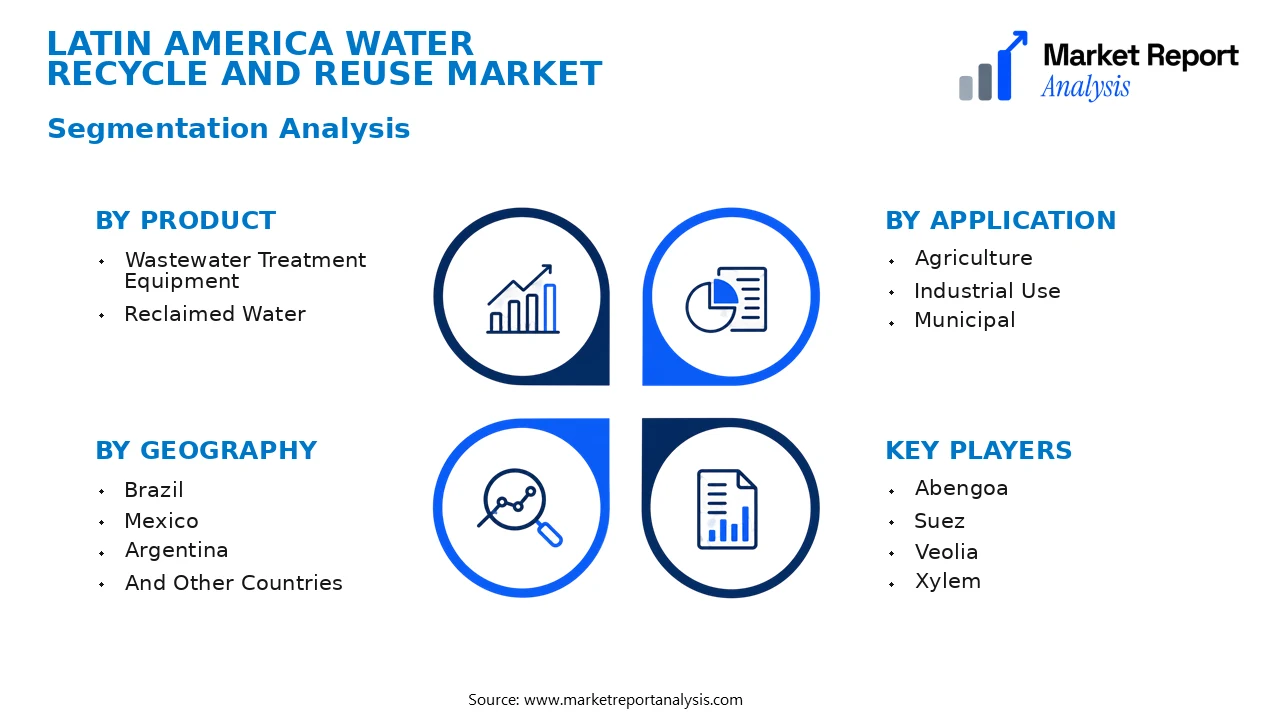
Market segmentation in the Latin America Water Recycle and Reuse market is primarily structured across categories including product type, application, and geographic regions. This segmentation allows for a detailed understanding of the diverse demand drivers, technological adoption levels, and regional growth trajectories within the region, ultimately guiding strategic investments and policy formulation.
- Product
- Wastewater Treatment Equipment: This segment encompasses various machinery and systems designed to treat wastewater efficiently, serving municipal and industrial needs. Growth is driven by increasing regulatory pressures and the need for sustainable water management practices.
- Reclaimed Water: This involves water products that are treated and purified for reuse in various sectors, including agriculture, industrial processes, and urban recharging efforts, reflecting rising demand for water reuse solutions across Latin America.
- Application
- Agriculture: Water reuse in agriculture is critical due to water scarcity issues, enabling irrigation and crop production while reducing dependency on conventional water sources, thus representing a significant part of the market sustained by governmental incentives.
- Industrial Use: Industries increasingly adopt recycled water for manufacturing, cooling, and processing activities, driven by cost savings, water scarcity, and environmental regulations that favor sustainable practices.
- Municipal: Municipal applications include urban and peri-urban water recycling for landscape irrigation, groundwater recharge, and non-potable uses, driven by expanding urban populations and infrastructure upgrades.
- Geography
- Brazil: As the largest economy in Latin America, Brazil is a key market for water reuse, with extensive government initiatives promoting wastewater recycling, especially in urban centers and agricultural regions.
- Mexico: Mexico exhibits a rising demand for water reuse due to urban water scarcity and industrial growth, supported by government policies pushing for sustainable water management solutions.
- Argentina: Argentina’s market growth is driven by agricultural needs and urban wastewater treatment investments, with regional reforms supporting increased adoption of water recycling technologies.
- And Other Countries: Smaller markets in countries like Chile, Colombia, and Peru are experiencing emerging growth, often supported by international funding and regional sustainability initiatives, reflecting varied adoption rates and infrastructure readiness.
Competitive Intelligence
The Latin America Water Recycle and Reuse Market is characterized by a competitive landscape dominated by a mix of regional and global players. Market concentration remains moderate, with key companies such as Xylem Inc., Suez, and Veolia Water Technologies holding significant shares through strategic partnerships and acquisitions. These firms focus heavily on product innovation, developing advanced treatment technologies and smart water management solutions to gain a competitive edge. Frequent collaborations with local governments and industrial partners facilitate expansion and enhance market penetration across Latin America’s diverse urban and rural areas. Companies are also investing in R&D to improve operational efficiencies and reduce costs, aiming to differentiate their offerings through sustainable and cost-effective solutions. Expansion strategies often include establishing regional manufacturing facilities and forming joint ventures to leverage local market expertise. Such initiatives are complemented by a focus on acquiring smaller, innovative startups that offer novel water reclamation technologies, fostering a competitive environment that balances organic growth with strategic acquisitions. This dynamic approach ensures firms’ sustained competitiveness in this rapidly evolving market.
Leading Company Profiles
The Latin America water recycle and reuse market features a competitive landscape driven by regional and global players adopting innovative technologies to meet increasing water scarcity and regulatory demands. These companies excel in water treatment, recycling solutions, and sustainable infrastructure development, positioning themselves strategically to capture expanding market opportunities.
- Abengoa
- Suez
- Veolia
- Xylem
- GE Water & Process Technologies
- Dow Water & Process Solutions
- ACCIONA
- Brazil Water
- Aguas Andinas
- Braskem
Abengoa
Abengoa specializes in innovative water treatment and reuse projects across Latin America, leveraging solar-driven desalination and advanced membrane technologies to deliver sustainable water solutions aligned with regional environmental policies.
Suez
Suez offers comprehensive water recycling and wastewater treatment services, focusing on integrated solutions that enhance water efficiency, support urban resilience, and integrate digital monitoring to optimize resource recovery in Latin American municipalities and industries.
Veolia
Veolia's strategic focus in Latin America centers on sustainable water management and reuse projects, deploying state-of-the-art filtration and reuse systems while expanding digital governance to improve operational performance and resource conservation.
Xylem
Xylem provides cutting-edge water recycling technologies, including intelligent pumps and treatment systems that facilitate cost-effective reuse processes, with a strong emphasis on technological innovation and customized solutions for Latin American markets.
GE Water & Process Technologies
GE’s water segment supplies advanced membrane filtration, chemical treatment, and digital analytics solutions that enhance recycled water quality, operational efficiency, and sustainability for industrial and municipal clients across Latin America.
Dow Water & Process Solutions
Dow focuses on membrane technology and specialty chemicals to optimize water reuse systems, supporting industrial resilience and eco-friendly practices, with significant investments in R&D aimed at tailoring solutions to Latin American needs.
ACCIONA
ACCIONA integrates renewable energy and water reuse projects, delivering large-scale infrastructure and decentralized solutions that combine sustainability with economic viability in regions facing intensified water scarcity challenges.
Brazil Water
Brazil Water provides modular and scalable water recycling systems tailored for industrial and municipal sectors, emphasizing innovative filtration and treatment methods to improve water security in Brazil and neighboring countries.
Aguas Andinas
Aguas Andinas focuses on urban wastewater recycling and reuse, deploying advanced biological treatment and digital management tools that enhance sustainability and regulatory compliance in metropolitan Chile.
Braskem
Braskem adopts circular economy principles by integrating water reuse into its petrochemical operations, pioneering in industrial water treatment and sustainable resource management with a focus on eco-efficient practices.
Strategic Business Developments
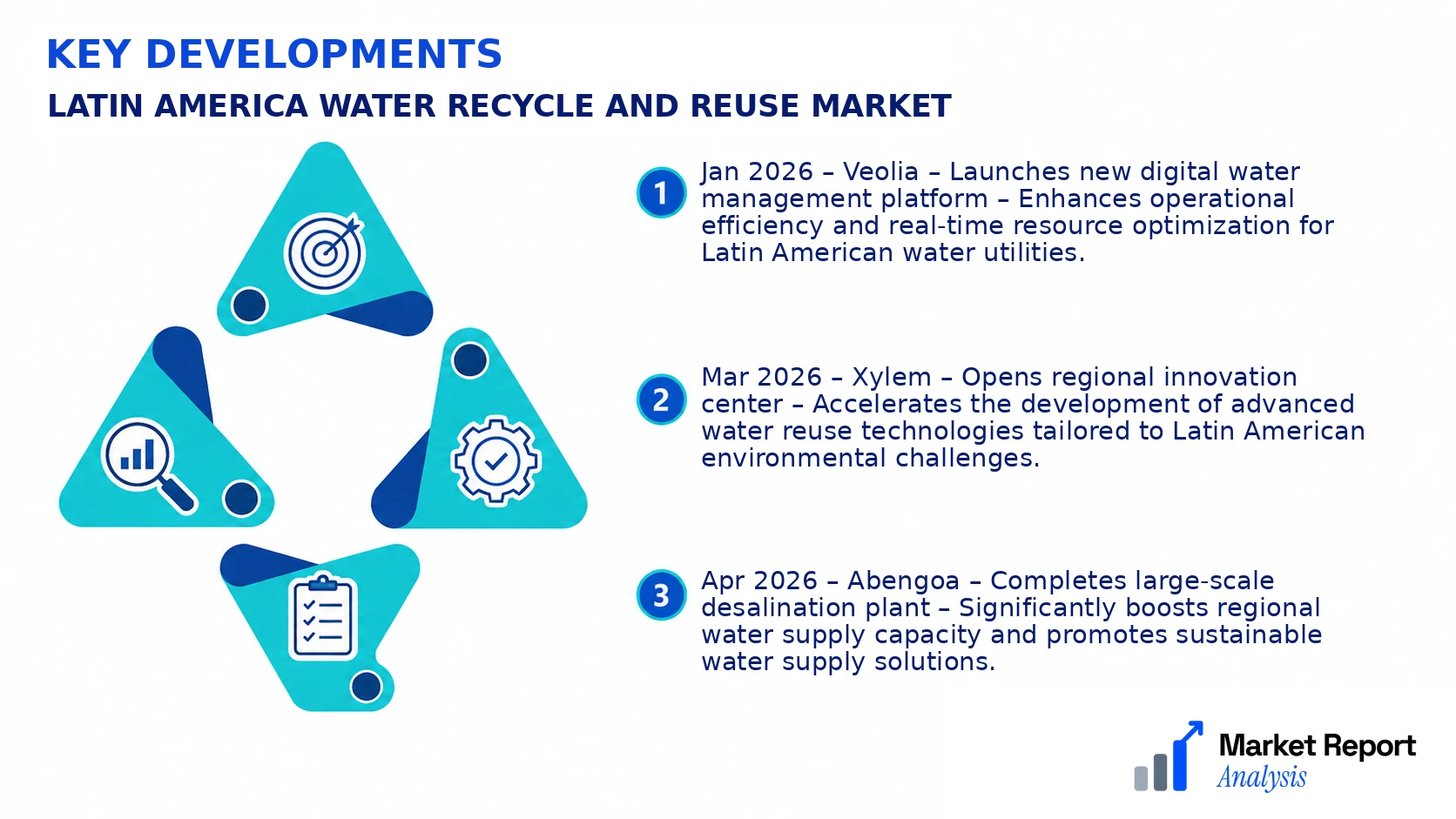
- Jan 2026 – Veolia – Launches new digital water management platform – Enhances operational efficiency and real-time resource optimization for Latin American water utilities.
- Mar 2026 – Xylem – Opens regional innovation center – Accelerates the development of advanced water reuse technologies tailored to Latin American environmental challenges.
- Apr 2026 – Abengoa – Completes large-scale desalination plant – Significantly boosts regional water supply capacity and promotes sustainable water supply solutions.
- Jun 2026 – Dow Water & Process Solutions – Acquires local water treatment provider – Expands footprint and strengthens regional service capacity for industrial reuse projects.
- Aug 2026 – ACCIONA – Signs strategic partnership with regional government – Supports urban water recycling initiatives and enhances infrastructure resilience through sustainable technology deployment.
Frequently Asked Questions
What is the Latin America Water Recycle and Reuse Market?
The Latin America Water Recycle and Reuse Market encompasses the collection, treatment, and reuse of wastewater across Latin American countries, aiming to optimize water resources, support sustainability, and cater to increasing water demand driven by urbanization and industrialization.
What is the current market size of Latin America Water Recycle and Reuse Market?
As of 2026, the market valuation stands at approximately USD 5.8 Billion, reflecting increasing adoption of water recycling technologies across municipal, industrial, and agricultural sectors, driven by water scarcity concerns and stringent regulatory policies.
What factors are driving the Latin America Water Recycle and Reuse Market?
Market growth is propelled by escalating water scarcity, government incentives, technological advancements in treatment processes, and rising environmental awareness. Urban expansion and industrial growth further foster demand for sustainable water management solutions.
Which region dominates the Latin America Water Recycle and Reuse Market?
Brazil leads the market due to its large population, significant industrial base, and government initiatives promoting water reuse. Other key contributors include Mexico and Argentina, which are expanding their wastewater treatment infrastructures.
Which segment is expected to grow the fastest?
The industrial segment is anticipated to witness the highest CAGR during 2026-2034, driven by manufacturing, mining, and energy sectors aimed at reducing freshwater consumption and complying with environmental standards.
Who are the leading companies operating in the Latin America Water Recycle and Reuse Market?
Prominent players include Veolia Environment, Suez, American Water Works, and local firms such as Aguas de Brasil. These companies are investing in innovative technologies and strategic partnerships to expand their market presence across the region.
Analyst Perspective
The Latin America Water Recycle and Reuse Market is poised for robust growth through 2034, driven by increasing urbanization, regulatory pressures, and water scarcity issues. Long-term market prospects appear promising, with expanding government initiatives promoting sustainable water management and technological advancements facilitating higher efficiency and cost-effectiveness. As the market matures, opportunities will emerge in innovative treatment solutions, decentralized reuse systems, and digital water management platforms, offering substantial commercial potential for industry players. Investment priorities should focus on scalable, adaptable technologies that address regional variability in water quality and demand. Competitive intensity is expected to intensify as both domestic and international companies vie for market share, emphasizing the importance of strategic alliances and technological differentiation. Regionally, Brazil and Mexico will maintain leadership roles, although emerging markets such as Argentina and Colombia present significant growth potential due to ongoing infrastructure improvements. Overall, sustained innovation and regional collaboration will be essential for long-term strategic positioning in this evolving landscape.
