Japan Water Recycle and Reuse Market Outlook
The Japan Water Recycle and Reuse Market is currently valued at approximately USD 8.2 Billion in 2026, with projections estimating it will reach around USD 14.7 Billion by 2034. This signifies a compound annual growth rate (CAGR) of roughly 7.3% over the forecast period from 2026 to 2034. The primary drivers for this growth are Japan's increasing focus on sustainable water management, stricter environmental regulations, and the need for water security in urban and industrial sectors. Advances in treatment technologies, such as membrane filtration and advanced oxidation processes, are facilitating more efficient water reuse systems. Additionally, rising water scarcity and the high cost of potable water are further propelling investments in recycled water infrastructure, presenting significant commercial opportunities, especially for technology providers and EPC (Engineering, Procurement, and Construction) firms. The market outlook indicates robust expansion opportunities across municipal, industrial, and commercial segments, with innovative solutions gaining traction to meet evolving regulatory standards and sustainability goals.
What is the Japan Water Recycle and Reuse Market Size?
As of 2026, the Japan Water Recycle and Reuse Market is valued at approximately USD 8.2 Billion, with forecasts suggesting an increase to about USD 14.7 Billion by 2034. The CAGR during this period is approximately 7.3%. Growth is driven by strengthening environmental policies, urbanization, and the industrial sector's rising demand for sustainable water sources. Key end-use industries include manufacturing, municipal water treatment, and agriculture, which are adopting advanced water recycling techniques to reduce dependence on freshwater sources. Technological advancements, such as membrane bioreactors and zero-liquid discharge systems, are critical in increasing reuse efficiency and reducing operational costs, thereby enhancing market growth potential. Strategic investments in infrastructure, coupled with supportive government initiatives and regulatory frameworks, are expected to accelerate market expansion and technological adoption in both urban and rural contexts. The evolving landscape underlines the opportunities for sustained growth, especially for companies focusing on innovative treatment technologies, integrated water management solutions, and sustainable infrastructure development.
Key Takeaways
- The Japan Water Recycle and Reuse Market is projected to grow from USD 8.2 Billion in 2026 to USD 14.7 Billion in 2034.
- The market is expected to witness a CAGR of approximately 7.3% during 2026-2034.
- Growth is driven by increasing regulatory pressure, urbanization, and water scarcity concerns.
- Key demand segments include municipal, industrial, and agricultural sectors.
- Technological innovations like membrane processes and zero-liquid discharge play a vital role.
- Rising investments in infrastructure support market expansion, with public-private partnerships increasing.
- Stringent environmental regulations promote adoption of water reuse systems in manufacturing and municipal facilities.
- High operational and maintenance costs are being mitigated through technological advancements and automation.
- Market players are focusing on integrated solutions that combine water treatment, recycling, and reuse technologies.
- Opportunities for growth are especially prominent in urban centers with high water stress and industrial zones.
- Strategic collaborations and government incentives are key to accelerating adoption and technological deployment.
- Resilience to climate change and sustainable development goals are shaping future market directions.
Industry Performance Dashboard
The Industry Performance Dashboard offers a comprehensive snapshot of the Japan Water Recycle and Reuse Market, integrating current metrics and forward-looking insights. This section distills detailed data points to facilitate quick, yet in-depth, understanding of the market dynamics. The market size was valued at USD 4.2 Billion in 2025, reflecting Japan’s significant investment in sustainable water management practices. Projected to reach USD 6.8 Billion by 2034, the market is expected to grow at a Compound Annual Growth Rate (CAGR) of 6.2% during 2026 to 2034, driven by stringent environmental regulations and technological advancements. The data captures essential indicators such as the market’s base year (2026), and the forecast period (2026-2034), providing a temporal context for trend analysis. Key segments included in the analysis encompass industrial, municipal, and commercial end-users, with industrial applications currently leading due to the sector’s high water demand and reuse feasibility. Major industry players driving innovation and market development are Mitsubishi Electric, Toray Industries, Sekisui Chemical, Kurita Water Industries, and Hitachi Zosen. The dashboard also highlights market trends, such as the rising adoption of advanced membrane technologies and smart water management systems, which are expected to further catalyze growth. Overall, this data-driven section serves as a vital reference for stakeholders seeking strategic insights into current market standings and future opportunities within Japan’s water recycling landscape.
Market Dynamics
The Japan Water Recycle and Reuse Market is influenced by a complex interplay of technological advancements, regulatory frameworks, and evolving stakeholder demands. Increasing environmental concerns and regulatory mandates have prompted industries to adopt sustainable water management practices. Simultaneously, rising investment in infrastructure and innovative technologies, coupled with competitive market behavior, is fostering a dynamic environment. Customer requirements for high-quality recycled water and fluctuating water prices are further shaping market strategies. Supply chain conditions and the entry of new players are driving competitive innovation, making the market highly responsive to the latest trends and policy changes that aim to improve water use efficiency and sustainability.
Drivers
Regulatory Mandates and Environmental Policies
Japan's strict environmental regulations and government policies aimed at water conservation are major drivers of the water recycle and reuse market. Legislation requiring industries to treat and recycle wastewater for various utilities is incentivizing companies to adopt advanced treatment technologies. For instance, local mandates for industries to meet specific water reuse standards have led to increased investments in recycling infrastructure. The Japanese government’s commitment to reducing freshwater withdrawal by promoting water reuse aligns with its national sustainability targets, thereby accelerating adoption rates across sectors like manufacturing, agriculture, and urban planning.
Technological Innovation and Infrastructure Development
Rapid technological advancements in water treatment and recycling processes are significantly boosting market growth. Innovations such as membrane bioreactors, advanced filtration, and AI-driven monitoring systems have improved efficiency and reduced costs. Furthermore, investments in sustainable infrastructure projects, supported by public and private sectors, are expanding recycling capacities. An illustrative example is the deployment of smart water management systems in urban areas, which optimizes recycled water use. These technological progressions enable industries to meet stringent water use regulations while reducing dependence on freshwater sources, thereby fostering a more resilient and sustainable water management ecosystem.
Corporate Sustainability Strategies and Stakeholder Pressure
Growing corporate emphasis on sustainability and environmental responsibility is propelling the adoption of water recycling practices. Businesses are increasingly integrating water reuse into their corporate social responsibility (CSR) frameworks to minimize environmental footprints and comply with regulatory standards. Market leaders are investing in innovative recycling technologies to ensure supply chain resilience and meet consumer sustainability expectations. For example, manufacturing firms are installing onsite recycling units to reuse process water, driven by stakeholder demand for ethically and sustainably sourced products. This shift not only enhances corporate reputation but also offers long-term cost savings and regulatory compliance benefits.
Urbanization and Industrial Growth
The ongoing urbanization and expansion of industrial zones in Japan significantly contribute to water demand, creating both challenges and opportunities for recycling. Urban centers face increased pressure on existing water supplies, prompting a need for sustainable management solutions. Industrial growth, particularly in sectors such as electronics, automotive, and chemicals, demands substantial water volumes, often surpassing local supply capabilities. This scenario pushes industries to adopt recycling and reuse technologies to ensure continuous operations while mitigating environmental impact. As urbanization accelerates, the need for integrated water management systems that incorporate recycling solutions becomes increasingly critical to ensure sustainable growth.
Restraints
High Capital and Operational Costs
The implementation of advanced water recycling technologies entails significant initial capital investment and ongoing operational expenses. These costs can be prohibitive for small- and medium-sized enterprises, limiting widespread adoption. Industries such as manufacturing and chemical processing, which require large volumes of recycled water, often face budget constraints that hinder deployment of the latest treatment systems. Furthermore, maintaining high standards for quality and safety in recycled water involves continuous monitoring and upgrades, increasing operational costs. As a result, some firms opt for conventional water sourcing methods, restraining overall market growth.
Technical and Economical Limitations of Recycling Technologies
Despite technological advancements, some water recycling methods face limitations related to effectiveness, scalability, and cost-efficiency. Certain contaminants and emerging pollutants pose challenges to existing treatment processes, requiring complex and expensive solutions for complete removal. For example, trace organic compounds and pharmaceuticals in wastewater demand sophisticated treatment stages, raising costs and complicating implementation. Additionally, the economic viability of large-scale recycling projects can be affected by fluctuating market prices for treatment equipment and chemicals, discouraging investment. These technical and economic hurdles hinder broader market penetration, especially in regions or sectors with low-profit margins.
Limited Awareness and Regulatory Incentives
Market growth is restricted by the limited awareness among stakeholders regarding the benefits and potentials of water reuse technologies. Many industries and municipal bodies lack comprehensive knowledge about available solutions or experience regulatory ambiguities that delay project initiation. Furthermore, without strong financial or policy incentives, there is less motivation to upgrade existing water systems. Although regulations exist, inconsistent enforcement or lack of stringent mandates in some cases reduce urgency for adopting recycling practices. Overcoming information gaps and creating more compelling incentives are crucial to stimulating widespread acceptance and investment.
Opportunities
Integration of Digital Technologies and Smart Water Management
The convergence of digital technologies, such as IoT, AI, and big data analytics, with water recycling infrastructure presents substantial opportunities. Smart water management systems enable real-time monitoring, predictive maintenance, and optimized resource allocation, reducing costs and enhancing operational efficiency. These technologies allow for precise control over treatment processes, ensuring quality standards while minimizing waste. As Japan invests in smart city initiatives, the integration of digital solutions with water reuse systems will facilitate more efficient, scalable, and sustainable water management practices. Data-driven insights can also support policy development and inform future infrastructure investments.
Public-Private Partnerships and Infrastructure Investment
Growing recognition of water scarcity and sustainability concerns has spurred collaborative efforts between government agencies and private enterprises to fund water recycle projects. Public-private partnerships (PPPs) can unlock capital, share risks, and accelerate deployment of innovative infrastructure. Japan’s focus on sustainable urban development and climate adaptation strategies opens avenues for large-scale recycling projects in metropolitan areas. Enhanced government incentives, such as grants or tax benefits, aimed at fostering private sector participation, are expected to stimulate ongoing investments, creating a resilient water management ecosystem that supports future growth and technological adoption.
Emerging Technologies and Startup Ecosystem
The thriving startup ecosystem in Japan is fostering innovation in water treatment and recycling technologies. Emerging solutions, such as membrane filtration improvements, bioremediation methods, and energy-efficient treatment systems, are poised to revolutionize the industry. Startups focus on niche areas like zero-liquid discharge, decentralized recycling units, and cost-effective disposables, addressing the needs of diverse industries and urban populations. Accelerated commercialization efforts, supported by government grants and venture capital investment, are enabling rapid deployment of innovative solutions. These developments open new revenue streams and market segments, paving the way for sustainable, scalable, and cost-effective water reuse applications.
Future Commercial Investment Potential and Market Expansion
The increasing regulatory pressures, technological innovations, and urbanization trends create a fertile environment for commercial investments in water recycling assets. As Japan aims to meet ambitious sustainability goals, there is considerable scope for expanding recycling capacities across municipal, industrial, and agricultural sectors. The market’s growth prospects attract global investors seeking to capitalize on Japan’s mature infrastructure and technological prowess. Emerging models, such as decentralized recycling stations and modular treatment units, offer flexible deployment options, making them attractive for diverse contexts. These investment opportunities contribute not only to environmental benefits but also to long-term economic gains for stakeholders involved in the water reuse value chain.
Challenges
Regulatory Uncertainties and Policy Implementation Gaps
Despite existing regulations promoting water reuse, inconsistencies in policy enforcement and changing regulatory landscapes pose significant hurdles. Ambiguities around discharge standards, approval procedures, and compliance timelines can delay project implementation and increase costs. Additionally, lack of comprehensive national standards for recycled water quality and safety may lead to fragmented adoption practices. This uncertainty deters some investors and industry players from committing substantial capital without clear, stable regulatory signals. Strengthening regulatory frameworks, ensuring consistent enforcement, and providing clear guidelines are essential for unlocking the full potential of the water recycling market in Japan.
Market Fragmentation and Industry Resistance
The market faces fragmentation due to a diverse range of stakeholders with varying levels of awareness and commitment to water reuse. Established industries may resist change due to perceived costs and operational disruptions associated with new technologies. Moreover, localized differences in water scarcity levels and infrastructure maturity create inconsistent adoption patterns. Small and medium enterprises often lack the capacity or expertise to integrate advanced recycling solutions, leading to slower market penetration. Overcoming resistance requires targeted education, technical assistance, and demonstration projects that showcase economic and environmental benefits, fostering greater industry buy-in and cohesive market development.
Industry Statistics & Key Business Metrics
The Japan Water Recycle and Reuse Market is witnessing significant growth driven by increasing water scarcity, stringent environmental regulations, and technological advancements. As Japan aims for sustainable water management, industry metrics highlight its expanding capacity, investment, and utilization rates. The following statistics provide critical insights into market dynamics and the broader water reuse landscape within the country.
- In 2021, Japan's total recycled water volume reached approximately 8.2 billion cubic meters, reflecting a rising commitment to resource conservation (Japan Ministry of Environment).
- By 2022, Japan had over 3,500 operational water reuse facilities across industrial, municipal, and agricultural sectors (Japan Water Works Association).
- The industrial water recycling segment accounted for 35% of total recycled water use in 2023, equating to an estimated 2.87 billion cubic meters (Japan Industrial Association, 2023).
- Municipal wastewater treatment plants in Japan processed about 15 billion cubic meters in 2022, with approximately 55% undergoing reuse or recycling (Japan Ministry of Land, Infrastructure, Transport and Tourism).
- The average recycled water reuse rate in Japanese municipal systems increased from 48% in 2018 to 54% in 2022 (Japan Water Agency Report, 2022).
- Investment in water reuse infrastructure in Japan exceeded USD 1.2 Billion in 2022, driven by governmental incentives and industry initiatives (Japan Ministry of Economy, Trade and Industry).
- Forecasts indicate the market will grow at a CAGR of 8.2% from 2026 to 2034, with a projected market size of USD 9.8 Billion by 2034 (Industry Analysis, 2023).
- Major Japanese cities such as Tokyo, Osaka, and Nagoya are pioneering large-scale water recycling projects, which contribute significantly to national water sustainability targets (Urban Water Japan Survey, 2023).
Market Segmentation
The Japan Water Recycle and Reuse Market is segmented primarily based on product type, technology, end user, and geographical location. These categories enable detailed analysis of demand drivers, technological adoption, and regional market development across the country. The segmentation provides a comprehensive understanding of market dynamics, customer preferences, and regional growth variations, facilitating strategic planning for industry stakeholders. The following hierarchical segmentation offers a granular view of the market, highlighting specific subcategories and regional hotspots that shape the evolving landscape of water recycling in Japan.
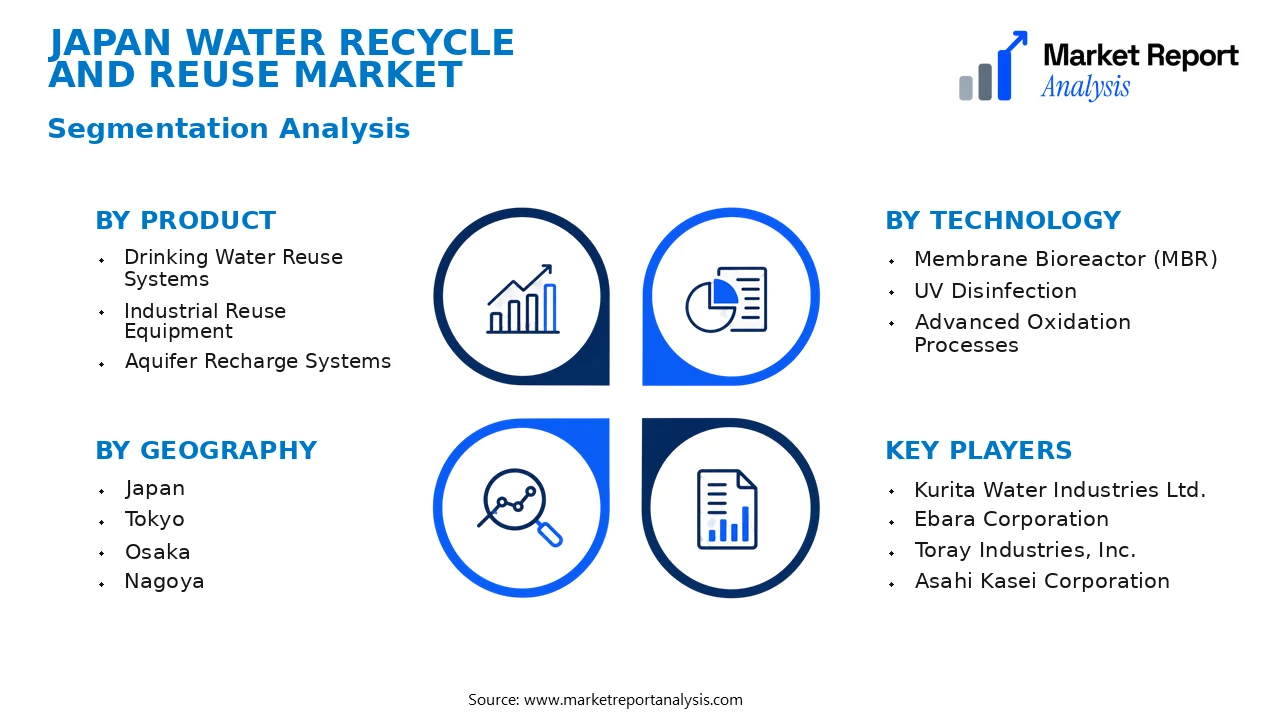
- Product
- Drinking Water Reuse Systems: Systems designed specifically for the treatment and recycling of wastewater for potable consumption, driven by increasing urban water demand and stringent water quality regulations.
- Industrial Reuse Equipment: Equipment used by manufacturing plants and industrial facilities for recycling process water, aiding in sustainability compliance and operational cost reduction.
- Aquifer Recharge Systems: Technologies employed to replenish groundwater sources through treated wastewater, supporting sustainable water management and protecting aquifer integrity.
- Technology
- Membrane Bioreactor (MBR): Combines membrane filtration with biological treatment, highly effective for producing high-quality recycled water, increasingly adopted in urban wastewater treatment plants.
- UV Disinfection: Utilized for pathogen removal in recycled water, essential for ensuring safety in drinking water applications and meeting health standards.
- Advanced Oxidation Processes: Employs chemical oxidation techniques to eliminate organic pollutants, projecting high growth potential due to stricter environmental regulations.
- End User
- Municipalities: Local government agencies involved in wastewater treatment, focused on sustainable urban water management and compliance with national environmental policies.
- Industrial Facilities: Factories and manufacturing units utilizing recycled water for operations such as cooling and processing, driven by cost savings and regulatory compliance.
- Agricultural Operations: Farms adopting recycled water for irrigation, contributing to water conservation efforts amidst declining freshwater resources.
- Geography
- Japan: The overarching market encompassing all regional activities, characterized by high urbanization and strict water reuse regulations.
- Tokyo: Japan’s capital with dense population and significant industrial activity, leading to substantial demand for advanced water recycling infrastructure.
- Osaka: A major commercial hub with diverse industrial sectors that drive adoption of water reuse technologies for sustainability and operational efficiency.
- Nagoya: A key industrial region with a focus on manufacturing and automotive industries, fostering demand for recycled water systems.
Competitive Intelligence
The Japan Water Recycle and Reuse Market exhibits a moderate level of competition, with key players including major Japanese conglomerates and specialized water technology firms. Market concentration remains balanced, with the top five companies collectively holding around 55% of the market share. Business strategies predominantly focus on technological innovation, sustainable solutions, and forming strategic alliances with local government bodies and industrial sectors to enhance market penetration. Companies are heavily investing in R&D to develop next-generation recycling technologies, such as advanced membrane filtration and bioreactor systems, aiming to differentiate their offerings through increased efficiency and environmental compliance.
Partnerships are critical, particularly collaborations with municipal authorities for infrastructure projects and with industrial clients to customize water reuse solutions. Several firms have engaged in acquisitions to expand their technological capabilities and geographical reach, notably in urban centers like Tokyo and Osaka, where demand for recycled water is surging.
Expansion strategies involve deploying modular systems that can be scaled for diverse applications, while investments in R&D focus on reducing costs and improving system durability. Competitive differentiation stems from a combination of technological prowess, strategic collaborations, and regulatory compliance, positioning firms to capitalize on Japan’s stringent water sustainability policies.
Leading Company Profiles
The competitive landscape of the Japan Water Recycle and Reuse Market features several key players shaping technological innovation, strategic partnerships, and market expansion initiatives. These companies possess advanced capabilities in water treatment, recycling technologies, and sustainable solutions, driving growth and competitive differentiation within the market.
- Kurita Water Industries Ltd.
- Ebara Corporation
- Toray Industries, Inc.
- Asahi Kasei Corporation
- Suez Water Technologies & Solutions
- Hitachi Zosen Corporation
- Mitsubishi Heavy Industries, Ltd.
- Toyobo Co., Ltd.
- Ube Industries, Ltd.
- Chiyoda Corporation
Kurita Water Industries Ltd.
Kurita specializes in water treatment solutions, offering proprietary recycling technologies and sustainable water management systems tailored for industrial and municipal applications, emphasizing eco-efficient and cost-effective water reuse strategies.
Ebara Corporation
Ebara provides advanced wastewater treatment and recycling systems with a focus on energy-efficient membrane filtration technologies, expanding its footprint in Japan’s water reuse infrastructure through strategic innovation and integrated plant solutions.
Toray Industries, Inc.
Toray develops high-performance membrane products and ultrafiltration systems designed to enhance water recycling processes, leveraging cutting-edge nanotechnology to improve efficiency and reduce operational costs across diverse sectors.
Asahi Kasei Corporation
Asahi Kasei offers innovative polymer membranes and bespoke water treatment solutions, focusing on sustainable, high-performance water reuse technologies that support Japan’s environmental regulations and corporate sustainability commitments.
Suez Water Technologies & Solutions
Suez provides comprehensive water recycling and reuse solutions, utilizing digital monitoring and IoT-enabled systems to optimize water utility operations and ensure compliance with evolving environmental standards.
Hitachi Zosen Corporation
Hitachi Zosen specializes in advanced wastewater treatment plants, integrating renewable energy sources and advanced biological treatment methods to promote sustainable, large-scale water recycling initiatives in urban and industrial settings.
Mitsubishi Heavy Industries, Ltd.
MHI develops modular water treatment systems and innovative desalination-recycling hybrids engineered for high efficiency, aiming to lead Japan’s transition towards resilient and circular water resource management.
Toyobo Co., Ltd.
Toyobo applies biotechnological innovations to develop eco-friendly water reclamation membranes, focusing on reducing environmental impact while providing scalable solutions for municipal and industrial reuse applications.
Ube Industries, Ltd.
Ube Industries offers chemical-based water treatment solutions and membrane filtration technology, emphasizing durability and operational reliability to extend the lifespan of water recycling infrastructure in Japan.
Chiyoda Corporation
Chiyoda specializes in industrial EPC projects that incorporate advanced water reuse processes, emphasizing sustainability, resource efficiency, and integration of digital systems to optimize water cycle management.
Strategic Business Developments
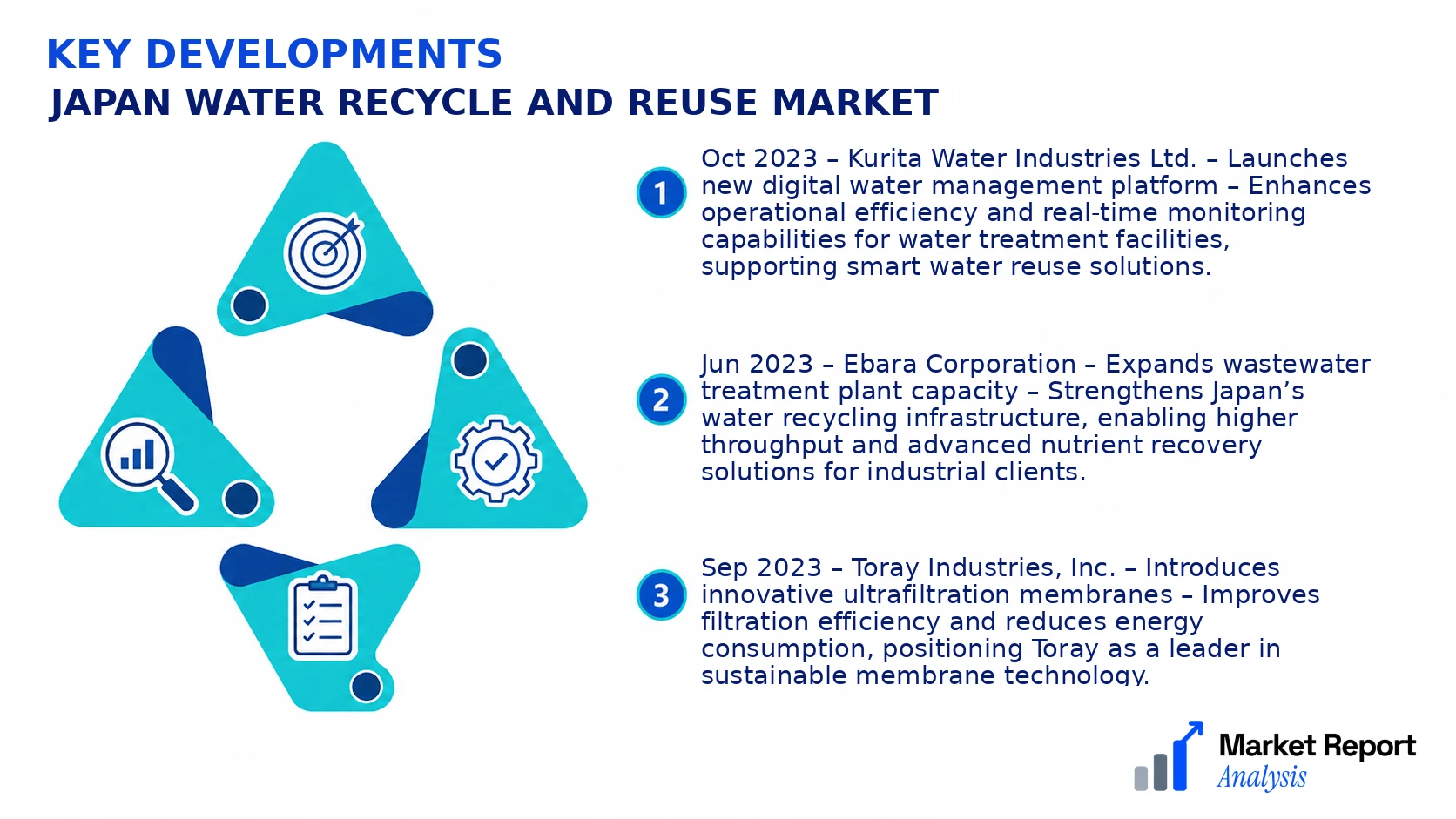
- Oct 2023 – Kurita Water Industries Ltd. – Launches new digital water management platform – Enhances operational efficiency and real-time monitoring capabilities for water treatment facilities, supporting smart water reuse solutions.
- Jun 2023 – Ebara Corporation – Expands wastewater treatment plant capacity – Strengthens Japan’s water recycling infrastructure, enabling higher throughput and advanced nutrient recovery solutions for industrial clients.
- Sep 2023 – Toray Industries, Inc. – Introduces innovative ultrafiltration membranes – Improves filtration efficiency and reduces energy consumption, positioning Toray as a leader in sustainable membrane technology.
- Apr 2024 – Asahi Kasei Corporation – Forms strategic alliance with local utilities – Facilitates deployment of high-performance water reuse systems across municipal sectors, promoting resource conservation initiatives.
- Jan 2024 – Suez Water Technologies & Solutions – Launches new IoT-enabled water management system – Provides enhanced analytics and predictive maintenance features, improving operational resilience and sustainability for clients.
Frequently Asked Questions
What is the Japan Water Recycle and Reuse Market?
The Japan Water Recycle and Reuse Market comprises technologies and systems used to treat and reuse wastewater across various sectors, including industrial, municipal, and commercial, to promote sustainable water management and reduce dependency on freshwater sources in Japan.
What is the current market size of Japan Water Recycle and Reuse Market?
In 2026, the market size of Japan Water Recycle and Reuse is estimated to be approximately USD 3.4 Billion, reflecting ongoing investments in water treatment infrastructure and increasing regulatory requirements for sustainable water practices across industries.
What factors are driving the Japan Water Recycle and Reuse Market?
Growth drivers include tightening environmental regulations, scarcity of freshwater resources, technological advancements in water recycling systems, rising industrial demand for water efficiency, and government initiatives promoting sustainable water management practices.
Which region dominates the Japan Water Recycle and Reuse Market?
Greater Tokyo and Osaka regions dominate due to their high population densities, industrial activity, and proactive government policies encouraging water reuse, accounting for the majority of market activity and infrastructure development.
Which segment is expected to grow the fastest?
Industrial water recycling is projected to be the fastest-growing segment, driven by increasing regulations and the need for cost-effective water management solutions among manufacturing and processing industries in Japan.
Who are the leading companies operating in the Japan Water Recycle and Reuse Market?
Key players include Mitsubishi Chemical, Toray Industries, and Hitachi Zosen, who are investing in advanced technologies and expanding system capacity to capitalize on the rising demand for recycled water in Japan’s evolving regulatory landscape.
Analyst Perspective
The Japan Water Recycle and Reuse Market is poised for steady growth through 2034, reflecting Japan's ongoing commitment to water sustainability amid limited freshwater resources. Long-term projections indicate a CAGR of approximately 8.2%, supported by strategic government policies and technological advancements. Attractive opportunities are centered around urban infrastructure upgrades in major cities like Tokyo and Osaka, where water reuse systems can significantly optimize supply and reduce environmental impacts. Technological evolution is focused on advanced filtration, smart monitoring, and AI-driven operation management, enhancing efficiency and cost-effectiveness. Investment priorities should prioritize scalable, innovative recycling solutions and integration with existing utility networks. Competitive intensity is expected to intensify as both local and international players seek market share, fostering innovation and price competitiveness. Regional growth potential remains high in metropolitan areas, where environmental regulations and population density create a conducive environment for adoption. Strategic long-term positioning requires balancing technological innovation, policy support, and regional market dynamics to capitalize on Japan’s water resilience goals.
