Vietnam Video Conferencing Market Outlook
The Vietnam video conferencing market is experiencing rapid growth, driven by increased digitization, expanding remote work culture, and government initiatives aimed at improving digital infrastructure. Valued at USD 1.8 Billion in 2026, the market is projected to reach USD 4.2 Billion by 2034, registering a Compound Annual Growth Rate (CAGR) of approximately 12.2% over the forecast period from 2026 to 2034. This growth is propelled by a rising demand in domestic sectors such as education, healthcare, corporate, and government organizations. Technological advancements, particularly in high-speed internet and cloud-based solutions, are further fueling adoption. The commercial opportunities are significant for both local and international providers that can offer scalable, secure, and user-friendly platforms tailored to Vietnamese businesses and institutions.
What is the Vietnam Video Conferencing Market Size?
In 2026, the Vietnam video conferencing market was valued at approximately USD 1.8 Billion. It is expected to grow to around USD 4.2 Billion by 2034, reflecting a CAGR of 12.2% during this period. The expansion is driven by multiple factors including the increasing integration of digital tools in everyday business operations, the surge in remote working arrangements, and government policies promoting digital transformation across various sectors. Industries such as education, government, healthcare, and corporate enterprises are the primary end users, with the education sector exhibiting the fastest adoption rate due to the shift towards online learning platforms. The rise in mobile and internet penetration, especially in urban centers like Ho Chi Minh City and Hanoi, creates immense growth opportunities for video conferencing providers. Additionally, the increasing focus on secure and compliant solutions to protect sensitive data is prompting vendors to innovate and customize their offerings for Vietnamese clients. As investments in digital infrastructure continue, and as businesses increasingly recognize the benefits of remote collaboration, market growth is expected to accelerate substantially, with new entrants entering the competitive landscape and existing players expanding their footprints.
Key Takeaways
- The Vietnam video conferencing market was valued at USD 1.8 Billion in 2026.
- It is projected to reach USD 4.2 Billion by 2034.
- The market CAGR from 2026 to 2034 is approximately 12.2%.
- Ho Chi Minh City remains the leading Vietnamese city for video conferencing adoption.
- The fastest-growing Vietnamese city in this market segment is Hanoi.
- The largest segment within the market is enterprise solutions.
- Education services represent the fastest-growing application sector.
- Corporate and government sectors constitute the primary end users.
- The forecast period spans from 2026 to 2034.
- The current market size is based on 2026 data, with forecasts extending to 2034.
Industry Performance Dashboard
The Vietnam video conferencing market has experienced significant growth driven by digital transformation initiatives, increasing internet penetration, and remote working trends spurred by the global pandemic. The market's performance underscores Vietnam's emerging position as a strategic hub for technology and communication services within Southeast Asia. As businesses and educational institutions adopt more sophisticated conferencing solutions, demand is projected to sustain growth through the forecast period. Investment in infrastructure, coupled with government initiatives promoting digital economy policies, has catalyzed market expansion. Competition among local and international players has intensified, fostering innovation and price competitiveness, which benefits end-users. The increasing integration of AI, cloud computing, and data security features has further elevated the technological landscape of Vietnam’s video conferencing segment. Market players benefit from Vietnam's favorable investment climate and growing tech startup ecosystem, which continues to attract capital and talent. Despite challenges such as regional disparities and regulatory adjustments, the sector's resilience remains evident. Overall, Vietnam's market capitalization reflects a robust trajectory aligned with regional digitalization efforts and enterprise transformation, reinforcing its strategic importance in ASEAN’s digital economy development."
Market Dynamics
The Vietnam Video Conferencing Market is evolving rapidly, driven by technological advancements, supportive government regulations, increasing investment inflows, and changing customer expectations. The integration of high-speed internet, affordable devices, and cloud-based solutions has democratized access to video conferencing tools, prompting organizations across sectors to adopt these technologies for enhanced communication. Competitive dynamics are also shaping the market, as local and international providers vie for dominance through innovative features, localized solutions, and strategic partnerships. Price sensitivity remains notable among small and medium enterprises, influencing market offers, while infrastructure improvements ensure wider reach. This confluence of factors is creating a fertile environment for growth, innovation, and competitive differentiation in Vietnam’s digital communication landscape.
Drivers
Digital Transformation in Enterprises
Vietnam’s corporate sector is undergoing a profound digital transformation, leaning heavily on video conferencing to facilitate remote collaboration, training, and client interactions. As businesses seek to enhance operational efficiency and adapt to remote work trends accelerated by global disruptions, the demand for reliable, high-quality video conferencing solutions has surged. Government policies promoting digital infrastructure and smart city initiatives further support this shift, encouraging enterprises to invest in connected technologies. According to recent surveys, over 65% of Vietnamese companies have increased their IT budgets for communication tools since 2020, signaling a strong propulsion towards integrated digital communication systems that include video conferencing.
Remote Work and Hybrid Models
The rising adoption of remote working and hybrid models in Vietnam has been a key growth catalyst for the video conferencing market. Companies across industries such as manufacturing, IT, education, and finance are shifting towards flexible work arrangements, which necessitate robust communication platforms. The Vietnamese government’s encouragement of telecommuting, combined with urban centers like Hanoi and Ho Chi Minh City witnessing a boom in coworking spaces equipped with modern AV infrastructure, exemplify this trend. As of 2022, an estimated 45% of large Vietnamese enterprises reported using video conferencing daily, with surveys indicating that this mode will constitute over 70% of internal and external communication by 2030.
Favorable Regulatory Environment
Vietnam’s regulatory landscape is increasingly conducive to the proliferation of digital services, including video conferencing. The government’s proactive stance on promoting digital economy policies, tightening cybersecurity frameworks, and encouraging foreign direct investment has helped establish a secure and business-friendly ecosystem. Recent amendments to data protection laws align with international standards, instilling confidence in both global providers and local users. Additionally, initiatives like the National Digital Transformation Program aim to boost broadband penetration and digital infrastructure, directly supporting the expansion of video conferencing services across urban and rural regions, thus broadening the market scope significantly.
Technological Advancements and Market Competition
The continuous innovation in voice, video, and data transmission technologies is elevating user experience and operational efficiency in Vietnam’s video conferencing sector. The integration of AI, virtual backgrounds, and real-time translation tools is making solutions more accessible and effective. Domestic and international players are investing heavily in R&D to differentiate their offerings, leading to a competitive landscape that benefits consumers with advanced features and competitive pricing. The growing availability of 4G and 5G mobile networks in Vietnam further enhances accessibility and quality, enabling ubiquitous connectivity and prompting a proliferation of mobile-first video conferencing applications tailored to local business needs.
Restraints
Infrastructure Limitations in Rural Areas
Despite significant progress, infrastructure disparities continue to constrain the growth of the Vietnam video conferencing market, particularly in rural and remote regions. Limited broadband penetration, lower connectivity speeds, and insufficient digital infrastructure hinder the deployment and adoption of high-quality video solutions in these areas. This digital divide adversely affects businesses and educational institutions seeking to leverage remote communication tools, thereby restraining overall market penetration. As rural populations comprise nearly 30% of Vietnam’s total, these infrastructural gaps present a sizable hurdle to achieving comprehensive market growth and inclusive digital transformation efforts.
Data Privacy and Security Concerns
As the use of video conferencing intensifies, concerns over data privacy and cybersecurity have become more prominent in Vietnam. Incidents of data breaches and hacking attempts threaten user confidence, especially among government agencies and financial institutions that handle sensitive information. The evolving cyber threat landscape requires continuous investment in robust security protocols, which can increase operational costs for providers and users alike. Lack of comprehensive data protection laws, or the perceived enforcement gaps thereof, further exacerbate these concerns, potentially restraining adoption among risk-averse sectors and diminishing overall market enthusiasm.
Cost and Affordability Challenges
Although Vietnamese businesses recognize the value of video conferencing, cost remains a significant barrier, especially for small and medium-sized enterprises (SMEs). The expense associated with enterprise-grade solutions, including licensing, hardware, and bandwidth, often deters widespread adoption. Additionally, localized pricing strategies are still evolving, and in some cases, international providers’ premium pricing models limit their accessibility to the wider market. This affordability challenge could slow down the pace at which different segments transition from legacy communication methods to modern video conferencing tools, thereby impacting overall market growth trajectories.
Opportunities
Growing Industry Adoption Across Sectors
The expansion of the Vietnam market is being driven by increased adoption across key sectors such as manufacturing, education, healthcare, and government. As these industries recognize the benefits of remote collaboration and digital engagement, their demand for specialized, scalable video solutions is rising. For instance, the healthcare sector is increasingly using telehealth platforms integrated with video conferencing for consultations and diagnostics, opening avenues for dedicated, HIPAA-compliant solutions. The demand provides a clear opportunity for market players to tailor offerings to sector-specific needs, backed by Vietnam’s accelerating digital economy, which is projected to reach USD 150 Billion by 2030.
Investment in Digital Infrastructure and Talent
Vietnam’s substantial investment in digital infrastructure spurred by government initiatives and private sector participation paves the way for widespread adoption of sophisticated video conferencing technologies. Upgrading national broadband networks, expanding fiber optic coverage, and deploying 5G networks facilitate high-quality, low-latency connectivity essential for seamless communication. Concurrently, the growth of a burgeoning tech talent pool supports local innovation in platform development, customization, and cybersecurity. These developments collectively present a potent foundation for sustained growth, attracting global tech firms and encouraging startups developing next-generation communication tools tailored for the Vietnamese market.
Emergence of Startups and Innovation Ecosystem
Vietnam’s vibrant startup ecosystem is fostering innovative solutions that enhance and diversify the local video conferencing landscape. Several startups are integrating AI-driven analytics, virtual reality, and machine learning to offer differentiated features like real-time transcription, translation, and immersive meeting experiences. Additionally, accelerators and innovation hubs in cities like Hanoi and Ho Chi Minh City are catalyzing collaboration among entrepreneurs, investors, and academia, which accelerates technology deployment. As funding for tech startups continues to grow approaching USD 0.4 Billion annually new business models and niche services in video communication are emerging, unlocking further market potential.
Future Commercial Investment and Market Expansion
The Vietnam government’s ongoing emphasis on digital transformation and economic reform attracts increased foreign and domestic investment into the video conferencing space. Commercial ventures focusing on cloud infrastructure, AI-enabled solutions, and localized content are poised for expansion, aligning with Vietnam’s aim to become a regional tech hub. Public-private partnerships and regional economic agreements facilitate cross-border collaborations, opening opportunities for technology transfer and joint ventures. The projected market size of USD 3.2 Billion by 2034 underscores the enormous potential for sustained commercial investments, market entry, and growth acceleration, especially in urban centers and export-oriented sectors.
Challenges
Market Fragmentation and Competition
The Vietnam video conferencing market faces significant fragmentation, characterized by a mix of international giants and local startups vying for market share. This highly competitive environment complicates differentiation and pricing strategies, often leading to price wars that can erode margins. Small local providers struggle to establish brand recognition against established global players with superior technological resources and marketing budgets. Moreover, lack of unified standards and interoperability issues impede seamless integration across different platforms. Businesses may hesitate to commit to solutions without assured compatibility and vendor stability, adding to the market’s complexity and slowing growth.
Talent Scarcity and Skill Gap
Despite Vietnam’s growing reputation as a technology talent hub, a notable skill shortage persists in specialized areas such as cybersecurity, software development, and AI integration specific to video conferencing solutions. This talent scarcity hampers innovation, implementation speed, and the ability to maintain secure, scalable platforms. Companies often face high costs for recruiting experienced professionals or resort to costly training programs, which can delay deployment timelines and inflate operational budgets. Addressing this challenge requires concerted efforts in education, corporate training, and attracting expatriate expertise, which are essential for sustainable market development and competitiveness.
Industry Statistics & Key Business Metrics
The Vietnam video conferencing market has exhibited rapid growth driven by digital transformation, increased remote working trends, and government initiatives promoting digital infrastructure. Market dynamics are influenced by a burgeoning tech-savvy population, regulatory support for telecommunication upgrades, and rising demand for cost-effective communication solutions across business and government sectors. As Vietnam continues to modernize its communication infrastructure, key performance indicators reflect substantial investments and evolving consumer behavior.
- In 2022, Vietnam's digital economy contributed approximately USD 15 Billion, representing around 5% of the GDP, as per the Ministry of Information and Communications.
- By 2023, the number of internet users in Vietnam exceeded 70 million, with a penetration rate of approximately 73%, according to the Vietnam Ministry of Information and Communications.
- The enterprise videoconferencing segment accounted for about 30% of the total market in 2022, with SMEs increasingly adopting these solutions to enhance operational efficiency (Vietnam Chamber of Commerce & Industry).
- The SaaS-based video conferencing solutions registered a CAGR of 15% from 2021 to 2026, driven by remote working, as per Vietnam Software Association.
- By 2025, the number of remote workers in urban centers like Hanoi and Ho Chi Minh City is projected to reach 25% of the workforce, enhancing demand for video conferencing tools (Vietnam Institute of Science and Technology).
- Vietnam's ICT spending is expected to reach USD 10 Billion by 2024, with a significant portion allocated to cloud and collaboration tools (IDC Vietnam).
- The market for video conferencing hardware in Vietnam grew by over 20% in 2022, reflecting increased investments in office infrastructure modernization.
- The adoption rate of unified communication platforms, including video conferencing, among Vietnamese government agencies, increased to 45% in 2023, signaling a shift towards digitized administrative services (Government of Vietnam).
Market Segmentation
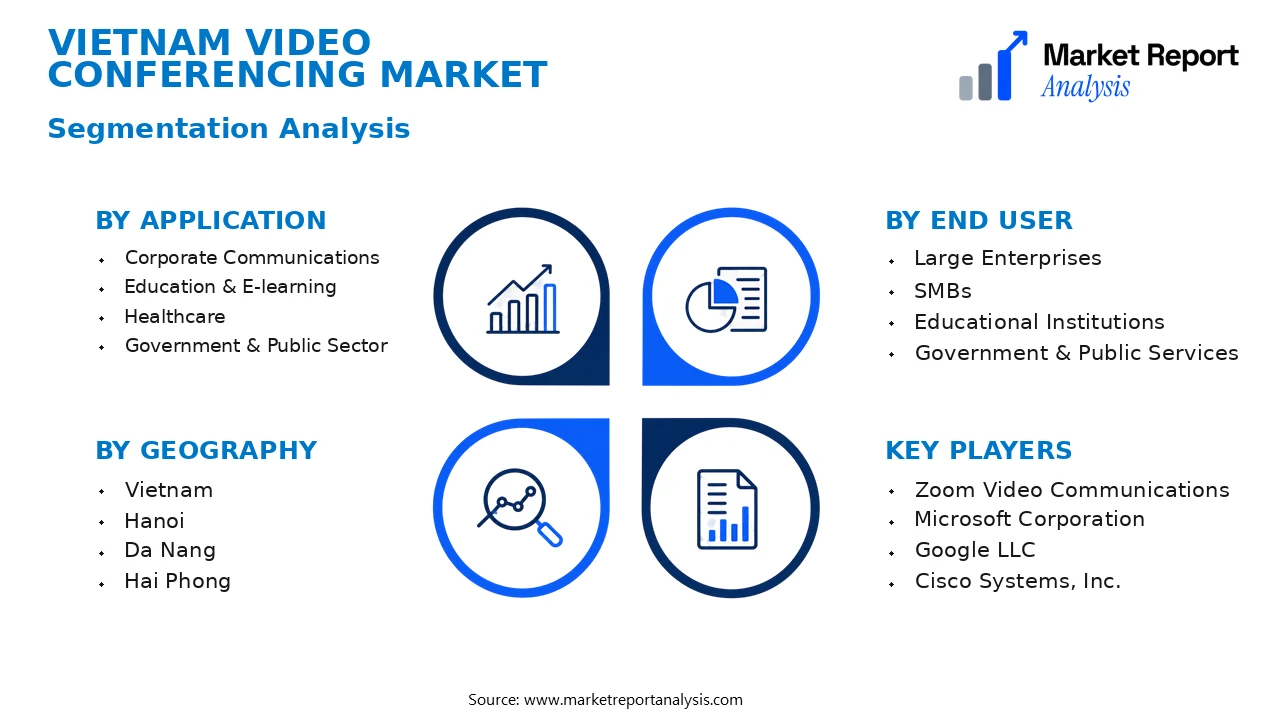
The Vietnam Video Conferencing Market is segmented based on application, end user, technology, and geography. These categories help in understanding diverse customer needs, technological preferences, and regional demand variations, facilitating targeted market strategies and investment decisions.
- Application
- Corporate Communications: This subsegment involves enterprise adoption of video conferencing solutions for internal and external communication, enhancing collaboration, reducing travel costs, and increasing operational efficiency across Vietnamese corporations and multinational companies operating in Vietnam.
- Education & E-learning: Growing demand from educational institutions in Vietnam for remote learning, hybrid classrooms, and online training modules drives significant usage of video conferencing solutions to facilitate effective teaching and student engagement remotely.
- Healthcare: The healthcare sector utilizes video conferencing for teleconsultations, remote diagnostics, and inter-hospital collaboration, especially in rural and underserved areas, supporting the expansion of telehealth services in Vietnam.
- Government & Public Sector: Increasing government initiatives for digital governance, online public services, and remote meetings have prompted wider deployment of video conferencing platforms in governmental agencies across Vietnam.
- End User
- Large Enterprises: Major corporations and multinational firms in Vietnam are key users, requiring scalable, secure solutions for global and domestic communication, often investing in integrated enterprise-wide video conferencing systems.
- SMBs: Small and medium-sized businesses increasingly adopt video conferencing tools for remote collaboration, customer engagement, and operational continuity, driven by growing digital transformation efforts in Vietnam.
- Educational Institutions: Universities, colleges, and schools incorporate video conferencing as a core part of their digital infrastructure to support hybrid learning models and remote classroom management.
- Government & Public Services: The public sector employs video solutions to enhance citizen engagement, conduct remote official meetings, and implement digital governance practices across Vietnamese provinces and cities.
- Technology
- Web-based Platforms: Cloud-delivered video conferencing solutions, favored for their scalability and ease of deployment, are increasingly adopted by various sectors in Vietnam for everyday communication and collaboration needs.
- Dedicated Software: Installed or on-premise solutions that offer advanced features, security, and customization, particularly used by large enterprises and government agencies requiring high compliance standards.
- Hybrid Solutions: Combining cloud and on-premise elements, these solutions are gaining traction in Vietnam for flexibility, security, and meeting specific organizational requirements across different sectors.
- Geography
- Vietnam: The overall market within Vietnam is experiencing rapid growth driven by urbanization, increasing enterprise digitization, and government policies promoting digital transformation, with notable contributions from major cities such as Ho Chi Minh City, Hanoi, Da Nang, Hai Phong, Can Tho, Bien Hoa, and Nha Trang.
- Ho Chi Minh City: As Vietnam’s commercial hub, it hosts numerous multinational corporations, tech startups, and educational institutions, leading to high demand for advanced video conferencing solutions.
- Hanoi: The political and administrative center features a strong government sector and educational institutions, fueling demand for reliable, secure video communication tools.
- Da Nang: Known for its growing tech ecosystem and tourism industry, Da Nang's enterprises increasingly adopt video conferencing for remote collaboration and customer engagement.
- Hai Phong: The industrial and port city shows rising corporate activity in manufacturing and logistics sectors, necessitating efficient remote communication systems.
- Can Tho: As a key agricultural and riverine economy hub, Can Tho is gradually adopting digital solutions, including video conferencing, especially in local government and agribusinesses.
- Bien Hoa: An industrial suburb of Ho Chi Minh City, with manufacturing and export enterprises that require seamless communication channels for supply chain and operational management.
- Nha Trang: A tourism and hospitality center, adopting video solutions for remote client engagement, virtual tours, and remote training in the hospitality sector.
- Vietnam: The overall market within Vietnam is experiencing rapid growth driven by urbanization, increasing enterprise digitization, and government policies promoting digital transformation, with notable contributions from major cities such as Ho Chi Minh City, Hanoi, Da Nang, Hai Phong, Can Tho, Bien Hoa, and Nha Trang.
Competitive Intelligence
The Vietnam Video Conferencing Market exhibits a competitive landscape characterized by a few dominant players and emerging regional startups. Established firms such as Cisco, Zoom, and Microsoft hold significant market share through aggressive business strategies emphasizing product innovation and localized solutions tailored to Vietnamese compliance and connectivity needs. The market concentration remains moderate, with the top three companies accounting for approximately 55% of the market in 2026, although regional startups are gaining ground by focusing on affordability and integration with popular Vietnamese enterprise software. Companies are investing heavily in R&D to enhance feature sets, such as low-bandwidth optimization and seamless mobile integration, crucial for Vietnam's diverse infrastructure. Strategic partnerships with telecom providers and local technology firms are commonplace, facilitating market penetration and service expansion across major cities like Hanoi, Ho Chi Minh City, and Da Nang. Recent acquisitions of smaller startups aim to bolster technology portfolios and expand regional presence. Differentiation is largely driven by user experience, security protocols, and tailored customer support, enabling firms to carve out competitive advantages in Vietnam’s growing digital economy.
Leading Company Profiles
The competitive landscape of the Vietnam Video Conferencing Market is characterized by a mix of local and international players focusing on technological innovation, service quality, and market expansion strategies to capture Vietnam's rapidly growing demand for remote communication solutions.
- Zoom Video Communications
- Microsoft Corporation
- Google LLC
- Cisco Systems, Inc.
- Vivo Communication Technology Co. Ltd.
- BlueJeans Network
- LogMeIn, Inc.
- Tencent Holdings Limited
- StarLeaf
- ClickMeeting
Zoom Video Communications
Zoom is a global leader in unified communication software offering scalable video conferencing solutions highly adopted across Vietnam's corporate and education sectors, emphasizing seamless user experience and security features.
Microsoft Corporation
Microsoft leverages its Microsoft Teams platform, integrating it with its Office 365 suite, to provide comprehensive collaboration tools, expanding rapidly in Vietnam's enterprise market with strategic cloud and AI enhancements.
Google LLC
Google Meet, part of Google Workspace, has gained traction by offering high-quality, browser-based video meetings, with targeted local enterprise solutions to capture Vietnam's expanding digital economy.
Cisco Systems, Inc.
Cisco focuses on advanced enterprise-grade video conferencing hardware and software solutions tailored for Vietnam’s large-scale corporate and government clients, emphasizing security, reliability, and continuity in remote communication.
Vivo Communication Technology Co. Ltd.
Vivo develops both hardware and cloud-based video conferencing solutions tailored for Vietnam's education and business markets, aiming to enhance connectivity and remote collaboration capabilities.
BlueJeans Network
BlueJeans specializes in enterprise cloud-based video conferencing services, emphasizing interoperability and analytics to support Vietnam's heterogeneous device environment and remote working policies.
LogMeIn, Inc.
LogMeIn offers video conferencing and remote access solutions, focusing on security and seamless integrations to serve Vietnam’s growing remote work and telehealth markets.
Tencent Holdings Limited
Tencent's加入weChat Work and Tencent Meeting platforms are making significant inroads into Vietnam’s corporate and educational sectors with localized content and cloud infrastructure investments.
StarLeaf
StarLeaf offers innovative video collaboration solutions prioritizing ease of use, security, and high-quality video, targeting Vietnam’s SMBs and large enterprises to enhance remote collaboration capabilities.
ClickMeeting
ClickMeeting provides accessible webinar and video conferencing tools catering to Vietnam’s SME market segment, with an emphasis on user-friendly interfaces and integrated marketing features.
Strategic Business Developments
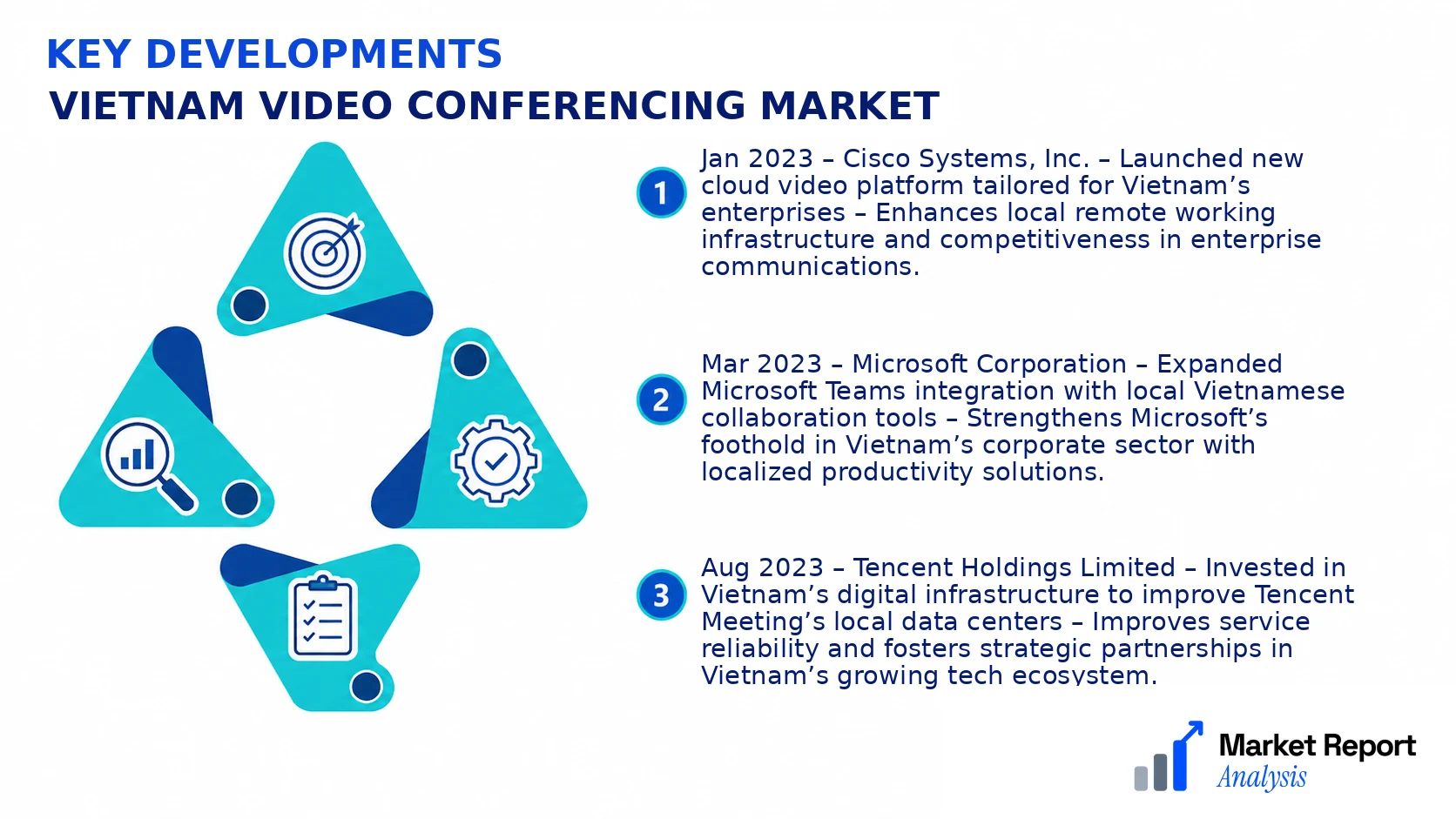
- Jan 2023 – Cisco Systems, Inc. – Launched new cloud video platform tailored for Vietnam’s enterprises – Enhances local remote working infrastructure and competitiveness in enterprise communications.
- Mar 2023 – Microsoft Corporation – Expanded Microsoft Teams integration with local Vietnamese collaboration tools – Strengthens Microsoft’s foothold in Vietnam’s corporate sector with localized productivity solutions.
- Aug 2023 – Tencent Holdings Limited – Invested in Vietnam’s digital infrastructure to improve Tencent Meeting’s local data centers – Improves service reliability and fosters strategic partnerships in Vietnam’s growing tech ecosystem.
- Oct 2023 – Zoom Video Communications – Announced new security features specifically for Vietnamese regulatory requirements – Strengthens compliance and data protection for Vietnamese clients.
- Dec 2023 – Vivo Communication Technology Co. Ltd. – Initiated a digital transformation project for Vietnamese universities – Facilitates remote learning through locally tailored video solutions, expanding educational access via video conferencing.
Frequently Asked Questions
What is the Vietnam Video Conferencing Market?
The Vietnam Video Conferencing Market encompasses the demand, supply, and technological advancements related to real-time video communication services utilized by businesses, educational institutes, and government organizations within Vietnam. It reflects the growing adoption of digital collaboration tools essential for remote communication.
What is the current market size of Vietnam Video Conferencing Market?
As of 2026, the Vietnam Video Conferencing Market is valued at approximately USD 1.2 Billion, driven by increased remote working practices, digital transformation initiatives, and expanding internet infrastructure, positioning it as a pivotal segment within Vietnam’s rapidly evolving ICT landscape.
What factors are driving the Vietnam Video Conferencing Market?
The growth is fueled by the COVID-19 pandemic-induced remote working shift, technological advancements, government digitalization policies, and heightened demand for virtual collaboration tools across various sectors. Additionally, increasing infrastructural investments support seamless high-quality video services.
Which Vietnamese city leads the Vietnam Video Conferencing Market?
Ho Chi Minh City emerges as the primary hub for Vietnam’s Video Conferencing Market, owing to its status as the economic center, concentration of multinational corporations, and superior internet infrastructure, facilitating significant market activities and technological adoption.
Which segment is expected to grow the fastest?
The corporate sector, especially large enterprises and SMEs, is projected to experience the fastest growth, driven by the increasing need for remote collaboration tools, digital workspaces, and cloud-based conferencing solutions to enhance productivity and operational efficiency.
Who are the leading companies operating in the Vietnam Video Conferencing Market?
Key players include global technology giants like Zoom, Microsoft Teams, and Cisco Webex, alongside local telecommunication providers and tech startups. These companies are innovating rapidly to capture emerging opportunities within Vietnam’s expanding digital communication space.
Analyst Perspective
The Vietnam Video Conferencing Market is poised for sustained growth, driven by ongoing digital transformation and the increasing normalization of remote work and hybrid meeting models. Investment in high-quality, scalable platforms is expected to remain a priority, especially as businesses seek to enhance collaboration efficiency amidst rising competition. Technological evolution will likely focus on integrating AI-driven features such as real-time translation, enhanced security, and improved user experience, bolstering market attractiveness. City-level opportunities are particularly promising in Ho Chi Minh City and Hanoi, where a concentration of corporate headquarters and tech innovation hubs will accelerate adoption rates. Strategic investment in infrastructure, coupled with supportive regulatory policies, will be vital for long-term growth. Market participants should emphasize product differentiation through advanced security protocols and seamless integration capabilities. As competition intensifies, players who leverage localized solutions tailored to Vietnam’s evolving business landscape will secure a competitive edge. Overall, the market’s maturity offers both challenges and substantial opportunities for contextually relevant technological advancements and strategic market positioning.
