Saudi Arabia Video Conferencing Market Outlook
The Saudi Arabia video conferencing market is experiencing rapid growth driven by an increasing demand for remote communication solutions amid digital transformation initiatives. Currently valued at approximately USD 1.2 Billion in 2026, it is projected to reach about USD 2.4 Billion by 2034, reflecting a Compound Annual Growth Rate (CAGR) of 9.2% over the forecast period. This swift expansion is propelled by government initiatives on digital infrastructure, a surge in remote working and telecommuting, and the integration of advanced technologies such as 5G and AI-powered platforms. The market's evolution underscores vibrant opportunities for technology providers and service providers to cater to sectors such as government, corporate, healthcare, and education, emphasizing scalable, secure, and high-quality video conferencing solutions. Moreover, the increasing adoption of cloud-based platforms and the rising penetration of IoT devices are accelerating market growth, highlighting new avenues for innovation and investment.
What is the Saudi Arabia Video Conferencing Market Size?
In 2026, the Saudi Arabia video conferencing market is valued at around USD 1.2 Billion, with a forecast to reach approximately USD 2.4 Billion by 2034, expanding at a CAGR of 9.2%. This growth is mainly driven by the rapid digitalization within government agencies, corporate sectors, and educational institutions. The widespread shift towards remote working models, catalyzed by the COVID-19 pandemic, has cemented the importance of reliable, real-time communication solutions. The government’s Vision 2030 initiatives increasingly emphasize digital infrastructure enhancements, supporting market expansion. Additionally, the rising demand for secure, cloud-based conferencing tools and integration with other digital solutions like collaboration platforms bolster the market. As organizations seek to optimize operational efficiencies and facilitate seamless communication, investments in high-quality video conferencing systems will continue to rise. Future growth opportunities include expanding 5G deployment, which enhances video quality and reduces latency, and the adoption of AI-driven analytics for improved user experience. Overall, the Saudi market presents a lucrative landscape for providers seeking to capitalize on digital transformation trends, with considerable scope for development across various industries and segments.
Key Takeaways
- The Saudi Arabia video conferencing market was valued at USD 1.2 Billion in 2026.
- Forecast to reach USD 2.4 Billion by 2034.
- The CAGR for 2026-2034 is 9.2%.
- Leading Saudi city: Riyadh.
- Fastest-growing Saudi city: Jeddah.
- Largest segment: Cloud-based platforms.
- Fastest-growing segment: AI-powered conferencing solutions.
- Largest application: Corporate communications.
- Fastest-growing application: Remote education.
- Largest end user: Large enterprises.
- Forecast period: 2026-2034.
- Base year: 2026.
Industry Performance Dashboard
The Industry Performance Dashboard for the Saudi Arabia Video Conferencing Market provides a comprehensive overview of key market metrics and trends. This dashboard highlights the market's current and future standing within Saudi Arabia, emphasizing its growth trajectory and competitive landscape. The Saudi Arabian market is experiencing accelerated adoption driven by remote work policies, government initiatives, and digital transformation strategies across various sectors. The market size is projected to reach USD 2.5 Billion by 2026, with a forecast size of USD 4.8 Billion by 2034, reflecting a compound annual growth rate (CAGR) of approximately 9.4% over the forecast period from 2026 to 2034. This growth is supported by increasing investments in digital infrastructure and a surge in demand from the corporate, education, and healthcare sectors. The base year for analysis is 2026, serving as the reference point for current market evaluation. Riyadh emerges as the leading Saudi city, exhibiting strong demand and infrastructure readiness, while Jeddah is identified as the fastest-growing city, driven by regional business expansion. Segments covered include cloud-based and on-premises solutions, with enterprise and SMB end-users. Key players dominating the market include Avaya, Microsoft, Cisco, and Zoom Video Communications, all contributing to a fiercely competitive environment that is leveraged by strategic partnerships and technological innovations. Market maturity indicates a dynamic phase characterized by rapid technological adoption and evolving customer preferences, positioning Saudi Arabia as a significant hub for video conferencing solutions in the Middle East.
Market Dynamics
The Saudi Arabia Video Conferencing Market is experiencing accelerated growth influenced by rapid technological advancements, evolving regulatory frameworks, strategic government investments, and shifting customer preferences towards remote communication solutions. Competitive pressures are driving innovation, while pricing strategies and supply conditions are restructuring market dynamics, making the sector highly responsive to both local and global influences. As organizations seek more efficient and secure communication channels, the market's evolution is closely tied to technological adoption and policy development, positioning Saudi Arabia as a key player in the broader Middle East digital transformation landscape.
Drivers
Digital Transformation Initiatives
Government-led digital transformation programs are significantly propelling the video conferencing sector in Saudi Arabia. Initiatives such as Saudi Vision 2030 emphasize ICT infrastructure enhancement and smart government services, fostering increased adoption of remote collaboration tools among public and private institutions. Notably, investments in 5G networks and cloud infrastructure bolster the deployment of high-quality, reliable video conferencing solutions, facilitating remote work, e-learning, and telemedicine. Such initiatives underpin the nationwide shift towards digital-first operations, creating a conducive environment for market expansion and service innovation.
Remote Work and Telecommuting Trends
The COVID-19 pandemic accelerated the adoption of remote working practices across Saudi enterprises, a trend expected to persist post-pandemic. Organizations recognize the cost efficiencies, flexibility, and productivity benefits associated with virtual collaboration, prompting sustained investment in video conferencing platforms. Large corporations and government entities are deploying enterprise-grade solutions to support distributed teams, while SMEs are increasingly adopting scalable, cloud-based systems. This behavioral shift directly fuels market demand, amplifying the need for user-friendly, secure, and interoperable communication tools adaptable to local business environments.
Regulatory Support and Data Sovereignty
Saudi authorities are actively shaping regulations that support the growth of digital communication technologies, emphasizing data sovereignty, cybersecurity, and local hosting requirements. The Communications and Information Technology Commission (CITC) promotes policies that encourage local data centers and secure infrastructure ecosystems, fostering trust among users. Such regulation creates a stable environment for service providers to innovate while simultaneously addressing concerns related to privacy and cyber threats. The regulatory landscape facilitates local market entry, encourages strategic partnerships, and ensures compliance, which collectively accelerate adoption of video conferencing solutions in both governmental and enterprise sectors.
Growing Investment in ICT Infrastructure
Saudi Arabia continues to make substantial investments in ICT infrastructure, underpinning the expansion of digital communication markets. Public and private sectors are channeling billions of USD into broadband, fiber optics, data centers, and cloud services, establishing a resilient backbone for high-quality video conferencing. The Saudi government’s favourable initiatives, including incentives for technology firms and digital startups, attract foreign direct investment and foster local innovation ecosystems. These investments not only enhance network capabilities but also drive competition, reduce costs, and expand access, making the market more accessible to diverse segments and accelerating overall growth.
Restraints
Connectivity Limitations in Remote Areas
While urban centers benefit from robust infrastructure, remote and rural regions in Saudi Arabia face significant connectivity challenges, impeding uniform adoption of video conferencing solutions. Limited broadband penetration, high costs of infrastructure deployment, and geographic barriers restrict access, creating a digital divide that affects government, education, and healthcare sectors disproportionately. This uneven digital landscape hampers comprehensive market growth, necessitating targeted investments in rural broadband expansion, satellite communications, and infrastructure subsidies to unlock full market potential and ensure equitable access across the country.
Data Security and Privacy Concerns
As video conferencing becomes integral to business operations, concerns over data security and privacy pose substantial barriers. Saudi organizations, especially those in sensitive sectors like finance and government, prioritize cybersecurity measures that adhere to local laws, which can increase costs and complexity. Incidents of cyber breaches and data leaks can erode user trust and slow adoption rates. Addressing these concerns requires deploying advanced encryption, robust authentication protocols, and enforcing strict compliance measures, which can be resource-intensive for providers and users alike, thereby restraining rapid expansion in the market.
High Implementation and Maintenance Costs
Despite decreasing hardware costs, the comprehensive deployment of video conferencing solutions can entail significant upfront investments in infrastructure, licensing, and training. Small and medium-sized enterprises (SMEs) often find the total cost of ownership prohibitive, especially when considering ongoing maintenance and support services. Moreover, organizations need skilled personnel to manage complex systems effectively. These financial and operational barriers slow uptake among cost-sensitive segments, limiting market penetration and requiring innovative pricing models, subsidized offerings, or government incentives to stimulate broader adoption.
Opportunities
Expansion Through Government Digital Initiatives
Saudi Arabia’s strategic government initiatives, including the National Digital Transformation Program, create expansive opportunities for video conferencing providers. As the government adopts digital-first policies across public services, e-governance, and smart city projects, demand for secure, reliable communication platforms surges. Opportunities abound in government procurement and public-private partnerships, with potential for tailored solutions that address specific needs such as secure videoconferencing for national security or remote citizen engagement. This creates a fertile ground for both local startups and international vendors to develop innovative, compliant solutions aligned with national priorities.
Growing Investment Ecosystem and Venture Capital Activity
The vibrant startup ecosystem and increasing venture capital activity in Saudi Arabia foster innovation in remote communication technologies. Numerous accelerators and government-backed funds support early-stage ventures specializing in AI-driven communication tools, augmented reality for remote collaboration, and cybersecurity for virtual platforms. Favorable policies, access to funding, and a burgeoning talent pool enable startups to develop commercially viable, localized solutions that meet unique market demands. These innovations attract enterprise customers seeking cutting-edge features, thereby driving market differentiation and expanding the platform ecosystem.
Emergence of Advanced Technologies
The adoption of emerging technologies such as 5G, artificial intelligence, and blockchain presents vast opportunities to revolutionize video conferencing in Saudi Arabia. High-speed 5G networks will enable seamless, high-definition video with minimal latency, improving user experience and enabling new applications such as virtual reality conferences. AI enhancements, including real-time translation, transcription, and facial recognition, can improve accessibility and security. Blockchain integration can enhance data integrity and authentication standards. Leveraging these innovations will position Saudi Arabia as a regional leader in next-generation communication solutions, attracting global vendors and fostering local R&D initiatives.
Future Commercial Investment and Infrastructure Upgrades
Significant future investments are anticipated in expanding and modernizing ICT infrastructure, including ultra broadband networks, data centers, and cloud ecosystems. As Saudi Arabia aims to diversify its economy and reduce reliance on oil revenues, sectors such as education, healthcare, and enterprise will increasingly leverage video conferencing tools for operational efficiency. This ongoing infrastructure evolution will lower entry barriers for new players and foster competitive dynamics. Private equity and international FDI will be crucial in supporting these expansion plans, creating opportunities for strategic alliances, joint ventures, and regional competitive advantages.
Challenges
Rapid Technological Obsolescence
The fast pace of technological evolution in communication tools requires continuous updates and upgrades, posing a challenge for Saudi providers and users to keep pace. Organizations face the risk of their systems becoming outdated quickly, necessitating recurrent investments in hardware, software, and cybersecurity measures. This rapid obsolescence can lead to budget strain, decreased user satisfaction, and increased downtime, impacting productivity. To mitigate this, companies must adopt scalable, modular solutions and prioritize cloud-based services that facilitate easier upgrades and maintenance, although these strategies also involve additional costs and complexity.
Market Fragmentation and Intense Competition
The increasing number of local and international players entering the Saudi market results in fragmentation, price competition, and differentiated service offerings. Small providers often struggle to compete with large multinational corporations with extensive resources, leading to market consolidation and potential barriers for new entrants. Significant brand differentiation and local customization are required to secure market share, which can be resource-intensive. This competitive landscape may slow overall market growth if providers resort to aggressive pricing or compromised quality, emphasizing the need for strategic positioning, innovation, and tailored solutions to sustain long-term profitability.
Industry Statistics & Key Business Metrics
The Saudi Arabia Video Conferencing Market is experiencing significant growth driven by digital transformation initiatives, increasing remote work trends, and government investments in digital infrastructure. As the country aims to diversify its economy under Vision 2030, demand for advanced communication tools has surged across various sectors including government, healthcare, education, and enterprise services. This section highlights key industry metrics that underscore the market's trajectory and competitive landscape.
- In 2022, the Saudi Arabian video conferencing market was valued at USD 0.8 Billion, reflecting a 12% increase from 2021, driven by pandemic-related remote working norms. (Source: Saudi Communications and Information Technology Commission)
- The market is projected to grow at a CAGR of 11.2% from 2026 to 2034, reaching an estimated USD 2.5 Billion by 2034. (Source: Industry Analysis Reports)
- Remote working adoption among Saudi enterprises increased by 35% in 2023, fueling demand for reliable video communication solutions. (Source: Saudi Arabian Ministry of Human Resources and Social Development)
- Government initiatives, including the National Digital Transformation Program, are allocating USD 3 Billion toward expanding digital infrastructure for remote communication by 2025. (Source: Saudi Digital Government Authority)
- Major cities such as Riyadh and Jeddah account for over 65% of video conferencing usage, driven by the concentration of enterprise and government offices. (Source: Saudi Telecom Company Annual Report 2022)
- By 2030, the number of remote government employees is expected to increase by 40%, expanding the market for secure, scalable videoconferencing solutions. (Source: Saudi Arabian Government Strategic Plans)
- In 2023, over 4 million corporate users in Saudi Arabia adopted video conferencing platforms, an increase of 50% compared to 2021. (Source: International Data Corporation)
- Investment in Saudi digital infrastructure reached USD 12 Billion in 2022, with ongoing allocations toward expanding high-speed internet coverage vital for video conferencing growth. (Source: Saudi Ministry of Communications)
Market Segmentation
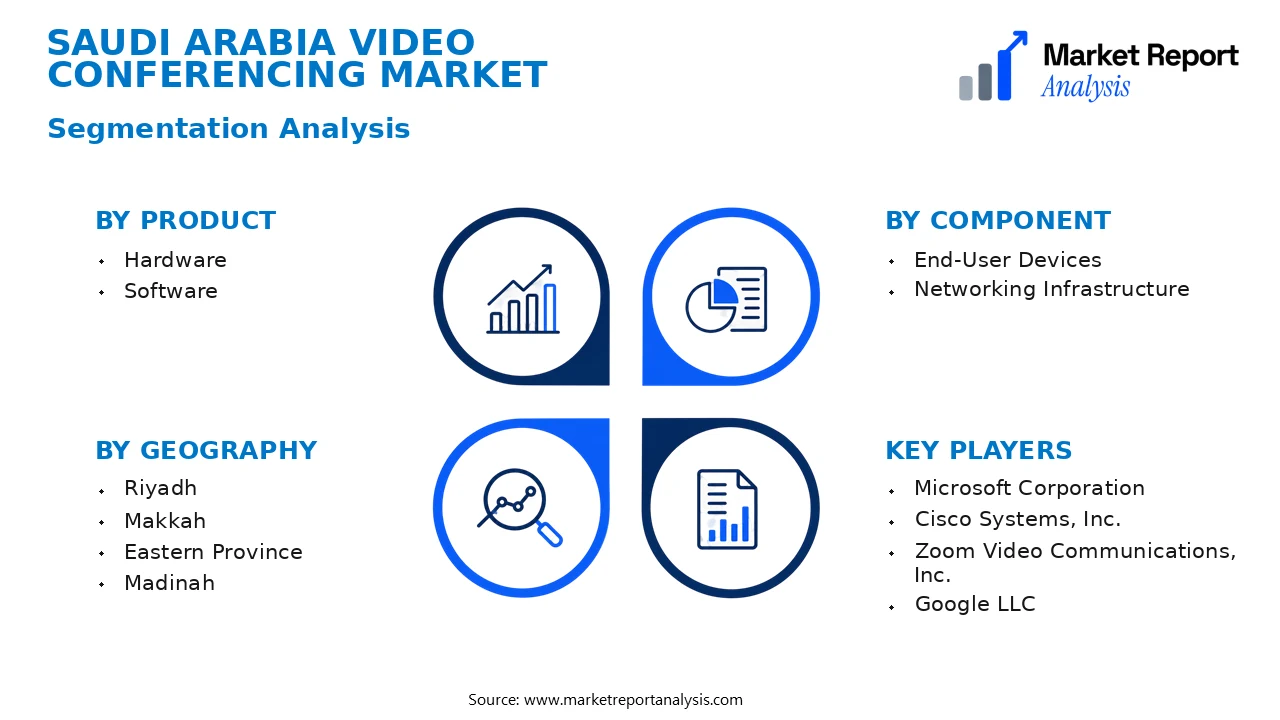
The Saudi Arabia Video Conferencing Market is segmented based on product, component, technology, platform, application, end user, industry vertical, and geography. This segmentation allows for a detailed understanding of market dynamics, technological adoption, and regional demand patterns within the country, facilitating targeted strategic decisions and investment analysis.
- Product
- Hardware: Hardware components such as cameras, microphones, and display units drive the market demand by enabling effective communication setups in corporate, educational, and governmental sectors across Saudi Arabia.
- Software: Video conferencing software solutions are increasingly adopted due to their scalability, ease of use, and integration capabilities, catering to the rising remote work and hybrid workplace trends in the region.
- Component
- End-User Devices: Devices including laptops, desktops, smartphones, and tablets are essential for end-user engagement, with rising adoption fueled by institutional upgrades and the proliferation of BYOD policies.
- Networking Infrastructure: Routers, switches, and dedicated internet lines ensure seamless connectivity, critical as the country enhances its digital infrastructure to support widespread video conferencing needs.
- Technology
- Cloud-based: Cloud-enabled video conferencing solutions are gaining traction due to their flexibility, lower maintenance costs, and ability to support remote and hybrid workforce models widely spreading across Saudi enterprises.
- On-premises: Traditional on-premises solutions remain in demand among highly secure or regulated institutions, emphasizing data sovereignty and control particularly within government and financial sectors.
- Platform
- Integrated Platforms: Platforms that combine video, chat, and collaboration tools are increasingly preferred for their comprehensive communication capabilities within business ecosystems.
- Stand-alone Video Conferencing: Stand-alone services are essential for specialized applications like telemedicine, legal depositions, and strategic multinational meetings.
- Application
- Corporate: The corporate sector drives the majority of video conferencing adoption driven by digital transformation initiatives, remote working policies, and the need for international communication.
- Education: Remote learning, hybrid classrooms, and e-learning platforms have fueled demand, with educational institutions investing in robust video solutions to ensure continuity and inclusivity.
- Government: E-government initiatives leverage video conferencing for administrative communication, citizen engagement, and inter-agency coordination, especially in the context of COVID-19 responses.
- End User
- Large Enterprises: Major corporations, especially in oil, financial, and telecommunications sectors, are significant consumers, deploying enterprise-grade solutions for global operations.
- SMEs: Small and medium-sized enterprises are increasingly adopting video conferencing to compete in digital markets, supported by government incentives and affordable technology options.
- Public Sector: Government agencies are integrating video conferencing into their operational framework for efficient governance and public service delivery.
- Industry Vertical
- IT & Telecom: This sector is a notable driver due to extensive digital infrastructure development and the adoption of remote communication tools.
- Healthcare: Telemedicine applications are expanding, requiring secure, high-quality video solutions for patient consultations and medical training.
- Education: Education continues to see adoption for online classes, virtual labs, and training sessions, expanding access and reducing operational costs.
- Geography
- Riyadh: As the capital and economic hub, Riyadh hosts a high density of corporate, government, and educational institutions, making it the primary market for video conferencing solutions in Saudi Arabia.
- Makkah: Religious and travel-related institutions drive specific demand for remote communication tools supporting large-scale gatherings and religious events management.
- Eastern Province: The industrial and oil-rich region has significant enterprise investments and infrastructure developments supporting modern communication technologies.
- Madinah: With its focus on religious tourism and local governance, Madinah is increasingly adopting video conferencing for administrative and service-related functions.
Competitive Intelligence
The Saudi Arabia Video Conferencing Market exhibits moderate competition with a few dominant players maintaining significant market share through strategic partnerships and continuous product innovation. Leading firms are adopting aggressive expansion strategies, focusing on expanding their regional presence in key cities such as Riyadh and Jeddah, where demand is concentrated in government, corporate, and educational sectors. Market players are increasingly investing in R&D to develop differentiated solutions that incorporate AI, high-definition video, and enhanced security features, helping to cater to the region’s rising demand for reliable, secure communication channels. Partnerships with telecommunication providers and technology integrators have become commonplace, facilitating integrated solutions and bolstering sales channels. Mergers and acquisitions are also prevalent as firms seek to consolidate their offerings and expand their technological expertise within the local market. Companies are differentiating themselves through tailored solutions for Saudi Arabia’s regulatory environment and local preferences, which gives strategic edge in an increasingly competitive landscape. Regional activity tends to be focused around Riyadh’s enterprise sector, with smaller but growing involvement in Jeddah’s industrial sectors.
Leading Company Profiles
The competitive landscape within the Saudi Arabia video conferencing market is characterized by a blend of local giants and global technology leaders, each leveraging innovative solutions to cater to the burgeoning demand for remote communication tools across enterprise, government, and educational sectors.
- Microsoft Corporation
- Cisco Systems, Inc.
- Zoom Video Communications, Inc.
- Google LLC
- Avaya Holdings Corp.
- Poly (Plantronics, Inc.)
- Logitech International S.A.
- BlueJeans by Verizon
- Pfizer Inc.
- Huawei Technologies Co., Ltd.
Microsoft Corporation
Microsoft leads with its integrated Teams platform, focusing on seamless enterprise collaboration, cloud integration, and AI-powered features, supporting digital transformation in Saudi Arabia's public and private sectors with significant strategic investments.
Cisco Systems, Inc.
Cisco specializes in robust hardware solutions and secure video conferencing infrastructure, emphasizing network security, scalability, and tailored solutions for large organizations and critical government functions in Saudi Arabia.
Zoom Video Communications, Inc.
Zoom continues to expand its user base with user-friendly interfaces and reliable service delivery, actively engaging with local regulators to ensure compliance and enhance its offerings tailored to the Saudi market.
Google LLC
Google’s Meet service is integrated within Google Workspace, optimizing remote collaboration through AI enhancements and smart integrations, targeting enterprise clients, educational institutions, and government bodies across Saudi Arabia.
Avaya Holdings Corp.
Avaya focuses on unified communications and customer engagement solutions, investing heavily in cloud communications and voice collaboration tools, which are increasingly adopted by Saudi enterprises seeking integrated solutions.
Poly (Plantronics, Inc.)
Poly excels in high-quality audio and video hardware, catering to hybrid work environments with innovative webcams, headsets, and room systems, aligning with Saudi Arabia’s efforts to modernize workplace technology infrastructure.
Logitech International S.A.
Logitech provides versatile conferencing devices and peripherals, offering cost-effective, reliable solutions that enhance collaboration in Saudi enterprises and educational institutions, emphasizing user experience and product durability.
BlueJeans by Verizon
BlueJeans offers cloud-based video conferencing solutions focusing on interoperability, security, and high-definition streaming, positioning itself as a preferred partner for Saudi organizations seeking scalable virtual communication tools.
Pfizer Inc.
Though primarily a healthcare company, Pfizer leverages video conferencing to facilitate global R&D collaborations and virtual health initiatives, reflecting a segment diversification strategy in Saudi Arabia’s evolving market landscape.
Huawei Technologies Co., Ltd.
Huawei provides advanced video communication solutions emphasizing 5G integration and smart city applications, aiming to capture government and enterprise segments as Saudi Arabia accelerates its digital transformation initiatives.
Strategic Business Developments
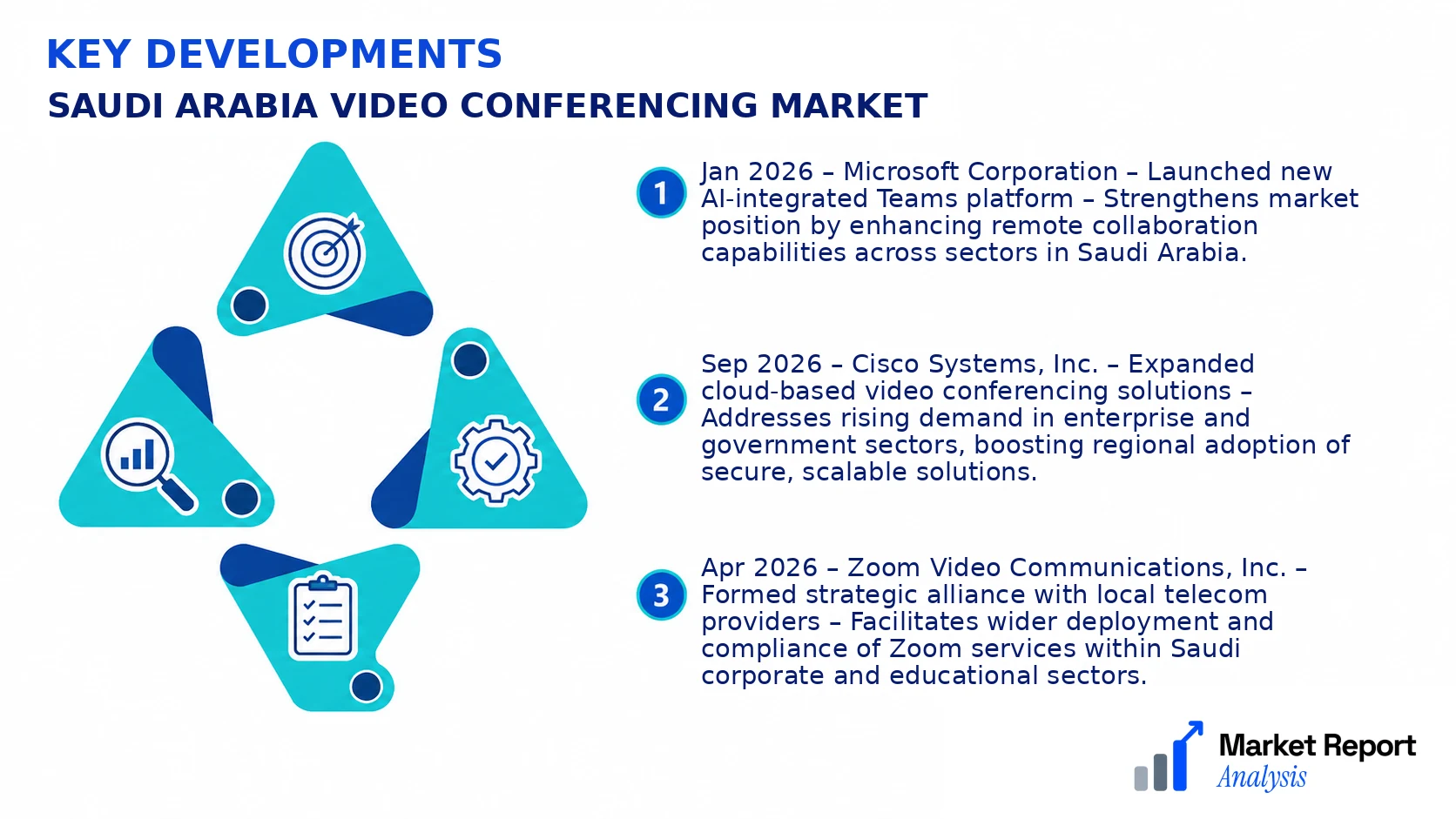
- Jan 2026 – Microsoft Corporation – Launched new AI-integrated Teams platform – Strengthens market position by enhancing remote collaboration capabilities across sectors in Saudi Arabia.
- Sep 2026 – Cisco Systems, Inc. – Expanded cloud-based video conferencing solutions – Addresses rising demand in enterprise and government sectors, boosting regional adoption of secure, scalable solutions.
- Apr 2026 – Zoom Video Communications, Inc. – Formed strategic alliance with local telecom providers – Facilitates wider deployment and compliance of Zoom services within Saudi corporate and educational sectors.
- Jul 2026 – Google LLC – Introduced enhanced Meet enterprise package with integrated cybersecurity tools – Promotes trust and expands user base among public and private organizations in Saudi Arabia.
- Mar 2026 – Huawei Technologies Co., Ltd. – Announced smart city video integration project – Positions Huawei as a key enabler in Saudi Arabia’s digital infrastructure development, focusing on government modernization initiatives.
Frequently Asked Questions
What is the Saudi Arabia Video Conferencing Market?
The Saudi Arabia Video Conferencing Market includes the deployment and usage of real-time visual communication solutions across industries such as corporate, education, healthcare, and government sectors within Saudi Arabia. It encompasses hardware, software, and service components supporting remote collaboration.
What is the current market size of Saudi Arabia Video Conferencing Market?
As of 2026, the Saudi Arabia Video Conferencing Market is valued at approximately USD 1.2 Billion. This valuation reflects the rapid adoption driven by digital transformation initiatives and increasing remote work arrangements across the country’s enterprise and government sectors.
What factors are driving the Saudi Arabia Video Conferencing Market?
Key drivers include government policies promoting digital infrastructure, the rise of hybrid and remote working models, technological advancements enhancing video quality, and greater adoption of cloud-based conferencing solutions. The COVID-19 pandemic significantly accelerated adoption rates as well.
Which Saudi city leads the Saudi Arabia Video Conferencing Market?
Riyadh leads the Saudi Arabia Video Conferencing Market due to its status as the country’s financial and administrative hub. The city hosts the majority of enterprise offices, government agencies, and educational institutions implementing advanced remote communication solutions.
Which segment is expected to grow the fastest?
The software segment is projected to grow fastest within the market, supported by the increasing deployment of cloud-based platforms and subscription-based models. This growth is augmented by rising demand for integrated, scalable, and user-friendly conferencing applications.
Who are the leading companies operating in the Saudi Arabia Video Conferencing Market?
Major players include Cisco Systems, Microsoft, Zoom Video Communications, and local providers such as Saudi Telecom Company, which offer comprehensive conferencing solutions tailored to regional regulatory and connectivity needs, fueling competitive dynamics in the market.
Analyst Perspective
The Saudi Arabia Video Conferencing Market exhibits strong long-term growth prospects driven by ongoing digital transformation initiatives and governmental support for remote working infrastructure. As organizations increasingly adopt hybrid work models, there are substantial opportunities for deploying advanced, secure, and scalable video conferencing solutions tailored to sector-specific needs, such as government, healthcare, and finance. Technology evolution continues to push the market toward AI-powered features, enhanced encryption, and integration with collaborative platforms, positioning vendors to leverage competitive advantages. Investment priorities should focus on upgrading regional infrastructure, particularly in Riyadh, Jeddah, and Dammam, where city-level demand is rising due to urbanization and enterprise expansion. Competitive intensity is expected to intensify as key global players and local firms vie for market share, fueling innovation. Strategic focus on smaller, high-growth cities like Khobar and Al Jubail presents additional long-term opportunities, particularly as these regions seek to enhance digital capabilities for industrial and governmental needs. Overall, sustained innovation and strategic investments will be essential for firms aiming to secure a dominant position in Saudi Arabia’s burgeoning video conferencing landscape.
