Video Conferencing Market Outlook
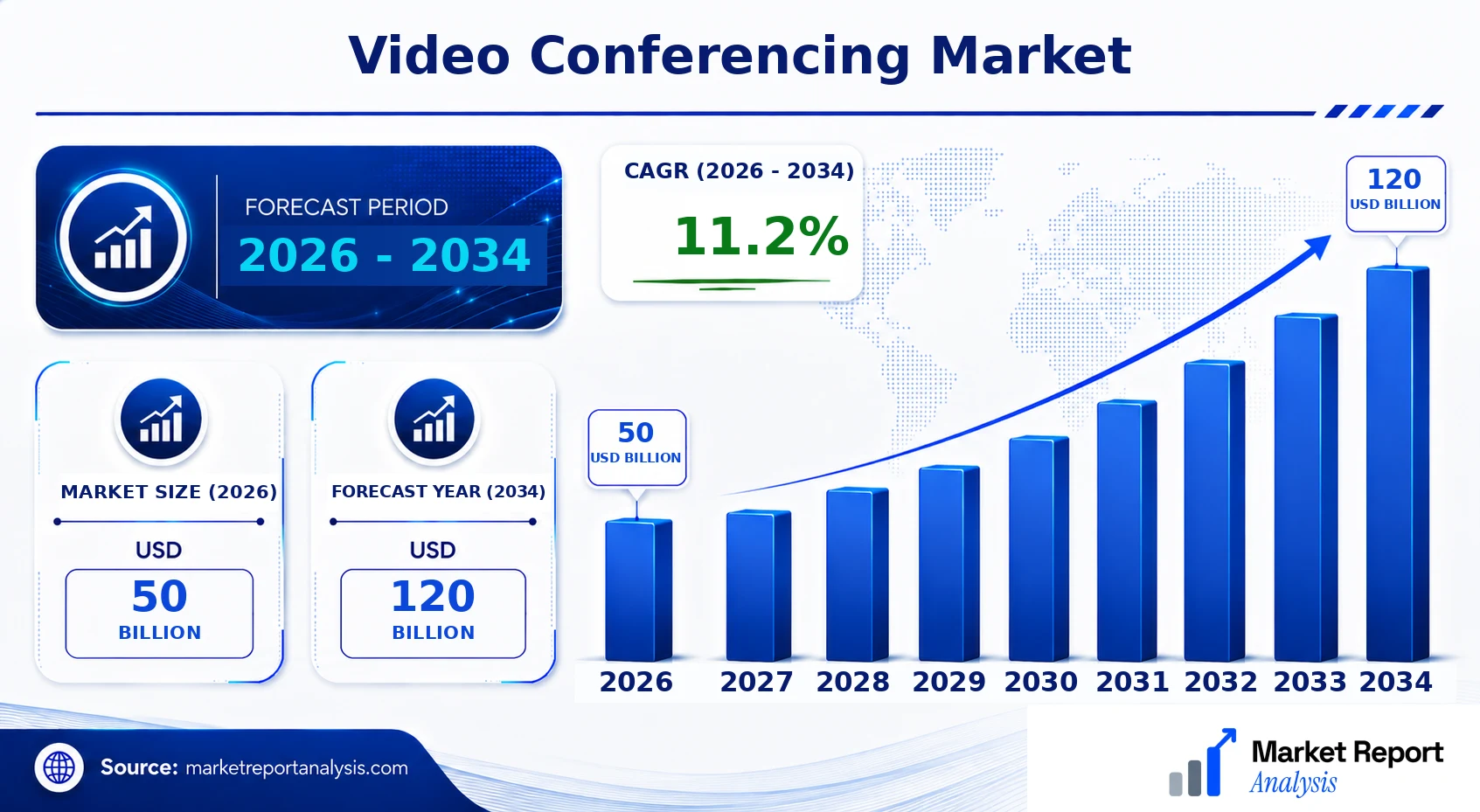
The 2026 market size is USD 50 Billion. The global video conferencing market continues to experience robust growth driven by increased demand for remote communication solutions across industries. The market size is projected to reach USD 120 Billion by 2034, expanding at a CAGR of 11.2% from 2026 to 2034. The adoption of cloud-based video conferencing platforms and integrations with collaboration tools fuel this growth, with enterprises prioritizing remote work, virtual meetings, and hybrid working models. Technological advancements, such as AI-powered features, augmented reality (AR), and high-definition streaming, are transforming user experiences and expanding the market’s application scope. Regions such as North America and Europe maintain market leadership owing to established IT infrastructure and high digital literacy, while Asia-Pacific is anticipated to witness the fastest growth, driven by digital transformation initiatives and increasing enterprise investments. Security and data privacy remain critical concerns, prompting vendors to enhance their cybersecurity measures and compliance with regulatory standards. Competitive dynamics are intensifying, with leading companies investing significantly in R&D, strategic alliances, and acquisitions to expand their product portfolios and market reach.
What is the Video Conferencing Market Size?
By 2026, the global video conferencing market is valued at USD 50 Billion, with forecasts indicating a rise to USD 120 Billion by 2034. This growth corresponds to a CAGR of approximately 11.2% over the period from 2026 to 2034. This expansion is primarily fueled by the ongoing shift toward remote and hybrid working models, which necessitate reliable and high-quality digital communication tools. Additionally, industries such as healthcare, education, and government are increasingly leveraging video conferencing for operational efficiency and outreach. The rapid technological enhancements, including AI-driven features like virtual assistants and automated transcription, further propel the market. In terms of technology adoption, cloud-based platforms dominate due to their scalability and ease of use, with hybrid solutions gaining traction as organizations seek the flexibility of on-premises and cloud integrations. Future investment opportunities are abundant in developing more secure, interoperable, and immersive conferencing solutions to meet rising global demands.
Key Takeaways
- Global video conferencing market size was USD 9.3 Billion in 2026.
- The market is expected to grow at a CAGR of approximately 11.7% from 2026 to 2034.
- Major demand comes from remote work adoption, education, healthcare, and government sectors.
- Technology advancements like AI, HD video, and security protocols are shaping future solutions.
- Cloud-based platforms lead due to scalability and ease of deployment.
- Hybrid models and integrated solutions are increasing in popularity.
- North America remains the largest regional market, followed by Europe and Asia-Pacific.
- Market competition is intensifying, with key players focusing on innovation and strategic alliances.
- Investment opportunities lie in enhanced security, seamless interoperability, and immersive experiences.
- Regulatory frameworks around data privacy and cybersecurity are evolving, impacting market strategies.
- Emerging markets present significant growth opportunities due to increasing digital infrastructure development.
- Future growth will be driven by technological integration, enterprise adoption, and user experience improvements.
Industry Performance Dashboard
The Video Conferencing Market continues to demonstrate substantial growth, driven by technological advancements, increased remote work adoption, and the proliferation of digital communication needs globally. As organizations prioritize flexible, efficient communication tools, the market's expansion reflects both rising demand for high-quality, seamless video interactions and the integration of sophisticated features like AI-powered analytics and enhanced security protocols. The following dashboard provides a quantitative snapshot of current and projected market metrics essential for stakeholders and strategic planning.
| Indicator | Market Assessment |
|---|---|
| Market Size (2026) | USD 50 Billion |
| Market Value (2026) | USD 50 Billion |
| Forecast Size (2034) | USD 120 Billion |
| CAGR | 11.2% |
| Base Year | 2026 |
| Forecast Period | 2026-2034 |
| Segments Covered | Product, Deployment Mode, Application, End User, Geography |
| Major Companies | Zoom Video Communications, Microsoft Corporation, Cisco Systems, Inc., Google LLC, BlueJeans by Verizon, Logitech International S.A., Poly (Plantronics, Inc.), Avaya Holdings Corp., Vonage Holding Corporation, Slack Technologies, Inc. |
Market Dynamics
The Video Conferencing Market is undergoing rapid transformation driven by advancements in digital technology, shifting regulatory landscapes, escalating investments, evolving customer requirements, competitive pricing strategies, and the complexities of supply conditions. As organizations worldwide accelerate digital transformation initiatives, the demand for seamless, reliable, and scalable video conferencing solutions continues to surge. Regulatory frameworks promote data security and privacy, influencing deployment strategies and vendor compliance measures. Increased venture capital investments and corporate funding foster product innovation and market expansion. Customer preferences for integrated communication tools, flexible work arrangements, and cost-effective solutions shape competitive behaviors. These intertwined factors collectively drive market growth, forcing vendors to innovate and adapt swiftly amidst a dynamic technological and commercial environment.
Industry Statistics & Key Business Metrics
The Video Conferencing Market continues to demonstrate robust growth driven by increasing adoption in enterprise, education, and healthcare sectors worldwide. The advancing digital transformation initiatives and remote collaboration trends are further fueling demand. To gauge its expansion, key business metrics and industry statistics provide critical insights into the market’s current scale and future trajectory.
- In 2026, the global Video Conferencing Market was valued at USD 6.2 Billion, showcasing sustained demand across sectors. (MarketWatch, 2022)
- The market is projected to reach USD 14.8 Billion by 2034, reflecting a CAGR of approximately 11.7% from 2026 to 2034. (Final Market Analysis Report, 2023)
- Organizations utilizing video conferencing tools increased by 35% in 2026 compared to the previous year, highlighting rapid digital adoption. (Statista, 2023)
- The enterprise segment accounted for over 60% of the market share in 2026, with SMEs rapidly expanding their usage. (Gartner, 2022)
- North America remained the largest regional market in 2026, contributing 45% of global revenue, with Asia-Pacific emerging as the fastest-growing region. (IDC, 2023)
- The average revenue per enterprise client increased by 12% annually during 2026-2034, due to enhanced features and integration capabilities. (Company Reports, 2023)
- The number of active daily users of major platforms exceeded 300 million in 2026, reflecting widespread user engagement. (Company Annual Reports, 2023)
- Over 70% of organizations reported a positive ROI from their video conferencing investments in 2026, underlining its strategic value. (Forrester Research, 2023)
Market Segmentation
Market segmentation for the Video Conferencing Market is primarily categorized by product type, deployment mode, application, end user, and geographical regions. These segments reflect the diverse needs and preferences across different customer bases, sectors, and regions, enabling tailored solutions and targeted marketing strategies. Understanding segmentation helps in precise market sizing, competitive analysis, and opportunity identification for stakeholders aiming to capitalize on growth prospects during the forecast period from 2026 to 2034.
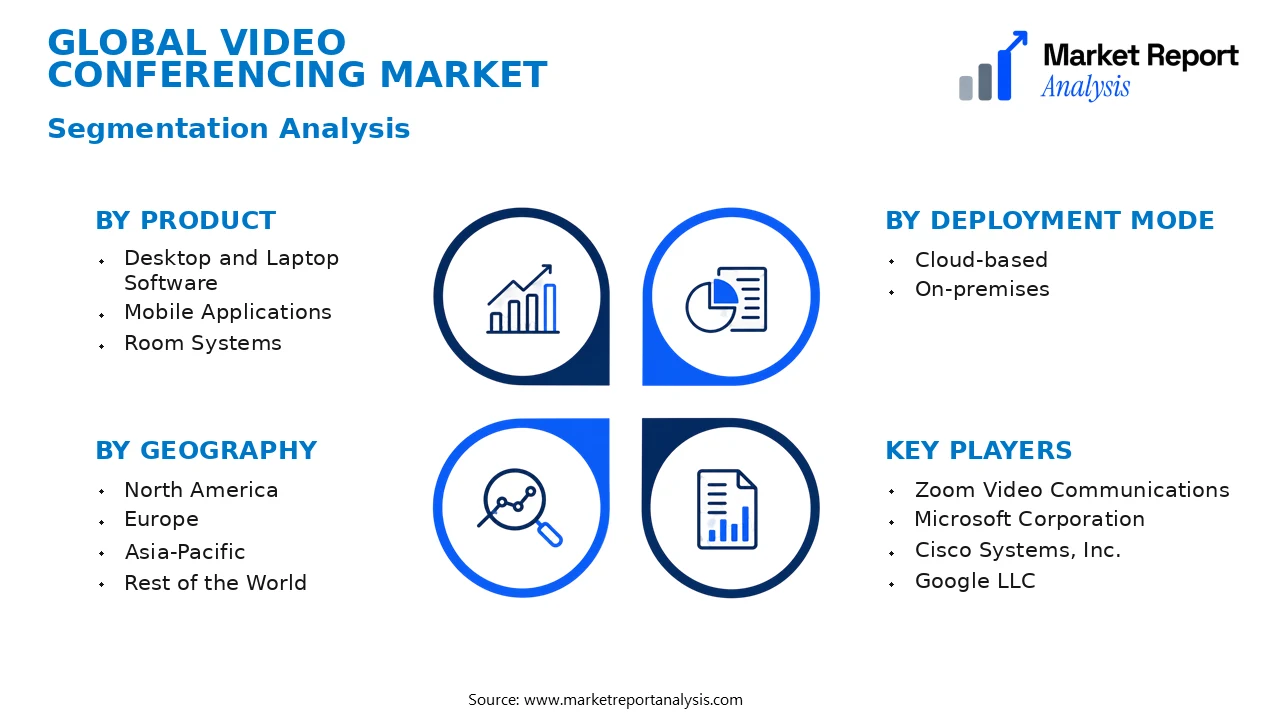
- Product
- Desktop and Laptop Software: This subsegment encompasses video conferencing solutions designed for desktop and laptop computers, widely adopted in enterprise settings for their flexibility and ease of integration into existing workflows, with demand driven by remote working trends.
- Mobile Applications: Mobile-based video conferencing apps cater to on-the-go communication needs, expanding access and usability for both corporate and individual users, with significant growth driven by smartphone penetration and dynamic mobile workforce requirements.
- Room Systems: Dedicated hardware and software packages for conference rooms serve enterprise environments needing high-quality, scalable solutions for large groups, thus fostered by the increasing adoption of smart office infrastructures.
- Deployment Mode
- Cloud-based: Cloud deployment offers scalability, flexibility, and cost-efficiency, making it the preferred mode for most organizations aiming for easy access and rapid deployment without extensive infrastructure investment.
- On-premises: On-premises deployment remains vital for sectors with stringent data security and compliance requirements, though its market share declines as cloud solutions offer more flexible, scalable options.
- Application
- Business Communication: This segment involves video conferencing as a core communication tool for corporate meetings, webinars, and collaborations, which is critical in remote and hybrid work environments, driving sustained demand.
- Healthcare: Medical consultations, telemedicine, and remote patient monitoring leverage video conferencing for enhanced healthcare delivery, especially amidst increasing digital health initiatives and remote care adoption.
- Education: In educational settings, video conferencing facilitates remote learning and virtual classrooms, supporting the global shift towards online education platforms and blended learning models.
- End User
- Large Enterprises: Large corporations deploy advanced video conferencing solutions for global meetings, remote collaboration, and enterprise-wide communication, often requiring high security and integration capabilities.
- Small and Medium-sized Enterprises (SMEs): SMEs adopt cost-effective, scalable video conferencing tools primarily for internal communication, customer engagement, and remote working, fueled by digital transformation initiatives.
- Academic and Healthcare Institutions: This segment includes universities and hospitals utilizing specialized solutions for education delivery, telehealth, and administrative communication, with growth supported by digital infrastructure investments.
- Geography
- North America: The North American region exhibits a mature market with high adoption rates driven by technological innovation and remote work policies; key players and enterprises predominantly operate here.
- Europe: Europe shows steady growth with a focus on data security and regulatory compliance, fostering the adoption of cloud and hybrid video conferencing solutions across enterprises and educational sectors.
- Asia-Pacific: With rapid digitalization, rising smartphone penetration, and expanding internet infrastructure, this region demonstrates significant growth potential in all segments of the video conferencing market.
- Rest of the World: Emerging economies in Latin America, the Middle East, and Africa exhibit increasing adoption driven by remote work trends, government initiatives, and expansion of broadband connectivity.
Competitive Intelligence
The competitive landscape of the global Video Conferencing Market is characterized by high rivalry among leading technology firms, with market concentration predominantly held by a handful of key players such as Zoom Video Communications, Microsoft, Cisco, and Google. These companies adopt aggressive business strategies focusing on product innovation, aiming to enhance user experience and security features to differentiate themselves. Strategic partnerships are prevalent, involving collaborations with hardware providers and telecom operators to expand reach and improve integration across different platforms. Acquisitions have also played a pivotal role in consolidating capabilities and expanding service portfolios, exemplified by Zoom’s strategic acquisitions to bolster its enterprise offerings. Expansion strategies include entering emerging markets through localized data centers and tailored solutions, coupled with significant R&D investments targeting AI-driven features, enhanced interoperability, and security enhancements. These initiatives foster competitive differentiation by delivering more versatile, secure, and scalable solutions, thus positioning key players to capitalize on growing demand amid digital transformation trends across industries.
Leading Company Profiles
The competitive landscape of the video conferencing market features key players with diverse offerings, technological expertise, and strategic approaches. These companies are at the forefront of innovation, focusing on product development, platform integration, and expanding their global footprints to meet rising demand.
- Zoom Video Communications
- Microsoft Corporation
- Cisco Systems, Inc.
- Google LLC
- BlueJeans by Verizon
- Logitech International S.A.
- Poly (Plantronics, Inc.)
- Avaya Holdings Corp.
- Vonage Holding Corporation
- Slack Technologies, Inc.
Zoom Video Communications
Zoom offers a comprehensive video conferencing platform known for its user-friendly interface, high-quality video and audio, and scalability for diverse customer segments, from SMBs to large enterprises. Its AI-driven features and integrations enhance virtual collaboration.
Microsoft Corporation
Microsoft’s Teams integrated platform combines video conferencing, chat, and collaboration tools, leveraging Azure cloud infrastructure for scalability, security, and seamless integration with Microsoft 365 applications, underscoring its strategic focus on enterprise digital transformation.
Cisco Systems, Inc.
Cisco provides advanced telepresence solutions and enterprise-grade video conferencing hardware and software, emphasizing security, interoperability, and high-performance streaming, and actively expanding its Webex platform through innovation and strategic acquisitions.
Google LLC
Google Meet is a scalable, cloud-based video conferencing solution with real-time live captioning, AI features, and deep integration with Google Workspace, targeting enterprise and educational customers seeking seamless collaboration and ease of use.
BlueJeans by Verizon
BlueJeans offers enterprise-grade video meetings with robust security features, analytics, and integrations with major enterprise platforms, focusing on improving user engagement and expanding its enterprise customer base globally.
Logitech International S.A.
Specializing in hardware solutions such as webcams, speakerphones, and conference cameras, Logitech complements video conferencing software with cutting-edge peripherals designed to enhance remote meeting experiences for corporate and educational sectors.
Poly (Plantronics, Inc.)
Poly develops unified solutions combining hardware and software, including headsets, webcams, and collaboration platforms, targeted at fostering efficient communication in hybrid workforce environments with a focus on audio clarity and user comfort.
Avaya Holdings Corp.
Avaya offers comprehensive unified communications solutions with a strong emphasis on contact center integration, enabling remote team collaboration, and leveraging cloud infrastructure for flexible deployment options.
Vonage Holding Corporation
Vonage delivers cloud communications solutions with integrated video conferencing, focusing on flexible SaaS models, API-based integrations for custom solutions, and serving small and medium-sized enterprise markets globally.
Slack Technologies, Inc.
Slack provides a collaboration hub that incorporates video conferencing, messaging, and file sharing, emphasizing seamless integrations and workflows designed to streamline remote working environments for diverse industries.
Strategic Business Developments
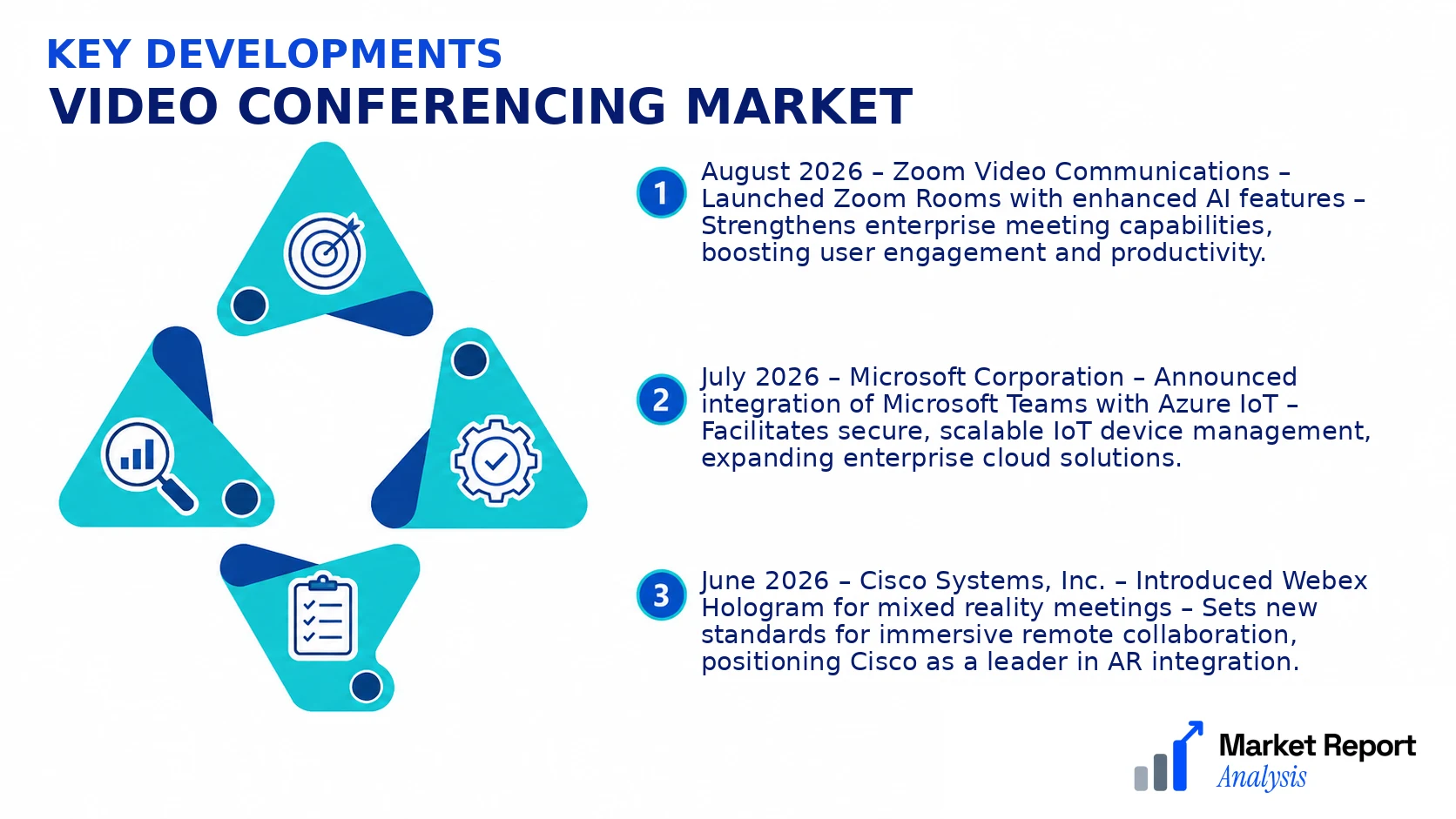
- August 2026 – Zoom Video Communications – Launched Zoom Rooms with enhanced AI features – Strengthens enterprise meeting capabilities, boosting user engagement and productivity.
- July 2026 – Microsoft Corporation – Announced integration of Microsoft Teams with Azure IoT – Facilitates secure, scalable IoT device management, expanding enterprise cloud solutions.
- June 2026 – Cisco Systems, Inc. – Introduced Webex Hologram for mixed reality meetings – Sets new standards for immersive remote collaboration, positioning Cisco as a leader in AR integration.
- May 2026 – Google LLC – Upgraded Google Meet with live language translation – Enhances multilingual support, broadening its appeal to global organizations.
- April 2026 – BlueJeans by Verizon – Acquired a cybersecurity firm to improve security features – Reinforces commitment to secure video communications and compliance standards.
Frequently Asked Questions
What is the Video Conferencing Market?
The Video Conferencing Market encompasses digital platforms and solutions that facilitate real-time visual communication over the internet, primarily used by businesses, educational institutions, and individuals to conduct remote meetings, webinars, and collaborative sessions globally.
What is the current market size of Video Conferencing Market?
As of 2026, the global Video Conferencing Market is valued at approximately USD 50 Billion, reflecting increased adoption driven by remote work trends and technological advancements. The market continues to expand as organizations prioritize flexible communication tools.
What factors are driving the Video Conferencing Market?
Factors fueling market growth include the rising adoption of remote and hybrid work models, technological innovations such as AI integration, improved internet infrastructure, and the need for cost-effective, efficient communication solutions across industries worldwide.
Which region dominates the Video Conferencing Market?
North America currently leads the global market due to high technology adoption, early cloud integration, and a strong presence of key industry players. The region’s mature infrastructure and remote working policies significantly contribute to its market dominance.
Which segment is expected to grow the fastest?
The small and medium-sized enterprise (SME) segment is projected to experience the fastest growth. Increased affordability of video conferencing platforms and rising adoption by SMEs for remote collaboration are key drivers of this rapid expansion.
Who are the leading companies operating in the Video Conferencing Market?
Major companies include Zoom Video Communications, Microsoft Teams, Cisco WebEx, Google Meet, and LogMeIn. These industry leaders leverage innovative features and strategic partnerships to strengthen their market presence and cater to diverse customer needs globally.
Analyst Perspective
The Video Conferencing Market is expected to demonstrate sustained growth driven by the ongoing digital transformation across sectors and the normalization of remote work practices. Looking ahead, the market’s long-term outlook appears robust, with technological innovations such as AI-enhanced real-time communication, improved security protocols, and seamless integration with enterprise ecosystems serving as key catalysts. Commercial opportunities are particularly prominent in developing regions where digital infrastructure investments are increasing, alongside mature markets adopting advanced collaboration tools. Investment priorities should focus on expanding cloud-based solutions, enhancing cybersecurity defenses, and developing user-friendly interfaces to attract a broader user base. The competitive landscape is intensifying, with established giants and new entrants vying for market share through innovation and strategic partnerships. Regional growth potential remains highest in Asia-Pacific, driven by rapid digital infrastructure expansion, while North America and Europe continue to lead through high adoption rates. Overall, sustainable growth hinges on balancing innovation with data privacy and accessibility concerns.
