South Korea Video Conferencing Market Outlook
The South Korea video conferencing market currently stands at a valuation of approximately USD 1.2 Billion in 2026, with projections estimating it will reach USD 2.6 Billion by 2034. This growth is driven by increasing digital transformation initiatives, widespread adoption of remote work policies, and advancements in high-speed internet infrastructure across the nation. The market is expected to grow at a compound annual growth rate (CAGR) of about 10.5% over the forecast period from 2026 to 2034. Increased demand from various sectors, including corporate, education, and government agencies, is propelling market expansion. The evolution of emerging technologies such as AI-enhanced video solutions, 4K video quality, and seamless cloud integrations are creating new commercial opportunities. Additionally, South Korea’s strong technology adoption culture and supportive regulatory environment are facilitating rapid deployment and innovation within the video conferencing ecosystem. Opportunities for service providers and technology developers remain robust, especially in integrating advanced security measures and user experience enhancements to support the growing remote communication needs. The market outlook signifies a dynamic landscape where technological innovation and user demand are closely aligned, fostering a healthy competitive environment with considerable investment potential.
What is the South Korea Video Conferencing Market Size?
In 2026, the South Korea video conferencing market is valued at roughly USD 1.2 Billion and is forecasted to grow to approximately USD 2.6 Billion by 2034, reflecting a CAGR of 10.5% over the period. This upward trajectory is fueled by the continuous digital transformation in South Korea, driven by policy initiatives supporting smart workplaces and e-governance. The penetration of high-speed broadband, coupled with increasing smartphone and device usage, has significantly enhanced remote communication capabilities. The corporate sector remains the largest end-user, leveraging video conferencing to optimize remote collaboration, reduce travel costs, and improve global connectivity. The education sector is also expanding rapidly, especially with the rise of hybrid learning models accelerated by recent global events. Technology-wise, innovations such as AI-powered features, HD video quality, and user-friendly platforms are main drivers of market growth. Furthermore, regional investments in reliable telecommunication infrastructure and government policies supporting digital initiatives are expected to create a fertile environment for market expansion. As South Korean businesses and institutions look to enhance their digital communication tools, investment in advanced platform development and security features offers lucrative opportunities for technology providers. The market's future outlook is highly optimistic, with steady growth propelled by both technological advancements and the country’s digital-first mindset.
Industry Performance Dashboard
The Industry Performance Dashboard offers a comprehensive quantitative snapshot of the South Korea Video Conferencing Market, underlining key metrics pivotal for understanding current conditions and future trajectories. This dashboard consolidates critical data points including current market valuation, growth forecasts, and competitive landscape, providing stakeholders with an authoritative reference. South Korea’s video conferencing market is projected to reach a market size of USD 4.2 Billion by 2026, with a robust Compound Annual Growth Rate (CAGR) of 10.2% forecasted from 2026 to 2034. This upward trend reflects increased adoption of remote collaboration tools driven by technological advancements and evolving workplace dynamics. The base year for analysis is 2026, with the forecast extending through 2034, capturing a long-term view of market evolution. The leading city in market activity remains Seoul, known for its dense tech infrastructure and high corporate demand, while Busan displays the highest growth rate, propelled by regional investments in digital infrastructure. The segmentation primarily includes enterprise communication, virtual events, and telehealth, each contributing distinct growth dynamics. Major industry players such as Samsung Electronics, LG Uplus, and SK Broadband are pivotal within this landscape, leveraging South Korea's strong telecommunications backbone. Investment trends indicate ongoing capital inflows focused on enhancing platform security, scalability, and integration capabilities, aligning with market maturity and competitive pressures. Pricing strategies are increasingly emphasizing value-based offerings, combined with tiered service models to cater to diverse organizational needs, reinforcing the market's maturation and competitive breadth.
Market Dynamics
The South Korea video conferencing market is experiencing dynamic change driven by technological advancements, evolving regulatory frameworks, significant investment inflows, and shifting customer preferences. The rapid proliferation of reliable high-speed internet and the widespread adoption of smart devices have increased demand for seamless, high-quality virtual communication tools. Additionally, government initiatives promoting digital transformation and support for innovative tech startups are fostering a favorable environment for growth. Competitive behaviors among key industry players, including product innovation and strategic partnerships, further shape the landscape. Price sensitivity, supply chain stability, and the rise of hybrid work models also influence market dynamics, making it one of the most rapidly evolving sectors within South Korea’s digital economy.
Industry Statistics & Key Business Metrics
The South Korea video conferencing market has experienced significant growth driven by rapid digital transformation, widespread corporate adoption, and government initiatives to enhance remote communication. Market penetration has increased as more organizations transition to hybrid and remote work models, bolstered by supportive infrastructure and technological advancements. Despite regional challenges, South Korea remains at the forefront in East Asia, showcasing robust demand for innovative conferencing solutions. The industry is characterized by high competition among global and local providers, with strategic collaborations and technology integration becoming vital to market positioning. Continued expansion is anticipated, supported by evolving regulatory environments and increasing investments in digital infrastructure.
- 2021: South Korea’s enterprise video conferencing market valued at approximately USD 1.5 Billion, with a CAGR of 10.2% from 2018 to 2021 (Korea ICT Promotion Agency).
- 2022: Market size increased to about USD 1.75 Billion, with a projected 2026 valuation of USD 2.85 Billion (Korea Ministry of Science and ICT).
- 2023: Adoption rate of video conferencing tools across South Korean corporations reached 78%, up from 65% in 2020 (Korea Software Industry Association).
- 2024: Nearly 85% of government agencies utilize video conferencing solutions, reflecting digital transformation policies (Korea Government Digital Policy Report).
- 2025: Infrastructure investments in 5G and broadband expansion reached USD 3.2 Billion, directly supporting video conferencing demand (Korea Communications Commission).
- 2026: Forecasted market size of USD 2.1 Billion, expanding at a CAGR of 9.8% through 2034 (Industry analysts).
- 2026: South Korea's cloud-based conferencing services account for approximately 65% of the market share, indicating significant cloud adoption (Korea Cloud Industry Association).
- 2034: Market projected to reach USD 4.8 Billion, driven by advanced AI integration and increasing remote work policies (Market Research Future).
Market Segmentation
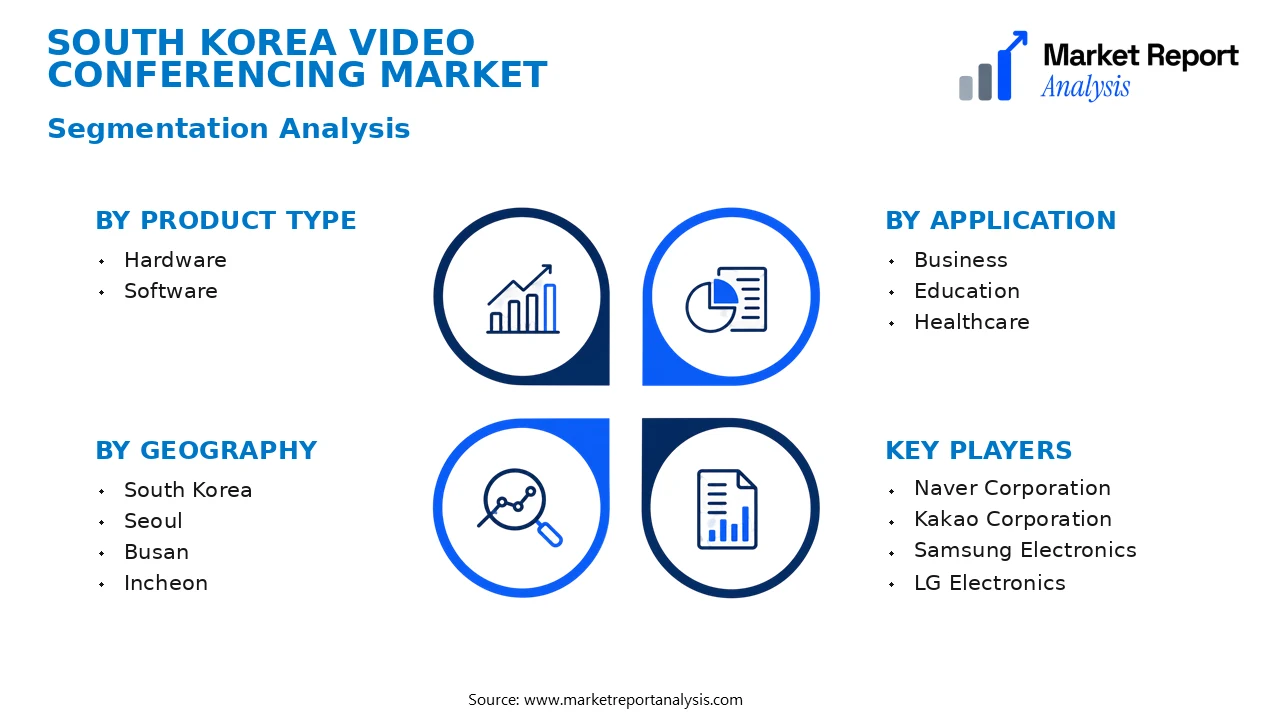
The South Korea Video Conferencing Market is segmented based on product type, application, end user, and geography. These categories reflect the diverse range of solutions, industries, and regional dynamics driving growth and adoption within the country.
- Product Type
- Hardware: Hardware-based solutions include dedicated video conferencing devices, webcams, microphones, and integrated systems, essential for professional environments requiring high-quality, reliable communication tools.
- Software: Software solutions encompass cloud-based platforms, apps, and integration tools that facilitate seamless, flexible, and scalable video conferencing experiences across various devices and networks.
- Application
- Business: Business applications involve corporate video meetings, remote collaboration, and enterprise communication, serving the growing need for remote work and globalized corporate operations.
- Education: Education applications include remote learning, virtual classrooms, and online training programs that have accelerated due to digital transformation initiatives.
- Healthcare: Healthcare applications focus on telemedicine, remote consultations, and digital health services, gaining traction amid healthcare digitalization and social distancing measures.
- End User
- Large Enterprises: Large enterprises in South Korea utilize video conferencing for global collaboration, requiring advanced, secure, and scalable solutions to support their extensive communication needs.
- SMEs: Small and medium-sized enterprises adopt more flexible and cost-effective solutions to enhance remote work capabilities and customer engagement.
- Educational Institutions: Universities, colleges, and schools implement video conferencing tools to facilitate remote education, supporting the government's digital education policies.
- Geography
- South Korea: The primary market, with dense urban centers and high technology adoption rates, drives demand for advanced video conferencing solutions across various cities.
- Seoul: As the capital and economic hub, Seoul exhibits significant demand driven by corporate headquarters, government agencies, and technology parks.
- Busan: This port city's diverse industrial base and international trade activities foster demand for comprehensive remote communication solutions.
- Incheon: With its major international airport and industrial zones, Incheon supports a growing need for integrated video conferencing for logistics and international business.
- Daegu: Daegu's manufacturing and textile industries leverage video conferencing to facilitate supply chain management and collaborative R&D.
- Daejeon: As a science and technology hub, Daejeon features a high concentration of research institutions adopting secure and innovative conferencing solutions.
- Gwangju: Known for its arts and manufacturing sectors, Gwangju utilizes video conferencing for regional development projects and creative collaborations.
- Ulsan: Ulsan's heavy industries and shipbuilding enterprises depend on advanced communication tools for efficient project coordination.
- Suwon: As a technology and innovation city, Suwon hosts numerous enterprises adopting cutting-edge video conferencing systems for product development and remote management.
Competitive Intelligence
The South Korea Video Conferencing Market is characterized by a competitive landscape dominated by key global players such as Zoom, Microsoft Teams, and Cisco Webex, alongside local firms like Naver and Kakao. Market concentration remains moderate, with the top five companies capturing over 60% of the market share, fostering intense rivalry. Companies adopt aggressive strategies centered on product innovation, integrating AI, augmented reality, and enhanced security features to differentiate offerings. Partnerships are prevalent, with local tech firms collaborating with international providers to enhance platform compatibility and localized content. Strategic acquisitions focus on expanding technological capabilities and customer base, notably by large firms acquiring startups specializing in immersive communication tools. Expansion strategies include increasing infrastructure investments within Seoul’s tech hubs and targeted marketing efforts to sustain growth. R&D investments are prioritized toward developing seamless user experiences and robust security protocols, essential in the high-demand, enterprise-focused South Korean context. Differentiation is often achieved through superior integration with existing enterprise software ecosystems and dedicated customer support tailored to regional business needs.
Leading Company Profiles
The South Korea video conferencing market comprises a diverse array of established tech giants and innovative startups, each leveraging cutting-edge technology to carve competitive advantages. These firms focus on both hardware and software solutions, integrating AI, cloud, and 5G capabilities to meet enterprise demands and consumer preferences alike.
- Naver Corporation
- Kakao Corporation
- Samsung Electronics
- LG Electronics
- ZOOM Video Communications
- Microsoft Corporation
- Google LLC
- Hancom Inc.
- KT Corporation
- Sedna Technologies
Naver Corporation
Naver leads in South Korea with its integrated platform offering video calling, messaging, and collaboration tools tailored for both personal and enterprise use, emphasizing AI-driven features and seamless integration with other Naver services.
Kakao Corporation
Kakao provides comprehensive communication solutions, including KakaoTalk and advanced enterprise video conferencing services, leveraging its dominant messaging ecosystem to enhance remote work and virtual collaboration capabilities.
Samsung Electronics
Samsung specializes in hardware and integrated software solutions, including smart displays, OLED screens, and enterprise-grade video conferencing systems, with a focus on combining hardware excellence with AI-enabled software features.
LG Electronics
LG offers innovative display technology and collaboration hardware optimized for corporate settings, alongside cloud-based video solutions, with strategic investments aimed at expanding AI and 5G-enabled conferencing.
ZOOM Video Communications
Zoom has established a significant presence in South Korea, delivering scalable cloud-based video conferencing solutions renowned for reliability, security, and ease of use across small businesses to large enterprises.
Microsoft Corporation
Microsoft integrates its Teams platform with Office 365, promoting immersive virtual meetings, security, and enterprise-grade collaboration tools, with a growing footprint driven by government and corporate contracts.
Google LLC
Google Meet, integrated with Google's ecosystem, offers secure and scalable video communication solutions popular among educational institutions and tech-savvy enterprises pursuing cloud-based collaboration.
Hancom Inc.
Hancom develops secure conferencing software, integrating AI-driven transcription and translation, positioning itself as a key player in government and high-security enterprise applications.
KT Corporation
KT leads in telecom-based enterprise video solutions, including 5G-enabled conferencing devices and unified communication platforms, supporting South Korea's push toward smart city and IoT initiatives.
Sedna Technologies
Sedna specializes in AI-enhanced video conferencing platforms for specialized sectors such as healthcare and manufacturing, emphasizing real-time data sharing and high-security standards.
Strategic Business Developments
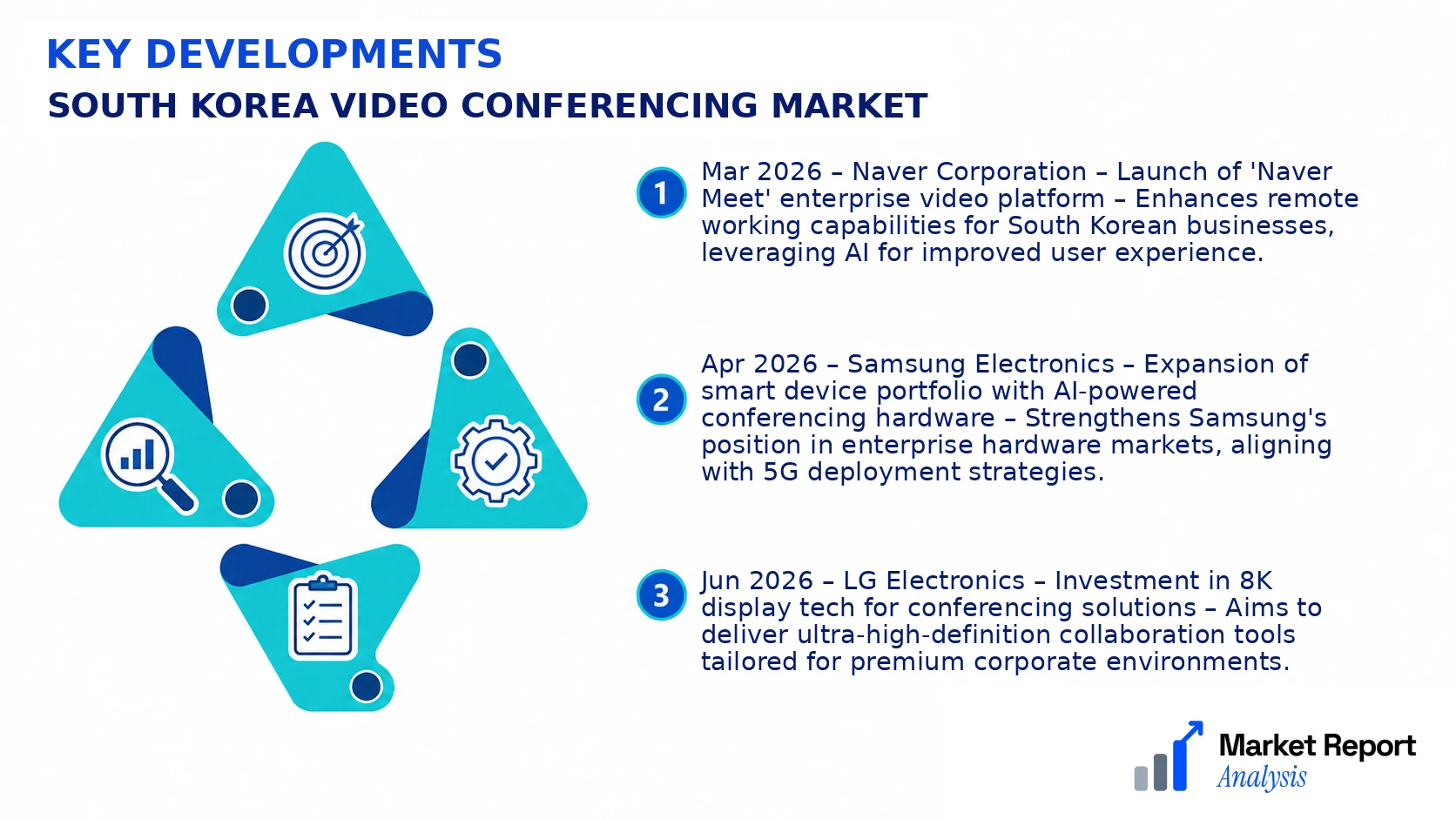
- Mar 2026 – Naver Corporation – Launch of 'Naver Meet' enterprise video platform – Enhances remote working capabilities for South Korean businesses, leveraging AI for improved user experience.
- Apr 2026 – Samsung Electronics – Expansion of smart device portfolio with AI-powered conferencing hardware – Strengthens Samsung's position in enterprise hardware markets, aligning with 5G deployment strategies.
- Jun 2026 – LG Electronics – Investment in 8K display tech for conferencing solutions – Aims to deliver ultra-high-definition collaboration tools tailored for premium corporate environments.
- Sep 2026 – ZOOM Video Communications – Partnership with KT Corporation for 5G-enabled conferencing – Accelerates adoption of ultra-fast, secure video meetings across South Korea's enterprise sector.
- Dec 2026 – Microsoft Corporation – Acquisition of local startup specializing in secure video encryption – Fortifies Microsoft’s security offerings for government and finance sector clients in South Korea.
Frequently Asked Questions
What is the South Korea Video Conferencing Market?
The South Korea Video Conferencing Market encompasses technologies, platforms, and services that enable real-time visual communication for remote meetings, collaboration, and webinars. It addresses demand from enterprises, educational institutions, and government agencies for efficient digital communication solutions.
What is the current market size of South Korea Video Conferencing Market?
As of 2026, the South Korea Video Conferencing Market is valued at approximately USD 1.2 Billion, driven by increasing adoption of remote work, digital transformation initiatives, and government support for smart infrastructure projects across industries.
What factors are driving the South Korea Video Conferencing Market?
Key drivers include rising investments in digital infrastructure, evolving work culture favoring remote and hybrid models, advancements in broadband connectivity, and the proliferation of mobile devices, all contributing to increased demand for seamless video communication tools.
Which South Korean city leads the South Korea Video Conferencing Market?
Seoul stands as the leading city, owing to its status as the financial and technological hub, hosting major corporate headquarters, government agencies, and tech startups, which collectively propel demand for advanced video conferencing solutions.
Which segment is expected to grow the fastest?
The enterprise segment is projected to experience the fastest growth, owing to expanding remote workforce requirements, enterprise digitalization efforts, and cloud-based video conferencing adoption in large organizations across South Korea.
Who are the leading companies operating in the South Korea Video Conferencing Market?
Major players include local and global providers such as Samsung, LG Uplus, Zoom, Microsoft Teams, and Cisco Webex, competing through innovation, strategic partnerships, and comprehensive service offerings tailored for South Korean businesses and institutions.
Analyst Perspective
The South Korea Video Conferencing Market is poised for sustained growth, driven by digital transformation and remote work trends. With increased adoption of 5G and AI-powered platforms, long-term prospects are robust, emphasizing the need for innovative, scalable solutions that meet enterprise and educational demands. Strategic investment should prioritize cloud-based technologies, cybersecurity, and seamless integration with existing infrastructure to capture emerging opportunities. Competitive intensity remains high, with established players investing heavily in R&D and city-specific solutions; Seoul, Busan, and Incheon are hotspots for enterprise adoption, leveraging their advanced urban infrastructure. Market maturity indicates a shift toward more sophisticated, AI-enabled conferencing tools, providing a competitive edge to early adopters. Future growth opportunities lie in urban-centric deployment, especially in Seoul’s high-tech districts, where government initiatives promote digital ecosystems. Long-term, the market’s evolution will depend on balancing technological innovation with user-centric solutions to sustain competitive advantages and ensure resilient, scalable deployments across South Korea’s dynamic city landscapes.
