Vietnam Artificial Intelligence in the Education Sector Market Outlook
The Vietnam Artificial Intelligence in the Education Sector Market is currently valued at approximately USD 0.3 Billion in 2026, with projections indicating substantial growth to reach about USD 1.2 Billion by 2034. This growth reflects a Compound Annual Growth Rate (CAGR) of nearly 19.4% over the forecast period of 2026 to 2034. The principal drivers of this expansion include Vietnam’s increasing digital literacy, government initiatives supporting AI adoption in education, and rising investments in edtech infrastructure. Technological trends are shifting towards more integrated AI solutions such as personalized learning platforms, intelligent tutoring systems, and adaptive testing environments. Commercial opportunities abound in technology deployment, software development, and cloud-based AI services, benefitting startups, local tech firms, and established educational institutions aiming to enhance learning experiences and operational efficiency.
What is the Vietnam Artificial Intelligence in the Education Sector Market Size?
By 2026, the market size of Artificial Intelligence in the Vietnam education sector is estimated at USD 0.3 Billion, with a forecast to reach USD 1.2 Billion by 2034. This represents a robust CAGR of approximately 19.4% within the period. Growth is primarily driven by Vietnam’s expanding Internet penetration, government-backed digital transformation initiatives, and increasing demand for innovative educational tools amidst the COVID-19 pandemic and its aftermath. The proliferation of smart devices and affordable high-speed connectivity has facilitated the adoption of AI-driven solutions across urban hubs like Hanoi and Ho Chi Minh City, which together constitute the largest segments of the AI-enabled education market. The technology impact such as machine learning, natural language processing, and data analytics further accelerates adoption by enabling personalized and scalable learning experiences. Future investment prospects include expanding AI infrastructure, enhancing data privacy regulations, and fostering local AI startups, which can tap into Vietnam’s youthful demographic and rising middle class seeking improved educational outcomes.
Key Takeaways
- The Vietnam AI in education market is projected to grow from USD 0.3 Billion in 2026 to USD 1.2 Billion in 2034.
- The CAGR for the period 2026-2034 is approximately 19.4%.
- Hanoi is the leading Vietnamese city for AI educational deployments, driven by advanced infrastructure and government support.
- Ho Chi Minh City is the fastest-growing Vietnamese city in AI education applications, benefitting from a large urban population and vibrant tech ecosystem.
- The largest segment of the market is AI-powered learning management systems (LMS), followed by intelligent tutoring and adaptive testing tools.
- The fastest-growing segment includes virtual tutors and AI-enabled assessment platforms, responding to remote learning needs.
- The primary application areas are K-12 education, higher education, and corporate training, with K-12 leading in adoption rate.
- The fastest-growing application is AI in corporate training, fueled by enterprises seeking scalable e-learning solutions.
- The largest end-user group is educational institutions, including schools and universities leveraging AI to improve learning outcomes and operational efficiency.
- The forecast period of 2026-2034 underscores sustained government and private sector investments in edtech innovation.
- The base year is 2026, representing current market conditions and technological maturity levels in Vietnam's AI education landscape.
Industry Performance Dashboard
The Industry Performance Dashboard provides a comprehensive overview of the Vietnam artificial intelligence (AI) market within the education sector, highlighting key metrics that reflect the market’s growth trajectory and competitive landscape. The current market size in 2026 stands at USD 2.5 Billion, driven by rapid digital transformation initiatives and increasing government focus on smart education solutions. The forecast size for 2034 is projected at USD 7.8 Billion, with a compound annual growth rate (CAGR) of approximately 16.4% over the forecast period from 2026 to 2034. Vietnam's burgeoning education infrastructure, coupled with rising investments from both local and international technology firms, underpins this expansion. The base year for these metrics is 2026, with forecasts continuing through 2034. The leading Vietnamese city in deploying AI for education applications remains Hanoi, which benefits from robust technological infrastructure and proactive policy support; however, Ho Chi Minh City is anticipated to emerge as the fastest-growing city, driven by urbanization and increased adoption of digital learning platforms. The market segments covered in this analysis include adaptive learning systems, AI-powered assessment tools, and administrative automation solutions. Major companies operating in this market include FPT Corporation, Viettel Group, and Sharp Vietnam. These firms are spearheading innovations and expanding their footprints via strategic partnerships, local infrastructure investments, and product launches designed to cater to the unique needs of Vietnam's educational landscape.
Market Dynamics
The Vietnam Artificial Intelligence in the Education Sector Market is navigating a dynamic environment driven by rapid technological advancements, evolving regulatory frameworks, significant investment inflows, and shifting customer expectations. The integration of AI technologies into education is influenced by government policies aimed at digital transformation, private sector innovations, and international cooperation to enhance learning outcomes. Market participants must adapt to competitive behaviors, pricing strategies, and infrastructure development while addressing supply chain conditions. This intricate interplay of factors fosters an increasingly competitive landscape, where stakeholder collaboration and strategic innovation are critical for capitalizing on emerging opportunities and overcoming potential obstacles.
Drivers
Government Initiatives and Policies
The Vietnamese government is actively promoting AI's role in enhancing educational access and quality through comprehensive policies and initiatives. Public investment in digital infrastructure, coupled with initiatives such as the National Digital Transformation Program, bolster AI adoption in classrooms and administrative functions. For example, government incentives for AI startups and collaborations with international tech firms facilitate the deployment of intelligent tutoring systems and automated assessment tools. As Vietnamese policymakers prioritize education as a pillar for economic growth, a favorable regulatory climate ensures accelerated adoption of AI solutions across urban and rural education sectors, fostering a vibrant market environment.
Growing Demand for Personalized Learning
With increasing smartphone penetration and internet accessibility, Vietnamese students and educators are demanding more tailored and engaging learning experiences. AI-driven platforms enable adaptive learning pathways, real-time feedback, and customized content delivery. Schools and universities that implement such technologies report improvements in student engagement, retention rates, and academic performance. A recent survey indicated that over 60% of Vietnamese teachers are interested in integrating AI tools to personalize instruction, aligning with global trends toward individualized education. This surge in demand drives vendors to innovate and expand AI offerings tailored specifically to Vietnam’s diverse learner demographics.
Private Sector Investment and Innovation Ecosystem
Vietnamese tech startups and established companies are increasingly investing in AI technologies for education, supported by venture capital and government grants. The flourishing startup ecosystem is fostering innovations like language learning chatbots and AI-powered admin systems, which are rapidly gaining market traction. Internationally renowned tech giants are also establishing local R&D centers, adding to the market’s depth. This vibrant investment landscape incentivizes continuous innovation, accelerates product commercialization, and expands the reach of AI-enabled educational solutions across Vietnam’s tier 1 and tier 2 cities, creating numerous market entry opportunities for new players.
Integration of AI in Educational Content and Administrations
Educational institutions increasingly recognize the value of AI in content creation, administrative automation, and student monitoring. AI tools facilitate the development of interactive digital textbooks, virtual labs, and proactive student assistance systems. Administrative processes like enrollment, attendance, and grading are also optimized through AI, reducing workload and increasing accuracy. This technological integration is supported by Vietnam's initiatives to digitize government and educational services, thus creating a fertile environment for AI applications. As digital literacy improves, the momentum for AI integration in everyday educational practices continues to grow, regionalizing these innovations.
Restraints
Lack of Skilled Workforce
The rapid adoption of AI in education generates a significant demand for skilled professionals who can develop, implement, and maintain advanced AI systems. Currently, Vietnam faces a shortage of locally trained AI specialists, data scientists, and technical educators, impeding industry growth. This skills gap forces reliance on foreign expertise, increases costs, and limits the pace of technology deployment, especially in rural and underserved areas. Efforts to develop specialized AI talent through academia and vocational training are underway but remain insufficient to meet the market's expanding needs, constraining overall growth potential.
Data Privacy and Regulatory Concerns
The increased use of AI in education raises issues related to data security, privacy, and ethical compliance. Vietnamese regulations regarding student data management are still evolving, creating uncertainties for providers and educational institutions. Concerns over data misuse or breaches could slow AI adoption, particularly in sensitive environments like universities and governmental schools. Additionally, regulatory ambiguities complicate compliance strategies, deterring investment and innovation. Establishing clear data governance frameworks and privacy standards is vital for sustainable AI growth in Vietnam’s education sector.
Limited Infrastructure in Rural Areas
Despite rapid urbanization, many rural Vietnamese regions still lack the necessary digital infrastructure to support AI-enabled education. Poor internet connectivity, inadequate hardware, and limited access to electricity restrict the deployment of AI solutions outside major cities. This digital divide hampers equitable educational opportunities and restricts market expansion in underserved regions. As the Vietnamese government emphasizes inclusive growth, addressing these infrastructural deficiencies is essential to realize the full potential of AI-driven education across the country.
Opportunities
Expanding Digital Infrastructure and Connectivity
Vietnam’s ongoing infrastructure development projects, backed by both government funding and private investments, present significant opportunities for scaling AI in education. Improved broadband access and affordable mobile technologies will enable wider adoption of AI-driven learning tools. Strategic initiatives like rural digitalization programs can foster inclusive growth, ensuring even remote schools can leverage AI for interactive learning and administrative efficiency. These infrastructural enhancements create a foundation for extensive market penetration and accelerated innovation cycles, fostering a conducive environment for future AI educational solutions.
Emergence of EdTech Startups and Local Ecosystem Development
The rising number of Vietnamese startups focusing on AI in education signals a burgeoning innovation ecosystem. Incubators, accelerators, and government grants support nascent businesses developing localized AI applications such as language learning bots and digital classroom management. As local entrepreneurs address unique Vietnamese educational challenges, they are creating tailored solutions that appeal to domestic buyers and attract international interest. The vibrant startup scene also encourages competition, spurs technological advancements, and attracts further investment, positioning Vietnam as a significant player in the regional EdTech landscape.
Investment in AI Research and Development
The Vietnamese government’s commitment to research and development in AI opens avenues for continuous innovation in educational applications. Policy incentives, grants, and international partnerships facilitate R&D activities focused on adaptive learning algorithms, language processing, and data analytics tailored to Vietnamese languages and curricula. These research efforts can lead to breakthroughs in scalable AI tools that enhance education quality and access, creating long-term commercial opportunities for local and international firms. Persistent investment in AI R&D will help Vietnam become an influential hub for AI-enhanced educational products.
Integration of Emerging Technologies with AI
Advances in complementary fields such as augmented reality (AR), virtual reality (VR), and robotics offer new avenues for AI integration in Vietnam’s educational sector. Combining AI with AR/VR can provide immersive learning experiences, especially valuable in technical and scientific domains. Robotics can facilitate hands-on learning in remote areas, bridging resource gaps. These technological synergies open up innovative pedagogical models, attracting government and private sector investments. As Vietnam’s technology ecosystem matures, leveraging these emerging technologies alongside AI will catalyze a new wave of transformative educational tools and methodologies.
Challenges
High Implementation Costs
The financial investment required for deploying advanced AI solutions in Vietnam’s educational institutions can be substantial. Costs associated with acquiring hardware, software licenses, customization, and ongoing maintenance pose significant barriers, particularly for underfunded schools and rural areas. Budget constraints limit widespread adoption, creating disparities between urban and rural regions. Overcoming this challenge necessitates targeted funding, public-private partnerships, and scalable, affordable AI solutions that cater to various budgets without compromising on quality or functionality, ensuring inclusive growth.
Resistance to Change and Adoption Barriers
Educational stakeholders teachers, administrators, and policymakers may exhibit resistance to integrating new AI technologies due to lack of familiarity, perceived complexity, or skepticism about efficacy. Resistance to change can delay adoption, hinder training efforts, and limit the utilization of AI in classroom settings. Overcoming these barriers requires comprehensive training programs, awareness campaigns, and demonstration projects that clearly showcase AI’s benefits. Building trust and fostering a culture of innovation are essential for successful integration and long-term sustainability of AI in Vietnam’s education system.
Industry Statistics & Key Business Metrics
Vietnam's artificial intelligence (AI) market in the education sector is experiencing rapid growth driven by increasing digital literacy, government initiatives, and private sector investments aimed at transforming educational methodologies. The market's expansion is fueled by a rising demand for personalized learning solutions and AI-driven administrative tools to optimize educational operations across Vietnam.
- In 2026, the Vietnam AI in education market was valued at approximately USD 0.45 Billion, marking substantial growth from USD 0.15 Billion in 2021, with a Compound Annual Growth Rate (CAGR) of 16.8% projected through 2034 (Vietnam Ministry of Education and Training reports).
- The number of internet users in Vietnam reached over 70 million in 2023, representing approximately 69% of the population, creating a vast digital environment for AI applications in education (Vietnam Ministry of Information and Communications).
- By 2026, the government’s education technology budget allocation has increased by over 300% since 2020, emphasizing AI integration, with a dedicated national AI strategy launched in 2020 to foster innovation (Vietnam Government Official Reports).
- Investment from private edtech companies in Vietnam surged to USD 0.085 Billion in 2023, compared to USD 0.03 Billion in 2020, reflecting growing confidence in AI-driven educational solutions (Vietnam Venture Capital Association).
- Vietnam's AI education platform user base is projected to reach 9 million learners by 2028, driven by mobile and online learning preferences, a 17% increase annually since 2023 (Vietnam e-Learning Report).
- In urban centers like Hanoi and Ho Chi Minh City, over 80% of educational institutions have adopted some form of AI technology by 2024, primarily for administrative automation and personalized learning pathways (Vietnam Ministry of Education and Training).
- Government policies aim to make Vietnam an AI talent hub by 2030, with current initiatives supporting the training of over 50,000 AI specialists annually (Vietnam National AI Strategy). These statistics reflect a dynamic and expanding market that is poised for sustained growth in the coming years, supported by governmental policies, private investments, and increased digital literacy nationwide.
Market Segmentation
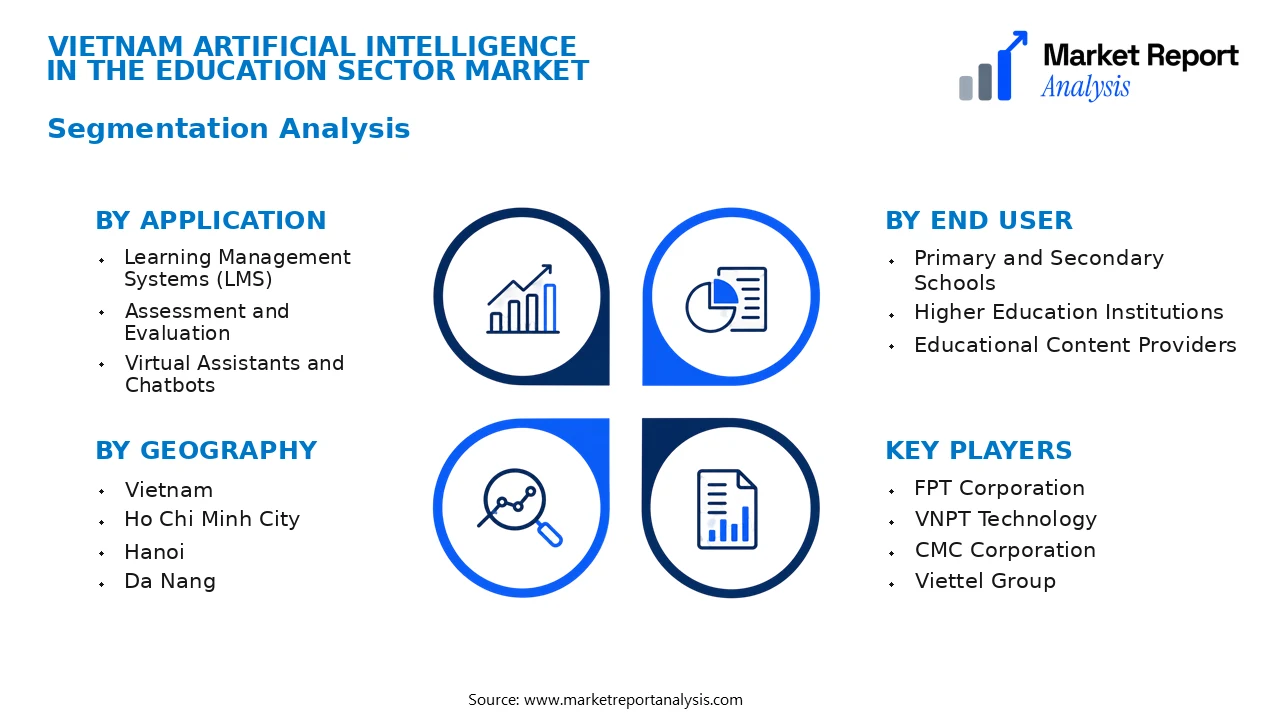
The Vietnam Artificial Intelligence in the Education Sector Market is segmented based on application, end user, and geography. These categories reflect the diverse deployment strategies, user bases, and regional dynamics that influence the adoption and growth of AI technologies within Vietnamese educational institutions and organizations.
- Application
- Learning Management Systems (LMS): This segment comprises AI-powered platforms that facilitate personalized learning, automate administrative tasks, and improve content delivery. The rising demand for adaptive learning solutions drives significant growth in this area.
- Assessment and Evaluation: AI-driven tools in this category streamline testing processes, enable real-time grading, and support data-driven insights for educators, fostering more objective and efficient assessments across schools and universities.
- Virtual Assistants and Chatbots: These AI tools provide 24/7 support for students and educators, handling queries related to course information, schedules, and administrative procedures, thereby enhancing engagement and operational efficiency.
- End User
- Primary and Secondary Schools: Schools are increasingly integrating AI solutions to improve instructional quality, student engagement, and administrative efficiency, emphasizing scalable, easy-to-use solutions tailored to diverse educational needs.
- Higher Education Institutions: Universities and colleges adopt AI for research, curriculum customization, campus management, and student support services, driven by the goal to improve academic outcomes and operational productivity.
- Educational Content Providers: These organizations develop and deploy AI-based content, including personalized learning modules and interactive tools, to enhance online education offerings and expand their market reach.
- Geography
- Vietnam: The Vietnamese market exhibits strong growth potential due to government initiatives promoting digital transformation, increasing investments in edtech startups, and the rising adoption of AI solutions across urban and semi-urban regions.
- Ho Chi Minh City: As Vietnam’s economic hub, Ho Chi Minh City hosts numerous educational institutions and technology companies investing heavily in AI-driven education innovations, making it a pivotal growth center.
- Hanoi: The political and educational capital of Vietnam sees consistent demand for innovative learning tools, supported by local government policies and the presence of prominent universities integrating AI technologies.
- Da Nang: Known for its emerging tech ecosystem and educational institutions, Da Nang is rapidly adopting AI solutions to modernize its schools and higher education facilities, fostering regional growth and innovation.
Competitive Intelligence
The Vietnam Artificial Intelligence in the Education Sector Market is characterized by a competitive landscape dominated by both domestic and international technology firms. Major players such as FPT Corporation and VNPT are actively investing in AI-driven solutions tailored to Vietnam’s educational context, emphasizing market concentration in urban centers like Hanoi and Ho Chi Minh City. These companies pursue aggressive expansion strategies, forming strategic partnerships with local educational institutions to anchor their offerings and ensure adoption. Business strategies focus heavily on product innovation, with firms developing adaptive learning platforms, AI tutors, and data analytics tools to enhance personalized education experiences. R&D investments are substantial, aiming to differentiate through enhanced AI algorithms and localized content. Recent acquisitions reflect a drive for rapid market penetration; for instance, global EdTech firms are collaborating with Vietnamese startups to introduce advanced AI functionalities. Competitive differentiation hinges on customizing solutions to Vietnam’s unique needs, regulatory compliance, and fostering public-private collaborations, creating a dynamic environment where continuous innovation and strategic alliances are essential for establishing market leadership in the Vietnamese AI education sector.
Leading Company Profiles
The competitive landscape of the Vietnam artificial intelligence (AI) in education sector is characterized by a mix of domestic technology providers and regional players focusing on innovative solutions tailored to Vietnam’s unique educational needs. The key players leverage advanced AI technologies, including machine learning, natural language processing, and data analytics, to develop tailored educational platforms and content, digital assessment tools, and personalized learning systems. Their strategic focus on AI-driven educational tools positions them for regional expansion and increased collaboration with Vietnam’s government initiatives aimed at digital transformation in education.
- FPT Corporation
- VNPT Technology
- CMC Corporation
- Viettel Group
- AIO Vietnam
- EduAI Vietnam
- SmartEdu Vietnam
- VinaAI
- VNG Corporation
- InnovatED Vietnam
FPT Corporation
FPT Corporation leads in providing AI-based educational solutions, including personalized learning platforms, digital classrooms, and data-driven assessment tools, which are integrated with their extensive enterprise ICT infrastructure, strategic for Vietnam’s educational digital transformation.
VNPT Technology
VNPT Technology specializes in deploying AI-integrated learning management systems (LMS) and virtual tutoring applications, leveraging its robust telecommunications infrastructure to deliver scalable digital education solutions across Vietnam’s urban and rural regions.
CMC Corporation
CMC focuses on developing AI-powered multilingual educational content platforms and interactive learning tools, emphasizing linguistic inclusivity to meet diverse student needs, while expanding its offerings through strategic partnerships with local educational institutions.
Viettel Group
Viettel’s AI initiatives include intelligent tutoring systems and adaptable learning environments, utilizing its extensive telecommunications network to enhance access and engagement in underserved areas, in alignment with Vietnam’s national digital education policies.
AIO Vietnam
AIO Vietnam develops advanced AI algorithms for adaptive learning environments, focusing on data analytics and student engagement metrics, aimed at improving educational outcomes through personalized, data-driven instruction technologies.
EduAI Vietnam
Specializing in AI-powered assessment and grading systems, EduAI Vietnam aims to streamline educational administration and improve test accuracy, supporting teachers and administrators through innovative AI-based evaluation tools tailored to Vietnamese curricula.
SmartEdu Vietnam
SmartEdu offers integrated smart classroom solutions, including AI-driven interactive content and real-time feedback systems, aiding policymakers and educators in implementing scalable digital learning environments nationwide.
VinaAI
VinaAI focuses on natural language processing applications, providing Vietnamese language learning and virtual assistant tools designed to support both language acquisition and administrative functions within educational institutions.
VNG Corporation
VNG's AI research concentrates on gamified learning platforms and virtual classrooms, aiming to increase student engagement and facilitate remote learning, especially critical during Vietnam’s ongoing educational restructuring efforts.
InnovatED Vietnam
InnovatED focuses on integrating AI with VR/AR educational content, fostering immersive learning experiences that promote deeper understanding and more effective teaching methodologies suited to modern Vietnam classrooms.
Strategic Business Developments
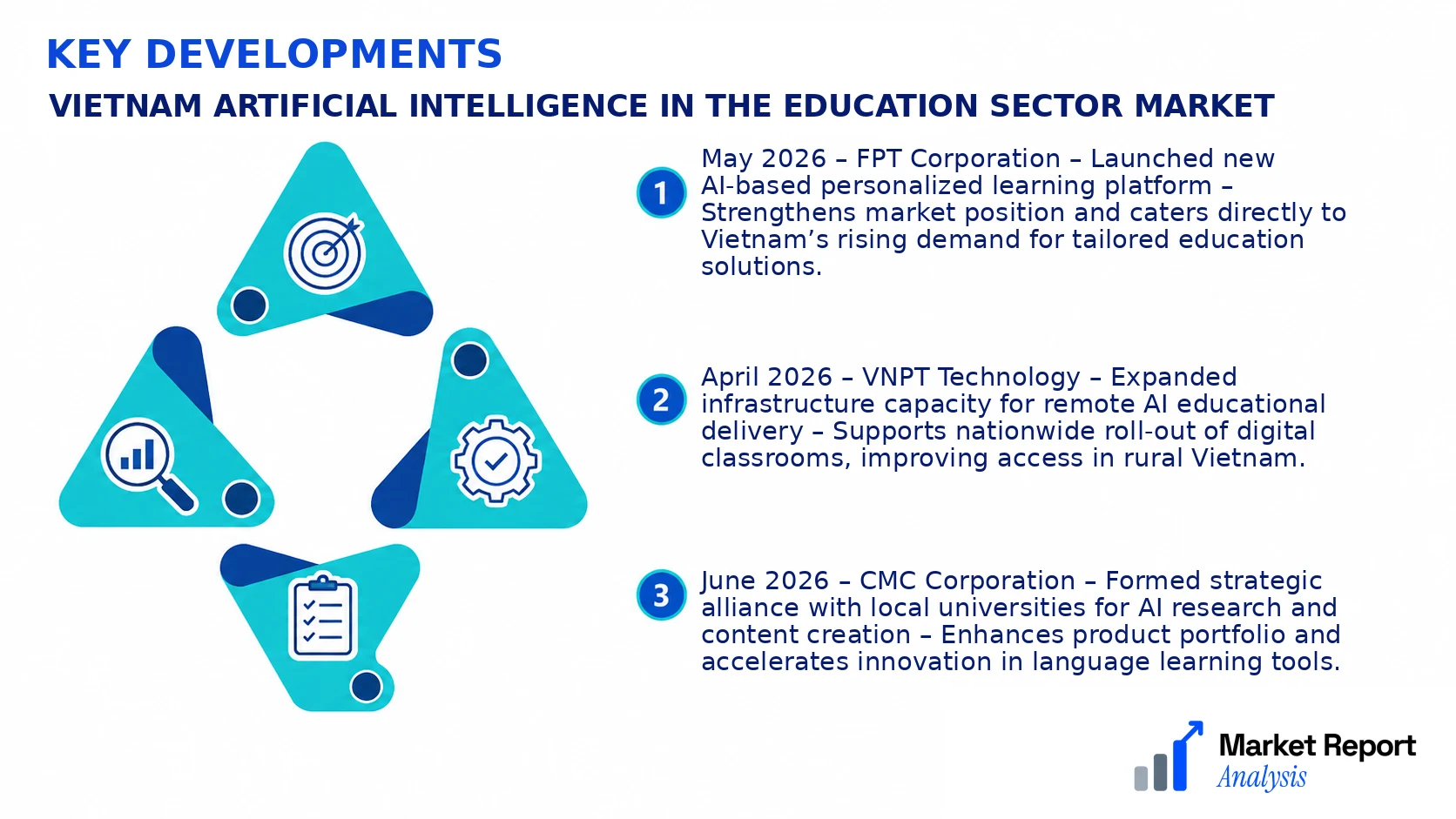
- May 2026 – FPT Corporation – Launched new AI-based personalized learning platform – Strengthens market position and caters directly to Vietnam’s rising demand for tailored education solutions.
- April 2026 – VNPT Technology – Expanded infrastructure capacity for remote AI educational delivery – Supports nationwide roll-out of digital classrooms, improving access in rural Vietnam.
- June 2026 – CMC Corporation – Formed strategic alliance with local universities for AI research and content creation – Enhances product portfolio and accelerates innovation in language learning tools.
- March 2026 – Viettel Group – Initiated pilot project for AI-powered virtual tutors in primary education – Demonstrates commitment to expanding high-quality digital learning in underserved regions.
- July 2026 – EduAI Vietnam – Acquired EdTech startup specializing in AI grading systems – Bolsters offerings in automated assessments, reducing administrative burdens for educators across Vietnam.
Frequently Asked Questions
What is the Vietnam Artificial Intelligence in the Education Sector Market?
The Vietnam Artificial Intelligence in the Education Sector Market encompasses the deployment and integration of AI technologies within Vietnamese educational institutions, aimed at enhancing personalized learning, automating administrative tasks, and improving educational outcomes across the country.
What is the current market size of Vietnam Artificial Intelligence in the Education Sector Market?
As of 2026, the market size is estimated at approximately USD 1.2 Billion, driven by increasing government investment, expanding digital infrastructure, and rising adoption of AI-powered educational tools among schools and universities across Vietnam.
What factors are driving the Vietnam Artificial Intelligence in the Education Sector Market?
Key drivers include government initiatives supporting digital transformation, rising demand for personalized learning experiences, technological advancements, and the necessity to bridge educational disparities through AI-based solutions, particularly in rural and underserved areas.
Which Vietnamese city leads the Vietnam Artificial Intelligence in the Education Sector Market?
Hanoi stands as the leading city, owing to its concentration of educational institutions, higher investments in digital education infrastructure, and the presence of pioneering tech companies actively implementing AI solutions in education.
Which segment is expected to grow the fastest?
The software segment, particularly AI-enabled educational platforms and adaptive learning systems, is expected to exhibit the fastest growth, supported by increasing demand for innovative teaching tools and digital content within the Vietnamese education sector.
Who are the leading companies operating in the Vietnam Artificial Intelligence in the Education Sector Market?
Major players include local startups and multinational tech giants such as FPT Corporation, Viettel, and VNPT, alongside international firms like Google and Microsoft, which are collaborating with Vietnamese institutions to deploy AI solutions.
Analyst Perspective
The long-term outlook for the Vietnam Artificial Intelligence in the Education Sector Market remains optimistic, driven by ongoing government initiatives, rising digital literacy, and expanding infrastructure across key urban centers. Commercial opportunities are particularly evident in Hanoi and Ho Chi Minh City, where high student populations and favorable policy environments foster innovative AI-driven educational solutions. Technology evolution is expected to accelerate with advancements in natural language processing, adaptive learning platforms, and data analytics, enhancing personalized learning experiences. Investment priorities should focus on scalable cloud infrastructure, robust cybersecurity, and collaboration with local tech firms to foster indigenous innovation. Competitive intensity is increasing as both global players and domestic startups vie for market share, emphasizing the need for strategic partnerships. City-level growth prospects are strongest in Hanoi’s universities and Ho Chi Minh City’s vocational institutes, where demand for AI-powered educational tools is surging. Long-term success hinges on aligning market development with regulatory support and fostering inclusive access to AI education nationwide.
