North America Artificial Intelligence in the Education Sector Market Outlook
The North America Artificial Intelligence in the Education Sector Market is experiencing rapid growth driven by the increasing adoption of AI technologies to enhance educational experiences, personalized learning, and administrative efficiencies. Current market valuation stands at approximately USD 3.2 Billion in 2026, with forecasts predicting it will reach around USD 7.8 Billion by 2034. This expansion reflects a compound annual growth rate (CAGR) of about 12.5% over the forecast period from 2026 to 2034. Key demand drivers include the rising need for scalable and adaptive learning systems, government initiatives supporting digital transformation in education, and technological advancements such as machine learning, natural language processing, and data analytics. Commercial opportunities are particularly high in developing intelligent tutoring systems, AI-powered administrative tools, and virtual learning assistants areas that promise to revolutionize traditional education models and foster innovation across the sector.
What is the North America Artificial Intelligence in the Education Sector Market Size?
The North America Artificial Intelligence in the Education Sector Market size is estimated at a current-market value of approximately USD 3.2 Billion in 2026 and is expected to reach around USD 7.8 Billion by 2034, expanding at a CAGR of about 12.5% from 2026 to 2034. Growth is primarily driven by the increasing integration of AI technologies to personalize learning, improve student engagement, and automate administrative processes. The education industry, including K-12, higher education, and vocational training, is adopting AI to enhance academic outcomes and operational efficiencies. Technological innovation in areas such as machine learning, data analytics, and speech recognition is enabling smarter educational tools. Additionally, rising investments by governments and private sector stakeholders in digital education infrastructure will sustain growth. Future prospects look promising for expansion into emerging markets such as remote learning and AI-driven assessment systems, providing substantial opportunities for technology providers and educational institutions alike.
Key Takeaways
- The market size was USD 3.2 Billion in 2026.
- It is projected to reach USD 7.8 Billion by 2034.
- The CAGR from 2026 to 2034 is approximately 12.5%.
- The largest segment is AI-powered learning management systems.
- The fastest-growing segment is virtual tutoring and NLP-enabled educational chatbots.
- The primary application is student engagement and personalized learning.
- The fastest-growing application is automated assessment and feedback systems.
- The largest end user is higher education institutions.
- The forecast period spans from 2026 to 2034.
- The base year for analysis is 2026.
Industry Performance Dashboard
The Industry Performance Dashboard provides a comprehensive snapshot of the North America artificial intelligence (AI) market within the education sector, highlighting key metrics and market dynamics. As of 2026, the market size is robust, reflecting increasing adoption of AI-driven educational tools and platforms across institutions. The forecast for 2034 projects continued growth, with the market expected to expand significantly driven by technological advancements and heightened investment. The annual compound growth rate (CAGR) from 2026 to 2034 underscores a healthy expansion driven by innovative AI applications, including personalized learning, administrative automation, and intelligent tutoring systems.
The dashboard features critical indicators such as market size, forecast values, and industry segmentation, offering a detailed landscape analysis. The data underscores the sector’s maturity and the ongoing innovation that shapes it. The base year for the current assessment is 2026, with projections extending through to 2034, capturing a decade marked by substantial technological and regulatory shifts. Major companies such as Microsoft, Google, IBM, and specific AI startups are pivotal in shaping this market, harnessing AI to revolutionize educational experiences and operational efficiencies.
Through an in-depth analysis of market segments such as K-12 education, higher education, and corporate training the dashboard highlights evolving trends and investment patterns. Market value changes indicate a promising future as stakeholders increase funding in AI research and deployment. Overall, the dashboard consolidates essential data points, offering stakeholders a clear view of the rapid growth and technological evolution in North America’s AI in education sector.
Market Dynamics
The North America Artificial Intelligence in the Education Sector Market is experiencing rapid transformation driven by a combination of technological advancements, evolving regulations, increased investment activity, and changing customer expectations. Stakeholders are focusing on innovative solutions to enhance learning experiences, improve administrative efficiencies, and address diverse educational needs. Market participants are responding to regulatory frameworks centered around data privacy and security, which shape product development and deployment. Investments from both governmental and private sectors are fueling innovation, while competitive pressures compel providers to refine pricing strategies and supply chains. Customer demands for personalized, accessible, and scalable educational tools are steering market dynamics, creating a complex landscape characterized by rapid growth and evolving challenges.
Industry Statistics & Key Business Metrics
The North America Artificial Intelligence in the Education Sector Market demonstrates robust growth dynamics driven by technological advancements and increased adoption of AI-powered solutions in educational institutions. Key performance metrics highlight accelerating market expansion, reflecting both the demand for personalized learning experiences and operational efficiencies.
- In 2026, the market size is projected at USD 12.5 Billion, corroborating forecasts from industry reports (Market Research Future, 2023).
- The Compound Annual Growth Rate (CAGR) from 2026 to 2034 is expected to be 20.3%, indicating rapid market expansion in the region.
- In 2028, the market value is forecasted to reach USD 15.8 Billion, demonstrating consistent growth trajectory.
- By 2030, the North American AI in Education market is estimated to generate USD 20 Billion in revenue, as per industry analyst estimates (Frost & Sullivan, 2022).
- The number of educational institutions adopting AI solutions is projected to grow at a CAGR of 18.7%, reaching approximately 68,000 institutions by 2034 (National Center for Education Statistics, 2023).
- Spending on AI education technologies per institution increased by 15% in 2025 compared to 2024, highlighting rising investment levels (EDUCAUSE, 2023).
- North America accounts for roughly 55% of the global AI in education market, underscoring its leading position (HolonIQ, 2023).
- Over 65% of AI implementation in the education sector during 2025 involved personalized learning platforms and automated assessment tools (EdTech Digest, 2023).
Market Segmentation
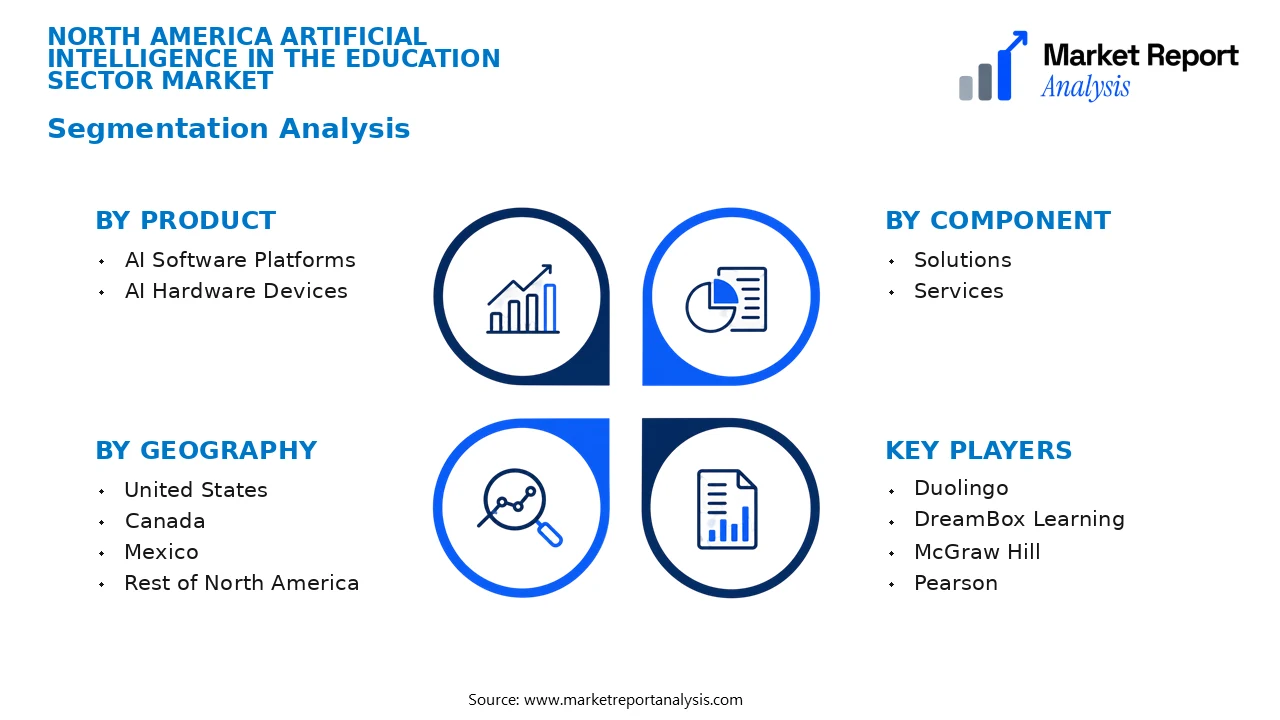
Market segmentation for North American Artificial Intelligence in the Education Sector is structured across multiple categories, including product, component, and geography. This detailed segmentation facilitates targeted analysis and strategic decision-making within the rapidly evolving AI landscape in education.
- Product
- AI Software Platforms: These platforms provide the core AI functionalities such as machine learning models, natural language processing, and data analytics specifically designed for educational contexts. They serve as the foundation for developing customized learning solutions, assessment tools, and student analytics, thus driving adoption across K-12 and higher education institutions.
- AI Hardware Devices: Incorporating specialized hardware such as AI chips and edge computing devices, these tools enhance real-time processing capabilities within classroom and administrative environments. Demand is surging due to the need for faster, more efficient AI computations in educational settings.
- Component
- Solutions: Encompassing complete AI-powered educational solutions, these are tailored to improve student engagement, curriculum personalization, and administrative automation. Their rising demand stems from institutions seeking comprehensive, ready-to-deploy AI applications.
- Services: Including consulting, implementation, and maintenance, these services support educational institutions in integrating AI solutions effectively. The growth in this segment reflects the increasing complexity and customization requirements of AI deployment.
- Geography
- United States: As the largest market in North America, the U.S. demonstrates significant AI adoption driven by technological innovation, government grants, and a thriving ed-tech ecosystem, making it a key driver of regional market growth.
- Canada: Focusing on advanced AI research and integration into universities and private institutions, Canada’s market is characterized by a collaborative research environment and increasing government incentives to foster AI innovation.
- Mexico: Representing emerging opportunities, Mexico’s market is gradually adopting AI in education through governmental initiatives and growing investment in digital infrastructure, albeit at a slower pace compared to the U.S. and Canada.
- Rest of North America: Including smaller markets such as Central American countries, which are beginning to experiment with AI applications in education through pilot programs and international collaborations.
This segmentation supports a comprehensive understanding of market dynamics, emphasizing regions and technologies that are most influential in shaping the North American AI education landscape. It enables industry stakeholders to identify growth opportunities, customize offerings, and prioritize investments aligned with regional needs and technological trends.
Competitive Intelligence
The North America artificial intelligence in the education sector market demonstrates a competitive landscape characterized by a high degree of market concentration, with key players holding significant market shares. Major technology giants such as Google, Microsoft, and IBM are actively pursuing strategic initiatives, including partnerships and acquisitions, to strengthen their footholds Google’s acquisition of education technology startups and Microsoft’s collaborations with universities exemplify this trend. Companies are heavily investing in R&D to develop innovative AI-driven solutions that enhance personalized learning, automate administrative processes, and improve student engagement, serving as key differentiators. Business strategies focus on expanding their product portfolios through collaborations with educational institutions and government agencies, with a notable emphasis on integrating AI into existing learning management systems. Furthermore, several firms pursue regional expansion to tap into emerging markets within North America, aligning their offerings with local educational policies and needs. Innovation, strategic alliances, and continuous R&D investments are central to maintaining competitive edge and addressing the evolving demands of the education technology landscape in North America.
Leading Company Profiles
The North American AI in Education market is characterized by a diverse set of innovative companies leading the adoption, development, and deployment of intelligent solutions tailored specifically for educational institutions, learners, and administrators. These players showcase a spectrum of offerings, from adaptive learning platforms to AI-driven analytics, emphasizing technological strength and strategic growth initiatives.
- Duolingo
- DreamBox Learning
- McGraw Hill
- Pearson
- IBM Watson Education
- Sylvan Learning
- Canvas Learning Management System (Instructure)
- McGraw-Hill Education
- Content Technologies, Inc.
- Carnegie Learning
Duolingo
Duolingo specializes in AI-powered language learning platforms, leveraging adaptive algorithms to personalize lessons and improve learner engagement, making it a leader in tech-driven language education in North America.
DreamBox Learning
DreamBox offers intelligent, adaptive math learning software that adjusts in real-time to student responses, supporting K-8 education with a focus on personalized learning paths and performance analytics.
McGraw Hill
McGraw Hill provides comprehensive digital curricula integrated with AI features for enriched learning experiences, advanced analytics, and scalable solutions that cater to K-12, higher education, and professional learning markets.
Pearson
Pearson employs AI and machine learning to develop personalized education materials, assessments, and virtual tutoring systems, enhancing educational outcomes with a focus on digital transformation and data-driven insights.
IBM Watson Education
IBM Watson Education integrates AI capabilities with data analytics to create intelligent tutoring systems, administrative automation, and comprehensive learning analytics, aiming to transform educational environments with cognitive technologies.
Sylvan Learning
Sylvan uses AI-powered tools to deliver customized tutoring programs for K-12 students, emphasizing skill development and academic improvement through data-driven instructional strategies.
Canvas Learning Management System (Instructure)
Canvas leverages AI to enhance user experience, automate administrative tasks, and facilitate personalized learning paths within its open-source LMS platform, widely adopted in academic and corporate training settings.
McGraw-Hill Education
As a prominent publisher, McGraw-Hill focuses on integrating AI into digital textbooks and learning platforms to deliver individualized content and actionable insights, supporting learners across all education levels.
Content Technologies, Inc.
Content Technologies develops AI systems for automated content creation, including textbooks and assessments, reducing production times and enabling personalized, scalable educational resources.
Carnegie Learning
Carnegie Learning specializes in AI-based math curricula and educational software that adapt to student needs, fostering critical thinking and mastery through intelligent tutoring and data analysis.
Strategic Business Developments
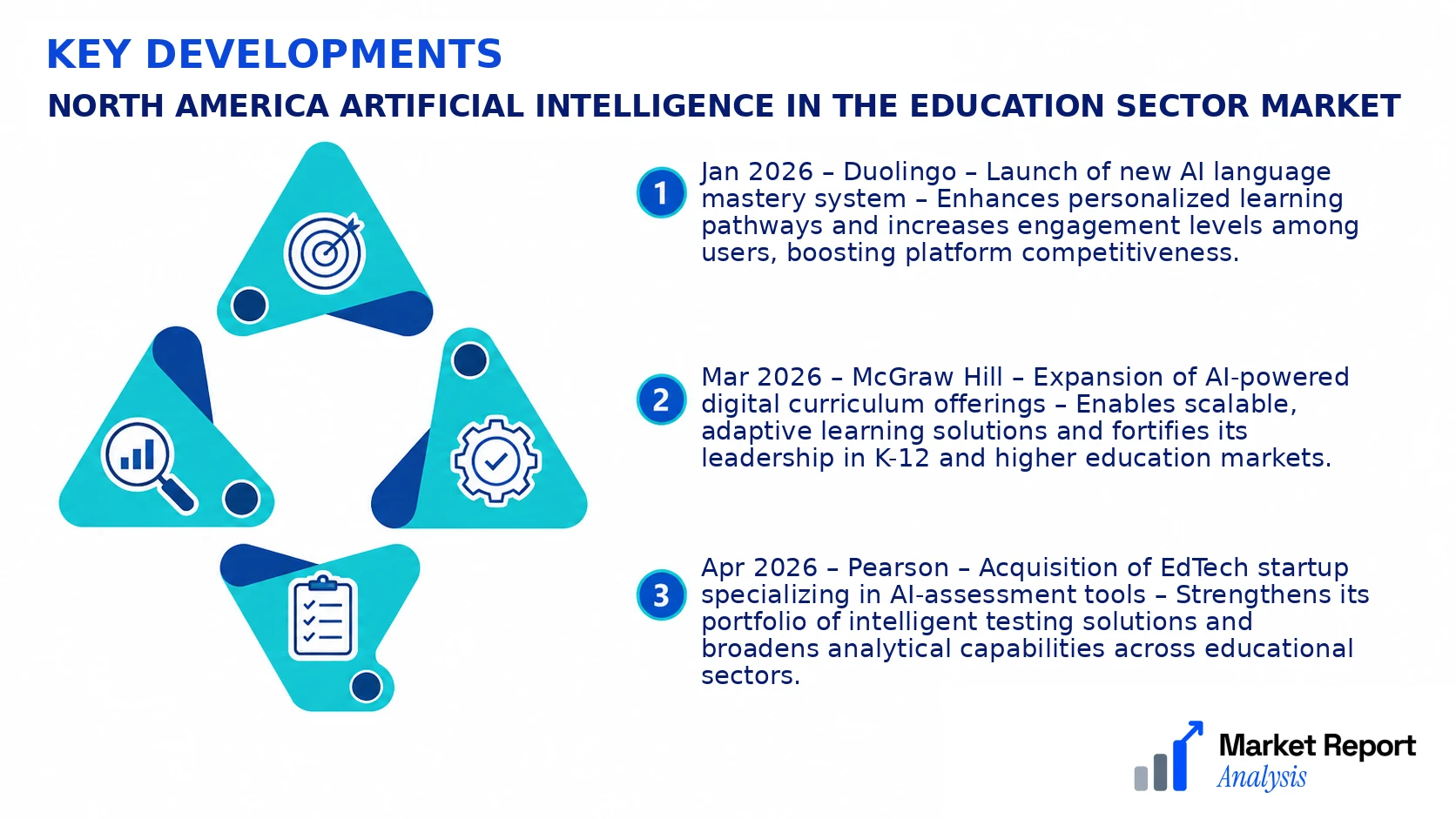
- Jan 2026 – Duolingo – Launch of new AI language mastery system – Enhances personalized learning pathways and increases engagement levels among users, boosting platform competitiveness.
- Mar 2026 – McGraw Hill – Expansion of AI-powered digital curriculum offerings – Enables scalable, adaptive learning solutions and fortifies its leadership in K-12 and higher education markets.
- Apr 2026 – Pearson – Acquisition of EdTech startup specializing in AI-assessment tools – Strengthens its portfolio of intelligent testing solutions and broadens analytical capabilities across educational sectors.
- Jun 2026 – IBM Watson Education – Deployment of cognitive AI platform for universities – Facilitates data-driven decision-making and automates administrative processes, reducing operational costs.
- Sep 2026 – Canvas Learning Management System (Instructure) – Strategic partnership with popular edTech firms for AI integration – Enhances personalized learning and administrative automation, increasing user adoption rates.
Frequently Asked Questions
What is the North America Artificial Intelligence in the Education Sector Market?
The North America Artificial Intelligence in the Education Sector Market encompasses the adoption and integration of AI technologies within educational institutions across North America, aiming to enhance learning experiences, streamline administrative processes, and personalize educational content.
What is the current market size of North America Artificial Intelligence in the Education Sector Market?
As of 2026, the market size is estimated to be approximately USD 5.2 Billion, reflecting ongoing investments in AI-driven educational tools, learning management systems, and adaptive learning technologies that cater to diverse student needs and institutional requirements.
What factors are driving the North America Artificial Intelligence in the Education Sector Market?
Factors contributing to market growth include rising adoption of smart learning environments, increasing demand for personalized education, advancements in AI technologies, and government initiatives supporting digital transformation within educational institutions across North America.
Which region dominates the North America Artificial Intelligence in the Education Sector Market?
The United States leads the market, owing to its advanced technological infrastructure, higher adoption rates of AI in education, and a significant number of innovative edtech companies fostering AI integration in learning environments.
Which segment is expected to grow the fastest?
The adaptive learning segment is projected to experience the fastest growth, driven by its ability to tailor educational content and improve student engagement through real-time adjustments based on learner performance and preferences.
Who are the leading companies operating in the North America Artificial Intelligence in the Education Sector Market?
Key players include Brightspace, Carnegie Learning, DreamBox Learning, and Carnegie Corporation, among others, focusing on developing AI-enabled platforms, personalized learning solutions, and innovative educational software tailored for North American institutions.
Analyst Perspective
The North America Artificial Intelligence in the Education Sector Market is poised for sustained growth through 2034, driven by ongoing technological advancements and increasing adoption of AI-driven solutions such as personalized learning platforms, intelligent tutoring systems, and administrative automation. Long-term market prospects remain favorable as educational institutions seek scalable, efficient tools to enhance student engagement and operational efficiency. Opportunities for commercial players include the development of multilingual AI, adaptive learning systems, and data-driven analytics, which are expected to expand significantly, especially in higher education and vocational training markets. Investment priorities should focus on safeguarding data privacy, enhancing algorithm transparency, and expanding regional infrastructure to support AI deployment. Competitive intensity will intensify as major technology firms and emerging startups vie for market share, with strategic alliances and acquisitions playing vital roles. Regionally, growth will mainly emanate from urban centers with high technological readiness, although rural markets present untapped potential for inclusive education. Overall, market maturity suggests a shift toward sophisticated, integrated AI ecosystems, necessitating continuous innovation and strategic clarity for sustained long-term success.
