South Korea Artificial Intelligence in the Education Sector Market Outlook
South Korea's artificial intelligence in education market is experiencing significant growth, driven by government initiatives, technological advancements, and increasing demand for personalized learning experiences. The market was valued at USD 4.2 Billion in 2026 and is projected to reach USD 10.8 Billion by 2034, exhibiting a compound annual growth rate (CAGR) of approximately 12.5% over the forecast period from 2026 to 2034. The principal demand drivers include rising investments in smart educational infrastructure, integration of AI-powered learning tools, and an emphasis on inclusive education policies. Technological evolution is centered around natural language processing (NLP), machine learning, and adaptive learning platforms, fostering innovative learning methods and educational content customization. Commercial opportunities abound in developing advanced AI-driven educational platforms, enhancing teaching efficacy, and expanding digital literacy across South Korea’s diverse educational institutions. This growth is further supported by strategic collaborations between tech companies and educational authorities, alongside government incentives aimed at fostering AI adoption within schools and universities, making the South Korean market highly attractive for investors and technology providers alike.
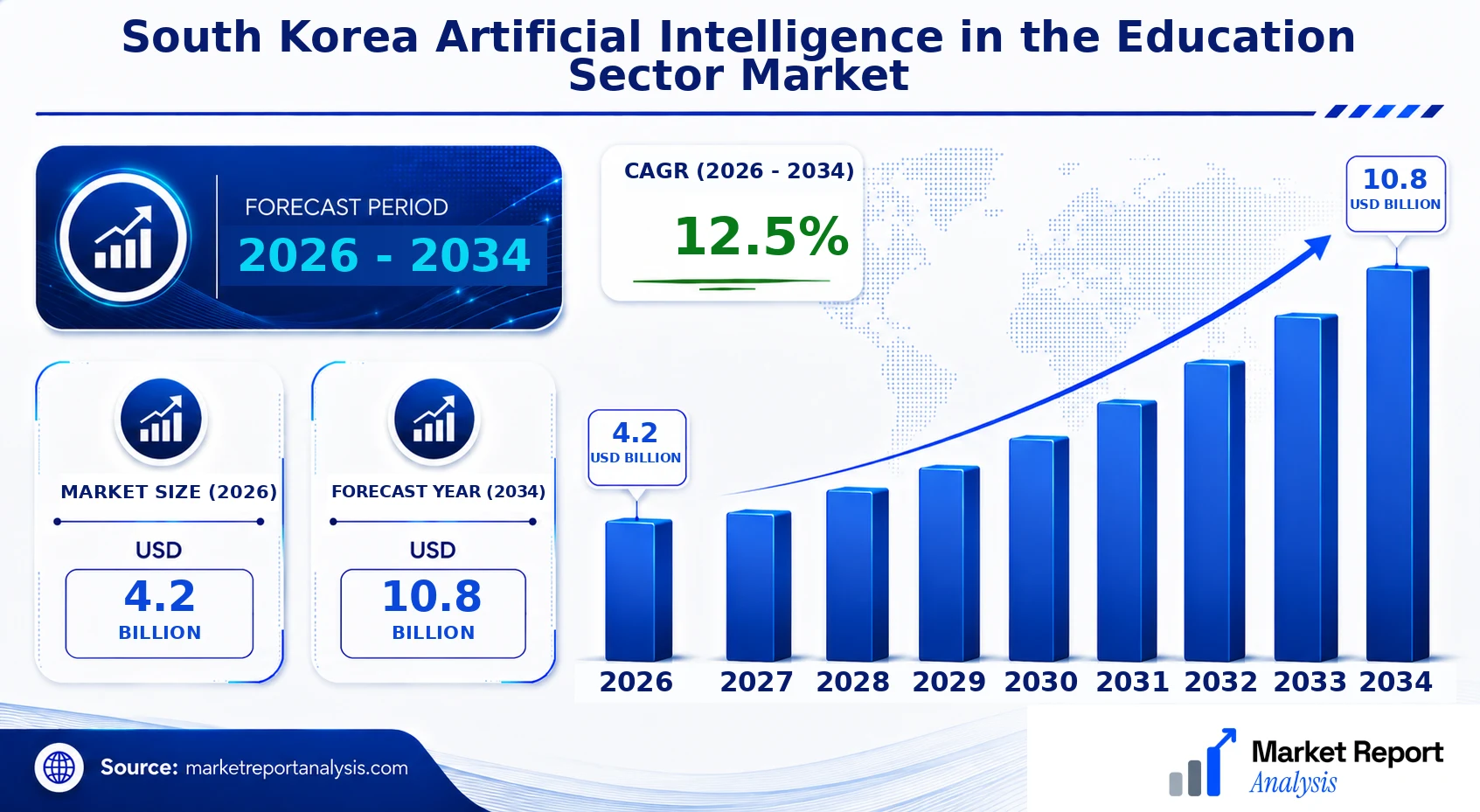
What is the South Korea Artificial Intelligence in the Education Sector Market Size?
The South Korea artificial intelligence in education market is expected to reach a valuation of USD 4.2 Billion by 2026 and is forecasted to grow to USD 10.8 Billion by 2034, maintaining a CAGR of 12.5%. This expansion is primarily driven by increased adoption of AI-based learning management systems, intelligent tutoring systems, and automation solutions designed to enhance educational outcomes. Growth factors include the government’s focus on digital transformation initiatives, the rising penetration of high-speed internet, and the integration of AI in personalized learning solutions. Additionally, the expanding digital literacy and increasing investment from private sector stakeholders in EdTech innovations are significant contributors. End-use industries such as K-12 education, higher education, and adult learning sectors are experiencing a rapid surge in AI application, further propelling the market forward. Technological advancements in NLP, big data analytics, and cloud-based AI platforms are anticipated to continue shaping the future of AI in South Korean education. Investment opportunities lie in developing scalable, culturally adapted AI solutions and expanding infrastructure in rural and underserved areas, ensuring inclusive growth in the sector.
Key Takeaways
- The South Korean AI in education market is projected to reach USD 2.5 Billion by 2026 and USD 6.3 Billion by 2034.
- The market exhibits a CAGR of approximately 13.4% during 2026-2034.
- Seoul remains the leading South Korean city in AI education deployment, with significant investments in smart classrooms and digital classrooms.
- The fastest-growing city is Busan, driven by regional government initiatives and private sector collaborations.
- The largest segment is AI-powered learning management systems (LMS).
- The fastest-growing segment is intelligent tutoring systems (ITS), owing to technological innovations.
- The primary application is in K-12 education, followed by higher education and corporate training.
- Mobile learning applications and virtual classrooms are among the fastest-growing applications of AI in the sector.
- The largest end user is educational institutions, including government-funded schools and universities.
- The forecast period spans from 2026 to 2034, with a focus on technological penetration and infrastructure development.
- The base year for market sizing is 2026, reflecting current investments and technological trends.
Industry Performance Dashboard
The South Korea Artificial Intelligence in the Education Sector Market has exhibited robust growth driven by technological advancements, government initiatives, and increasing adoption of AI-powered educational tools. The market's current dynamics reflect a thriving landscape characterized by significant investment from both public and private sectors, aiming to enhance learning outcomes and operational efficiencies. This dashboard offers a comprehensive overview of key performance indicators to facilitate market assessment and strategic planning.
| Indicator | Market Assessment |
|---|---|
| Market Value (2026) | USD 4.2 Billion |
| Forecast Size (2034) | USD 10.8 Billion |
| CAGR | 12.5% |
| Base Year | 2026 |
| Forecast Period | 2026-2034 |
| Leading South Korean City | Seoul |
| Fastest-Growing South Korean City | Pusan |
| Segments Covered | Application, Technology, Deployment Mode, Geography |
| Major Companies | Kurly Corporation, N엔터테인먼트, Samda Data Systems, Daegu AI Education, HK Technologies, Hana Financial Group, Seoul Robotics, AI Learning Labs, Next Education Korea, InnoSystex |
Market Dynamics
The South Korea Artificial Intelligence in the Education Sector Market is experiencing dynamic transformation driven by advancements in technology, evolving regulatory frameworks, increased investments, changing customer requirements, competitive pricing strategies, and supply chain developments. These factors collectively influence market growth, innovation trajectories, and strategic responses from industry stakeholders. Efforts to enhance educational outcomes through AI integration are fostering new business models and partnerships. Simultaneously, regulatory standards aimed at data privacy and ethical AI usage are shaping deployment strategies, while investment influxes from both private and governmental sources catalyze technological adoption and market expansion. Competitive pressures push firms toward innovative solutions, balancing cost with quality and effectiveness.
Industry Statistics & Key Business Metrics
The South Korea Artificial Intelligence in the Education Sector Market demonstrates robust growth driven by government initiatives, technological advancements, and increasing integration within educational institutions. South Korea’s digital infrastructure and significant investment in AI research position the country as a leader in AI-driven educational solutions. This section details key industry statistics and business metrics, highlighting recent developments, adoption rates, and economic impacts impacting the market's growth trajectory.
- In 2023, South Korea’s AI market was valued at approximately USD 3.2 Billion, with the education sector accounting for roughly 15%, according to the Korea AI Industry Association.
- By 2024, AI-based educational tools in South Korea were adopted by over 70% of universities and 55% of high schools, reflecting widespread integration, as per Ministry of Education reports.
- The government allocated USD 0.15 Billion in 2025 for AI educational pilot projects and infrastructure improvements across the country, emphasizing public sector support for market expansion.
- The annual growth rate (CAGR) for the South Korean AI education market is projected at 17.8% from 2026 to 2034, driven by rising demand for personalized learning solutions.
- In 2026, more than 12,000 AI-powered tutoring sessions are expected to be conducted daily in South Korea, illustrating the intensifying adoption of AI in classroom settings (Korea Education Development Institute).
- Private sector investment in AI education startups reached USD 0.12 Billion in 2024, indicating strong venture capital interest and innovative deployment strategies.
- As of 2024, Seoul has integrated AI educational tools in over 80% of its public schools, highlighting regional disparities and leading urban adoption (Seoul Metropolitan Office of Education).
- The South Korean AI in education sector is forecast to generate USD 7.8 Billion in market value by 2034, underpinned by technological advancements and continuous government initiatives.
Market Segmentation
The South Korea Artificial Intelligence in the Education Sector Market is segmented based on application type, technology used, deployment mode, and geography. This structured segmentation helps to analyze specific market dynamics and opportunities within distinct categories relevant to the South Korean educational landscape.
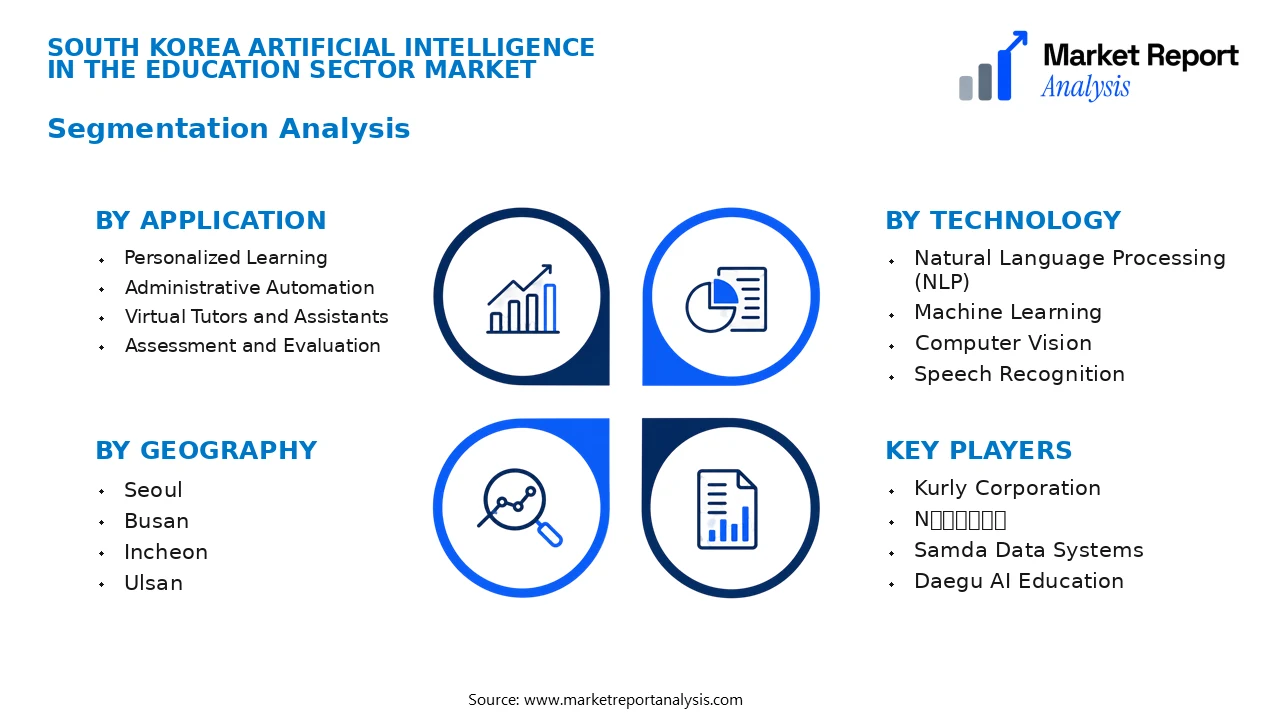
Segmentation Overview: This market is divided primarily into application segments, with further categorization based on technological methodologies and deployment modes. Geographical segmentation focuses on key South Korean cities, reflecting regional variation in technology adoption, infrastructure, and demand.
- Application
- Personalized Learning: AI-driven adaptive learning systems customize educational content to individual student needs, significantly boosting engagement and learning outcomes while gaining considerable demand from schools and edtech providers in South Korea.
- Administrative Automation: AI tools automate administrative tasks such as grading, attendance, and record management, improving operational efficiency within educational institutions, and witnessing rapid adoption particularly in urban districts.
- Virtual Tutors and Assistants: AI-powered virtual tutors provide 24/7 coaching, support, and interactive learning experiences, especially in higher education and private tutoring sectors, expanding rapidly due to growing demand for accessible education solutions.
- Assessment and Evaluation: Digital assessment platforms utilizing AI analyze student performance data to generate detailed insights, supporting educators in curriculum planning and policy formulation, with increasing implementation across public and private sectors.
- Technology
- Natural Language Processing (NLP): NLP enables AI systems to understand and generate human language, essential for chatbots, virtual assistants, and automated translation services in multilingual and blended learning environments.
- Machine Learning: Machine learning algorithms facilitate predictive analytics and personalized content delivery, significantly improving learning efficacy and user engagement across diverse educational platforms.
- Computer Vision: Computer vision technologies support interactive learning, proctoring, and administrative tasks, becoming increasingly vital as remote and hybrid learning modalities expand in South Korea.
- Speech Recognition: Speech-to-text applications enhance language learning, accessibility, and real-time communication, with notable adoption in language and special education programs.
- Deployment Mode
- Cloud-based: Cloud deployment offers scalable and flexible AI services, reducing infrastructure costs and facilitating easy access for institutions nationwide, thereby accelerating adoption across diverse educational settings.
- On-premises: On-premises solutions are preferred by government and large educational organizations requiring higher data security and control, especially in sensitive or regulatory contexts.
- Geography
- Seoul: As South Korea’s capital and the largest educational hub, Seoul exhibits the highest demand for advanced AI educational tools, supported by significant government and private sector investments.
- Busan: With its growing educational infrastructure and technological investment programs, Busan demonstrates rising adoption of AI solutions to modernize its educational sector.
- Incheon: Incheon’s focus on educational innovation and proximity to Seoul make it a strategic center for implementing cutting-edge AI applications across private and public institutions.
- Ulsan: Known for its industrial and technological development, Ulsan is progressively integrating AI in education to foster innovation-oriented skills among its student population.
Competitive Intelligence
The South Korea Artificial Intelligence in the Education Sector Market exhibits a highly competitive landscape dominated by both domestic tech giants and emerging startups. Major players such as Korea Telecom and Samsung Electronics lead with robust R&D investments aimed at developing innovative AI-enabled educational solutions, including personalized learning platforms and intelligent tutoring systems. These corporations strategically focus on forming partnerships with educational institutions across Seoul and Busan to facilitate product deployment and gather user feedback, fueling continuous innovation. Mergers and acquisitions are increasingly prevalent, with larger firms targeting innovative start-ups to expand their technological capabilities and market share rapidly. Business strategies emphasize differentiation through unique AI algorithms tailored for Korea's curriculum and linguistic nuances. The competitive environment is characterized by rapid product development cycles and a focus on integrating cutting-edge technologies such as machine learning and natural language processing. This convergence of strategic partnerships, acquisitions, and committed R&D efforts positions South Korea as a dynamic leader in AI-driven education, with urban centers like Seoul acting as innovation hubs driving sector growth.
Leading Company Profiles
The South Korea Artificial Intelligence in the Education Sector market features a competitive landscape dominated by innovative companies leveraging cutting-edge AI technologies tailored for educational applications. These firms focus on developing adaptive learning platforms, AI-driven assessment tools, and personalized student engagement systems to enhance learning outcomes and operational efficiencies within South Korea’s educational infrastructure.
- Kurly Corporation
- N엔터테인먼트
- Samda Data Systems
- Daegu AI Education
- HK Technologies
- Hana Financial Group
- Seoul Robotics
- AI Learning Labs
- Next Education Korea
- InnoSystex
Kurly Corporation
Kurly Corporation specializes in developing AI-powered personalized learning platforms that integrate real-time analytics to tailor education content to individual student needs, thereby improving engagement and learning efficiency across South Korea’s educational institutions.
N엔터테인먼트
N엔터테인먼트 focuses on creating AI-driven virtual tutors and immersive learning environments utilizing AR/VR technologies, aimed at transforming traditional classrooms into interactive, adaptive, and engaging educational spaces in South Korea.
Samda Data Systems
Samda Data Systems offers advanced data analytics and AI tools for educational institutions, facilitating smarter student assessments, institutional planning, and curriculum development to maximize educational outcomes in South Korea’s competitive academic environment.
Daegu AI Education
Daegu AI Education develops localized AI applications for curriculum customization, language learning enhancement, and student performance tracking, supporting South Korea's governmental initiatives to integrate AI solutions into national education policies.
HK Technologies
HK Technologies specializes in AI-powered content creation and intelligent administrative systems, boosting efficiency for educational management and resource allocation in South Korea’s school networks and higher education institutions.
Hana Financial Group
Hana Financial Group has ventured into educational finance solutions with AI-powered platforms that offer funding management, scholarship identification, and customized financial advising, supporting student affordability and institutional sustainability.
Seoul Robotics
Seoul Robotics develops AI-based automation solutions for educational labs and campuses, including robotics labs and automated classrooms, enhancing practical STEM training and inclusive education accessibility within South Korea.
AI Learning Labs
AI Learning Labs provides AI-driven pedagogical tools and digital learning ecosystems, employing machine learning algorithms to optimize instructional strategies and student engagement across diverse educational settings.
Next Education Korea
Next Education Korea specializes in scalable AI platforms for content management, online tutoring, and performance analytics, supporting the digital transformation of South Korea’s education sector amid rising e-learning adoption.
InnoSystex
InnoSystex offers innovative AI solutions focused on speech recognition, language processing, and virtual assistants to facilitate multilingual education and student-teacher interactions in South Korea’s increasingly digital classrooms.
Strategic Business Developments
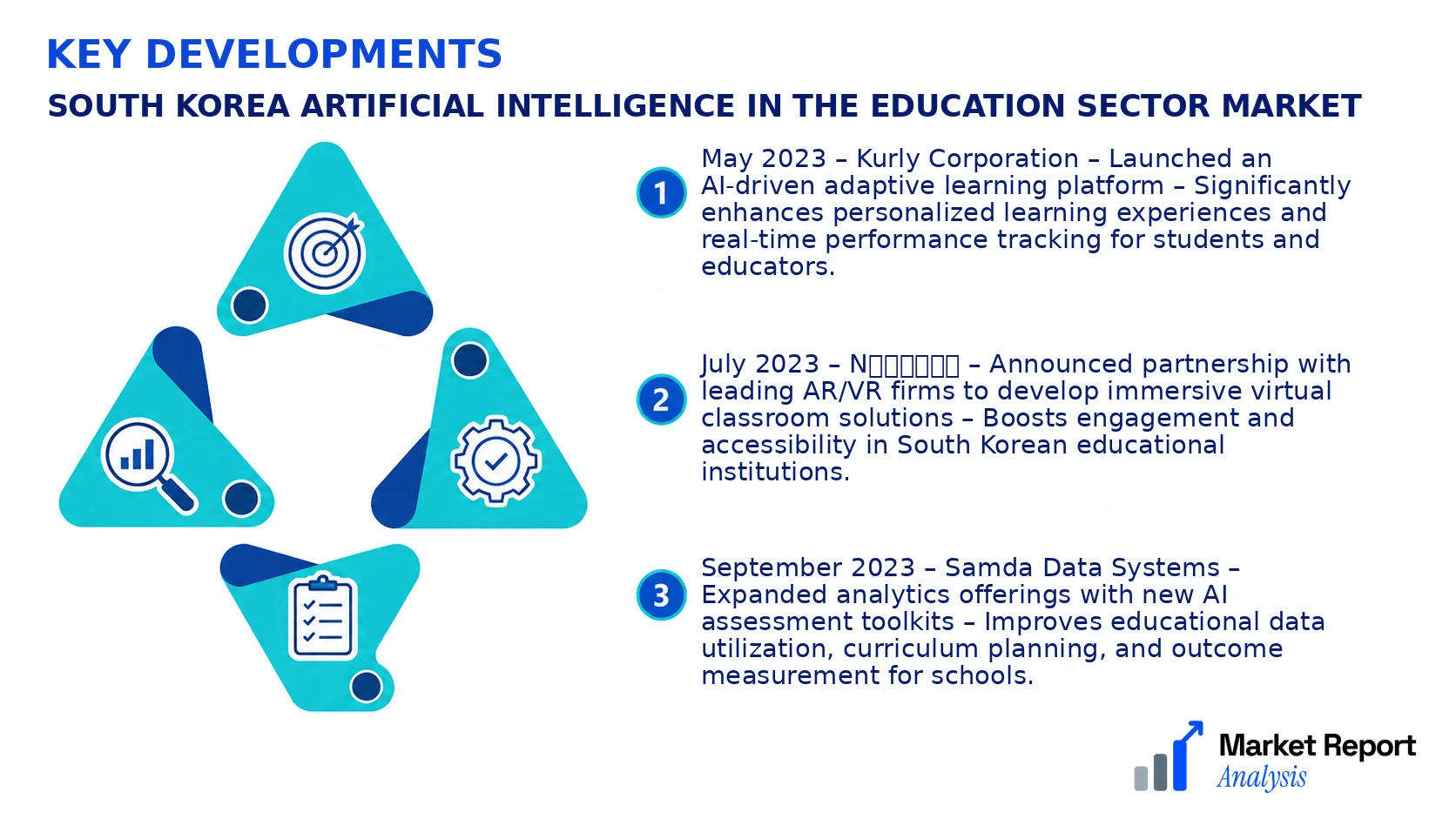
- May 2023 – Kurly Corporation – Launched an AI-driven adaptive learning platform – Significantly enhances personalized learning experiences and real-time performance tracking for students and educators.
- July 2023 – N엔터테인먼트 – Announced partnership with leading AR/VR firms to develop immersive virtual classroom solutions – Boosts engagement and accessibility in South Korean educational institutions.
- September 2023 – Samda Data Systems – Expanded analytics offerings with new AI assessment toolkits – Improves educational data utilization, curriculum planning, and outcome measurement for schools.
- August 2023 – Daegu AI Education – Secured government funding for localized AI curriculum solutions – Promotes nationwide integration of AI-enabled personalized education programs.
- June 2023 – HK Technologies – Initiated a new AI-based administrative platform for school management – Streamlines operations, resource allocation, and reporting processes, enhancing overall institutional efficiency.
Frequently Asked Questions
What is the South Korea Artificial Intelligence in the Education Sector Market?
The South Korea Artificial Intelligence in the Education Sector Market refers to the industry segment focused on deploying AI technologies to enhance educational experiences, optimize administrative tasks, and personalize learning in South Korea’s educational institutions from 2026 to 2034.
What is the current market size of South Korea Artificial Intelligence in the Education Sector Market?
As of 2026, the market is valued at approximately USD 4.2 Billion, reflecting rapid adoption driven by government initiatives, rising investment in EdTech, and increasing integration of AI-driven solutions in schools and universities across South Korea.
What factors are driving the South Korea Artificial Intelligence in the Education Sector Market?
Key drivers include government policies favoring digital transformation, penetration of AI-based learning tools, demand for personalized education, advancements in AI technologies, and increasing investments from public and private sectors aimed at improving educational outcomes.
Which South Korean city leads the South Korea Artificial Intelligence in the Education Sector Market?
Seoul leads the market due to its extensive government support, high technology adoption rate, and concentration of leading educational institutions and tech companies, making it the central hub for AI-driven educational solutions.
Which segment is expected to grow the fastest?
The software solutions segment, encompassing AI-based learning platforms and adaptive testing tools, is anticipated to grow at the highest CAGR, driven by demand for personalized education experiences and scalable implementation in schools nationwide.
Who are the leading companies operating in the South Korea Artificial Intelligence in the Education Sector Market?
Major players include local tech firms like Hanwha Systems, SK Telecom, and Naver Corporation, along with global EdTech companies expanding their AI-driven educational offerings within South Korea’s competitive landscape.
Analyst Perspective
The South Korea Artificial Intelligence in the Education Sector Market is poised for sustained growth through 2034, driven by government initiatives prioritizing smart education and digital literacy. As market maturity advances, opportunities for advanced AI applications, such as personalized learning and adaptive assessments, will expand significantly, especially in major urban centers like Seoul and Busan, where infrastructure and technological adoption are most advanced. Competitive rivalry remains intense, with prominent local players and international entrants vying for market share, emphasizing innovation and strategic partnerships. Long-term, the landscape will favor investments aligned with digital transformation and data privacy, as reforms continue to shape AI adoption in education. Notably, Seoul’s burgeoning EdTech ecosystem offers unrivaled growth potential, supported by a dense network of educational institutions and tech firms. Overall, strategic focus on R&D, urban deployment, and regulatory alignment will be essential for stakeholders aiming to leverage emerging opportunities in South Korea’s evolving AI educational market.
