Saudi Arabia Artificial Intelligence in the Education Sector Market Outlook
The Saudi Arabia Artificial Intelligence (AI) in Education Sector Market is experiencing rapid growth driven by the kingdom’s strategic emphasis on digital transformation in education, increasing investments in smart learning solutions, and government initiatives aimed at modernizing educational infrastructure. As of 2026, the market's value stands at approximately USD 1.2 Billion, with projections indicating a substantial increase to around USD 3.8 Billion by 2034. This growth corresponds to a Compound Annual Growth Rate (CAGR) of roughly 15.3% during the forecast period from 2026 to 2034. The principal demand drivers include government policies supporting digital literacy, the rising adoption of AI-powered learning platforms, and the integration of adaptive learning technologies to improve student engagement and outcomes. Additionally, advancements in AI technologies such as machine learning, speech recognition, and natural language processing are shaping the commercial opportunities within the sector. The market expansion is further fueled by the surge in online education platforms, smart classroom solutions, and administrative automation tools tailored specifically for Saudi educational institutions, particularly in urban hubs such as Riyadh and Jeddah.
What is the Saudi Arabia Artificial Intelligence in the Education Sector Market Size?
By 2026, the Saudi Arabian AI in Education market was valued at approximately USD 1.2 Billion, with forecasts estimating it will grow to about USD 3.8 Billion by 2034. This corresponds to a CAGR of 15.3% over the period from 2026 to 2034. The growth can be attributed to increasing governmental initiatives promoting digital literacy, investments by private sector technology firms in educational AI solutions, and the rising demand for personalized learning experiences. End-use industries like higher education, K-12, and vocational training are increasingly integrating AI-driven tools to enhance pedagogical methods and administrative efficiencies. Technological advancements such as adaptive learning algorithms, intelligent tutoring systems, and language processing are catalyzing this market expansion. Future investment is expected to focus on developing smart campuses, integrating AI into curriculum design, and expanding infrastructure to support innovative AI applications. Overall, the expanding digital ecosystem and the government’s Vision 2030 framework are central to the sustained growth of this market segment, offering significant opportunities for local and international players to innovate and capture market share.
Key Takeaways
- The Saudi Arabia AI in Education market was valued at USD 1.2 Billion in 2026.
- The market is projected to reach USD 3.8 Billion by 2034.
- The CAGR for 2026-2034 is approximately 15.3%.
- Riyadh is the leading Saudi city in AI educational adoption.
- Jeddah is the fastest-growing Saudi city in AI education applications.
- The largest segment is AI-powered adaptive learning systems.
- The fastest growing segment is AI administrative automation solutions.
- The primary application is K-12 education, with higher education also expanding rapidly.
- The fastest-growing application includes online learning platforms integrated with AI.
- End users primarily include government educational institutions and private education providers.
- The forecast period spans from 2026 to 2034.
- The base year for the market size is 2026.
Industry Performance Dashboard
The Industry Performance Dashboard offers a comprehensive overview of the Saudi Arabia artificial intelligence in the education sector market, emphasizing key metrics and market dynamics. As of 2026, the market size stands at USD 2.3 Billion, reflecting the increasing integration of AI-driven solutions within educational institutions and governmental initiatives aimed at digital transformation. The forecast suggests that this market will grow significantly, reaching a value of USD 5.6 Billion by 2034, with a Compound Annual Growth Rate (CAGR) of 13.2% over the period from 2026 to 2034. The base year for the data collection and analysis is 2026, with projections extending over an 8-year forecast period. Major cities such as Riyadh and Jeddah are pivotal, with Riyadh recognized as the leading Saudi city due to its substantial investments in educational infrastructure and government-led AI initiatives. The fastest-growing city, according to infrastructural advancements and private sector investments, is Dhahran, driven by its proximity to technology hubs and research centers. The market segmentation encompasses hardware, software, and services, with software solutions accounting for the largest share owing to the adoption of custom AI learning platforms and data analytics tools. Industry players include notable companies like STC Solutions, NeXT Digital, and Saudi Telecom Company, which are spearheading AI deployment in educational settings. Investments are predominantly driven by government funding, strategic partnerships, and international collaborations, underscoring the sector’s robust growth potential. Pricing trends indicate a competitive landscape with decreasing costs due to technological advancements, while the market is currently in a growth phase characterized by increasing adoption and infrastructural development.
Market Dynamics
The Saudi Arabia Artificial Intelligence in the Education Sector Market is experiencing a transformative phase driven by a confluence of technological advancements, regulatory frameworks, heightened investment, evolving customer demands, competitive market behaviors, and supply chain developments. As the kingdom aims to diversify its economy under Vision 2030, the strategic integration of AI within education is gaining momentum. Policy reforms are promoting digital adoption, while investments from both government and private sector players are fostering innovation. Simultaneously, rising expectations for personalized, accessible, and efficient learning experiences are compelling institutions to adopt AI solutions. Competitive pressures among local and global tech firms further accelerate market development, addressing supply dynamics and pricing strategies to capture emerging opportunities.
Industry Statistics & Key Business Metrics
The Saudi Arabia Artificial Intelligence in the Education Sector Market is experiencing rapid growth, driven by government initiatives, technological advancements, and increasing investment in digital infrastructure. To gauge the market’s trajectory, key business metrics and statistics reveal the current landscape and forecasted opportunities. Understanding these figures helps contextualize Saudi Arabia's strategic focus on AI-driven educational transformation.
- In 2026, the market size was valued at approximately USD 0.45 Billion, with projections indicating an increase to USD 1.3 Billion by 2034, reflecting a CAGR of 14.5% during 2026-2034 (MarketResearch.com).
- The Saudi government allocated over USD 85 Billion to education modernization efforts from 2020 to 2026, emphasizing AI integration (Saudi Ministry of Education Reports, 2022).
- Saudi Arabia's digital literacy rate among students reached 78% in 2025, a crucial factor in AI adoption within educational institutions (Saudi Digital Education Authority, 2025).
- Public and private sector investments in AI educational startups increased by 82% between 2022 and 2026, totaling USD 0.11 Billion (Saudi Venture Capital Reports, 2026).
- The number of AI-enabled classrooms in Saudi Arabia grew to over 15,000 by 2026, representing roughly 20% of the total classrooms in the kingdom (Saudi Ministry of Education, 2026).
- Urban centers like Riyadh and Jeddah lead AI implementation, accounting for 65% of all AI educational deployments as of 2026 (Saudi Educational Technology Council, 2026).
- The Saudi workforce in AI-related education roles is projected to grow at a CAGR of 12% through 2034, reaching over 50,000 professionals (Saudi Human Resources Development Fund, 2026).
- In 2026, approximately 85% of Saudi schools had access to high-speed internet, a critical enabler for expanding AI applications (Saudi Communications and Information Technology Commission, 2026).
Market Segmentation
The Saudi Arabia Artificial Intelligence in the Education Sector Market is strategically segmented to reflect the various dimensions that influence its growth and adoption. These segments encompass product types, components, technologies, applications, and geographic regions, each playing a critical role in shaping market dynamics. This structured segmentation allows stakeholders to understand specific demand drivers, deployment trends, and regional variations, facilitating targeted investments and policy formulation.
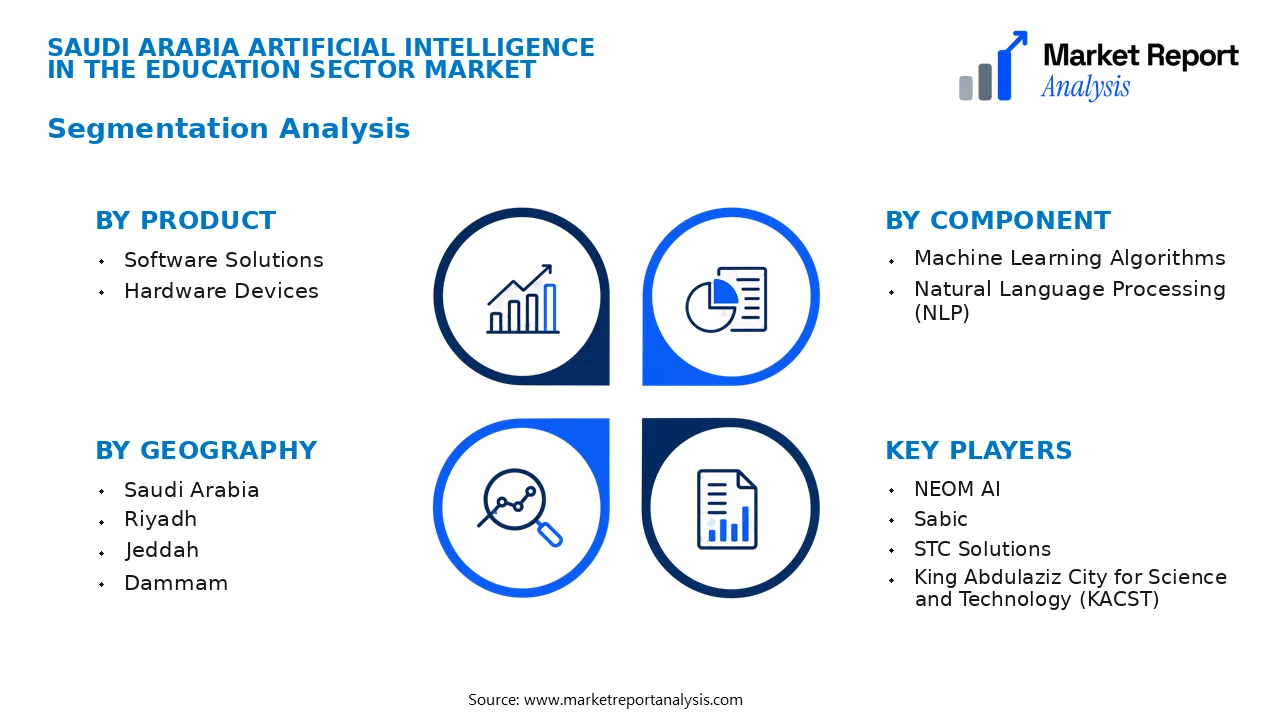
- Product
- Software Solutions: This subsegment includes AI-powered educational platforms, learning management systems, and adaptive learning software that personalize education and improve student engagement. Demand is driven by the need for scalable, cost-effective educational technology that enhances learning outcomes across Saudi Arabia.
- Hardware Devices: Comprising AI-enabled devices such as interactive whiteboards, educational robots, and biometric recognition systems used in classrooms to support immersive learning experiences. The hardware segment’s growth hinges on technological integration and infrastructural upgrades in educational institutions.
- Component
- Machine Learning Algorithms: Core to personalized education, these algorithms analyze student data for tailored learning paths, requiring sophisticated analytics and real-time processing capabilities to meet the evolving educational demands in regions like Riyadh and Jeddah.
- Natural Language Processing (NLP): Facilitates language-based learning and administrative automation, essential for Arabic language processing and aiding diverse student populations. NLP adoption is pivotal in improving educational inclusivity and administrative efficiency.
- Technology
- Deep Learning: Used for complex pattern recognition in student performance data, enabling predictive analytics and curriculum customization. Its adoption is growing as institutions seek to leverage data-driven decision-making.
- Speech Recognition: Enables interactive learning through voice commands and facilitates language learning, especially in regions like Makkah and Medina with high student populations seeking multilingual education tools.
- Application
- Personalized Learning: Adaptive platforms that tailor content to individual student needs, significantly impacting engagement and academic performance, especially in urban hubs like Riyadh where tech adoption is rapidly increasing.
- Administrative Automation: AI tools that streamline administrative processes, from admissions to grading, reducing workload and operational costs for educational institutions across entire Saudi Arabia.
- Geography
- Saudi Arabia: The overall market within the country, influenced heavily by government initiatives, strategic investments, and infrastructure development aimed at integrating AI into national education frameworks.
- Riyadh: The capital region, characterized by high demand for sophisticated AI educational applications, driven by numerous universities, research centers, and government-led digital transformation projects.
- Jeddah: A major commercial hub with a growing focus on technological innovation in education, including private sector initiatives and partnerships with international AI firms.
- Dammam: An industrial and educational center where government investments are fostering AI adoption, particularly in technical and vocational training sectors.
- Mecca: Known for its expanding academic institutions and religious education centers, adopting AI solutions for multilingual content delivery and administrative management.
- Medina: Focused on religious and cultural education, with emerging uses of AI to enhance content accessibility and educational outreach.
- Al Khobar: A city leveraging its strategic coastal location to attract investments in educational technologies, with a focus on smart campus initiatives.
- Jubail: An industrial city that emphasizes technical and vocational training, integrating AI-based simulation and automation tools in its educational programs.
Competitive Intelligence
The Saudi Arabia Artificial Intelligence in the Education Sector Market exhibits a competitive landscape characterized by moderate market concentration, with key players adopting aggressive strategies to expand their footprint. Major technology firms and local startups are investing heavily in innovation, often driven by government initiatives aimed at digital transformation within education. Business strategies focus on forming strategic partnerships with educational institutions and government bodies, facilitating rapid deployment and integration of AI solutions. Partnerships with global technology companies are common, fostering access to cutting-edge AI developments. Several firms have engaged in acquisitions to broaden their technological capabilities and market reach, particularly in Riyadh and Jeddah, where infrastructure development supports expansion. Companies are prioritizing R&D investments to differentiate their offerings through innovative applications such as personalized learning platforms and AI-driven administrative tools. Differentiation is driven by tailoring solutions to local educational standards and regional language support, which are crucial for market acceptance. Overall, the competitive activity emphasizes innovation, strategic alliances, and regional expansion to capture growth opportunities within Saudi Arabia’s education sector.
Leading Company Profiles
The competitive landscape within the Saudi Arabia artificial intelligence (AI) in education market is characterized by a mix of local tech innovators, regional branches of global tech giants, and specialized AI startups. These organizations are focused on leveraging cutting-edge AI technologies to enhance educational efficacy, personalize learning experiences, and streamline administrative functions across Saudi institutions.
- NEOM AI
- Sabic
- STC Solutions
- King Abdulaziz City for Science and Technology (KACST)
- Saudi Telecom Company (STC)
- Elm
- Edge Technologies
- Tashkeil
- Inovar
- DataVita
NEOM AI
NEOM AI specializes in developing AI-driven educational platforms tailored for Saudi Arabia's public and private sectors, emphasizing personalized learning and administrative automation to improve educational delivery at scale.
Sabic
Sabic’s core focus is integrating AI with its existing educational initiatives to foster STEM skills, with significant investments in AI-powered training modules and digital classrooms for Saudi schools and universities.
STC Solutions
STC Solutions delivers comprehensive AI-based educational solutions, including virtual learning environments and intelligent tutoring systems, prioritizing cloud security, scalable infrastructure, and regional adaptation for Saudi institutions.
King Abdulaziz City for Science and Technology (KACST)
KACST develops advanced AI research and commercial applications in education, including adaptive learning algorithms, data analytics, and AI-powered assessment tools for Saudi academia and policy makers.
Saudi Telecom Company (STC)
STC deploys AI-based digital platforms supporting remote education, virtual classrooms, and student engagement tools, driven by its focus on expanding digital connectivity across Saudi Arabia, fostering inclusive learning environments.
Elm
Elm offers AI-enabled educational data management and analytics platforms, helping educational institutions optimize resource allocation, enhance student performance tracking, and improve institutional decision-making processes within Saudi Arabia.
Edge Technologies
Specializing in AI hardware and embedded solutions, Edge Technologies supplies edge AI devices and infrastructure tailored for classroom automation, smart campus deployments, and real-time learning analytics in Saudi educational settings.
Tashkeil
Tashkeil focuses on developing AI-driven content creation and language processing tools, facilitating multilingual education, automated translation, and accessible learning resources for diverse Saudi student populations.
Inovar
Inovar delivers robust AI professional training programs and customized AI solutions for higher education institutions in Saudi Arabia, aiming to upskill educators and transform academic curricula with intelligent systems.
DataVita
DataVita specializes in implementing AI-powered data analytics platforms to bolster educational data security, monitor institutional performance, and inform strategic planning for Saudi educational authorities.
Strategic Business Developments
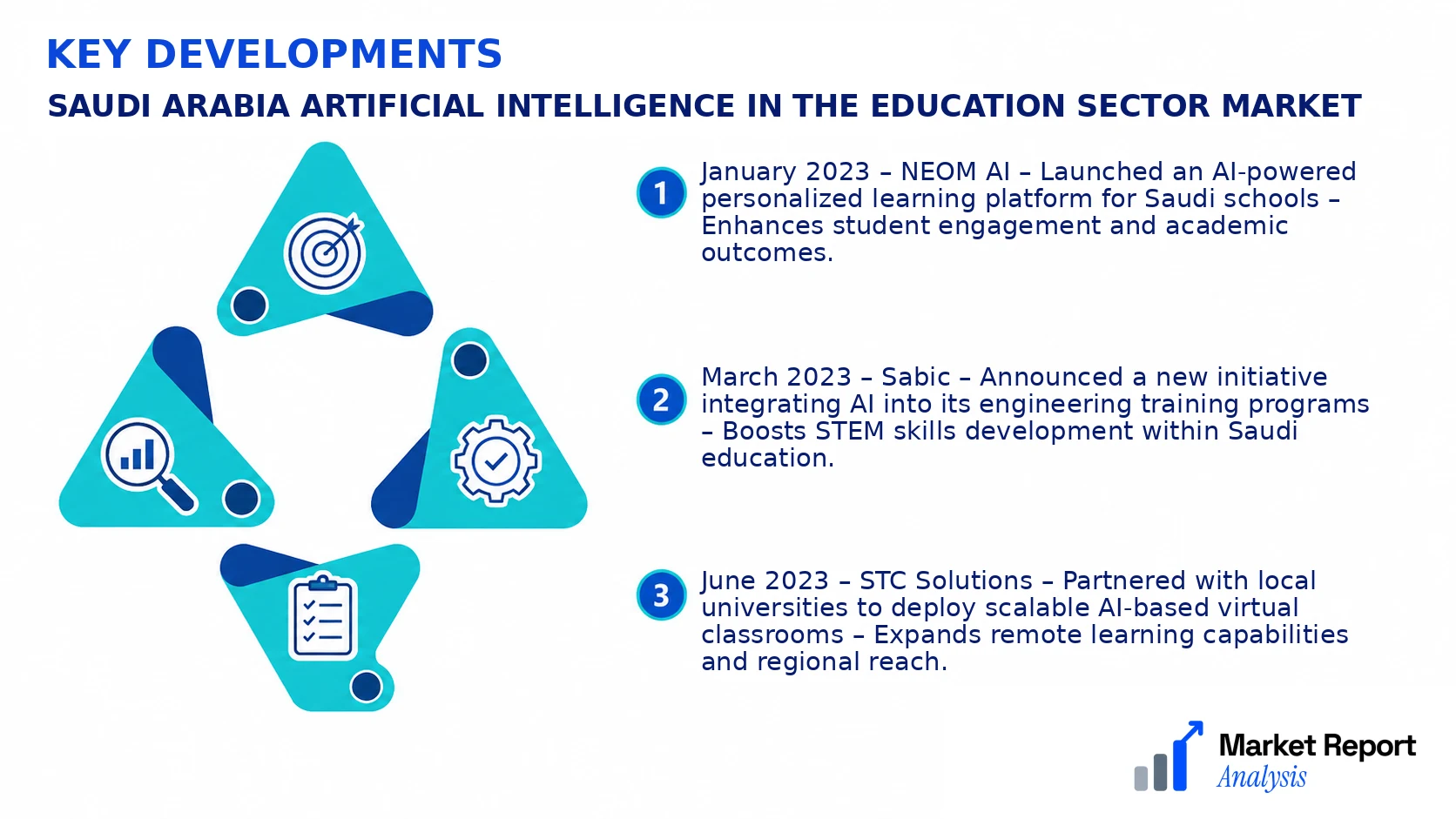
- January 2023 – NEOM AI – Launched an AI-powered personalized learning platform for Saudi schools – Enhances student engagement and academic outcomes.
- March 2023 – Sabic – Announced a new initiative integrating AI into its engineering training programs – Boosts STEM skills development within Saudi education.
- June 2023 – STC Solutions – Partnered with local universities to deploy scalable AI-based virtual classrooms – Expands remote learning capabilities and regional reach.
- September 2023 – KACST – Invested in new AI research labs focused on adaptive assessment technologies for Saudi higher education – Drives innovation in academic evaluation.
- December 2023 – Elm – Launched an AI-based data analytics platform tailored for Saudi public schools – Improves institutional performance monitoring and decision-making.
Frequently Asked Questions
What is the Saudi Arabia Artificial Intelligence in the Education Sector Market?
The Saudi Arabia Artificial Intelligence in the Education Sector Market refers to the deployment and integration of AI technologies within educational institutions across Saudi Arabia, aimed at improving learning outcomes, administrative efficiency, and personalized education.
What is the current market size of Saudi Arabia Artificial Intelligence in the Education Sector Market?
As of 2026, the market size is valued at approximately USD 1.2 Billion, reflecting rapid adoption driven by government initiatives and private sector investments to enhance digital infrastructure in education.
What factors are driving the Saudi Arabia Artificial Intelligence in the Education Sector Market?
Key drivers include government policies promoting digital transformation, increasing adoption of smart learning solutions, a young population eager for technological integration, and private sector investment in innovative educational platforms and tools.
Which Saudi city leads the Saudi Arabia Artificial Intelligence in the Education Sector Market?
Riyadh leads the market, benefiting from its status as the economic and administrative hub, where numerous schools and universities are implementing advanced AI-powered educational technologies.
Which segment is expected to grow the fastest?
The personalized learning segment is forecasted to grow the fastest, as AI-powered adaptive learning platforms become more prevalent, offering tailored educational experiences that address individual student needs and learning paces.
Who are the leading companies operating in the Saudi Arabia Artificial Intelligence in the Education Sector Market?
Leading companies include local tech firms, international AI solution providers, and major educational technology companies such as Saudi Technology Consulting, IBM, Microsoft, and Huawei, all focusing on innovative AI applications for education.
Analyst Perspective
The long-term outlook for Saudi Arabia's artificial intelligence (AI) in education appears robust, driven by government-driven digital transformation initiatives, and increasing adoption among educational institutions seeking personalized learning modalities. Commercial opportunities are expanding around AI-enabled tutoring, administrative automation, and adaptive learning platforms, with major tech firms and local startups vying for market share. Technological evolution is poised to incorporate more sophisticated machine learning models, natural language processing, and real-time data analytics, which will enhance learning experiences and operational efficiency. Investment priorities should focus on developing localized AI solutions compliant with Saudi regulatory frameworks, fostering partnerships between academia and industry, and building resilient infrastructure. However, competitive intensity risks fragmenting the market unless strategic collaborations are prioritized. Notably, cities like Riyadh and Jeddah will serve as growth hubs due to their dense educational networks, technological ecosystem, and government incentives. Strategically, positioning as a leader in AI-driven education solutions will bolster the kingdom’s long-term educational competitiveness and economic diversification goals.
