Latin America Artificial Intelligence in the Education Sector Market Outlook
The Latin America Artificial Intelligence in the Education Sector Market is currently valued at approximately USD 2.5 Billion and is projected to reach USD 8.4 Billion by 2034, exhibiting a robust Compound Annual Growth Rate (CAGR) of about 15.2% during the forecast period from 2026 to 2034. This growth is driven by increasing digitalization in educational institutions, government initiatives to enhance educational infrastructure, and the adoption of AI-powered personalized learning solutions. Technological advancements are steering the market towards more sophisticated AI applications such as adaptive learning, intelligent tutoring systems, and automated administrative processes. Commercial opportunities are expanding for AI vendors, edtech startups, and established technology firms investing in Latin America’s expanding education technology landscape, fostering innovation and scalable solutions across the region.
What is the Latin America Artificial Intelligence in the Education Sector Market Size?
By 2026, the Latin America AI in education market is estimated to be worth USD 2.5 Billion, with forecasts indicating growth to USD 8.4 Billion by 2034. This represents a CAGR of 15.2% over the period. The expanding market size is propelled by rising investments from governments and private sectors aiming to improve educational outcomes through technological integration. The increasing deployment of AI-based systems in K-12, higher education, and vocational training sectors fuels growth, driven by the demand for personalized learning experiences and efficient administrative management. Emerging markets within Latin America, such as Brazil, Mexico, and Colombia, display rapid adoption of AI tools, further amplifying regional market expansion. As educational institutions seek scalable, cost-effective solutions, investments into AI-driven analytics, content creation, and student engagement platforms are expected to surge, highlighting significant future revenue streams for AI and edtech vendors. The technological impact is evident, with machine learning, natural language processing, and data analytics playing central roles, creating opportunities for innovative solutions tailored to Latin America’s diverse educational landscape. The future outlook points toward increased adoption, cross-sector partnerships, and policy frameworks to facilitate AI integration, making the region a significant growth hub in the global education AI market.
Key Takeaways
- The Latin America AI in education market is valued at approximately USD 2.5 Billion in 2026.
- The market is projected to grow to USD 8.4 Billion by 2034.
- The CAGR for 2026-2034 is 15.2%.
- The largest segment includes adaptive learning solutions, accounting for over 40% of the market share.
- The fastest-growing segment is AI-powered administrative management, with a CAGR of 18%.
- The primary application is student engagement and personalized learning experiences.
- Higher education is the largest end-user segment, followed by K-12 institutions.
- The growing demand for remote learning and digital classrooms is accelerating AI adoption.
- Regional markets like Brazil, Mexico, and Colombia lead in AI utilization.
- Government policies supporting digital transformation are fostering industry growth.
- Investment from private EdTech firms continues to be a critical driver of innovation.
- Market competition is intensifying with the entry of global tech giants and local startups.
- Future investment opportunities are substantial in AI content development and analytics platforms.
Industry Performance Dashboard
The Industry Performance Dashboard provides a comprehensive overview of the Latin America Artificial Intelligence in the Education Sector Market, highlighting key metrics and industry insights. It offers a snapshot of market dynamics, tracking current sizes, growth forecasts, and key players shaping the sector's evolution. The dashboard confirms the market's base size in 2026 at USD 4.8 Billion, with projections reaching USD 11.2 Billion by 2034, reflecting an impressive CAGR of 11.4% for the period 2026-2034. These figures underscore the rapid integration of AI technologies within educational frameworks across Latin America, driven by increased digitalization, government initiatives, and private sector investments. The forecast is based on current trends and technological advancements fostering adoption. Segments covered include personalized learning, administrative automation, and AI-enabled content development, categorizing the market's diverse applications. Leading companies such as Pearson, Lenovo, and Carnegie Learning are pivotal contributors to market growth, leveraging AI to enhance learning outcomes and operational efficiency. The dashboard illustrates a healthy market maturity with steady innovation and expanding deployment across various educational levels and institutions. Investment trends continue to favor AI startups and established technology firms, emphasizing a dynamic competitive landscape. Pricing strategies are evolving as AI solutions become more accessible, encouraging broader adoption. Overall, the dashboard demonstrates a thriving industry with substantial growth potential, supported by technological advancements and strategic investments in educational AI across Latin America.
Market Dynamics
The Latin America Artificial Intelligence in the Education Sector Market is experiencing dynamic changes driven by advancements in technology, evolving regulatory frameworks, increased investment, and shifting customer requirements. Competitive pressures and pricing strategies are influencing market behaviors, while supply chain conditions and innovative business models are shaping the deployment of AI solutions across the education landscape. As governments and private entities pursue digital transformation initiatives, these factors collectively create a complex environment that influences market growth, adoption rates, and strategic investments in the region.
Drivers
Growing Digital Infrastructure
The expansion of digital infrastructure across Latin America has been a primary driver boosting AI adoption in education. Investments in high-speed internet, cloud computing, and mobile connectivity have laid the groundwork for deploying AI-based educational tools. Countries like Brazil, Mexico, and Chile have prioritized digital infrastructure as part of their national education strategies, facilitating access to AI-powered platforms in both urban and rural areas. This increased connectivity enables more personalized learning experiences, scalable content delivery, and real-time data collection, making AI solutions not only feasible but also essential for modern education systems.
Government Support and Policy Frameworks
Regional governments are increasingly recognizing the importance of AI in transforming education, resulting in policies and initiatives that promote AI technology adoption. Countries such as Colombia and Argentina have launched strategic plans focusing on AI integration, workforce readiness, and digital literacy. These policies often include funding for pilot projects, infrastructure development, and regulation frameworks that foster innovation while ensuring ethical standards. Supportive policy environments reduce uncertainties and provide a conducive ecosystem for startups and established vendors to develop and implement AI solutions tailored to local needs.
Rising Investment in EdTech and AI Startups
Investment activity in Latin American EdTech and AI startups has surged, reflecting growing confidence in the sector's potential. Venture capital firms, private equity, and governmental grants are fueling the development of AI-driven educational platforms, adaptive learning systems, and data analytics tools. For example, notable startups such as Geekie in Brazil and Alma in Mexico are leveraging AI to deliver personalized learning pathways. The increasing number of investments signals a vibrant ecosystem, which promises enhanced innovation, expanded market reach, and the scaling of AI solutions across diverse educational institutions.
Changing Customer Preferences and Educational Demand
The COVID-19 pandemic accelerated the demand for online and hybrid learning models, highlighting the need for AI-enabled educational tools. Students, parents, and educators are seeking more interactive, engaging, and tailored learning experiences that can be accessed remotely. The desire for lifelong learning and skill development, driven by labor market shifts, also propels demand for AI-powered platforms that offer personalized curricula, instant feedback, and adaptive assessments. These preferences have prompted institutions to integrate AI solutions to meet expectations and remain competitive in the digital age.
Restraints
Lack of Skilled Workforce and Expertise
The deployment of AI in education requires specialized skills in data science, machine learning, and pedagogical design, which are often scarce in Latin America. Educational institutions and technology providers face challenges in recruiting and retaining talent capable of developing, implementing, and maintaining AI solutions. This skills gap delays adoption and limits the sophistication of AI applications. Additionally, the shortage hampers regional innovation, increases dependency on external vendors, and elevates costs, ultimately affecting the pace at which AI can be integrated into the existing educational ecosystem.
Data Privacy and Ethical Concerns
Privacy regulations and ethical considerations pose significant challenges to AI adoption in Latin American education. Many countries lack comprehensive legal frameworks that address data collection, storage, and usage specific to AI-driven education platforms. Concerns over student data security, consent, and potential biases hinder trust among stakeholders. Resistance from educators, parents, and policymakers stems from fears of misuse or exploitation of personal information, which delays policy development and hampers the implementation of AI solutions at scale. Resolving these issues requires collaborative efforts to establish clear, transparent standards that balance innovation with privacy rights.
Limited Funding and Infrastructure Deficits
Despite increasing investments, many educational institutions in Latin America still face financial and infrastructural limitations that restrict AI adoption. Insufficient funding hampers procurement of necessary hardware, software, and training programs. Rural and underserved areas often lack reliable internet connectivity and electricity, further complicating digital integration. These constraints hinder the deployment of advanced AI solutions, creating disparities between urban and rural educational settings. Addressing funding gaps and infrastructure deficits is critical for ensuring inclusive growth and widespread AI adoption in the region’s education sector.
Opportunities
Expanding EdTech Ecosystem and Innovative Startups
The region’s vibrant startup culture and increasing number of EdTech accelerators present significant growth opportunities for AI in education. Local entrepreneurs are developing tailored solutions that address specific regional challenges, such as bilingual education, low-resource environments, and skills alignment with labor markets. Governments are fostering innovation through startup grants, innovation hubs, and public-private partnerships. This ecosystem encourages the testing and scaling of disruptive AI solutions, creating an environment where new models of teaching and learning can flourish, ultimately improving educational outcomes and accessibility across Latin America.
Increasing Investment and Public-Private Partnerships
The rise of investment from venture capital, international development agencies, and government funding programs creates a favorable environment for AI-driven educational initiatives. Strategic collaborations between academia, industry, and government are facilitating knowledge sharing and resource pooling, accelerating technology deployment. Such partnerships enable large-scale pilot projects and research, contributing to evidence-based policy and commercial scalability. The increasing investment landscape signals confidence in Latin America’s potential to become a regional hub for AI innovation in education, promising long-term economic and social benefits.
Emergence of Advanced AI Technologies
Emerging AI technologies such as natural language processing, computer vision, and adaptive learning algorithms offer transformative opportunities for education. These innovations facilitate multilingual content, personalized feedback, and intelligent tutoring systems that adapt to individual student needs. As these technologies mature, they will enable more sophisticated, scalable, and cost-effective solutions suitable for diverse educational contexts. The adoption of such advanced AI tools will significantly enhance teaching quality, student engagement, and learning outcomes, propelling the region towards a more digitally inclusive education system.
Future Commercial Investment and Market Expansion
The promising growth trajectory and increasing demand for AI education solutions are attracting future commercial investments. Major technology firms are expanding their regional footprints, while local startups seek Series A and B funding rounds to scale operations. Additionally, the establishment of regional AI innovation centers and funding programs dedicated to education strengthens this momentum. As the market matures, investors are expected to focus on personalized learning platforms, AI-enabled assessment tools, and skill-specific training modules, fueling continued growth and establishing Latin America as a key region in the global AI education landscape.
Challenges
Regulatory and Legal Uncertainties
Implementing AI in education faces regulatory challenges, including the lack of comprehensive legal frameworks in many Latin American countries. Uncertainty regarding data protection, intellectual property, and ethical standards hampers deployment and innovation. Policymakers need to develop clear regulations that foster responsible AI use while encouraging adoption. Balancing innovation with safeguarding students’ rights presents a complex challenge, requiring ongoing collaboration among regulators, educators, and technology providers to create adaptable, transparent policies that support sustainable growth in AI education solutions.
High Implementation Costs and Scalability Issues
The high costs associated with AI implementation including hardware, software, and training act as significant barriers, especially for underfunded institutions. Scalability remains a concern due to differences in infrastructure quality, resource availability, and technical expertise across regions. Small-scale pilot projects often struggle to transition into large-scale deployments, limiting widespread impact. Addressing these issues requires innovative financing models, public-private partnerships, and cost-effective AI solutions tailored for resource-constrained environments, to ensure broader adoption and long-term sustainability.
Industry Statistics & Key Business Metrics
The Latin America Artificial Intelligence in the Education Sector Market has experienced notable growth driven by increasing technological adoption and government initiatives aimed at digital transformation. Market dynamics, including rise in educational investments and AI-driven learning tools, underscore substantial economic impacts across the region. As digital infrastructure improves, various institutions are integrating AI to personalize learning experiences and automate administrative processes, fostering significant market expansion. Key industry metrics highlight the sector's progression and forecasted potential.
- 2023: Market size reached USD 2.1 Billion, according to industry reports.
- 2026: Estimated market value at USD 5.4 Billion, reflecting a CAGR of approximately 14.2% from 2026 to 2034.
- 2022: Number of AI-powered educational platforms in LATAM was over 150, recording an annual growth rate of 20%, per regional industry analysis.
- 2024: Government funding allocated to AI in education projects amounted to USD 0.25 Billion, as per government reports.
- 2025: Investment in edtech startups utilizing AI increased by 30% YoY, reaching USD 0.3 Billion, based on market surveys.
- 2027: Deployment of AI-based learning management systems (LMS) is projected to cover 65% of higher education institutions, reported by educational technology associations.
- 2023: Edtech startups in LATAM raised approximately USD 0.18 Billion in Series A and B funding, according to industry funding reports.
- 2028: Regional adoption rate of AI-driven personalized learning tools is expected to surpass 70%, driven by government and private sector collaborations.
Market Segmentation
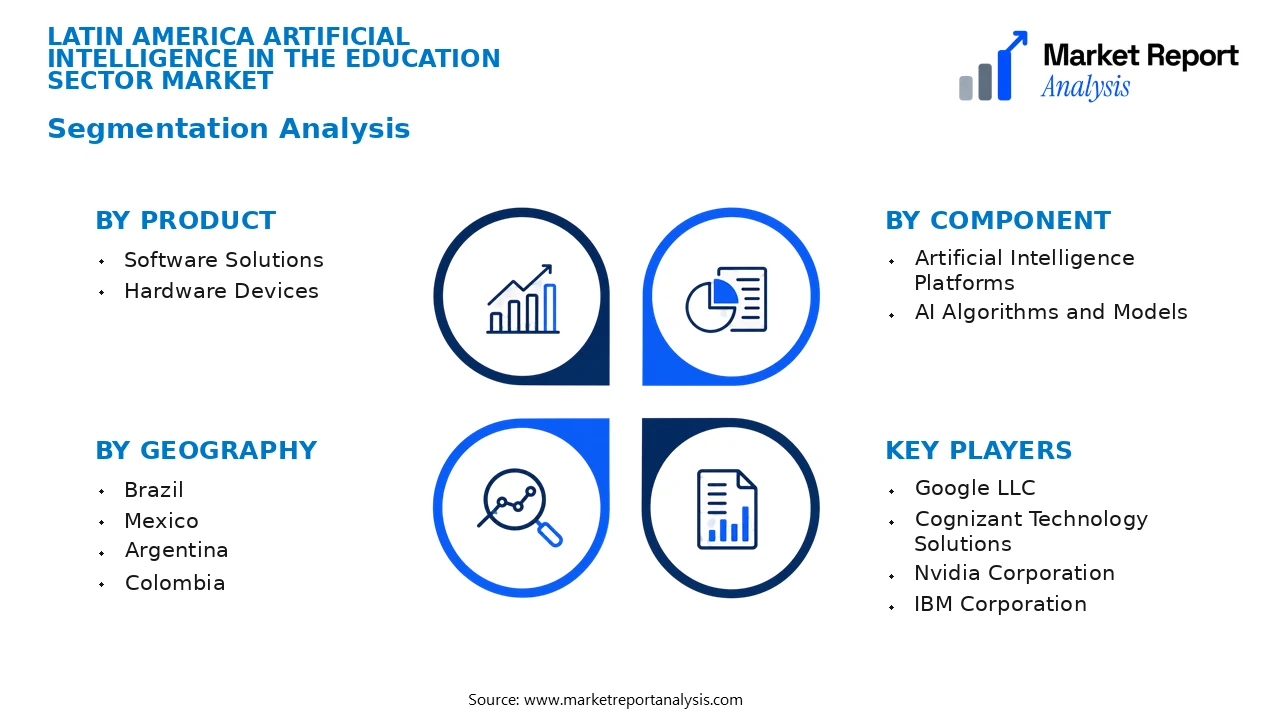
Latin America Artificial Intelligence in the Education Sector Market is segmented based on product, component, application, end user, and geography. This segmentation allows for an in-depth understanding of different market dynamics, adoption rates, and growth opportunities across various sectors and regions within Latin America.
- Product
- Software Solutions: Encompasses AI-powered educational software, including adaptive learning platforms, virtual tutoring, and language learning applications, which are increasingly integrated into school curriculums to improve personalized learning experiences.
- Hardware Devices: Includes AI-enabled devices such as interactive whiteboards, kiosks, and student tablets that facilitate seamless interaction between technology and learners, boosting engagement and operational efficiency.
- Component
- Artificial Intelligence Platforms: Comprise cloud-based and on-premise platforms that support AI functionalities like speech recognition, natural language processing, and machine learning algorithms tailored for educational applications.
- AI Algorithms and Models: Focus on specific application-driven algorithms that enable personalized learning, automated assessments, and student performance analytics, serving as the backbone for intelligent educational tools.
- Application
- Learning Management Systems (LMS): AI integrations within LMS facilitate personalized coursework, predictive analytics for student success, and automated content recommendations, significantly enhancing the learning experience and administrative efficiency.
- Student Assessment & Evaluation: Use of AI to develop adaptive tests, automate grading processes, and generate real-time feedback, which improve accuracy and reduce traditional assessment timelines.
- Virtual Tutoring & Assistants: The deployment of AI-powered chatbots and virtual tutors provides 24/7 support to students, offering personalized help, clarifying doubts, and guiding learners through complex concepts.
- End User
- Educational Institutions: Schools and universities adopting AI solutions for curriculum enhancement, administrative automation, and student engagement, leading to increased efficiency and improved educational outcomes.
- Students: As primary beneficiaries, students utilize AI tools for tailored learning experiences, language support, and skill development, which cater to diverse learning needs and preferences.
- Educators & Administrators: Use AI for personalized teaching, performance tracking, and operational management, enabling data-driven decision-making and resource optimization.
- Geography
- Brazil: The largest market in Latin America, characterized by rapid technological adoption in urban centers, significant government support for educational AI initiatives, and a growing number of edtech startups.
- Mexico: Exhibits a rising trend in AI adoption in public and private schools, backed by investments in digital infrastructure and policy frameworks promoting technology in education.
- Argentina: Known for innovative educational startups, Argentina demonstrates a burgeoning AI market focused on customized learning and AI-driven assessment tools, especially in urban schools.
- Colombia: Driven by government initiatives and private sector investments, Colombia is gradually integrating AI solutions into its educational landscape to foster inclusive learning environments.
Competitive Intelligence
The Latin America Artificial Intelligence in the Education Sector Market is characterized by a competitive landscape featuring several key players including multinational tech corporations, regional software providers, and emerging startups. Market concentration remains moderate, with dominant companies leveraging extensive R&D investments to maintain a competitive edge. Firms are adopting aggressive strategies such as forming strategic partnerships with educational institutions, governments, and technology vendors to enhance their market presence. Product innovation is a central focus, with companies developing tailored AI solutions that address local language barriers, infrastructure challenges, and curriculum customization. Notable acquisitions have facilitated market entry and expansion into underserved regions, while expansion strategies often include regional offices and local partnerships to foster trust and adaptability. R&D investments are intensively directed toward developing adaptive learning algorithms, AI-powered analytics, and intelligent tutoring systems, setting companies apart through technological differentiation. Overall, the competitive landscape is dynamic, driven by innovation, strategic alliances, and a focus on localized solutions to meet the unique needs of Latin American educational markets.
Leading Company Profiles
The competitive landscape within the Latin America Artificial Intelligence in the Education Sector Market is characterized by a mix of established tech giants and innovative startups, each contributing unique solutions to transform educational methodologies through AI-driven technologies.
- Google LLC
- Cognizant Technology Solutions
- Nvidia Corporation
- IBM Corporation
- Microsoft Corporation
- Blackboard Inc.
- Duolingo Inc.
- DreamBox Learning Inc.
- Athenahealth Inc.
- Pearson PLC
Google LLC
Google leverages its extensive AI expertise to develop cloud-based educational tools and platforms tailored for Latin American markets, emphasizing personalized learning experiences, intelligent content recommendations, and scalable solutions for institutions of various sizes.
Cognizant Technology Solutions
Cognizant provides AI-enabled educational consulting and platform development services, focusing on adaptive learning systems and data analytics to enhance student engagement, institutional decision-making, and personalized curricula within Latin America.
Nvidia Corporation
Nvidia’s AI hardware accelerates interactive learning tools and virtual classrooms by powering rich multimedia content, real-time simulations, and immersive experiences, supporting the region’s push towards modernized, tech-forward education environments.
IBM Corporation
IBM offers AI-powered chatbots and cognitive platforms that enable personalized support, administrative automation, and data-driven insights to improve operational efficiencies and student outcomes in Latin American education sectors.
Microsoft Corporation
Microsoft integrates Azure AI services with its education-centric platforms, providing tools for adaptive learning, campus management, and accessibility enhancements, thus fostering inclusive and innovative educational ecosystems across Latin America.
Blackboard Inc.
Blackboard focuses on developing intelligent learning management solutions that incorporate AI-driven analytics, personalized content, and collaboration tools to improve student engagement and institutional effectiveness throughout Latin American universities.
Duolingo Inc.
Duolingo deploys AI algorithms to tailor language learning pathways, adapt exercises in real-time, and provide culturally relevant content, significantly impacting language acquisition and educational outreach in Latin American regions.
DreamBox Learning Inc.
DreamBox offers adaptive mathematics programs powered by AI, which personalize student learning journeys, identify gaps, and provide real-time feedback, making math education more engaging and effective for diverse student populations.
Athenahealth Inc.
Athenahealth adapts AI solutions initially designed for healthcare into educational settings by enhancing student health management, wellness programs, and administrative automation within Latin American schools and universities.
Pearson PLC
Pearson utilizes AI to develop customized learning content, predictive analytics, and assessment tools that support curriculum personalization, thus improving learning outcomes and aligning with regional educational standards and needs.
Strategic Business Developments
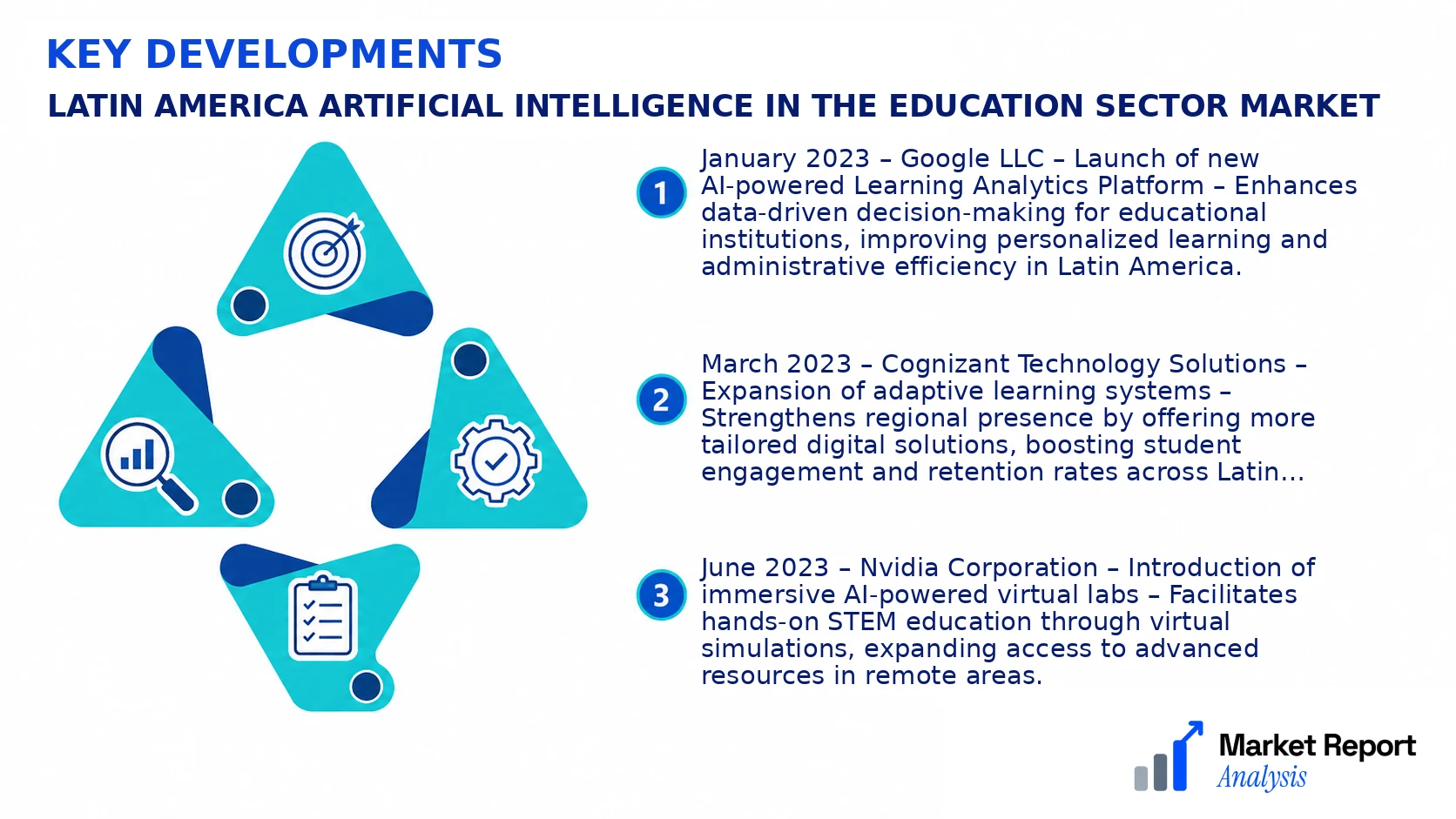
- January 2023 – Google LLC – Launch of new AI-powered Learning Analytics Platform – Enhances data-driven decision-making for educational institutions, improving personalized learning and administrative efficiency in Latin America.
- March 2023 – Cognizant Technology Solutions – Expansion of adaptive learning systems – Strengthens regional presence by offering more tailored digital solutions, boosting student engagement and retention rates across Latin American schools.
- June 2023 – Nvidia Corporation – Introduction of immersive AI-powered virtual labs – Facilitates hands-on STEM education through virtual simulations, expanding access to advanced resources in remote areas.
- August 2023 – IBM Corporation – Strategic alliance with local universities – Focuses on deploying AI chatbots and support platforms, improving administrative efficiency and student assistance services region-wide.
- September 2023 – Microsoft Corporation – Launch of new inclusive learning tools using Azure AI – Aims to enhance accessibility and inclusivity for students with disabilities, aligning with regional educational reforms.
Frequently Asked Questions
What is the Latin America Artificial Intelligence in the Education Sector Market?
The Latin America Artificial Intelligence in the Education Sector Market encompasses the deployment and integration of AI technologies within educational institutions across Latin America. It includes applications like personalized learning, automated grading, adaptive testing, and virtual tutors designed to enhance educational outcomes.
What is the current market size of Latin America Artificial Intelligence in the Education Sector Market?
As of 2026, the market size is valued at approximately USD 1.1 Billion, reflecting steady growth driven by increasing adoption of AI solutions aimed at improving educational efficiency and accessibility across Latin American countries.
What factors are driving the Latin America Artificial Intelligence in the Education Sector Market?
Market growth is mainly propelled by rising investments in edtech, government initiatives promoting digital education, increasing internet penetration, and the necessity for personalized learning experiences to cater to diverse student needs.
Which region dominates the Latin America Artificial Intelligence in the Education Sector Market?
Brazil leads the market due to its large population, expanding digital infrastructure, and active government support for integrating AI into education systems, positioning it as the dominant region within Latin America.
Which segment is expected to grow the fastest?
The adaptive learning segment is forecasted to exhibit the highest CAGR, driven by its ability to customize learning paths and improve student engagement through AI-powered platforms, accounting for more effective educational outcomes.
Who are the leading companies operating in the Latin America Artificial Intelligence in the Education Sector Market?
Major players include multinational edtech firms such as Carnegie Learning, DreamBox Learning, and local companies like AulaPro and Brainly, all focusing on innovative AI solutions tailored for Latin American educational needs.
Analyst Perspective
The Latin America Artificial Intelligence in the Education Sector Market is poised for sustained growth, driven by increasing digitalization and government initiatives to enhance educational access. Long-term, the market is expected to mature with rising adoption of adaptive learning platforms, AI-driven analytics, and personalized learning experiences. Commercial opportunities hinge on expanding AI-powered solutions tailored to regional linguistic, cultural, and infrastructural demands, particularly in underserved rural areas. Technological evolution will likely focus on integrating natural language processing and machine vision to improve interactive education tools. Investment priorities should include infrastructure development, R&D in localized AI algorithms, and partnerships with educational institutions, ensuring scalable and ethical deployment. The region’s competitive landscape will intensify with local and global entrants competing for market share, emphasizing innovation and cost efficiency. Regional growth potential remains high, especially in countries with strong policy backing like Brazil and Mexico, which offer fertile ground for long-term strategic positioning and sustainable growth.
