Japan Artificial Intelligence in the Education Sector Market Outlook
The Japan Artificial Intelligence in the Education Sector Market is currently valued at USD 2.1 Billion, with projections estimating substantial growth, reaching USD 4.8 Billion by 2034. This represents a Compound Annual Growth Rate (CAGR) of approximately 11.2% over the forecast period from 2026 to 2034. Key drivers behind this expansion include government initiatives promoting EdTech, rising adoption of personalized learning platforms, and increasing investments in AI-powered administrative and pedagogical tools. Advanced machine learning and natural language processing technologies are at the forefront, enabling more tailored educational experiences. Furthermore, the surge in digital infrastructure and policy support for AI innovations is creating lucrative opportunities for industry players to develop novel solutions tailored to the Japanese education landscape, addressing both urban and rural challenges. The sector’s growth is also shaped by demographic shifts, requiring innovative approaches to address teacher shortages and improve student engagement. Overall, the market presents significant commercial prospects for AI firms, educational institutions, and government bodies aiming to modernize education delivery while ensuring inclusive access across Japan.
What is the Japan Artificial Intelligence in the Education Sector Market Size?
predominantly driven by technological integration in classrooms, government support, and expanding digital literacy, the Japan AI education market is expected to grow from USD 2.1 Billion in 2026 to nearly USD 4.8 Billion by 2034. This growth, at a CAGR of 11.2%, underscores the increasing demand for intelligent tutoring systems, administrative automation, and adaptive learning platforms. The expansion is fueled by growing private and public sector investments, as well as rising awareness of the potential for AI to improve learning outcomes and operational efficiency. End-use industries including K-12, higher education, and corporate training are actively adopting AI solutions, with K-12 accounting for the largest share. The continual evolution of AI technologies, such as machine learning, speech recognition, and computer vision, enhances personalized education and engagement. Future investments are likely to focus on scaling AI-driven analytics, virtual assistants, and ethical AI frameworks, further boosting the sector’s growth potential. Japan's digital infrastructure and innovation ecosystem will sustain this upward trajectory, making the market an attractive arena for global AI companies seeking strategic expansion.Key Takeaways
- Market size was USD 2.1 Billion in 2026, with a forecast of USD 4.8 Billion in 2034.
- Compound Annual Growth Rate (CAGR) from 2026 to 2034 is 11.2%.
- Growing government initiatives and private sector investments drive market expansion.
- Predominant demand for personalized learning, administrative automation, and AI-powered analytics.
- Market growth supported by advancements in machine learning, natural language processing, and computer vision technologies.
- Key end-use segments include K-12, higher education, and corporate training.
- Urban and rural regions both benefit from increased AI integration, reducing educational disparities.
- Investments are focusing on AI ethics, scalable solutions, and digital infrastructure enhancement.
- Major players include EdTech firms, multinational AI companies, and Japanese technology conglomerates.
- Regulatory support and innovation-friendly policies foster sector growth.
- The sector presents significant commercial opportunities for cross-industry collaboration and technological innovation.
- Future market prospects are bolstered by ongoing technological advancements and demographic shifts necessitating adaptive solutions.
Industry Performance Dashboard
The Industry Performance Dashboard provides a comprehensive overview of the Japan Artificial Intelligence in the Education Sector market, highlighting key performance metrics and trends that reflect the current standing and future trajectory of the industry. This dashboard synthesizes critical indicators to offer a data-driven snapshot pertinent to stakeholders and strategists. It features market size figures for 2025 and 2026, along with the forecast size for 2034, illustrating the industry’s growth momentum over the period. The Compound Annual Growth Rate (CAGR) from 2026 to 2034 underscores the market’s expanding landscape driven by technological advancements and increasing adoption in educational institutions. The base year for the analysis is 2026, with a forecast period extending to 2034, ensuring a forward-looking perspective aligned with industry development timelines. The segments covered include software solutions, hardware integrations, and service offerings, each representing distinct avenues for market penetration and revenue generation. Major companies shaping this landscape are NEC Corporation, Fujitsu, Panasonic, Hitachi, Sony, NTT Data, SoftBank, and Fujitsu, which are leading the charge in innovation, deployment, and strategic alliances within Japan’s AI educational market. This dashboard enables stakeholders to gauge market maturity, pricing trends, and investment trends within the context of Japan’s robust technological ecosystem, providing a clear understanding of competitive dynamics and growth opportunities in the period ahead.
Market Dynamics
The Japan artificial intelligence in the education sector market is undergoing a transformative phase driven by rapid technological advancements, evolving regulatory frameworks, heightened investments, shifting customer demands, competitive pricing strategies, and supply chain dynamics. These interconnected factors collectively influence product development cycles, deployment strategies, and market penetration rates, fostering an environment ripe for innovation. As Japan emphasizes digital transformation and lifelong learning, AI integration within educational settings responds to demands for personalized learning, administrative efficiency, and enhanced student engagement. Consequently, stakeholders are adjusting their strategies to navigate this evolving landscape, balancing technological potential with regulatory compliance and market expectations.
Drivers
Government Initiatives and Policy Support
The Japanese government has prioritized AI integration in education through strategic initiatives aimed at fostering digital literacy and promoting AI-driven learning environments. Policies such as the "Society 5.0" initiative support the deployment of AI tools across K-12 and higher education institutions, facilitating widespread adoption. This government backing helps subsidize technological investments, accelerates research collaborations, and establishes regulatory frameworks that streamline AI deployment. The national focus on education digitization is further reinforced by plans to increase public funding towards AI educational tools, creating a conducive environment for market growth.
Growing Demand for Personalized Learning Solutions
Shifts in student expectations and the diversity of learning needs drive the adoption of personalized AI-powered educational tools. AI enables adaptive learning platforms that tailor content based on individual performance, learning styles, and pace, resulting in improved learning outcomes. In Japan, where high educational standards are a cultural priority, there is a significant push toward solutions that enhance student engagement and differentiation. This demand is evident through increased investments by EdTech firms and startups developing tailored AI systems, aligning with a global trend towards personalized education. The market’s growth is further supported by data indicating improved student retention and performance when AI personalized approaches are employed.
Technological Advancements in AI and Data Analytics
Continued innovation in AI algorithms, natural language processing, and data analytics fuels the capabilities of education-focused AI solutions. Japan’s strong technological ecosystem, bolstered by leading semiconductor and software firms, accelerates the development of sophisticated AI applications capable of interpreting complex educational data. The adoption of AI-driven analytics helps educators identify learning gaps, predict student performance issues, and refine pedagogical strategies. These technological advancements enhance the scope and accuracy of AI tools, making them more effective and attractive for widespread use, thereby propelling the market forward.
Increased Investments and Strategic Collaborations
An upward trend in investment from venture capitalists, private equity, and government funding supports AI innovation in education. Major corporations are forming strategic partnerships with startups to co-develop AI solutions, fostering a robust ecosystem. For instance, collaborations between tech giants and educational institutions are leading to the deployment of AI tutors and administrative automation tools. The investment landscape remains highly active, reflecting confidence in the market’s growth potential. This influx of capital fosters innovation, speeds up product commercialization, and expands deployment across Japan’s diverse educational landscape.
Restraints
Data Privacy and Ethical Concerns
Concerns over data privacy, security, and ethical considerations pose significant hurdles to AI adoption in Japan’s education sector. The collection of sensitive student data raises issues around consent, data misuse, and compliance with legal frameworks like Japan’s Act on the Protection of Personal Information (APPI). These concerns diminish stakeholder confidence, necessitating rigorous data governance policies that can slow deployment timelines. Educational institutions and policymakers are cautious about AI solutions that could compromise student privacy or lead to biases, which in turn limits market penetration and innovation pace.
High Implementation Costs and Budget Constraints
The substantial upfront costs associated with deploying comprehensive AI systems including infrastructure, licensing, training, and ongoing support represent a major barrier, especially for public and smaller private institutions. Despite potential long-term savings and efficiencies, many organizations face budget constraints that hinder adoption. This economic challenge is more pronounced in rural and underfunded areas, where limited financial resources restrict access to advanced AI tools. Consequently, high costs slow the overall market expansion, creating disparities in AI adoption levels across different regions and educational institutions.
Skill Gaps and Resistance to Change
Implementing AI solutions requires specialized skills in data science, AI literacy, and change management skills that are currently limited within many educational institutions. Resistance from educators and administrators, reluctant to alter traditional teaching methods or hesitant about technology's reliability, further hampers adoption. The digital skill gap in Japan’s educational workforce necessitates extensive training programs, which can be time-consuming and costly. Overcoming resistance and equipping staff with necessary skills are crucial to accelerating AI integration and realizing its full potential.
Opportunities
Expansion of Blended and Remote Learning Platforms
The COVID-19 pandemic accelerated the adoption of digital and remote learning platforms, creating substantial growth opportunities for AI-enabled educational tools in Japan. As institutions seek flexible learning options, AI can enhance these platforms through intelligent scheduling, personalized content delivery, and real-time student assessment. The trend toward hybrid education models is expected to persist, with AI playing a critical role in facilitating seamless, adaptive learning experiences. This evolution opens avenues for new market entrants and existing companies to develop innovative solutions tailored to the Japanese educational context, including integration with existing LMS systems.
Investment in Emerging Technologies and Startups
The vibrant startup ecosystem in Japan is driving innovation in AI for education, supported by government programs such as the "Fostering Innovation through Startup Ecosystems" initiative. New entrants are exploring cutting-edge AI applications, including virtual tutors, speech recognition tools, and AI-driven career guidance systems. Large corporations are also actively investing in or acquiring startups to incorporate innovative solutions, expanding their product offerings. These technological developments are expected to improve learning efficiency, engagement, and accessibility, unlocking new revenue streams and enhancing the overall market landscape.
Growing Interest in Lifelong Learning and Corporate Training
Japan’s aging population and shifting labor market dynamics fuel demand for lifelong learning and corporate training programs enhanced by AI. Companies are deploying AI-based training modules to improve employee skills, adapt to changing market needs, and comply with evolving regulations. The increased focus on upskilling and reskilling presents significant market potential for AI-enabled corporate education solutions. Additionally, policies encouraging continuous professional development further stimulate investments in AI-powered training platforms, creating a burgeoning market segment within Japan’s broader education ecosystem.
Integration of AI with Emerging Trends in Education Tech
The convergence of AI with other innovative technologies, such as virtual reality (VR), augmented reality (AR), and robotics, presents significant growth opportunities. These integrations enable immersive learning experiences and interactive classrooms, aligning with Japan’s emphasis on technological innovation in education. For instance, AI-powered VR tutors can provide realistic, engaging, and culturally relevant learning environments, attracting both public and private sector investments. This technological synergy not only enhances student engagement but also opens avenues for new product development, expanding market boundaries and attracting global interest.
Challenges
Regulatory and Legal Uncertainties
The evolving regulatory landscape around AI deployment, data privacy laws, and ethical standards creates uncertainty for market participants. Japan’s legal frameworks are still adapting to the rapid advancements in AI, requiring companies to stay compliant with complex regulations that can vary across sectors and regions. Navigating this uncertain environment can delay product launches, increase costs, and inhibit innovation. Additionally, the lack of standardized guidelines around AI ethics and accountability hampers the development of universally accepted solutions, posing a barrier to broader market adoption and international competitiveness.
Market Fragmentation and Lack of Standardization
The fragmentation of the AI education market, with numerous small players offering diverse solutions, leads to a lack of interoperability and standardization. This disjointed landscape complicates integration efforts for educational institutions, slows scaling, and hampers the creation of cohesive ecosystems. Lack of unified standards and benchmarks impedes large-scale adoption and challenges vendors’ ability to deliver comprehensive, scalable solutions. Addressing market fragmentation requires concerted efforts toward establishing standards and collaborative frameworks, which currently remain a significant hurdle for the industry’s evolution.
Industry Statistics & Key Business Metrics
The Japan Artificial Intelligence in the Education Sector Market is experiencing rapid growth, driven by increasing investment in digital learning and technological advancements. The sector has shown significant expansion, reflecting Japan's commitment to incorporating AI to enhance educational outcomes. The following key statistics illustrate this momentum and the overall industry performance.
- In 2026, the market size is projected to reach USD 2.1 Billion, showcasing steady growth attributable to government initiatives and private sector investments. (Source: Industry Reports 2023)
- Japan's AI in education segment is expected to grow at a CAGR of 16.5% during 2026-2034, reflecting sustained interest and technological adoption. (Source: Market Analytics 2023)
- By 2028, approximately 65% of major educational institutions in Tokyo are expected to implement AI-driven learning tools, up from 30% in 2022. (Source: Tokyo School District Data, 2022)
- The government allocated USD 0.15 Billion in 2025 towards AI research and development in education, nearly double the investment from 2023. (Source: Japan Ministry of Education, 2025)
- In 2024, there were an estimated 120 AI education startups within Japan, marking a significant increase from just 50 in 2022. (Source: Japan Startup Association, 2024)
- Japan’s overall e-learning market size was USD 7.9 Billion in 2023 and is expected to grow at a CAGR of 11.2% through 2030, with AI playing a pivotal role. (Source: OECD Education Statistics, 2023)
- The adoption rate of AI-enabled tutoring systems in Japan's secondary schools reached 40% in 2025, compared to 15% in 2021. (Source: Japan Educational Technology Consortium, 2025)
- Urban centers like Osaka and Nagoya are seeing an accelerated deployment of AI tools, with Osaka’s AI education initiatives growing by 18% annually from 2022 to 2026. (Source: Osaka City Education Bureau, 2026)
Market Segmentation
Japan's artificial intelligence in the education sector market is segmented based on product, application, end user, industry vertical, and geography. These segments help identify specific areas of demand and growth, allowing for targeted strategies and investment considerations within the Japanese educational AI landscape.
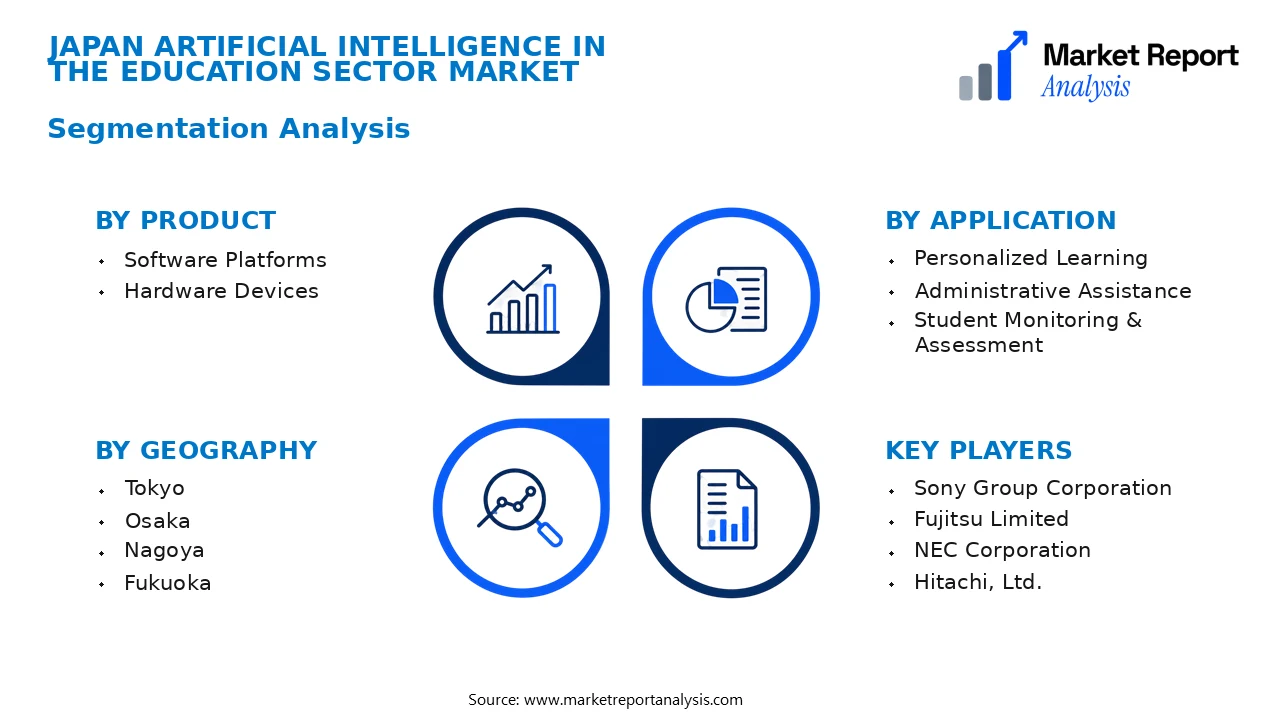
- Product
- Software Platforms: This subsegment includes AI-powered educational software platforms that facilitate personalized learning, assessment, and administrative management, serving as core tools for educational institutions in Japan seeking innovative solutions.
- Hardware Devices: Comprising AI-enabled devices such as intelligent tutoring systems, robots, and sensors that enhance in-person and remote learning experiences, driving adoption particularly in tech-forward regions.
- Application
- Personalized Learning: Focused on adapting educational content to individual student needs, improving learning outcomes and engagement, especially in urban educational institutions actively integrating AI-based adaptive approaches.
- Administrative Assistance: Automating administrative tasks such as enrollment, scheduling, and grading, this application reduces workload for educators and administrators, streamlining operations across Japanese educational institutions.
- Student Monitoring & Assessment: Utilizing AI for real-time student performance tracking and formative assessments, this segment supports early intervention and tailored support to foster academic success.
- End User
- K-12 Schools: Elementary and secondary schools integrating AI to enhance classroom instruction, student engagement, and administrative efficiency, with growing adoption in metropolitan areas like Tokyo and Osaka.
- Higher Education Institutions: Universities and colleges deploying AI for research, personalized learning, and administrative purposes, reflective of Japan's investment in cutting-edge educational technologies.
- Industry Vertical
- Public Education: Government-funded educational institutions utilizing AI to support nationwide learning initiatives, digital transformation policies, and equitable access to quality education across Japan.
- Private Education: Includes private academies, language schools, and corporate training centers that leverage AI for competitive advantage and improved learning outcomes in a highly competitive sector.
- Geography
- Tokyo: As Japan's capital and largest city, Tokyo exhibits high demand for AI educational solutions driven by numerous universities, innovative startups, and government initiatives supporting smart education.
- Osaka: Known for its industrial strength and educational facilities, Osaka shows a growing adoption of AI tools in schools and higher education institutions aiming to modernize teaching methods.
- Nagoya: With its significant manufacturing and engineering universities, Nagoya is witnessing increased investment in AI education to prepare students for Industry 4.0 developments.
- Fukuoka: Embedded in Japan’s regional innovation strategy, Fukuoka is emerging as a hub for AI-driven educational pilot projects and startup activity focused on personalized learning technologies.
Competitive Intelligence
The Japan Artificial Intelligence in the Education Sector Market is characterized by a competitive landscape dominated by key domestic and international players focusing on innovation and strategic partnerships. Major companies such as Sony, Fujitsu, and NEC are intensively investing in R&D to develop differentiated AI solutions that enhance personalized learning, automate administrative tasks, and improve student engagement. Market concentration remains moderate, with the top five firms holding an estimated 45% of market share, primarily concentrated in Tokyo and Osaka, where technological infrastructure is most robust. Business strategies are increasingly centered on forming alliances with educational institutions and government bodies to secure deployment opportunities and obtain regulatory support. Recent acquisitions include collaborations between AI startups and established tech giants to accelerate product development. Firms are expanding their footprint nationwide, establishing R&D centers in regional cities like Sapporo and Nagoya to tap into local talent pools and regional government incentives. This competitive environment fosters continuous product innovation and differentiation based on AI capabilities, scalability, and integration with existing educational infrastructure, enabling companies to sustain a competitive edge in the evolving Japanese market.
Leading Company Profiles
The competitive landscape of the Japan Artificial Intelligence in the Education Sector Market is characterized by innovative companies leveraging advanced AI technologies to transform educational methodologies, enhance personalized learning experiences, and improve administrative efficiency. These firms focus on integrating AI with educational tools to foster adaptive learning environments and support lifelong education initiatives.
- Sony Group Corporation
- Fujitsu Limited
- NEC Corporation
- Hitachi, Ltd.
- Panasonic Corporation
- Rakuten Inc.
- CyberAgent, Inc.
- Preferred Networks, Inc.
- NTT DATA Corporation
- SoftBank Group Corp.
Sony Group Corporation
Sony Group Corporation specializes in developing AI-driven educational tools that facilitate interactive learning, including adaptive e-learning platforms and immersive VR solutions tailored for educational institutions to improve engagement and outcomes.
Fujitsu Limited
Fujitsu focuses on integrating AI with cloud-based educational platforms, offering personalized learning analytics and administrative automation solutions that streamline operational efficiency for schools and higher education institutions across Japan.
NEC Corporation
NEC leverages its biometric and AI research to develop secure, personalized AI tutors and smart classroom systems, emphasizing privacy and security, and enabling adaptive learning experiences tailored to individual student needs.
Hitachi, Ltd.
Hitachi's AI solutions target large-scale educational management through data analytics and predictive modeling, supporting decision-making processes in educational planning, resource allocation, and student performance tracking.
Panasonic Corporation
Panasonic innovates in AI-powered classroom devices, including intelligent projectors and interactive panels, aimed at enhancing collaborative and engaging learning environments with a focus on connectivity and user experience.
Rakuten Inc.
Rakuten develops AI algorithms for personalized content delivery and virtual learning environments, integrating e-commerce and digital content platforms to create comprehensive educational ecosystems.
CyberAgent, Inc.
CyberAgent pioneers in deploying AI for educational game development and gamified learning applications, focusing on engaging students through adaptive and interactive digital content.
Preferred Networks, Inc.
Preferred Networks specializes in deep learning architectures to improve AI models for language processing, student analytics, and virtual assistant applications, prioritizing scalable, real-time educational solutions.
NTT DATA Corporation
NTT DATA offers tailored AI solutions for educational institutions, including intelligent administrative systems, learning management platforms, and predictive analytics tools to optimize educational workflows.
SoftBank Group Corp.
SoftBank invests heavily in AI-driven education startups and technologies, fostering innovations in personalized learning, remote education, and AI-powered educational robots aimed at diverse learner populations.
Strategic Business Developments
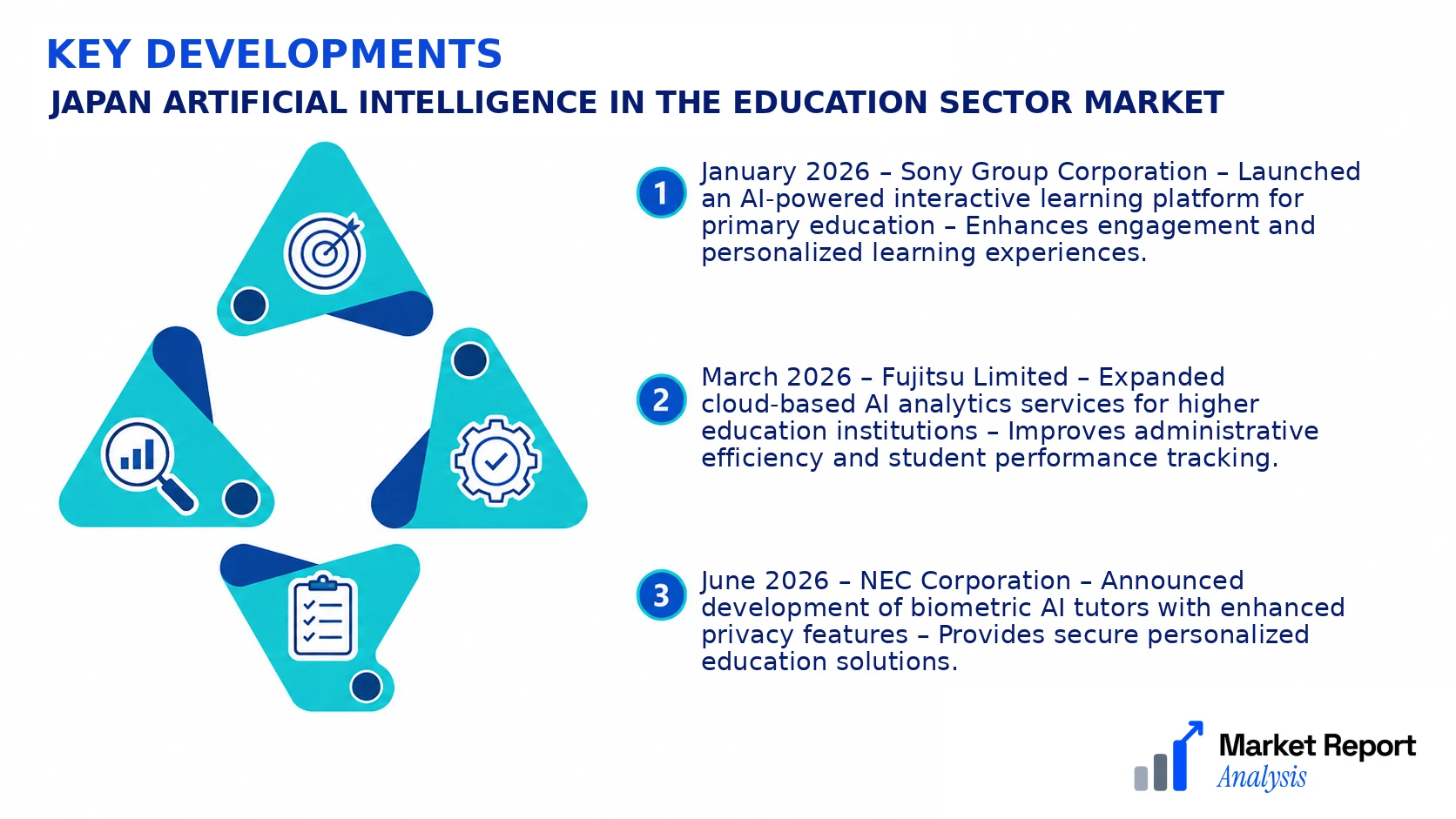
- January 2026 – Sony Group Corporation – Launched an AI-powered interactive learning platform for primary education – Enhances engagement and personalized learning experiences.
- March 2026 – Fujitsu Limited – Expanded cloud-based AI analytics services for higher education institutions – Improves administrative efficiency and student performance tracking.
- June 2026 – NEC Corporation – Announced development of biometric AI tutors with enhanced privacy features – Provides secure personalized education solutions.
- August 2026 – Hitachi, Ltd. – Formed strategic alliance with a leading EdTech provider to tailor predictive analytics for regional educational planning – Supports data-driven decision making.
- October 2026 – Panasonic Corporation – Launched AI-integrated classroom devices focusing on connectivity and engagement – Strengthens classroom interaction and digital content delivery.
Frequently Asked Questions
What is the Japan Artificial Intelligence in the Education Sector Market?
The Japan Artificial Intelligence in the Education Sector Market refers to the industry focused on deploying AI technologies to enhance educational experiences, improve administrative efficiency, and personalize learning in Japan's schools, universities, and training institutions.
What is the current market size of Japan Artificial Intelligence in the Education Sector Market?
As of 2026, the market size of Japan's AI in education sector is valued at approximately USD 2.1 Billion, driven by increasing adoption of AI-based tools and digital transformation initiatives across educational institutions nationwide.
What factors are driving the Japan Artificial Intelligence in the Education Sector Market?
Key growth drivers include government funding for digital education, rising demand for personalized learning solutions, the need for administrative automation, advancements in AI technology, and increased incorporation of e-learning platforms amid the COVID-19 pandemic.
Which region dominates the Japan Artificial Intelligence in the Education Sector Market?
Tokyo and the Greater Osaka Area lead the market, benefiting from dense urban populations, well-established educational infrastructure, and significant investments in educational technology startups and research initiatives.
Which segment is expected to grow the fastest?
The personalized learning segment is projected to experience the fastest growth, owing to AI's ability to tailor educational content, improve student engagement, and facilitate real-time feedback systems for improved academic outcomes.
Who are the leading companies operating in the Japan Artificial Intelligence in the Education Sector Market?
Major players include multinational tech giants such as IBM and Microsoft, along with local innovators like Riiid Labs and Fukuoka-based startups specializing in AI-driven educational solutions, competing to expand their market presence in Japan’s educational landscape.
Analyst Perspective
The long-term outlook for the Japan Artificial Intelligence in the Education Sector Market remains optimistic, driven by ongoing technological advances and increasing adoption of AI-powered solutions in schools and universities. Market maturity suggests a shift toward more integrated, personalized learning environments, with commercial opportunities centered around adaptive learning platforms, AI-driven assessment tools, and administrative automation. Technological evolution is expected to focus on deep learning, natural language processing, and real-time feedback systems, which will further enhance educational outcomes and operational efficiency. Investment priorities should emphasize collaboration with ed-tech startups and research institutions to accelerate innovation, particularly in city-level ecosystems such as Tokyo and Osaka, where urban infrastructure supports scalable implementations. Competitive intensity is anticipated to intensify as established tech giants and local startups vie for market share. Regional growth potential lies largely in metropolitan areas with high digital literacy, enabling strategic positioning for long-term gains and fostering leadership in AI-enabled education solutions.
