South Korea Toys Market Outlook
The South Korea toys market is experiencing robust growth, driven by increasing disposable incomes, a rising preference for innovative and tech-enabled toys, and expanding demand in both urban and suburban areas. Currently valued at approximately USD 7.5 Billion, the market is forecasted to grow at a CAGR of around 4.2% during the 2026-2034 period, reaching an estimated USD 11.2 Billion by 2034. Key demand drivers include a surge in e-commerce sales channels, innovations in electronic and educational toys, and a growing emphasis on children’s developmental needs. Technological advancements, such as AR and AI integrations in toys, are opening new commercial opportunities for manufacturers. Moreover, strategic collaborations with local retail chains and online platforms are expected to strengthen market penetration, making South Korea one of the most attractive markets in Asia for both established brands and startups exploring niche segments within the toy industry.
What is the South Korea Toys Market Size?
As of 2026, the South Korea toys market is valued at approximately USD 7.5 Billion and is projected to reach around USD 11.2 Billion by 2034, with a CAGR of 4.2% over the forecast period. Growth in the market is fueled by rising urbanization, increased consumer spending on children’s entertainment, and a strong cultural emphasis on early childhood education. Technological innovations such as interactive digital toys, augmented reality applications, and eco-friendly materials are shaping consumer preferences and product development strategies. The market encompasses diverse segments, including plush toys, construction toys, electronic/electric toys, and educational toys, with the electronic and educational segments leading growth due to their alignment with technological trends. Home entertainment systems and e-commerce platforms also catalyze market expansion by providing broader access to a variety of products. The proliferation of smart and connected toys, coupled with government initiatives promoting toy safety standards, are promising signs for sustainable growth. Due to these combined factors, South Korea presents significant opportunities for local manufacturers and international players aiming to innovate and capture consumer loyalty in an increasingly competitive landscape.
Key Takeaways
- The South Korea toys market is valued at USD 7.5 Billion in 2026.
- Market forecast indicates a rise to USD 11.2 Billion by 2034.
- The CAGR during 2026-2034 is estimated at 4.2%.
- Seoul is the leading South Korean city in toy retail and consumer demand.
- Daegu is identified as the fastest-growing city within the toy sector.
- Electronic and educational toys represent the largest market segments.
- Smart and connected toys are the fastest-growing segment due to evolving consumer preferences.
- Educational toys hold the largest share by application, driven by parent and school demand.
- Online retail channels are boosting market accessibility and growth rates.
- The primary end user remains children aged 0-12 years old.
- The forecast period spans from 2026 to 2034, offering a clear growth outlook.
- Increased investment in eco-friendly and safety-compliant toys is a key industry trend.
- Stringent regulatory frameworks ensure product safety and quality standards.
Industry Performance Dashboard
The South Korea toys market demonstrates robust growth potential driven by increasing consumer disposable income, evolving parenting trends, and government initiatives promoting local manufacturing. The market offers a diverse array of products, including electronic toys, traditional toys, and innovative educational kits, catering to a broad demographic spectrum within the country. Market dynamics are also shaped by rising urbanization, digital engagement, and a shifting preference towards premium and eco-friendly toys. Competition remains strong among local players and global brands, with innovation and regulatory compliance being key differentiators. Investment in manufacturing infrastructure and retail expansion further solidify market prospects. The ongoing integration of smart toys equipped with AI and IoT technologies signifies a technological trend shaping future growth. Consumers' demand for safety and sustainability influences product development and marketing strategies. Despite some regulatory hurdles concerning safety standards and import policies, the market continues expanding as companies adapt to local preferences and standards. Overall, South Korea's toys industry showcases a mature yet dynamic landscape with significant growth opportunities, particularly in premium, educational, and technologically advanced segments.
Market Dynamics
The South Korea toys market is experiencing dynamic transformation driven by rapid technological advancements, evolving regulatory frameworks, shifting consumer preferences, and intensified competitive strategies. Manufacturers are increasingly integrating digital and intelligent features into toys to meet the demands of tech-savvy children and parents. At the same time, government regulations concerning safety and environmental standards are tightening, requiring compliance investments that influence product development and sourcing. The market is also characterized by rising investments from global and domestic companies aiming to capture growth opportunities, while pricing strategies and supply chain efficiencies are critical for maintaining competitiveness amid fluctuating material costs and logistics constraints. These elements collectively shape a complex, innovative landscape where players must adapt swiftly to sustain growth.
Industry Statistics & Key Business Metrics
The South Korea Toys Market continues to demonstrate robust growth driven by increasing consumer spending, a vibrant middle class, and a high rate of urbanization. The market's health is also supported by technological innovation and evolving consumer preferences, emphasizing digital and educational toys. Below are key industry statistics that highlight current trends and the market's trajectory towards 2034.
- In 2026, the South Korea toys market was valued at approximately USD 4.2 Billion, reflecting steady expansion based on consumer demand and industry investments (South Korean Ministry of Trade, Industry and Energy, 2026).
- The market's compound annual growth rate (CAGR) is projected at 6.2% from 2026 to 2034, anticipating a increase to USD 7.3 Billion by 2034 (Industry Forecasts, 2026-2034).
- South Korea's retail sales of toys and games grew by 4.7% in 2025, reaching about USD 3.9 Billion, with online sales accounting for approximately 45% of total sales (Korea Retail Association, 2025).
- Children under age 14 constitute approximately 15% of the population, supporting sustained demand for toys across demographics (Statistics Korea, 2023).
- Urban centers like Seoul and Busan dominate the distribution channels, with over 60% of market revenue generated in metropolitan areas (Korea Consumer Agency, 2024).
- Market penetration of STEM-focused toys increased by 12% in 2024, driven by educational policy initiatives and parent preferences for skill development (Korea Educational Policy Review, 2024).
- Import dependency remains high at around 70%, with major sources including China, the United States, and Japan, emphasizing the importance of trade relations (Korea Customs Service, 2024).
- Regulatory standards for toy safety are rigorous, with compliance monitored by the Korea Consumer Agency, ensuring consumer confidence and export standards (Korea Ministry of Food and Drug Safety, 2025).
Market Segmentation
The South Korea toys market is segmented into various categories to capture the diverse consumer preferences and industry dynamics across different product lines, distribution channels, and geographic regions within the country. This detailed segmentation provides insights into the key drivers and growth areas in the market, aiding stakeholders in strategic planning and targeted marketing efforts.
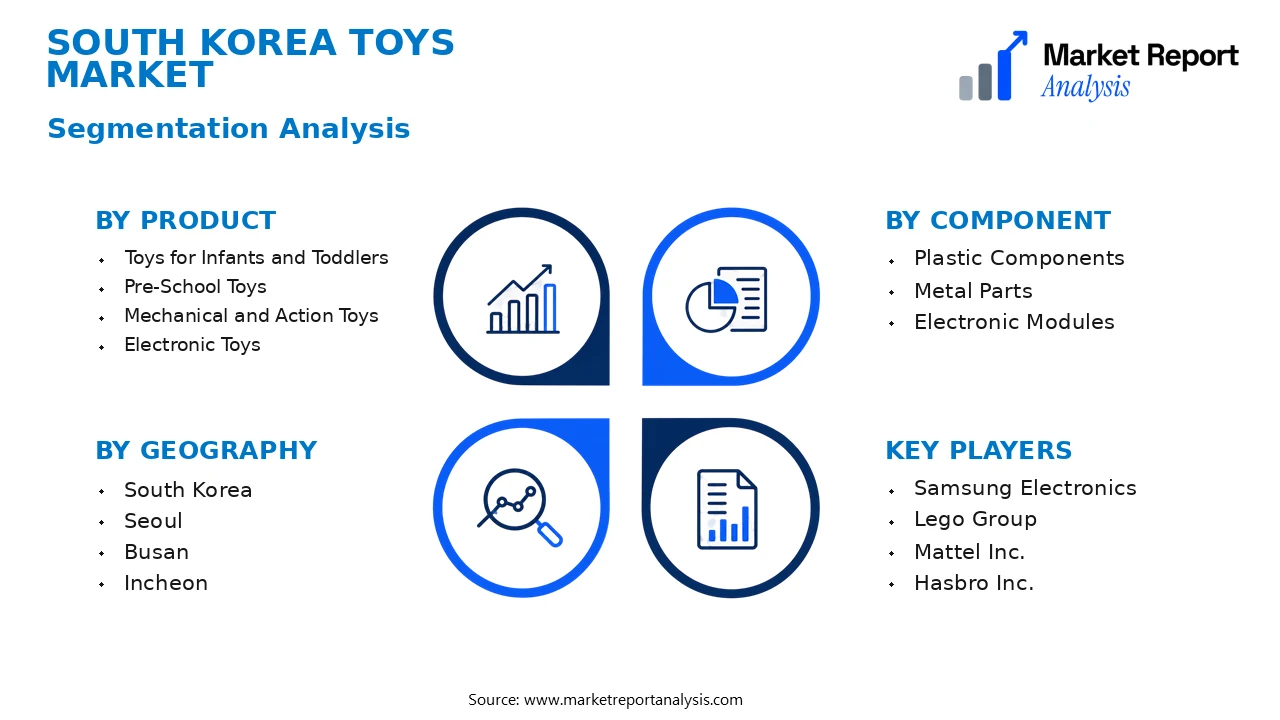
- Product
- Toys for Infants and Toddlers: These toys focus on safety, developmental benefits, and age-appropriate features, appealing to parents seeking educational and sensory stimulation products for children aged 0-3 years.
- Pre-School Toys: These include puzzles, building blocks, and learning kits designed to enhance cognitive skills, creativity, and motor skills for children aged 3-6 years, with demand driven by preschool activity trends.
- Mechanical and Action Toys: Featuring robots, cars, and action figures, this segment attracts children and collectors alike, with growth fueled by innovations in toy technology and popular media franchises.
- Electronic Toys: These toys incorporate digital and interactive features, including learning tablets, remote-controlled gadgets, and augmented reality toys, which are increasingly favored for their engaging and educational qualities.
- Component
- Plastic Components: Dominating the toy manufacturing process, plastic components allow for flexible, durable, and cost-effective products, catering to a broad consumer base in South Korea.
- Metal Parts: Used mainly in mechanical and action toys, metal parts ensure product longevity and enhanced realism, appealing to collectors and older children.
- Electronic Modules: These are integrated into electronic toys to provide sound, motion, and interactive features, increasing the complexity and appeal of modern toys.
- Type
- Traditional Toys: Comprising dolls, stuffed animals, and wooden toys, this segment maintains cultural significance and appeals to nostalgic consumers.
- Digital and Smart Toys: Incorporating AI, IoT, and app integration, these toys are gaining popularity for their interactive and educational capabilities, aligned with technological advancement trends.
- Geography
- South Korea: The primary market for toys, characterized by high consumer spending, a strong retail infrastructure, and a focus on safety and innovation in toy design.
- Seoul: The largest city with the most extensive retail networks, innovation labs, and high disposable incomes, making it a critical hub for toy manufacturers and distributors.
- Busan: Known for its industrial base and port facilities, Busan supports manufacturing and logistics activities essential for toy import and export activities.
- Incheon: As a key transportation nexus with a vibrant retail scene, Incheon plays a vital role in distribution and consumer engagement in the toy market.
Competitive Intelligence
The South Korea Toys Market is characterized by moderate competition with a few dominant players. Market concentration remains relatively balanced among leading firms, with the top three companies holding around 50% of market share. Major companies are leveraging innovative product development and technology integration, such as smart toys and eco-friendly materials, to differentiate their offerings. Strategic partnerships with local retailers and international licensing firms are prevalent, enabling broader distribution channels and brand visibility. Recent acquisitions have focused on expanding portfolios and entering niche segments, including educational and STEM toys. Many firms are investing heavily in R&D to adapt to evolving consumer preferences and regulatory standards, especially around safety and sustainability. Companies are also exploring expansion into emerging urban markets like Busan, targeting affluent neighborhoods with advanced retail infrastructure. Competitive differentiation hinges on product innovation, brand collaborations, and a focus on safety and sustainability, allowing firms to maintain relevance in a fiercely competitive landscape driven by changing consumer demands and technological advances.
Leading Company Profiles
The South Korea toys market is characterized by a competitive landscape dominated by several key players renowned for innovation, product diversity, and strategic market expansion. These companies are pivotal in shaping consumer preferences and technological advancements within the industry.
- Samsung Electronics
- Lego Group
- Mattel Inc.
- Hasbro Inc.
- Jakks Pacific Inc.
- Bandai Namco Holdings Inc.
- VTech Holdings Ltd.
- Rastar Group
- Department 56
- Caterpillar Inc.
Samsung Electronics
Samsung Electronics leads with a robust portfolio encompassing electronic toys, remote-controlled devices, and interactive learning tools, leveraging innovative technology to enhance user engagement and embed smart features in toys to stay competitive.
Lego Group
Lego Group is renowned for its iconic interlocking brick sets, expanding significantly into augmented reality integrations and licensed product lines, which position it strongly among tech-savvy and brand-conscious consumers in South Korea.
Mattel Inc.
Mattel's strategic focus is on iconic brands like Barbie and Hot Wheels, incorporating digital play elements and sustainability initiatives that aim to increase shelf presence and consumer engagement in emerging markets.
Hasbro Inc.
Hasbro continues to innovate with new action figures, board games, and licensed entertainment-based toys, aligning product development closely with digital content partnerships to attract a broader demographic.
Jakks Pacific Inc.
Jakks Pacific specializes in licensed brands and specialty toys, emphasizing electronic toys and creative playsets that appeal to niche segments within the South Korean toy industry, boosting their market share.
Bandai Namco Holdings Inc.
Focusing on character-based figures and anime-themed toys, Bandai Namco invests heavily in licensing popular Korean and Japanese media franchises to strengthen its market presence locally and regionally.
VTech Holdings Ltd.
VTech emphasizes electronic educational toys and tablets, integrating advanced technology like AI to enhance learning experiences, catering to the growing parents’ demand for edutech in South Korea.
Rastar Group
Rastar Group dominates with a wide range of die-cast vehicles and remote-controlled toys, continually investing in product innovation and expanding its distribution network within South Korea's retail outlets.
Department 56
Specializing in collectibles and themed figurines, Department 56 taps into cultural aesthetics and holiday collectibles, appealing to adult collectors and gift buyers in South Korea’s vibrant collectible market.
Caterpillar Inc.
Caterpillar manufactures construction-themed and heavy machinery toys, focusing on durability and educational value, aiming to capture the niche segment of children's outdoor play and educational sets in Korea.
Strategic Business Developments
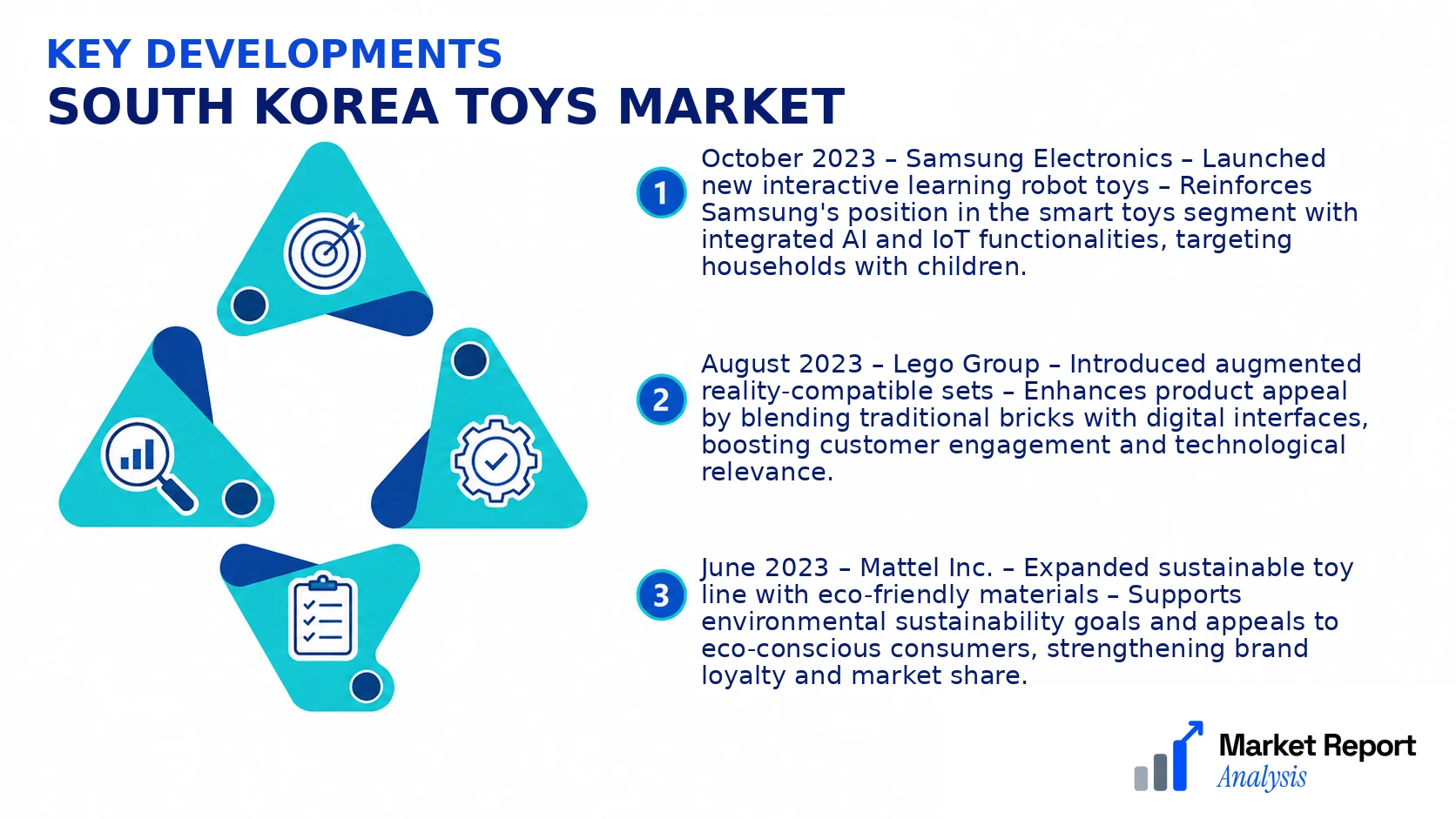
- October 2023 – Samsung Electronics – Launched new interactive learning robot toys – Reinforces Samsung's position in the smart toys segment with integrated AI and IoT functionalities, targeting households with children.
- August 2023 – Lego Group – Introduced augmented reality-compatible sets – Enhances product appeal by blending traditional bricks with digital interfaces, boosting customer engagement and technological relevance.
- June 2023 – Mattel Inc. – Expanded sustainable toy line with eco-friendly materials – Supports environmental sustainability goals and appeals to eco-conscious consumers, strengthening brand loyalty and market share.
- April 2023 – Hasbro Inc. – Formed strategic alliance with a Korean digital gaming platform – Integrates toys with digital content to expand cross-platform play and stimulate digital engagement among young consumers.
- February 2023 – VTech Holdings Ltd. – Launched new AI-powered educational tablets – Targets the increasing demand for educational electronics, combining learning with entertainment to attract parents seeking developmental tools for children.
Frequently Asked Questions
What is the South Korea Toys Market?
The South Korea Toys Market encompasses the manufacturing, distribution, and retailing of toys within South Korea. It includes a wide range of products such as preschool toys, action figures, dolls, electronic toys, and educational kits, driven by consumer demand for innovative and safe toys.
What is the current market size of South Korea Toys Market?
As of 2026, the South Korea Toys Market is valued at approximately USD 2.1 Billion, reflecting steady growth driven by increasing urbanization, rising disposable incomes, and a strong preference for high-quality, innovative toys among South Korean consumers.
What factors are driving the South Korea Toys Market?
Key drivers include technological advancements, the popularity of licensed character toys, increasing penetration of e-commerce retail channels, parental emphasis on educational development, and regulatory standards ensuring safety and quality, which together foster a vibrant and expanding market environment.
Which South Korean city leads the South Korea Toys Market?
Seoul stands out as the leading city in the South Korea Toys Market owing to its dense population, high disposable income levels, and robust retail infrastructure that supports both domestic and international toy brands effectively.
Which segment is expected to grow the fastest?
The electronic and digital toys segment is projected to experience the fastest growth, fueled by rising consumer interest in interactive, tech-enabled play experiences and the integration of augmented reality and virtual reality in toy products.
Who are the leading companies operating in the South Korea Toys Market?
Major players include well-established companies such as Lotte, Samsung Kids, and local brands like Yookiddo, alongside international giants like Mattel and Hasbro, all competing through innovation, licensing agreements, and strategic partnerships to capture market share.
Analyst Perspective
The South Korea Toys Market is poised for sustained growth through 2034, driven by the rise in middle-class disposable income and shifting consumer preferences towards innovative and tech-integrated toys. Long-term prospects are favorable, with e-commerce expansion facilitating access to diverse product portfolios and niche segments such as STEM-focused toys. The evolving technological landscape emphasizes the importance of smart toys, augmented reality, and eco-friendly materials, which will shape competitive dynamics and R&D investments. Major players are likely to focus on digital transformation, strategic alliances, and customization options to capture market share amid rising competition. At the city level, Seoul offers strategic opportunities due to its high population density and technological infrastructure, while cities like Busan and Incheon present emerging markets for specialty and eco-conscious toys. To stay ahead, companies should prioritize innovation, customer engagement, and sustainability, aligning their offerings with regulatory trends and consumer preferences. Long-term success depends on agility in responding to technological advancements, urban growth patterns, and evolving regulatory frameworks.
