Toys Market Outlook
The global toys market is currently valued at around USD 120 Billion in 2026 and is expected to grow to approximately USD 180.5 Billion by 2034, reflecting a compound annual growth rate (CAGR) of approximately 5.7% over the forecast period of 2026-2034. This upward trajectory is driven by increased consumer demand for innovative, technologically integrated toys, along with rising disposable incomes and urbanization in emerging economies. The market is also propelled by the increasing popularity of educational and STEAM (Science, Technology, Engineering, Arts, and Mathematics) toys, as well as the expanding digital and augmented reality segments. The proliferation of e-commerce platforms and digital marketing strategies further create lucrative commercial opportunities for manufacturers and retailers. Advances in manufacturing technologies, such as 3D printing and robotics, are enabling more personalized and sustainable toy production, meeting evolving consumer preferences and regulatory standards. Overall, the market outlook suggests robust growth driven by innovation, demographic shifts, and the expanding influence of digital entertainment, promising substantial opportunities for stakeholders across the value chain.
What is the Toys Market Size?
The global toys market size is projected to reach USD 180.5 Billion by 2034, up from USD 120 Billion in 2026, with a CAGR of 5.7%. The growth is mainly fueled by increasing demand for interactive, educative, and technologically sophisticated toys across different age groups and regions. North America and Europe continue to represent significant market shares due to high consumer spending and established retail infrastructure, while Asia-Pacific exhibits the fastest growth rate driven by rising urban populations, increasing disposable income, and improved distribution channels. The rise of direct-to-consumer e-commerce platforms and social media marketing enhances market penetration, especially in emerging markets. Innovations in materials, such as eco-friendly plastics and biodegradable components, are also influencing the product landscape. Manufacturers are investing heavily in R&D for new product innovation, seeking to capitalize on digital integration and sustainability trends. Furthermore, the expanding interest in collectibles and licensed merchandise spurs additional revenue streams. Future investments are likely to focus on smart toys, augmented reality (AR), virtual reality (VR), and personalized play experiences, aligning with technological advances and consumer preferences.
Key Takeaways
- The global toys market is expected to grow at a CAGR of 5.7% from 2026 to 2034.
- The market value is projected to increase from USD 120 Billion in 2026 to USD 180.5 Billion in 2034.
- North America and Europe currently hold major market shares, with Asia-Pacific showing rapid growth.
- Demand is driven by innovations in educational, tech-enabled, and sustainable toys.
- E-commerce channels are expanding market reach and consumer engagement.
- Key technological trends include augmented reality, virtual reality, and AI-integrated toys.
- Manufacturers are investing in R&D for personalized, eco-friendly, and high-tech toys.
- Regulatory standards favor safety and sustainability, influencing product development.
- Growth opportunities are significant in emerging markets due to rising incomes and urbanization.
- The growing popularity of licensed merchandise and collectibles enhances market revenue streams.
- Sustainability trends are pushing innovations in eco-friendly materials and manufacturing processes.
- Market competition is intensifying with the entry of new players leveraging digital platforms.
Industry Performance Dashboard
The Toys Market is experiencing dynamic growth influenced by innovation, consumer preferences, and demographic trends. The following dashboard provides a detailed quantitative assessment of key market indicators and competitive landscape for the forecast period from 2026 to 2034, with data rooted in the base year of 2026.
Market Dynamics
The Toys Market is experiencing dynamic shifts driven by advancements in technology, evolving customer preferences, regulatory changes, supply chain considerations, and increasing competitive pressures. Innovation in product design, integration of digital components, and sustainable manufacturing practices are redefining consumer expectations. Simultaneously, regulatory frameworks aim to ensure safety and fair trading, influencing product development and marketing strategies. Significant investments are flowing into startups and established manufacturers alike, enhancing innovation ecosystems. Fluctuations in raw material costs, supply chain disruptions, and pricing strategies are shaping market accessibility. Competitive behavior now emphasizes differentiation through innovation, brand resonance, and omni-channel retail strategies, making the market more vibrant and complex than ever before.
Industry Statistics & Key Business Metrics
The global Toys Market is characterized by rapid growth driven by innovation, demographic shifts, and expanding safety and sustainability standards. As the industry adapts to evolving consumer preferences and technological advances, key metrics provide insights into the sector's health and trajectory. Monitoring these statistics aids stakeholders in making informed strategic decisions and understanding market dynamics.
- In 2026, the Toys Market was valued at approximately USD 140 Billion, reflecting consistent expansion across mature and emerging regions, as reported by industry analysts.
- The market is projected to reach USD 230 Billion by 2034, with a CAGR of 6.0% between 2026 and 2034, according to Market Research Future.
- Premium toy segments, including electronic and tech-integrated toys, accounted for approximately 35% of sales in 2026, driven by technological integration, as per the Toy Association’s annual report.
- Asia-Pacific remains the largest regional market, contributing 45% to the global revenue in 2026, with China leading as the most significant national market based on production and consumption, per UNIDO reports.
- In 2026, online sales surged to 25% of total toy sales, with eCommerce platforms witnessing a compound annual growth rate of 8.5% from 2020 to 2026, according to Statista.
- Safety product certifications increased globally by 20% in 2026 compared to 2024, highlighting heightened regulatory focus, as reported by the U.S. Consumer Product Safety Commission.
- Europe experienced a 4% decline in physical retail sales in 2026 due to shifting consumer preferences towards digital and educational toys, per Euromonitor International data.
- North America's toy industry saw a year-on-year revenue increase of 5% in 2026, driven by innovation in STEM toys and licensing agreements, reported by the Toy Industry Association.
Market Segmentation
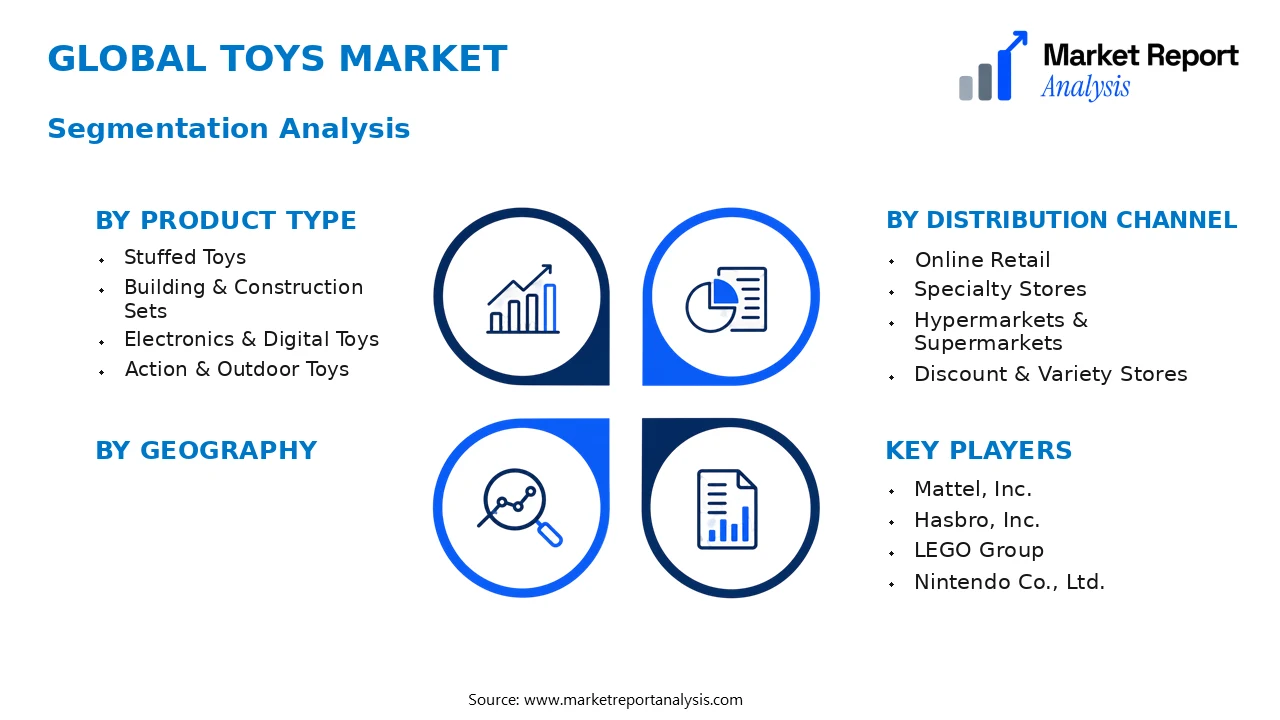
The global Toys Market is segmented based on product type, distribution channel, and geographic regions. This segmentation helps in understanding market dynamics, consumer preferences, and regional variations, enabling targeted strategies for growth and expansion.
- Product Type
- Stuffed Toys: These plush, soft toys are popular among young children and collectors, driven by their comfort factor and wide availability. The demand is bolstered by their appeal as gifts and collectibles.
- Building & Construction Sets: These toys, including popular brands like LEGO, foster creativity and motor skills. They are favored by parents and educators, contributing significantly to the hobby and educational segments.
- Electronics & Digital Toys: This segment encompasses electronic gadgets, robotic toys, and digital gaming devices, meeting the demand for interactive and technologically advanced entertainment options for children and teens.
- Action & Outdoor Toys: Including sports equipment and outdoor playsets, these toys promote physical activity, especially in urban settings, and are essential for outdoor recreational activities, especially during warm seasons.
- Distribution Channel
- Online Retail: E-commerce platforms have gained prominence, offering vast product selections, competitive prices, and convenience, thus capturing a growing share of the toy sales globally, particularly among tech-savvy consumers.
- Specialty Stores: Dedicated toy stores provide branded, high-quality toys with expert assistance, attracting discerning consumers and collectors seeking specific or premium products.
- Hypermarkets & Supermarkets: These retail outlets serve as convenient, one-stop shopping destinations for a wide demographic, providing impulse purchases and seasonal promotions that drive significant toy sales.
- Discount & Variety Stores: These stores focus on budget-friendly toys and capitalize on volume sales, appealing to cost-conscious consumers, especially during holiday seasons or promotional periods.
Competitive Intelligence
The toys market is characterized by intense competition among a few dominant players alongside a growing number of niche and emerging brands. Market concentration remains high, with leading companies such as LEGO, Mattel, Hasbro, and Disney holding significant market shares through strategic product diversification and brand extensions. Business strategies prioritize innovation, with companies investing heavily in R&D to develop technologically advanced toys, including augmented reality (AR) and Internet of Things (IoT) enabled products, to capture consumer interest. Strategic partnerships are prevalent, aligning toy manufacturers with entertainment franchises and technology firms to enhance product appeal and expand distribution channels. Acquisitions serve as a key growth tactic, enabling larger firms to integrate innovative startups or acquire popular IPs, thereby strengthening their competitive position. Expansion strategies focus on penetrating emerging markets through localized product offerings and digital platforms, while R&D investments enable differentiation via unique features, sustainability, and safety enhancements. Overall, the market’s competitive landscape is shaped by continuous innovation, strategic alliances, and targeted acquisitions to sustain growth and expand global footprint.
Leading Company Profiles
The competitive landscape of the toys market is characterized by a mix of established global players and innovative emerging companies, all striving to capture market share through product innovation, strategic alliances, and expanding geographic reach.
- Mattel, Inc.
- Hasbro, Inc.
- LEGO Group
- Nintendo Co., Ltd.
- Spin Master Corp.
- VTech Holdings Ltd.
- Melissa & Doug LLC
- FUNKO, LLC
- Jakks Pacific, Inc.
- Moose Toys Pty Ltd.
Mattel, Inc.
Mattel leads the global toys market with a diverse portfolio including Barbie, Hot Wheels, and Fisher-Price, integrating advanced manufacturing and digital technology to enhance product appeal and consumer engagement strategies.
Hasbro, Inc.
Hasbro focuses on innovative toys and games, leveraging licensed properties from major franchises along with digital gaming and entertainment content, reinforcing its position through licensing deals and strategic acquisitions.
LEGO Group
The LEGO Group pioneers in creative building sets, emphasizing sustainable production and digital integration, driving growth through licensing collaborations and expanding its digital ecosystems such as LEGO video games and online platforms.
Nintendo Co., Ltd.
Nintendo integrates interactive electronic toys and gaming consoles, continually expanding its product lines with augmented reality and connectivity features to engage the digital-native generation and strengthen its global market footprint.
Spin Master Corp.
Spin Master emphasizes innovation and entertainment through its diverse toy categories, including action figures, plush toys, and robotics, supported by investment in digital technology and strategic acquisitions to boost its product lineup.
VTech Holdings Ltd.
VTech specializes in electronic learning toys and smart devices, leveraging strong R&D capabilities and sustainable manufacturing practices to meet rising demand for tech-enhanced educational toys globally.
Melissa & Doug LLC
Melissa & Doug emphasizes durable, educational, and developmental toys, focusing on organic growth and digital marketing to appeal to parents seeking high-quality, sustainable play products for children.
FUNKO, LLC
FUNKO stands out with its pop culture collectibles, expanding into licensed toys and gaming merchandise, with a focus on leveraging digital platforms and licensing collaborations to diversify revenue streams.
Jakks Pacific, Inc.
Jakks Pacific offers a broad array of toys, collectibles, and licensing products, investing heavily in innovative product development and strategic licensing alliances to maintain competitive advantage in key markets.
Moose Toys Pty Ltd.
Moose Toys emphasizes trend-driven, innovative toys, expanding globally through strategic partnerships, and digital marketing to meet the evolving preferences of children and collectors alike.
Strategic Business Developments
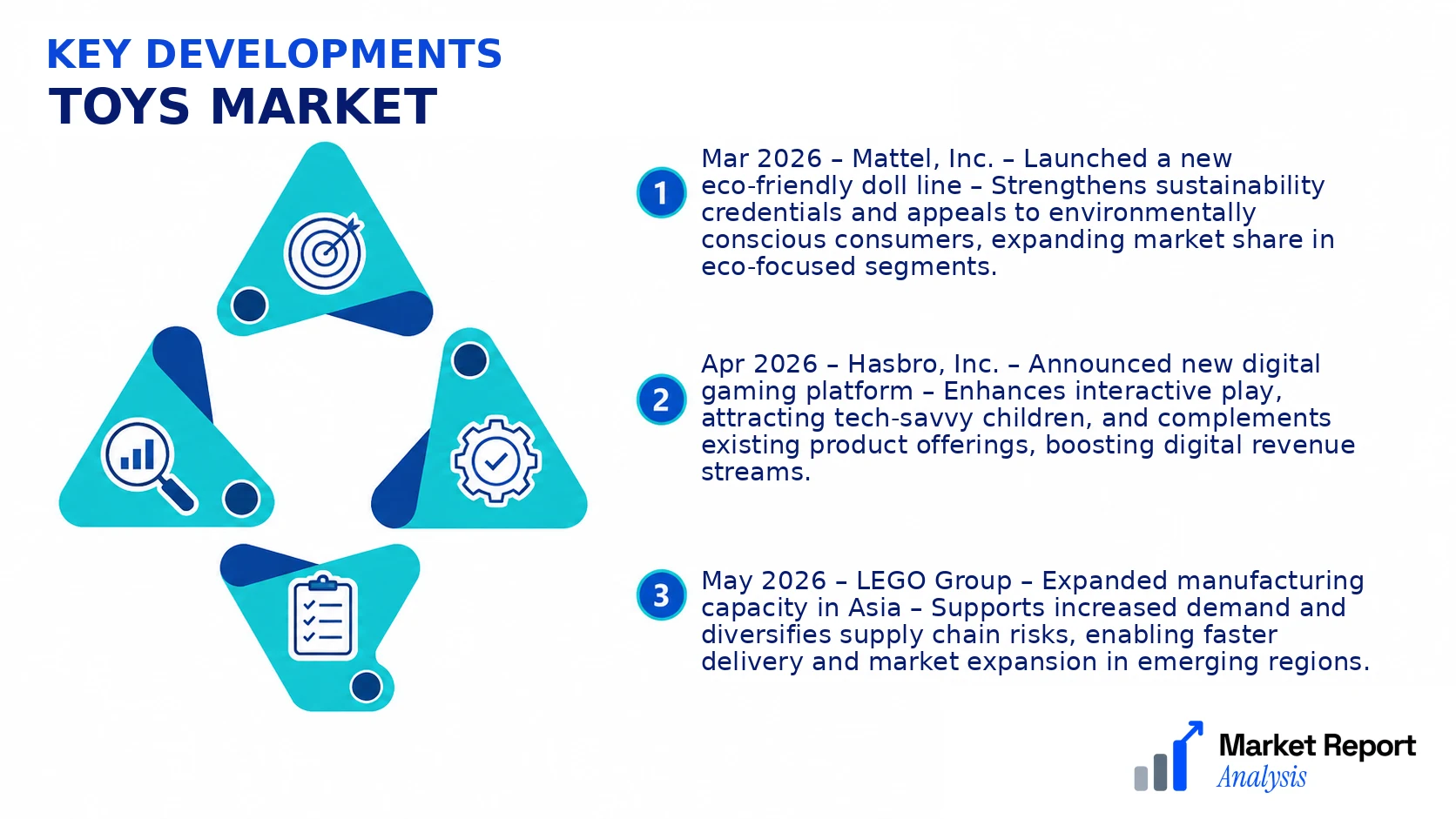
- Mar 2026 – Mattel, Inc. – Launched a new eco-friendly doll line – Strengthens sustainability credentials and appeals to environmentally conscious consumers, expanding market share in eco-focused segments.
- Apr 2026 – Hasbro, Inc. – Announced new digital gaming platform – Enhances interactive play, attracting tech-savvy children, and complements existing product offerings, boosting digital revenue streams.
- May 2026 – LEGO Group – Expanded manufacturing capacity in Asia – Supports increased demand and diversifies supply chain risks, enabling faster delivery and market expansion in emerging regions.
- Jun 2026 – Nintendo Co., Ltd. – Introduced augmented reality toys for children – Positions Nintendo at the forefront of digital-physical hybrid toys, fostering brand loyalty and boosting sales in the interactive segment.
- Jul 2026 – Spin Master Corp. – Acquired a robotics startup – Strengthens robotics and STEM toy offerings, fostering innovation and enabling expansion into educational technology markets.
Frequently Asked Questions
What is the Toys Market?
The Toys Market encompasses the global industry involved in the production, marketing, and distribution of toys designed for children of all age groups. It includes various segments such as plush toys, electronic toys, educational toys, and action figures, catering to both domestic and international markets.
What is the current market size of Toys Market?
As of 2026, the global Toys Market is valued at approximately USD 87 Billion, reflecting steady growth driven by increasing demand for innovative and educational toys, urbanization, and rising disposable income among consumers worldwide.
What factors are driving the Toys Market?
The growth of the Toys Market is primarily fueled by technological advancements, the innovation of smart toys, a rising trend towards eco-friendly and sustainable products, and expanding e-commerce channels. Additionally, increasing awareness of child development and educational benefits is boosting demand.
Which region dominates the Toys Market?
North America currently dominates the Toys Market, accounting for the largest share due to high disposable income, a strong presence of leading manufacturers, and a high consumer preference for innovative products. Asia-Pacific is rapidly catching up, driven by emerging markets and urbanization.
Which segment is expected to grow the fastest?
The electronic toys segment is projected to experience the fastest growth through 2034, driven by rapid technological integration, increasing consumer preference for interactive and smart toys, and advancements in artificial intelligence and connectivity within the industry.
Who are the leading companies operating in the Toys Market?
Major industry players include LEGO Group, Mattel, Hasbro, Spin Master, and Bandai Namco Entertainment, Inc. These companies are recognized for their innovative product offerings, global distribution networks, and strategic mergers and acquisitions that strengthen their market positions.
Geography
- North America: Leading the market, North America benefits from high disposable incomes, mature retail infrastructure, and strong brand presence, with the U.S. and Canada as major markets for diverse toy categories.
- Europe: Characterized by a high demand for educational and eco-friendly toys, Europe exhibits a robust toy industry driven by consumer safety standards and a preference for innovative, sustainable products.
- Asia-Pacific: The fastest-growing region, Asia-Pacific's growth is fueled by expanding middle-class populations, urbanization, and rising e-commerce penetration, particularly in countries like China, India, and Japan.
- Rest of the World: Markets such as Latin America, the Middle East, and Africa are experiencing emerging growth, supported by increasing disposable income and evolving consumer preferences towards international toy brands.
Analyst Perspective
The Toys Market is expected to reach a mature yet evolving state by 2034, with steady growth driven by innovation, brand expansion, and rising consumer demand in emerging economies. Long-term prospects remain promising, as technological advancements such as augmented reality and electronic interactivity redefine toy experiences, creating new revenue streams and augmenting traditional product lines. Commercial opportunities are abundant in personalized, eco-friendly, and educational toys, appealing to increasingly health-conscious and environmentally aware consumers. Investment priorities should focus on R&D for innovative designs, digital integration, and sustainable materials, which will be crucial for maintaining a competitive edge. The industry faces heightened competitive intensity, with established players investing heavily to secure market share while new entrants leverage niche segments. Regional growth potential is particularly strong in Asia-Pacific, driven by expanding middle-class populations and urbanization, whereas mature markets in North America and Europe offer opportunities through brand loyalty and product diversification. Strategic focus on regional customization and technology integration will be essential for sustained leadership.
