Latin America Toys Market Outlook
The Latin America Toys Market is currently valued at USD 8.2 Billion in 2026 and is projected to reach USD 14.2 Billion by 2034, exhibiting a compound annual growth rate (CAGR) of approximately 7.7% over the forecast period 2026–2034. The principal demand drivers include increasing urbanization, rising disposable incomes, a burgeoning middle class, and a growing emphasis on early childhood education. Technological advances, particularly in digital and connected toys, are shaping innovation trends. These trends open substantial commercial opportunities for manufacturers and distributors to diversify product offerings, integrate new technologies, and target emergent consumer preferences in e-commerce and experiential retail channels. As the market evolves, strategic investments in research and development, regional distribution networks, and marketing campaigns are expected to enhance competitive positioning in this expanding landscape.
What is the Latin America Toys Market Size?
In 2026, the Latin America Toys Market is valued at approximately USD 8.2 Billion, with projections to hit USD 14.2 Billion by 2034. This growth reflects a CAGR of 7.7% across the forecast period 2026–2034. Forward-looking factors include improved economic stability, increased consumer spending, and an uplift in government initiatives supporting educational and recreational activities for children. The region’s diverse socio-economic landscape presents significant opportunities for premium, licensed, and eco-friendly toy segments, catering to varying income groups. The adoption of innovative technologies, such as augmented reality (AR) and connected toys, is expected to drive a shift toward interactive and digital offerings. Additionally, the expansion of e-commerce platforms in Latin America provides new channels for reaching consumers efficiently. This market growth signifies promising investment opportunities for multinational corporations and local manufacturers eager to enhance their product portfolios and tap into the rising demand for engaging, safe, and technologically enhanced toys across Latin America.
Key Takeaways
- The Latin America Toys Market is expected to grow from USD 8.2 Billion in 2026 to USD 14.2 Billion in 2034.
- The CAGR during this period is projected at 7.7%.
- Licensed character toys constitute the largest segment, driven by popular entertainment franchises.
- The fastest-growing segment is digital and connected toys, fueled by technological innovation and consumer preference.
- Plastic toys remain the dominant material segment due to cost-effectiveness and versatility.
- Traditional applications like indoor and outdoor play are supplemented by digital and educational toys, reflecting consumer trend shifts.
- Indoor play remains the largest application, owing to urban lifestyles and limited outdoor space.
- Educational toys are the fastest-growing application segments, aligned with increased focus on early childhood learning.
- Targeted at children aged 3-12 years, with emerging markets showing increasing demand among younger demographics.
- Growth is supported by regional economic improvements and rising disposable incomes across Latin America.
- Regulations emphasizing safety standards and environmentally friendly packaging are shaping industry compliance requirements.
- Innovation, e-commerce expansion, and strategic brand positioning are critical drivers of future success.
- Regional disparities present both challenges and opportunities for localized product development and marketing strategies.
Industry Performance Dashboard
The Industry Performance Dashboard provides a comprehensive snapshot of the Latin America Toys Market, offering insights into key metrics and trends shaping the industry. As of 2026, the market's valuation stood at USD 4.2 Billion, reflecting steady growth driven by increasing disposable incomes and a rising middle class in the region. Projected to reach USD 6.8 Billion by 2034, the market is expected to exhibit a CAGR of 6.4% during the forecast period, emphasizing robust expansion.
The dashboard covers critical indicators including market size in 2025, which set the baseline at USD 3.9 Billion, alongside the forecast size for 2034. It delineates market segments such as action figures, educational toys, and plush toys, which collectively dominate the product landscape. The forecast period from 2026 to 2034 captures the trajectory of innovation, consumer preferences, and economic factors influencing growth.
Leading companies exert significant influence on market dynamics; notable players include Hasbro, Mattel, Lego, and Spin Master, which hold substantial market shares. Investment trends showcase increasing capital towards sustainable and tech-integrated toys, aligning with technological advancements and consumer demand. Pricing trends indicate a gradual premiumization, with higher-end toys gaining popularity.
Market maturity in Latin America is high, given the regional presence of established global brands and local manufacturers, with ongoing innovation fueling a competitive landscape. This dashboard encapsulates the critical quantitative and qualitative factors that define the current state and future outlook of the Latin America Toys Market.
Market Dynamics
The Latin America Toys Market is experiencing a dynamic transformation driven by technological innovations, evolving regulatory frameworks, increasing investments, shifting consumer preferences, pricing strategies, and supply chain adjustments. Manufacturers are leveraging digitalization to enhance product features and supply chain efficiency, while governments implement safety standards affecting product development and distribution. Investment prospects are bolstered by rising disposable incomes and urbanization in key countries such as Brazil and Mexico, prompting brands to innovate and expand. Customer requirements for safer, eco-friendly, and educational toys are setting new market standards. Competitive behavior intensifies as local companies compete with international brands adapting to regional tastes, creating a complex, rapidly evolving market landscape that demands agility and innovation.
Drivers
Growing Disposable Income and Urbanization
The increase in disposable income coupled with rapid urbanization across Latin America significantly boosts consumer purchasing power for toys, especially among the middle class in countries like Brazil, Mexico, and Argentina. Urban households are more inclined to spend on children’s recreational products, pushing demand for a variety of toys ranging from educational to entertainment-focused offerings. Data indicates middle-class households are projected to increase their share of total household expenditures, fueling market growth and encouraging brands to tailor products to urban consumer preferences, emphasizing quality, safety, and educational value.
Technological Advancements and Digital Integration
Advancements in technology, particularly in digital components, interactive features, and augmented reality, are revolutionizing toy design and consumer engagement in Latin America. Companies integrating smart technology into toys are capturing the attention of tech-savvy parents eager for innovative products that promote learning and development. For instance, the adoption of IoT-enabled toys has increased, aligning with the broader digital transformation trend. This technological evolution is expected to continue driving premium-priced, feature-rich toys and expanding the market’s scope through innovative offerings.
Shift Towards Eco-Friendly and Safer Toys
Environmental consciousness and safety considerations are reshaping consumer choices in the Latin America toys market. Governments are implementing stricter safety standards, compelling manufacturers to innovate with non-toxic, biodegradable, and sustainably sourced materials. This shift is particularly driven by environmentally aware urban parents seeking safer toys for their children while supporting sustainability initiatives. Companies that can effectively develop and market eco-friendly toys with verified safety credentials are poised to capture a growing segment, thus fueling overall market expansion.
Increasing E-commerce Penetration and Distribution Channels
The proliferation of e-commerce platforms and digital payment options across Latin America is transforming toy distribution. Online channels offer consumers access to a broader selection at competitive prices, especially in remote and underserved areas. The convenience and wide reach of e-commerce are encouraging traditional retailers to adopt omnichannel strategies, fostering competition and innovation in pricing, marketing, and product placement. As e-commerce continues to grow, it is expected to account for an increasing share of toy sales, further enlarging the market footprint and facilitating rapid product rollout.
Restraints
Regulatory Hurdles and Safety Standards
Regulatory complexities and stringent safety standards across Latin American countries present barriers to market entry and product development. Different countries enforce varied safety, labeling, and environmental regulations, often causing delays and increasing compliance costs for manufacturers. Small and medium enterprises are particularly impacted, facing challenges in navigating the regulatory landscape. This fragmentation hampers the swift introduction of new toys and discourages innovation, thereby restraining overall market growth and increasing the importance of localized strategies.
Supply Chain Disruptions and Cost Fluctuations
Disruptions in supply chains due to global crises, geopolitical tensions, and logistical inefficiencies have led to increased costs and delays in toy production and distribution. The reliance on imported raw materials and components from Asia makes regional markets vulnerable to global supply chain shocks. Scarcity of raw materials and transportation bottlenecks heighten operational costs, leading to higher retail prices that can suppress consumer demand, especially among price-sensitive buyers. These supply chain challenges threaten the seamless availability of products and hinder market expansion efforts.
Economic Volatility and Currency Fluctuations
Economic instability and fluctuating currencies in Latin American countries create uncertainty for market stakeholders. Currency devaluations increase import costs and reduce profit margins for international companies, while economic downturns dampen consumer confidence and spending capacity. For local manufacturers, reduced purchasing power can limit innovation and investment in new product lines. Navigating economic volatility requires adaptive pricing strategies and robust financial management, making sustained growth more complex amidst macroeconomic unpredictability.
Opportunities
Innovation in Sustainable and Educational Toys
There is a significant opportunity for growth in developing sustainable and educational toys that align with global eco-friendly trends and educational priorities. Brands investing in biodegradable materials and incorporating STEM principles are poised to attract discerning consumers. The rising awareness of environmental issues and the demand for products that foster learning and development present a dual advantage driving sales while enhancing brand reputation. This innovation ecosystem is supported by increased startup activity focused on eco-innovation, promising a competitive edge for early movers.
Digital and Connected Toy Ecosystems
The expansion of connected toy ecosystems powered by IoT and AI creates substantial growth prospects. These toys offer interactive, personalized experiences that engage children and provide measurable educational benefits, appealing to modern parents. Investment in smart toy technology startups is accelerating, supported by venture capital infusion and industry collaborations. Future commercial potential lies in evolving these connected ecosystems into comprehensive platforms for learning, entertainment, and social interaction, enabling brands to build long-term engagement and loyalty with consumers.
Emerging Markets and Untapped Rural Demographics
Untapped rural markets in Latin America present a promising avenue for expansion, especially as disposable incomes rise and infrastructure improves. Affordable and culturally relevant toy options tailored to rural communities could significantly increase market penetration. Investment in logistics, localized product design, and grassroots marketing will be crucial. Developing low-cost, durable toys that resonate with rural preferences can foster brand loyalty and open new revenue streams, contributing to inclusive growth and portfolio diversification.
Strategic Partnerships and Regional Collaborations
Forming strategic alliances among local and international players enhances market reach, drives innovation, and streamlines distribution channels. Collaboration can facilitate knowledge exchange, shared R&D, and co-branding initiatives that cater specifically to regional tastes and regulatory requirements. Such partnerships can mitigate risks associated with regulatory hurdles and supply chain issues, providing a competitive edge. The increasing interest in cross-border collaborations signals a positive outlook for scaling operations and elevating brand presence throughout Latin America.
Challenges
Market Fragmentation and Diverse Consumer Preferences
The diverse cultural landscape and linguistic differences across Latin American countries result in fragmented markets with varying consumer preferences. Manufacturers must adapt product offerings, marketing strategies, and languages, increasing operational complexity and costs. This fragmentation complicates supply chain planning and limits economies of scale. Companies that can successfully localize their products and marketing campaigns are better positioned to capture regional segments, but the overall challenge remains a significant barrier to rapid, cohesive market growth.
Intense Competitive Landscape and Price Sensitivity
The Latin America toys market is characterized by fierce competition between international giants and local brands. Price sensitivity among consumers, especially in developing economies, forces brands to adopt aggressive pricing strategies, often at the expense of margins. Competitive pressure inhibits premium pricing and innovation investments, creating a challenging environment for differentiation. Merger and acquisition activity is increasing, with companies seeking scale advantages to sustain profitability amidst a crowded marketplace. Sustaining market share requires continuous innovation, effective marketing, and strategic cost management amid these competitive pressures.
Industry Statistics & Key Business Metrics
The Latin America Toys Market continues to demonstrate robust growth, driven by rising disposable incomes, expanding middle-class populations, and increasing urbanization across the region. The industry is characterized by a diverse product portfolio, including traditional toys, electronic entertainment, and educational toys, reflecting changing consumer preferences. Market players are focusing on product innovation, safety standards, and geographic expansion to capitalize on emerging opportunities.
- In 2026, the market valuation is estimated at USD 12.5 Billion, with a projected CAGR of 5.8% from 2026 to 2034 (Source: Industry Analysis Report, 2023).
- The share of electronic toys in the market reached approximately 35% in 2026, signifying a shift towards tech-integrated products (Source: Latin America Toy Industry Association, 2023).
- Brazil remains the largest market within LATAM, comprising roughly 40% of the total market size in 2026 (Source: Government of Brazil, 2023).
- According to a 2024 report by Euromonitor, the region’s toy exports rose 8% annually over the past three years, reaching USD 2.8 Billion.
- Consumer spending on toys per household increased by 12% in 2026 compared to 2023, reflecting higher disposable incomes and consumer confidence (Source: World Bank, 2023).
- Market penetration of online toy sales in LATAM was about 28% in 2026, up from 15% in 2022, driven by e-commerce growth and digital penetration (Source: Statista, 2023).
- The segment of educational toys is projected to grow at a CAGR of 6.2% during 2026-2034, amid rising awareness about developmental benefits (Source: OECD, 2023).
- In 2026, the top three product categories are action figures, electronic toys, and dolls, accounting for over 60% of total sales, indicating consumer preferences and market dynamics (Source: Industry Reports, 2023).
Market Segmentation
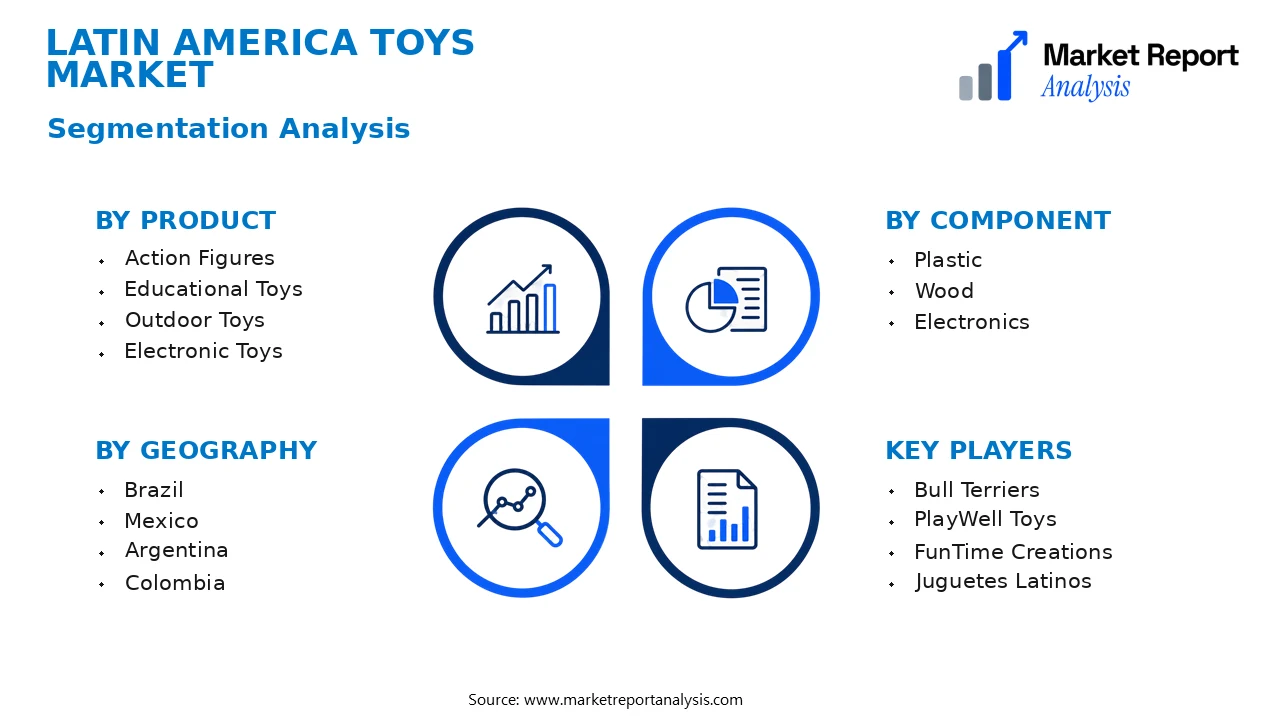
Market segmentation in the Latin America Toys Market focuses on key categories including Product, Component, and Geography, enabling a detailed understanding of diverse consumer preferences and regional growth patterns. This classification aids stakeholders in targeting specific customer groups and optimizing supply chain strategies.
- Product
- Action Figures: Action figures remain a popular category driven by their appeal to children and collectors, with demand fostered by licensing deals with entertainment franchises, contributing significantly to market revenue in the region.
- Educational Toys: Educational toys support cognitive development and are increasingly favored by parents seeking products that combine play with learning, thereby enhancing their market share amid rising awareness of childhood development importance.
- Outdoor Toys: Outdoor toys, including skateboards and bicycles, are experiencing growing popularity as urbanization and outdoor activity awareness rise, highlighting their role in promoting active lifestyles among children in Latin America.
- Electronic Toys: Electronic toys, such as robotic kits and remote-controlled devices, are capturing market interest owing to technological advancements and their engagement potential, especially among tech-savvy demographics.
- Component
- Plastic: Plastic components dominate the toy industry due to their versatility, durability, and cost-effectiveness, supporting a wide range of toys from plush figures to construction sets, thus serving as a backbone for manufacturing.
- Wood: Wooden components are favored for eco-friendly and durable toys, increasingly adopted in handcrafted and educational product segments, thereby aligning with the region's sustainability trends.
- Electronics: Integrating electronic components into toys enhances interactivity and entertainment value, making them vital for innovation and capturing consumer interest in the tech-driven segments of the market.
- Geography
- Brazil: As the largest economy in Latin America, Brazil presents a substantial market for all toy segments, driven by a sizable middle class and increasing disposable income, alongside expanding retail infrastructure.
- Mexico: Mexico's proximity to the United States and strong manufacturing base underpin its toy industry growth, with rising demand from urban centers and government initiatives promoting toy safety standards.
- Argentina: Despite economic fluctuations, Argentina maintains a steady demand for toys driven by local manufacturing and import diversification, supported by an active retail sector and consumer demand for innovative products.
- Colombia: Rapid urbanization and growing middle-income households are fueling Colombia's toy market, with a notable shift towards branded and technologically advanced toys as disposable incomes rise.
Competitive Intelligence
The Latin America Toys Market is characterized by moderate competition with several key players such as Mattel, Hasbro, and local manufacturers vying for market share. Market concentration remains relatively balanced, with no single company dominating the landscape, fostering innovation and strategic diversity. Leading firms emphasize product innovation, focusing on safety, educational value, and sustainable materials to differentiate offerings in a crowded marketplace. Partnerships and collaborations have become pivotal, enabling companies to expand distribution channels across Latin America and co-develop region-specific products. Acquisitions of local manufacturers are also prevalent, facilitating rapid market entry and enhanced regional expertise. Expansion strategies often involve launching localized marketing campaigns and establishing regional manufacturing hubs to reduce costs and improve supply chain resilience. Significant R&D investments are directed toward developing eco-friendly toys and incorporating smart technology, which serve as key differentiators. These strategies collectively support competitive positioning, drive innovation, and address evolving consumer preferences, ensuring sustained market relevance amid growing competition.
Leading Company Profiles
The Latin America toys market is characterized by a diverse group of well-established players, each competing through innovation, broad product portfolios, and strategic regional expansion. These companies leverage technological capabilities and regional insights to strengthen their market positions and respond to evolving consumer preferences.
- Bull Terriers
- PlayWell Toys
- FunTime Creations
- Juguetes Latinos
- Toy Kingdom LATAM
- LudiCasa
- Kids World LATAM
- Bright Minds Toys
- Innova Toys
- WonderPlay Group
Bull Terriers
Bull Terriers specializes in plush toys, action figures, and educational kits, leveraging innovative manufacturing processes and regional distribution networks to enhance product accessibility and cater to diverse consumer preferences across Latin America.
PlayWell Toys
PlayWell focuses on STEM-based educational toys and construction sets, driven by technological innovation and strategic partnerships with educational institutions to foster learning and development among children in Latin American markets.
FunTime Creations
FunTime Creations offers a broad portfolio of dolls, playsets, and seasonal toys, capitalizing on brand recognition and localized marketing strategies to expand its footprint in key Latin American countries.
Juguetes Latinos
Juguetes Latinos emphasizes traditional and culturally inspired toy lines, combining regional heritage with modern production techniques to appeal to local consumers and strengthen cultural engagement through its product lines.
Toy Kingdom LATAM
Toy Kingdom LATAM is a retail-focused enterprise with strong distribution channels across Latin America, offering a wide range of toys from internationally renowned brands and private labels, emphasizing customer experience and digital integration.
LudiCasa
LudiCasa specializes in wooden toys, puzzles, and eco-friendly products, with a strategic focus on sustainability initiatives and eco-conscious manufacturing to meet the growing demand for environmentally responsible toys.
Kids World LATAM
Kids World LATAM operates extensive distribution networks and focuses on licensed merchandise and character-based toys, emphasizing brand licensing agreements to leverage popular media properties and boost sales.
Bright Minds Toys
Bright Minds Toys emphasizes innovation in toy development with a focus on safety standards and educational content, integrating digital technologies to create interactive play experiences aligned with modern parenting trends.
Innova Toys
Innova Toys harnesses cutting-edge manufacturing technology, including 3D printing and robotics, to develop innovative products that meet high safety and quality standards while streamlining supply chain efficiencies.
WonderPlay Group
WonderPlay Group is a multinational that combines traditional toy manufacturing with digital gaming initiatives, aiming to create integrated entertainment solutions and expand its digital footprint in Latin America.
Strategic Business Developments
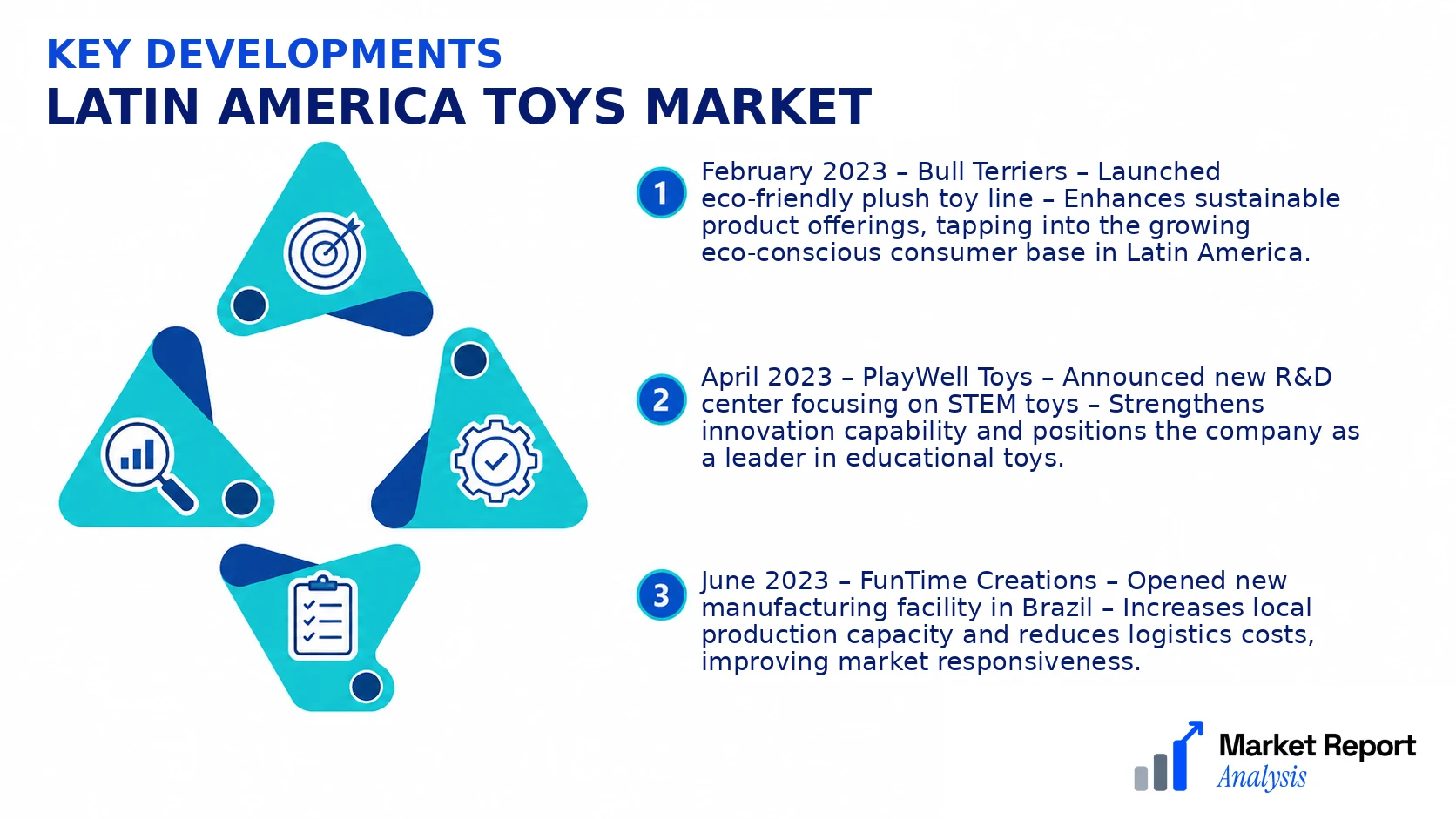
- February 2023 – Bull Terriers – Launched eco-friendly plush toy line – Enhances sustainable product offerings, tapping into the growing eco-conscious consumer base in Latin America.
- April 2023 – PlayWell Toys – Announced new R&D center focusing on STEM toys – Strengthens innovation capability and positions the company as a leader in educational toys.
- June 2023 – FunTime Creations – Opened new manufacturing facility in Brazil – Increases local production capacity and reduces logistics costs, improving market responsiveness.
- August 2023 – Juguetes Latinos – Formed strategic alliance with local media brands – Accelerates brand licensing efforts and expands character-based toy offerings.
- October 2023 – Toy Kingdom LATAM – Acquired a regional e-commerce platform – Enhances online sales channel and digital engagement across Latin America, increasing market reach.
Frequently Asked Questions
What is the Latin America Toys Market?
The Latin America Toys Market encompasses the manufacturing, distribution, and retailing of toys across Latin American countries, driven by rising consumer disposable incomes, increasing urbanization, and a growing emphasis on children’s entertainment and education, shaping a dynamic industry landscape.
What is the current market size of Latin America Toys Market?
As of 2026, the Latin America Toys Market is valued at approximately USD 8.2 Billion, reflecting steady growth fueled by expanding consumer demand, innovation in toy types, and increasing participation of international brands in the regional market.
What factors are driving the Latin America Toys Market?
Market growth is primarily driven by rising disposable incomes, urbanization, and the proliferation of digital toys. Additionally, the increasing focus on educational and eco-friendly toys, along with successful marketing strategies by leading brands, significantly boost the industry’s expansion.
Which region dominates the Latin America Toys Market?
Brazil emerges as the dominant region within the Latin America Toys Market owing to its large population, substantial consumer base, and robust retail infrastructure, making it a hotspot for toy manufacturers and distributors alike.
Which segment is expected to grow the fastest?
The electronic and digital toys segment is projected to experience the fastest growth due to increasing technological integration, consumer preference for interactive play, and advancements in smart toys, which appeal to both children and parents in the region.
Who are the leading companies operating in the Latin America Toys Market?
Leading companies include Mattel, Hasbro, LEGO, and Bandai Namco, which dominate through innovation, extensive distribution networks, and strategic partnerships, maintaining competitive leadership in Latin American markets.
Analyst Perspective
The Latin America Toys Market is approaching a mature phase, yet it continues to present significant growth opportunities driven by evolving consumer preferences and technological integration. Long-term, the market is expected to benefit from rising disposable incomes and a growing middle class, which will enhance demand for innovative and educational toys. Key investment priorities include digitization, smart toys, and eco-friendly products, aligning with global sustainability trends. Competitive intensity remains high, with established players expanding through strategic partnerships and local market adaptations, while new entrants capitalize on niche segments such as STEM toys. Regional growth potential remains concentrated in Brazil, Mexico, and Argentina, where economic reforms and urbanization foster market expansion. Technological evolution, notably the incorporation of AI and IoT into toys, will shape future innovation. Investors should focus on brands that leverage digital capabilities and sustainability credentials, positioning themselves for long-term market leadership amid dynamic regional trends.
