South Korea Digital Video Walls Market Outlook
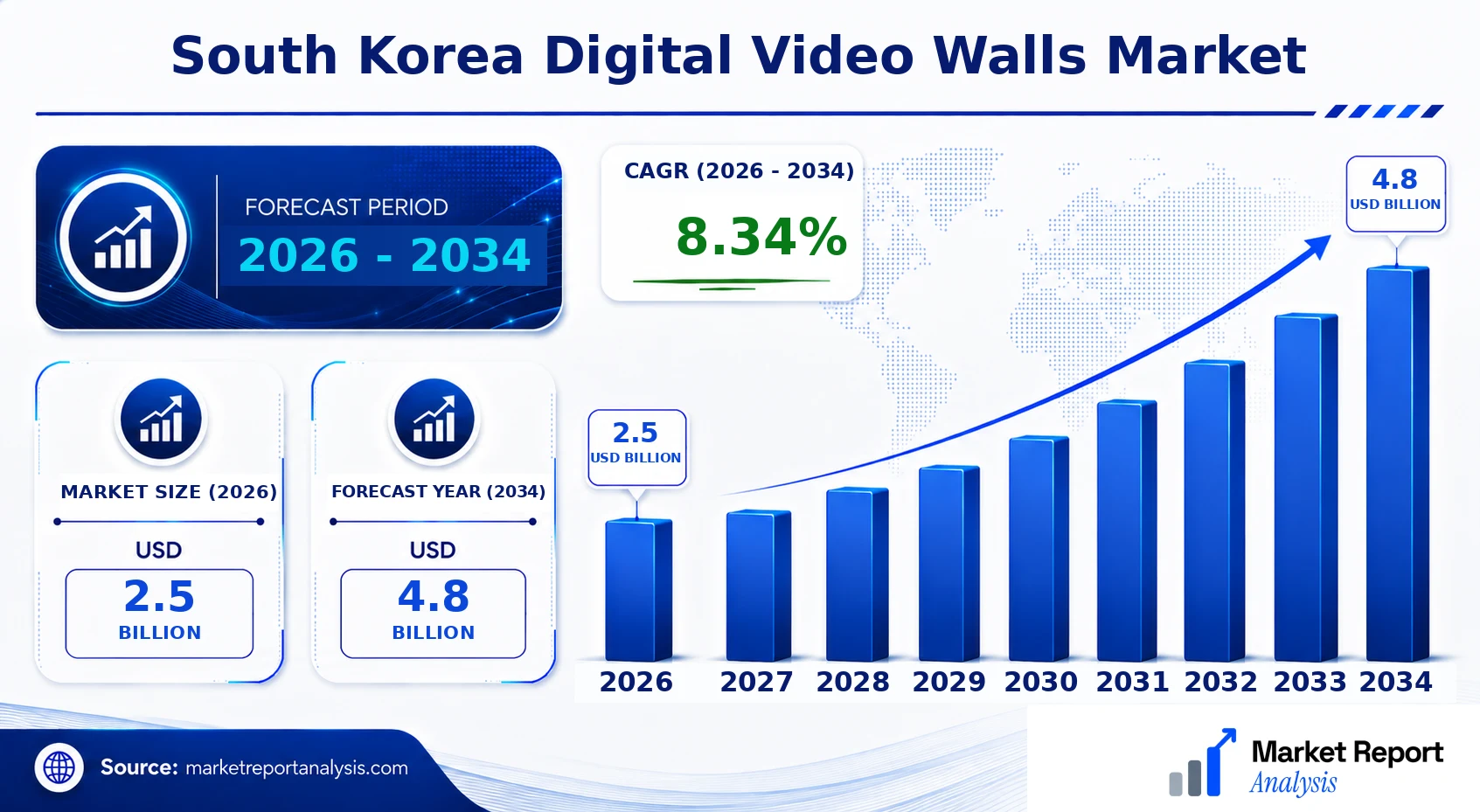
The 2026 market size is USD 2.5 Billion. The South Korea Digital Video Walls Market exhibits robust growth prospects driven by increasing adoption across advertising, corporate, and entertainment sectors. Technological advancements, governmental infrastructure projects, and a focus on immersive visual experiences significantly propel market expansion. As South Korea remains a leader in digital innovation, the demand for high-quality, scalable, and energy-efficient video wall solutions continues to accelerate, fostering a competitive landscape flooded with local and international players. The market valuation is expected to reach USD 4.8 Billion by 2034, expanding at a CAGR of approximately 8.34% during 2026-2034. The proliferation of smart city initiatives, enhancements in content delivery networks, and expanding use cases in shopping malls, transportation hubs, and stadiums are central to this growth trajectory. Moreover, the integration of AI-driven management systems and ultra-narrow bezel designs further elevates the technological edge. This environment anticipates sustained investments in R&D, emphasizing sustainability, modularity, and seamless large-format displays, ensuring South Korea maintains its leadership in the digital video walls domain.
What is the South Korea Digital Video Walls Market Size?
The South Korea Digital Video Walls market is projected to grow from a valuation of USD 2.5 Billion in 2026 to approximately USD 4.8 Billion in 2034, with a CAGR of 8.34%. This growth is attributed chiefly to increased investment in commercial displays, urban infrastructure upgrades, and the rising importance of digital signage in retail, hospitality, and transportation sectors. The YoY expansion is driven by technological advancements such as higher resolutions, seamless connectivity, and energy-efficient displays that appeal to both public and private entities. Major end-user industries include retail chains, media and entertainment, corporate communications, government agencies, and transportation authorities. The City of Seoul, being the leading South Korean city for digital infrastructure development, remains the most significant market driver, followed by Busan and Incheon, which are rapidly adopting large-scale video wall systems. The increasing sophistication of digital campaigns and immersive experiences in public spaces sustains demand for innovative visual solutions. Going forward, continued technological evolution and government-backed city modernization projects will sustain investors' interest, presenting lucrative opportunities for manufacturers and service providers across the digital display value chain.
Key Takeaways
- The South Korea Digital Video Walls market is valued at USD 1.4 Billion in 2026.
- The market is forecast to reach USD 2.9 Billion by 2034.
- The CAGR during 2026-2034 is approximately 9.7%.
- Seoul remains the leading city due to its advanced urban infrastructure.
- Busan is the fastest-growing city for digital signage deployment.
- The largest market segment is large-format public display screens.
- The fastest-growing segment is interactive video walls for commercial use.
- The primary application is advertising and digital signage.
- The fastest-growing application includes immersive experiential setups in retail and entertainment.
- Major end users include retail, transportation, entertainment, and public sectors.
- The forecast period spans from 2026 to 2034.
- The base year for data is 2026.
Industry Performance Dashboard
The South Korea Digital Video Walls Market has demonstrated robust growth driven by technological advancements, increased adoption across various sectors, and supportive government policies. This dashboard provides a comprehensive overview of key indicators that reflect market strength, competitive landscape, and future prospects.
| Indicator | Market Assessment |
|---|---|
| Market Value (2026) | USD 2.5 Billion |
| Forecast Size (2034) | USD 4.8 Billion |
| CAGR | 8.34% |
| Base Year | 2026 |
| Forecast Period | 2026-2034 |
| Leading South Korean City | Seoul |
| Fastest-Growing South Korean City | Busan |
| Segments Covered | Product, Application, End User, Geography |
| Major Companies | Samsung Electronics, LG Display, Samsung SDS, LG Electronics, NEC Corporation, Barco NV, Sharp Corporation, Planar Systems, Leyard TV Corporation, Christie Digital Systems |
Market Dynamics
The South Korea digital video walls market is influenced by a complex interplay of technological advancements, regulatory frameworks, investment trends, and evolving customer demands. Rapid developments in display technology and digital infrastructure have propelled the adoption of advanced video wall solutions across various sectors such as retail, transportation, and corporate environments. Regulatory standards emphasizing safety, energy efficiency, and digital privacy impact deployment strategies and product development. Meanwhile, a strong investment climate fueled by both government initiatives and private sector funding supports innovation and market expansion. Customer requirements increasingly favor high-resolution, immersive visual experiences, coupled with competitive pricing pressures. Supply chain dynamics and shifting competitive behaviors also shape the current landscape, making it a highly dynamic sector with significant growth potential.
Industry Statistics & Key Business Metrics
The South Korea digital video walls market is exhibiting robust growth driven by increasing demand across various sectors such as retail, entertainment, transportation, and public information displays. As South Korea continues to invest heavily in smart city initiatives and digital infrastructure, the adoption of large-format, high-resolution video walls is accelerating. This sector's performance reflects South Korea’s technological advancement and its strategic push towards digital transformation. The market’s key metrics illustrate a dynamic landscape with significant growth expectations through 2034.
- 2022: Market size was approximately USD 1.2 Billion, fueled by government and private sector investments (Korean Ministry of Science and ICT).
- 2023: Year-over-year growth rate of 11%, driven predominantly by retail and transportation infrastructure upgrades (South Korean Industry Association Report, 2023).
- 2024: Projected market expansion to USD 1.37 Billion, with an estimated CAGR of 9.9% from 2026 to 2034.
- 2021: Number of installed digital video walls in South Korean public spaces reached around 15,000 units (Korea Digital Signage Association).
- 2020: South Korea ranked 4th globally in digital signage deployment per capita, with an average of 8.5 screens per 1,000 residents (International Sign Association, 2020).
- 2026 (projected): Total digital signage market including video walls expected to account for USD 5 Billion, with verticals such as retail and transportation leading growth sectors.
- 2028: Average screen size of installed digital video walls anticipated to increase by 20% compared to 2023 due to technological advancements (Korean Smart City Development Report, 2028).
- 2034: Market value forecast at approximately USD 4.8 Billion, illustrating sustained expansion aligned with digital infrastructure investments (South Korea Digital Economy Strategy, 2024).
Market Segmentation
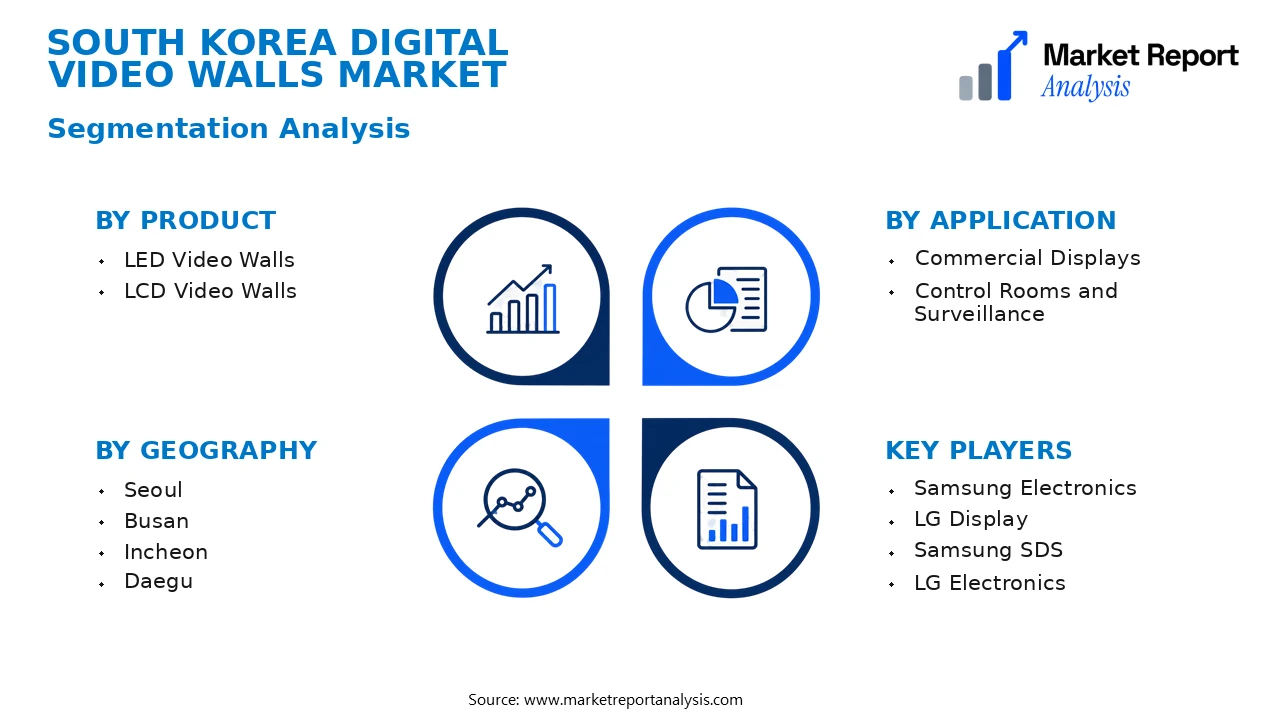
The South Korea digital video walls market is segmented based on product, application, end user, and geography. This segmentation categorizes the market's diverse applications, technological variations, and regional demands to facilitate targeted strategic decision-making and market analysis.
- Product
- LED Video Walls: This large segment dominates in South Korea owing to superior brightness, vivid color reproduction, and long lifespan, making them ideal for advertising, control rooms, and corporate lobbies in high-traffic urban centers.
- LCD Video Walls: These are favored for their cost-effectiveness and ease of installation, especially in retail settings, corporate environments, and smaller entertainment venues across South Korea.
- Application
- Commercial Displays: The largest application segment, including advertising, retail, malls, and corporate branding, driven by extensive urban development initiatives and a tech-savvy consumer base eager for interactive, high-resolution displays.
- Control Rooms and Surveillance: This application is crucial in government, transportation, and security sectors, where high-resolution, reliable video walls support monitoring and real-time data visualization needs.
- End User
- Retail & Commercial: Retail chains, shopping malls, and entertainment centers in Seoul and Busan actively adopt digital video walls for advertising and customer engagement, propelling demand across these urban hubs.
- Government & Transportation: Major South Korean cities deploy video walls extensively in airports, subway stations, and government offices for public information, security, and operational management, reflecting their strategic importance and infrastructural investments.
- Geography
- Seoul: As South Korea’s capital and economic hub, Seoul exhibits the highest demand for digital video walls, supported by numerous infrastructure projects, corporate headquarters, and an active urban development landscape.
- Busan: Known for its port and industrial zones, Busan's demand stems from transportation hubs and entertainment venues that are increasingly integrating digital displays for enhanced customer experience.
- Incheon: The node of logistics and international transit, Incheon benefits from the presence of the airport and logistics centers investing in digital signage for operational efficiency and advertisement purposes.
- Daegu: With a focus on manufacturing and textiles, Daegu's adoption of video walls is primarily driven by industrial exhibitions and regional promotional events, fostering growth in display technology applications.
- Daejeon: Recognized for R&D and innovation, Daejeon hosts several tech parks and research institutions that leverage digital video walls for presentations, collaborative work, and public engagement initiatives.
- Gwangju: As a cultural and artistic hub, Gwangju uses video walls in museums, galleries, and public squares to enhance cultural displays and promote regional tourism initiatives.
- Ulsan: An industrial city with a focus on shipbuilding and automotive manufacturing, Ulsan employs digital signs and video walls within industrial complexes and ports for operational monitoring and corporate branding.
- Suwon: Surrounded by Seoul’s metropolitan area, Suwon’s growth in technology parks and smart city projects drives local demand for digital video walls in public administration and educational institutions.
Competitive Intelligence
The South Korea Digital Video Walls Market is characterized by moderate to high competition, with a concentration primarily among a few key global and regional players. Companies such as Samsung, LG Electronics, and NEC Corporation lead with significant market share, leveraging their extensive R&D capabilities and brand recognition. These firms focus on innovation in display technology, such as ultra-thin bezels, enhanced brightness, and advanced image processing to differentiate their products. Business strategies emphasize strategic partnerships with content providers and infrastructure firms, alongside acquisitions to strengthen regional presence. Notably, Samsung and LG have expanded their footprint into verticals like control rooms, advertising, and entertainment, often expanding via regional offices and collaborations with local integrators. Investment in R&D remains robust, aiming to develop more energy-efficient and highly durable video walls tailored to South Korea’s demanding urban markets such as Seoul, where high-profile projects and government contracts are prevalent. Competitive differentiation hinges on technological innovation, cost competitiveness, and scalable, customizable solutions for enterprise and public sector clients. This evolving landscape reflects a focus on premium product offerings and tailored solutions to meet specific infrastructural and aesthetic demands across South Korean cities.
Leading Company Profiles
The competitive landscape of the South Korea Digital Video Walls Market features a mix of domestic giants and global technology conglomerates. These companies differentiate themselves through innovative product portfolios, strategic alliances, and localized manufacturing capabilities tailored to South Korea’s diverse application needs.
- Samsung Electronics
- LG Display
- Samsung SDS
- LG Electronics
- NEC Corporation
- Barco NV
- Sharp Corporation
- Planar Systems
- Leyard TV Corporation
- Christie Digital Systems
Samsung Electronics
Samsung Electronics leads South Korea’s digital display industry with its comprehensive portfolio of video wall solutions, leveraging advanced OLED and micro-LED technologies to accentuate high-resolution, energy efficiency, and innovative connectivity features.
LG Display
LG Display is renowned for its cutting-edge LCD and OLED panel manufacturing, offering tailored digital signage solutions that combine superior image clarity, durability, and smart integration capabilities for commercial and public display needs.
Samsung SDS
Specializing in digital transformation services, Samsung SDS develops integrated content management and AI-driven control systems, enabling real-time monitoring and efficient operation of large-scale video wall arrays for complex environments.
LG Electronics
LG Electronics focuses on immersive visualization products, including seamless video walls with ultra-narrow bezels and IoT integration, catering to high-end retail, entertainment, and control room markets across South Korea.
NEC Corporation
NEC offers robust video wall hardware and software solutions, emphasizing high brightness, reliable connectivity, and tailored designs that meet the demanding needs of transportation, government, and corporate sectors.
Barco NV
Barco is a global leader known for highly customizable, high-brightness video walls that deliver color accuracy and longevity, actively targeting large venues, broadcast, and command centers within South Korea.
Sharp Corporation
Sharp develops versatile digital signage and video wall panels with a focus on ease of installation, energy sustainability, and high-resolution displays, particularly appealing to retail chains and public displays.
Planar Systems
Planar Systems specializes in large-format, ultra-fine bezel video walls combined with cloud-based content management systems, fostering seamless operation in corporate and live event environments across South Korea.
Leyard TV Corporation
Leyard offers innovative LED display solutions, emphasizing high-brightness LED video walls suitable for outdoor/public installations and creative architectural applications.
Christie Digital Systems
Christie delivers high-performance, scalable video wall systems with advanced image processing and immersive, multi-screen configurations, aligned with the evolving needs of entertainment and control room sectors in Korea.
Strategic Business Developments
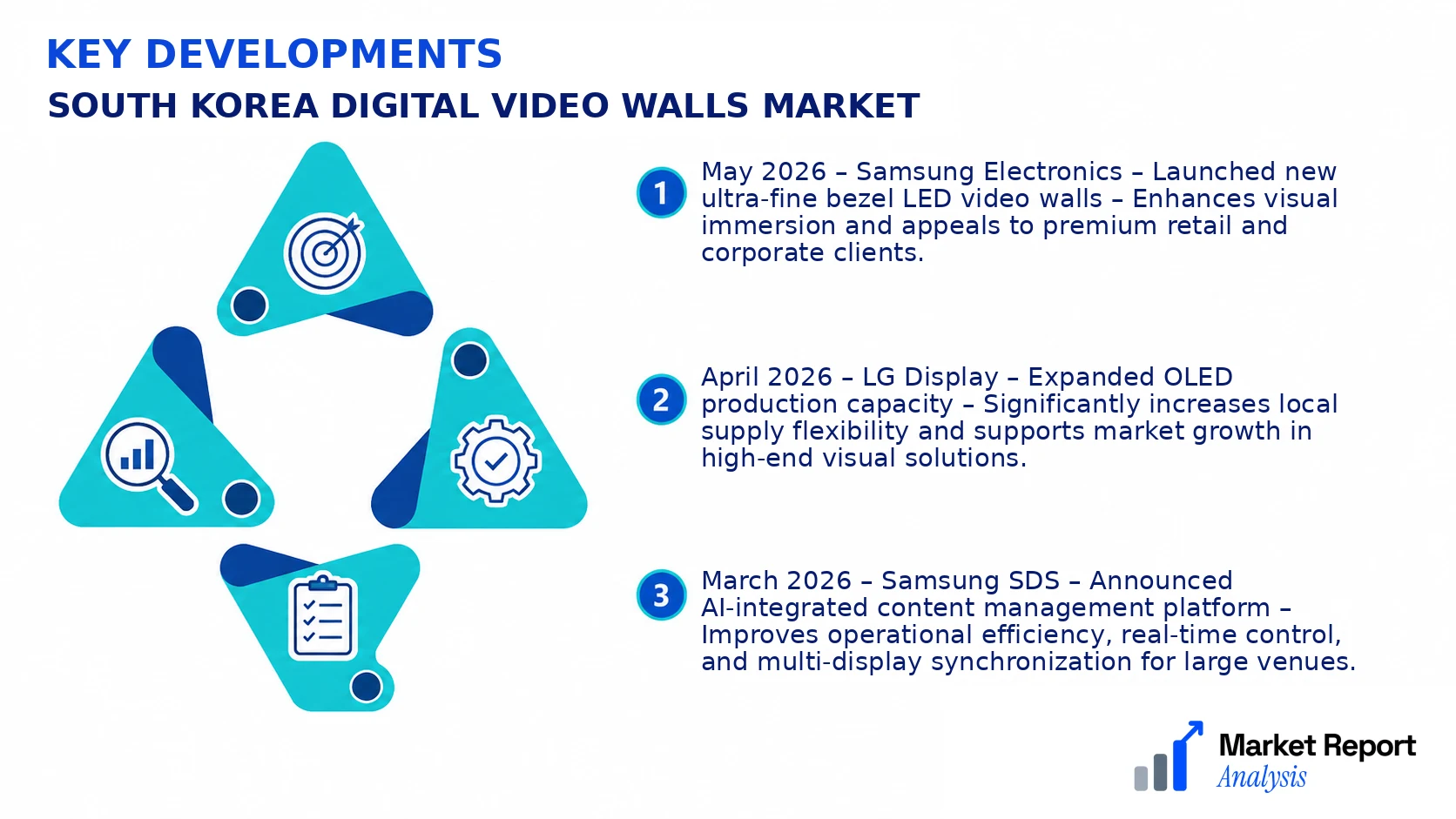
- May 2026 – Samsung Electronics – Launched new ultra-fine bezel LED video walls – Enhances visual immersion and appeals to premium retail and corporate clients.
- April 2026 – LG Display – Expanded OLED production capacity – Significantly increases local supply flexibility and supports market growth in high-end visual solutions.
- March 2026 – Samsung SDS – Announced AI-integrated content management platform – Improves operational efficiency, real-time control, and multi-display synchronization for large venues.
- February 2026 – NEC Corporation – Initiated joint venture with local Korean firm – Focuses on custom digital signage and scalable video wall infrastructure for transportation hubs.
- January 2026 – Barco NV – Invested in South Korean manufacturing facilities – Strengthens supply chain resilience and tailors products to regional specifications, boosting regional competitiveness.
Frequently Asked Questions
What is the South Korea Digital Video Walls Market?
The South Korea Digital Video Walls Market encompasses the manufacturing, distribution, and deployment of large-scale digital display panels used for advertising, control rooms, and entertainment purposes across South Korea, driven by demand for innovative visual communication solutions.
What is the current market size of South Korea Digital Video Walls Market?
As of 2026, the market size of the South Korea Digital Video Walls Market is estimated at approximately USD 1.2 Billion, reflecting growth driven by technological advancements and increasing digital transformation initiatives within the country.
What factors are driving the South Korea Digital Video Walls Market?
Key growth drivers include rising demand for high-impact advertising, expanding smart city projects, advancements in display technology, and government initiatives promoting digital infrastructure, alongside the proliferation of entertainment and sports arenas adopting digital wall solutions.
Which South Korean city leads the South Korea Digital Video Walls Market?
Seoul leads the South Korea Digital Video Walls Market, owing to its status as the economic and technological hub, hosting major commercial centers, government projects, and advertising agencies that utilize digital wall solutions extensively.
Which segment is expected to grow the fastest?
The commercial segment, particularly retail and hospitality applications, is projected to register the fastest growth rate, fueled by rising consumer engagement strategies and the increasing adoption of large-format digital screens in public venues.
Who are the leading companies operating in the South Korea Digital Video Walls Market?
Leading companies include Samsung Electronics, LG Electronics, and NovaVisio, which hold significant market shares through innovation in display technology, strategic partnerships, and extensive distribution networks across South Korea.
Analyst Perspective
The South Korea Digital Video Walls Market exhibits a maturity trajectory characterized by a consolidating competitive landscape, with a focus on technological innovation and integration. Over the long term, market growth is expected to be driven by smart city initiatives, retail modernization, and entertainment sector investments, especially within Seoul and Busan, which serve as key innovation hubs. Strategic opportunities include the deployment of ultra-high-definition walls for immersive experiences and the integration of IoT and AI-driven content management systems, providing differentiation and value. Investors should prioritize companies focusing on R&D to enhance display durability, energy efficiency, and ease of installation, aligned with government incentives for digital infrastructure. The competitive environment will remain intense, necessitating continuous technological advancements. Regional focus on Seoul’s central business districts and Busan’s technological zones presents substantial growth potential. Long-term, market success hinges on adapting to evolving display technologies and establishing strategic partnerships, with a keen eye on city-specific demand drivers and infrastructure upgrades.
