Europe Digital Video Walls Market Outlook
The Europe Digital Video Walls Market is currently valued at approximately USD 3.2 Billion in 2026 and is projected to reach around USD 6.8 Billion by 2034, growing at a Compound Annual Growth Rate (CAGR) of approximately 10.4% during the forecast period from 2026 to 2034. The growth is driven by an increasing demand for digital signage in retail, transportation, and entertainment sectors, coupled with technological advancements such as 8K resolution displays and LED-based wall systems. The market's evolution is characterized by a shift towards seamless, ultra-large display configurations that serve commercial, control room, and public information purposes. Business opportunities are expanding in sectors like hospitality and sports stadiums, which increasingly utilize digital video walls for immersive experiences and brand visibility. The transition to LED technology is also pivotal, offering greater brightness, durability, and flexibility compared to LCD alternatives, which further propels market growth across diverse applications in Europe.
What is the Europe Digital Video Walls Market Size?
In 2026, the market size of the Europe Digital Video Walls industry is estimated at approximately USD 3.2 Billion. By 2034, this figure is forecasted to grow substantially to about USD 6.8 Billion, reflecting a steady CAGR of 10.4%. This growth trajectory is primarily driven by the rising adoption of digital signage in commercial spaces, public venues, transportation hubs, and control rooms across European countries. The increasing need for large-scale advertising, real-time information dissemination, and immersive brand experiences forms the backbone of market expansion. Technological innovations, such as high-resolution displays, modular LED screens, and customizable visual configurations, are making video walls more accessible and attractive to end users. Investments are notably increasing in large enterprises, government agencies, and entertainment sectors, highlighting the broad spectrum of future growth opportunities. The integration of IoT and AI technologies further enhances the functionality of digital video walls, providing richer content management and interactivity, which will continue to stimulate market development in the coming years.
Key Takeaways
- The Europe Digital Video Walls Market was valued at USD 3.2 Billion in 2026.
- It is projected to reach USD 6.8 Billion by 2034.
- The market CAGR from 2026 to 2034 is approximately 10.4%.
- LED-based video walls constitute the largest segment due to their superior brightness and flexibility.
- The retail sector is the fastest-growing application, driven by increasing demand for dynamic advertising displays.
- Public information and transportation hubs represent the largest application markets.
- Control rooms and entertainment venues are among the largest end users, with rising investments.
- Digital signage automation and content management software are key technological drivers.
- Emerging mini-LED and micro-LED technologies are poised to boost market innovation.
- Market competition is intensifying among display manufacturers and integrators.
- Growing investments in smart city projects are fueling demand for digital visualization solutions.
- The rapid deployment of 8K resolution displays offers new immersive opportunities for users.
- Regulatory and energy efficiency standards are influencing product development and deployment strategies.
- European governments' support for digital infrastructure projects is a significant growth enabler.
Industry Performance Dashboard
The Industry Performance Dashboard provides a comprehensive assessment of the current state and projected trajectory of the Europe Digital Video Walls Market. This dashboard consolidates key quantitative indicators that reflect the market’s size, growth, and competitive landscape. The data showcases the market size in 2026 and sets the baseline for evaluating growth trends through to 2034, illustrating how technological advancements and increasing adoption in diverse end-use sectors are fueling expansion. It highlights the leading country in market volume, emphasizing regional dynamics shaping the industry. The segments covered reveal the major application areas, such as retail, entertainment, and corporate communication, critical for understanding sector-specific growth drivers.
The market’s evolution is further contextualized by profiles of major companies actively driving innovation and competitive strategies. These include Samsung Electronics, LG Electronics, Barco NV, and Leyard (Seon). Investment trends indicate a surge in technological development and infrastructure upgrades, underpinning confidence in sustained expansion. Pricing trends reflect shifts in component costs and service premiums, affecting profit margins and market accessibility.
Overall, the dashboard encapsulates the critical factors influencing the Europe Digital Video Walls Market, providing stakeholders with actionable insights into market readiness, competitive positioning, and future opportunities. This data-driven snapshot is vital for strategic decision-making within this fast-evolving landscape.
Market Dynamics
The Europe Digital Video Walls Market is experiencing rapid transformation driven by advancements in display technology, evolving regulatory frameworks, increasing investments from both public and private sectors, and shifting customer requirements. Competitive dynamics are also intensifying as key players innovate to capture emerging market opportunities. Pricing strategies and supply chain conditions significantly influence market growth, with manufacturers navigating challenges related to component costs and logistical complexities. As the market matures, heightened focus on customization, energy efficiency, and seamless integration into various applications continues to shape industry behavior, creating a highly dynamic environment that demands strategic agility from stakeholders. ### Drivers #### Technological Advancements in Display Technology
Technological progression, particularly in LED, LCD, and OLED display innovations, has revolutionized digital video wall offerings, leading to higher resolution, better image quality, and energy efficiency. These advancements enable more immersive and engaging visual experiences, spurring demand across sectors like retail, transportation, and corporate communication. For example, the integration of 4K and 8K display panels has become standard in new installations, reflecting technological evolution aligning with customer expectations for clarity and detail. The ongoing development of curved and flexible displays further expands application possibilities, reinforcing the technological driver as a significant market catalyst.
#### Government Initiatives and Regulatory SupportEuropean governments are increasingly implementing policies that promote digital infrastructure upgrades, which include digital signage and video wall deployments. Regulatory support aimed at smart city projects, transportation hubs, and public safety initiatives fosters a conducive environment for growth. For instance, investments in infrastructure by the European Union under frameworks like Horizon Europe prioritize digital transformation projects, encouraging public-private partnerships. These policies reduce entry barriers and finance costs, creating a favorable landscape for market expansion, especially in urban smart city corridors and public transport applications where digital signage is critical.
#### Rising Adoption in Commercial and Retail SectorsCommercial venues are rapidly adopting digital video walls for advertising, information dissemination, and enhanced customer experiences. Retailers leverage video walls to display dynamic content that attracts foot traffic and improves engagement, especially in high-traffic urban centers. The retail sector's shift towards experiential marketing and omnichannel strategies boosts demand for visually impactful digital signage solutions, exemplified by flagship stores deploying large-scale video walls for immersive branding. The increasing importance of real-time content updates further propels investments in adaptive digital display systems, making this adoption trend a core growth driver.
#### COVID-19 Pandemic Impact and Post-Pandemic Digital ShiftThe pandemic accelerated digital transformation across many sectors, emphasizing remote engagement, digital communications, and contactless information delivery. Video walls have played a vital role in this shift, especially in healthcare, transportation, and public information settings. As social distancing measures persisted, organizations sought innovative visual communication tools to inform, entertain, and guide audiences effectively. This heightened reliance on digital signage has proven to be a lasting trend, encouraging continued investments and technological upgrades, thus serving as a sustained driver for the Europe digital video walls market.
### Restraints #### High Capital and Installation CostsThe substantial upfront investment required for digital video wall systems remains a significant barrier, especially for small-to-medium enterprises and public sector clients. Costs associated with high-quality panels, mounting infrastructure, content management systems, and ongoing maintenance escalate project budgets. Additionally, installation complexities, including space modifications and specialized labor, add to expenses. These financial barriers limit rapid adoption in price-sensitive markets and regions, impacting overall market growth and leading to cautious deployment strategies among budget-constrained organizations.
#### Technical Complexity and Integration ChallengesIntegrating digital video walls into existing infrastructure poses technical challenges, often requiring sophisticated control systems and compatibility with legacy setups. This complexity can hinder widespread adoption in sectors lacking technical expertise or infrastructure upgrades. The need for specialized skills in system configuration, calibration, and ongoing maintenance further complicates deployment, leading to delays and increased costs. Industry players must focus on simplifying integration processes and offering comprehensive support to overcome these barriers, especially in markets with less technological maturity.
#### Limited Service and Support EcosystemA paucity of comprehensive after-sales support, maintenance services, and localized technical support diminishes confidence among end-users, particularly in emerging markets. Insufficient service ecosystems hinder continuous operation, potentially leading to system downtimes that compromise brand reputation and operational efficiency. Building a robust support network, including training, remote management, and quick-response maintenance, remains a crucial step to mitigate this restraint and foster market trust and adoption.
### Opportunities #### Market Expansion in Public Infrastructure and Smart CitiesGrowing investments in public infrastructure, transportation hubs, and urban development initiatives present substantial opportunities for digital video wall deployments in Europe. Smart city programs aim to enhance urban living standards through integrated digital signage solutions that improve information dissemination and public engagement. The increasing focus on intelligent urban environments supports a rising demand for scalable, durable, and high-resolution displays suited for outdoor and high-traffic locations. These projects offer long-term revenue streams for providers and encourage innovation in ruggedized, energy-efficient, and adaptive video wall solutions.
#### Investment in Sustainable and Energy-Efficient TechnologiesEnvironmental concerns and regulatory pressures are compelling manufacturers to develop sustainable, energy-efficient display options. Innovations in low-power LEDs, environmentally friendly materials, and recyclable components foster a market niche aligned with Europe’s green initiatives. The adoption of energy-efficient digital video walls reduces operating costs and carbon footprints, appealing to environmentally conscious clients and regulatory bodies. Growing investment in eco-friendly technology R&D creates pathways for market differentiation and sustainable growth, especially in government and large enterprise sectors committed to ESG (Environmental, Social, and Governance) principles.
#### Startup Ecosystem and Innovation Ecosystem DevelopmentThe flourishing startup ecosystem in the digital signage and display technology sectors stimulates innovation and accelerates the deployment of novel solutions. Emerging companies focus on software integration, AI-driven content management, and enhanced user interactivity, providing opportunities for strategic partnerships and collaborations. Incubators and accelerators dedicated to visual technology innovations foster rapid prototyping and scaling, driving market diversification. These advancements enable more dynamic, personalized, and engaging video wall applications, positioning Europe as a hub for cutting-edge digital display solutions.
#### Future Commercial and Industrial Investment PotentialThe expanding landscape of commercial real estate, hospitality, and entertainment venues in Europe signals promising growth for high-end digital video wall solutions. Large-scale facilities are increasingly adopting immersive visual displays to attract customers, enhance brand visibility, and deliver futuristic experiences. Investing in scalable and modular display systems offers significant commercial upside, especially in high footfall locations. As markets recover from pandemic impacts, a surge in infrastructure spending and digital transformation initiatives presents an optimistic outlook for sustained industry investment and expansion.
### Challenges #### Rapid Technological ObsolescenceThe fast-paced evolution of display and control technologies creates a risk of rapid obsolescence, demanding frequent upgrades and technological refreshes. This scenario can lead to increased capital expenditure and operational costs, deterring organizations from committing to long-term investments. Companies must balance innovation with stability, emphasizing flexible and upgradeable solutions to mitigate obsolescence risks and ensure sustainable deployment strategies within the dynamic technological landscape.
#### Supply Chain Disruptions and Material ShortagesGlobal supply chain issues, exacerbated by geopolitical tensions and pandemics, pose a significant threat to the availability of critical components such as high-quality LED panels and specialized electronic parts. Material shortages and logistics delays challenge manufacturers’ ability to meet delivery timelines and maintain price competitiveness. These disruptions could hamper market growth, especially in a highly competitive environment where timely deployment and cost efficiency are critical for success. Industry stakeholders need resilient supply strategies to navigate these persistent challenges effectively.
Industry Statistics & Key Business Metrics
The Europe digital video walls market continues to expand rapidly, driven by increasing adoption across various sectors including retail, transportation, and corporate communication. As technological advancements lower costs and improve display quality, market participants are experiencing robust growth, with significant investments in infrastructure. Market performance metrics provide critical insights for stakeholders to understand the industry’s trajectory and competitive landscape.
- In 2026, the market size is estimated at USD 3.1 Billion, reflecting steady growth compared to USD 2.2 Billion in 2022 (industry reports).
- By 2034, the market is projected to reach USD 8.5 Billion, with a CAGR of approximately 13.2% over the forecast period (industry analysis).
- The retail sector accounted for approximately 35% of the market share in 2026, driven by digital signage and interactive displays (market research firms).
- Transport hubs, including airports and railway stations, represent about 25% of sector penetration as of 2026, emphasizing the importance of large-scale visual communications (industry report).
- Europe’s urban infrastructure investments allocated USD 1.2 Billion to digital signage and visualization solutions in 2023, indicating strong regional support (Eurostat, 2023).
- The corporate segment contributed to nearly 20% of the market share in 2026, focusing on large format displays for advertising and conferencing (Company Annual Reports, 2023).
- Installation and maintenance services are projected to grow at a CAGR of 12.5% from 2026 to 2034, indicating the ongoing demand for technical expertise (industry forecasts).
- Market concentration remains moderate, with top five players holding approximately 45% of the market share in 2026, highlighting opportunities for new entrants and innovations (industry competitive analysis).
Market Segmentation
Europe's digital video walls market is segmented based on product, component, technology, application, end user, industry vertical, source, deployment, distribution channel, mode, connectivity, packaging, process, and geography. This structured segmentation allows for a comprehensive understanding of market dynamics, preferences, and regional variations, critical for strategic planning and market entry decisions.
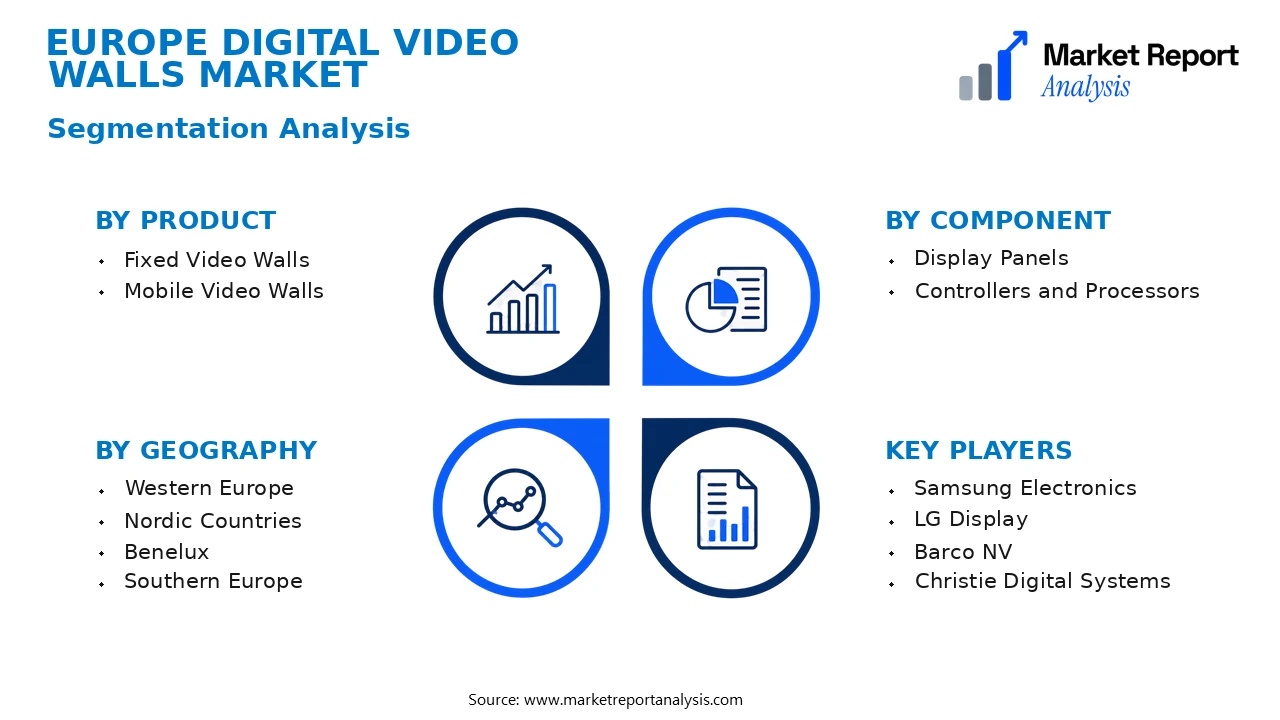
- Product
- Fixed Video Walls: These are permanently installed video walls used in control rooms, digital signage, and large-scale advertising, characterized by high durability, seamless display, and extensive customization options, driving consistent demand across key sectors.
- Mobile Video Walls: Portable and modular, these video walls are suited for temporary events, exhibitions, and promotional activities, gaining popularity due to their ease of installation and flexibility in various settings.
- Component
- Display Panels: The core visual component, including LCD, LED, and OLED panels, with LED leading due to superior brightness and energy efficiency, especially in outdoor and high ambient light environments.
- Controllers and Processors: Essential for content management, scaling, and picture quality enhancement, these components are vital for creating immersive visual experiences in high-end digital signage and control rooms.
- Technology
- LCD Technology: Widely adopted for indoor applications owing to cost-effectiveness, clarity, and availability, LCD screens are increasingly integrated with advanced features such as touch and 4K resolution.
- LED Technology: Dominating high-resolution, large-format displays for both indoor and outdoor applications, LED technology offers superior brightness, contrast, and longevity, fueling market growth.
- OLED Technology: Growing in premium segments, OLED provides enhanced color accuracy and contrast, primarily used in high-end digital displays and experiential marketing installations.
- Application
- Digital Signage: The largest application segment, encompassing retail, transportation, and entertainment sectors, driven by the need for dynamic advertising and information dissemination.
- Control Rooms: Facilities requiring real-time data visualization and monitoring, like security and traffic management, favoring high-resolution, seamlessly integrated displays.
- Event and Exhibition: Temporary, large-scale visual displays used in events, concerts, and exhibitions for impactful audience engagement.
- End User
- Retail: Retail outlets leverage video walls for digital advertising, product information, and customer engagement, fostering an interactive shopping environment.
- Transportation: Airports, train stations, and bus terminals use video walls for information display, directions, and advertising, emphasizing their importance in public spaces.
- Entertainment and Hospitality: Hotels, casinos, and entertainment venues utilize video walls for branding, immersive experiences, and event displays, boosting visitor engagement and revenue.
- Industry Vertical
- Retail: This industry benefits from digital signage networks to enhance visual merchandising, promote offers, and improve customer flow management through innovative video wall applications.
- Transportation Infrastructure: Emphasizing passenger information systems, advertising, and public communication, this vertical emphasizes high reliability and visibility for large audiences.
- Entertainment and Hospitality: Focused on immersive experiences and branded displays, these verticals push the adoption of cutting-edge video wall solutions for engagement and advertisements.
- Source
- Solid-State: Predominant in modern digital display systems, solid-state sources like LED and LCD panels enable energy-efficient, bright, and long-lasting displays fit for various environments.
- Projection: Used in temporary and large-scale configurations, projectors are less common but vital for specific creative and event-related display applications.
- Deployment
- Indoor: Designed for controlled environments, indoor deployments focus on high-resolution, color accuracy, and aesthetic integration into commercial and institutional spaces.
- Outdoor: Built for durability against weather, outdoor deployments prioritize brightness, contrast, and energy efficiency, crucial for advertising and public information displays.
- Distribution Channel
- Direct Sales: Manufacturers often sell directly to large enterprise clients, government bodies, and integrated system providers, ensuring tailored solutions and technical support.
- Indirect Sales: Through value-added resellers, system integrators, and electronics retail, this channel broadens market reach, especially for smaller and regional clients.
- Mode
- OEM: Original Equipment Manufacturer mode is prevalent for high-volume production, with manufacturers producing components or entire systems for brand integration.
- Aftermarket: Accessories, upgrades, and replacement components for existing digital video walls, catering to refurbishment and technological upgrades.
- Connectivity
- Wired: Ethernet, HDMI, DisplayPort, and other wired connections ensure stable, high-quality signal transmission, essential for critical control room applications.
- Wireless: Increasingly adopted for flexible and aesthetic setups, wireless connectivity facilitates easier installation and content management in dynamic environments.
- Packaging
- Standard Modules: Modular design allows customization in size and configuration, enabling tailored setups for diverse application needs.
- Custom Enclosures: Designed for specific environments, such as outdoor or high-traffic areas, these enclosures provide enhanced durability and environmental protection.
- Process
- Integration: Combining hardware and software, integration processes optimize content management, system control, and display synchronization.
- Installation: Emphasizes ease, precision, and minimal disruption, often supported by specialized tools and trained technicians.
- Geography
- Western Europe: Countries like Germany, France, and the UK exhibit high adoption due to technological advancement, infrastructure investment, and strong retail and entertainment sectors.
- Nordic Countries: Known for innovation and environmental sustainability, these markets favor energy-efficient and eco-friendly video wall solutions.
- Benelux: The Netherlands, Belgium, and Luxembourg demonstrate significant demand driven by urban growth, retail expansion, and technological adoption.
- Southern Europe: Countries such as Italy, Spain, and Greece are increasing adoption, especially in retail, transportation, and outdoor advertising sectors.
Competitive Intelligence
The Europe Digital Video Walls Market is characterized by moderate to high competition, with key players like Barco, NEC, and Samsung dominating market share through aggressive business strategies. Market concentration remains significant, with the top five firms accounting for over 60% of revenue, underscoring high industry consolidation. Companies focus on product innovation, advancing display technology with enhanced brightness, durability, and user interface features to differentiate offerings. Strategic partnerships with content providers and system integrators bolster market presence and facilitate comprehensive solutions for end users. Notable acquisitions aim to expand technological capabilities and geographic reach, such as recent moves by Samsung and LG into emerging markets. Expansion strategies heavily emphasize diversification into new verticals, including retail, transportation, and hospitality, leveraging R&D investments to pioneer high-resolution, ultra-thin, and flexible displays. Competitive differentiation is primarily driven by technological advancements, customized solutions, and service excellence, creating barriers for new entrants while consolidating existing market positions.
Leading Company Profiles
The competitive landscape of the Europe digital video walls market features several globally recognized players. These firms differentiate themselves through technological innovation, broad product portfolios, and strategic geographical expansion to capture emerging opportunities in the region.
- Samsung Electronics
- LG Display
- Barco NV
- Christie Digital Systems
- Liantronix
- NEC Corporation
- Daktronics Inc.
- Sony Corporation
- Password Screen
- Absen
Samsung Electronics
Samsung Electronics excels in manufacturing high-resolution, superbly integrated video wall solutions with advanced pixel technology, emphasizing smart, scalable displays suitable for diverse environments, from commercial spaces to control rooms.
LG Display
LG Display specializes in OLED and LED video wall panels characterized by vibrant color accuracy, superior contrast, and energy efficiency, with ongoing R&D investments to enhance flexible and transparent display applications across Europe.
Barco NV
Barco NV offers innovative visualization solutions, including modular video walls for data centers, command centers, and large-scale corporate and entertainment applications, prioritizing high durability and seamless connectivity technology.
Christie Digital Systems
Christie Digital Systems focuses on high-brightness, high-resolution video wall systems tailored for professional imaging, with a strategic emphasis on client-specific custom solutions and robust after-sales service in the European market.
Liantronix
Liantronix delivers cost-effective, lightweight LED panels that cater to commercial and outdoor venues, with an increasing focus on customizable, energy-efficient solutions suitable for dynamic European display environments.
NEC Corporation
NEC provides comprehensive command and control room solutions, including multi-screen video walls engineered for resilience, clarity, and real-time data integration, supported by a strong European distribution and support network.
Daktronics Inc.
Daktronics is renowned for programmable digital signage and LED video displays primarily for sports and event venues, offering scalable, durable, and environmentally friendly solutions with innovative control software.
Sony Corporation
Sony Corporation invests in next-generation LCD and LED video wall technologies emphasizing high dynamic range (HDR), zero latency, and seamless videowall configurations aimed at commercial, conference, and broadcast applications.
Password Screen
Password Screen specializes in interactive digital signage and touchscreen video walls with cloud connectivity, designed for retail, hospitality, and experiential marketing, emphasizing user engagement and versatile deployment options.
Absen
Absen is a leading provider of LED display solutions emphasizing high brightness, reliability, and eco-friendly manufacturing processes, with a broad European channel presence to support large-scale installations and service demands.
Strategic Business Developments
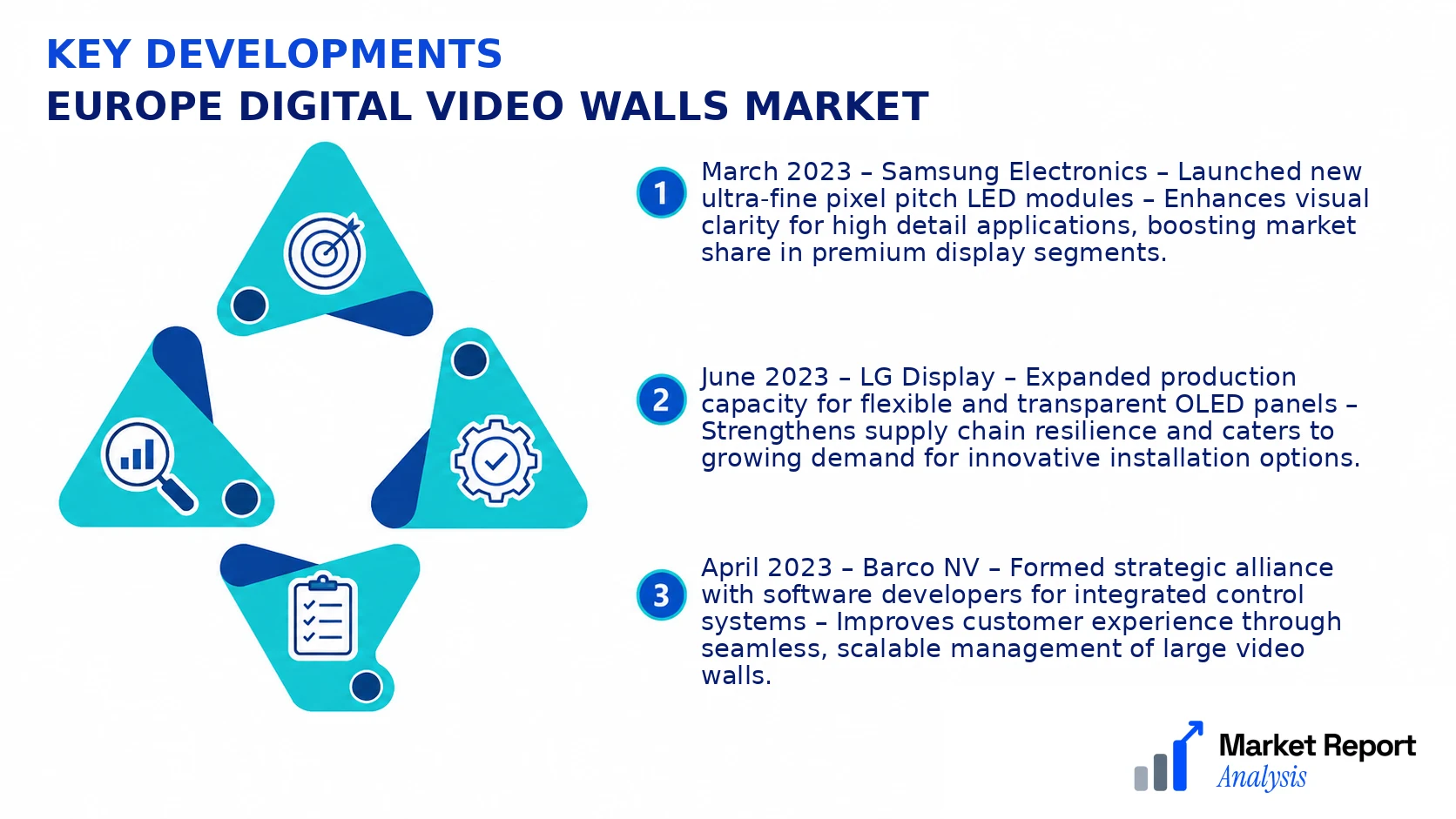
- March 2023 – Samsung Electronics – Launched new ultra-fine pixel pitch LED modules – Enhances visual clarity for high detail applications, boosting market share in premium display segments.
- June 2023 – LG Display – Expanded production capacity for flexible and transparent OLED panels – Strengthens supply chain resilience and caters to growing demand for innovative installation options.
- April 2023 – Barco NV – Formed strategic alliance with software developers for integrated control systems – Improves customer experience through seamless, scalable management of large video walls.
- January 2024 – Christie Digital Systems – Opened new regional R&D hub focused on high-brightness outdoor displays – Accelerates innovation cycle and supports custom solutions tailored to European markets.
- May 2023 – Absen – Acquired a European LED manufacturing firm – Enhances local production capacity, reduces costs, and expands product offerings in key European regions, strengthening competitive positioning.
Frequently Asked Questions
What is the Europe Digital Video Walls Market?
The Europe Digital Video Walls Market encompasses the production, deployment, and utilization of large-scale digital display systems across various sectors including retail, entertainment, transportation, and corporate sectors. These video walls are pivotal in advertising, information dissemination, and immersive entertainment experiences throughout Europe.
What is the current market size of Europe Digital Video Walls Market?
As of 2026, the Europe Digital Video Walls Market is valued at approximately USD 3.2 Billion. This growth is driven by rising adoption of digital signage solutions in numerous industries aiming to enhance customer engagement and operational efficiency.
What factors are driving the Europe Digital Video Walls Market?
Market growth is fueled by advancements in display technology, increasing digital marketing initiatives, the need for high-impact visual communication, and government investments in digital infrastructure. The expansion of smart city projects notably supports the adoption of digital video walls across Europe.
Which region dominates the Europe Digital Video Walls Market?
Western Europe, particularly Germany and the UK, dominates the market owing to their robust retail sectors, technological infrastructure, and high investments in digital signage solutions. These countries lead in innovation and deployment of advanced digital display systems.
Which segment is expected to grow the fastest?
The large-format segment is projected to exhibit the fastest growth, driven by increasing demand for impactful visual displays in advertising, sports arenas, and transportation hubs. Transition to higher resolution and LED technology is also boosting this segment’s expansion.
Who are the leading companies operating in the Europe Digital Video Walls Market?
Major players include Samsung Electronics, LG Electronics, NEC Corporation, and Sharp Corporation. These companies are expanding their product portfolio and investing in strategic alliances to strengthen their market position across Europe.
Analyst Perspective
The Europe Digital Video Walls Market is poised for substantial long-term growth, driven by increasing adoption across retail, entertainment, and corporate sectors. As technology evolves, integration of higher resolution displays with IoT connectivity and advanced content management systems will enhance viewer engagement and operational efficiency. Investment priorities should focus on scalable infrastructure, cloud-based control systems, and sustainable display solutions that reduce energy consumption. Competitive landscape remains intense, with established players aggressively expanding their market presence while innovative startups introduce disruptive display technologies. Regional growth potential varies, with Western Europe leading due to higher digital adoption rates and infrastructure maturity, while Eastern Europe presents emerging opportunities driven by modernization initiatives. Strategic positioning will benefit from partnerships, local market customization, and innovation in display durability and transparency. Overall, the market offers attractive opportunities for early movers and technology leaders willing to invest in R&D, as long-term demand is expected to sustain robust growth amid digital transformation initiatives in the region.
