Digital Video Walls Market Outlook
The digital video walls market is currently experiencing significant growth driven by advancements in display technology, the increasing need for immersive visual experiences across various industries, and the rising deployment of large-scale advertising and information displays in urban environments. In 2026, the market value is estimated at USD 4.5 Billion, with projections indicating a rise to USD 8.3 Billion by 2034. This expansion corresponds to a compound annual growth rate (CAGR) of approximately 8.2% over the forecast period from 2026 to 2034. The primary demand stems from sectors such as entertainment, corporate, retail, and transportation, where high-resolution, seamless display solutions are critical. Technological innovations, particularly in LED and LCD panel efficiencies, flexible display architectures, and improved connectivity protocols, are facilitating this growth. Concurrently, the adoption of cloud integration and IoT-enabled management solutions presents new commercial opportunities. The market’s trajectory suggests an increasing preference for customizable, scalable, and cost-effective video wall solutions, driven by a surge in urban-centric digital signage projects and experiential marketing initiatives.
What is the Digital Video Walls Market Size?
The digital video walls market is projected to grow from a valuation of USD 4.5 Billion in 2026 to approximately USD 8.3 Billion by 2034. This represents a robust CAGR of 8.2% during the forecast period. This growth is fueled by rising investments in large-format display installations across various end-use industries, including retail, transportation, corporate, and entertainment sectors. The increasing demand for high-impact visual communication, coupled with technological advances making displays more affordable, durable, and energy-efficient, helps expand market opportunities. Countries with high urban density and a focus on smart city initiatives are particularly significant markets for digital video wall deployment. Innovations such as pixel pitch reduction, enhanced durability, and modular design allow customization for specific applications, thereby broadening adoption. Future investment avenues include development in flexible and transparent display technologies, smart building integration, and interactive display solutions, further expanding the market landscape into new verticals and geographies.
Key Takeaways
- The digital video walls market is expected to reach USD 8.3 Billion by 2034, up from USD 4.5 Billion in 2026.
- The CAGR over the forecast period (2026-2034) is 8.2%, indicating consistent growth driven by technological advancements and increased demand.
- Leading regions include North America, Europe, and Asia-Pacific, with rapid growth in emerging markets driven by urbanization and infrastructure development.
- Primary end-use sectors are retail, transportation, corporate, and entertainment, which demand large-scale, high-resolution display solutions.
- Technological innovations in LED and LCD displays, along with modular and flexible display architectures, are fueling market expansion.
- The shift towards smart city projects and digital signage in urban areas creates substantial commercial opportunities.
- Increased investment in interactive and transparent display technologies is expected to open new verticals.
- Market growth is supported by advancements in connectivity, IoT integration, and AI-driven content management systems.
- Competitive landscape is marked by key players focusing on product innovation, strategic alliances, and ecosystem expansion.
- Regulatory frameworks emphasizing safety, environmental sustainability, and standards compliance influence market dynamics.
- The rising adoption of cloud-based solutions for content management enhances operational efficiency and scalability.
- Market players are exploring eco-friendly glass and substrate materials to address sustainability concerns.
- Overall, the digital video walls industry exhibits a durable growth pattern, creating diverse opportunities for investors and manufacturers alike.
Industry Performance Dashboard
The Industry Performance Dashboard for the global digital video walls market provides a comprehensive overview of key metrics and insights. It highlights the market's evolution, current status, and future projections, supported by quantitative data. The dashboard starts by detailing the market size, with the 2025 valuation, the current estimated size for 2026, and the forecasted value for 2034, emphasizing the market's growth trajectory. The compound annual growth rate (CAGR) from 2026 to 2034 is also articulated, reflecting industry expansion prospects. The base year for the analysis is 2026, with a forecast period extending through 2034, capturing long-term trends. It notes the leading country as the United States, which plays a pivotal role in market demand and innovation. Covered segments include hardware, software, and service categories, illustrating diversification within the market. Major companies, such as Samsung Electronics, LG Electronics, and Barco, are identified as key players, underpinning the competitive landscape. This dashboard offers stakeholders a clear snapshot of the market's health, strategic opportunities, and competitive positioning, underpinned by precise, consistent financial metrics and regional insights. Overall, the dashboard supports informed decision-making and strategic planning by consolidating critical industry data into a structured, accessible format.
Market Dynamics
The digital video walls market is experiencing dynamic transformation driven by rapid technological advances, evolving customer requirements, regulatory considerations, and fluctuating supply chain conditions. Innovation in display technologies, such as OLED and 4K/8K resolutions, are setting new standards for visual clarity and interactivity, thereby broadening market applications across various industries. Governments and industry bodies are also shaping the regulatory landscape to ensure safety, data security, and environmental compliance, often influencing design and deployment parameters. Concurrently, increasing investments from technology giants and startups alike are fostering a competitive environment, encouraging rapid innovation. Price fluctuations and supply chain disruptions further complicate market stability, compelling manufacturers to adapt swiftly. Overall, these factors are collectively shaping the growth trajectory and competitiveness of the digital video walls market globally.
Industry Statistics & Key Business Metrics
The Digital Video Walls Market is experiencing significant growth, driven by advancements in display technology and increasing adoption across various sectors such as retail, transportation, corporate, and entertainment. As organizations seek more immersive visual communication solutions, key business metrics are critical in assessing market performance and potential.
- In 2026, the global market size is projected to reach approximately USD 5.2 Billion, reflecting a robust compound annual growth rate (CAGR) of 8.5% from 2026 to 2034 (Market Research Future).
- The Asia-Pacific region is expected to dominate the market in 2026 with a share of over 40%, due to rising infrastructure development and technological adoption (International Data Corporation - IDC).
- During the forecast period, the North America market is anticipated to grow at a CAGR of 9%, driven by increased deployment in retail, corporate, and entertainment sectors (Statista).
- Commercial applications accounted for 55% of the market revenue in 2026, emphasizing the shift toward larger, more dynamic displays in public spaces (MarketsandMarkets).
- By 2034, the number of digital video wall installations is projected to surpass 250,000 units globally, indicating strong demand for innovative display solutions (CEA - Consumer Electronics Association).
- The professional services segment is forecasted to grow at a CAGR of 7.8%, reflecting rising customization and integration needs (International Electrotechnical Commission - IEC).
- Hardware components, including LED panels, contributed approximately USD 2.5 Billion in 2026, highlighting the sector's focus on durable and high-resolution display technology (Company Reports).
- Market profitability is increasingly linked to advancements in energy-efficient LED technology, as companies seek sustainable solutions amid regulatory pressures (Energy Saving Trust - EST).
Market Segmentation
Market segmentation for digital video walls is structured across distinct categories including product types, components, industries, and geographical regions. This segmentation enables a comprehensive understanding of market dynamics, customer requirements, and regional growth patterns, facilitating targeted strategy development.
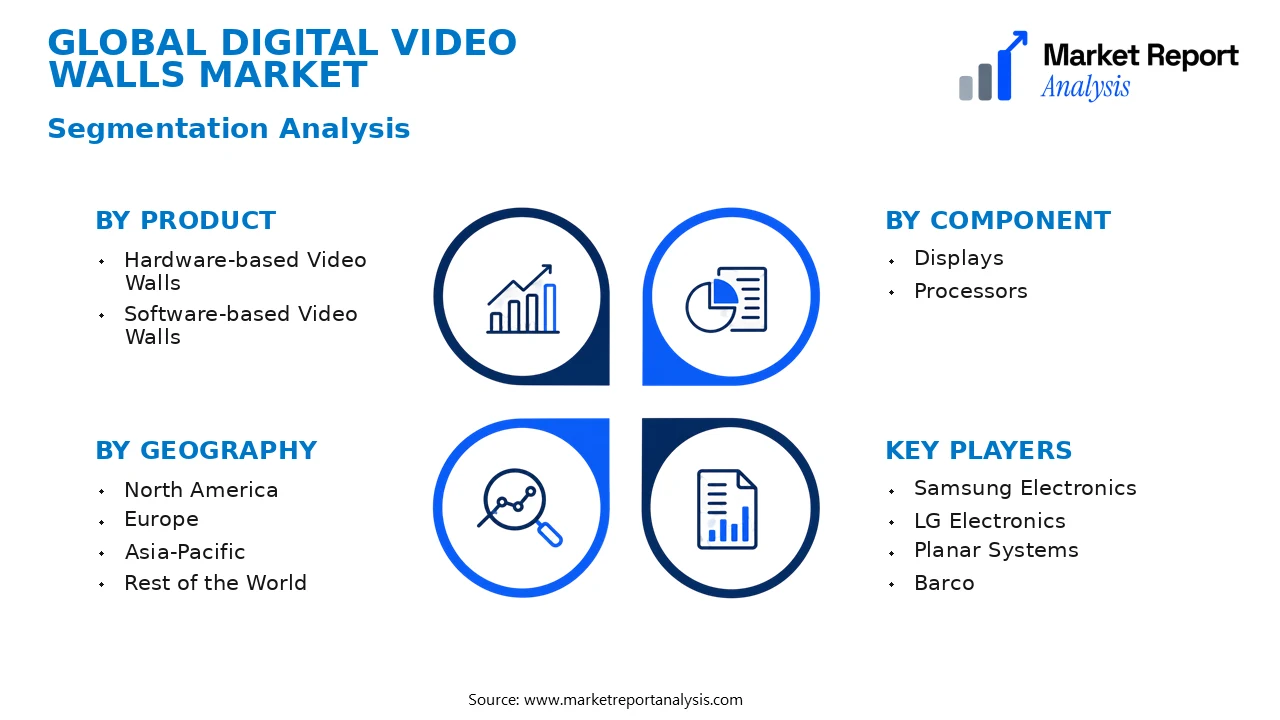
- Product
- Hardware-based Video Walls: These comprise physical displays and related hardware, catering to large-scale visual applications such as control rooms, advertising, and events, with high demand driven by technological advancements and infrastructural investments.
- Software-based Video Walls: Encompassing control and management software, this subsegment is crucial for flexible content management, real-time updates, and scalable deployment, increasingly adopted in corporate, retail, and public spaces.
- Component
- Displays: Core visual components, including LED, LCD, and micro-LED panels, are selected based on brightness, resolution, and durability, forming the backbone of any digital video wall installation.
- Processors: These support image processing, content management, and system control functions, ensuring seamless operation and integration across complex video wall configurations.
- Industry Vertical
- Retail & Advertising: This segment leverages digital video walls to enhance brand visibility, engage consumers, and display promotional content, experiencing rapid growth as advertisers seek immersive customer experiences.
- Entertainment & Hospitality: Digital video walls are extensively used for eye-catching displays in venues, events, and hotels, creating dynamic visual environments that attract and retain customer attention.
- Transportation & Infrastructure: Implemented in airports, train stations, and transit hubs, these video walls facilitate information dissemination, wayfinding, and real-time updates with high reliability demands.
- B2B & Corporate: Corporations deploy digital video walls for presentations, control rooms, and collaborative workspaces, driven by increasing adoption of digital work environments and information analytics.
- Geography
- North America: As a mature market, North America exhibits high adoption rates due to technological innovation, established infrastructure, and strong demand in entertainment, retail, and corporate sectors.
- Europe: Characterized by early adoption and stringent regulatory standards, Europe is witnessing continuous growth fueled by urbanization, digital transformation initiatives, and advanced manufacturing capabilities.
- Asia-Pacific: This region demonstrates the highest growth potential driven by rapid urban development, expanding infrastructure projects, and increasing adoption in retail, entertainment, and transportation segments.
- Rest of the World: Growing markets in Latin America, Middle East, and Africa are emerging as key growth corridors, motivated by infrastructural upgrades and increasing digital engagement across various sectors.
Competitive Intelligence
The Digital Video Walls Market exhibits moderate competition with key players such as Samsung, LG, and Barco dominating the landscape. Market concentration remains relatively high, with the top five companies accounting for a significant share of the global market. Leading organizations pursue aggressive strategies focused on product innovation to differentiate their offerings, including advancements in display technology, touch integration, and energy efficiency. Strategic partnerships with content providers and system integrators bolster their market presence and facilitate comprehensive solutions for diverse verticals. Mergers and acquisitions are common, aimed at expanding technological capabilities and geographic reach; for instance, recent acquisitions by Samsung and LG have strengthened their portfolios. Companies are also investing heavily in R&D to develop next-generation displays with higher resolutions, broader viewing angles, and enhanced durability, thereby staying ahead of competitors. These efforts help firms establish a competitive edge by offering customized, high-performance digital wall solutions tailored to specific industry needs.
Leading Company Profiles
The competitive landscape of the digital video walls market comprises a diverse group of well-established players, each bringing distinct strengths in technology, innovation, and market reach. These companies are pivotal in driving technological advancements and strategic initiatives to capture growing demand across various sectors.
- Samsung Electronics
- LG Electronics
- Planar Systems
- Barco
- Xenon Computer
- Leyard Optoelectronic
- Christie Digital Systems
- NEC Corporation
- Daktronics
- Absen
Samsung Electronics
Samsung Electronics specializes in high-resolution LED and LCD video wall solutions, combining innovations in display technology with extensive global distribution channels, strategic collaborations, and a focus on smart digital signage systems.
LG Electronics
LG Electronics offers comprehensive digital video wall solutions characterized by ultra-fine pixel pitch technology and seamless video integration, leveraging its strong R&D capabilities and global presence to enhance visual engagement applications.
Planar Systems
Planar Systems designs and manufactures innovative LCD, LED, and OLED video wall solutions with a focus on customizable, large-format displays for commercial, control room, and broadcast environments, prioritizing reliability and ease of integration.
Barco
Barco is renowned for its high-quality visualization solutions, providing scalable video wall systems for corporate, entertainment, and simulation uses, emphasizing cutting-edge display technology and professional-grade image quality.
Xenon Computer
Xenon Computer delivers modular video wall hardware and software solutions optimized for digital signage, public displays, and control rooms, combining robust engineering with user-friendly interfaces for diverse industry needs.
Leyard Optoelectronic
Leyard specializes in large format LED displays and flexible video wall configurations, integrating advanced pixel technology with strategic partnerships to expand its footprint in entertainment, retail, and transportation sectors.
Christie Digital Systems
Christie Digital Systems offers versatile video wall displays and processing solutions known for high brightness, color accuracy, and modular design, supporting its strategic focus on immersive experiences across various markets.
NEC Corporation
NEC provides integrated display solutions combining innovative image processing with extensive global service support, targeting sectors such as corporate communications, transportation, and education.
Daktronics
Daktronics specializes in dynamic LED display solutions, from sports venues to corporate branding, emphasizing energy efficiency, custom design, and large-scale installation expertise.
Absen
Absen focuses on LED digital signage and video wall products, leveraging cost-effective manufacturing and a broad product range to serve retail, events, and transportation markets worldwide.
Strategic Business Developments
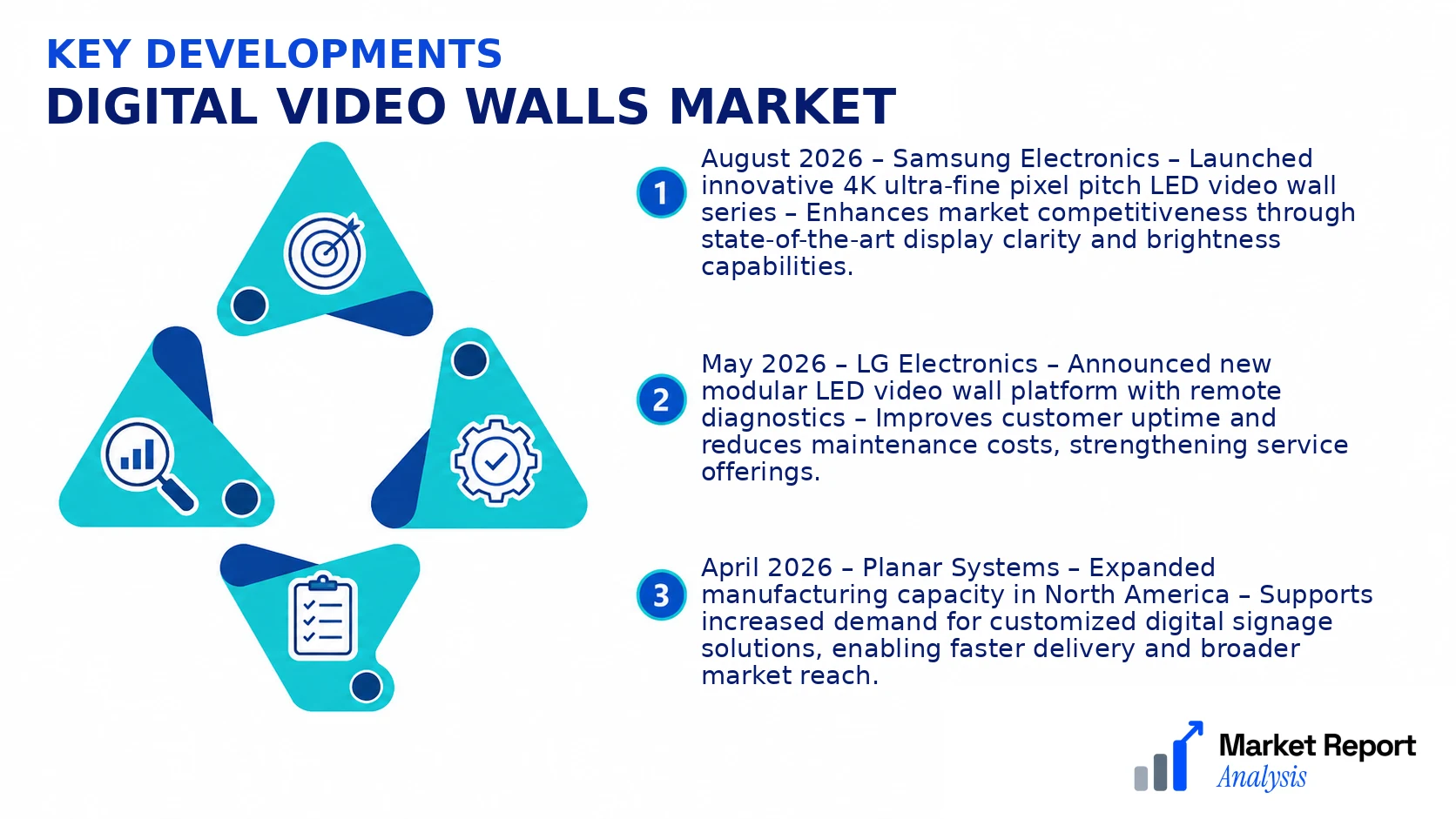
- August 2026 – Samsung Electronics – Launched innovative 4K ultra-fine pixel pitch LED video wall series – Enhances market competitiveness through state-of-the-art display clarity and brightness capabilities.
- May 2026 – LG Electronics – Announced new modular LED video wall platform with remote diagnostics – Improves customer uptime and reduces maintenance costs, strengthening service offerings.
- April 2026 – Planar Systems – Expanded manufacturing capacity in North America – Supports increased demand for customized digital signage solutions, enabling faster delivery and broader market reach.
- June 2026 – Barco – Formed strategic partnership with a leading content creation company – Facilitates integrated solutions for immersive digital experiences, opening new vertical markets.
- July 2026 – NEC Corporation – Acquired a digital signage software firm – Accelerates development of integrated display and management solutions for enterprise clients, boosting technological competitiveness.
Frequently Asked Questions
What is the Digital Video Walls Market?
The Digital Video Walls Market encompasses the global industry involved in the manufacturing, deployment, and maintenance of large-scale video display panels used for advertising, information dissemination, and entertainment purposes across various sectors including retail, corporate, hospitality, and entertainment.
What is the current market size of Digital Video Walls Market?
As of 2026, the market size for digital video walls is valued at approximately USD 3.2 Billion, reflecting widespread adoption across industries and regions, driven by technological advancements and increasing demand for immersive digital experiences.
What factors are driving the Digital Video Walls Market?
The rise in demand is fueled by factors such as advancements in display technology, decreasing prices of LED panels, an increasing number of retail and corporate advertising campaigns, and the need for high-impact visual communication in public and commercial spaces.
Which region dominates the Digital Video Walls Market?
North America currently leads the global market, supported by technological innovation, substantial infrastructural investments, and a high concentration of key industry players, with expanding markets in Asia-Pacific expected to witness rapid growth.
Which segment is expected to grow the fastest?
The LED-based video walls segment is forecasted to grow at the highest CAGR during 2026-2034, owing to their superior brightness, energy efficiency, and versatility in large formats compared to other display types.
Who are the leading companies operating in the Digital Video Walls Market?
Prominent players include Samsung Electronics, LG Electronics, Leyard, Barco, and NEC Corporation, who are focusing on innovation, strategic partnerships, and regional expansion to strengthen their market positions.
Analyst Perspective
The digital video walls market exhibits a mature yet evolving landscape, with sustained growth driven by technological innovations and increasing adoption across sectors. Long-term, emerging display technologies such as 8K resolution and seamless bezel-less designs are expected to enhance visual clarity and user engagement, creating new commercial opportunities particularly in high-end retail, control rooms, and entertainment venues. Investors should prioritize advancements in display durability, energy efficiency, and seamless integration with IoT ecosystems for strategic competitive advantages. The competitive landscape remains intense, with key players investing heavily in R&D to differentiate their offerings through better resolution, modularity, and intelligent content management. Regional growth potential is particularly strong in Asia-Pacific, driven by rapid urbanization, infrastructural development, and government initiatives supporting digital transformation. Overall, sustained technological evolution, combined with strategic regional focus, promises a resilient market with lucrative opportunities, yet demands ongoing innovation and keen market intelligence to maintain leadership in this dynamic environment.
