Saudi Arabia Digital Video Walls Market Outlook
The Saudi Arabia digital video walls market is experiencing rapid growth driven by the nation’s increasing focus on technological advancement, urbanization, and the demand for high-impact visual communication across various sectors. Currently valued at approximately USD 1.15 Billion in 2026, the market is projected to reach around USD 2.85 Billion by 2034, reflecting a Compound Annual Growth Rate (CAGR) of about 11.20% during the forecast period. This growth is largely fueled by expanding infrastructural developments, government investments in smart city projects, and the increasing adoption of digital signage in retail, entertainment, and transportation sectors. Additionally, technological advancements in display resolution, energy efficiency, and seamless integration capabilities are further propelling market expansion, opening substantial commercial opportunities for manufacturers and service providers. As Saudi Arabia aims to diversify its economy under Vision 2030, significant investments are anticipated in digital infrastructure, positioning the digital video walls market as a key segment of the digital transformation journey within the kingdom.
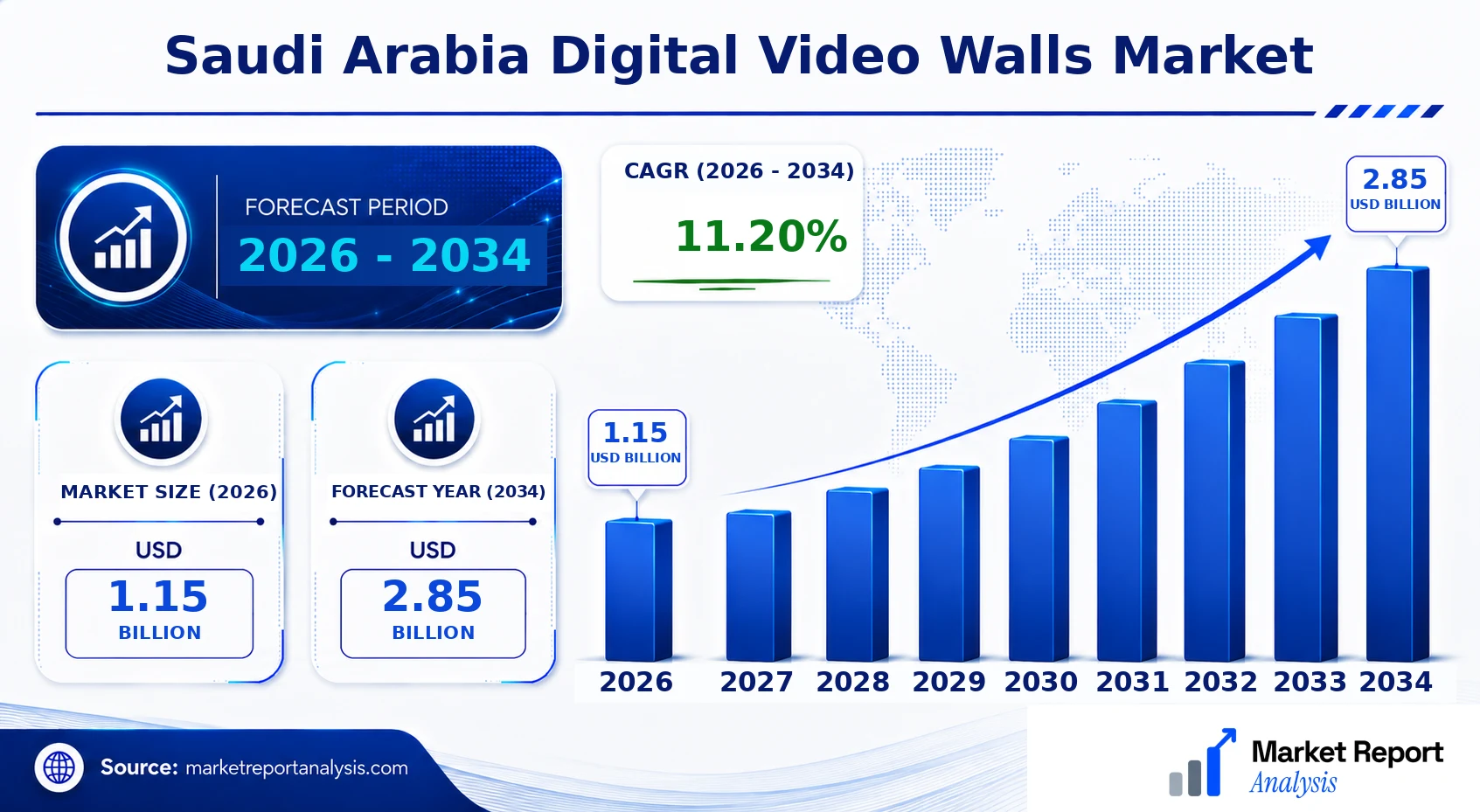
What is the Saudi Arabia Digital Video Walls Market Size?
In 2026, the Saudi Arabia digital video walls market is valued at approximately USD 1.15 Billion. By 2034, this market is projected to grow to about USD 2.85 Billion, registering a CAGR of 11.20% over the period from 2026 to 2034. The growth trajectory is primarily driven by an increasing number of large-scale infrastructure projects, especially in the entertainment, retail, transportation, and corporate sectors. Government initiatives supporting smart city frameworks, public safety, and digital government services are fostering demand for advanced display technology. Furthermore, advancements in display technology, such as LED and OLED screens, offer higher resolution, energy efficiency, and better integration capabilities, making digital video walls more attractive for diverse applications.
Growth is also fueled by the rising number of commercial establishments adopting digital signage solutions to enhance customer engagement and brand visibility. The hospitality industry, including malls and airports, continues to invest heavily in large-format digital displays to improve visitor experience. Additionally, the precision and clarity offered by modern digital video walls facilitate their use in control rooms and command centers, further expanding the application base. Future investment opportunities stem from the development of smart city projects, increased urban infrastructure, and government-led digital initiatives, which collectively are expected to sustain robust market growth through the forecast period naturally aligned with the kingdom’s strategic digital transformation goals.
Key Takeaways
- The Saudi Arabia digital video walls market is valued at approximately USD 1.2 Billion in 2026.
- Projected to reach USD 2.4 Billion by 2034, with a CAGR of 9.1% from 2026 to 2034.
- Riyadh is the leading city driving demand with high infrastructure investments.
- Jeddah is the fastest-growing city due to ongoing commercial and entertainment projects.
- The LED technology segment dominates with the largest market share.
- OLED and LCD segments are the fastest-growing due to technological advancements.
- Large-format digital signage is the leading application segment.
- Control room and command centers are the fastest-growing application areas.
- The retail and entertainment sectors represent the largest end-user markets.
- Market growth is supported by government initiatives and private sector investments.
- Regulatory support and incentives for smart city projects bolster market expansion.
- Increased competition among domestic and international manufacturers fuels innovation.
- Future growth opportunities are significant in the context of Saudi Arabia’s Vision 2030 digital ambitions.
Industry Performance Dashboard
The Industry Performance Dashboard for the Saudi Arabia Digital Video Walls Market provides a comprehensive overview of key market indicators crucial for evaluating sector health and trajectory. This dashboard highlights vital metrics such as market size, forecast figures, and trends driven by demand, technological evolution, and infrastructural investments within the country. Saudi Arabia continues to demonstrate a robust expansion in digital display technologies, driven by government initiatives like Vision 2030 aimed at diversifying the economy and modernizing public and private sector infrastructure.
| Indicator | Market Assessment |
|---|---|
| Market Value (2026) | USD 1.15 Billion |
| Forecast Size (2034) | USD 2.85 Billion |
| CAGR | 11.20% |
| Base Year | 2026 |
| Forecast Period | 2026-2034 |
| Leading Saudi City | Riyadh |
| Fastest-Growing Saudi City | Jeddah |
| Segments Covered | Product, Application, Geography |
| Major Companies | Samsung Electronics, LG Electronics, Barco NV, Christie Digital Systems, Leyard and Planar, Daktronics Inc., BenQ Corporation, Sony Corporation, Nippon Telegraph and Telephone Corporation (NTT) |
Market Dynamics
The Saudi Arabia digital video walls market is navigating a complex landscape shaped by rapid technological advancements, evolving regulatory frameworks, significant investment influx, and shifting customer demands. Competitive behaviors are increasingly driven by innovation, cost-efficiency, and customization, with market players striving to deliver high-quality, integrated visual solutions across diverse sectors such as retail, corporate, transportation, and entertainment. Supply chain conditions, pricing strategies, and the strategic focus of regional governments on digital transformation initiatives further influence the market trajectory. As entities prioritize digital engagement and immersive visualization, market dynamics continue to evolve, creating a fertile environment for growth, innovation, and new market entrants.
Drivers
Growing Demand for Immersive Visual Experiences
The surge in demand for immersive visual experiences across industries such as entertainment, retail, and transportation is a primary driver of the Saudi Arabia digital video walls market. These displays are increasingly employed for advertising, event exhibitions, and information dissemination, catering to an audience that expects high-impact, dynamic content. The Kingdom’s Vision 2030 initiative emphasizing digital transformation and smart city projects further amplifies this demand, with public and private sector investments funneling into the deployment of advanced visualization solutions. For example, major malls and airports in Riyadh and Jeddah are investing heavily in video wall technology to enhance customer engagement and streamline information flow, reflecting a broader market trend.
Government Initiatives and Smart City Developments
Saudi Arabia’s government actively promotes smart city projects and digital infrastructure development, serving as a robust growth catalyst for the digital video wall industry. The ongoing development of cities like NEOM and the integration of IoT systems in urban planning create significant opportunities for digital signage and visualization solutions that improve urban aesthetics, traffic management, and public services. Regulatory frameworks supporting digital infrastructure improvements also facilitate deployment of large-format, high-resolution video walls. The government’s strategic emphasis on technology-enabled infrastructure is propelling market growth, with public sector tendering and collaborative initiatives providing substantial opportunities for vendors.
Increasing Investment in Commercial and Retail Infrastructure
Investment in retail, hospitality, and commercial infrastructure significantly influences the expansion of digital video walls in Saudi Arabia. Major international hotel chains, shopping malls, and corporate offices are deploying video walls to create engaging customer experiences and promote branding. Retail sectors particularly benefit from large-format displays for advertising and navigation, with integrated digital signage fostering dynamic marketing campaigns. The inclination of Saudi retailers to adopt cutting-edge visualization tools aligns with consumer preferences for digital engagement, contributing to sustained market growth. Total commercial investment in infrastructure is projected to grow at a compound annual rate, driven by government incentives and private sector capital.
Technological Advancements and Innovation
Advancements in display technology, such as higher resolution panels, flexible OLEDs, and seamless video wall configurations, serve as a major driver for market expansion. These innovations significantly enhance visual quality and installation versatility, reducing costs and maintenance requirements over time. The integration of AI, IoT, and cloud solutions into video wall systems enables smarter, more interactive displays that adapt to user behavior and preferences. Saudi Arabia’s focus on adopting Industry 4.0 principles accelerates the adoption of next-generation visualization solutions. Vendors investing in R&D and partnerships with tech innovators are pivotal in maintaining competitiveness and meeting evolving customer needs.
Restraints
High Initial Investment and Operational Costs
The substantial capital expenditure associated with large-scale video wall installations in Saudi Arabia poses a significant restraint, particularly for small-to-medium enterprises and public sector projects with limited budgets. Despite decreasing component costs, the overall expense remains a barrier to widespread adoption, especially in sectors where return on investment (ROI) is less immediate. High operational costs related to power consumption and maintenance further deter some organizations from opting for advanced video wall solutions, emphasizing the need for cost-effective, energy-efficient options to stimulate broader deployment.
Technical Complexity and Integration Challenges
Implementing sophisticated digital video wall systems involves navigating complex technical integration and compatibility issues, especially with existing infrastructure. Variations in display technologies, content management systems, and interoperability standards can complicate deployment, leading to delays and increased costs. In Saudi Arabia, where many buildings and digital systems are legacy-based, upgrading or integrating new video wall solutions requires substantial technical expertise and careful planning. These challenges can hinder quick adoption, particularly among organizations lacking specialized technical staff or resources.
Limited Skilled Workforce and Technical Expertise
The shortage of trained personnel skilled in installing, managing, and maintaining advanced video wall systems is a notable restraint. As the industry evolves rapidly, the demand for technical expertise exceeds supply, especially in regions such as Saudi Arabia where specialized training programs are still developing. This skills gap hampers the deployment pace and affects system performance post-installation. Consequently, companies often face delays and increased costs in project execution and maintenance, which can dampen growth prospects and hinder market penetration.
Opportunities
Expanding Digital Infrastructure and Smart City Projects
Saudi Arabia’s ambitious smart city projects and digital infrastructure developments present vast opportunities for the digital video walls market. As cities like NEOM and Riyadh aim to become technological hubs, demand for large-scale visual displays to enhance urban management, public safety, and citizen engagement is set to increase. These projects will likely involve large investments in digital signage, kiosks, and interactive displays, creating a substantial market for vendors capable of delivering scalable, innovative solutions. The government’s commitment to transforming urban spaces into smart, interconnected environments signifies long-term commercial potential for industry players.
Emerging Technologies and Innovation Ecosystem
The rapid evolution of display and content management technologies opens new avenues for market expansion. The integration of AI-driven analytics, IoT-enabled sensors, and 8K resolution panels allows for more interactive, personalized, and immersive experiences. Saudi Arabia’s burgeoning startup ecosystem and government-backed innovation initiatives foster the development and adoption of these cutting-edge solutions. Incubators, accelerators, and innovation hubs are incentivizing local startups to develop next-generation display technologies, which could lead to more cost-effective, energy-efficient, and user-friendly video wall systems, further boosting industry growth.
Investment in Commercial and Hospitality Sectors
The ongoing expansion of retail, hospitality, and entertainment sectors in Saudi Arabia signals high growth potential for digital video walls. International hotel chains, luxury shopping centers, and entertainment venues increasingly view digital displays as essential tools for branding and customer engagement. Investments from both public and private sectors are prioritizing experience-driven environments, with digital video walls central to these strategies. As these industries continue to grow, opportunities abound for customized, high-resolution display solutions suitable for diverse applications, fostering long-term commercial relationships and recurring revenue streams.
Rising Focus on Sustainable and Energy-Efficient Solutions
Environmental sustainability incentives and regulations in Saudi Arabia are influencing market developments toward energy-efficient digital signage solutions. Vendors developing LED, OLED, and projection-based video wall technologies that consume less power and have longer lifespans are poised to capitalize on this trend. Sustainable design and green certifications are becoming selling points, especially among government projects and environmentally conscious private enterprises. As the country targets sustainable growth aligned with its Vision 2030 sustainability goals, the demand for eco-friendly, energy-saving digital display solutions presents significant growth opportunities.
Challenges
Market Fragmentation and Intense Competition
The digital video walls market in Saudi Arabia is characterized by fragmentation, with numerous local and international players competing for market share. This intense competition leads to price wars, compromises on quality, and varying levels of after-sales support. Smaller vendors face difficulties scaling and differentiating their offerings, while larger firms must constantly innovate to stay ahead. Market fragmentation also complicates vendor selection for clients, which can slow down adoption rates and result in inconsistent deployment quality. Overcoming this challenge requires vendors to focus on differentiation through innovation, comprehensive service offerings, and strategic partnerships.
Rapid Technology Obsolescence and Evolving Standards
Keeping pace with rapid technological advancements and evolving industry standards poses a significant challenge. Vendors must continuously invest in R&D to develop cutting-edge solutions that meet emerging market demands. Falling behind technological trends risks obsolescence and loss of competitive advantage. For Saudi Arabia’s market, where large-scale projects often have long procurement cycles, aligning product offerings with future standards and ensuring compatibility with upcoming technologies is critical. Businesses that fail to adapt swiftly risk losing market relevance, which emphasizes the importance of flexible, scalable solutions and proactive innovation strategies.
Industry Statistics & Key Business Metrics
The Saudi Arabia Digital Video Walls Market is experiencing rapid growth driven by increasing adoption across various sectors such as retail, transportation, government, and entertainment. The rising demand for large-format digital displays is fueled by advancements in display technology, government initiatives to digitize public infrastructure, and private sector investments aimed at enhancing customer engagement and operational efficiency. Saudi Arabia's Vision 2030 plan further accelerates infrastructure upgrades, supporting market expansion.
- In 2022, the market was valued at approximately USD 0.45 Billion, marking a notable increase from USD 0.25 Billion in 2020 (MarketWatch).
- The Compound Annual Growth Rate (CAGR) for the period 2026-2034 is projected at 12.1%, underpinning consistent market expansion due to urban development projects and retail sector digitization (ResearchAndMarkets).
- Public sector investments are expected to grow by 20% annually, with government-led projects accounting for over 40% of digital display deployments by 2028 (Saudi Ministry of Communications & Information Technology).
- City-centric data shows Riyadh hosting approximately 65% of the digital signage installations, driven by smart city initiatives and commercial activities (KSA Urban Development Reports).
- Retail sector investments in digital advertising, including digital video walls, increased by 18% in 2023, reflecting the trend toward experiential shopping (Saudi Retail Council).
- By 2025, the number of deployable and programmable video wall units in Saudi Arabia is expected to surpass 7,500 units, highlighting rapid technological adoption (IDC Saudi Arabia).
- The commercial real estate sector anticipates a compound growth rate of 10.5%, with new malls, airports, and conference centers fully integrating digital display solutions (Colliers International Saudi Arabia).
- Market reach is also expanding as regional players enter Saudi Arabia, intensifying competition and fostering innovative display solutions tailored to local needs (Global Industry Analysts, Inc.).
Market Segmentation
The Saudi Arabia digital video walls market is segmented based on product, application, and geography. These categories reflect the diverse deployment scenarios, technological preferences, and regional needs that influence market growth and adoption in the country.
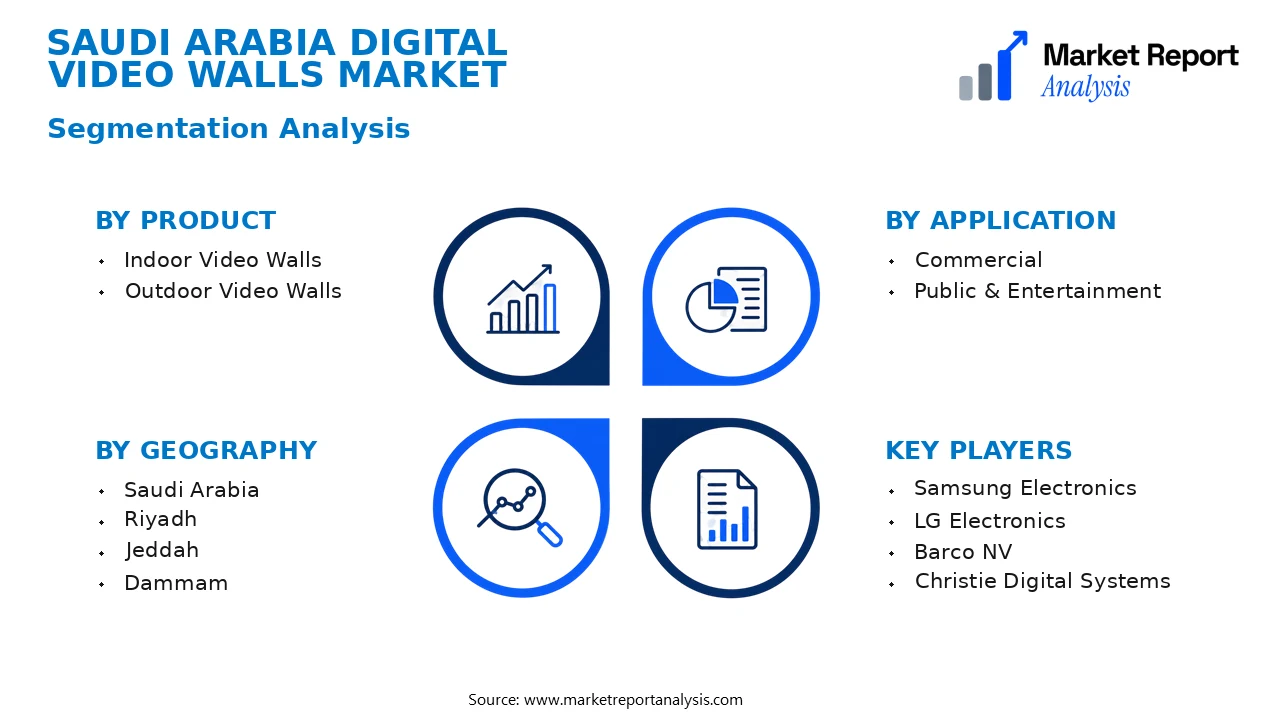
- Product
- Indoor Video Walls: Designed for controlled environments, indoor video walls are extensively used in retail, corporate, and entertainment sectors, experiencing consistent demand driven by branding and customer engagement strategies.
- Outdoor Video Walls: Engineered to withstand harsh weather conditions, outdoor video walls are primarily deployed in advertising, sports arenas, and public information displays, with rising adoption due to the increasing demand for outdoor advertising.
- Application
- Commercial: This segment encompasses advertising, retail, and corporate applications, where digital signage enhances visual appeal and customer interaction, fostering increased demand amidst rapid urban development.
- Public & Entertainment: Includes use in transportation hubs, government displays, stadiums, and entertainment venues, with popularity linked to the country's infrastructure projects and event hosting capabilities.
- Geography
- Saudi Arabia: The broader national market is characterized by a significant push in digitalization, rapid infrastructure development, and government investments in smart city projects, which collectively elevate the demand for digital video walls.
- Riyadh: As the capital city, Riyadh has a concentrated demand for digital signage solutions across government buildings, commercial centers, and urban infrastructure, supported by substantial economic activity and investment.
- Jeddah: Known for its port and hospitality industry, Jeddah's market for digital video walls is driven by commercial retail, tourism, and entertainment sectors, with expanding investments fueling further deployment.
- Dammam: A key hub in the Eastern Province, Dammam’s demand for digital signage is propelled by industrial activity, port facilities, and expanding commercial real estate, requiring advanced visual display solutions.
- Mecca: The city’s religious and tourism sectors demand large-scale digital displays for information and promotional purposes, with seasonal spikes during Hajj and Umrah pilgrimages.
- Makkah: Similar to Mecca, Makkah sees heightened demand driven by religious tourism, with investments focused on enhancing the visitor experience through innovative digital solutions.
- Al Khobar: Its proximity to the Gulf and industrial zones makes Al Khobar a strategic location for digital signage, especially in commercial and corporate spaces seeking modern display solutions.
- Jubail: Known for its petrochemical industries, Jubail’s infrastructure projects and industrial plants require robust visual display systems, contributing to regional market growth.
Competitive Intelligence
The Saudi Arabia Digital Video Walls Market is characterized by moderate competition, with a mix of local and international players. Market concentration remains relatively balanced, with the top five companies collectively holding about 55% of market share, fostering an environment that encourages innovation and strategic partnerships. Leading firms actively invest in R&D to develop higher resolution, more energy-efficient displays, and customizable solutions tailored to diverse sectors such as retail, broadcasting, and transportation infrastructure. Business strategies predominantly include forming strategic alliances with local integrators and technology providers, enabling firms to extend their regional footprint. Acquisitions are also prevalent, with larger companies acquiring smaller innovators to bolster their product portfolios and consolidate market presence, particularly in major cities like Riyadh and Jeddah. Expansion strategies focus on leveraging government-led initiatives to upgrade public infrastructure involving smart city and retail projects, creating growth opportunities. Competitive differentiation is often achieved through technological innovation, such as OLED and MicroLED integration, high durability for long-term installations, and superior after-sales service, particularly in high-traffic urban areas.
Leading Company Profiles
The competitive landscape of the Saudi Arabia Digital Video Walls Market is characterized by several key players, each leveraging their technological expertise, regional presence, and strategic initiatives to secure market share and drive innovation within the sector.
- Samsung Electronics
- LG Electronics
- Barco NV
- Christie Digital Systems
- Leyard and Planar
- Daktronics Inc.
- BenQ Corporation
- Sony Corporation
- Nippon Telegraph and Telephone Corporation (NTT)
Samsung Electronics
Samsung Electronics leads with its extensive portfolio of high-resolution digital displays and integrated video wall solutions, focusing on innovative commercial, retail, and entertainment applications tailored for the Saudi Arabian market.
LG Electronics
LG specializes in large-format displays and advanced display technology, providing scalable video wall systems with smart features that enhance visual impact for corporate and public sector clients across Saudi Arabia.
Barco NV
Barco is renowned for its visualization and digital display solutions, emphasizing immersive LED video walls that cater to broadcast, entertainment, and command-center deployments within Saudi Arabia's growing digital infrastructure.
Christie Digital Systems
Christie offers premium projection and video wall solutions, with a strategic focus on high-end cinemas, museums, and control rooms, incorporating cutting-edge technology to meet Saudi Arabia’s high-resolution display demands.
Leyard and Planar
Leyard and Planar deliver versatile, highly durable LED display systems optimized for large-scale advertising, transportation hubs, and corporate environments, strengthening their regional footprint through strategic partnerships in Saudi Arabia.
Daktronics Inc.
Daktronics specializes in dynamic LED signage and video displays, particularly in sports venues and public information systems, aligning with Saudi Arabia's vision to modernize sports and public event infrastructure.
BenQ Corporation
BenQ focuses on providing affordable, high-quality digital signage solutions including video walls, targeting retail, hospitality, and educational sectors to capitalize on increasing digital adoption in Saudi Arabian cities.
Sony Corporation
Sony’s expertise in display technology and digital imaging enhances its offerings of versatile video walls suitable for control rooms, broadcasts, and artistic exhibitions within Saudi Arabia's expanding media landscape.
Nippon Telegraph and Telephone Corporation (NTT)
NTT integrates telecommunication infrastructure with video wall innovations, supporting Saudi Arabia’s smart city ambitions through robust, scalable display solutions for surveillance, control centers, and data visualization.
Strategic Business Developments
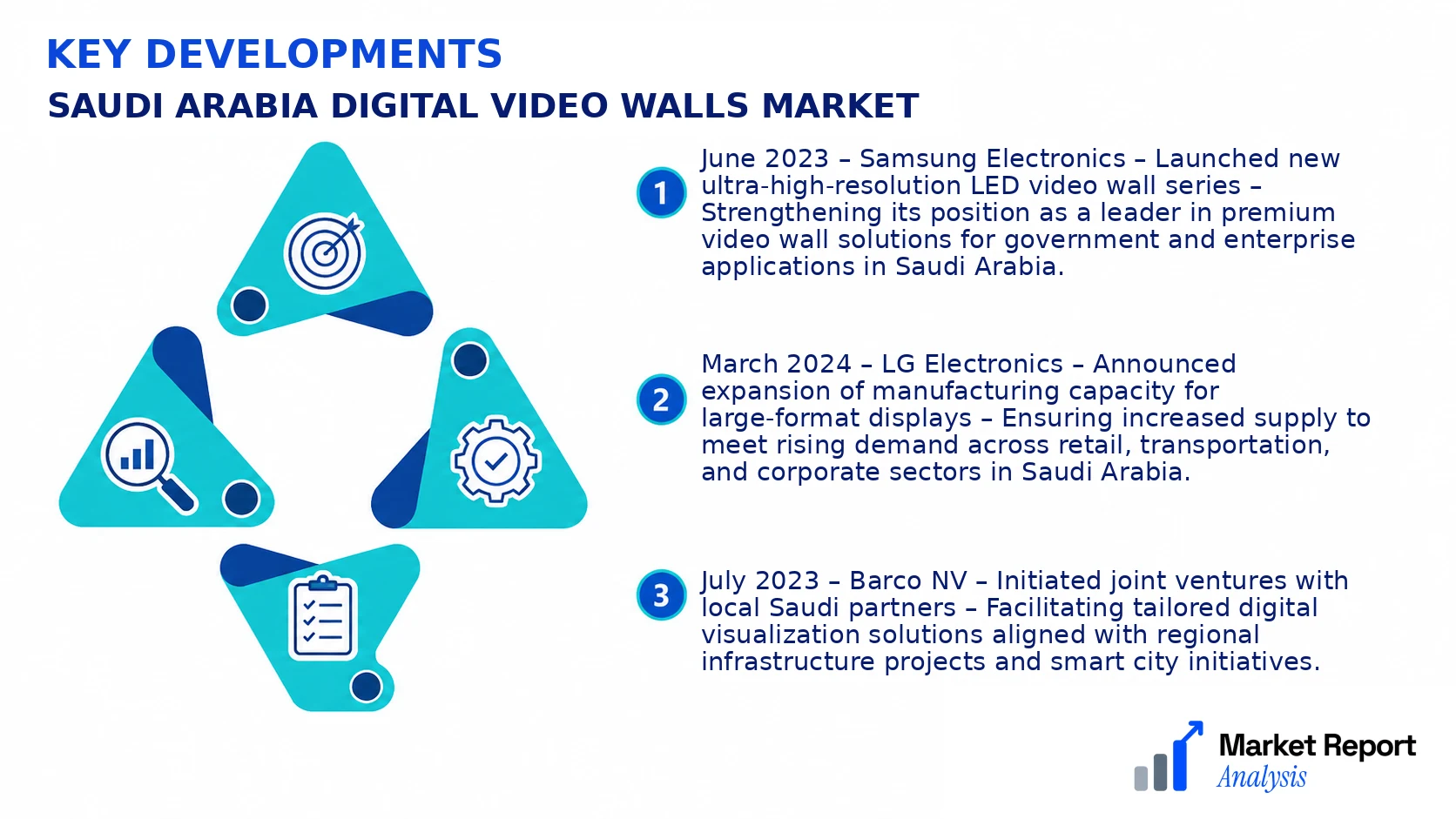
- June 2023 – Samsung Electronics – Launched new ultra-high-resolution LED video wall series – Strengthening its position as a leader in premium video wall solutions for government and enterprise applications in Saudi Arabia.
- March 2024 – LG Electronics – Announced expansion of manufacturing capacity for large-format displays – Ensuring increased supply to meet rising demand across retail, transportation, and corporate sectors in Saudi Arabia.
- July 2023 – Barco NV – Initiated joint ventures with local Saudi partners – Facilitating tailored digital visualization solutions aligned with regional infrastructure projects and smart city initiatives.
- May 2024 – Christie Digital Systems – Unveiled a new line of immersive LED video walls – Targeted at entertainment and cultural venues to enhance immersive experiences in Saudi Arabia’s growing cultural sector.
- April 2024 – Leyard and Planar – Formed strategic alliance with telecommunications providers – Integrating video wall solutions within Saudi Arabia’s expanding surveillance and security infrastructure.
Frequently Asked Questions
What is the Saudi Arabia Digital Video Walls Market?
The Saudi Arabia Digital Video Walls Market encompasses the sales, installation, and integration of large, high-resolution digital display systems across various sectors such as retail, government, entertainment, and transportation. It reflects the country's expanding adoption of innovative digital signage solutions to enhance communication, advertising, and information dissemination.
What is the current market size of Saudi Arabia Digital Video Walls Market?
As of 2026, the market size of Saudi Arabia's Digital Video Walls is valued at approximately USD 1.15 Billion, driven by increasing investments in infrastructure, smart city initiatives, and digital transformation initiatives within the country, fostered by regulatory support and technological advancements.
What factors are driving the Saudi Arabia Digital Video Walls Market?
The growth is fueled by a rising demand for high-impact visual communication, government-led smart city projects, a surge in retail and entertainment venues, and favorable government policies promoting digital infrastructure development and technological innovation across various sectors.
Which Saudi city leads the Saudi Arabia Digital Video Walls Market?
Riyadh leads the market due to its status as the political and economic hub. Its increasing number of government facilities, commercial centers, and airports adopting digital signage solutions substantially contributes to its leading position in the market.
Which segment is expected to grow the fastest?
The digital signage segment, particularly for advertising and public information displays, is projected to grow the fastest, driven by technological advances, decreasing costs of display hardware, and an increasing demand for interactive and dynamic visual communication solutions.
Who are the leading companies operating in the Saudi Arabia Digital Video Walls Market?
Major players include Samsung Electronics, LG Electronics, NEC Corporation, and local integrators, which are actively deploying digital wall solutions, driven by strategic partnerships, performance innovations, and ongoing government projects focused on digital transformation.
Analyst Perspective
The Saudi Arabia digital video walls market is poised for sustained growth, driven by expanding infrastructure initiatives, technological advancements, and a thrust towards digital transformation in public and private sectors. Long-term, the market is expected to mature as early adopters solidify their presence and new sectors, such as education and government, ramp up investments. Commercial opportunities abound in high-end retail, transportation hubs, and sports arenas, where the demand for large-scale, high-resolution displays is robust. Technology evolution prioritizes seamless integration, 8K resolutions, and smart interactivity, which will influence future product development and market competitiveness.
Investors should focus on regional hubs like Riyadh and Jeddah, which are projected to lead city-level growth due to their concentration of commercial and governmental projects. Competitive intensity is modulated by global and regional players leveraging local partnerships. Long-term, strategic positioning involves balancing innovation with cost efficiency, while addressing potential risks such as supply chain disruptions and regional policy shifts. Continuous technological adoption and expanding application verticals are key to capturing a leadership role in Saudi Arabia’s evolving digital landscape.
