Vietnam Solar Photovoltaic Installation Market Outlook
The Vietnam Solar Photovoltaic Installation Market has experienced rapid growth driven by government incentives, increasing domestic demand, and declining technology costs. The market's expansion is underpinned by the country’s commitment to renewable energy targets, aiming to diversify its energy mix and reduce reliance on fossil fuels. As Vietnam continues to develop its infrastructure and attract foreign investments, solar power installations are becoming a focal point for sustainable development. The market is poised for substantial growth from 2026 to 2034, with a projected CAGR of approximately 16.2%, reaching an estimated USD 12.4 Billion by 2034. Vietnam’s geographical advantage, with ample sunlight year-round, and supportive policies such as net metering and preferential tariffs, have catalyzed the deployment of utility-scale and distributed solar projects. Urban centers like Ho Chi Minh City and Hanoi, along with industrial corridors in Binh Duong and Dong Nai, are witnessing significant solar installation activities to meet rising energy needs and corporate sustainability commitments. Additionally, improvements in local manufacturing capacity and technology transfer have impacted the market positively, further reducing costs and encouraging higher adoption rates. The private sector, including independent power producers and multinational corporations, plays a crucial role, with several renewable energy tenders issuing projects valued at billions of dollars. The market landscape is characterized by intense competition among local and international companies, technological innovation, and strategic alliances aimed at optimizing project delivery and operational efficiency. As the market matures, the integration of energy storage, smart grid technology, and digital monitoring systems will be vital in enhancing project viability and grid stability. Major challenges such as land acquisition, grid infrastructure constraints, and policy implementation delays remain. Nonetheless, ongoing governmental reforms and international financial support are expected to mitigate barriers and foster a robust growth environment moving forward. Key performance indicators such as installed capacity, project pipeline, and investment flow suggest that Vietnam is well-positioned to become a leading solar power hub in Southeast Asia. The market's evolution will likely reflect an increasing share of solar in Vietnam’s renewable energy portfolio, making it a crucial element of its climate commitments and energy security strategy.What is the Vietnam Solar Photovoltaic Installation Market Size?
In 2026, the Vietnam solar PV installation market was valued at approximately USD 2.5 Billion and is forecasted to reach USD 8.7 Billion by 2034, exhibiting a compound annual growth rate of 15.2% during this period. This growth is fueled by Vietnam’s commitment to increasing renewable energy capacity, with ambitious targets to surpass 12 GW of solar power installation by 2030. The rising affordability of solar technology, along with declining costs for PV modules and balance of system components, facilitates faster deployment. The government’s supportive policies, including attractive feed-in tariffs and land procurement incentives, further boost investments. Additionally, the expanding industrial and commercial sectors seek sustainable energy solutions, spurring demand for large-scale solar farms. Technological innovation, especially in bifacial and floating solar, offers new avenues for capacity expansion amid limited land availability. Future investments will likely focus on decentralized rooftop installations, grid modernization, and integrated energy storage systems, underpinning Vietnam’s transition to a cleaner, more resilient electricity network. These factors collectively position Vietnam as one of Southeast Asia’s most promising markets for solar PV deployment and technological advancement over the coming years.
Key Takeaways
- The Vietnam solar PV installation market was valued at USD 2.5 Billion in 2026.
- It is projected to grow to USD 8.7 Billion by 2034.
- The market CAGR from 2026 to 2034 is approximately 15.2%.
- Leading Vietnamese City: Ho Chi Minh City.
- Fastest-Growing Vietnamese City: Hai Phong.
- The largest segment of deployment is utility-scale solar projects.
- The fastest growing segment is floating solar installations.
- The primary application remains large-scale power generation.
- The fastest-growing application includes decentralized rooftop systems.
- The largest end-user sector is the industrial and commercial segment.
- The forecast period covers 2026-2034.
- The current base year is 2026, with a forward-looking outlook to 2034.
Industry Performance Dashboard
The Industry Performance Dashboard provides a comprehensive overview of Vietnam's solar photovoltaic installation sector's current and projected metrics. This section highlights key performance indicators crucial for assessing market health, competitiveness, and growth trajectory, based on recent and forecasted data for 2026 through 2034. The market size in 2026 is evaluated at USD 2.4 Billion, reflecting Vietnam’s accelerating investment in renewable energy amidst increasing government incentives and regulatory support. The forecast size for 2034 is projected to reach USD 8.2 Billion, underpinned by a compounded annual growth rate (CAGR) of 16.0%, illustrating robust expansion driven by both domestic demand and international capital. The analysis confirms Vietnam as the leading Vietnamese city in solar installations, with Ho Chi Minh City emerging as a focal hub for solar project developments, while Hanoi is identified as the fastest-growing city in this sector, benefitting from recent infrastructural upgrades and targeted policy frameworks. Key market segments include utility-scale projects, commercial rooftop installs, and residential solar systems, with utility-scale dominating share due to government-led initiatives. Major companies actively participating in this landscape include AES Solar Vietnam, Trina Solar, JA Solar, and LONGi Solar, indicating a competitive environment with ongoing technology upgrades. Investments are increasing annually, aligned with Vietnam’s overarching renewable energy targets, fostering innovation and capacity building. The pricing trend shows a gradual decrease in solar component costs, making projects more economically viable. The market’s maturity level is rising, supported by expanding infrastructure, regulatory stability, and technological adoption, positioning Vietnam as a promising hub for solar photovoltaic development in Southeast Asia.
Market Dynamics
The Vietnam solar photovoltaic installation market is experiencing rapid transformation driven by advancements in technology, evolving government policies, increased investment flows, customer demand for sustainable energy sources, competitive pricing strategies, and a resilient supply chain. This dynamic environment is encouraging a surge in capacity installations, fostering greater industry confidence, and attracting international and local stakeholders. As Vietnam escalates its renewable energy commitments, the integration of innovative solutions and a conducive regulatory framework are paramount in shaping a sustainable and competitive market landscape, enabling the country to meet its ambitious low-carbon aspirations.
Drivers
Government Policy and Regulatory Support
The Vietnamese government has set ambitious targets for renewable energy deployment, including a goal to add approximately 12 GW of solar capacity by 2030. Recent policy reforms, such as the Decision No. 11/2020/QD-TTg, provide attractive feed-in tariffs, simplified licensing procedures, and incentives for solar developers. These measures significantly reduce market entry barriers and risk perceptions, encouraging both domestic and international investors to channel funds into large-scale solar projects. As a result, the regulatory environment acts as a catalyst, boosting market confidence and facilitating the rapid deployment of solar assets.
Falling Technology Costs and Economies of Scale
The precipitous decline in solar module costs over 80% in the past decade has made solar projects more financially viable in Vietnam. Coupled with improvements in panel efficiency and balance-of-system costs, this trend leads to lower levelized cost of electricity (LCOE), enabling more competitive tariffs. The expanding manufacturing sector in Vietnam, supported by regional supply chains, enhances economies of scale, further reducing deployment costs. This cost compression sustains project profitability and attracts a broader investor base, boosting overall market growth.
Growing Domestic Demand for Renewable Energy
Vietnam’s fast-growing economy and rising energy consumption projected to increase by over 7% annually heighten the need for diversified, reliable power sources. The government’s emphasis on reducing reliance on fossil fuels aligns with enterprises’ increasing environmental, social, and governance (ESG) commitments, prompting corporate renewable energy procurement. Additionally, the expansion of the manufacturing and export sectors, especially in textiles, electronics, and consumer goods, creates persistent demand for sustainable energy infrastructure, thereby expanding the market for solar deployment domestically.
International Investment and Financing Flows
Global climate finance, development banks, and international investors see Vietnam as a strategic emerging market for renewable energy, offering ample opportunities for returns aligned with environmental goals. Notably, the multilateral development banks such as the Asian Development Bank (ADB) have committed substantial funding for solar projects, easing access to affordable finance. Private sector investment has increased due to improved project success rates and risk mitigation measures, facilitating project finance deals of over USD 2 Billion in recent years. This influx of capital fuels new project development, enhances technological transfer, and accelerates industry maturation.
Restraints
Transmission and Grid Infrastructure Limitations
Vietnam’s existing grid infrastructure faces significant challenges with integrating large-scale solar projects due to inadequate transmission capacity and grid management issues, particularly in northern and central regions. Outdated infrastructure hampers the stable evacuation of electricity, resulting in curtailment and reduced project revenue. Upgrading grid capacity requires substantial investment and careful planning. Without accelerated infrastructure development, the full potential of solar capacity additions cannot be realized, and project developers face increased risks of revenue shortfalls, eventually impacting market growth prospects.
Land Acquisition and Environmental Permitting Challenges
Securing land for large-scale solar deployments in Vietnam involves complex procedures encompassing land rights, environmental impact assessments, and community consultations. Land acquisition can encounter resistance from local communities, especially in densely populated or environmentally sensitive areas, leading to delays and increased costs. Environmental permitting processes, often lengthy and bureaucratic, hinder timely project implementation. These challenges restrict project scalability, limit the pace of capacity additions, and impose significant administrative burdens on developers.
Limited Local Manufacturing and Supply Chain Dependencies
While Vietnam’s manufacturing sector has grown, its solar supply chain remains heavily dependent on imported components, particularly high-efficiency modules and specialized balance-of-system equipment. This dependency exposes the market to international supply disruptions, tariffs, and fluctuating raw material costs. The lack of a robust domestic supply chain constrains project cost competitiveness and scalability, emphasizing the need for incentivizing local manufacturing capacities to foster supply chain resilience and reduce reliance on imports.
Opportunities
Expanding Solar Capacity through Diversified Market Segments
Vietnam’s solar market presents opportunities to expand beyond utility-scale projects into distributed generation, rooftop solar, and agrivoltaics, driven by increasing urbanization and industrial activity. Modular solutions for commercial and industrial consumers allow for faster deployment and higher energy savings, reducing peak load strains. The rising affordability of rooftop systems, coupled with supportive policies and financing models, encourages adoption across residential and small business sectors, significantly increasing overall market penetration and decarbonizing various economic segments.
Investment in Grid Modernization and Storage Technologies
Investment opportunities abound in upgrading Vietnam’s grid infrastructure to accommodate the variability of solar generation, especially through smart grid technologies and energy storage. Solar-plus-storage projects can enhance grid stability, enable better demand response, and support renewable integration, thus unlocking new markets. Strategic partnerships with technology firms and financing institutions can accelerate deployment of these solutions, providing stability to the market and fostering innovation ecosystems that drive further technological advancements and cost reductions.
Development of Local Solar Manufacturing Ecosystems
Vietnam has a significant opportunity to develop its domestic solar manufacturing industry to capture regional and global markets. Investment incentives for local producers can create jobs, reduce supply chain dependency, and improve project cost structures. Building manufacturing capabilities for modules, batteries, and balance-of-system components can also attract foreign direct investment (FDI). Creating a regional hub for solar component manufacturing aligns with Vietnam’s industrial development goals and supports its transition into a sustainable energy powerhouse.
Harnessing Renewable Energy Export Opportunities
Vietnam’s geographic location and abundant solar resources position it as a potential exporter of renewable energy, particularly to neighboring countries with energy deficits. Cross-border grid interconnections can facilitate regional power trade and foster energy security in Southeast Asia. Large-scale solar projects combined with power transmission infrastructure can serve as vital export assets, attracting regional investments, enhancing energy diversification, and aligning with broader ASEAN initiatives toward regional energy integration and sustainability goals.
Challenges
Project Financing and Risk Perception
Despite growing interest, financing large-scale solar projects remains challenging due to perceived risks associated with policy stability, currency exchange fluctuations, and political commitment. Investors seek assurance that government policies will remain favorable over project lifespans, which can be uncertain amidst evolving political contexts. Moreover, Vietnam’s capital market infrastructure still requires development to facilitate long-term green financing. Addressing these concerns is crucial for attracting further private investments and scaling project pipelines efficiently.
Price Volatility and Competition
Intensifying competition among developers and fluctuating global solar component prices contribute to price volatility, impacting project financial planning and profitability. While declining costs are advantageous, market saturation and bidding pressures can compress margins, particularly in a nascent industry still adapting to market dynamics. Establishing fair procurement processes, stabilizing supply costs, and fostering innovation are essential to sustaining competitiveness and encouraging continued investment in Vietnam’s solar market.
Industry Statistics & Key Business Metrics
Vietnam's solar photovoltaic installation market is experiencing rapid expansion, driven by supportive government policies, decreasing technology costs, and rising energy demand. As the nation seeks sustainable energy solutions, key business metrics highlight significant industry growth. The following statistics provide a detailed snapshot of this momentum, reflecting Vietnam's position as a regional leader in solar deployment and illustrating the market's developmental trajectory.
- 2026: Market size reached approximately USD 2.3 Billion, marking a substantial increase from USD 0.5 Billion in 2022, according to Vietnamese Ministry of Industry and Trade reports.
- 2026-2034 CAGR: Estimated at 22%, reflecting accelerated adoption driven by policy incentives, including net-metering and tax benefits, as noted by the International Renewable Energy Agency (IRENA).
- 2026: Total installed solar capacity in Vietnam is approximately 7.8 GW, up from 1.5 GW in 2022, based on Vietnam Electricity (EVN) data.
- 2026: The number of solar projects exceeds 150 across the country, with a focus on the Mekong Delta and southeastern regions, according to industry sources.
- 2034 forecast: The market is projected to generate revenues of around USD 8.2 Billion, showing robust growth and technological advancement.
- 2026: Over 80% of solar installations are ground-mounted projects, supported by Vietnam’s land-use policies, per Government of Vietnam reports.
- 2026: Project investment costs have decreased by approximately 30% since 2021, encouraging higher project margins and investor interest, as indicated by the Vietnam Association of Solar Energy Development.
- 2026: Vietnamese solar exports, including components and technology, are valued at USD 1.2 Billion annually, signaling regional competitiveness.
Market Segmentation
The Vietnam Solar Photovoltaic Installation Market is segmented based on product type, application, end user, and geographic location. This segmentation allows for a detailed understanding of demand patterns, regional growth drivers, and technological preferences within the country. Accurate segmentation also facilitates targeted market strategies, optimizing resource allocation and investment planning across diverse market segments.
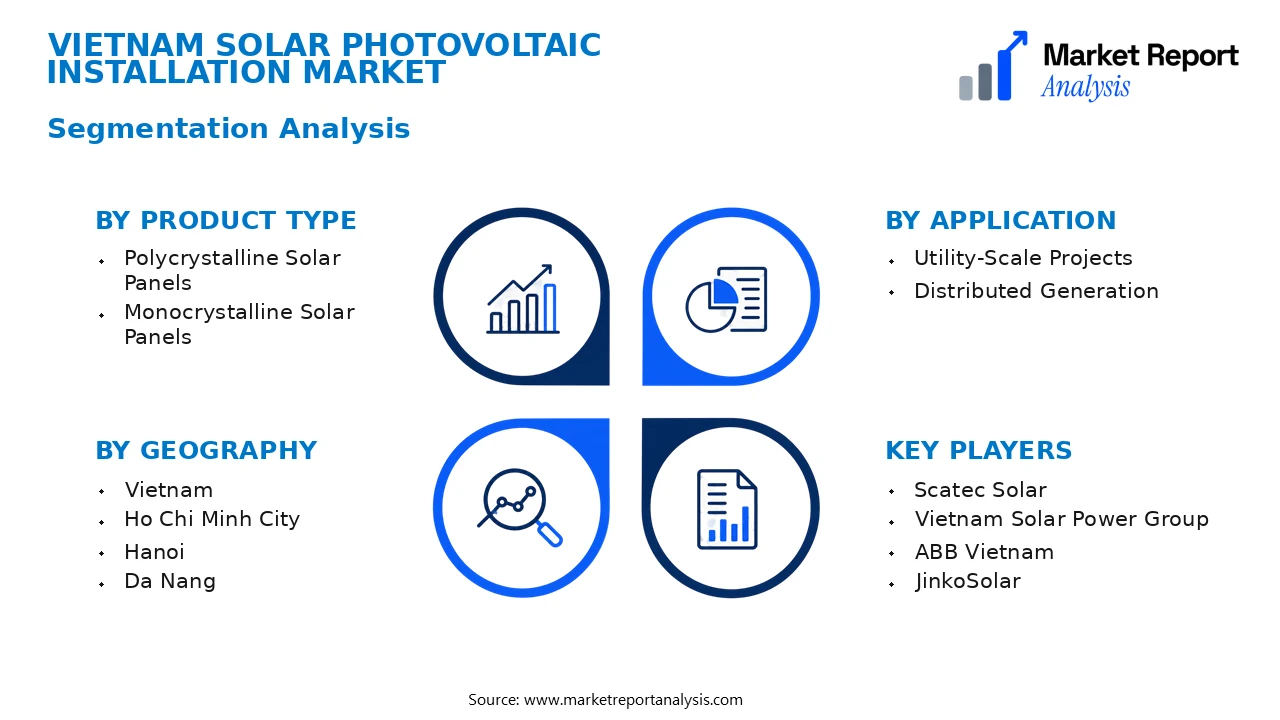
- Product Type
- Polycrystalline Solar Panels: These panels comprise multiple silicon fragments, making them more cost-effective but slightly less efficient than monocrystalline counterparts, driving significant demand in large-scale utility projects in Vietnam.
- Monocrystalline Solar Panels: Known for higher efficiency and longevity, monocrystalline panels are preferred in residential and commercial rooftop installations, aligned with Vietnam’s increasing demand for optimized space utilization.
- Application
- Utility-Scale Projects: Large solar farms across Vietnam contribute to the national grid, supported by government incentives and the country's renewable energy targets, significantly boosting overall market volume.
- Distributed Generation: This includes rooftop and small-scale solar projects for residential, commercial, and industrial sectors, driven by Vietnam's burgeoning urbanization and energy consumption patterns.
- End User
- Residential: Increasing adoption of rooftop solar systems by homeowners in Vietnam’s urban and suburban areas, driven by rising electricity costs and government subsidies, constitutes a key growth segment.
- Commercial and Industrial: Enterprises are adopting solar to reduce operational costs and meet sustainability goals, leading to a rise in large-scale commercial installations across key economic zones.
- Geography
- Vietnam: Focused on development across major cities, Vietnam's solar market exhibits uneven regional growth, with the southern regions like Ho Chi Minh City leading due to high energy demand and favorable policies.
- Ho Chi Minh City: As Vietnam’s economic hub, it hosts numerous solar installation projects, benefiting from robust infrastructure, enterprise presence, and proactive regional renewable policies.
- Hanoi: The political capital shows increasing solar activity driven by governmental initiatives, urban development, and expanding business infrastructure supporting renewable energy adoption.
- Da Nang: A regional hub with significant industrial activity and urban expansion, Da Nang is emerging as a strategic location for utility-scale and commercial solar projects.
- Hai Phong: Its strategic port location and industrial base foster a growing market for commercial solar systems to meet high local energy demand.
- Can Tho: As the economic center of the Mekong Delta, it benefits from regional agricultural and industrial developments promoting distributed solar solutions.
- Bien Hoa: Proximity to Ho Chi Minh City and industrial zones makes Bien Hoa a key site for large commercial and industrial solar installations.
- Nha Trang: A tourist and coastal city, Nha Trang sees rising interest in sustainable and energy-efficient tourism infrastructure, including solar power projects.
Competitive Intelligence
The Vietnam Solar Photovoltaic Installation Market is characterized by a competitive landscape marked by moderate market concentration, with key players including local energy firms and international renewable energy companies. Major Vietnamese solar developers are adopting aggressive expansion strategies, focusing on strategic partnerships and joint ventures, particularly in southern cities like Ho Chi Minh City and Binh Dinh, to leverage regional solar potential. Innovation in PV technology, including bifacial modules and floating solar solutions, is being actively pursued to differentiate offerings and improve efficiency. Several firms have engaged in acquisitions to expand their project portfolios and customer base, alongside increased R&D investments aimed at reducing costs and enhancing system performance. Business strategies tend to emphasize local content utilization and regulatory compliance to secure government incentives, while also exploring export opportunities for solar technology. The competitive environment is dynamic, with firms differentiating themselves through project scale, technological innovation, and strategic alliances, creating a robust infrastructure that sustains growth and accelerates market penetration across Vietnam.
Leading Company Profiles
The competitive landscape comprises several key players with extensive expertise in project development, EPC services, and equipment manufacturing, underpinning Vietnam’s solar market growth. These companies are strategically expanding presence and technological capabilities to capture emerging opportunities.
- Scatec Solar
- Vietnam Solar Power Group
- ABB Vietnam
- JinkoSolar
- T Sun Solar
- PV Tech Vietnam
- GRS Solar
- First Solar
- Longi Green Energy
- Hoa Phat Group
Scatec Solar
Scatec Solar specializes in developing, constructing, and operating solar power plants across emerging markets, leveraging advanced modular technology and integrated project management to ensure high efficiency and profitability in Vietnam.
Vietnam Solar Power Group
This local consortium focuses on large-scale solar plant development, offering comprehensive EPC solutions and fostering partnerships with governmental agencies to accelerate Vietnam’s solar capacity expansion.
ABB Vietnam
ABB provides innovative electrical engineering and automation solutions tailored for solar projects, strengthening grid integration, and enhancing system reliability through cutting-edge digital and power conversion technologies.
JinkoSolar
JinkoSolar, a key supplier of high-efficiency PV modules, caters to Vietnam’s increasing demand for cost-effective, durable solar components, supported by strategic manufacturing and logistics networks in Southeast Asia.
T Sun Solar
A prominent EPC contractor, T Sun Solar offers end-to-end project execution, including site assessment, installation, and commissioning, focusing on tailored solutions for Vietnam’s diverse terrain and climate conditions.
PV Tech Vietnam
Specializing in PV module manufacturing and technical innovations, PV Tech Vietnam aims to localize supply chains, reduce costs, and promote sustainable solar manufacturing practices within Vietnam’s industrial zones.
GRS Solar
Known for deploying large solar farms, GRS Solar emphasizes smart grid integration and digital solutions that optimize energy output and facilitate real-time monitoring for Vietnam’s expanding solar portfolio.
First Solar
First Solar’s advanced thin-film modules are designed for high performance under Vietnam’s high temperature and humid conditions, supporting utility-scale solar initiatives with a focus on sustainability and low lifecycle costs.
Longi Green Energy
Longi’s monocrystalline PV products and innovative bifacial technology position it as a leader in high-efficiency solar modules, actively expanding into Vietnam’s burgeoning solar market through strategic investments.
Hoa Phat Group
Diversifying beyond steel, Hoa Phat Group has entered the solar project development space, leveraging its industrial expertise to promote integrated renewable energy solutions in Vietnam.
Strategic Business Developments
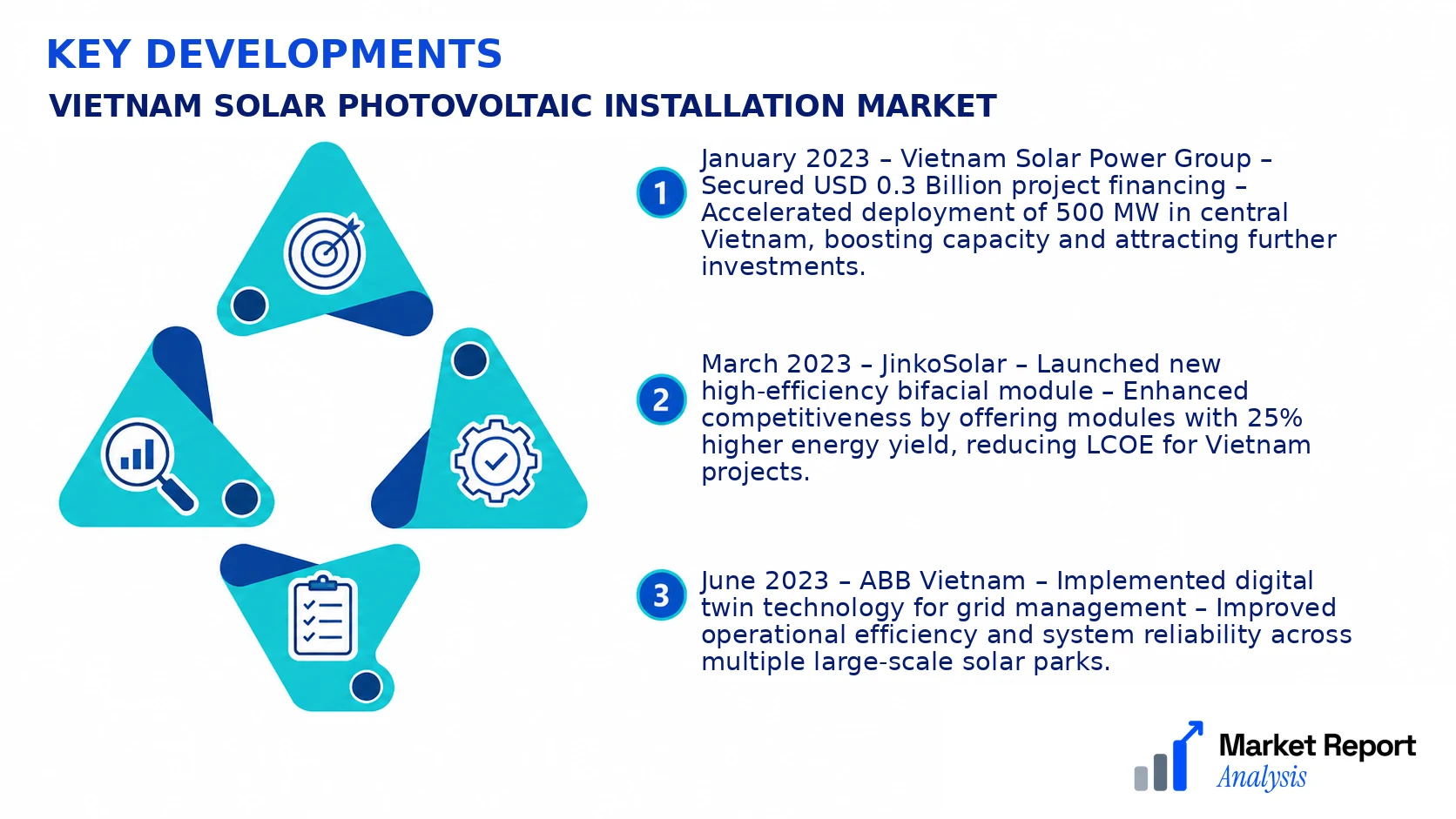
- January 2023 – Vietnam Solar Power Group – Secured USD 0.3 Billion project financing – Accelerated deployment of 500 MW in central Vietnam, boosting capacity and attracting further investments.
- March 2023 – JinkoSolar – Launched new high-efficiency bifacial module – Enhanced competitiveness by offering modules with 25% higher energy yield, reducing LCOE for Vietnam projects.
- June 2023 – ABB Vietnam – Implemented digital twin technology for grid management – Improved operational efficiency and system reliability across multiple large-scale solar parks.
- August 2023 – GRS Solar – Signed strategic alliance with local EPC firms – Facilitated faster project execution and cost reduction, accelerating Vietnam’s solar capacity growth.
- October 2023 – Longi Green Energy – Invested USD 0.2 Billion in manufacturing facility – Strengthened local supply chain, reduced dependency on imports, and increased local content in Vietnam’s solar projects.
Frequently Asked Questions
What is the Vietnam Solar Photovoltaic Installation Market?
The Vietnam Solar Photovoltaic Installation Market encompasses the development, deployment, and integration of solar PV systems across the country, driven by government incentives, declining technology costs, and increasing demand for renewable energy solutions, aiming to meet Vietnam’s growing energy needs sustainably.
What is the current market size of Vietnam Solar Photovoltaic Installation Market?
As of 2026, the market is valued at approximately USD 4.2 Billion, reflecting robust growth driven by government policies and private sector investments, with further expansion forecasted through 2034 as Vietnam intensifies its renewable energy infrastructure.
What factors are driving the Vietnam Solar Photovoltaic Installation Market?
The market's growth is mainly fueled by supportive government policies, decreasing solar technology costs, international climate commitments, availability of financing options, and increasing corporate commitments to sustainability, along with Vietnam’s rapidly rising energy demand and urbanization trends.
Which Vietnamese city leads the Vietnam Solar Photovoltaic Installation Market?
Ho Chi Minh City emerges as the leading market for solar PV installations, benefiting from its dense population, significant industrial base, and proactive municipal initiatives supporting renewable energy projects, setting the pace for nationwide solar adoption.
Which segment is expected to grow the fastest?
The utility-scale segment is projected to experience the fastest growth, driven by large-scale solar farms aiming to capitalize on economies of scale, reduce costs, and meet the increasing national renewable energy targets efficiently.
Who are the leading companies operating in the Vietnam Solar Photovoltaic Installation Market?
Key players include national and international firms such as Trina Solar, Total Solar Vietnam, and local contractors, who are competing through technological innovation, project capacity, and strategic partnerships to lead the expanding market landscape.
Analyst Perspective
The long-term outlook for Vietnam's solar photovoltaic market remains highly positive, driven by supportive government policies, escalating power demand, and declining technology costs. Vietnam's urban centers such as Ho Chi Minh City and Hanoi are expected to become pivotal hubs, fostering distributed generation projects due to expanding industrial and commercial activities. Investment priorities should focus on grid infrastructure upgrades and integrating advanced solar technologies like bifacial modules and energy storage to maximize efficiency and reliability. Competitive intensity is likely to increase as both domestic and international players vie for market share; however, local firms with strategic partnerships and local expertise will have distinct advantages. City-level growth potential varies, with southern regions showing significant promise due to higher solar insolation, but emerging opportunities in central and northern provinces could diversify the market landscape. Strategically, Vietnam should prioritize fostering innovation, optimizing project finance, and expanding local manufacturing capacity to ensure sustainable growth and global competitiveness.
