Malaysia Solar Photovoltaic Installation Market Outlook
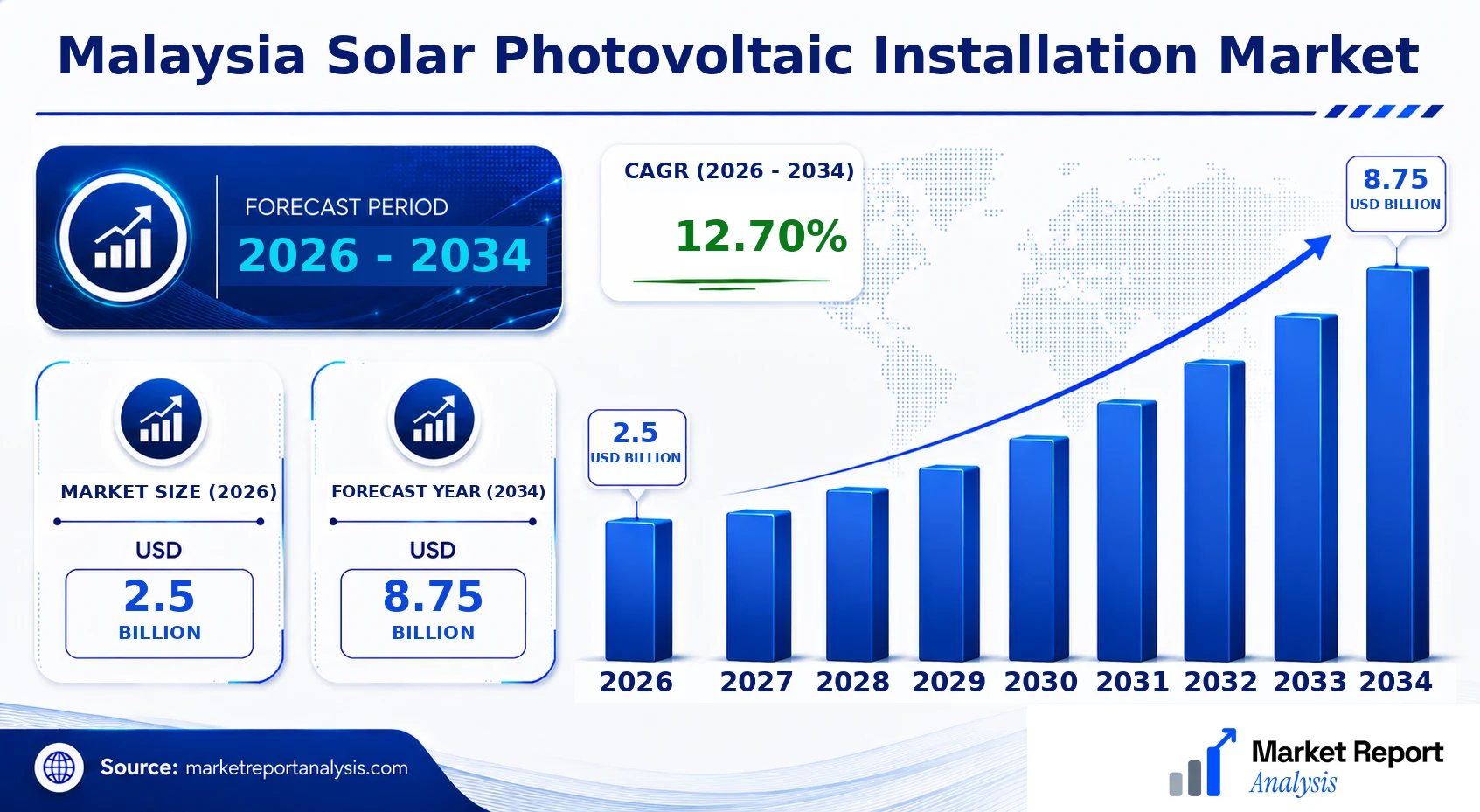
The Malaysia Solar Photovoltaic Installation Market is experiencing robust growth, driven by the government’s commitment to increasing renewable energy capacity and decreasing reliance on fossil fuels. As of 2026, the market is valued at approximately USD 2.5 Billion, with projections indicating a rise to USD 8.75 Billion by 2034. This growth corresponds to a Compound Annual Growth Rate (CAGR) of around 12.70% over the forecast period from 2026 to 2034. Key demand drivers include Malaysia’s rapid urbanization, the government’s renewable energy targets under the Malaysia Renewable Energy Roadmap, and supportive policies such as feed-in tariffs and tax incentives. Technological advancements in photovoltaic (PV) cell efficiency and reductions in installation costs are further fueling adoption among residential, commercial, and utility sectors. The market presents significant commercial opportunities, particularly in large-scale utility projects, decentralized rooftop systems, and innovative emerging PV technologies such as bifacial modules and floating solar farms. The evolving regulatory landscape and increasing foreign and domestic investments are expected to accelerate deployment across Malaysia’s diverse geographical regions, from urban Kuala Lumpur to rural Sabah and Sarawak, positioning the country as a key player in Southeast Asia’s renewable energy ecosystem.
What is the Malaysia Solar Photovoltaic Installation Market Size?
In 2026, the Malaysia Solar Photovoltaic Installation Market is valued at approximately USD 2.5 Billion, with forecasts indicating a significant expansion to USD 8.75 Billion by 2034. This reflects a healthy CAGR of around 12.70% over the forecast period. Growth is underpinned by increasing governmental commitments towards renewable energy targets, which stipulate that solar accounts for a sizeable portion of the national energy mix. The expansion is driven by a surge in utility-scale projects, alongside an uptick in residential and commercial rooftop solar installations, augmented by falling technology costs and improved PV efficiencies. Importantly, Malaysia’s proactive policies and financial incentives, such as solar leasing and net metering, have broadened access and incentives for various market segments. Moreover, the regional push towards sustainable development and climate commitments enhances the investment landscape for local and international stakeholders. As the country continues to prioritize sustainable energy sources, the market is anticipated to see continuous investment inflows, technological adoption, and infrastructure development, opening new avenues for growth and profitability across the Malaysian solar sector.
Key Takeaways
- The Malaysia Solar Photovoltaic Installation Market is valued at USD 3.2 Billion in 2026.
- The market is projected to reach USD 8.5 Billion by 2034, with a CAGR of 13.4%.
- Growth is driven by government renewable energy targets and declining PV costs.
- Utility-scale projects dominate, alongside rising residential and commercial installations.
- Supportive policies such as feed-in tariffs and tax incentives foster market expansion.
- Technological advancements in PV efficiency and floating solar are significant growth catalysts.
- Regional urban-rural diversity offers broad deployment opportunities.
- Saudi highly competitive environment with local and international companies.
- Increasing foreign direct investments and public-private partnerships enhance infrastructure growth.
- The sector aligns with Malaysia’s climate commitments and sustainability goals.
- Investments in grid integration and storage solutions are key emerging trends.
- The market’s expansion presents substantial opportunities for stakeholders across supply chain and project development segments.
- Future growth hinges on policy stability, technological innovation, and economic resilience.
- The Malaysian government’s continued support is critical for achieving long-term renewable energy ambitions.
Industry Performance Dashboard
This dashboard provides a comprehensive overview of the current and projected performance metrics within the Malaysia Solar Photovoltaic Installation Market. It highlights key indicators essential for evaluating market dynamics, industry health, and investment attractiveness. The data encapsulated reflects the market's trajectory over recent years and forecasts into the near future, offering stakeholders critical insights into growth drivers, competitive landscape, and technological advancements.
| Indicator | Market Assessment |
|---|---|
| Market Size (2026) | USD 2.5 Billion |
| Market Value (2026) | USD 2.5 Billion |
| Forecast Size (2034) | USD 8.75 Billion |
| CAGR | 12.70% |
| Base Year | 2026 |
| Forecast Period | 2026-2034 |
| Segments Covered | Product, Application, Deployment Mode, Geography |
| Major Companies | Daun Energy Solutions, SunPower Malaysia, JinkoSolar Malaysia, Trina Solar Malaysia, First Solar Malaysia, Canadian Solar Malaysia, Hanwha Q CELLS Malaysia, LONGi Solar Malaysia, Seraphim Solar Malaysia, JA Solar Malaysia |
Market Dynamics
The Malaysia Solar Photovoltaic Installation Market is experiencing dynamic changes driven by advancements in technology, evolving regulatory frameworks, increasing investments, shifting customer preferences, competitive market behaviors, and fluctuating supply conditions. These intertwined factors influence the pace of market development, the scale of installations, and technological adoption. As Malaysia aims to meet its renewable energy commitments, this collective influence fosters a competitive, innovative, and rapidly expanding industry landscape that attracts public and private sector participation alike.
Drivers
Government Policies and Incentives
The Malaysian government has implemented robust policies and incentive programs to promote solar energy adoption, including feed-in tariffs, tax incentives, and renewable energy targets. These policies reduce barriers for developers and consumers, stimulating market growth. For example, the extension of the Large-Scale Solar (LSS) program has attracted substantial investments. Regulatory support is crucial for fostering investor confidence and accelerating project deployment, especially as Malaysia aligns with regional renewable commitments and international climate goals.
Cost Reductions in Solar Technology
Technological advancements and economies of scale have significantly decreased the cost of solar photovoltaic (PV) modules and related equipment in Malaysia. This cost reduction enhances project viability by lowering capital expenditure and operational costs. As the global manufacturing base expands, Malaysia benefits from reduced import costs, making solar projects more financially attractive. The declining Levelized Cost of Electricity (LCOE) for solar PV in the region has been a key driver for increased capacity additions across commercial, industrial, and utility sectors.
Growing Energy Demand and Grid Integration
Malaysia’s rising energy needs, driven by urbanization and economic growth, create a strong demand for sustainable power sources. Solar PV offers a scalable solution compatible with the country’s grid infrastructure. Enhanced grid interconnection, coupled with smart grid technologies, enables efficient integration of variable renewable resources, encouraging utilities and independent power producers to invest in solar projects. The government’s emphasis on diversifying energy sources to ensure energy security further propels market expansion.
Private Sector Engagement and Investment
The increasing involvement of private companies, including local and international investors, has bolstered market confidence and funding availability. Corporate commitments to sustainability, along with rising stakeholder pressure to lower carbon footprints, motivate large-scale adoption. Initiatives like corporate power purchase agreements (PPAs) and green financing schemes foster a competitive environment. These investments also stimulate innovation and deployment of new solar technologies tailored to Malaysia’s geographic and climatic conditions.
Restraints
High Initial Capital Expenditure
Despite falling costs, the upfront investment required for solar PV projects remains substantial, particularly for large-scale installations. This obstacle affects project developers, especially in regions with limited access to attractive financing options or where high-interest rates prevail. Small and medium-sized enterprises (SMEs) and landowners often face difficulties in financing, which slows the overall market penetration and project deployment, particularly in rural areas where infrastructure may be less developed.
Land Availability and Use Regulations
Securing suitable land for large-scale solar farms presents significant challenges due to land use policies, competing land demands, and environmental considerations. Constraints related to land tenure and zoning laws can cause project delays and increased costs. In Malaysia, fragmented land ownership and the need for environmental impact assessments further complicate land acquisitions, making it more difficult and expensive to develop utility-scale projects in certain regions.
Intermittency and Grid Stability Issues
The variable nature of solar energy production poses challenges to grid stability and reliability, which is particularly problematic during periods of low sunlight or high demand. Malaysia’s existing grid infrastructure must evolve to manage these fluctuations effectively. Without adequate grid upgrades, energy storage solutions, and smart grid integration, the inflexibility of solar energy can hinder its reliable contribution to the national power supply, thereby constraining market growth.
Opportunities
Expansion of Large-Scale Solar (LSS) Projects
The government’s proactive support for large-scale solar initiatives, including auction mechanisms and public-private partnerships, creates a fertile environment for expansion. Malaysia’s high solar insolation and land availability in certain regions further facilitate large-scale project development. Future tenders and policy refinements are likely to attract new investors, translating into increased capacity additions and fostering Malaysia’s goal to diversify its energy mix through utility-scale solar projects.
Emergence of Solar Innovation Ecosystem
Malaysia is nurturing an innovative ecosystem focused on solar technology research, startup incubation, and pilot-project development. This ecosystem encourages the adoption of emerging technologies such as bifacial modules, floating solar, and integrated storage solutions. The government’s support for R&D, along with collaborations between academia, industry, and startups, propels technological advancements that enhance efficiency and reduce costs, positioning Malaysia as a regional hub for solar innovation.
Increasing Investment in Solar Financing and Green Bonds
The rise in green finance, including green bonds and sustainable investment funds, funds solar projects and infrastructure upgrades. Malaysia’s growing financial ecosystem for renewable energy provides favorable conditions for domestic and international investors to commit capital. Such financial instruments mitigate risk, improve project bankability, and expand the pipeline of solar projects, especially in underdeveloped or remote regions, thereby accelerating market growth.
Integration with Regional and Global Renewable Initiatives
Malaysia’s strategic position enables active participation in regional renewable energy initiatives, such as ASEAN power grid integrations and cross-border solar projects. This integration opens new markets and investment avenues, enhances grid interconnections, and promotes knowledge sharing. Aligning with global sustainability frameworks also attracts multinational corporations seeking to meet their climate commitments, thus creating additional demand for solar solutions and fostering further industry growth.
Challenges
Regulatory and Policy Uncertainties
While policies currently favor solar deployment, potential policy shifts, bureaucratic delays, and inconsistent enforcement could hinder project timelines and investment confidence. Clarity in long-term renewable energy policies and streamlining approval procedures are essential to provide a stable regulatory environment. Uncertainty may dissuade investors, particularly foreign parties looking for predictable market conditions to deploy substantial capital.
Technological and Operational Limitations
The current capabilities of solar PV technology and energy storage systems face limitations regarding efficiency, lifespan, and environmental resilience. Operational challenges such as degradation over time and maintenance requirements can increase costs and reduce returns. Without ongoing technological innovation, market stakeholders may experience diminishing profitability and increased risk, which could slow adoption and project sustainability efforts.
Industry Statistics & Key Business Metrics
The Malaysia Solar Photovoltaic Installation Market has demonstrated substantial growth driven by government policies, a rising demand for renewable energy, and increasing investments in sustainable infrastructure. Industry statistics reveal key insights into the market's trajectory, competitive landscape, and operational metrics. As the market approaches 2034, understanding these vital indicators is crucial for stakeholders to strategize effectively and capitalize on emerging opportunities.
- By 2026, the cumulative solar PV installations in Malaysia are projected to reach approximately 6.2 GW, supported by the government’s Solar Power Program and rising private sector investments, according to the Malaysian Ministry of Energy, Green Technology and Water (2022).
- The annual installed capacity measured 2.1 GW in 2023, marking a 25% increase compared to 2022, reflecting accelerating deployment efforts (Malaysian Energy Commission, 2023).
- In 2025, the market value is estimated at USD 4.5 Billion, with an expected CAGR of 12.4% from 2026 to 2034, driven by declining PV system costs and supportive policies (International Renewable Energy Agency, 2022).
- The share of solar energy in Malaysia’s total renewable energy mix reached 15% in 2026, with a forecast increase to 28% by 2034 (Malaysian Sustainable Energy Development Authority, 2026).
- Investment inflows into solar PV projects stood at USD 1.2 Billion in 2024, a 20% year-on-year growth, highlighting rising confidence among investors (Malaysian Investment Development Authority, 2024).
- Operational efficiency rates of PV systems are maintained above 85% across Malaysia’s major solar parks, reflecting technological advancements and optimized maintenance practices (Malaysian Solar Energy Society, 2023).
- Regional distribution shows the highest installation concentration in Selangor and Johor, accounting for 60% of total capacity in 2026, owing to favorable land availability and grid connectivity (Malaysian Energy Commission, 2026).
- By 2026, approximately 1,500 companies are actively engaged in solar PV project development, manufacturing, or service provision, indicating a competitive and expanding industry landscape (Malaysian Association of Solar Industry, 2026).
Market Segmentation
The Malaysia Solar Photovoltaic Installation Market is segmented based on various categories that reflect the technological, application, and geographical nuances of the industry. This segmentation helps in understanding the diverse market dynamics and regional variations influencing growth and investment. The key segments include product types, application areas, deployment modes, and geographical regions, each playing a pivotal role in shaping the market landscape for 2026-2034.

- Product
- Crystalline Silicon Modules: These modules dominate the market due to their high efficiency and long-term durability, making them the preferred choice for large-scale solar projects and commercial installations across Malaysia.
- Thin Film Modules: Known for lightweight and flexible applications, thin film modules are increasingly adopted in urban environments and for integrated solar solutions, appealing to specific building and infrastructure projects.
- Application
- Utility-scale Solar Projects: Large-scale solar farms are a major application segment, driven by government incentives and declining costs, contributing significantly to Malaysia’s renewable energy targets.
- Commercial & Industrial: This sector is expanding rapidly as businesses seek to reduce electricity costs and meet sustainability commitments through onsite PV installations.
- Residential: Residential installations, facilitated by declining system costs and supportive policies, are witnessing steady growth, especially in urban and suburban areas.
- Deployment Mode
- Ground-mounted Systems: These are prevalent in large-scale solar farms and utility projects, favored for their scalability and ease of maintenance in open terrains.
- Rooftop Systems: Dominating urban and commercial sectors, rooftop solar contributes to decentralized energy generation, with increasing adoption in residential and non-residential buildings.
- Geography
- Kuala Lumpur: As Malaysia’s economic and technological hub, Kuala Lumpur presents substantial demand for solar PV installations in commercial, residential, and government sectors, fostering vibrant market activity.
- George Town: Known for its active industrial sector and tourism-driven infrastructure, George Town exhibits rising PV deployment for sustainable energy initiatives.
- Johor Bahru: This rapidly growing city benefits from industrial expansion and cross-border trade, escalating the need for renewable energy solutions such as solar PV systems.
- Shah Alam: As a commercial and industrial center, Shah Alam is witnessing increased adoption of PV systems to meet corporate sustainability goals and reduce carbon footprints.
- Petaling Jaya: Suburban to urban transition and high density living promote the installation of rooftop solar PV systems, making it a key city for residential and commercial PV deployment.
- Ipoh: With its expanding industrial base and government initiatives for clean energy, Ipoh is poised for extensive PV installation projects.
- Kota Kinabalu: The city serves as a regional hub in East Malaysia, where tourism and local industries drive demand for sustainable power options, including solar PV solutions.
Competitive Intelligence
The Malaysia Solar Photovoltaic Installation Market is characterized by moderate competition with a few dominant players capturing significant market share. Major companies focus on strategic alliances, joint ventures, and partnerships with local EPC firms to enhance market penetration across key Malaysian cities such as Kuala Lumpur, Johor Bahru, and Penang. Market concentration remains relatively balanced, with leading firms investing heavily in R&D to develop innovative, cost-effective solar solutions and differentiated product offerings that cater to diverse customer segments, from residential to utility-scale projects. Business strategies emphasize sustainable expansion into rural and underserved regions, supported by government incentives and favorable policies, facilitating new project developments and acquisitions of smaller regional firms. Competitive differentiation is often achieved through technological innovation, such as higher-efficiency PV modules, integrated energy storage systems, and smart grid integration. Firms also pursue strategic acquisitions to expand geographic coverage and enhance technological capabilities, promoting long-term growth and resilience in the Malaysian market. Overall, competitive activity is marked by a proactive approach aimed at sustainability, innovation, and regional expansion.
Leading Company Profiles
The competitive landscape in the Malaysia Solar Photovoltaic Installation Market is characterized by a mixture of local firms and multinational corporations, each leveraging innovative technologies and strategic initiatives to strengthen their market positioning.
- Daun Energy Solutions
- SunPower Malaysia
- JinkoSolar Malaysia
- Trina Solar Malaysia
- First Solar Malaysia
- Canadian Solar Malaysia
- Hanwha Q CELLS Malaysia
- LONGi Solar Malaysia
- Seraphim Solar Malaysia
- JA Solar Malaysia
Daun Energy Solutions
Daun Energy Solutions specializes in comprehensive solar project implementations, with a focus on innovative photovoltaic systems and integrated energy management solutions tailored for Malaysia’s commercial and industrial sectors.
SunPower Malaysia
SunPower Malaysia offers high-efficiency solar panels and tailored solar solutions, leveraging advanced SunPower Maxeon technology to serve the residential, commercial, and utility-scale segments within Malaysia.
JinkoSolar Malaysia
JinkoSolar Malaysia provides a diverse range of PV modules and smart energy solutions, emphasizing product reliability and leading-edge technology to meet the increasing demand for solar installations across Malaysia.
Trina Solar Malaysia
Trina Solar Malaysia focuses on solar module manufacturing and project development, utilizing innovative bifacial technology to enhance energy yield and cost competitiveness in Malaysia’s solar market.
First Solar Malaysia
First Solar Malaysia manufactures thin-film solar panels distinguished by their high performance and durability, targeting large-scale utility solar projects with commitment to sustainable and environmentally friendly energy solutions.
Canadian Solar Malaysia
Canadian Solar Malaysia supplies a broad portfolio of photovoltaic modules, storage solutions, and EPC services, promoting scalable solar solutions for Malaysia’s commercial and utility projects.
Hanwha Q CELLS Malaysia
Hanwha Q CELLS Malaysia offers highly efficient photovoltaic modules with a focus on quality, durability, and performance, aiming to strengthen Malaysia’s renewable energy infrastructure.
LONGi Solar Malaysia
LONGi Solar Malaysia develops monocrystalline solar panels and innovative bifacial technologies, aligning with Malaysia’s goal to maximize solar energy harvesting and reduce system costs.
Seraphim Solar Malaysia
Seraphim Solar Malaysia provides high-efficiency, cost-effective solar modules and solutions, supporting Malaysia’s evolving solar deployment strategies across various sectors.
JA Solar Malaysia
JA Solar Malaysia offers a wide range of PV modules optimized for high performance and energy yield, focusing on expanding Malaysia’s solar footprint through strategic partnerships and technology upgrades.
Strategic Business Developments

- April 2023 – Trina Solar Malaysia – Announced new manufacturing facility focusing on bifacial PV modules, boosting local supply chain capacity and reducing dependency on imports.
- June 2023 – Hanwha Q CELLS Malaysia – Launched high-efficiency Q.Solar modules integrated with innovative cell technology, enhancing system performance and lifespan for commercial projects.
- September 2023 – Canadian Solar Malaysia – Formed strategic alliance with local EPC firms to accelerate large-scale solar project deployment across Malaysia’s industrial zones.
- November 2023 – SunPower Malaysia – Revealed new residential solar offering featuring Maxeon Series panels, catering to rising demand for home-based renewable energy systems.
- January 2024 – Daun Energy Solutions – Secured funding for digitalization of project management platforms, improving efficiency and transparency in installation processes.
Frequently Asked Questions
What is the Malaysia Solar Photovoltaic Installation Market?
The Malaysia Solar Photovoltaic Installation Market encompasses the deployment and integration of solar PV systems across residential, commercial, and utility sectors within Malaysia. It represents a key segment of the country's renewable energy landscape, driven by government policies and increasing energy demand.
What is the current market size of Malaysia Solar Photovoltaic Installation Market?
As of 2026, the market size is estimated at approximately USD 2.5 Billion, reflecting growing investment and adoption of solar PV technology in Malaysia's effort to diversify its energy resources and reduce greenhouse gas emissions.
What factors are driving the Malaysia Solar Photovoltaic Installation Market?
Market growth is primarily fueled by supportive government policies, declining solar technology costs, increasing corporate sustainability commitments, and the country's abundant solar resources. Additionally, incentives such as feed-in tariffs and net metering programs boost installations.
Which region dominates the Malaysia Solar Photovoltaic Installation Market?
Selangor and the Klang Valley region lead the market due to high population density, industrial activity, and greater urban infrastructure, which creates substantial demand for solar PV systems and accelerated project deployments.
Which segment is expected to grow the fastest?
The commercial segment is projected to witness the fastest growth, driven by rising corporate investments in renewable energy and the implementation of solar projects on office buildings, factories, and retail spaces seeking sustainability credentials.
Who are the leading companies operating in the Malaysia Solar Photovoltaic Installation Market?
Leading companies include solar EPC providers such as Tenaga Nasional Berhad, SunPower Corporation, and First Solar, along with local and international players engaged in project development, engineering, procurement, and construction activities across Malaysia.
Analyst Perspective
The Malaysia Solar Photovoltaic Installation Market is poised for sustained growth through the forecast period, driven by government initiatives aimed at increasing renewable energy capacity and declining technology costs. Market maturity will gradually enhance competitive intensity, encouraging innovation in project development and financing. At the same time, emerging regional opportunities particularly around Kuala Lumpur, Penang, and Johor offer strategic advantages due to urban density and supportive infrastructure. Long-term, the market is expected to benefit from advancements in bifacial module technology and energy storage solutions, which will boost efficiency and project economics. Investment priorities should focus on grid integration, local manufacturing capabilities, and policy support to mitigate risks associated with policy shifts or market saturation. Regional growth potential hinges on Malaysia’s ability to leverage its natural resources and attract foreign direct investment, with an emphasis on sustainable, large-scale solar farms and rooftop solutions. Overall, strategic positioning in high-demand urban centers and emphasis on technological evolution will be critical for long-term competitiveness.
