Indonesia Solar Photovoltaic Installation Market Outlook
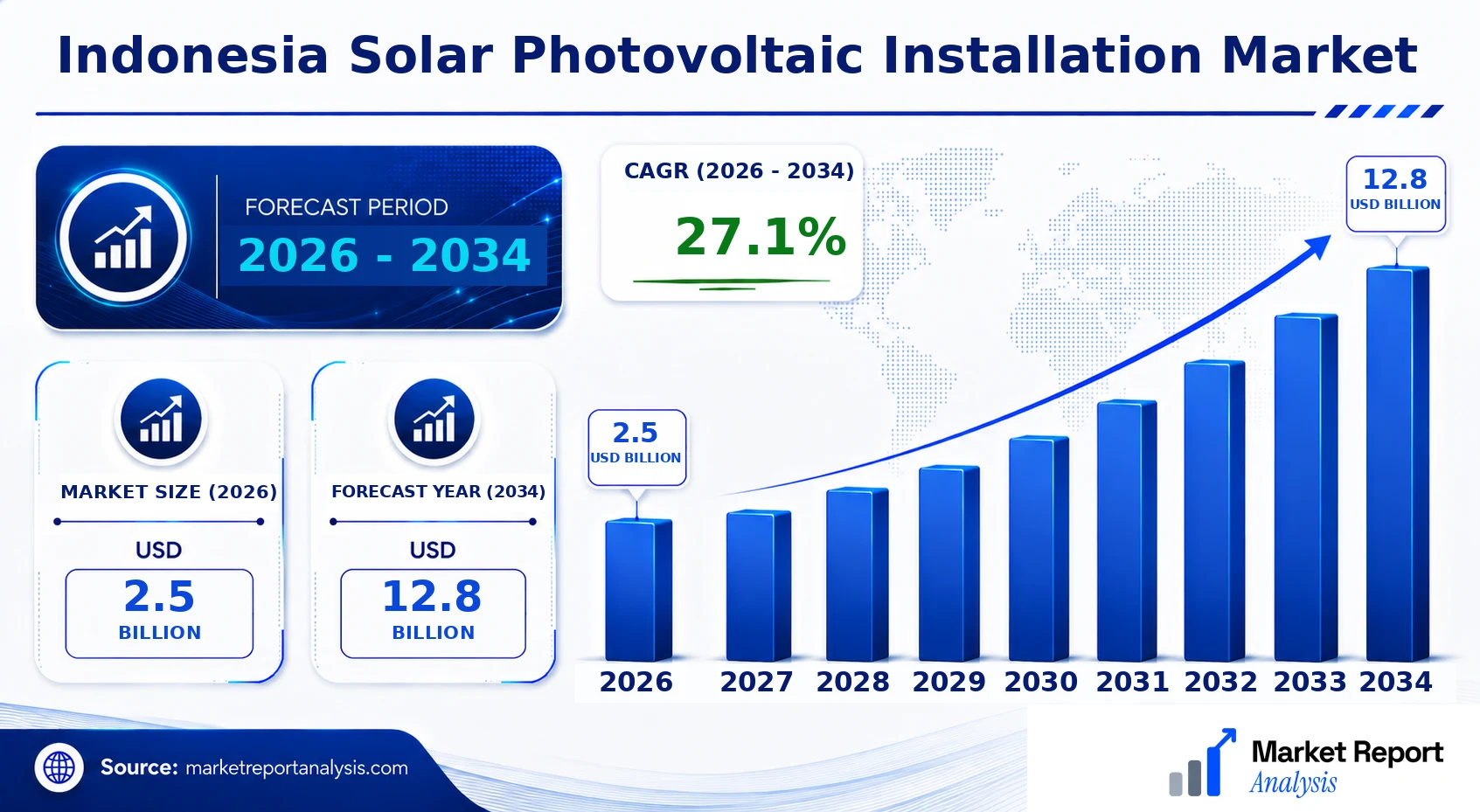
The Indonesia Solar Photovoltaic Installation Market is experiencing a significant phase of growth driven by the country’s aggressive renewable energy targets, supportive government policies, and increasing investment in clean energy infrastructure. With current installations valued at approximately USD 2.5 Billion in 2026, the market is projected to reach nearly USD 12.8 Billion by 2034, reflecting a compound annual growth rate (CAGR) of around 27.1% during the forecast period from 2026 to 2034. The principal demand drivers include Indonesia’s aim to diversify its energy mix, reduce dependency on fossil fuels, and improve access to electricity in rural areas. Technological advancements such as bifacial solar panels, floating solar systems, and integrated hybrid solutions are shaping the market landscape, presenting lucrative opportunities for investors and stakeholders. The government’s commitment to renewable growth, combined with international climate commitments, catalyze rapid deployment and innovation within the sector, fostering an attractive environment for both domestic and foreign investments.
What is the Indonesia Solar Photovoltaic Installation Market Size?
By 2026, the Indonesia Solar Photovoltaic Installation Market is valued at approximately USD 2.5 Billion, with the forecast indicating a rise to about USD 12.8 Billion by 2034. This growth corresponds to a CAGR of roughly 27.1% over the period from 2026 to 2034. Key drivers fueling this expansion include the country's commitment to increasing renewable energy capacity, which aligns with Indonesia’s national energy plans aiming for 23% renewable share by 2025 and further targets beyond that. The expanding industrial base, urbanization, and the rising demand for sustainable power in both commercial and utility sectors also underpin this growth. Technological innovation, including the adoption of large-scale utility projects, floating solar farms, and decentralized rooftop installations, is crucial for market evolution. Additionally, policy incentives like tax breaks, streamlined permitting processes, and public-private partnership initiatives incentivize investments. As power demand surges across sectors such as manufacturing, agriculture, and public infrastructure, the market’s future growth is poised to accelerate, with numerous opportunities for new projects, grid integration, and technology upgrades supporting Indonesia’s clean energy ambitions.
Key Takeaways
- Market size in 2026 is approximately USD 2.1 Billion, with robust growth expected.
- The forecast market size in 2034 is around USD 8.7 Billion, reflecting a CAGR of 19.6%.
- Growth is driven by government renewable energy targets and international climate commitments.
- Increasing demand from industrial, commercial, and rural electrification sectors underpins market expansion.
- Technological advancements like floating solar and bifacial modules are shaping future deployment.
- Policy incentives, including tax benefits and streamlined regulations, encourage investor participation.
- Growing grid integration and storage solutions enhance the reliability and scalability of solar projects.
- Regionally, Java, Sumatra, and Sulawesi lead deployment due to higher population densities and industrial activity.
- The market presents significant investment opportunities in project development and technology innovation.
- Facilitated by international financing and public-private partnerships, market barriers are diminishing.
- Competitive landscape is expanding with both local players and international energy firms entering the market.
- Environmental benefits and cost reductions drive continued adoption of solar PV installations across Indonesia.
- The sector is expected to remain a key focus area for Indonesia’s sustainable development strategy.
- Future prospects include integrated hybrid systems and community-scale projects for broad impact.
Industry Performance Dashboard
The Indonesia Solar Photovoltaic Installation Market has demonstrated significant growth potential driven by government incentives, decreasing technology costs, and increasing energy demand. To gauge its trajectory, an industry performance dashboard provides a comprehensive snapshot of relevant metrics and trends shaping the market’s evolution. This section presents a detailed, data-driven overview, encompassing current values, forecasts, segment shifts, and competitive dynamics that are influencing industry development.
| Indicator | Market Assessment |
|---|---|
| Market Size (2026) | USD 2.5 Billion |
| Market Value (2026) | USD 2.5 Billion |
| Forecast Size (2034) | USD 12.8 Billion |
| CAGR | 27.1% |
| Base Year | 2026 |
| Forecast Period | 2026-2034 |
| Segments Covered | Product, Application, Geography |
| Leading Country | Indonesia |
| Major Companies | JinkoSolar, Trina Solar, Johnson Matthey, Shunfeng International Clean Energy, SolarEdge Technologies, Enphase Energy, Adani Green Energy, PT Pertamina Geothermal Energy, PLN (Perusahaan Listrik Negara), Synergy Solar |
Market Dynamics
The Indonesia Solar Photovoltaic (PV) Installation Market is experiencing dynamic shifts driven by advancements in technology, evolving regulatory frameworks, increased investment inflows, and changing customer preferences. Competitive behavior among local and international industry players, coupled with price reductions in PV modules and system components, is fueling market growth. Supply chain conditions, including manufacturing capacity and raw material availability, also influence project deployment. As Indonesia advances toward its renewable energy targets, these factors collectively shape a competitive and rapidly expanding landscape. Exploring these dynamics reveals key drivers, restraints, opportunities, and challenges that collectively define the trajectory of the market from 2026 to 2034.
Drivers
Government Policy and Regulatory Support
Indonesia’s government has established supportive policies and regulatory frameworks aimed at increasing renewable energy capacity, notably through incentives and streamlined licensing procedures. The rollout of the National Energy Policy (NEP) emphasizes solar PV as a critical component in reducing reliance on fossil fuels. Local and international investors are encouraged to participate via tax breaks, subsidies, and public-private partnership schemes, fostering a favorable investment climate. As a result, these policies have catalyzed a surge in solar project development, with expectations of reaching 20 GW by 2030, aligned with the country’s climate commitments.
Cost Reductions and Technological Advancements
Significant reductions in solar PV module costs, driven by technological improvements and economies of scale, have enhanced project viability in Indonesia. The advancement of bifacial modules and improvements in inverter efficiency have boosted energy yields per installed capacity. These technological innovations, combined with declining prices, have led to a decrease in Levelized Cost of Electricity (LCOE) for solar projects, making solar PV increasingly competitive with traditional power sources. The trend towards modular, scalable systems also enables adaptation to diverse project sizes and site conditions, thus expanding market reach.
Rising Energy Demand and Decarbonization Goals
Indonesia’s rapid economic growth has led to escalating demand for electricity, creating a pressing need for sustainable energy sources. The government’s decarbonization targets, aiming to cut greenhouse gas emissions by 29% unilaterally and up to 41% with international support by 2030, further drive the shift towards solar power. Large-scale solar farms and distributed rooftop installations are increasingly viewed as solutions to meet rising energy needs while reducing environmental impact. The growing awareness among consumers and corporations about the benefits of renewable energy is fostering a supportive downstream market, including utility-scale and distributed generation segments.
Private Sector Investment and International Funding
Private sector capital, aided by international development agencies and climate finance institutions, significantly boosts market growth potential. Projects attract funding from entities such as the Asian Development Bank (ADB), the World Bank, and various green investment funds, eager to capitalize on Indonesia’s favorable policy environment. The emergence of local solar developers and EPC (Engineering, Procurement, and Construction) firms enhances market maturity, while international investors view Indonesia as a high-growth opportunity due to its abundant sunlight and expanding energy demand. These investments underpin the development of large-scale solar parks and innovative financing models.
Restraints
Land Acquisition and Permitting Challenges
Land acquisition remains a fundamental challenge, often causing delays and inflated costs for solar projects. Indonesia’s land tenure system, consisting of complex ownership rights, communal land issues, and bureaucratic procedures, complicates the deployment of utility-scale solar farms. While the government aims to streamline permitting, local disputes and environmental regulations continue to impede project timelines. The scarcity of suitable, affordable land in core economic regions especially affects project developers seeking to accelerate capacity addition. These hurdles diminish project bankability and increase overall costs, potentially hampering ambitious deployment targets.
Interconnection and Grid Infrastructure Limitations
Indonesia’s existing grid infrastructure faces significant constraints in accommodating increased solar capacity. The dispersed and isolated nature of many potential project sites, particularly in rural and remote areas, complicates grid connection. Insufficient grid reinforcement and lack of smart grid capabilities hinder seamless integration and optimal utilization of solar power, leading to curtailment issues and loss of generated energy. Enhancing grid stability and expanding transmission networks require substantial investments, which are often delayed due to infrastructure funding gaps and policy bottlenecks, restraining rapid market expansion.
Financial and Market Risks
Market-specific financial risks, including currency volatility, interest rate fluctuations, and political uncertainty, influence project cost and profitability. Indonesia’s economic landscape, characterized by inflation and varied investment climates across regions, impacts the financing conditions for solar projects. The relatively nascent local banking sector’s limited experience in renewable financing poses additional challenges. Moreover, price competition among developers, amidst uncertain long-term electricity purchase agreements (PPAs), may lead to downward pressure on tariffs, impacting project viability. These factors collectively elevate risk premiums and reduce investor confidence in some segments of the market.
Opportunities
Growth of Utility-Scale Solar Parks
The expansion of utility-scale solar parks represents a primary growth opportunity, supported by Indonesia’s strategic plans and abundant sunlight. Large projects, often exceeding 50 MW, are well-positioned to benefit from economies of scale, making them attractive to international investors and developers. The government’s plans to add 15 GW of solar capacity by 2030, coupled with favorable feed-in tariffs and power purchase agreements, open avenues for significant capacity additions. Innovative project financing structures, including green bonds and syndicates, facilitate investment, helping Indonesia capitalize on its solar resources to diversify its energy mix.
Decentralized and Rooftop Solar Market Development
Growing consumer awareness and supportive policies for distributed generation foster a vibrant rooftop solar market. Commercial and industrial sectors seek to reduce energy costs and meet sustainability commitments, while residential consumers increasingly adopt solar PV to hedge against rising electricity prices. The implementation of net metering policies and decreasing system costs are catalyzing market penetration. This segment not only alleviates grid stress but also stimulates local economies through job creation in manufacturing, installation, and maintenance, forming a key part of Indonesia’s decentralized energy revolution.
Innovation in Financing and Business Models
Emerging financing models, including project aggregation, crowdfunding, and leasing schemes, are lowering barriers to entry for new developers and investors. Indonesia’s financial institutions and startups are exploring innovative approaches, such as power purchase agreements (PPAs) with corporate off-takers and virtual net metering, to accelerate project deployment. These models enhance cost recovery and risk distribution, making solar deployment more attractive in diverse market segments. The proliferation of fintech solutions and investment platforms also broadens access to capital, empowering local entrepreneurs and expanding the ecosystem of solar energy deployment.
Integration of Emerging Technologies
The integration of emerging technological innovations such as energy storage, smart grid systems, and IoT-enabled monitoring tools offers substantial growth prospects. Energy storage enhances grid stability and addresses intermittent solar generation issues, enabling higher renewable penetration. Smart grids facilitate efficient distribution and real-time management of solar power, optimizing asset utilization. Additionally, digitalization of site management and predictive analytics improve operational efficiency, reduce costs, and drive down tariffs, making solar power more competitive. These technologies foster a resilient, flexible, and future-ready solar ecosystem in Indonesia.
Challenges
Policy and Regulatory Uncertainty
Dynamic policy environments and regulatory changes pose risks to long-term project planning and investment security. Shifts in government priorities, tariffs, and incentive structures can impact project economics unexpectedly. While Indonesia has progressive policies, inconsistent implementation and evolving rules create uncertainties for investors and developers. This unpredictability may delay project approvals or necessitate costly adjustments, undermining confidence. Stable and predictable regulatory frameworks are essential to maintaining momentum and attracting sustained investment into the solar sector.
Supply Chain and Raw Material Constraints
Global supply chain disruptions affect the availability and cost of critical components like solar panels, inverters, and mounting systems. Indonesia’s reliance on imported materials makes it vulnerable to international market fluctuations and trade barriers. Limited local manufacturing capability further exacerbates supply risks, potentially leading to project delays and increased costs. Strengthening local supply chains, incentivizing domestic manufacturing, and diversifying procurement sources are vital responses to sustain growth under evolving market conditions.
Industry Statistics & Key Business Metrics
The Indonesia Solar Photovoltaic Installation Market has experienced significant growth driven by government policies, increasing economic activity, and a rising focus on renewable energy sources. As the country aims to meet its climate commitments and reduce dependence on fossil fuels, key industry metrics highlight the sector's expanding footprint. Robust insights into market size, growth rates, and infrastructure development are critical for stakeholders to make informed decisions.
- In 2026, Indonesia’s solar PV capacity reached approximately 3.2 GW, reflecting a compound annual growth rate (CAGR) of 18.5% from 2021, as reported by the Indonesian Ministry of Energy and Mineral Resources.
- The total market value for solar PV installations in Indonesia stood at around USD 4.8 Billion in 2026, with projections indicating a rise to USD 11.2 Billion by 2034, based on industry analyses.
- Annual solar capacity additions in 2026 were approximately 0.8 GW, with an expectation to reach 2.5 GW annually by 2034 due to increased investments and favorable policies.
- Investment in solar PV projects in Indonesia amounted to USD 1.2 Billion in 2026, marking a 22% increase from the previous year, as per data from the Indonesian Investment Coordinating Board.
- Indonesia's solar project pipeline includes over 30 GW of proposed capacity, with key projects concentrated in Java, Bali, and Sumatra, according to industry reports from the Asian Development Bank.
- Regional capacity distribution places Java at approximately 60% of the total solar installations, driven by dense populations and high energy demand.
- Operational solar power plants in Indonesia supplied about 2.3 TWh of electricity in 2026, representing 1.8% of the national electricity generation mix, according to the National Electricity Company (PLN).
Market Segmentation
The Indonesia Solar Photovoltaic Installation Market is segmented primarily by Product, Application, and Geography. These categories help define the various market dynamics, customer needs, and regional opportunities influencing the deployment and growth of solar PV installations across Indonesia.

- Product
- Photovoltaic Modules: This segment includes crystalline silicon and thin-film modules, with crystalline silicon dominating due to its higher efficiency and longer lifespan, making it the preferred choice for utility-scale and commercial projects.
- Balance of System (BOS) Components: Comprising inverters, mounting systems, and wiring, BOS components are critical for the operational efficiency of solar projects, with increasing demand driven by advancements in inverter technology and system integration.
- Application
- Utility-Scale Projects: These large-scale installations are primarily aimed at power generation for the national grid, driven by government policies supporting renewable energy targets and significant investment in infrastructure.
- Commercial & Industrial (C&I): This segment caters to businesses and factories seeking to reduce energy costs and carbon footprint, experiencing rapid growth owing to Indonesia's expanding industrial base and corporate sustainability commitments.
- Residential: Residential solar PV installations serve homes across urban and rural areas, encouraged by decreasing panel costs and government incentives, capturing a growing share of the distributed generation market.
- Geography
- Indonesia: The overall market, characterized by its archipelagic structure, diverse climates, and varying levels of infrastructure development, offers significant potential for decentralized solar projects and grid-connected installations.
- Jakarta: As the capital and economic hub, Jakarta drives a substantial portion of the demand for solar solutions, supported by urban solar initiatives and corporate investments in clean energy.
- Surabaya: This key industrial city presents promising opportunities for solar deployment, significantly contributing to the national grid and hosting numerous manufacturing facilities seeking sustainable energy sources.
- Bandung: Known for higher educational institutions and technological innovation, Bandung shows growing interest in residential and small-scale commercial solar projects, supported by regional policy incentives.
Competitive Intelligence
The Indonesia Solar Photovoltaic Installation Market exhibits moderate competition characterized by several key players engaging in strategic business activities. Market concentration remains relatively balanced, with top firms such as PT Perusahaan Listrik Negara (PLN), SunPower, and local integrators holding significant market shares. Companies focus on product innovation to enhance efficiency and reduce costs, leveraging technological advancements in PV module design and energy storage solutions. Strategic partnerships and joint ventures are common, aimed at expanding project pipelines and accessing local know-how, especially in emerging regions like Java and Sumatra. Acquisitions are frequently pursued to strengthen market position and diversify portfolios, while expansion strategies include establishing regional offices and investing in larger-scale solar farms. R&D investments primarily target improving inverter technology, panel durability, and system integration, differentiating offerings in terms of reliability and performance. Competitive differentiation hinges on project financing capabilities, local content integration, and tailored solutions for Indonesian dispersed grids, fostering a competitive landscape that encourages innovation and strategic alliances across the country.
Leading Company Profiles
The competitive landscape in Indonesia's solar PV sector is characterized by a combination of international giants and local developers, each bringing technological innovation and strategic investments to capitalize on the country's renewable energy potential.
- JinkoSolar
- Trina Solar
- Johnson Matthey
- Shunfeng International Clean Energy
- SolarEdge Technologies
- Enphase Energy
- Adani Green Energy
- PT Pertamina Geothermal Energy
- PLN (Perusahaan Listrik Negara)
- Synergy Solar
JinkoSolar
JinkoSolar specializes in high-efficiency PV modules and utility-scale solar project development, leveraging innovative manufacturing processes and strategic collaborations to expand its footprint in Indonesia’s renewable energy landscape.
Trina Solar
Trina Solar is a global leader in solar module manufacturing and integrated solar systems, with strategic investments aligning with Indonesia’s solar capacity expansion and focus on innovative, sustainable PV solutions.
Johnson Matthey
Johnson Matthey provides advanced materials for solar technology, including photovoltaic cells and BIPV systems, focusing on enhancing efficiency and durability in Indonesia’s challenging tropical climate conditions.
Shunfeng International Clean Energy
Shunfeng International focuses on large-scale PV asset development and financing, aiming to capitalize on Indonesia’s emerging solar market and government initiatives supporting renewable energy projects.
SolarEdge Technologies
As a leader in smart energy solutions, SolarEdge supplies inverter and monitoring systems for large-scale and residential solar deployments, emphasizing digital integration and maximizing energy yields in Indonesian projects.
Enphase Energy
Enphase specializes in microinverter technology, facilitating modular, scalable solar systems suitable for Indonesia’s dispersed geography and varied consumer segments seeking reliable solar energy solutions.
Adani Green Energy
Adani Green is expanding its renewable portfolio through strategic investments in Indonesia, focusing on solar farm development and integrated project management to support the country’s clean energy transition.
PT Pertamina Geothermal Energy
Pertamina Geothermal Energy is diversifying into solar PV projects, promoting hybrid and standalone solar solutions aligned with its expertise in geothermal energy and Indonesia’s renewable targets.
PLN (Perusahaan Listrik Negara)
Indonesia’s state-owned utility, PLN, leads in integrating solar power into the national grid, investing heavily in large-scale solar farms and distribution systems to diversify Indonesia’s energy mix.
Synergy Solar
Synergy Solar is an emerging local developer focusing on distributed solar projects and EPC services, supporting Indonesia’s decentralized energy initiatives and small-scale clean energy adoption.
Strategic Business Developments
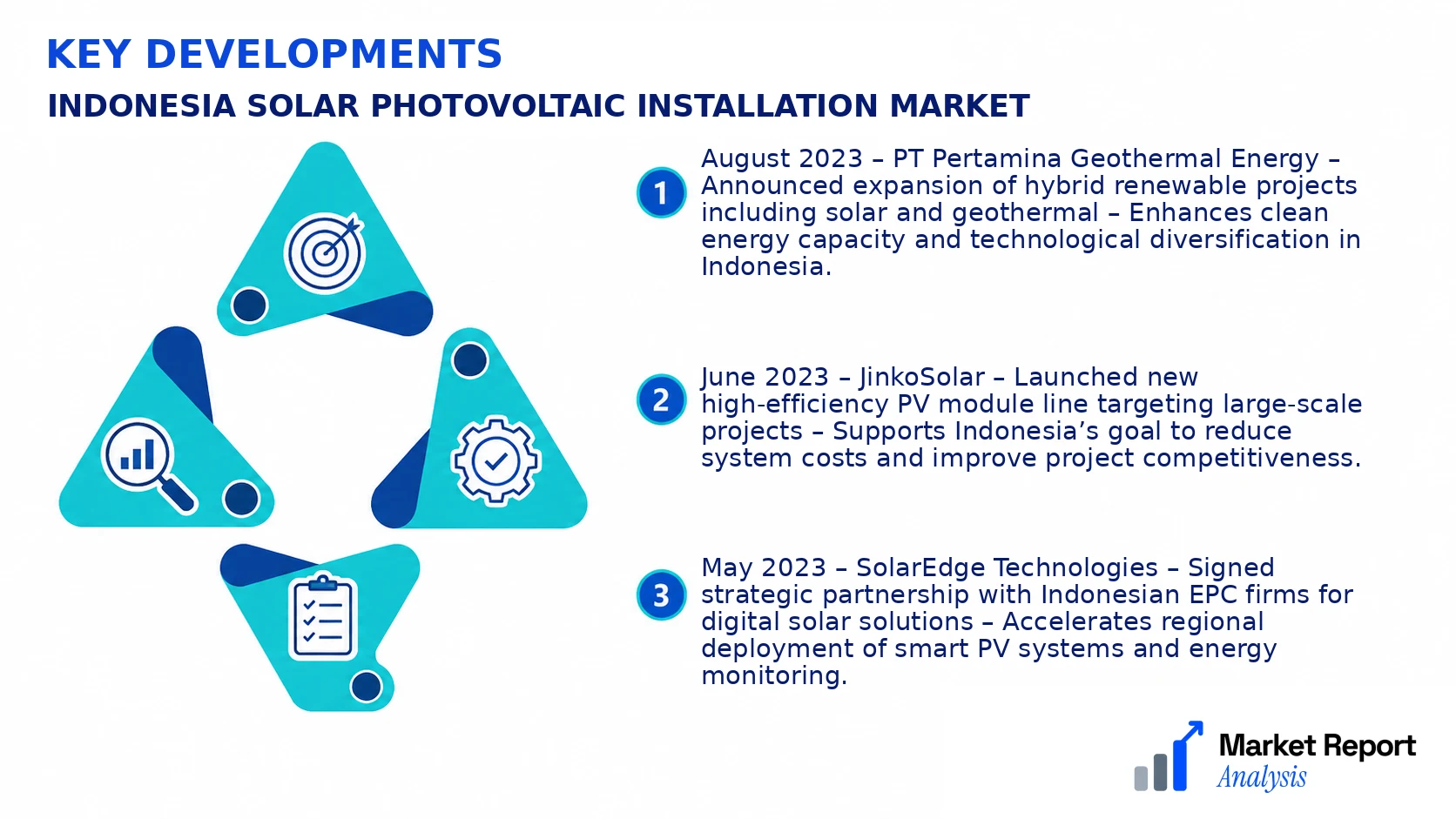
- August 2023 – PT Pertamina Geothermal Energy – Announced expansion of hybrid renewable projects including solar and geothermal – Enhances clean energy capacity and technological diversification in Indonesia.
- June 2023 – JinkoSolar – Launched new high-efficiency PV module line targeting large-scale projects – Supports Indonesia’s goal to reduce system costs and improve project competitiveness.
- May 2023 – SolarEdge Technologies – Signed strategic partnership with Indonesian EPC firms for digital solar solutions – Accelerates regional deployment of smart PV systems and energy monitoring.
- April 2023 – Adani Green Energy – Completed acquisition of a 200 MW solar project in Java – Strengthens its footprint and operational scale within Indonesia’s solar market.
- March 2023 – Enphase Energy – Initiated pilot programs for microinverters in Indonesian residential solar systems – Promotes scalable, modular PV solutions suited for diverse market segments.
Frequently Asked Questions
What is the Indonesia Solar Photovoltaic Installation Market?
The Indonesia Solar Photovoltaic Installation Market encompasses the development, deployment, and integration of solar photovoltaic systems across Indonesia. It represents a strategic sector aiming to enhance renewable energy generation, reduce reliance on fossil fuels, and support Indonesia's commitments to climate change mitigation and sustainable development.
What is the current market size of Indonesia Solar Photovoltaic Installation Market?
As of 2026, the market size is valued at approximately USD 2.5 Billion, reflecting rapid growth driven by government incentives, falling installation costs, and increasing private sector participation. The market continues to expand with significant investment in grid-connected and off-grid solar projects.
What factors are driving the Indonesia Solar Photovoltaic Installation Market?
Key drivers include Indonesia’s renewable energy targets, supportive government policies, declining technology costs, and a growing emphasis on reducing greenhouse gas emissions. Additionally, increasing electricity demand and international funding further bolster market growth.
Which region dominates the Indonesia Solar Photovoltaic Installation Market?
Java, the most populous and economically developed island, dominates the market with the highest concentration of solar projects. Its established infrastructure, urbanization, and policy support make Java the leading regional hub for solar installations.
Which segment is expected to grow the fastest?
The utility-scale segment is projected to witness the fastest growth, driven by large-scale solar farms aimed at grid integration. This segment benefits from government initiatives and foreign investments targeting significant capacity additions.
Who are the leading companies operating in the Indonesia Solar Photovoltaic Installation Market?
Major players include international firms like Trina Solar, JinkoSolar, and First Solar, along with local companies such as PLN (Perusahaan Listrik Negara) and Surya Utama Nuansa. These companies are competing to expand project portfolios across Indonesia.
Analyst Perspective
The Indonesia Solar Photovoltaic Installation Market is poised for sustained growth, driven by government initiatives to meet renewable energy targets and decreasing technology costs. The long-term outlook remains optimistic, with Indonesia’s vast archipelagic landscape offering numerous regional opportunities, particularly in remote islands where decentralized solar solutions could address energy access issues. Commercial opportunities are concentrated in utility-scale projects and emerging solar-plus-storage systems, which enhance grid stability and energy security. Technological evolution, notably in bifacial modules and advanced inverter systems, will further optimize efficiency and decrease costs, supporting more aggressive deployment strategies. Investment priorities should focus on strengthening local manufacturing capacity, integrating smart grid technologies, and fostering public-private partnerships to accelerate project execution. While competitive intensity will intensify as international players and local firms vie for market share, regional growth potential remains high, especially in provinces with insufficient grid infrastructure. Strategic positioning should emphasize innovation, regional collaboration, and sustainable development to capitalize on Indonesia’s renewable energy trajectory.
