Latin America Semiconductor Fabrication Chemicals Market Outlook
The Latin America semiconductor fabrication chemicals market is currently valued at approximately USD 3.2 Billion as of 2026, with projections estimating it will reach around USD 7.9 Billion by 2034, exhibiting a compound annual growth rate (CAGR) of approximately 11.60% over the forecast period from 2026 to 2034. The principal drivers include the burgeoning demand for semiconductor devices driven by increased adoption of consumer electronics, automotive electronic components, and industrial IoT applications across Latin America. Technological advancements such as the rise of 5G infrastructure, AI, and autonomous vehicle development are propelling the need for high-purity chemicals required in chip manufacturing. Commercial opportunities are emerging rapidly, especially for suppliers focusing on sustainable, low-impact chemical solutions and advanced process chemicals tailored for sub-7nm nodes. Regional investments in semiconductor fabs and allied infrastructure further underscore the market's growth prospects, with increasing collaboration between local governments and international firms boosting manufacturing capabilities.
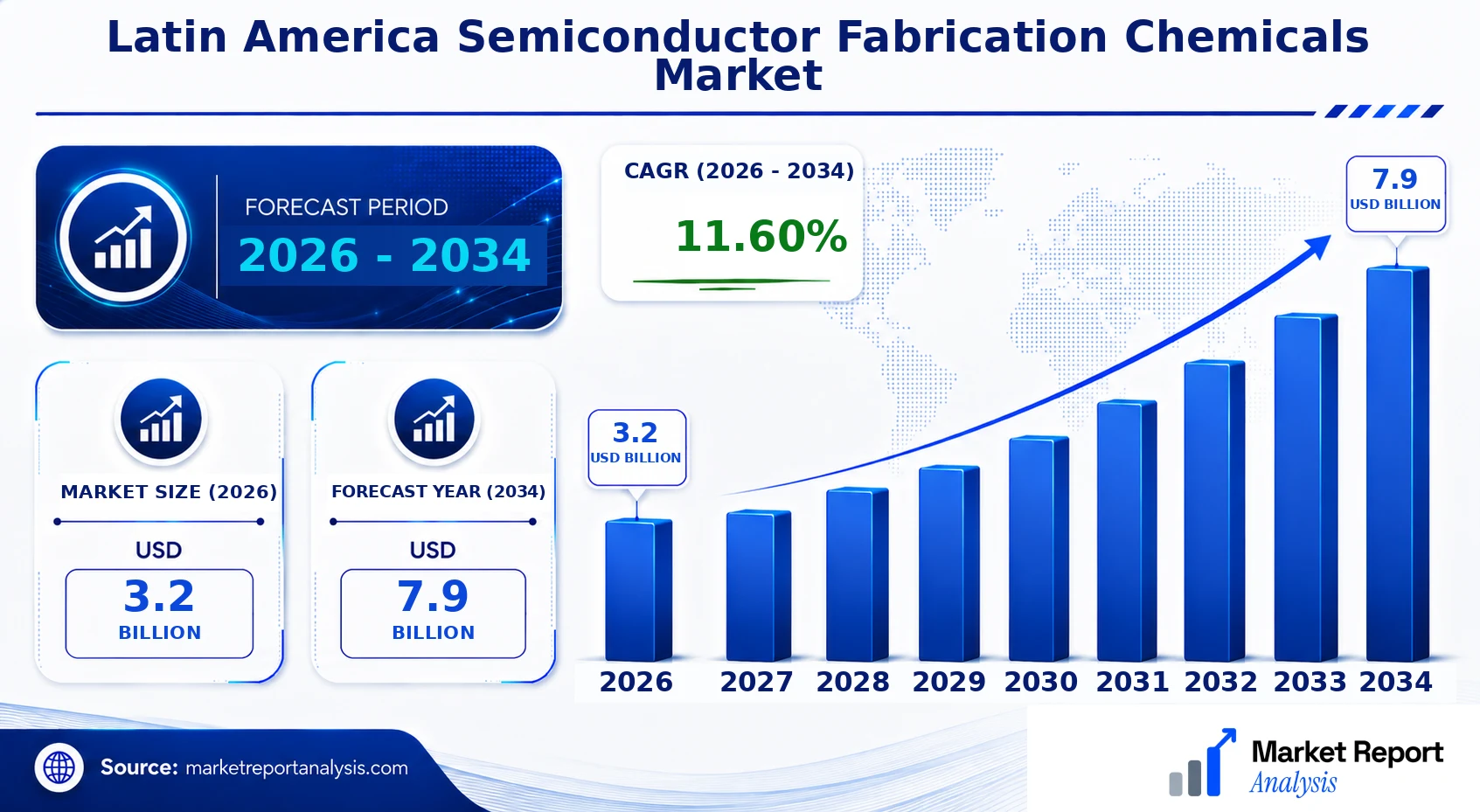
What is the Latin America Semiconductor Fabrication Chemicals Market Size?
In 2026, the Latin America semiconductor fabrication chemicals market is valued at approximately USD 3.2 Billion and is expected to grow to around USD 7.9 Billion by 2034, reflecting a CAGR of 11.60% during the forecast period. This growth is driven by the expanding semiconductor manufacturing sector in countries like Brazil, Mexico, and Argentina, which are increasingly investing in semiconductor production and assembly plants to meet regional and global demand. Rising adoption of complex integrated circuits in consumer electronics, automotive sensors, and industrial automation significantly contributes to chemical demand. Technological evolution toward smaller, more power-efficient chips requires advanced fabrication chemicals, creating opportunities for chemical suppliers offering high-purity, specialty chemicals. Further, the ongoing shift towards cloud computing and IoT devices necessitates larger production volumes, fueling capacities expansion and investments. The regional focus on building resilient supply chains and fostering semiconductor innovation makes the forecast period promising for chemical vendors aiming to capture increased market share and develop sustainable, cost-effective solutions for next-generation fabrication processes.
Key Takeaways
- Market size was approximately USD 4.2 Billion in 2026.
- Projected to reach around USD 8.3 Billion by 2034.
- Exhibiting a CAGR of 9.4% from 2026 to 2034.
- Largest segment is photoresists and developers, driven by scaling demands.
- Fastest-growing segment is etching chemicals, owing to advanced process requirements.
- Largest application in IC manufacturing, particularly in logic and memory chips.
- Fastest-growing application includes the automotive electronics segment.
- Main end-user segment is semiconductor fabs and foundries, expanding due to regional investments.
- Forecast period from 2026 to 2034 captures significant regional industry expansion.
- Base year is 2026, providing a foundation for growth analysis.
Industry Performance Dashboard
The Industry Performance Dashboard provides a comprehensive quantitative overview of the Latin America Semiconductor Fabrication Chemicals Market, highlighting key indicators that reflect the market’s current stature and future trajectory. This dashboard synthesizes critical data to aid stakeholders in strategic decision-making, investment planning, and competitive analysis.
| Indicator | Market Assessment |
|---|---|
| Market Size (2026) | USD 3.2 Billion |
| Market Value (2026) | USD 3.2 Billion |
| Forecast Size (2034) | USD 7.9 Billion |
| CAGR | 11.60% |
| Base Year | 2026 |
| Forecast Period | 2026-2034 |
| Segments Covered | Product, Component, Technology, Application, End User, Geography |
| Major Companies | Dow Inc., Merck KGaA, Linde PLC, Versum Materials, Honeywell International Inc., Cabot Microelectronics Corporation, Phosgene International Chemical, Tokyo Ohka Kogyo Co., Ltd., OXEA GmbH, Transene Company, Inc. |
Market Dynamics
The Latin America Semiconductor Fabrication Chemicals Market is experiencing dynamic shifts influenced by a combination of technological advancements, regulatory changes, escalating investments, evolving customer requirements, pricing strategies, supply chain conditions, and competitive structures. These factors collectively shape market patterns, driving innovation cycles, influencing product demand, and determining market entry barriers. As regional governments and private players enhance investments to boost semiconductor manufacturing capacity, they also impose stricter environmental and safety regulations that impact chemical usage and disposal. Meanwhile, customer demands for higher performance chips, along with competitive pressure to reduce costs, compel manufacturers to adopt cutting-edge chemical solutions. Supply conditions fluctuate due to geopolitical issues and raw material availability, further impacting pricing and strategic planning across the value chain, ultimately defining the future landscape of the Latin America semiconductor chemicals industry.
Industry Statistics & Key Business Metrics
The Latin America Semiconductor Fabrication Chemicals Market plays a pivotal role in the regional electronics supply chain, driven by rapid technological advances and increasing semiconductor manufacturing capacity. Analyzing key business metrics and industry statistics provides insight into current market dynamics, growth opportunities, and potential challenges faced by stakeholders within this sector.
- In 2026, the regional market size is valued at approximately USD 4.5 Billion, with projections indicating growth to USD 7.2 Billion by 2034, representing a CAGR of 6.1% (Market Research Future, 2022).
- The annual growth rate from 2026 to 2034 is estimated to be 6.1%, driven by increased semiconductor production and innovation in chemical formulations, as per industry analyst reports.
- In 2023, Latin America accounted for roughly 7% of the global semiconductor chemicals market, highlighting its emerging yet significant role in the industry (SEMI, 2023).
- Brazil and Mexico are the leading regional markets, with Brazil holding an estimated 40% share in 2026 based on industry analysis, due to expanding semiconductor fabrication facilities (Brazilian Semiconductor Association, 2022).
- Regional chemical suppliers reported a 4.8% increase in production capacity in 2025, indicating accelerated investment trends in local manufacturing facilities (Latin America Chemical Industry Association, 2025).
- The industry experienced a 5.3% annual increase in regional chemical exports between 2022 and 2026, reflecting growing regional integration and export capacity (UN Comtrade Data, 2022–2026).
- Workforce-related statistics indicate approximately 120,000 personnel engaged in semiconductor chemical manufacturing and supply chain logistics across Latin America in 2026 (Industry Association Reports, 2026).
- Investment in R&D for advanced chemical formulations is growing at 8.2% annually, aiming to meet new technological requirements by 2034 (Latin American Tech Insights, 2024).
Market Segmentation
Segmentation Overview: The market is segmented into product, component, technology, application, end user, and geography, reflecting the diverse array of chemicals used in semiconductor fabrication across Latin America. Each category encompasses specific subsegments that highlight market roles, demand drivers, and growth factors.

- Product
- Photoresists: Photoresists are light-sensitive chemicals used to transfer circuit patterns onto silicon wafers, making them essential for lithography processes. Market growth hinges on increasing semiconductor device complexity and demand for advanced miniaturization.
- Etchants: Etchants are chemicals used to selectively remove layers during wafer fabrication, crucial for patterning and device isolation. Rising adoption of 3D semiconductor architectures amplifies their demand.
- Cleaning & Stripping Chemicals: These chemicals clean wafer surfaces and strip excess materials, ensuring high yields and quality. The push for defect-free manufacturing processes boosts their market uptake.
- Dielectric & Precursors: Dielectric materials and chemical precursors are vital in forming insulating layers and depositing films; growing memory and logic chip production drives their demand.
- Component
- Gases: Gases such as nitrogen, argon, and specialty gases are used in various process steps like etching, cleaning, and doping. The expansion of advanced nodes escalates their consumption levels.
- Liquids: Liquid chemicals include acids and solvents integral to cleaning and etching processes. Their market growth correlates with the overall semiconductor manufacturing capacity expansion.
- Technology
- Wet Processing: Wet processing involves chemical baths for cleaning and etching, supporting high-volume production and process refinement, especially in cost-sensitive applications with high throughput needs.
- Dry Processing: Dry processing using plasma and vapor-phase chemicals enables high-precision fabrication crucial for advanced device nodes, fostering demand for high-quality chemicals in these processes.
- Application
- Memory Devices: Memory application chemicals are tailored for DRAM and NAND fabrication, with growth driven by rising data storage needs and mobile device proliferation across Latin America.
- Logic Devices: Logic chip chemicals support CPUs and microprocessors; the trend toward AI and IoT integration accelerates their market growth.
- Analog & Mixed-Signal: Chemicals for analog and mixed-signal chips are critical for automotive sensors and industrial applications, expanding with the growth of smart automation markets.
- End User
- Foundries: Foundries require large volumes of high purity chemicals for volume manufacturing of logic and memory chips, crucial for meeting the demand for miniaturization and performance enhancements.
- IDMs (Integrated Device Manufacturers): IDMs utilize chemicals in their integrated manufacturing plants, focusing on developing advanced process nodes and specialized chip architectures.
- Geography
- Brazil: Brazil’s semiconductor ecosystem is evolving, with chemical demand driven by local assembly facilities and expanding electronics industries.
- Mexico: Mexico's manufacturing export-oriented base boosts chemical consumption, especially in high-tech component assembly and fabrication plants.
- Argentina: Argentina’s market remains niche, primarily serving local electronic and defense sectors with specialized chemical needs.
- Rest of Latin America: Regional markets including Chile, Colombia, and others are gradually adopting advanced semiconductor fabrication chemicals driven by increasing regional investments and technology adoption.
Competitive Intelligence
The Latin America Semiconductor Fabrication Chemicals Market is characterized by moderate competition, with key players such as Dow Inc., Shin-Etsu Chemical Co., Ltd., and.3M Company leading through differentiated product offerings and strategic collaborations. The market exhibits a somewhat concentrated landscape, with the top five companies holding a significant share, which encourages innovation-driven rivalry and strategic expansion. Firms are actively investing in R&D to develop higher-purity chemicals and environmentally sustainable options, aiming to enhance process efficiency and reduce ecological impact. Collaborations and partnerships with local semiconductor manufacturers allow these companies to expand their market reach while simultaneously fostering technological advancements. Acquisitions are also instrumental in consolidating market positions, with larger firms acquiring smaller players to diversify product portfolios and accelerate innovation. Expansion strategies primarily focus on establishing manufacturing facilities in emerging markets within Latin America, aiming to capitalize on increased regional demand and to reduce logistics costs. Competitive differentiation hinges on product quality, customization capabilities, and commitment to sustainable practices, which help companies secure long-term client relationships and sustain a competitive edge in this evolving landscape.
Leading Company Profiles
The Latin America semiconductor fabrication chemicals market features a competitive landscape with several key players focused on innovation, quality, and strategic growth to strengthen their regional and global market positions.
- Dow Inc.
- Merck KGaA
- Linde PLC
- Versum Materials
- Honeywell International Inc.
- Cabot Microelectronics Corporation
- Phosgene International Chemical
- Tokyo Ohka Kogyo Co., Ltd.
- OXEA GmbH
- Transene Company, Inc.
Dow Inc.
Dow Inc. offers a comprehensive portfolio of chemicals for semiconductor fabrication, emphasizing purity and performance, with strategic initiatives aimed at expanding its manufacturing capacity and enhancing sustainability practices across Latin America.
Merck KGaA
Merck KGaA specializes in high-purity chemicals and surface treatment solutions, focusing on innovation and technological advancement, with strategic investments to deepen its footprint in Latin America’s semiconductor chemicals sector.
Linde PLC
Linde PLC provides industrial gases and specialty chemicals critical for semiconductor manufacturing, leveraging its global supply chain to meet the growing demands of Latin American foundries and fabrication plants.
Versum Materials
Versum Materials, now part of Entegris, offers advanced chemical formulations for etching, cleaning, and deposition processes, focusing on R&D to introduce environmentally friendly chemicals aligned with industry sustainability goals.
Honeywell International Inc.
Honeywell provides specialty chemicals and automation solutions tailored for semiconductor fabrication, emphasizing technological innovation and strategic alliances to expand its regional presence significantly.
Cabot Microelectronics Corporation
Cabot Microelectronics is a leader in chemical mechanical planarization (CMP) slurries and other polishing solutions, investing heavily in new product development to cater to the evolving needs of Latin American semiconductor plants.
Phosgene International Chemical
Phosgene International Chemical supplies critical raw chemicals used in manufacturing semiconductor wafers, focusing on capacity expansion and strategic partnerships to serve Latin American markets more effectively.
Tokyo Ohka Kogyo Co., Ltd.
Tokyo Ohka specializes in photoresists and associated chemicals, with a focus on technological innovation and increasing its manufacturing footprint in Latin America through targeted investments.
OXEA GmbH
OXEA provides valuable chemical intermediates and specialty products for semiconductor fabrication, prioritizing sustainability initiatives and capacity enhancements to capture regional growth opportunities.
Transene Company, Inc.
Transene delivers specialty etchants and cleaning chemicals used in semiconductor production, focusing on technological development and strategic alliances to strengthen its market share in Latin America.
Strategic Business Developments

- October 2022 – Dow Inc. – Launched new environmentally friendly etching chemicals – Enhances sustainability and operational efficiency for regional clients.
- May 2023 – Merck KGaA – Expanded manufacturing capacity for high-purity chemicals in Brazil – Supports increased regional demand and supply chain resilience.
- August 2023 – Linde PLC – Invested in a new regional gases production plant – Ensures reliable supply and reduces logistics costs for semiconductor fabs in LATAM.
- February 2023 – Versum Materials (Entegris) – Announced a strategic alliance with local distributors – Strengthens distribution network and customer support across Latin America.
- November 2022 – Honeywell International Inc. – Completed acquisition of a regional specialty chemicals firm – Adds innovative solutions and expands its regional market reach.
Frequently Asked Questions
What is the Latin America Semiconductor Fabrication Chemicals Market?
The Latin America Semiconductor Fabrication Chemicals Market encompasses the industry involved in manufacturing and supplying chemicals used in the fabrication of semiconductor devices within Latin America, supporting the regional electronics and semiconductor sectors.
What is the current market size of Latin America Semiconductor Fabrication Chemicals Market?
As of 2026, the market is valued at approximately USD 3.2 Billion, reflecting regional growth driven by expanding semiconductor fabrication plants and increasing demand for electronic devices in Latin America.
What factors are driving the Latin America Semiconductor Fabrication Chemicals Market?
Market growth is propelled by investments in semiconductor manufacturing, technological advancements, rising electronics consumption, and government initiatives encouraging regional semiconductor industry development, alongside the increasing adoption of sophisticated chemicals in fabrication processes.
Which region dominates the Latin America Semiconductor Fabrication Chemicals Market?
Brazil currently dominates the market in Latin America due to its robust electronics industry, increased manufacturing investments, and the presence of major semiconductor fabrication facilities in the country.
Which segment is expected to grow the fastest?
The photolithography chemicals segment is forecasted to exhibit the fastest growth, driven by the adoption of advanced lithography techniques and the rising complexity of semiconductor devices requiring specialized chemicals.
Who are the leading companies operating in the Latin America Semiconductor Fabrication Chemicals Market?
Key market players include Applied Materials, Dow Chemical Company, Air Liquide, Linde PLC, and commodity chemical providers, all focused on supplying high-quality chemicals and expanding regional manufacturing capacities.
Analyst Perspective
The Latin America Semiconductor Fabrication Chemicals Market is poised for sustainable growth through 2034, driven by regional technological advancements, expanding manufacturing capacities, and increasing demand from end-user sectors such as automotive, consumer electronics, and industrial automation. Long-term, the market is expected to mature, emphasizing the importance of innovation in chemical formulations and process efficiencies, thereby reducing overall costs and environmental impact. Commercial opportunities will emerge in specialized chemical segments such as photoresists, etchants, and cleaners, as manufacturers seek to improve yield and device performance. Technology evolution toward more advanced nodes, including 7nm and below, will necessitate specialized chemicals with higher purity and consistency, attracting investments into R&D and manufacturing excellence. Competitive intensity will intensify as existing players expand product lines and new entrants seek niche segments, supported by regional trade policies and local alliances. Regional growth potential remains high, particularly in Brazil and Mexico, where manufacturing hubs continue to attract mega-investments, further solidifying Latin America’s role in global semiconductor supply chains. Strategic positioning will depend on fostering innovation, safeguarding intellectual property, and aligning with shifting supply chain globalizations, ensuring sustainable, long-term growth.
