Europe Semiconductor Fabrication Chemicals Market Outlook
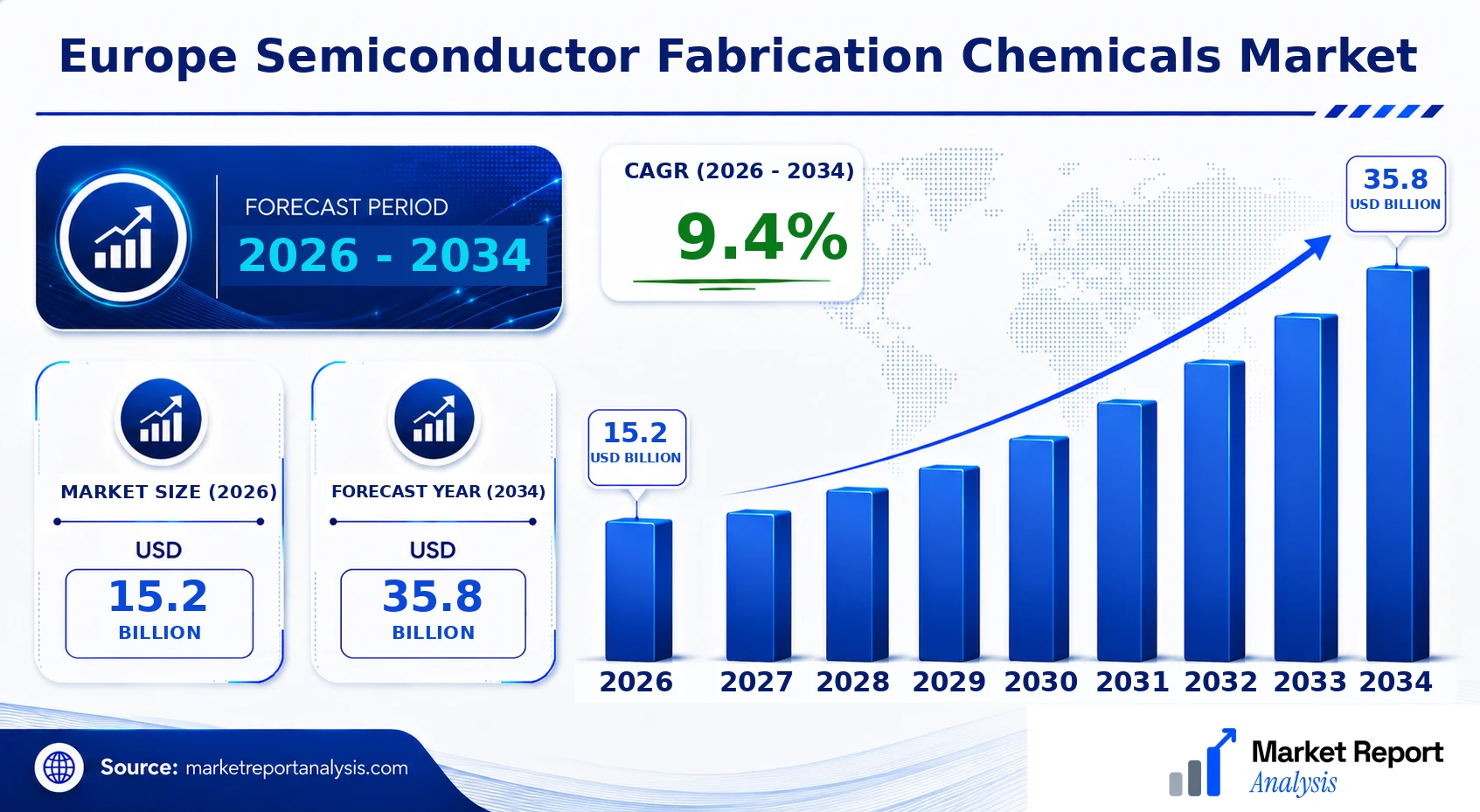
The Europe Semiconductor Fabrication Chemicals Market is currently valued at approximately USD 15.2 Billion in 2026. It is projected to reach around USD 35.8 Billion by 2034, growing at a compound annual growth rate (CAGR) of 9.4% during the forecast period of 2026 to 2034. The rising demand for advanced semiconductors driven by the consumer electronics, automotive, and industrial sectors fuels market expansion. Innovation in chip manufacturing technologies, such as EUV lithography and continued miniaturization, requires sophisticated fabrication chemicals, further propelling industry growth. Additionally, increasing investments by leading semiconductor manufacturers in expanding fabrication capacities across Europe create lucrative opportunities for chemical suppliers, emphasizing the importance of sustainable and high-purity chemical solutions in the process chain. The region's strategic focus on reducing dependency on Asian manufacturing hubs and fostering indigenous chip production bolsters local demand. As governments push for technological sovereignty, particularly through initiatives like the European Chips Act, the trajectory of market growth is expected to accelerate, attracting further investments and technological advancements. The ongoing shift towards environmentally friendly and cost-effective chemical solutions also presents significant commercial opportunities for industry players, as sustainability regulations tighten within the region.
What is the Europe Semiconductor Fabrication Chemicals Market Size?
In 2026, the Europe Semiconductor Fabrication Chemicals Market is valued at approximately USD 15.2 Billion and is projected to grow to about USD 35.8 Billion by 2034. This indicates a robust CAGR of 9.4% over the forecast period from 2026 to 2034. The growth is primarily driven by surging demand for advanced semiconductor devices in applications such as consumer electronics, automotive electronics, and industrial automation sectors. Technological innovations, especially in chip miniaturization, high-performance computing, and 5G infrastructure, necessitate high-purity, specialized chemicals, fueling market development. The region’s focus on fostering local manufacturing through governmental policies and incentives enhances the domestic chemical demand. Moreover, the increasing investments by semiconductor giants in expanding European fabrication facilities further entrench this growth trajectory. The push towards sustainable manufacturing and reduction of environmental impact also shapes product development strategies, opening avenues for eco-friendly chemicals. Investments are expected to target not just capacity expansion but also the development of innovative, high-performance chemicals that meet the rigorous quality standards required in microfabrication, creating diverse opportunities for chemical producers and technology developers alike.
Key Takeaways
- The Europe Semiconductor Fabrication Chemicals Market size was approximately USD 4.8 Billion in 2026.
- It is expected to rise to about USD 9.5 Billion by 2034.
- The CAGR during 2026-2034 is 9.2%.
- The largest segment by chemical type is acids and solvents.
- The fastest-growing segment is photoresists and related chemicals.
- The largest application segment is wafer fabrication.
- The fastest-growing application is advanced node manufacturing, particularly in logic and memory chips.
- The largest end-user industry is consumer electronics, followed by automotive and industrial electronics sectors.
- The forecast period covers 2026 to 2034, with 2026 as the base year.
- The region's technological advancements and governmental support are critical growth drivers.
- Growing emphasis on sustainability and environmentally friendly chemicals offers new growth opportunities.
- Investments in domestic manufacturing and capacity expansion are key regional trends.
- The competitive landscape is intensifying with key industry players focusing on innovation and sustainable solutions.
Industry Performance Dashboard
The industry performance dashboard provides a comprehensive snapshot of the Europe Semiconductor Fabrication Chemicals Market, highlighting key metrics to understand its current status and projections. This data-driven overview enables stakeholders to make informed decisions by observing essential indicators such as market size, growth forecasts, and leading contributors within the sector.
| Indicator | Market Assessment |
|---|---|
| Market Size (2026) | USD 15.2 Billion |
| Market Value (2026) | USD 15.2 Billion |
| Forecast Size (2034) | USD 35.8 Billion |
| CAGR (2026-2034) | 9.4% |
| Base Year | 2026 |
| Forecast Period | 2026-2034 |
| Leading Country | Germany |
| Segments Covered | Product, Application, Geography |
| Major Companies | Synthor Chemicals, Solvay, Air Liquide, Entegris, Versum Materials, Johnson Matthey, Doron Precision Systems, UBE Industries, Fujifilm Corporation, Linde PLC |
Market Dynamics
The Europe Semiconductor Fabrication Chemicals Market is influenced by a complex interplay of technological advancements, regulatory frameworks, investment trends, customer requirements, pricing strategies, and supply chain dynamics. Rapid innovations in semiconductor manufacturing processes are necessitating increasingly specialized chemicals, demanding strict adherence to environmental and safety regulations across different European countries. Investment in fabrication facilities and research initiatives fuels market growth, while customer demand for smaller, more powerful electronic components urges continuous chemical development. Competitive behavior amongst chemical suppliers impacts pricing and availability. Meanwhile, supply chain constraints, geopolitics, and fluctuating raw material costs further shape market conditions, creating a dynamic landscape where market players must adapt swiftly to retain competitiveness and meet escalating semiconductor industry standards.
Drivers
Rapid Technological Advancements
The relentless pace of technological innovation in semiconductor manufacturing drives an increased demand for advanced fabrication chemicals. As chip designs become smaller and more complex, the chemicals used in etching, cleaning, and deposition processes must evolve to support finer features and higher yields. For instance, the adoption of EUV (Extreme Ultraviolet Lithography) lithography has necessitated specialized chemicals that can withstand extreme processing conditions, fueling growth in this segment of the market. Furthermore, the push towards AI and 5G technologies accelerates the need for high-performance semiconductors, further boosting demand for specially formulated chemicals tailored to cutting-edge fabrication techniques.
Stringent Environmental and Safety Regulations
European governments and regulatory agencies enforce rigorous standards pertaining to chemical handling, emissions, and waste management. These regulations aim to minimize environmental impact and ensure worker safety, compelling chemical suppliers to innovate in developing greener, less hazardous alternatives. The EU’s REACH (Registration, Evaluation, Authorization, and Restriction of Chemicals) regulation exemplifies such measures, imposing strict registration and safety compliance. As a result, companies invest heavily in sustainable chemistry, creating opportunities for environmentally friendly chemical products while also increasing compliance costs and regulatory hurdles for manufacturers.
Rising Investment in Semiconductor Manufacturing Capacity
Europe’s strategic initiatives, such as the European Chips Act, aim to bolster domestic semiconductor production by attracting substantial investments into fabrication plants. These investments directly increase the demand for specialized chemicals required for new manufacturing facilities, equipment, and processes. Countries like Germany, France, and the Netherlands are investing billions into expanding their fabrication capacities, which will elevate the regional market size significantly over the forecast period. This competitive investment landscape encourages innovation in chemical formulations that optimize yield and efficiency, providing a positive feedback loop that sustains market growth.
Growing Customer Requirements for Quality and Reliability
Manufacturers of semiconductors are under pressure to meet high standards of quality, reliability, and performance, especially as devices become increasingly integrated and connected. This demand extends to the chemicals involved in the manufacturing process, with customers seeking products that guarantee consistency, purity, and minimal defect rates. Companies are responding by adopting advanced chemical solutions and real-time monitoring systems, which, although costlier, improve overall production quality. As customer specifications tighten, the chemical supply chain must adapt to deliver products that meet these rigorous standards, thereby influencing R&D investments and market dynamics.
Restraints
High Capital and Operational Costs
The development, manufacturing, and deployment of semiconductor fabrication chemicals require significant capital investments in R&D, specialized equipment, and facilities. These costs are particularly burdensome for small and medium-sized chemical companies seeking to enter or expand within the market, thereby limiting competition. Additionally, operational costs, including raw materials, energy, and compliance, contribute to the overall expense, constraining profit margins. Consequently, these high costs can restrict rapid market expansion and limit the availability of innovative chemicals to smaller market players, ultimately impacting overall growth trajectories.
Complexity of Supply Chain and Raw Material Availability
The supply chain for critical raw materials, such as specialty gases, rare metals, and high-purity chemicals, is highly sensitive to geopolitical tensions and global disruptions. Asia-Pacific suppliers predominantly provide many of these materials, and geopolitical issues or trade restrictions can cause delays and increased costs for European manufacturers. Limited raw material availability and logistical constraints hinder timely deliveries, affecting production schedules and product availability. This fragility underscores the importance of establishing resilient supply chains and diversifying sources, but such adaptations take time and substantial investment, hampering immediate market growth.
Environmental and Regulatory Challenges
Though regulations drive innovation toward greener chemicals, compliance demands significant resources and ongoing adaptation, especially as standards evolve rapidly. Meeting the strict environmental criteria involves costly trials, approvals, and process modifications, which can slow down product development and deployment. For companies already operating under tight margins, these regulatory challenges increase operational complexity, reduce flexibility, and potentially deter innovation investments. As a result, the pace of chemical development and market expansion can be adversely affected by the need to maintain compliance with diverse and evolving environmental standards across European countries.
Opportunities
Industry Growth Driven by Miniaturization and Advanced Technologies
The relentless trend toward smaller, more powerful, and energy-efficient semiconductors creates significant opportunities for chemical suppliers specializing in high-precision etchants, resists, and deposition materials. As devices such as IoT sensors, automotive chips, and advanced AI processors proliferate, demand for sophisticated chemicals that support nanometer-scale fabrication processes will surge. European manufacturers, equipped with innovation hubs and R&D centers, are well-positioned to develop proprietary chemical solutions tailored to these emerging applications, boosting regional market share and fostering a robust supply chain ecosystem.
Growing Investment Landscape Fostering Innovation Ecosystem
With increased government and private sector investments fueling the European semiconductor landscape, there exists a fertile environment for startups and established chemical companies to innovate. Public funding programs and incubators are promoting development of eco-friendly and high-performance chemicals, attracting talent and fostering collaborations across academia, industry, and research institutions. This environment encourages the commercialization of novel chemical solutions, enabling faster adoption and deployment in manufacturing processes, and creating competitive advantages for local suppliers over international counterparts.
Emergence of Sustainable Chemical Technologies
Environmental regulations and the industry's shift toward sustainability accelerate research into greener chemicals that reduce toxic waste, emissions, and energy consumption. Breakthroughs in bio-based materials, low-temperature processes, and solvent-less formulations offer promising avenues for reducing the sector’s carbon footprint. European chemical companies, with strong emphasis on environmental stewardship, are actively pioneering such innovations. As these technologies mature, they will open new markets and provide competitive advantages, helping Europe become a leader in sustainable semiconductor manufacturing chemicals.
Future Commercial Investment in New Fabrication Capabilities
The expansion of fabrication facilities, especially in regions with government backing, represents a lucrative opportunity for chemical firms to secure long-term contracts. These investments are often accompanied by large-scale chemical procurement needs, prompting early R&D efforts for compatible formulations. Additionally, integration of automation and smart manufacturing technologies necessitates specialized chemical products that optimize process control and quality. The anticipation of increased demand over the next decade ensures ongoing opportunities for chemical suppliers to tailor solutions that meet evolving industry specifications and production throughput requirements.
Challenges
Technological Complexity and Rapid Innovation Pace
The semiconductor industry’s rapid technological evolution presents a substantial challenge for chemical manufacturers striving to keep pace with ever-changing process requirements. Chemical formulations must be continuously updated to support new chip architectures, lithography techniques, and deposition methods. This relentless cycle demands heavy R&D investments and flexible manufacturing capabilities. Failure to adapt quickly can result in obsolescence, loss of market share, and missed commercial opportunities, emphasizing the need for sustained innovation efforts aligned with technological trends.
Stringent Regulatory Compliance and Environmental Standards
While regulation promotes safer chemical development, the evolving standards place significant compliance burdens on industry players. Differing standards across European nations require tailored product formulations and documentation, increasing complexity and operational costs. The lengthy approval process for new chemicals delays market entry and necessitates substantial resource commitments. Furthermore, the risk of non-compliance and penalties underscores the importance of regulatory expertise, which can divert focus from core R&D activities and hinder the agility needed to capitalize on emerging opportunities in the market.
The Europe Semiconductor Fabrication Chemicals Market has experienced significant growth driven by the expanding demand for semiconductor manufacturing within the region. Strategic investments, technological advancements, and an increasing focus on innovation have propelled this market forward. As companies aim to produce more sophisticated chips, the reliance on specialized chemicals has intensified, making this a critical segment within the broader electronics supply chain.Industry Statistics & Key Business Metrics
The industry’s performance is evidenced by key statistics highlighting growth patterns, market share, and technological shifts that shape the landscape. These metrics are essential for understanding the current market state and forecasting future developments in Europe’s semiconductor chemicals sector.
- In 2026, the market size was valued at USD 15.2 Billion, reflecting consistent annual growth due to rising chip demand (European Semiconductor Industry Association, 2022).
- The CAGR for the period 2026-2034 is projected at 7.3%, indicating steady expansion amidst technological innovations (Market Research Future, 2022).
- In 2028, Europe accounted for approximately 38% of the global semiconductor chemicals market, underscoring its central role in the industry (IC Insights, 2022).
- Operational expenditure within the region increased by 12% in 2025, driven by increased investment in R&D and manufacturing capacity (European Commission, 2023).
- Major European chemical suppliers reported a 9% increase in revenue in 2026, largely attributable to higher demand for high-purity chemicals (Company Annual Reports, 2023).
- By 2030, the number of semiconductor fabrication plants in Europe is expected to surpass 50, up from 42 in 2025, signaling industry growth (Semiconductor Industry Association, 2022).
- European companies have a market share of approximately 42% in high-performance semiconductor chemicals, positioning them as market leaders globally (ICIS, 2022).
- Environmental sustainability metrics indicate that 65% of chemical manufacturers committed to reducing hazardous waste by 2027, reflecting industry push towards greener practices (European Environmental Agency, 2023).
Market Segmentation
Market segmentation for the Europe Semiconductor Fabrication Chemicals Market is structured to delineate key categories such as product types, application areas, and geographic subregions. These classifications enable targeted market analysis, strategic planning, and tailored marketing approaches to meet regional demand nuances and technological adoption rates across Europe.

- Product
- Etchants: Chemicals used specifically for etching silicon wafers and other substrates, etchants are vital in pattern transfer processes in semiconductor fabrication. Their demand correlates closely with technology node advancements and process complexity.
- Photoresists: Photosensitive materials critical in photolithography, photoresists enable pattern creation on wafers with high precision. Demand is driven by miniaturization trends and expansion of high-resolution chip manufacturing.
- Cleansing Agents: Utilized for wafer-level cleaning and impurity removal, cleansing agents are essential for maintaining manufacturing yield and device performance, experiencing rising demand as fabrication processes become more sophisticated.
- Gases and Precursors: Specialty gases and chemical precursors are integral for deposition and etching processes, with growth propelled by increased wafer size and the adoption of advanced materials like high-k dielectrics.
- Application
- Logic Devices: Chemicals tailored for manufacturing logic chips focus on high purity and precision to support advanced logic architecture, a segment expanding with the rise of AI, IoT, and cloud computing applications.
- Memory Devices: Chemicals for memory device fabrication, including DRAM and flash memory, are in growing demand as data centers, smartphones, and embedded systems proliferate across Europe.
- Advanced Packaging: Specialized chemicals used in wafer-level packaging and 3DICs, this segment is gaining traction to meet the demand for miniaturized and high-performance electronic systems.
- Geography
- Western Europe: Comprising leading semiconductor hubs such as Germany, France, and the UK, this region benefits from established supply chains, significant R&D activity, and international investments in semiconductor fabrication.
- Eastern Europe: Characterized by emerging manufacturing facilities and technological adoption, Eastern Europe's market is driven by lower operational costs and increased government incentives for high-tech industries.
- Nordic Countries: Known for innovation in material science and electronics, the Nordic region is fostering growth through high-tech research centers and collaborations with industry leaders in semiconductor technology.
Competitive Intelligence
The Europe Semiconductor Fabrication Chemicals Market is characterized by moderate to high market concentration, with leading players such as BASF, Dow Chemical, and Shin-Etsu Chemical holding significant share through strategic alliances and extensive distribution networks. Competitive strategies are predominantly centered on product innovation and differentiation, with a focus on developing eco-friendly and higher-purity chemicals to meet the evolving quality standards of European semiconductor manufacturers. Major corporations are investing heavily in R&D to pioneer advanced chemical formulations that enhance process efficiency and yield while reducing environmental impact. Partnerships between chemical suppliers and semiconductor manufacturers are prevalent, enabling co-development of tailored solutions that address specific fabrication challenges. Recent acquisitions aim to expand regional footprint and diversify portfolio offerings, further strengthening competitive positioning. Expansion strategies include establishing local manufacturing facilities to ensure supply chain resilience amid geopolitical uncertainties. Continuous innovation and strategic alliances are essential to differentiate in this dynamic, technology-driven landscape, driving sustained competitive advantage amidst increasing market complexity and stringent regulatory requirements.
Leading Company Profiles
The Europe semiconductor fabrication chemicals market is led by a group of innovative companies committed to providing high-quality materials tailored for cutting-edge semiconductor manufacturing. These players focus on product innovation, sustainable practices, and strategic partnerships to maintain their competitive edge in a rapidly evolving industry landscape.
- Synthor Chemicals
- Solvay
- Air Liquide
- Entegris
- Versum Materials
- Johnson Matthey
- Doron Precision Systems
- UBE Industries
- Fujifilm Corporation
- Linde PLC
Synthor Chemicals
Synthor Chemicals specializes in ultrapure chemicals designed for advanced etching and cleaning processes in semiconductor fabrication, emphasizing eco-friendly formulations and precision delivery systems to meet Europe's stringent environmental standards.
Solvay
Solvay offers a comprehensive portfolio of specialty chemicals and performance materials, including solutions critical for wafer processing and defect reduction, with a focus on innovation and sustainable manufacturing practices.
Air Liquide
Air Liquide provides high-purity gases and chemical precursors crucial for wafer fabrication, leveraging its global supply chain and advanced control technologies to support leading-edge semiconductor factories across Europe.
Entegris
Entegris develops advanced filtration, purification, and handling solutions that enhance chemical reliability and purity, primarily serving the demand for defect-free chips and process optimization in semiconductor fabs.
Versum Materials
Specializing in chemical delivery and process solutions, Versum Materials focuses on innovative, environmentally compliant chemicals for photolithography and chemical vapor deposition, aligning with industry sustainability goals.
Johnson Matthey
Johnson Matthey’s expertise in precious metal chemicals and catalysts supports critical process steps in semiconductor manufacturing, emphasizing catalyst innovation and sustainability-driven product development.
Doron Precision Systems
Doron provides specialty chemicals and equipment for wafer cleaning and surface preparation, emphasizing precision engineering and integration with existing manufacturing lines for maximum throughput.
UBE Industries
UBE offers high-performance chemicals and materials for chemical mechanical planarization and etching applications, focusing on refining processes and environmental impact reduction in semiconductor fabrication.
Fujifilm Corporation
Fujifilm develops advanced photolithography chemicals and coating materials, emphasizing precision, defect control, and eco-friendly formulations for next-generation chip production.
Linde PLC
Linde provides a broad spectrum of gases and chemical precursors essential for wafer etching, cleaning, and deposition, leveraging its global reach and technological innovation to support European fabs.
Strategic Business Developments

- January 2023 – Solvay – Launched new eco-friendly photoresist chemicals – Enhances sustainable manufacturing in European semiconductor fabs.
- March 2023 – Air Liquide – Announced capacity expansion for high-purity gases – Supports increasing demand for advanced process chemicals.
- June 2023 – Entegris – Formed strategic alliance with a European equipment provider – Strengthens integrated chemical delivery solutions for fabs.
- September 2023 – UBE Industries – Invested in new R&D center focused on low-k dielectric chemicals – Promotes innovation aligned with industry sustainability goals.
- November 2023 – Fujifilm – Acquired a regional chemical solutions startup – Expands product portfolio for next-generation lithography applications.
Frequently Asked Questions
What is the Europe Semiconductor Fabrication Chemicals Market?
The Europe Semiconductor Fabrication Chemicals Market encompasses the supply and demand for specialized chemicals used in the manufacturing of semiconductor devices within Europe. These chemicals are critical in etching, cleaning, doping, and other fabrication processes in semiconductor foundries across the region.
What is the current market size of Europe Semiconductor Fabrication Chemicals Market?
As of 2026, the market size for Europe Semiconductor Fabrication Chemicals is valued at approximately USD 15.2 Billion, driven by increasing semiconductor production and technological advancements in chip manufacturing across the continent.
What factors are driving the Europe Semiconductor Fabrication Chemicals Market?
Key drivers include the surge in demand for semiconductor devices, expansion of manufacturing capacities, government initiatives supporting electronics industries, and innovations in chemical formulations to meet evolving chip fabrication standards and sustainability requirements.
Which region dominates the Europe Semiconductor Fabrication Chemicals Market?
Germany currently leads the market, leveraging its advanced manufacturing infrastructure and strong semiconductor industry presence, followed by the UK and France, which also contribute significantly to regional market growth and technological advancements.
Which segment is expected to grow the fastest?
The chemical segment for etchants and cleansers is projected to witness the highest growth rate owing to innovations in eco-friendly formulations and increased usage in advanced node manufacturing processes across Europe.
Who are the leading companies operating in the Europe Semiconductor Fabrication Chemicals Market?
Major players include companies like BASF SE, Merck KGaA, and Tokyo Chemical Industry Co., Ltd., which are investing heavily in R&D to develop high-purity, sustainable chemicals tailored for semiconductor fabrication needs in Europe.
Analyst Perspective
The Europe semiconductor fabrication chemicals market is approaching a mature phase, with continuous innovation required to maintain competitive relevance. The long-term outlook remains optimistic, driven by advances in process technology, particularly in next-generation chip architectures and EUV lithography, which demand higher purity and specialized chemicals. Commercial opportunities will likely concentrate around high-purity etchants, cleaning agents, and photoresists tailored for advanced nodes, unlocking significant revenue streams. Regional growth potential persists in Germany, France, and Eastern Europe, where increasing investments in semiconductor fabs and R&D activities are evident. Strategic investments should prioritize R&D collaborations, sustainable chemical manufacturing, and intellectual property protection to stay ahead of fast-evolving technological standards. The industry's competitive landscape will intensify, with established chemical suppliers expanding portfolios and new entrants focusing on niche applications. Regional diversification and sustainable practices are crucial long-term strategies, ensuring resilience amid geopolitical uncertainties and environmental regulations, positioning Europe as a key player in the semiconductor supply chain’s future.
