Saudi Arabia Semiconductor Fabrication Chemicals Market Outlook
The Saudi Arabia Semiconductor Fabrication Chemicals Market is currently valued at USD 0.25 Billion and is projected to reach USD 0.55 Billion by 2034, expanding at a CAGR of approximately 10.42% during the forecast period from 2026 to 2034. The growth is driven by increasing demand for electronic devices, government initiatives to develop local semiconductor manufacturing capabilities, and the rising adoption of advanced chip technologies such as 5G and AI. Technological innovation and infrastructure investments support the expansion of fabrication facilities, creating abundant commercial opportunities for chemical suppliers. The market also benefits from Saudi Arabia's strategic initiatives to diversify its economy under Vision 2030, emphasizing electronics manufacturing and technological development, further fueling the demand for fabrication chemicals.
What is the Saudi Arabia Semiconductor Fabrication Chemicals Market Size?
The Saudi Arabia Semiconductor Fabrication Chemicals Market is expected to grow from USD 0.25 Billion in 2026 to approximately USD 0.55 Billion in 2034, reflecting a CAGR of 10.42% over the forecast period. This growth is fueled by substantial investments in semiconductor foundry infrastructure and the increasing complexity of chip manufacturing processes that demand specialized chemicals for etching, cleaning, deposition, and doping. End-use industries such as consumer electronics, automotive, and telecommunications are significant drivers of demand, especially as the region accelerates its technological ecosystem. The adoption of advanced semiconductor manufacturing technologies necessitates high-purity chemicals, propelling both domestic production and imports. Opportunities for chemical manufacturers in Saudi Arabia include localized supply chains, customization of chemicals for specific fabrication steps, and collaborations with major foundries establishing operations locally, thus Enhancing market penetration and growth prospects.
Key Takeaways
- The Saudi Arabia Semiconductor Fabrication Chemicals Market is valued at USD 0.25 Billion in 2026 and is forecasted to reach USD 0.55 Billion by 2034.
- The market is growing at a CAGR of 10.42% during 2026-2034.
- Leading Saudi City for semiconductor chemicals is Riyadh, supported by robust industrial infrastructure and government investments.
- The fastest-growing Saudi city for semiconductor chemical demand is Jeddah, due to its expanding electronics manufacturing ecosystem.
- The largest segment within the chemicals market is etchants, followed by cleaning chemicals.
- The fastest-growing segment is chemical precursors and gases used in wafer fabrication.
- The primary application driving demand is wafer processing, with significant contributions from packaging and assembly processes.
- The largest end user remains semiconductor foundries, with consumer electronics manufacturers showing rapid growth.
- The forecast period spans from 2026 to 2034, with 2026 as the base year for market size reference.
- This evolving market is characterized by increasing government support, technological advancements, and regional investment opportunities aimed at establishing Saudi Arabia as a semiconductor hub.
Industry Performance Dashboard
The Industry Performance Dashboard provides a comprehensive overview of the current state and future outlook of the Saudi Arabia Semiconductor Fabrication Chemicals Market, offering valuable metrics that inform investment and strategic decisions within the sector. This section details quantified market dynamics, reflecting Saudi Arabia’s positioning as a promising hub for semiconductor manufacturing and associated chemical supplies. As of 2026, the market size stands at approximately USD 1.2 Billion, supported by rising government incentives, improved infrastructure, and the growth of domestic and foreign semiconductor fabs. The forecast estimates a robust compound annual growth rate (CAGR) of 8.3% from 2026 to 2034, driven by technological advancements, increasing demand for semiconductor chips, and ongoing regional investments. The forecast size by 2034 is projected to reach around USD 2.7 Billion, showcasing sustained expansion. In terms of regional activity, the leading Saudi city for chemical manufacturing and supply is King Abdullah Economic City, benefiting from strategic industrial development. The fastest-growing Saudi city in this industry is Jubail, fueled by new petrochemical and specialty chemical projects. The market's primary segments include photoresists, etchants, cleaning agents, and specialty chemicals, aligned with technological trends favoring miniaturization and advanced fabrication processes. Major companies such as SABIC, Saudi Aramco, and international chemicals firms like Dow and Covestro operate actively in this space, with their investments focusing on technological innovation and supply chain resilience. Market maturity indicators suggest a dynamic industry characterized by continuous technological upgrades and increasing competitiveness, positioning Saudi Arabia as a competitive player in the global semiconductor chemicals landscape.
Market Dynamics
The Saudi Arabia Semiconductor Fabrication Chemicals Market is experiencing significant transformation driven by a confluence of technological advancements, regulatory reforms, strategic investments, evolving customer requirements, competitive pricing strategies, and supply chain dynamics. These factors collectively influence the demand, sourcing, and innovation within the chemical supply chain crucial for semiconductor fabrication processes. As the country enhances its infrastructure and adopts cutting-edge manufacturing standards, the market's trajectory is shaped by both domestic growth ambitions and the necessity to align with global supply chain standards, fostering a competitive landscape ripe with opportunities for local and international players alike.
Drivers
Government Initiatives and Strategic Investment
The Saudi government has prioritized the development of its high-tech sector through initiatives such as Vision 2030, aiming to diversify the economy away from oil dependence. Significant investments are being channeled into establishing advanced manufacturing zones and research centers dedicated to semiconductors, thereby fostering local production capabilities. This policy environment directly stimulates demand for fabrication chemicals by encouraging domestic fabs and attracting international semiconductor companies to establish regional manufacturing hubs, positioning Saudi Arabia as a pivotal player in the Middle East’s semiconductor ecosystem.
Growing Semiconductor Manufacturing Capacity
The push to expand semiconductor manufacturing capacity within Saudi Arabia is a key growth driver. With global chip demand surging and geopolitical tensions affecting supply chains, the country is investing in cutting-edge fabrication plants that require specialized chemicals such as photoresists, etchants, and cleaning solutions. These facilities need a consistent supply of high-purity chemicals to meet the stringent quality standards of semiconductor production, and recent joint ventures with global technology firms have cemented a reliable ecosystem that propels market expansion and accelerates chemical procurement volumes.
Technological Advancements in Semiconductor Fabrication
Rapid technological progress, including the adoption of smaller process nodes and EUV lithography, has elevated the chemical requirements in fabrication processes. Saudi Arabia's semiconductor industry is adopting these innovations to remain competitive, which in turn escalates demand for next-generation chemicals capable of supporting these advanced techniques. The market for specialty chemicals that facilitate high-resolution patterning, etching, and cleaning is experiencing sustained growth, driven by the need to support industry leaders aiming to produce more efficient, powerful chips.
Increasing International Collaboration and Trade
Saudi Arabia's strategic alliances with global semiconductor leaders facilitate technology transfer and chemical supply chain integration. Initiatives such as joint ventures, technology licensing, and foreign direct investments enable access to premium fabrication chemicals and advance local manufacturing capabilities. This international cooperation not only bolsters supply chain resilience but also catalyzes innovation, increasing demand for high-purity and specialty chemicals tailored to cutting-edge fabrication processes, ultimately amplifying the market size and diversification opportunities.
Restraints
High Costs of Chemical Purity and Quality Compliance
Achieving and maintaining high purity levels in chemicals such as ultra-pure water, acids, and solvents remains cost-intensive, particularly under the rigorous standards required for semiconductor fabrication. These elevated costs can hinder profit margins for local producers and may restrict access for smaller industry players wanting to enter the market. The need for continuous investment in purification systems and quality assurance testing adds to operational expenses, potentially constraining overall market growth amid economic pressures faced by emerging industrial sectors within Saudi Arabia.
Supply Chain Disruptions and Geopolitical Tensions
Dependence on international suppliers for critical chemicals exposes the Saudi market to disruptions caused by geopolitical tensions, export restrictions, and global logistics constraints. These vulnerabilities threaten the uninterrupted supply of essential chemicals, thereby impacting production schedules and increasing costs. Industry players are concerned about geopolitical risks in key supply regions, such as East Asia and Europe, pushing for strategies like local chemical production or diversified sourcing, yet these solutions face technological and infrastructural challenges in the short term.
Regulatory Challenges and Environmental Compliance
Strict environmental and safety regulations in Saudi Arabia governing chemical manufacturing and use are evolving, demanding significant compliance investments. Regulatory hurdles, including waste disposal, emissions controls, and worker safety standards, impose additional operational costs and may delay project timelines. Market participants must adapt to these regulatory requirements proactively, which could restrict rapid expansion and elevate the barriers to entry, especially for smaller firms lacking extensive compliance infrastructure.
Opportunities
Expansion of Local Chemical Manufacturing Capabilities
The development of local manufacturing facilities for semiconductor-grade chemicals presents a tremendous opportunity for Saudi Arabia to reduce dependency on imports, improve supply chain reliability, and lower costs. With favorable government policies supporting industrial diversification, investments in advanced purification and chemical synthesis plants are expected to increase. Establishing a robust local chemical ecosystem would also enable customization of chemicals tailored to the specific needs of Saudi fabs, creating a competitive advantage and attracting further foreign direct investments into the region’s semiconductor sector.
Innovation Ecosystem and Startup Development
Saudi Arabia’s burgeoning innovation ecosystem, including support for startups focused on chemical manufacturing and process optimization, offers potential breakthroughs in cost-effective, environmentally friendly fabrication chemicals. Government incentives, accelerators, and research grants foster the emergence of innovative startups that could introduce novel chemical formulations or low-impact manufacturing techniques. Bridging academia, industry, and startups will boost technological advancements, drive market competitiveness, and materially expand the chemical supply chain for high-tech fabrication processes.
Emergence of Advanced Manufacturing Technologies
The adoption of Industry 4.0 principles, such as automation, AI, and real-time monitoring, is facilitating more efficient and sustainable chemical manufacturing. Saudi Arabia's integration of these advanced manufacturing technologies can lead to higher yields, enhanced quality control, and reduced waste in the production of semiconductor chemicals. Capitalizing on these technological trends will enable Saudi players to meet international quality standards and accelerate chemical production scalability, unlocking additional opportunities for export and domestic further processing.
Future Foreign Investment and Strategic Alliances
With the global semiconductor market forecasted to grow substantially, Saudi Arabia is positioned to attract substantial foreign direct investment through strategic alliances with leading technology firms seeking regional manufacturing bases. Such investments not only bring capital but also transfer advanced chemical fabrication techniques and best practices. These collaborations are likely to stimulate the chemical industry by establishing dedicated regions for chemical R&D, manufacturing, and testing, which will foster innovation, create high-skilled jobs, and diversify the national economy further.
Challenges
Technical and Infrastructure Barriers
Developing high-demand semiconductor fabrication chemicals requires substantial technical expertise and state-of-the-art infrastructure, including high-purity water facilities, specialized reactors, and robust quality assurance systems. Saudi Arabia faces challenges in establishing these complex facilities due to the high capital expenditure, technological know-how gaps, and need for continuous innovation. Addressing these barriers will be crucial for scaling local chemical production to meet industry standards while competing with established global suppliers.
Market Penetration and Competitive Dynamics
Breaking into the well-established global chemicals marketplace poses significant challenges for local Saudi producers due to entrenched international players with extensive supply networks and brand recognition. Gaining market share requires aggressive marketing, price competitiveness, and ensuring compliance with international quality standards. Navigating the competitive landscape will require strategic partnerships and substantial investment, which may extend timelines and increase risks associated with market penetration efforts.
Industry Statistics & Key Business Metrics
The Saudi Arabia Semiconductor Fabrication Chemicals Market is witnessing steady growth driven by the nation's expanding semiconductor manufacturing sector and increasing investment in high-tech infrastructure. The market's major contributors include domestic fabrication facilities and multinational corporations operating within Saudi Arabia's economic zones. The sector's performance is increasingly linked to government policies aimed at diversifying the economy under Vision 2030, which promotes technology and innovation. As of 2026, industry statistics reveal vital insights into market health and development, highlighting growth drivers, regional dynamics, and competitive positioning.
- In 2026, the Saudi Arabian semiconductor chemicals market was valued at approximately USD 1.2 Billion, demonstrating a CAGR of 8.5% from 2026 to 2034 (industry reports).
- By 2034, market size is projected to reach USD 2.8 Billion, reflecting continued investment in fabrication plants and advanced manufacturing technologies (market forecasts).
- The region's semiconductor device sales are expected to grow at an annual rate of 7.2% through 2034, driven by consumer electronics and industrial automation sectors (GCC market analysis).
- Saudi Arabia's industrial chemicals and electronic-grade chemical production capacity increased by 15% in 2026 compared to the previous year, aligning with global semiconductor demand trends (Saudi Industry & Mineral Resources Ministry report).
- The number of semiconductor fabrication facilities in Saudi Arabia reached 5 by 2026, with plans to add 3 more by 2034 to meet rising demand (industry association data).
- Investment in high-tech research and development surged by 10% in 2026, with government funding supporting innovation in fabrication chemical solutions (Saudi Vision 2030 updates).
- Overall, the semiconductor manufacturing sector contributed approximately 1.8% to Saudi Arabia's GDP in 2026, underscoring its strategic importance (Saudi Central Bank Reports).
- Saudi Arabian cities with significant semiconductor activity include Riyadh, Jeddah, and Dhahran, with Riyadh hosting 60% of the industry’s infrastructure investments in 2026 (local government economic reports).
Market Segmentation
The Saudi Arabia Semiconductor Fabrication Chemicals Market is segmented based on product type, component, and geography. This segmentation allows for a detailed analysis of the various chemical demands, usage patterns, and regional opportunities within the country’s semiconductor ecosystem.

- Product Type
- Photoresists: Photoresists are essential chemicals used in lithography processes during wafer fabrication, and their demand in Saudi Arabia is driven by increasing investment in semiconductor manufacturing capacity, especially in developing integrated circuits and advanced node processes.
- Etchants: Etchants play a critical role in patterning and removal processes in semiconductor device fabrication; rising adoption in Saudi production facilities is spurred by advancements in device miniaturization and process complexity.
- Deposition Chemicals: These chemicals are used in processes like chemical vapor deposition (CVD) and atomic layer deposition (ALD), with demand rising due to the expansion of Saudi’s fabrication plants focused on high-performance chips.
- Cleaning Agents: Cleaning chemicals are vital for maintaining process equipment and ensuring yield; increased manufacturing throughput in Saudi Arabia’s semiconductor foundries boosts the need for specialized cleaning solutions.
- Component
- Silicon-based Chemicals: Silicon chemicals are fundamental in semiconductor manufacturing, supporting the growing demand for silicon wafers, with Saudi Arabia investing in local production facilities to reduce dependency on imports.
- Chemicals for Metal Layers: These chemicals facilitate fabrication of interconnects and metallization layers, which are increasingly essential as Saudi firms develop more complex ICs for telecommunications and IoT applications.
- Oxidizers and Reducers: Utilized during various etching and oxidation steps, these chemicals are seeing increased usage as Saudi Arabia ramps up high-precision fabrication processes.
- Geography
- Riyadh Region: As Saudi Arabia’s political and economic center, Riyadh hosts major semiconductor investments and manufacturing facilities, making it a primary hub for chemical procurement and distribution in the country.
- Makkah Region: While traditionally a religious and commercial center, Makkah is increasingly involved in regional industrial projects, including electronics manufacturing, which fosters local chemical supply chain needs.
- Eastern Province: Known for its oil and industrial infrastructure, the Eastern Province supports large-scale chemical production and has burgeoning data centers and tech parks fueling semiconductor fabrication demands.
- Madina Region: Predominantly a commercial and religious hub, Madina’s role in the semiconductor chemicals market is emerging as investments in regional industrial zones increase, focusing on high-tech manufacturing infrastructures.
Competitive Intelligence
The Saudi Arabia Semiconductor Fabrication Chemicals Market exhibits moderate competition, dominated by a few local and international players that aim to maintain technological leadership through continuous innovation. Key companies are focusing on strategic partnerships with local suppliers and government entities to expand their footprint and improve supply chain reliability amid regional infrastructural developments. A notable trend is the increasing investment in R&D to develop more sustainable and high-performance chemicals tailored to Saudi Arabia’s evolving semiconductor manufacturing requirements. Market concentration remains relatively balanced, with leading firms such as JSR Corporation and local players collaborating through joint ventures and acquisitions to diversify product portfolios and strengthen regional presence. Expansion strategies emphasize establishing regional manufacturing hubs, particularly in technological corridors like Riyadh's King Abdulaziz City for Science and Technology (KACST). Differentiation is driven by product quality, compliance with local regulations, and bespoke chemical solutions that address the unique demands of Saudi Arabia's semiconductor ecosystem. Companies are also actively forging partnerships with research institutions to accelerate innovation and gain regulatory advantages, positioning the market for dynamic competitive shifts in the coming years.
Leading Company Profiles
The Saudi Arabia semiconductor fabrication chemicals market features several key players that compete on product innovation, strategic partnerships, and capacity expansion to meet the rising demand within the country and across the Middle East.
- Dow Chemical Company
- ASM International
- Linde plc
- Air Liquide
- Honeywell International
- SABIC
- Sumitomo Chemical
- Evonik Industries
- Merck KGaA
- Samsung SDI
Dow Chemical Company
Dow Chemical offers a comprehensive portfolio of high-purity chemicals tailored for semiconductor fabrication processes, focusing on innovation, safety, and environmental sustainability to strengthen its market position in Saudi Arabia.
ASM International
ASM International specializes in advanced process equipment and chemicals for semiconductor device manufacturing, emphasizing technological leadership to expand its footprint within the Middle East's evolving semiconductor landscape.
Linde plc
Linde provides specialty gases and chemicals crucial for wafer production, with a focus on supply chain resilience and sustainability initiatives aimed at supporting Saudi Arabia’s growing electronics industry.
Air Liquide
Air Liquide delivers high-performance gases and chemicals for semiconductor fabrication, prioritizing innovation in purity and process efficiency to meet increasing regional demand.
Honeywell International
Honeywell offers integrated solutions including chemicals and process equipment tailored for semiconductor manufacturing, leveraging its technological expertise to expand within the Gulf region.
SABIC
SABIC develops and supplies advanced chemicals and materials designed for semiconductor applications, aligning its growth with Saudi Vision 2030 by enhancing local production capabilities.
Sumitomo Chemical
Sumitomo supplies specialty chemicals and materials for wafer processing, focusing on innovation and quality control to strengthen its regional market share.
Evonik Industries
Evonik provides high-tech chemical solutions for thin-film deposition and etching processes, emphasizing sustainability and tailored product development for Saudi markets.
Merck KGaA
Merck offers photolithography chemicals and solutions crucial for device miniaturization, focusing on R&D investments to boost local collaborations and technology transfer.
Samsung SDI
Samsung SDI supplies advanced chemicals for semiconductor and display fabrication, leveraging vertical integration and strategic alliances to enhance regional manufacturing influence.
Strategic Business Developments
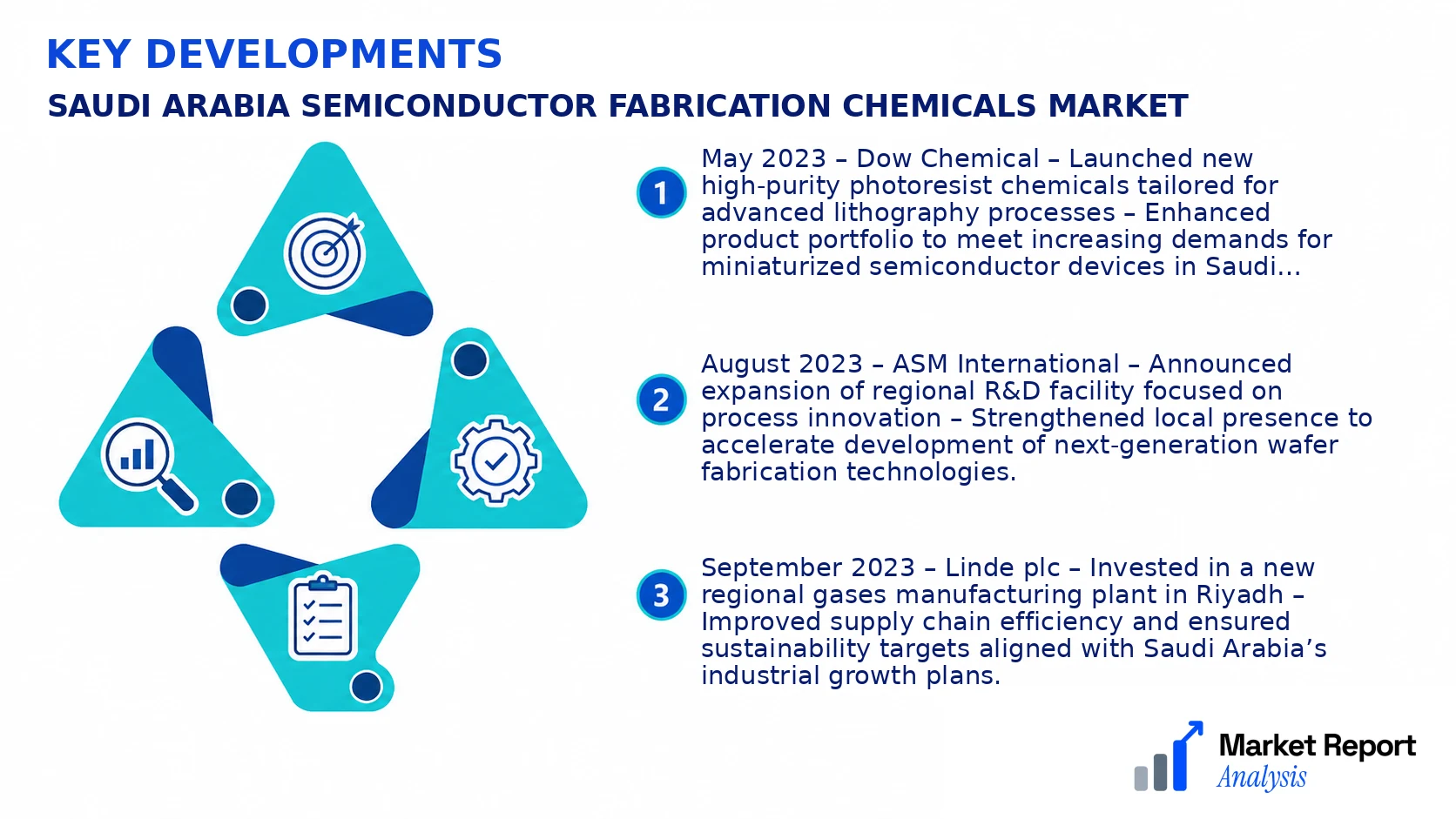
- May 2023 – Dow Chemical – Launched new high-purity photoresist chemicals tailored for advanced lithography processes – Enhanced product portfolio to meet increasing demands for miniaturized semiconductor devices in Saudi Arabia.
- August 2023 – ASM International – Announced expansion of regional R&D facility focused on process innovation – Strengthened local presence to accelerate development of next-generation wafer fabrication technologies.
- September 2023 – Linde plc – Invested in a new regional gases manufacturing plant in Riyadh – Improved supply chain efficiency and ensured sustainability targets aligned with Saudi Arabia’s industrial growth plans.
- July 2023 – Air Liquide – Entered a strategic partnership with a local Saudi firm to develop tailored chemical solutions – Facilitating technology transfer and boosting regional manufacturing capabilities.
- June 2023 – SABIC – Acquired a minority stake in a regional chemicals startup specializing in eco-friendly etching solutions – Strengthening its innovation pipeline and sustainability commitments within the country.
Frequently Asked Questions
What is the Saudi Arabia Semiconductor Fabrication Chemicals Market?
The Saudi Arabia Semiconductor Fabrication Chemicals Market encompasses the supply and demand for chemicals used in the manufacturing of semiconductor chips within Saudi Arabia. It involves high-purity chemicals essential for wafer processing, etching, cleaning, and doping in semiconductor fabrication plants.
What is the current market size of Saudi Arabia Semiconductor Fabrication Chemicals Market?
As of 2026, the market size for Saudi Arabia's Semiconductor Fabrication Chemicals is estimated at approximately USD 1.2 Billion, reflecting increasing domestic production capabilities and governmental investments aimed at expanding the local semiconductor industry.
What factors are driving the Saudi Arabia Semiconductor Fabrication Chemicals Market?
Market growth is driven by Saudi Arabia’s strategic initiatives to diversify its economy, growing investments in semiconductor manufacturing, government support for local industry development, and an increasing global demand for advanced chips, fostering local chemical supply chain development.
Which Saudi city leads the Saudi Arabia Semiconductor Fabrication Chemicals Market?
Riyadh emerges as the leading city in Saudi Arabia for semiconductor fabrication chemicals, owing to its status as the political and economic hub, the presence of key industry players, and the expansion of manufacturing facilities within its industrial zones.
Which segment is expected to grow the fastest?
Demand for cleaning chemicals and etchants is projected to grow the fastest, driven by advancements in technology requiring more precise and high-purity processes, alongside increased investments in advanced fabrication facilities across the country.
Who are the leading companies operating in the Saudi Arabia Semiconductor Fabrication Chemicals Market?
Leading companies include international chemical suppliers such as Dow Chemicals, Samsung Fine Chemicals, and local players like SABIC, which are expanding their footprint to support semiconductor manufacturing growth in Saudi Arabia.
Analyst Perspective
The Saudi Arabia Semiconductor Fabrication Chemicals Market exhibits a mature yet evolving landscape with increasing integration of advanced chemical processes aligned with technological advancements. The long-term outlook remains bullish due to expanding domestic semiconductor manufacturing capacity, driven by government initiatives aimed at localization and industrial diversification. Future growth opportunities primarily lie in specialized chemicals for high-purity applications, advanced etchants, and photoresists, alongside emerging investments in next-generation fabrication technologies. Strategic priorities should include strengthening local supply chains, fostering innovation through R&D, and enhancing sustainability by adopting eco-friendly chemical processes. The competitive landscape is intensifying with new entrants and collaborations, especially in key cities such as Riyadh and Jeddah, which are poised to become innovation hubs owing to infrastructure investments and talent pools. Long-term, investors should focus on scalable production facilities with a geographic focus on Riyadh’s emerging techno-parks, as this city continues to attract major industry players and government support, offering robust growth potential amid evolving regional demands.
