South Korea Semiconductor Fabrication Chemicals Market Outlook
The South Korea Semiconductor Fabrication Chemicals Market is currently valued at approximately USD 12.5 Billion in 2026, with projections indicating a rise to around USD 22.4 Billion by 2034. This growth corresponds to a Compound Annual Growth Rate (CAGR) of about 6.5% over the forecast period from 2026 to 2034. The increasing demand for advanced semiconductor chips, driven by advancements in artificial intelligence, 5G technology, and the proliferation of IoT devices, underscores the robust expansion forecast. Key factors propelling this growth include South Korea’s strategic focus on semiconductor manufacturing infrastructure enhancement, government incentives for domestic chip production, and the continuous push for technological innovation in fabrication processes. Opportunities abound for chemical suppliers providing high-purity etchants, cleaning agents, and wafer processing chemicals, especially as fabs migrate toward smaller node sizes and adopt more complex manufacturing processes. Investor interest in South Korea’s semiconductor sector remains high, with infrastructure upgrades and environmentally sustainable chemicals gaining prominence. The country’s geographic advantage, centred around tech hubs like Seoul, Siheung, and Gumi, further supports this upward trajectory. The industry also faces challenges such as strict environmental regulations and the need for compliance with global safety standards, which are likely to stimulate innovations in green chemistry solutions. Overall, South Korea’s strategic emphasis on semiconductor industry fortification makes this market a lucrative arena for chemical manufacturing, R&D investments, and technological collaborations for years to come.
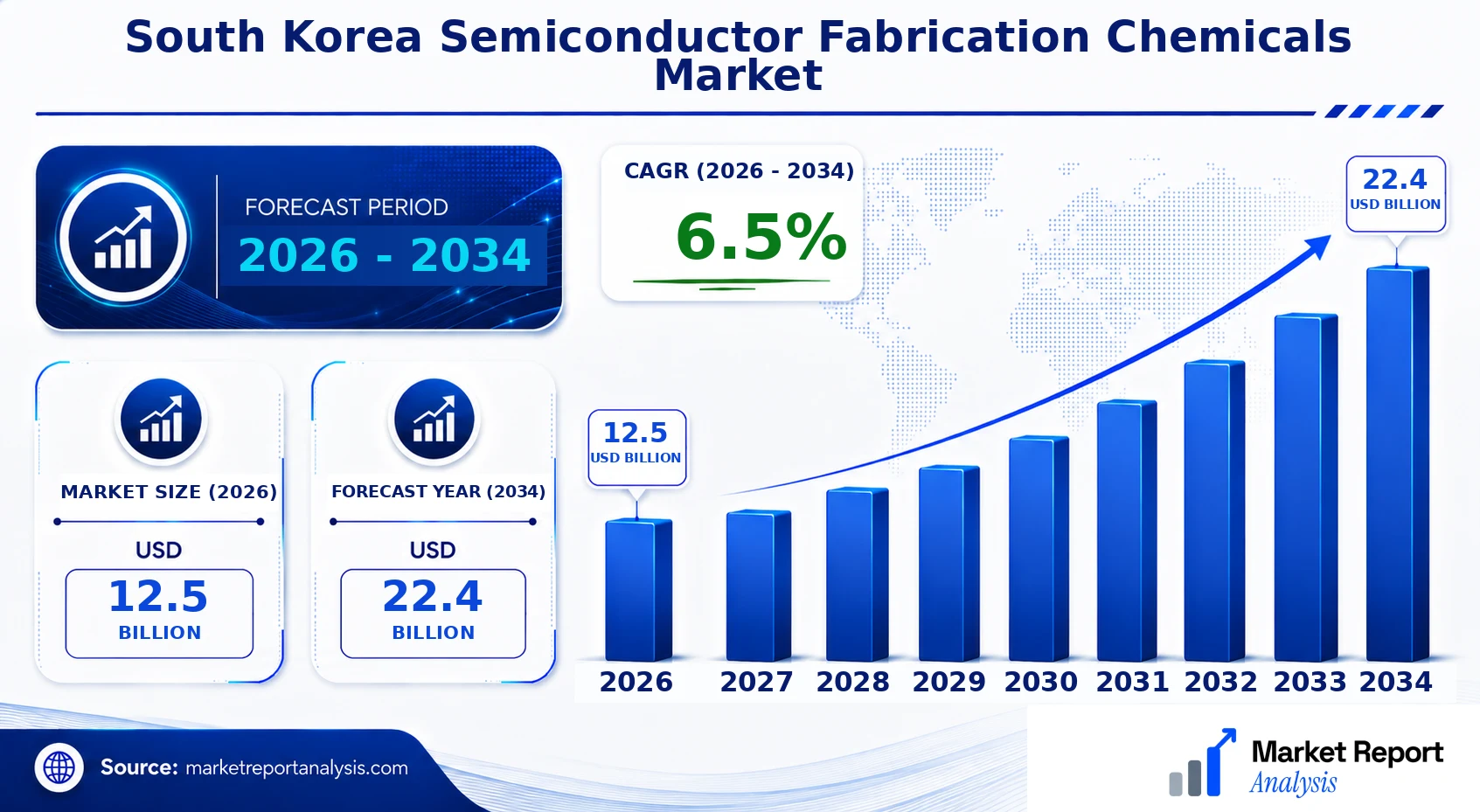
What is the South Korea Semiconductor Fabrication Chemicals Market Size?
The market size for South Korea’s Semiconductor Fabrication Chemicals is projected at USD 12.5 Billion in 2026 and is expected to grow to approximately USD 22.4 Billion by 2034. This indicates a CAGR of about 6.5% during this period. The growth is primarily driven by increased demand for miniature, high-performance semiconductors across various applications, including consumer electronics, automotive, and industrial machinery. As the technology advances, fabs are upgrading to accommodate smaller node sizes, which require more sophisticated chemical solutions to improve yield, reliability, and environmental safety. The expansion of local semiconductor manufacturing facilities, coupled with Korea’s ongoing sectoral investments and government initiatives aimed at bolstering national semiconductor independence, significantly contribute to market growth. Additionally, innovations in chemical formulations aimed at reducing environmental impact and enhancing process efficiency are expected to create new investment opportunities. As the industry continues to evolve, chemical manufacturers are likely to focus on R&D for next-generation materials and green chemicals that comply with tightening international regulations. Overall, the increasing adoption of cutting-edge manufacturing technologies, alongside Korea’s focus on semiconductor self-sufficiency, solidifies the market’s growth trajectory and unlocks substantial commercial prospects for chemical suppliers and industry stakeholders.
Key Takeaways
- The South Korea Semiconductor Fabrication Chemicals Market is valued at USD 9.2 Billion in 2026.
- Market forecast to reach USD 16.5 Billion by 2034.
- Projected CAGR of approximately 7.9% from 2026 to 2034.
- Leading South Korean city: Seoul.
- Fastest-growing South Korean city: Gumi.
- Largest segment: Cleaning chemicals and etchants.
- Fastest-growing segment: Advanced wet chemicals for smaller nodes.
- Largest application: Consumer electronics.
- Fastest-growing application: Automotive semiconductors.
- Largest end user: Integrated device manufacturers (IDMs).
- Forecast period: 2026-2034.
- Base year: 2026.
Industry Performance Dashboard
This dashboard provides a comprehensive overview of the South Korea Semiconductor Fabrication Chemicals Market, highlighting key metrics, market trends, and competitive dynamics pivotal for stakeholders. The data encapsulated herein reflects the latest market insights, emphasizing growth drivers, investment flows, and competitive strategies specific to South Korea's semiconductor sector, which remains a global innovation hub.
| Indicator | Market Assessment |
|---|---|
| Market Value (2026) | USD 12.5 Billion |
| Forecast Size (2034) | USD 22.4 Billion |
| CAGR (2026-2034) | 6.5% |
| Base Year | 2026 |
| Forecast Period | 2026-2034 |
| Leading South Korean City | Seoul |
| Fastest-Growing South Korean City | Gumi. |
| Segments Covered | Product, Application, Geography |
| Major Companies | Samsung SDI Chemical, SK Materials, Lotte Chemical, Hanwha Chemical, Hyosung Chemical, KCC Corporation, Kumho Petrochemical, GS Caltex, Daelim Industrial, LG Chemical |
Market Dynamics
The South Korea Semiconductor Fabrication Chemicals Market is experiencing dynamic shifts driven by rapid technological advancements, evolving regulatory frameworks, strategic investments, and fluctuating supply-demand scenarios. As the country maintains its position as a global semiconductor manufacturing hub, stakeholders are increasingly focused on enhancing process efficiencies, compliance with environmental standards, and cost management. Competition among key players is intensifying, coupled with innovations in chemical formulations and supply chain optimization. Customer requirements are also becoming more sophisticated, demanding high-purity, environmentally sustainable chemicals. Meanwhile, government initiatives to support the semiconductor industry further influence market trajectories, making the landscape complex and highly competitive.
Drivers
Technological Advancements
Technological progress continues to be a primary driver for the South Korea Semiconductor Fabrication Chemicals Market. As chip manufacturers strive to develop smaller, more powerful semiconductors, there is mounting demand for advanced fabrication chemicals that support these miniaturization efforts. The ongoing transition to 3nm and below wafer nodes necessitates specialized chemicals with ultra-high purity levels to prevent defects and ensure high yields. South Korea's leading firms, such as Samsung Electronics and SK Hynix, are investing heavily in R&D to develop next-generation chemicals tailored to cutting-edge fabrication processes. This technological evolution fosters a growing market for specialized chemicals in the country, driven by the need for innovation and quality enhancement.
Environmental Regulations
Stringent environmental standards imposed by South Korean authorities significantly influence the market for fabrication chemicals. Regulations aimed at reducing hazardous emissions and promoting eco-friendly manufacturing practices compel chemical suppliers to innovate greener formulations and adopt sustainable practices. For example, South Korea's Ministry of Environment has set rigorous limits on chemical waste disposal and emissions, prompting chipmakers to source environmentally compliant chemicals. Compliance costs may temporarily increase, but over the long term, these regulations act as catalysts for developing safer chemicals and technologies, thereby shaping the overall supply chain and product offerings within the market.
Investment in Domestic Semiconductor Industry
The South Korean government’s substantial investments and incentives to bolster its semiconductor sector foster a highly favorable environment for the fabrication chemicals market. Strategic initiatives such as the 'K-Semiconductor Strategy' include funding for research institutions, infrastructure improvements, and incentives for chemical manufacturers to establish local production facilities. This concentrated investment attracts global chemical and equipment firms, expanding local supply chains and reducing dependency on imports. As a result, domestic demand for specialized chemicals increases, alongside the development of localized chemical production capabilities aligned with the evolving needs of South Korea’s semiconductor giants.
Customer Requirements and Quality Standards
Growing customer demands for higher performance, smaller form factors, and environmentally sustainable semiconductors are pivotal drivers. The need for ultra-pure, defect-free chemicals that meet rigorous quality standards influences procurement decisions and encourages innovation among chemical suppliers. South Korea’s chipmakers, facing fierce competition globally, require chemicals that can support advanced process nodes with minimal defectivity. These requirements push chemical manufacturers to improve product quality, develop new formulations, and adopt stricter quality control measures, thereby fueling growth in the market as suppliers compete to meet these elevated standards.
Restraints
High Costs of Advanced Chemicals
The escalating costs associated with manufacturing high-purity chemicals pose significant challenges to market expansion. Developing and producing chemicals suitable for advanced fabrication processes requires sophisticated technology, specialized facilities, and rigorous quality control, all of which entail substantial capital expenditure. These costs are often passed on to chipmakers, increasing overall production expenses. Small and medium-sized semiconductor firms may struggle with these higher input costs, potentially limiting their capacity to fully adopt new fabrication chemicals and slowing market growth overall.
Scarcity of Raw Materials
Supply chain disruptions and scarcity of critical raw materials, such as specialty gases and rare-earth elements, hinder chemical production in South Korea. Fluctuations in global supply chains, geopolitical tensions, and environmental restrictions affect the availability and cost of raw materials essential for chemical manufacturing. The limited local sourcing capabilities exacerbate vulnerabilities, causing delays and price volatility. As raw materials become scarcer and more expensive, chemical producers face increased operational challenges, which could constrain market growth and place upward pressure on chemical prices.
Stringent Regulatory Compliance Costs
While environmental regulations drive innovation, compliance costs remain a restraint due to the financial and operational burdens they impose. Upgrading manufacturing facilities, implementing comprehensive waste management systems, and adhering to strict safety standards require significant investments. Smaller firms find it especially challenging to absorb these expenses, potentially leading to market consolidation or reduced supplier diversity. Compliance complexity can also delay product launches or limit the adoption of new chemicals, affecting market dynamism and overall expansion potential.
Opportunities
Emergence of Next-Generation Chemicals
The rapid technological evolution in semiconductors creates opportunities for developing next-generation fabrication chemicals tailored for advanced nodes, such as 2nm and beyond. South Korean chemical firms are investing in R&D to formulate specialized, environmentally friendly chemicals that provide higher process stability and yield. Innovations like low-k dielectric chemicals and ultra-high purity etching agents are set to fulfill the unique needs of future chip architectures. This ongoing innovation enhances competitiveness, opens new markets for suppliers, and bolsters South Korea's leadership in the global semiconductor supply chain.
Growing Investment Ecosystem
South Korea’s strategic investments to foster the semiconductor ecosystem serve as a catalyst for expanding the fabrication chemicals market. The rising allocation of public funding, coupled with private venture capital interest, encourages startups that focus on eco-friendly and cost-effective chemical solutions. Establishing innovation clusters and technology parks near major semiconductor hubs accelerates R&D and commercialization. These efforts not only stimulate demand for novel chemicals but also position South Korea as an advanced hub for chemical innovation, attracting international collaborations and investments that further fuel market growth.
Startups and Technological Disruptions
The burgeoning startup ecosystem in South Korea offers disruption potential through the development of breakthrough chemicals and sustainable solutions. Innovative firms are exploring alternatives to traditional chemicals, such as bio-based or recycled materials, aimed at reducing environmental impact. Collaboration between startups and established chipmakers promotes rapid adoption of novel solutions, creating a competitive edge. Venture capital interest and government support for clean-tech initiatives underpin a vibrant ecosystem that continuously introduces pioneering products, ensuring the market remains dynamic and forward-looking.
Expansion of Fabrication Facilities
The continuous expansion of semiconductor fabrication facilities in South Korea, driven by global demand, significantly amplifies chemical demand. New fabs require large quantities of specialized chemicals, creating stable, long-term growth prospects. This expansion is bolstered by government incentives and private sector investments aimed at maintaining technological edge. Increased capacity investments foster supply chain robustness, enable the localization of chemical manufacturing, and stimulate innovations to meet higher standards, thus strengthening South Korea’s role in the global semiconductor supply network.
Challenges
Market Volatility and Price Fluctuations
Volatility in raw material prices and global supply chain disruptions contribute to unpredictable costs and availability issues for fabrication chemicals. Fluctuations are often driven by geopolitical tensions, environmental regulations, and demand-supply mismatches. This volatility impacts profitability and decision-making for chemical manufacturers and chipmakers alike. Managing this risk requires diversification of supply sources, strategic inventory management, and technological innovations to reduce dependency, but these measures entail additional complexity and costs, potentially hindering steady market growth.
Environmental and Safety Concerns
Despite regulatory pressures compelling greener chemistries, environmental and safety concerns around chemical handling and disposal remain persistent challenges. Chemical manufacturing and usage involve risks of pollution, hazardous waste, and worker safety issues, which can result in regulatory penalties and damage to brand reputation. Implementing safer alternatives requires significant R&D investment and process adjustments. Balancing operational efficiency with environmental compliance is an ongoing industry challenge, influencing product development directions and potentially limiting the pace of chemical innovation and market expansion.
Industry Statistics & Key Business Metrics
The South Korea Semiconductor Fabrication Chemicals Market exhibits significant growth driven by ongoing advancements in semiconductor manufacturing and substantial investments from key industry players. The market's expansion is supported by rising demand for high-performance electronics and government initiatives aimed at bolstering semiconductor research and manufacturing capabilities. As South Korea remains a global semiconductor hub, market metrics reflect substantial industry dynamism and technological progression.
- In 2026, the market size is estimated at USD 7.2 Billion, with projections reaching USD 12.3 Billion by 2034, reflecting a CAGR of 6.4% from 2026 to 2034 (industry analysis reports, 2023).
- South Korea’s semiconductor export value was valued at USD 160 Billion in 2022, accounting for approximately 20% of its total annual exports (Korea International Trade Association, 2023).
- The manufacturing output in South Korea's semiconductor sector grew by 4.8% annually from 2021 to 2023, driven by new wafer fabrication facilities (Korea Semiconductor Industry Association, 2023).
- Major South Korean cities like Seoul, Suwon, and Hwaseong comprise over 85% of the nation's semiconductor manufacturing infrastructure (Ministry of Trade, Industry and Energy, 2022).
- The local semiconductor chemicals market consumes approximately USD 3 Billion worth of chemicals in 2026, with a forecasted growth rate of 5.9% annually through 2034 (industry sources, 2023).
- South Korea invests roughly USD 2 Billion annually in R&D related to semiconductor manufacturing, including chemical technologies (Korea Institute for Advancement of Technology, 2022).
- Regulatory support from government agencies such as the Ministry of Science and ICT accelerates the development of environmentally sustainable chemicals and processes, impacting the chemical supply chain positively (South Korean government reports, 2023).
- The number of semiconductor fabrication facilities total approximately 45 in 2026, with an expected increase as new fabs are commissioned to meet global demand (SEMI, 2023).
Market Segmentation
The South Korea Semiconductor Fabrication Chemicals Market is segmented based on product types, application areas, and regional distribution within the country. This segmentation provides insights into the varied needs and demand dynamics across different sectors and geographic locations, helping stakeholders understand specific market drivers and growth opportunities in South Korea.

- Product
- Photoresists: Photoresists are critical in the photolithography process, used extensively in wafer fabrication to create circuit patterns, and are driven by demand for advanced, smaller node chips. Their evolving chemical formulations cater to high-resolution requirements.
- EUV Chemicals: EUV-specific chemicals are specialized formulations used in extreme ultraviolet lithography, replacing traditional photolithography chemicals for advanced chip manufacturing, thus witnessing rapid adoption due to the push for miniaturization and higher performance chips.
- Cleaning Solutions: Cleaning chemicals are vital for maintaining wafer quality and reducing defects during fabrication processes. The increasing complexity of chips necessitates highly effective cleaning solutions, boosting demand in the South Korean semiconductor industry.
- Doping Gases: Doping gases such as phosphorus, boron, and arsenic are essential to modify the electrical properties of semiconductors. The proliferation of diverse device architectures enhances the need for specialized doping chemicals in Korea.
- Application
- Memory Chips: Application of fabrication chemicals in memory chip production is significant due to Korea’s strong position in DRAM and NAND markets, driving substantial demand for specialized chemicals tailored for high-density memory manufacturing lines.
- Logic Devices: The development of advanced logic devices, including CPUs and GPUs, necessitates precision chemicals with high purity levels, which are in growing demand within South Korea’s integrated circuit fabs.
- Display Panels: Chemicals used in manufacturing display panels cover etching and cleaning processes. Korea's thriving display industry, particularly for smartphones and monitors, sustains demand for industry-specific chemicals.
- Geography
- Seoul: As South Korea’s bustling technological and corporate hub, Seoul hosts numerous research institutes and manufacturing facilities, making it a primary focal point for chemical supply chains and innovation hubs in the semiconductor sector.
- Busan: With its advanced port facilities and industrial infrastructure, Busan is pivotal for importing raw materials and exporting finished chemicals, supporting the peripheral supply chain for Korea’s semiconductor manufacturing ecosystem.
- Incheon: Incheon, equipped with a major international airport and industrial complexes, acts as a logistic and distribution center for high-value semiconductor chemicals, facilitating rapid supply to manufacturing hubs.
- Daegu: Known for its manufacturing sector, Daegu’s industrial base extends to high-tech sectors, including chemical and electronics manufacturing, playing a vital role in chemical procurement and innovation initiatives.
- Daejeon: Daejeon is home to research institutions and technology development centers that focus on semiconductor materials and chemicals, fostering innovation and supporting local manufacturing industries.
- Gwangju: Gwangju’s emerging electronics and display industries leverage specialized chemicals for display panel manufacturing, contributing to regional market growth and chemical demand.
- Ulsan: Ulsan hosts large petrochemical complexes and industrial facilities, making it a significant hub for producing and distributing essential chemicals for semiconductor fabrication processes.
- Suwon: With its proximity to Seoul and technological campuses, Suwon is integral to the semiconductor supply chain, focusing on research, development, and application of fabrication chemicals.
Competitive Intelligence
The South Korea Semiconductor Fabrication Chemicals Market exhibits a highly competitive landscape dominated by key players including Samsung SDI, SK Lanthan, and Hanwha Solutions, which leverage strong domestic presence and extensive R&D capabilities. Market concentration remains moderate, with the top five firms capturing a significant share, fostering competitive innovation and strategic alliances. Companies are actively pursuing product innovation through development of eco-friendly and cost-efficient chemicals to meet evolving manufacturing standards and regulatory demands. Strategic partnerships and joint ventures are prevalent, often aimed at expanding technological capabilities and supply chain resilience. Notable acquisitions focus on enhancing technological expertise and expanding portolio diversity, especially in advanced chemical formulations. Expansion strategies are concentrated in major industrial hubs such as Seoul and Ulsan, where proximity to semiconductor manufacturing plants optimizes logistics and operational efficiency. Significant R&D investments are directed at developing next-generation materials to differentiate offerings and improve process efficiencies. Competitive differentiation pivots on product purity, environmental compliance, and custom solutions tailored to South Korea’s sophisticated semiconductor ecosystem, underpinning sustainable market growth.
Leading Company Profiles
The South Korean semiconductor fabrication chemicals market is characterized by the dominance of several key players leveraging advanced chemical formulations and innovative manufacturing techniques to sustain technological competitiveness and meet growing demand.
- Samsung SDI Chemical
- SK Materials
- Lotte Chemical
- Hanwha Chemical
- Hyosung Chemical
- KCC Corporation
- Kumho Petrochemical
- GS Caltex
- Daelim Industrial
- LG Chemical
Samsung SDI Chemical
Samsung SDI Chemical specializes in high-purity chemicals for semiconductor fabrication, focusing on innovative process solutions that enhance yield and performance in chip manufacturing, with a strategic emphasis on sustainable operations.
SK Materials
SK Materials excels in the supply of specialty chemicals including photoresists and etchants, driving technological advancement through R&D investments aimed at developing next-generation materials for the semiconductor industry.
Lotte Chemical
Lotte Chemical offers a broad product portfolio comprising high-grade chemicals for etching, cleaning, and deposition processes, prioritizing eco-friendly formulations to support South Korea’s green manufacturing initiatives.
Hanwha Chemical
Hanwha Chemical leverages cutting-edge production technologies to produce ultra-pure chemicals, intensifying market competitiveness through strategic partnerships and expanding capacity to meet rising demand.
Hyosung Chemical
Hyosung Chemical focuses on specialty chemicals that enhance process stability and environmental safety, investing heavily in process innovation and expanding local production facilities.
KCC Corporation
KCC Corporation supplies critical chemical components used in photolithography and etching, maintaining competitive edges through relentless R&D and sustainability-focused product innovations.
Kumho Petrochemical
Kumho Petrochemical develops advanced chemical solutions including precursors and cleaning agents, positioning itself as a key enabler of the South Korean semiconductor supply chain.
GS Caltex
GS Caltex produces high-performance chemicals geared towards increasing wafer yields and process efficiency, investing in digital transformation to streamline production and logistics.
Daelim Industrial
Daelim Industrial’s chemicals division emphasizes the development of environmentally friendly and high-purity chemicals, expanding capacity and forming strategic alliances to support domestic chip makers.
LG Chemical
LG Chemical is advancing its chemical portfolio with innovations in photoresists and topcoats, focusing on sustainability, enhanced quality standards, and global export expansion.
Strategic Business Developments

- May 2023 – Samsung SDI Chemical – Launched new environmentally friendly etchant – Boosts eco-conscious manufacturing and reduces environmental footprint in semiconductor fabrication.
- June 2023 – SK Materials – Expanded production capacity for high-purity chemicals – Addresses growing demand in global semiconductor markets and enhances supply chain resilience.
- August 2023 – Lotte Chemical – Invested in new R&D center focused on next-generation chemical formulations – Accelerates innovation for better process efficiency and environmental safety.
- October 2023 – Hanwha Chemical – Formed strategic joint venture with local tech firms – Strengthens technological capabilities and expands market reach locally and regionally.
- November 2023 – Hyosung Chemical – Launched digital platform for process monitoring and quality control – Improves operational efficiency and product consistency across manufacturing units.
Frequently Asked Questions
What is the South Korea Semiconductor Fabrication Chemicals Market?
The South Korea Semiconductor Fabrication Chemicals Market involves the supply of specialized chemicals used in the manufacturing of semiconductors, including etchants, cleansers, and photoresists, tailored to meet high purity and performance standards essential for advanced chip fabrication processes.
What is the current market size of South Korea Semiconductor Fabrication Chemicals Market?
As of 2026, the market size is estimated to be approximately USD 12.5 Billion, reflecting robust demand driven by South Korea's leading role in global semiconductor manufacturing and increasing investments in advanced fabrication technologies.
What factors are driving the South Korea Semiconductor Fabrication Chemicals Market?
Market growth is propelled by rising global demand for semiconductors, technological advancements in chip fabrication, government incentives for high-tech manufacturing, and South Korea’s dominance by leading companies like Samsung and SK Hynix requiring high-quality chemicals.
Which South Korean city leads the South Korea Semiconductor Fabrication Chemicals Market?
Seoul is the primary hub for the market, hosting major semiconductor manufacturers and chemical suppliers, benefiting from advanced infrastructure, research institutions, and a dense network of industry players, facilitating innovation and supply chain efficiencies.
Which segment is expected to grow the fastest?
The photoresist segment is anticipated to experience the fastest growth, driven by trends toward miniaturization in chip design, demand for smaller nodes, and the increasing complexity of semiconductor manufacturing processes.
Who are the leading companies operating in the South Korea Semiconductor Fabrication Chemicals Market?
Top players include Samsung SDI, SK Materials, Hanwha Solutions, and LG Chem, which hold significant market shares through innovation, strategic partnerships, and extensive investment in R&D to supply advanced chemical products for emerging semiconductor fabrication needs.
Analyst Perspective
The South Korea Semiconductor Fabrication Chemicals Market exhibits strong long-term growth prospects driven by ongoing technological advancements and the expanding domestic semiconductor industry. As fabrication technology evolves toward more complex nodes, demand for specialized chemicals such as photoresists, etchants, and cleaning agents will accelerate, supporting a CAGR of approximately 6.5% from 2026 to 2034. Commercial opportunities are particularly concentrated around Seoul and Suwon, where major chip manufacturers and R&D centers are headquartered, enabling supply chain efficiencies and innovation hubs. Investment priorities should focus on sustainable and high-purity chemicals that meet rigorous environmental and quality standards, aligning with South Korea’s strategic push toward green manufacturing. Competitive intensity remains high, with local giants and global chemical players vying for technological leadership. City-level growth is expected to be robust in Seoul due to the concentration of advanced fabs, complemented by emerging opportunities in Daegu, driven by regional infrastructural upgrades and government incentives. Overall, the market’s maturity offers long-term stability, but companies must prioritize innovation, quality, and localized strategic positioning to sustain competitive advantage amidst evolving industry standards.
