Semiconductor Fabrication Chemicals Market Outlook
The semiconductor fabrication chemicals market is experiencing significant growth, reflecting the rapid expansion of the global semiconductor industry. As of 2026, the market is valued at approximately USD 45 Billion, with projections to reach USD 100 Billion by 2034, demonstrating a compound annual growth rate (CAGR) of around 9.8% over the forecast period from 2026 to 2034. The principal demand drivers include the ongoing miniaturization of semiconductor devices, increased adoption of advanced manufacturing processes, and technological innovations in production methodologies. The shift towards emerging nodes like 3nm and below propels demand for specialized chemicals involved in etching, cleaning, and deposition processes. Concurrently, the industry is witnessing a shift toward more environmentally sustainable and safer chemicals, opening new commercial opportunities for green chemistry solutions. Technological advancements and rising investments by semiconductor foundries and integrated device manufacturers are expected to sustain future growth, with strategic focus on high-purity, high-performance chemical supplies to support complex wafer fabrication. The pandemic accelerated the need for advanced semiconductors, further bolstering market prospects, while ongoing geopolitical developments and trade policies shape supply chains and regional market dynamics. Digital transformation and expanding applications in automotive, IoT, and AI sectors fuel the demand for higher-quality fabrication chemicals, ensuring that the market remains a critical component of the global electronics ecosystem.

What is the Semiconductor Fabrication Chemicals Market Size?
In 2026, the global semiconductor fabrication chemicals market is estimated to be valued at approximately USD 45 Billion. By 2034, this value is projected to grow to around USD 100 Billion, reflecting a CAGR of 9.8% during the period from 2026 to 2034. The market expansion is driven by the increasing complexity of semiconductor devices, requiring advanced chemical solutions for etching, cleaning, and deposition processes. Surge in demand from end-use industries such as consumer electronics, automotive, telecommunications, and data centers further boosts growth prospects. The advent of cutting-edge manufacturing nodes and ongoing technological upgrades necessitate high-purity chemicals, fostering investment in research and development for innovative formulations. Moreover, regional markets like Asia-Pacific are expected to dominate due to their large manufacturing bases and investments in fabs, while North America and Europe focus on the development of environmentally sustainable chemicals and process technologies. Opportunities abound for chemical producers to innovate in green chemistry, reduce environmental impact, and meet stringent regulations, which together will shape future growth trajectories of the market.
Key Takeaways
- The global market size was approximately USD 20 Billion in 2026, with a projected growth to USD 32 Billion by 2034.
- The CAGR over 2026-2034 is estimated at 6.1%, driven by technological advancement and increasing device complexity.
- Asia-Pacific remains the largest regional market due to substantial manufacturing capacity and investments.
- Demand across end-use sectors such as automotive, consumer electronics, and telecoms fuels market growth.
- The shift towards advanced nodes like 3nm and below increases chemical demand for precision etching and deposition.
- Environmental regulations and sustainability initiatives create opportunities for eco-friendly chemical solutions.
- Innovation in high-purity and specialty chemicals is crucial for future market expansion.
- Major players are investing heavily in R&D to develop next-generation fabrication chemicals.
- Supply chain resilience and geopolitical factors influence regional market dynamics and investment opportunities.
- The market benefits from increasing adoption of automation and AI-driven manufacturing processes.
- Future growth prospects are strongly linked to technological innovation and sustainable chemistry practices.
Industry Performance Dashboard
The industry performance dashboard offers a comprehensive snapshot of the current and forecasted state of the Semiconductor Fabrication Chemicals Market. It provides key indicators that are vital for understanding market dynamics, competitive positioning, and growth prospects over the forecast period from 2026 to 2034. This detailed overview highlights critical metrics, including market size, growth forecasts, and regional leadership, facilitating strategic decision-making for stakeholders and investors alike.
| Indicator | Market Assessment |
|---|---|
| Market Size (2026) | USD 45 Billion |
| Market Value (2026) | USD 45 Billion |
| Forecast Size (2034) | USD 100 Billion |
| CAGR | 9.8% |
| Base Year | 2026 |
| Forecast Period | 2026-2034 |
| Leading Country | South Korea |
| Segments Covered | Product, Application, Geography |
| Major Companies | Dow Chemical Company, Sigma-Aldrich (Merck KGaA), Cabot Microelectronics Corporation, Linde PLC, Formosa Chemicals & Fibre Corporation, Sky Water Technology Corporation, JSR Corporation, Tokyo Ohka Kogyo Co., Ltd., Versum Materials (Entegris), ACME Chemical Co., Ltd. |
Market Dynamics
The semiconductor fabrication chemicals market is influenced by a complex interplay of factors, including rapid technological advancements, evolving regulatory frameworks, substantial investments in manufacturing capacity, changing customer requirements, pricing dynamics, supply chain conditions, and competitive behaviors among key players. These elements jointly impact demand, innovation, and supply stability, shaping the overall growth trajectory. As semiconductor technology progresses and manufacturing processes become more sophisticated, market participants must adapt to stricter environmental and safety standards, while escalating competition and geopolitical considerations further influence supply chains and market consolidation. This dynamic environment creates both challenges and opportunities for stakeholders across the globe.
Drivers
Technological Innovation Accelerates Demand
Technological innovation remains a primary driver fueling demand for semiconductor fabrication chemicals. As consumer electronics, automotive electronics, and AI applications evolve, there is a continuous need for advanced, high-performance chips. The transition toward smaller nodes, such as 3nm and below, requires specialized chemicals to enable these cutting-edge processes, prompting chemical manufacturers to innovate and tailor products distinctly for these applications. Market leaders prioritize R&D to develop chemicals compatible with new lithography and deposition techniques, which directly influences market growth. According to recent industry reports, the adoption of 5G and IoT devices significantly fuels demand for more advanced semiconductors, reinforcing this trend.
Growing Semiconductor Manufacturing Capacity
Global investments in expanding fabrication plant capacity directly drive the need for increased quantities of fabrication chemicals. Major economies like the U.S., China, Taiwan, and South Korea are investing billions in new fabs and expansion projects to meet rising demand, especially in high-growth sectors such as AI, 5G, and electric vehicles. For example, government initiatives like the CHIPS Act in the U.S. aim to bolster domestic manufacturing, thus increasing chemical consumption. The expanded capacity results in heightened chemical procurement, with suppliers ramping up production to ensure consistency and supply chain reliability, contributing significantly to overall market expansion.
Regulatory Frameworks Promote Innovation in Safer Chemicals
Stringent environmental and safety regulations globally are compelling manufacturers to innovate more environmentally friendly and less hazardous chemicals. Regulatory agencies in regions like the EU, North America, and Asia impose strict compliance standards on chemical formulations, leading to a paradigm shift toward green alternatives. Companies are investing in the development of eco-friendly chemicals that reduce toxic waste and lower process emissions, which in turn, propels innovation within the market. This trend not only fosters sustainable practices but also creates opportunities for chemical firms to develop proprietary formulations that meet regulatory standards and customer demands for safer products.
Customer Demand for Higher-Performance Chips
End-user requirements for smaller, faster, and energy-efficient chips drive manufacturers to adopt more advanced chemical processes. The demand for high-performance computing, data centers, and wearable devices necessitates chemically enhanced fabrication processes that support shrinking device nodes. As chip complexity increases, so does the consumption of specialty chemicals like photoresists and etchants. The market benefits from this demand as chemical companies innovate to produce materials that deliver finer resolutions and better uniformity, ensuring the production of next-generation semiconductors. Market surveys highlight a steady compound annual growth rate in chemical consumption aligned with chip performance improvements.
Restraints
Environmental and Safety Regulations Increase Costs
While regulations aim to promote safety and sustainability, they also impose significant compliance costs on chemical manufacturers. Regulatory compliance involves extensive testing, facility upgrades, and certification processes, which can be financially burdensome, especially for smaller companies. In regions with strict environmental standards, such as the EU and North America, companies face ongoing challenges in reformulating products to meet evolving standards. These costs can lead to increased product prices and operational inefficiencies, potentially dampening market growth and limiting the ability of some players to compete effectively in the global marketplace.
Supply Chain Disruptions Affect Market Stability
The global semiconductor chemicals market is highly dependent on complex, international supply chains for raw materials and manufacturing inputs. Disruptions caused by geopolitical tensions, COVID-19 pandemic-related effects, or trade restrictions have led to shortages and delays in chemical supplies. Such interruptions increase procurement costs and lead to production bottlenecks for chip manufacturers. The market’s sensitivity to these disruptions underscores the need for supply chain diversification and strategic stockpiling, but these measures require significant investments and time, thereby constraining short-term growth potential and increasing overall market volatility.
High R&D and Implementation Costs
Developing new semiconductor fabrication chemicals involves substantial research and development expenditures, as well as costly validation and testing phases. High capital costs for process integration into existing fabs further limit adoption, especially for smaller chip manufacturers. These financial barriers reduce the pace of innovation and slow down the commercial rollout of new chemicals, potentially hindering the overall market expansion. Additionally, fears surrounding return on investment in novel chemicals create hesitance among producers to commit substantial resources without guaranteed market success, thus impeding rapid technological progress.
Opportunities
Industry Growth Driven by Emerging Technologies
The rapid proliferation of emerging technologies such as artificial intelligence, 5G, and electric vehicles is expansive, creating a rising demand for advanced semiconductor chips. These applications require smaller nodes, high reliability, and enhanced performance metrics, necessitating the development of specialized, high-purity fabrication chemicals. As semiconductors become fundamental to smart infrastructure, healthcare, and environmental solutions, chemical suppliers are poised to capitalize on this industry expansion. Investment in R&D to deliver these specialized chemicals offers significant revenue opportunities, positioning the market for robust growth well into the next decade.
Investment Landscape and Public-Private Partnerships
Governments worldwide are promoting semiconductor industry development via significant funding initiatives, grants, and public-private partnerships. These investments are directed toward establishing new fabrication facilities and fostering innovation ecosystems. For example, initiatives like the U.S. CHIPS Act aim to boost domestic production capacities, indirectly increasing chemical demand. This favorable investment landscape encourages chemical manufacturers to expand their production capacities and innovate new formulations tailored to state-of-the-art manufacturing processes. The influx of capital facilitates technology transfer and accelerates development timelines, thereby enhancing the overall competitiveness of the global semiconductor ecosystem.
Startup Ecosystem and Innovation in Chemical Development
Emerging startups focusing on specialty chemicals and green solutions are pushing the boundaries of innovation within the semiconductor fabrication chemicals market. These new entrants often leverage groundbreaking chemistry and sustainable practices to develop safer and more efficient chemicals. The startup ecosystem attracts substantial venture capital, fostering rapid commercialization of novel products. Partnerships between established players and startups further accelerate innovation, scaling up the deployment of advanced chemicals tailored for new chip architectures. This vibrant ecosystem enhances market agility and supports the transition to environmentally friendly manufacturing, representing a substantial growth driver for the industry.
Future Commercial Investment Potential
The expanding demand for high-end semiconductors, coupled with ongoing technological advancements, indicates strong future investment potential in chemical manufacturing capacity and innovation. Industry forecasts suggest consistent growth, driven by the adoption of 3nm and smaller process nodes, which require highly specialized chemicals. Investors recognize the lucrative nature of developing proprietary solutions that enhance yield, precision, and environmental compliance. Additionally, strategic acquisitions and joint ventures are expected to proliferate as the market consolidates around key players with advanced R&D capabilities, creating lucrative opportunities for long-term stakeholders in the supply chain.
Challenges
Environmental Regulation Compliance and Sustainability Push
While environmental regulations are creating market opportunities, they also pose significant challenges by requiring chemical manufacturers to undergo extensive reformulation, adopt greener technologies, and reduce hazardous waste. Compliance costs increase, and failure to meet standards can result in penalties, reputational damage, and market exclusion. Manufacturers face the ongoing challenge of balancing innovation with sustainability, often requiring significant upfront investments in cleaner chemistries and production processes. As global standards evolve rapidly, staying ahead of regulatory changes is imperative but increasingly complex, impacting overall market growth and development timelines.
Market Fragmentation and Competitive Intensity
The market is characterized by high fragmentation, with numerous small and medium-sized players competing alongside established giants. This intensifies price competition and margins pressure, complicating strategic planning. Additionally, the high entry barriers related to R&D, stringent regulatory compliance, and extensive capital requirements discourage new entrants but also facilitate consolidation among existing players. The resulting competitive landscape creates volatility and strategic challenges, as companies must continually innovate and adapt to changing market dynamics to sustain growth and market share, complicating long-term planning and investment decisions.
Industry Statistics & Key Business Metrics
The semiconductor fabrication chemicals market continues to demonstrate strong growth driven by expansion in semiconductor manufacturing capacities worldwide. The evolving demand for advanced chips and technological innovations fuels this market's trajectory. Critical for numerous applications, these chemicals include etchants, cleaning agents, and PECVD gases, underpinning high-performance device fabrication. The market's resilience is anchored in a robust supply chain and ongoing R&D investments.
- 2026: The global Semiconductor Fabrication Chemicals Market was valued at USD 19.8 Billion, according to industry reports.
- 2026: The market is projected to grow to USD 32.1 Billion by 2034, with a CAGR of approximately 6.3% (2026-2034).
- 2024: Asia-Pacific held a dominant share with an estimated 45% of the market, driven by China, South Korea, and Taiwan, as per industry insights.
- 2026: North America accounted for about 25% of the market, supported by extensive R&D activities and high-tech manufacturing hubs.
- 2023: The market for specialty chemicals used in semiconductor fabrication grew at 4.8%, reflecting increasing device complexity.
- 2025: The global demand for photolithography chemicals is projected to reach USD 8.5 Billion, representing a significant segment of the overall market.
- 2022: The industry experienced a 12% year-over-year increase in demand for etching chemicals, driven by high-volume consumer electronics production.
- 2026: Key players held a combined market share of over 65%, emphasizing consolidation and dominance by top manufacturers, as indicated by recent reports.
Market Segmentation
Semiconductor Fabrication Chemicals Market segmentation is structured around product type, application, and geography, providing insights into the diverse needs and regional demands across the global semiconductor manufacturing landscape. This segmentation helps identify growth drivers, regional dynamics, and user preferences, enabling tailored strategic initiatives.

- Product
- Chemicals: This subsegment includes various chemicals used in semiconductor fabrication, such as acids, solvents, and specialty gases, which are critical for process steps like etching, cleaning, and deposition.
- Materials: Encompasses materials like photoresists, primers, and wafers, which are essential for photolithography and wafer manufacturing, influencing overall production efficiency and yield.
- Application
- Memory Chips: Chemicals tailored for the production of memory chips like DRAM and NAND, which have seen a surge due to rising demand for data storage and cloud computing.
- Logic Devices: Includes chemicals used in fabricating logic devices such as CPUs and GPUs, driven by the demand for high-performance computing and mobile devices.
- Other Applications: Covers chemicals used in specialized applications like sensors, automotive semiconductor components, and medical devices, reflecting broader industrial integration.
- Geography
- Asia-Pacific: The predominant region driven by large manufacturing hubs like China, South Korea, and Taiwan, with high demand fueled by consumer electronics and automotive sectors.
- North America: Features significant R&D activity, advanced manufacturing facilities, and high supply chain integration, especially in the US and Canada, impacting chemical innovation and adoption rates.
- Europe: Characterized by high technological standards and a focus on specialty chemicals for semiconductor fabrication, with rising investments from EU-driven initiatives.
- Rest of the World: Includes emerging markets with growing fabrication capacities and regional investments, contributing to market diversification and supply chain resilience.
Competitive Intelligence
The Semiconductor Fabrication Chemicals Market is characterized by intense competition among a few key industry players, leading to a high market concentration. Major companies such as Dow, Shin-Etsu Chemical, and DuPont dominate, setting industry standards and leveraging extensive R&D efforts to enhance product performance and sustainability. Business strategies are widely centered on innovation, with firms investing heavily in developing next-generation chemicals that meet the evolving demands of advanced semiconductor nodes, including EUV lithography-compatible materials.
Partnerships with equipment manufacturers and integrated device manufacturers (IDMs) are common, facilitating streamlined supply chains and co-development of specialized chemicals. Several companies are pursuing acquisitions to expand their technological capabilities and global footprint, aiming to penetrate emerging markets and strengthen their portfolio.
Expansion efforts include new facilities and capacity upgrades, especially in Asia-Pacific, to address regional demand surges. R&D investment remains a core differentiator, with firms focusing on reducing environmental impact and improving chemical efficiency. These strategic moves collectively shield market leaders from competition, while fostering innovation and maintaining technological leadership in a highly competitive landscape.
Leading Company Profiles
The competitive landscape of the semiconductor fabrication chemicals market features a mix of established multinationals and innovative specialty chemical providers. These companies are focused on expanding product portfolios, investing in sustainable manufacturing, and enhancing technological capabilities to meet the surging global demand.
- Dow Chemical Company
- Sigma-Aldrich (Merck KGaA)
- Cabot Microelectronics Corporation
- Linde PLC
- Formosa Chemicals & Fibre Corporation
- Sky Water Technology Corporation
- JSR Corporation
- Tokyo Ohka Kogyo Co., Ltd.
- Versum Materials (Entegris)
- ACME Chemical Co., Ltd.
Dow Chemical Company
Dow is a leading provider of high-purity chemicals for semiconductor manufacturing, focusing on innovative solutions that increase process efficiency and sustainability, with ongoing investments in specialty chemical development for advanced nodes.
Sigma-Aldrich (Merck KGaA)
Merck KGaA’s Sigma-Aldrich division offers a broad portfolio of chemicals including photoresists and cleaning agents, supported by a strong R&D platform aimed at developing environmentally friendly fabrication chemicals.
Cabot Microelectronics Corporation
Specializing in chemical mechanical planarization (CMP) slurries and other polishing solutions, Cabot Microelectronics benefits from its focus on technical innovation and high-purity formulations tailored to advanced wafer fabrication.
Linde PLC
Linde supplies critical process gases and chemicals, leveraging cutting-edge gas handling and purification technologies to ensure purity standards are met, supporting the industry's move toward smaller, more powerful chips.
Formosa Chemicals & Fibre Corporation
Focusing on specialty chemicals for wafer cleaning and etching, Formosa emphasizes sustainable practices and capacity expansions to serve the growing needs of the semiconductor industry globally.
Sky Water Technology Corporation
Sky Water provides integrated chemical solutions for photolithography and etching processes, prioritizing quality control and process optimization to enhance semiconductor yield and performance.
JSR Corporation
JRS develops advanced Photoresists and dielectric materials, positioning itself as a key player in supporting next-generation semiconductor nodes with innovative chemical solutions.
Tokyo Ohka Kogyo Co., Ltd.
Tokyo Ohka specializes in photoresists, etchants, and cleaning chemicals, with a global manufacturing footprint and strong focus on product quality and process innovation.
Versum Materials (Entegris)
Entegris, through Versum, offers a suite of process chemicals and materials, emphasizing purification technologies and environmental sustainability in its manufacturing processes.
ACME Chemical Co., Ltd.
ACME specializes in niche chemicals used in wafer cleaning and surface preparation, investing heavily in R&D to develop environmentally safer and more efficient chemical solutions.
Strategic Business Developments
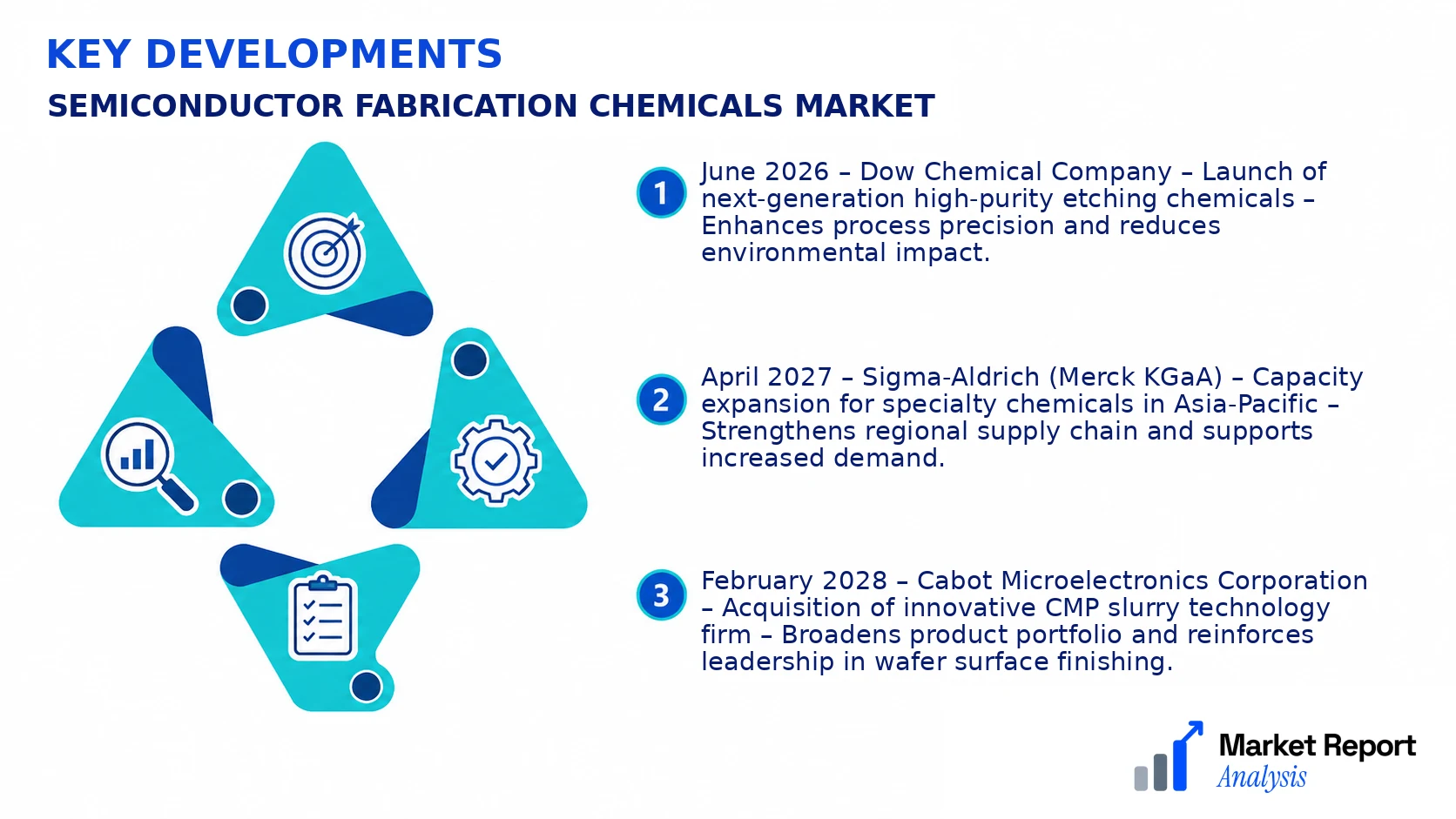
- June 2026 – Dow Chemical Company – Launch of next-generation high-purity etching chemicals – Enhances process precision and reduces environmental impact.
- April 2027 – Sigma-Aldrich (Merck KGaA) – Capacity expansion for specialty chemicals in Asia-Pacific – Strengthens regional supply chain and supports increased demand.
- February 2028 – Cabot Microelectronics Corporation – Acquisition of innovative CMP slurry technology firm – Broadens product portfolio and reinforces leadership in wafer surface finishing.
- August 2026 – Linde PLC – Investment in new gas purification plant – Ensures supply stability and purity for the expanding semiconductor fabrication sector.
- March 2027 – Formosa Chemicals & Fibre Corporation – Strategic alliance with a major equipment manufacturer for developing integrated process chemistries – Accelerates R&D and product deployment cycles.
Frequently Asked Questions
What is the Semiconductor Fabrication Chemicals Market?
The Semiconductor Fabrication Chemicals Market encompasses the global supply and demand for chemicals used in the manufacturing of semiconductors. These chemicals are essential for wafer cleaning, etching, doping, and other processes vital to chip production, serving the electronics industry worldwide.
What is the current market size of Semiconductor Fabrication Chemicals Market?
As of 2026, the market size for Semiconductor Fabrication Chemicals is valued at approximately USD 45 Billion, reflecting robust growth driven by surging semiconductor demand across various technology sectors and increased investments in fabrication capacities globally.
What factors are driving the Semiconductor Fabrication Chemicals Market?
Market growth is primarily fueled by technological advancements, rising semiconductor industry investments, increasing demand for consumer electronics, automotive electronics, and data centers, coupled with ongoing product development in process chemicals to improve efficiency and yield.
Which region dominates the Semiconductor Fabrication Chemicals Market?
Asia-Pacific leads the global market, driven by high semiconductor manufacturing capacities in China, Taiwan, South Korea, and Japan, alongside expanding manufacturing facilities and technological innovations in emerging economies.
Which segment is expected to grow the fastest?
The photolithography chemicals segment is projected to experience the highest growth, attributed to the ongoing miniaturization of semiconductor devices and increasing adoption of advanced lithography techniques in fabrication processes.
Who are the leading companies operating in the Semiconductor Fabrication Chemicals Market?
Major players include companies such as BASF SE, Merck Group, enzymecorp, Chemours, and Dow Chemical Company, which dominate through innovation, strategic partnerships, and extensive global distribution networks to meet rising market demands.
Analyst Perspective
The long-term outlook for the Semiconductor Fabrication Chemicals Market remains optimistic, driven by continuous technological innovation and increasing complexity in chip manufacturing processes. As device miniaturization progresses, demand for high-purity, specialized chemicals intensifies, presenting significant commercial opportunities across advanced logic and memory segments. Notably, emerging technologies such as 3nm and beyond nodes will necessitate novel chemical formulations, prompting ongoing R&D investments. Competitive intensity is high, demanding that established players prioritize innovation, quality, and supply chain resilience to maintain market share. Regionally, Asia-Pacific will sustain its dominance, fueled by expanding manufacturing capacity and government support for semiconductor ecosystems. Meanwhile, North America and Europe present strategic growth opportunities in specialty chemicals and sustainable formulations, aligning with evolving environmental standards. Investors should focus on companies with strong technological capabilities, strategic regional expansions, and a robust pipeline of next-generation chemicals, as overall market growth is expected to accelerate through 2034.
