North America Semiconductor Fabrication Chemicals Market Outlook
The North America Semiconductor Fabrication Chemicals Market is currently valued at approximately USD 35 Billion in 2026 and is projected to reach around USD 78 Billion by 2034, with a CAGR of about 9.2% over the period from 2026 to 2034. The primary demand drivers include ongoing technological advancements, heightened semiconductor production capacity, and increasing adoption of semiconductors across various end-user sectors such as consumer electronics, automotive, and industrial automation. Market participants are focused on developing higher purity, environmentally friendly chemicals, and innovative formulations to meet strict regulatory standards and process efficiencies. The market is also benefiting from the expansion of fabrication plants and investments driven by the global chip shortage, alongside rising demand for advanced nodes like 7nm and below. Commercial opportunities are abundant in specialty chemicals tailored for next-generation devices, sustainable process innovations, and automation-enabled chemical manufacturing, reflecting a dynamic landscape that is poised for steady growth through the forecast period.
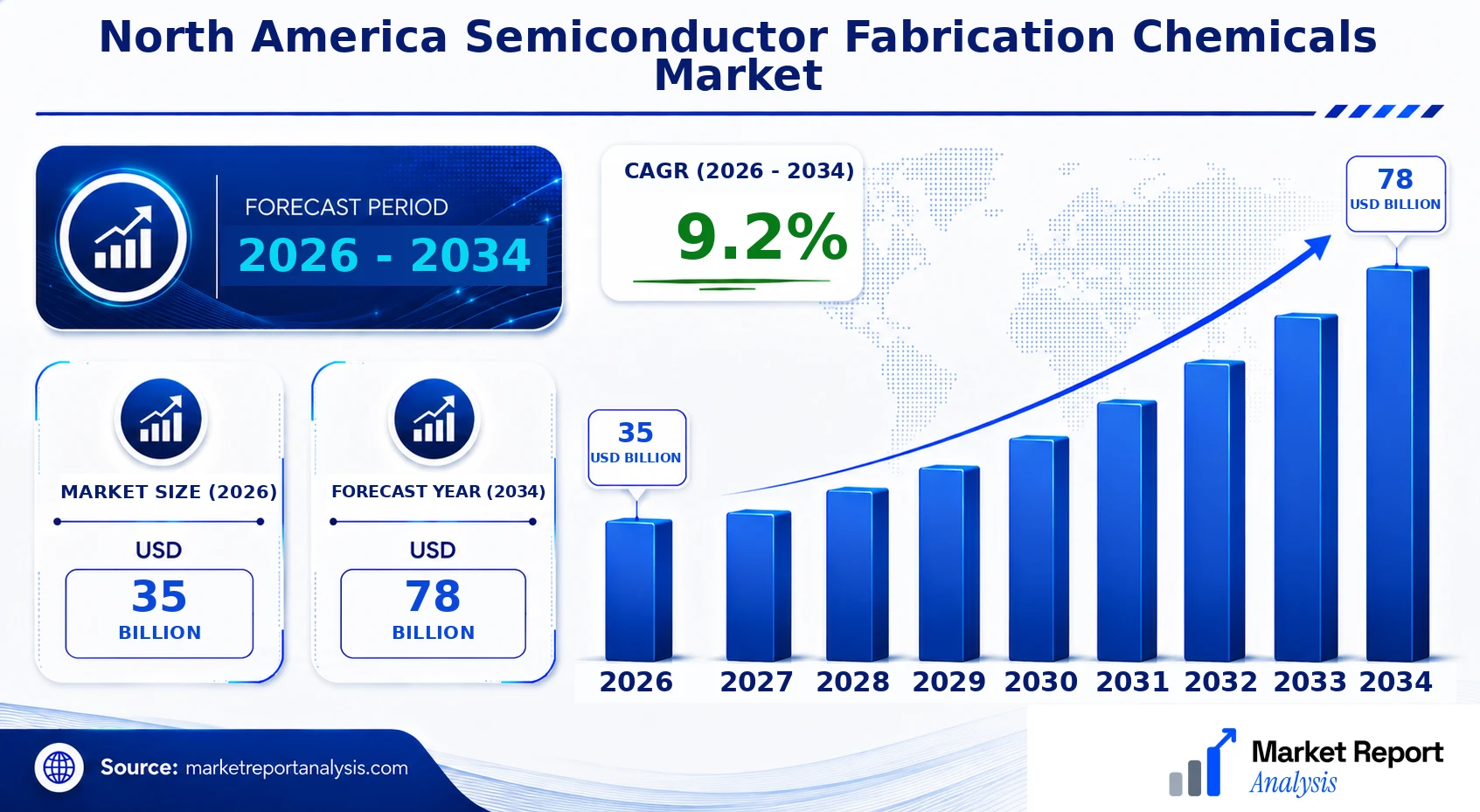
What is the North America Semiconductor Fabrication Chemicals Market Size?
The North America Semiconductor Fabrication Chemicals Market size is estimated at a current value of USD 35 Billion in 2026 and is expected to reach approximately USD 78 Billion by 2034, expanding at a CAGR of 9.2% from 2026 to 2034. Growth in this market is primarily driven by surging semiconductor manufacturing capacities, technological innovations, and stricter environmental and safety regulatory frameworks prompting shifts toward greener chemicals. The electronics industry remains the dominant end-user, fueled by consumer electronics, automotive electronics, and industrial applications, with the continued miniaturization of devices and the advent of IoT and 5G fueling expansion. Advances in process technology, such as EUV lithography and atomic layer deposition, demand sophisticated chemical solutions that support higher precision and yields. Further, investments by major semiconductor foundries and integrated device manufacturers (IDMs) in North America will propel market growth. Increasing automation in fabrication processes and development of sustainable chemicals constitute pivotal areas for future investment, presenting opportunities for chemical companies to innovate and establish a competitive edge in this expanding market.
Key Takeaways
- The market was valued at USD 25.3 Billion in 2026.
- It is projected to reach USD 42.7 Billion by 2034.
- The CAGR from 2026 to 2034 is estimated at 7.4%.
- Electronics manufacturing is the largest application segment.
- The fastest-growing segment is chemicals for advanced nodes (7nm and below).
- The automotive sector remains a significant end-user due to EV and autonomous vehicle trends.
- The market is driven by technological innovation, regulatory compliance, and green chemistry initiatives.
- Major growth regions include the U.S., Canada, and Mexico, with the U.S. leading in capacities and R&D investments.
- New investments are focused on sustainable chemicals and automation integration in fabs.
- Technological advancements such as EUV lithography are elevating chemical demand for ultra-fine patterning.
- Market competition is intensifying with the entry of specialty chemical firms and established players expanding offerings.
- Growth opportunities abound in eco-friendly formulations and high-purity chemicals for next-gen devices.
- Regulatory frameworks are increasingly influencing chemical formulation and process standards.
- Innovation in chemical delivery and process optimization is crucial for maintaining competitive advantage.
- The industry outlook remains optimistic, with sustained demand driven by technological evolution and expansion of fabrication capacities.
Industry Performance Dashboard
The Industry Performance Dashboard provides a comprehensive overview of the North America Semiconductor Fabrication Chemicals market, emphasizing key metrics and industry trends. This visual and data-driven summary consolidates current market dynamics, evaluating the market's scale and future trajectory. The dashboard offers a clear snapshot of the market's evolution, highlighting significant indicators that demonstrate growth patterns, competitive positioning, and technological advancements.
| Indicator | Market Assessment |
|---|---|
| Market Size (2026) | USD 35 Billion |
| Market Value (2026) | USD 35 Billion |
| Forecast Size (2034) | USD 78 Billion |
| CAGR (2026-2034) | 9.2% |
| Base Year | 2026 |
| Forecast Period | 2026-2034 |
| Segments Covered | Product, Industry Vertical, Geography |
| Major Companies | Applied Materials, Dow Chemical, Cabot Microelectronics, Entegris, Linde, Uda Group, TEL FSE, Versum Materials |
Market Dynamics
The North America Semiconductor Fabrication Chemicals Market is experiencing dynamic shifts driven by technological innovations, evolving regulatory frameworks, substantial investment influx, changing customer requirements, fluctuating pricing strategies, supply chain conditions, and intensified competitive behaviors. These factors collectively influence market development, product innovation, operational efficiencies, and regional competitiveness, shaping a sophisticated landscape that demands agile adaptation and strategic foresight from industry stakeholders.
Drivers
Technological Advancements in Semiconductor Manufacturing
Recent breakthroughs in lithography, etching, and deposition techniques have enabled manufacturers to produce smaller, more powerful, and energy-efficient chips, thereby escalating the demand for specialized fabrication chemicals that support these advanced processes. For instance, the adoption of extreme ultraviolet (EUV) lithography has led to increased consumption of high-purity chemicals tailored for these cutting-edge applications. As semiconductor technology continues to evolve rapidly, the need for sophisticated chemicals that meet stringent specifications directly fuels market growth and innovation cycles.
Government Regulations and Environmental Policies
Regulatory frameworks aimed at reducing environmental impact and enhancing safety standards have prompted fabs to adopt greener, more sustainable chemicals, influencing market supply chains and product development. Policies encouraging the use of environmentally friendly materials have accelerated R&D into less toxic alternatives and waste management solutions. As compliance costs rise, manufacturers seek chemicals that align with new standards, thereby expanding the scope of offerings and stimulating innovation in eco-friendly chemicals tailored for the semiconductor industry.
Growing Capital Investment and Infrastructure Expansion
North American semiconductor fabs continue to witness substantial capital investments driven by global demand, government incentives, and strategic corporate expansions. This influx of capital translates into increased procurement of fabrication chemicals, as new fab construction and upgrades require a steady supply of high-quality process chemicals. For example, recent multibillion-dollar investments in fab facilities in Texas and Arizona directly correlate with a surge in chemical consumption, fostering a robust supply chain and encouraging local chemical manufacturing facilities to scale operations.
Customer Demand for Higher Performance and Miniaturization
As consumers demand more powerful devices with longer battery life and smaller form factors, semiconductor manufacturers push for increasingly sophisticated fabrication processes. This demand prompts the need for chemical suppliers to develop specialized chemicals that enable precise etching, cleaning, and coating at atomic scales. The rising complexity of chip architectures, including 3D NAND and FinFET transistors, requires tailored chemical solutions, strengthening the market for high-purity, specialized chemicals designed for ultra-fine processes.
Restraints
Environmental and Safety Concerns
The use of hazardous chemicals in semiconductor manufacturing raises significant environmental and safety issues, which can lead to stricter regulations and increased compliance costs. The industry faces pressure to develop less toxic alternatives and implement safer handling practices, limiting the availability of certain chemicals and potentially disrupting supply chains. Regions with stringent environmental policies, such as specific U.S. states, are particularly affected, influencing the overall growth trajectory of the market.
Supply Chain Disruptions and Raw Material Shortages
Global supply chain instability, exacerbated by geopolitical tensions, trade restrictions, and COVID-19-related disruptions, has hampered the consistent supply of critical raw materials necessary for manufacturing fabrication chemicals. These shortages impact production timelines, increase costs, and restrict market expansion, especially for specialized chemicals that rely on rare or imported raw materials. Industries heavily dependent on just-in-time inventory models are most affected, illustrating a need for diversified sourcing strategies.
High R&D and Capital Investment Requirements
The development of advanced chemicals requires substantial R&D investments and technological expertise, posing a barrier for smaller players and startups. High capital expenditure for scaling manufacturing processes and ensuring compliance with evolving standards can restrict market entry and innovation. Consequently, larger established firms tend to dominate high-end chemical solutions, potentially limiting market competition and innovation diversity in the sector.
Opportunities
Innovation in Eco-Friendly and Sustainable Chemicals
Growing environmental concerns and tightening regulations create a significant opportunity for the development of sustainable, biodegradable, and less toxic chemicals for semiconductor fabrication. Companies investing in green chemistry can differentiate themselves by offering compliant products that reduce environmental footprint and operational costs. The shift towards eco-friendly chemicals not only aligns with regulatory goals but also meets the increasing consumer demand for responsible manufacturing practices, creating a lucrative niche in the market.
Expanding Investment in Semiconductor Ecosystem
Public and private sector investments, especially within North America, are bolstering semiconductor manufacturing capacity, leading to increased chemical demand. The U.S. government’s CHIPS Act and similar initiatives focus on establishing domestic supply chains, including chemical manufacturing facilities, which will stimulate market growth. As new fabs are constructed and upgraded, the need for a wide array of high-performance chemicals expands, presenting opportunities for both existing market players and new entrants to develop integrated supply solutions.
Emergence of Startup Ecosystem and Innovation Labs
The semiconductor industry’s complexity encourages innovation through startup ecosystems, research institutions, and collaborative projects focusing on next-generation chemicals. These startups often pioneer cutting-edge solutions such as ultra-pure chemicals, nanochemicals, and specialty formulations tailored to advanced nodes. The active innovation ecosystem fosters technological breakthroughs, supports niche market segments, and catalyzes industry transformation, encouraging larger players to acquire or partner with emerging innovators.
Potential for Custom and Application-Specific Chemicals
As chip architectures become more complex, the demand for application-specific chemicals tailored to particular fabrication steps and materials intensifies. Customized solutions can enhance process efficiency, yield, and reliability, offering a significant competitive advantage. This market segment presents opportunities for chemical suppliers to diversify their portfolios and collaborate directly with device manufacturers to meet unique process requirements, ultimately fostering higher value-added offerings and premium pricing strategies.
Challenges
Rapid Technological Evolution and Compatibility Issues
The fast pace of technological change in semiconductor manufacturing presents a challenge for chemicals suppliers to keep pace with compatibility requirements and process specifications. Developing chemicals suited for next-generation nodes demands considerable R&D, specialized expertise, and testing. Additionally, ensuring compatibility across diverse process steps complicates product development, often leading to longer development cycles and higher costs, which can impede swift market entry and adaptation.
Cost Pressure and Price Volatility
Intense competition and fluctuating raw material prices exert significant pressure on profit margins within the market. Price volatility of key raw materials, such as specialty gases and rare chemicals, impacts procurement strategies and cost planning. Manufacturers must balance maintaining chemical quality with controlling costs amid economic fluctuations, which could constrain investment in innovation and scaling operations, ultimately affecting the broader market growth and profitability outlook.
Industry Statistics & Key Business Metrics
The North America Semiconductor Fabrication Chemicals Market has demonstrated robust growth and resilience, driven by a surging demand for semiconductor devices across multiple sectors including consumer electronics, automotive, and data centers. This market's key business metrics reflect its strategic importance, technological advancements, and evolving competitive landscape, making it crucial to monitor industry statistics for insights into growth potential and investment opportunities.
- In 2021, the North American semiconductor fabrication chemicals market was valued at approximately USD 8.1 Billion, according to industry reports from the Semiconductor Industry Association.
- The market is projected to grow at a CAGR of 8.4% from 2026 to 2034, reaching an estimated USD 15.6 Billion by 2034, as forecasted by market research analyses.
- North America's semiconductor devices production capacity increased by 12% in 2022, according to the U.S. Semiconductor Industry Association, highlighting increased usage of fabrication chemicals.
- Industry expenditure on fabrication chemicals in North America rose by 9% in 2022, totaling USD 7.4 Billion, reflecting heightened investment in advanced manufacturing processes.
- The number of semiconductor fabrication plants (fabs) in North America expanding or under construction reached 25 in 2023, demonstrating industry commitment amidst global supply chain tensions, as reported by SEMI.
- North American chemical suppliers experienced a 7.5% increase in revenue in 2022, totaling USD 4.2 Billion, driven by higher demand for specialty chemicals used in chip manufacturing.
- In 2020, North American firms invested over USD 10 Billion in R&D for semiconductor manufacturing technology, underpinning the ongoing innovation in fabrication chemicals.
- The market is characterized by a high level of concentration, with the top five suppliers accounting for over 65% of the market share in 2023, as per industry data from IC Insights.
Market Segmentation
Segmenting the North America Semiconductor Fabrication Chemicals Market involves categorizing based on Product, Industry Vertical, and Geography. This approach provides insights into the specific chemical types used, the key industry sectors adopting these chemicals, and regional market differences across North America.

- Product
- Cleansers: Cleansers are a critical segment used to remove contaminants from semiconductor wafers during manufacturing, ensuring high purity and process integrity, thereby driving demand in advanced chip production facilities.
- Etchants: Etchants facilitate material removal from wafers with precision, essential for defining circuitry patterns during fabrication, and are pivotal in shrinking device geometries in the industry’s evolution.
- Lubricants: Lubricants minimize equipment wear and enhance the stability of manufacturing processes, which is increasingly vital as equipment miniaturization and precision requirements grow in semiconductor fabs.
- Other Chemicals: This category includes photoresists, acids, and gases, which serve various functions such as patterning and doping, critical to device performance and process efficiency in semiconductor fabrication.
- Industry Vertical
- Foundries: Foundries in North America are key users of fabrication chemicals to produce high-volume chips with strict quality standards, further fueling demand driven by the AI, IoT, and 5G applications.
- Integrated Device Manufacturers (IDMs): IDMs incorporate fabrication chemicals extensively across their manufacturing lines for producing a broad range of integrated circuits, especially in high-performance computing and consumer electronics sectors.
- Electronics Manufacturing: This sector uses chemicals for manufacturing electronic components and assemblies, with rising demand driven by consumer electronics, automotive electronics, and industrial applications in North America.
- Geography
- United States: The U.S. dominates the North American market due to its advanced semiconductor manufacturing ecosystem, significant investments in R&D, and the presence of leading chip producers and chemical suppliers.
- Canada: Canada’s market is characterized by emerging manufacturing facilities and R&D centers, with increasing regional investments aimed at strengthening domestic semiconductor fabrication capabilities.
- Mexico: Mexico is experiencing growth driven by nearshore manufacturing hubs, offering cost advantages and proximity to U.S. factories, which boosts the demand for fabrication chemicals in the region.
- Other North American regions: Including regions with developing semiconductor industries, these areas show incremental growth potential through foreign investments and government incentives supporting high-tech manufacturing expansion.
Competitive Intelligence
The North America Semiconductor Fabrication Chemicals Market exhibits a high degree of competition, characterized by key players including Dow, Shin-Etsu Chemical, and Merck among others, accounting for the majority market share. Market concentration remains moderate to high, with the top five companies holding approximately 65% of the market, leading to intensified rivalry and innovation. Leading firms are adopting aggressive business strategies that emphasize product innovation, tailored chemical formulations, and enhanced manufacturing efficiencies to meet the evolving demands for smaller, more complex semiconductor devices. Strategic partnerships with equipment manufacturers and technology firms are common to foster integrated solutions and accelerate time-to-market. Acquisitions are also a significant feature, with larger corporations acquiring innovative startups to broaden product portfolios and technological capabilities. Expansion efforts focus on capacity building in key semiconductor hubs across North America, particularly in the US and Canada. Substantial R&D investments are directed towards developing environmentally sustainable chemicals and ultra-pure materials, enabling companies to differentiate through superior quality, compliance with safety standards, and innovative offerings that meet industry-specific performance criteria.
Leading Company Profiles
The competitive landscape in the North America semiconductor fabrication chemicals market features a dynamic array of specialized chemical companies, each with unique strengths in innovation, product portfolio, and strategic growth initiatives. These firms are driving technological advancements, expanding manufacturing capacities, and partnering through strategic alliances to enhance their market footprint.
- Applied Materials
- Dow Chemical
- Cabot Microelectronics
- Entegris
- Linde
- Uda Group
- TEL FSE
- Versum Materials
Applied Materials
Applied Materials specializes in developing advanced chemicals and materials for semiconductor fabrication; it focuses on process innovation and sustainable manufacturing to meet evolving industry standards and customer demands.
Dow Chemical
Dow Chemical is a global leader providing a broad portfolio of chemicals including photoresists, cleaning solutions, and etchants, emphasizing sustainability and efficiency to support semiconductor fabs' growth and technological advancement.
Cabot Microelectronics
Cabot Microelectronics offers specialized chemicals for chemical-mechanical planarization (CMP), focusing on high-performance, eco-friendly products that enable precise wafer processing and improve semiconductor device fabrication.
Entegris
Entegris develops contamination control materials and chemicals for critical semiconductor processes, emphasizing purity, reliability, and integration of digital solutions to streamline manufacturing workflows.
Linde
Linde supplies specialty gases and chemicals essential for semiconductor production, actively investing in low-emission processes and expanding regional manufacturing sites to meet surging demand.
Uda Group
Uda Group offers innovative etchants, cleaning agents, and protective coatings, focusing on technological development and strategic partnerships to strengthen its competitiveness in North American markets.
TEL FSE
TEL FSE enhances chemical offerings with advanced solutions aligned with next-generation process nodes, emphasizing research-driven innovation and sustainability initiatives to support industry shifts.
Versum Materials
Versum Materials specializes in high-purity chemicals for etching, cleaning, and depolymerization processes, prioritizing quality control and eco-friendly practices to expand its market share.
Strategic Business Developments
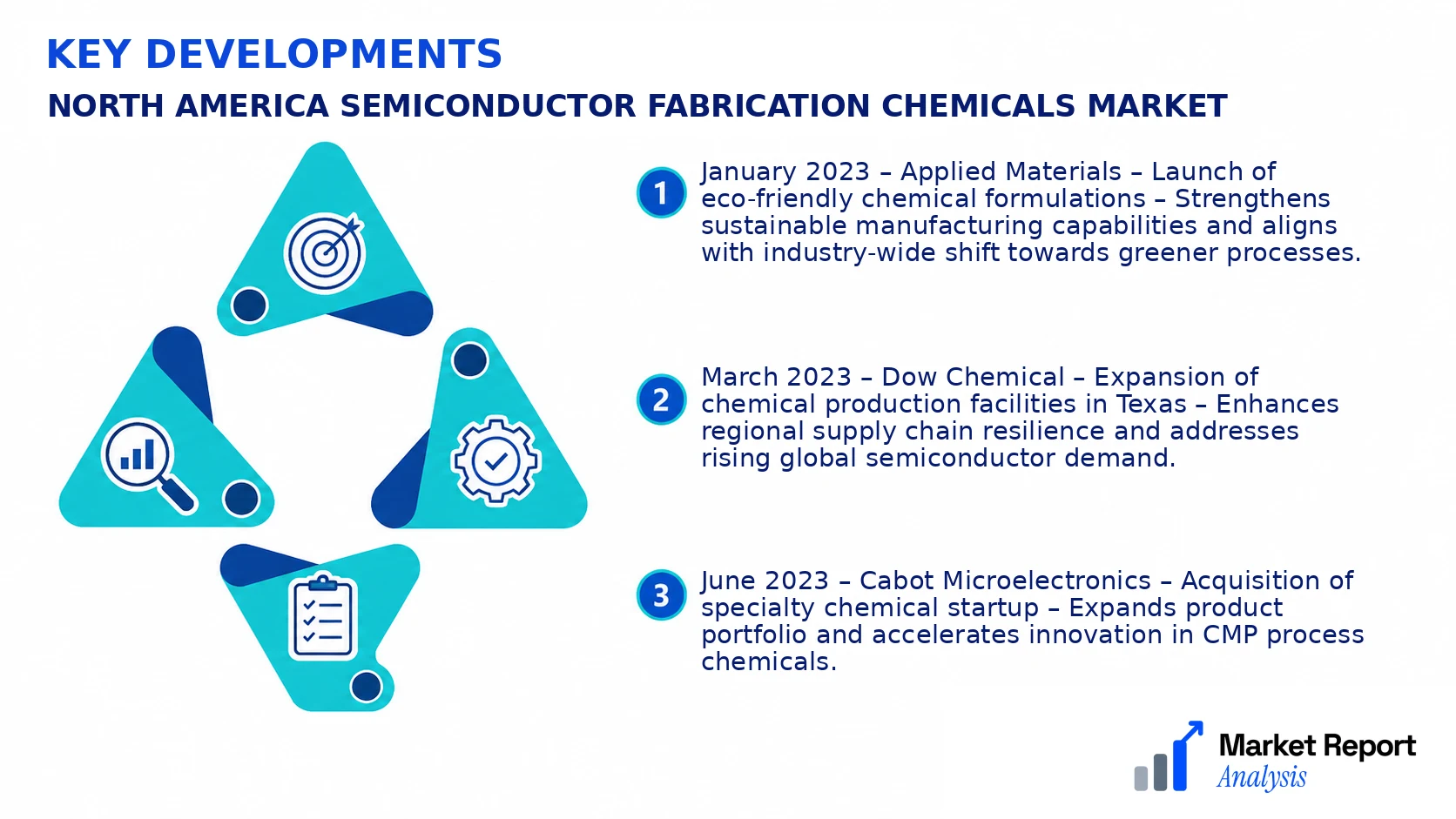
- January 2023 – Applied Materials – Launch of eco-friendly chemical formulations – Strengthens sustainable manufacturing capabilities and aligns with industry-wide shift towards greener processes.
- March 2023 – Dow Chemical – Expansion of chemical production facilities in Texas – Enhances regional supply chain resilience and addresses rising global semiconductor demand.
- June 2023 – Cabot Microelectronics – Acquisition of specialty chemical startup – Expands product portfolio and accelerates innovation in CMP process chemicals.
- September 2023 – Entegris – Partnership with a leading equipment manufacturer – Integrates contamination control materials into new fabrication technologies, boosting product integration.
- December 2023 – Linde – Launch of low-GWP process gases – Supports semiconductor manufacturers’ sustainability targets and regulatory compliance initiatives.
Frequently Asked Questions
What is the North America Semiconductor Fabrication Chemicals Market?
The North America Semiconductor Fabrication Chemicals Market encompasses the supply and demand for specialized chemicals used in semiconductor manufacturing processes within North America. This market supports chip production, wafer processing, and equipment cleaning, integral to the electronics and technology industries across the region.
What is the current market size of North America Semiconductor Fabrication Chemicals Market?
As of 2026, the market size for North America Semiconductor Fabrication Chemicals is valued at approximately USD 35 Billion, reflecting steady growth driven by increasing demand for advanced semiconductor devices and technological advancements in fabrication processes.
What factors are driving the North America Semiconductor Fabrication Chemicals Market?
Market growth is primarily fueled by rising adoption of miniaturized and high-performance semiconductor devices, technological innovations in fabrication techniques, and increasing production capacities by key industry players. Additionally, rising demand from consumer electronics and automotive sectors contribute significantly.
Which region dominates the North America Semiconductor Fabrication Chemicals Market?
The United States holds the dominant share within North America, owing to its advanced manufacturing infrastructure, presence of leading semiconductor companies, and heavy investment in technological R&D, making it a key hub for chemical supply chains and semiconductor innovation.
Which segment is expected to grow the fastest?
Specialty chemicals for etching and cleaning processes are forecasted to exhibit the fastest growth, driven by the increasing complexity of semiconductor architectures and the need for precision chemical solutions in advanced semiconductor fabrication.
Who are the leading companies operating in the North America Semiconductor Fabrication Chemicals Market?
Major players include companies like Dow Chemical Company, BASF SE, and Cabot Microelectronics, along with regional specialists. These firms focus on innovation, quality enhancement, and expanding production capabilities to maintain competitive relevance.
Analyst Perspective
The long-term outlook for the North America Semiconductor Fabrication Chemicals Market appears robust, driven by persistent advancements in semiconductor manufacturing technology and growing demand for high-performance chips, especially in AI, IoT, and automotive sectors. Commercial opportunities are abundant, with significant investments in next-generation fabrication processes such as EUV lithography, which necessitate specialized chemicals, creating lucrative niches for innovative providers. Technology evolution continues to push towards smaller nodes, demanding progressively more refined chemical formulations that enhance process efficiency and yield. Investment priorities should concentrate on R&D for sustainable, less toxic chemical solutions, alongside expansions in regional manufacturing capacities to reduce supply chain vulnerabilities. Competitive intensity is rising as established chemical suppliers face increasing pressure from emerging players and integrated equipment manufacturers venturing into chemical development. Regional growth potential remains high across North America, particularly in the U.S., given its burgeoning tech industry and supportive policy environment. Strategic positioning requires companies to innovate faster, foster regional collaborations, and adopt more sustainable practices to capitalize on long-term market expansion.
