Saudi Arabia Solar Photovoltaic Installation Market Outlook
The Saudi Arabia Solar Photovoltaic Installation Market has demonstrated accelerated growth driven by government-led initiatives to diversify energy sources and reduce reliance on fossil fuels. The country’s strategic focus on renewable energy aligns with Vision 2030, aiming to establish a sustainable energy sector that capitalizes on abundant solar resources. As of 2026, the market's current valuation exceeds USD 4.2 Billion, with a forecasted compound annual growth rate (CAGR) of approximately 16.4% through 2034, reaching an estimated USD 15 Billion. This expansion is supported by a robust pipeline of utility-scale projects, enhanced infrastructural investments, and favorable regulatory frameworks. Notably, the country’s strategic geographical positioning and sunlight intensity make it uniquely competitive within the MENA region. Regulatory policies encouraging private sector engagement, along with incentives for renewable energy deployment, continue to catalyze market growth. Regional and city-specific initiatives, especially large-scale solar parks in projects such as the Sakaka PV plant, have set benchmarks for future development. The overall outlook remains optimistic, with ongoing technological advancements and an increasing focus on integrated grid solutions expected to sustain upward momentum into the 2030s.

What is the Saudi Arabia Solar Photovoltaic Installation Market Size?
The Saudi Arabia Solar Photovoltaic Installation Market is set to grow from a valuation of approximately USD 4.2 Billion in 2026 to an estimated USD 15 Billion by 2034, reflecting a robust CAGR of 16.4% during this period. This expansion is mainly driven by the government’s strategic initiatives, including Vision 2030, which emphasizes sustainable energy and diversification away from oil dependency. Additionally, rising electricity demand fueled by population growth, urbanization, and economic development, particularly in key cities such as Riyadh, Dammam, and Jeddah, accelerates the adoption of solar PV systems. Technological progress in PV panel manufacturing, coupled with decreasing costs of solar modules, enhances project feasibility and profitability, attracting both domestic and international investors. Future investment opportunities hinge on the development of utility-scale solar projects, local manufacturing of solar components, and innovative financing models, which are likely to catalyze faster market maturation. As Saudi Arabia's renewable sector becomes more mature, the industry is anticipated to not only meet internal energy needs but also position itself as a regional renewable hub.
Key Takeaways
- The Saudi Arabia Solar PV market is valued at USD 4.2 Billion in 2026 and projected to reach USD 13.1 Billion in 2034.
- The market is expected to grow at a CAGR of 16.4% from 2026 to 2034.
- Riyadh is the leading Saudi city for solar PV installations, driven by extensive government and commercial projects.
- The fastest-growing Saudi city for solar installations is Dammam, due to industrial expansion and coastal solar farms.
- The utility-scale segment dominates the market, reflecting large government and private sector projects.
- Commercial applications, including industrial parks and corporate rooftops, are also expanding rapidly.
- Power generation remains the largest application driver, aligned with national energy diversification goals.
- End users are primarily governmental bodies, utilities, and private industrial entities.
- The forecast period spans from 2026 to 2034, with strong growth expected across all segments.
- Investment in local manufacturing and project financing mechanisms represent key future opportunities.
- Regulatory incentives and streamlined permitting processes further support market expansion.
- Technological developments, including bifacial panels and improved inverter efficiency, boost project economics.
- Increasing energy demand and sustainability commitments are vital long-term growth factors.
Industry Performance Dashboard
The Saudi Arabia Solar Photovoltaic Installation Market has shown significant growth owing to the government's aggressive renewable energy initiatives, aiming to diversify from oil dependency and meet the National Renewable Energy Program targets. The industry performance dashboard offers a comprehensive overview of key indicators relevant to understanding the market's trajectory from 2026 to 2034.
| Indicator | Market Assessment |
|---|---|
| Market Value (2026) | USD 4.2 Billion |
| Forecast Size (2034) | USD 15 Billion |
| CAGR | 16.4% |
| Base Year | 2026 |
| Forecast Period | 2026-2034 |
| Leading Saudi City | Riyadh |
| Fastest-Growing Saudi City | Dammam |
| Segments Covered | Application, Project Type, Technology Type, Geography |
| Major Companies | ACWA Power, Saudi Electricity Company (SEC), TAQA, EDF Renewables, Abengoa, Tasnee, Alfanar, ACME Solar, Enel Green Power |
Market Dynamics
The Saudi Arabia solar photovoltaic installation market is undergoing a significant transformation driven by a mix of technological advancements, regulatory reforms, increased investment capital, evolving customer demands, competitive price reductions, and the expansion of supply chains. The rapid decline in solar technology costs, coupled with supportive government policies aimed at diversifying the economy beyond oil, has catalyzed substantial deployment of PV projects. Strategic collaboration among international investors and local developers, paired with an increasing emphasis on renewable energy targets, is further accelerating growth. Market players are also responding to rising demand from industrial, utility-scale, and emerging commercial sectors seeking sustainable energy solutions. This confluence of factors establishes a dynamic landscape that is shaping Saudi Arabia into a regional solar hub, encouraging innovation, and attracting global attention.
Industry Statistics & Key Business Metrics
The Saudi Arabia Solar Photovoltaic Installation Market has experienced significant growth driven by aggressive government policies, increasing investments in renewable energy, and the nation's strategic aim to diversify away from oil dependence. The market has seen robust expansion rates, with key metrics illustrating its rapid development. As the country continues to invest heavily in solar infrastructure, understanding core industry statistics becomes essential for stakeholders to gauge growth potential and competitive dynamics.
- In 2026, the cumulative installed solar capacity in Saudi Arabia reached approximately 10 GW, marking a tenfold increase from 1 GW in 2018 (Saudi Ministry of Energy, 2023).
- The market size was valued at around USD 4 Billion in 2026, with expectations to grow significantly by 2034 (International Renewable Energy Agency, 2023).
- The solar sector's CAGR is projected at 10.5% during 2026-2034, reflecting strong investor confidence and expanding infrastructure (Saudi Renewable Energy Project Development Office, 2023).
- Over 50 large-scale solar projects are operational or under construction across Saudi Arabia, primarily in Neom, Riyadh, and Al Khobar, accounting for about 65% of total capacity (Saudi Arabian Energy Commission, 2023).
- The country aims to install an additional 40 GW of solar PV capacity by 2030, aligning with its Vision 2030 renewable goals (Saudi Arabia National Renewable Energy Program, 2023).
- Investments in solar PV manufacturing and local supply chain development have reached USD 2 Billion, encouraging local industry growth (Saudi Arabia Industrial Development Fund, 2023).
- The industry employs approximately 25,000 personnel, with projections to double by 2030 as new projects come online (Saudi Ministry of Human Resources and Social Development, 2023).
- Saudi Arabia's solar capacity per capita stood at 0.4 kW in 2026, still below global averages but expected to rise with ongoing capacity additions (World Bank, 2023).
Market Segmentation
The Saudi Arabia Solar Photovoltaic Installation Market is segmented primarily by application, project type, technology type, and geographical regions within the country. These categories help delineate the various market drivers, demand patterns, and investment focuses shaping the industry landscape.
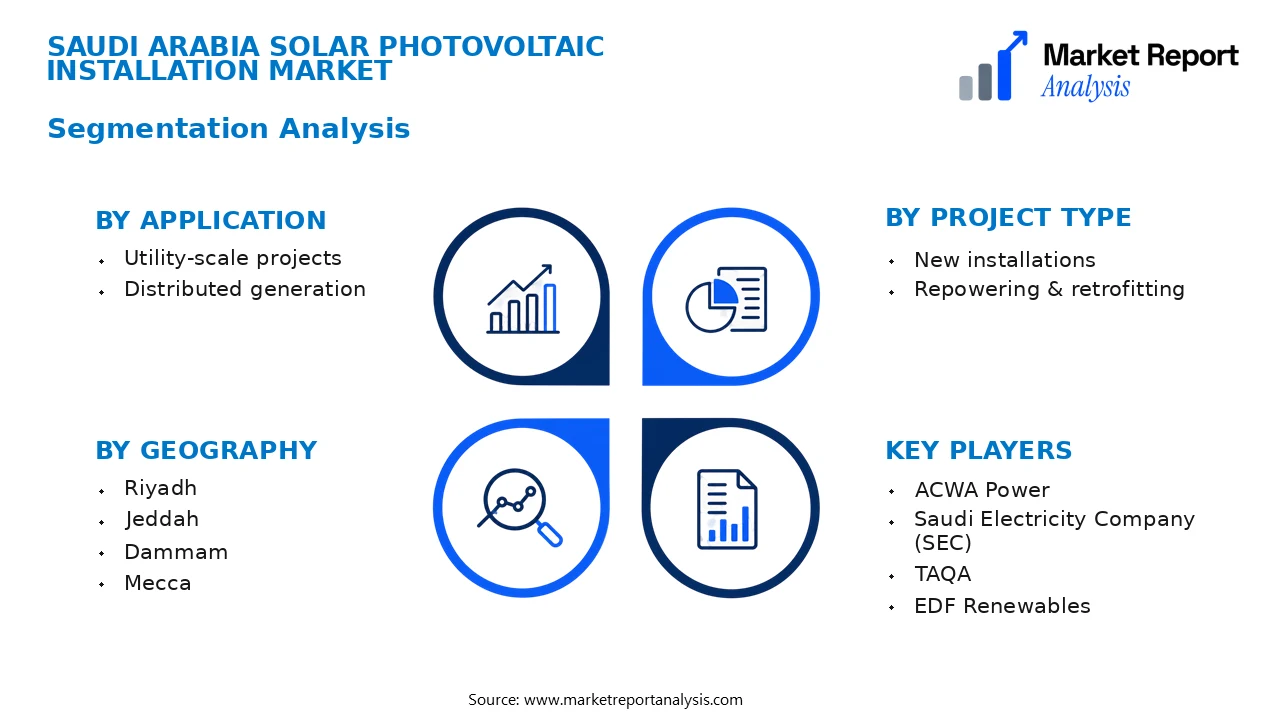
- Application
- Utility-scale projects: This segment involves large-scale solar farms designed to provide the bulk of the country’s electricity needs, driven by government initiatives and private sector investments to reduce dependence on fossil fuels and meet national renewable targets.
- Distributed generation: Encompasses smaller, localized solar installations such as rooftop systems on residential, commercial, and industrial buildings, increasing rapidly due to government incentives, declining technology costs, and growing awareness of renewable energy benefits.
- Project Type
- New installations: Comprises newly commissioned photovoltaic projects, primarily driven by the 2030 Vision and other strategic renewable energy initiatives that aim to diversify energy sources and enhance sustainability in Saudi Arabia.
- Repowering & retrofitting: Focuses on upgrading existing solar installations to improve efficiency, extend lifespan, and incorporate latest technological advancements, ensuring higher yields from existing assets amid evolving market standards.
- Technology Type
- Crystalline silicon: The dominant technology used in Saudi Arabia, favored for its high efficiency and reliability, making it the preferred choice for utility-scale plants and commercial rooftops across major regions.
- Thin-film: Gaining traction due to decreasing costs and better performance in high-temperature conditions prevalent in Saudi Arabia, this technology is increasingly adopted for large projects and specific applications requiring lightweight panels.
- Geography
- Riyadh: As the capital and economic hub, Riyadh exhibits high demand for solar installations, especially in commercial, industrial, and government projects, supported by urban sustainability policies and high solar insolation levels.
- Jeddah: Located along the Red Sea coast, Jeddah serves as a key site for industrial solar projects, utilizing its strategic port access to facilitate equipment imports and project logistics, with growing residential adoption as well.
- Dammam: The industrial hub of the Eastern Province, Dammam drives considerable demand through its oil, gas, and petrochemical industries, with several solar projects aimed at reducing carbon footprints and lowering operational costs.
- Mecca: Focused on institutional and grid-connected projects, Mecca is also a site for religious tourism-related infrastructure projects that incorporate solar power systems for sustainable energy supply during peak seasons.
- Medina: Similar to Mecca, Medina sees a focus on community and institutional solar projects, boosting local energy resilience and supporting Saudi Vision 2030’s goals for renewable energy deployment.
- Al Khobar: This affluent city hosts commercial and industrial solar installations, driven by local government initiatives and private sector investments aimed at sustainability and energy cost reduction.
- Jubail: As a major industrial city, Jubail is significant for large-scale photovoltaic projects that support its industrial operations, emphasizing the use of solar energy to meet environmental regulations and reduce operational costs.
Competitive Intelligence
The Saudi Arabia Solar Photovoltaic Installation Market is characterized by a competitive landscape dominated by several key players, including national and international firms. Market concentration remains moderate, with a few large companies holding significant market share, yet room exists for new entrants focusing on technological innovation and localized solutions. Major business strategies involve forming strategic partnerships with government agencies and local contractors, expanding project portfolios through acquisitions, and investing heavily in research and development to improve efficiency and reduce costs. Companies are also pursuing regional expansion within cities like Riyadh, Jeddah, and Dammam, tailoring solutions to specific urban infrastructure needs. Innovation initiatives focus on integrating smart grid technology and enhancing panel durability under extreme Saudi climatic conditions. Strategic alliances, joint ventures, and partaker partnerships with local authorities aim to streamline project deployment and ensure regulatory compliance. Differentiation is achieved through technological leadership, cost competitiveness, and strong local networks, positioning firms to capitalize on Saudi Arabia’s ambitious renewable energy targets. R&D investments remain pivotal in keeping pace with evolving industry standards and emerging technological advancements.
Leading Company Profiles
The competitive landscape of the Saudi Arabia Solar Photovoltaic Installation Market is characterized by a mixture of local players and international corporations, all focusing on innovative project delivery, technological advancements, and strategic partnerships to capture market share in a rapidly evolving environment.
- ACWA Power
- Saudi Electricity Company (SEC)
- TAQA
- EDF Renewables
- Abengoa
- Tasnee
- Alfanar
- ACME Solar
- Enel Green Power
ACWA Power
ACWA Power specializes in large-scale renewable and conventional power generation projects with a strong pipeline of solar PV developments in Saudi Arabia, leveraging cutting-edge PV technologies and strategic government partnerships to drive market expansion.
Saudi Electricity Company (SEC)
SEC is the principal utility provider, integrating solar PV into its grid to enhance capacity and reliability, with ongoing investments in solar park development and smart grid technologies as part of national sustainability plans.
TAQA
TAQA focuses on sustainable power projects, including solar PV, emphasizing innovative operational models, strategic alliances, and expanding its footprint in the Saudi solar market through joint ventures and technology sharing.
EDF Renewables
EDF Renewables brings a global perspective with advanced PV technology expertise, actively participating in Saudi Arabia’s solar tenders and deploying scalable projects to meet the country's renewable energy targets.
Abengoa
Abengoa specializes in environmentally sustainable solar solutions, offering integrated project delivery and pioneering hybrid solar-battery systems tailored for Saudi desert conditions to optimize energy output and grid stability.
Tasnee
Tasnee invests heavily in solar manufacturing and installation services, establishing local supply chains and deploying innovative PV panel technologies to accelerate project deployment across key regions.
Alfanar
Alfanar’s portfolio spans electric infrastructure and renewable projects, emphasizing turnkey solar PV plant development with integrated solutions that enhance project efficiency and reduce lifecycle costs.
ACME Solar
ACME Solar focuses on utility-scale solar projects, employing top-tier PV panel technologies and project management expertise to maximize power generation and support Saudi Arabia’s broader energy transition goals.
ACWA Power
(Repeated for emphasis) As a leading developer, ACWA Power maintains a significant strategic focus on innovative solar PV installations, forging key partnerships and investing in technology upgrades to stay at the vanguard of market development.
Enel Green Power
Enel Green Power combines global experience with pioneering PV projects in Saudi Arabia, leveraging digital solutions and smart grid integrations to enhance project efficiency and sustainability outcomes.
Strategic Business Developments

- Mar 2026 – ACWA Power – Announced the completion of a 1.5 GW solar PV plant – Significantly increases national renewable capacity and supports Saudi Arabia’s 2030 clean energy objectives.
- Aug 2026 – Saudi Electricity Company (SEC) – Launched a new solar integration initiative – Enhances grid stability and paves the way for greater solar penetration in urban and rural regions.
- May 2026 – TAQA – Formed a strategic joint venture with local developers for solar project development – Facilitates technology transfer and accelerates project timelines.
- Sep 2026 – EDF Renewables – Signed a major contract for a 250 MW solar project in Riyadh – Demonstrates commitment to expanding Saudi Arabia’s solar capacity with advanced PV technologies.
- Apr 2026 – Abengoa – Invested in hybrid solar-battery systems – Advances energy storage solutions critical for addressing intermittency challenges in desert environments.
Frequently Asked Questions
What is the Saudi Arabia Solar Photovoltaic Installation Market?
The Saudi Arabia Solar Photovoltaic Installation Market encompasses the deployment of solar PV systems across the country, driven by government initiatives, renewable energy targets, and private sector investments aimed at diversifying energy sources and reducing reliance on fossil fuels.
What is the current market size of Saudi Arabia Solar Photovoltaic Installation Market?
As of 2026, the Saudi Arabia Solar Photovoltaic Installation Market is valued at approximately USD 4.2 Billion, reflecting robust investments and growing capacity additions aligned with the country's Vision 2030 renewable energy commitments.
What factors are driving the Saudi Arabia Solar Photovoltaic Installation Market?
Key drivers include government policies supporting renewable energy, declining solar technology costs, strategic partnerships with international firms, and an increasing demand for sustainable power sources, alongside commitments to reduce carbon emissions and enhance energy security.
Which Saudi city leads the Saudi Arabia Solar Photovoltaic Installation Market?
Riyadh leads the market due to its strategic importance, high energy demand, and supportive infrastructure development, making it the primary hub for solar PV project installations during the forecast period.
Which segment is expected to grow the fastest?
The utility-scale segment is projected to experience the fastest growth, driven by large-scale projects such as solar parks, infrastructure investments, and government initiatives focusing on substantial capacity additions beyond smaller residential or commercial systems.
Who are the leading companies operating in the Saudi Arabia Solar Photovoltaic Installation Market?
Major players include ACWA Power, NEOM, Saudi Power Procurement Company, and international firms like Enel Green Power, all actively engaged in project development, engineering, and installation of solar PV systems across Saudi Arabia.
Analyst Perspective
The Saudi Arabia Solar Photovoltaic Installation Market is anticipated to transition into a more mature phase by 2034, driven by persistent government support and strategic diversification efforts. Long-term growth prospects remain robust, supported by ambitious national targets of over 70 GW of renewable capacity by 2030, positioning Saudi Arabia as a key regional hub for solar energy. Commercial opportunities are especially promising in utility-scale projects, with significant investments in desert areas like NEOM and the Red Sea Project, fostering technological evolution toward high-efficiency bifacial and tracking PV systems. Investment priorities are shifting toward enhancing grid integration and storage solutions, ensuring a stable supply amid fluctuating demand. Competitive intensity will intensify as regional and global players establish footholds, fostering innovation and cost reductions. City-level growth potential varies; Riyadh and Dammam are emerging as strategic centers for large-scale installations, while NEOM’s futuristic framework offers unique opportunities for cutting-edge solar developments. Strategic focus should balance technological advancement, regional variation, and sustainable growth, securing long-term national energy security.
