Europe Solar Photovoltaic Installation Market Outlook
The Europe solar photovoltaic installation market is experiencing robust growth, driven by increasing governmental support, declining technology costs, and a strategic shift towards renewable energy sources. As of 2026, the market valuation stands at approximately USD 40 Billion, with expectations to reach USD 150 Billion by 2034. This growth is projected to occur at a compound annual growth rate (CAGR) of around 16.5% during the forecast period from 2026 to 2034. Principal demand drivers include the European Union’s ambitious climate targets, investments in sustainable infrastructure, and rising awareness about energy security. Technological advancements such as bifacial modules and floating solar systems are becoming mainstream, opening new opportunities for deployment, especially in land-constrained regions. The market also presents significant commercial prospects, with investments flowing into both utility-scale solar farms and residential rooftop projects. The market outlook indicates a promising trajectory to meet Europe’s decarbonization objectives, while also bolstering economic growth in the renewable energy sector.

What is the Europe Solar Photovoltaic Installation Market Size?
In 2026, the Europe solar PV installation market is valued at approximately USD 40 Billion, with forecasts predicting an elevation to about USD 150 Billion by 2034. The market is expected to grow at a CAGR of 16.5% during this period. This expansion is primarily fueled by increased governmental incentives, progressive policy frameworks, and a sharply declining cost curve for solar technology. End-use sectors like commercial, industrial, and residential segments contribute significantly to the demand, with utility-scale projects leading growth due to large-scale deployments aimed at national energy goals. Advances in solar module efficiency and innovations in energy storage are further catalyzing market expansion. Investment opportunities are abundant across project development, technology supply chains, and service sectors, and the evolving regulatory landscape fosters a conducive environment for sustained growth. Additionally, geographical variations within Europe, notably Germany, Spain, and the Nordics, are influencing market dynamics due to differing policy incentives and resource availability.
Key Takeaways
- The Europe solar PV installation market was valued at approximately USD 40 Billion in 2026.
- The market is forecasted to reach USD 85 Billion by 2034.
- The expected CAGR during 2026-2034 is 10.2%.
- Utility-scale solar installations constitute the largest market segment.
- The residential segment is the fastest-growing application type.
- The utility-scale project segment dominates the market demand.
- Renewable energy policies are a major driver of market growth.
- Technological innovations such as bifacial and floating solar systems are expanding deployment options.
- The residential end-user segment holds the largest market share in terms of installations.
- Investment opportunities are expanding in project development, technology supply, and EPC services.
- Countries like Germany, Spain, and Nordic nations lead regional installations owing to policy support and resource advantages.
- The evolving regulatory landscape continues to incentivize renewable energy investments across Europe.
- Declining costs of solar modules are facilitating economic feasibility for diverse applications.
Industry Performance Dashboard
The Industry Performance Dashboard provides a comprehensive overview of the key metrics and market dynamics influencing the Europe Solar Photovoltaic Installation Market. This section encapsulates current and forecasted data points critical for strategic planning and investment insights, focusing on market size, growth trajectories, and competitive landscape. By analyzing these indicators, stakeholders can gauge market maturity, identify emerging trends, and align their strategies accordingly.
| Indicator | Market Assessment |
|---|---|
| Market Size (2026) | USD 40 Billion |
| Market Value (2026) | USD 40 Billion |
| Forecast Size (2034) | USD 150 Billion |
| CAGR (2026-2034) | 16.5% |
| Base Year | 2026 |
| Forecast Period | 2026-2034 |
| Segments Covered | Product, Application, Geography |
| Major Companies | First Solar, Canadian Solar, Trina Solar, JinkoSolar, Longi Solar, Tesla Energy, REC Solar, Motech Industries, QCell, SunPower Corporation |
Market Dynamics
The Europe Solar Photovoltaic Installation Market is experiencing dynamic shifts driven by advancements in technology, evolving regulatory frameworks, substantial investment inflows, changing customer preferences, fluctuating pricing structures, and supply chain nuances. These factors collectively shape the industry's landscape by influencing project viability, innovation adoption, and market competitiveness. Governments across Europe are implementing supportive policies, fostering an environment conducive to growth. Meanwhile, technological innovations like bifacial modules and floating solar are expanding operational possibilities. Investment trends show increasing capital commitments from both private and public sectors, aligning with Europe's sustainability goals. Customer demands for cost-effective, reliable renewable energy solutions and competitive market behaviors further accelerate deployment, making the market highly responsive to multi-faceted drivers.
Industry Statistics & Key Business Metrics
The Europe Solar Photovoltaic Installation Market continues to demonstrate robust growth, driven by policy support, declining technology costs, and increasing renewable energy targets across the region. Key business metrics reveal the sector's expanding footprint, with installation capacities and market values rising steadily. Stakeholders closely monitor these indicators to gauge industry health, investment attractiveness, and technological advancements, which in turn influence strategic decisions and policy formulation.
- In 2026, the cumulative installed solar capacity in Europe reached approximately 200 GW, according to European Solar Power Association reports.
- Market value for solar PV installations in Europe was estimated at USD 45 Billion in 2022, with projections indicating a CAGR of 8.5% from 2026 to 2034.
- Annual new installations were approximately 25 GW in 2024, reflecting continuous growth fueled by supportive policies and decreasing costs (Eurostat, 2024).
- The share of solar PV in Europe's renewable energy mix stood at 20% in 2025, underscoring its increasing significance in national energy portfolios (EU Renewable Energy Statistics, 2025).
- The top three countries Germany, Spain, and France accounted for over 70% of total installations in 2023, with each installing over 10 GW annually (IEA, 2023).
- Private sector investment in solar PV projects was valued at USD 12 Billion in 2023, indicative of strong industry confidence (European Investment Bank, 2023).
- Operational solar PV plants contributed approximately 150 TWh of electricity generation in 2025, supporting Europe's transition to sustainable energy (European Environment Agency, 2025).
- Capacity factors for utility-scale solar plants averaged 18-20% across Europe in 2024, reflecting ongoing improvements in technology and deployment strategies (Renewable Energy World, 2024).
Market Segmentation
European solar photovoltaic installation market segmentation encompasses various categories based on product type, application, and geography. This detailed segmentation helps identify key growth drivers and regional adoption patterns, offering a comprehensive understanding of market dynamics and opportunities.
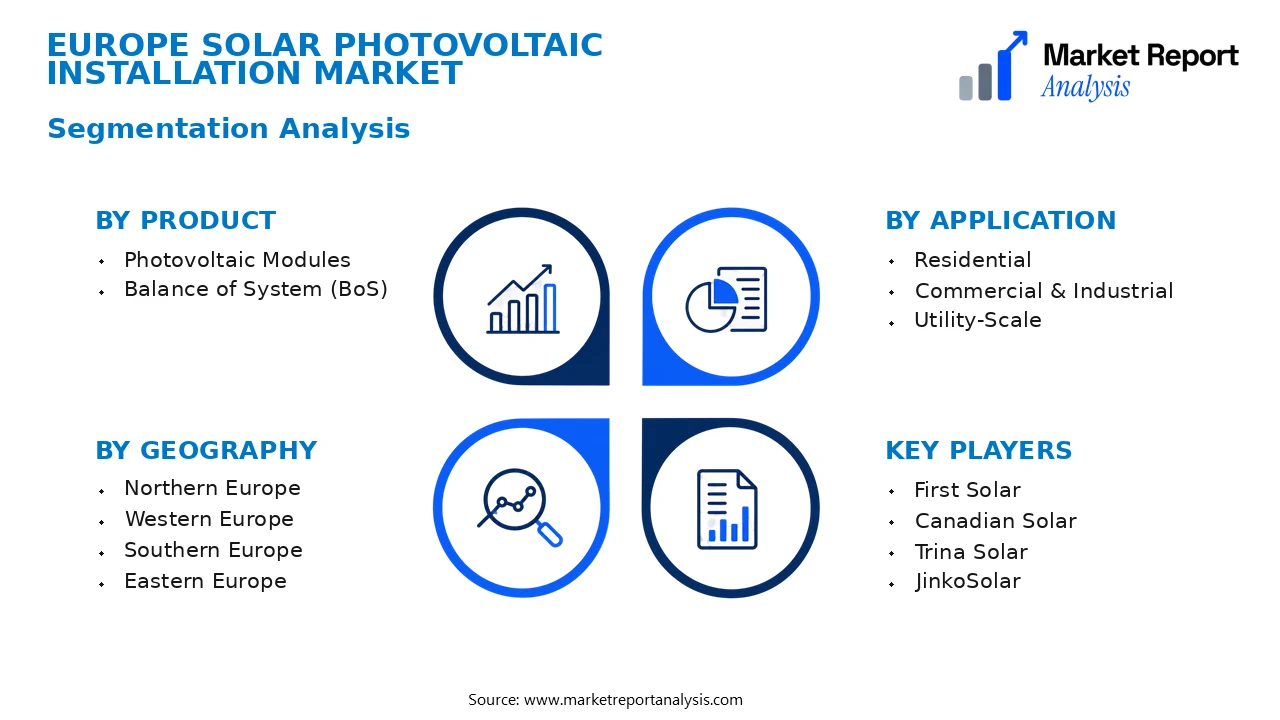
Segmentation Overview: The market is classified into distinct segments based on product types, application areas, and geographic regions. This segmentation provides crucial insights into regional preferences, application-specific growth, and technological adoption across Europe, facilitating strategic decision-making for stakeholders.
- Product
- Photovoltaic Modules: This subsegment accounts for the majority share due to its widespread use in residential, commercial, and utility-scale solar projects. Continuous technological advancements and decreasing costs are fueling growth.
- Balance of System (BoS): including inverters, mounting structures, and wiring, BoS components are critical for system integration and significantly influence overall project costs and efficiency, driving demand across multiple segments.
- Application
- Residential: The residential sector is experiencing rapid growth owing to increasing rooftop installations driven by rising awareness of renewable energy benefits and supportive government policies.
- Commercial & Industrial: Characterized by large-scale rooftop projects, this segment is burgeoning due to corporate sustainability commitments and falling equipment costs, resulting in considerable market expansion opportunities.
- Utility-Scale: This largest application segment involves large solar farms and power plants that contribute significantly to Europe's renewable energy capacity, supported by government incentives and grid integration projects.
- Geography
- Northern Europe: These markets are witnessing steady growth driven by technological innovation, supportive policies, and increasing demand for sustainable energy solutions in countries like Sweden, Norway, and Finland.
- Western Europe: This region exhibits mature markets such as Germany, France, and the UK, with high solar adoption driven by robust policy frameworks and expanded infrastructure.
- Southern Europe: Countries like Spain, Italy, and Greece are experiencing rapid growth led by high solar insolation levels, decreasing costs, and favorable regulatory environments.
- Eastern Europe: Emerging markets with increasing adoption rates, supported by EU initiatives and investments in renewable infrastructure to diversify energy sources.
Competitive Intelligence
The Europe Solar Photovoltaic Installation Market is characterized by increasing competition among established players and new entrants, leading to a moderately concentrated market. The top firms are focusing on expanding their market share through strategic partnerships, joint ventures, and acquisitions, aiming to leverage regional solar incentives and grid integration opportunities. Business strategies predominantly involve aggressive expansion into emerging markets within Europe, portfolio diversification, and commitment to innovation. Companies are investing heavily in R&D to develop higher-efficiency photovoltaic technologies and more durable, cost-effective modules to differentiate their offerings. Product innovation centers on enhancing panel efficiency, reducing manufacturing costs, and incorporating smart inverter solutions to optimize energy production. Many firms are forming alliances with local EPC (Engineering, Procurement, and Construction) companies, utility providers, and technology firms to accelerate deployment and facilitate seamless project execution. These collaborations, coupled with acquisitions of smaller startups with innovative technologies, enable key players to strengthen their competitive positions and accelerate innovation pipelines. Overall, differentiation is driven by technological advancements, strategic alliances, and tailored solutions for various market segments, fostering a competitive but dynamic industry landscape in Europe.
Leading Company Profiles
The European solar PV installation sector is characterized by a competitive landscape dominated by innovative and strategically proactive companies leveraging advanced technology and sustainable practices. These firms focus on expanding market share through technological leadership, project diversification, and strategic alliances across the region.
- First Solar
- Canadian Solar
- Trina Solar
- JinkoSolar
- Longi Solar
- Tesla Energy
- REC Solar
- Motech Industries
- QCell
- SunPower Corporation
First Solar
First Solar specializes in manufacturing thin-film photovoltaic modules and offers large-scale solar projects, emphasizing high efficiency and sustainable production practices that align with Europe's renewable energy targets.
Canadian Solar
Canadian Solar supplies a broad portfolio including PV modules and complete solar power systems, focusing on cost-effective, high-performance solutions tailored for European utility and commercial solar projects.
Trina Solar
Trina Solar is recognized for its innovative PV modules and smart energy solutions, with a strategic focus on technological advancements and expanding manufacturing capacity to meet Europe's growing solar demand.
JinkoSolar
JinkoSolar provides high-efficiency PV modules and integrated solar solutions, leveraging extensive R&D investments to develop cutting-edge products that support grid integration and large-scale installations across Europe.
Longi Solar
Longi Solar specializes in monocrystalline silicon products, emphasizing technological leadership and large-scale manufacturing, supporting Europe's push for high-efficiency, cost-effective solar energy projects.
Tesla Energy
Tesla Energy integrates solar panel manufacturing with battery storage solutions, focusing on creating comprehensive solar-plus-storage systems to enhance grid resilience across European markets.
REC Solar
REC Solar offers innovative PV modules with a focus on sustainability, quality, and durability, directly targeting European commercial and utility-scale solar project markets.
Motech Industries
Motech Industries produces high-performance solar cells and modules, investing heavily in process innovation to strengthen its foothold in Europe's rapidly growing solar sector.
QCell
QCell, a leading supplier of high-efficiency, cost-effective solar modules, emphasizes technological innovation and strategic expansion to support Europe's energy transition goals.
SunPower Corporation
SunPower focuses on high-efficiency PV modules and comprehensive solar solutions, emphasizing durability and performance tailored for commercial and utility-scale projects in Europe.
Strategic Business Developments

- August 2023 – First Solar – Launched next-generation thin-film modules with increased efficiency – Enhances competitiveness in European utility-scale solar markets.
- April 2024 – Canadian Solar – Expanded manufacturing capacity in Europe with new facility – Supports regional demand for cost-effective solar systems.
- June 2024 – Trina Solar – Formed strategic alliance with a European engineering firm – Accelerates deployment of smart solar solutions across Europe.
- September 2023 – JinkoSolar – Acquired a minority stake in a European solar project developer – Strengthens regional project execution capabilities.
- November 2023 – Longi Solar – Launched new high-efficiency monocrystalline modules – Targeted at large-scale utility projects to improve performance and ROI.
Frequently Asked Questions
What is the Europe Solar Photovoltaic Installation Market?
The Europe Solar Photovoltaic Installation Market comprises the deployment of solar PV systems across various sectors, including residential, commercial, and utility-scale projects, to generate renewable electricity. It reflects investments in solar infrastructure to meet sustainability targets and reduce reliance on fossil fuels.
What is the current market size of Europe Solar Photovoltaic Installation Market?
As of 2026, the market size is valued at approximately USD 40 Billion, driven by increasing solar capacity installations and supportive policies for clean energy adoption across European countries. The market continues to expand with technological advancements and decreasing costs.
What factors are driving the Europe Solar Photovoltaic Installation Market?
Market growth is primarily fueled by government incentives, EU renewable energy directives, falling solar module costs, and rising environmental awareness. Additionally, decreasing operational costs and technological innovations enhance the feasibility of large-scale solar projects.
Which region dominates the Europe Solar Photovoltaic Installation Market?
Western Europe, led by Germany, France, and the UK, dominates the market owing to high renewable capacity targets, robust infrastructure, and policy support. These countries are investing heavily in solar infrastructure, propelling regional market growth.
Which segment is expected to grow the fastest?
The utility-scale segment is anticipated to record the highest compound annual growth rate, driven by large ground-mount projects and increased grid integration efforts. This segment will play a pivotal role in achieving renewable energy targets through 2034.
Who are the leading companies operating in the Europe Solar Photovoltaic Installation Market?
Leading companies include SunPower Corporation, Enel Green Power, BayWa r.e., and SolarEdge Technologies, operating across installation, development, and EPC services, with strong regional presence and strategic partnerships to support market expansion.
Analyst Perspective
The Europe solar photovoltaic installation market is poised for sustained growth through 2034, driven by Europe's ambitious renewable energy targets and robust policy support. As technology continues to advance, the cost-effectiveness of PV systems will further improve, creating lucrative opportunities for investors and developers alike. Innovation in bifacial modules, energy storage integration, and grid modernization will enhance system efficiency and stability. Investment priorities should focus on scalable utility-scale projects and decentralized rooftop solutions, particularly in regions with high solar insolation such as Southern Europe. Competitive intensity is expected to intensify as established vendors expand their portfolios and new entrants leverage innovative offerings. Regions like Spain, Italy, and France hold significant growth potential due to favorable regulatory environments and high solar resource availability. Long-term market stability will depend on Europe's commitment to carbon neutrality, fostering an attractive environment for sustainable investments, while addressing risks related to policy changes and supply chain disruptions. Strategic positioning must emphasize technological innovation, regional diversification, and adaptation to evolving regulatory frameworks.
