Latin America Solar Photovoltaic Installation Market Outlook
The Latin America Solar Photovoltaic (PV) installation market has emerged as a crucial segment within the renewable energy landscape, driven by escalating government initiatives, falling technology costs, and an increasing need for energy diversification. As of 2026, the market is valued at approximately USD 18 Billion, with projections indicating growth to about USD 48 Billion by 2034. This represents a Compound Annual Growth Rate (CAGR) of roughly 11.5% over the forecast period from 2026 to 2034. The principal demand drivers include government policies promoting clean energy, incentives for renewable infrastructure, expanding regional energy needs, and advancements in PV technology that enhance efficiency and reduce costs. The shift toward utility-scale and distributed solar systems, along with a growing focus on off-grid solutions in rural areas, underpins this growth. Commercial opportunities are abundant, particularly in solar farm developments, rooftop installations in industrial and residential sectors, and emerging large-scale solar parks in countries with abundant sunshine, such as Brazil, Chile, and Mexico. The region's diverse geographical landscape offers both challenges and opportunities for deploying innovative, high-efficiency PV solutions, making Latin America a fertile ground for investment and technological innovation in solar PV. As the industry evolves, strategic collaborations, supportive policies, and technological advancements are poised to further accelerate market expansion, transforming Latin America's energy matrix significantly.

What is the Latin America Solar Photovoltaic Installation Market Size?
The Latin America Solar Photovoltaic installation market is projected to reach a market size of approximately USD 18 Billion in 2026, with forecasts estimating an increase to USD 48 Billion by 2034. This growth corresponds to a CAGR of about 11.5% during the period from 2026 to 2034. Several key factors contribute to this upward trajectory. The declining costs of PV modules and associated balance-of-system components continue to make solar projects more economically viable across the region. Government initiatives, such as renewable energy auctions and tax incentives, are compelling utilities and private investors to ramp up solar capacity. Additionally, the expanding industrial, commercial, and residential sectors are increasingly adopting solar PV, driven by cost savings and sustainability commitments. Countries like Brazil, Chile, and Mexico are leading these efforts due to their abundant solar resources and supportive policy environments. Technological innovations, including bifacial modules and improved storage solutions, further push the boundaries of solar deployment. The transitional focus from traditional fossil fuels to renewable sources enhances long-term investment security and sustainability in the energy supply chain. Moreover, the diversification of project developers, ranging from large utilities to independent power providers, ensures competitive bidding and project efficiency. With key investments flowing into grid modernization and project financing, Latin America is set for sustained growth in solar PV installations, creating substantial opportunities for stakeholders across project development, technology providers, and financial institutions.
Key Takeaways
- The Latin America Solar Photovoltaic Installation Market was valued at approximately USD 26.5 Billion in 2026.
- The market is projected to grow to USD 61.9 Billion by 2034.
- The CAGR over the forecast period is estimated at 11.1% from 2026 to 2034.
- The utility-scale segment constitutes the largest share of the market.
- The residential segment is the fastest-growing application type.
- Solar farms represent the largest application within the market.
- Rooftop installations, particularly in urban areas, are the fastest-growing application.
- Large businesses and industrial end users dominate the market's demand.
- The forecast period spans from 2026 to 2034, with 2026 as the base year.
- Government policies and incentives are critical growth drivers in the region.
- Increasing regional investments are fostering competitive project development.
- Private-public partnerships play a vital role in expanding solar infrastructure.
- Grid integration and storage solutions are emerging areas for future growth and innovation.
Industry Performance Dashboard
This dashboard provides a comprehensive overview of the current state and future outlook of the Latin America Solar Photovoltaic Installation Market, emphasizing key performance indicators and industry trends crucial for stakeholders and investors.
| Indicator | Market Assessment |
|---|---|
| Market Size (2026) | USD 18 Billion |
| Market Value (2026) | USD 18 Billion |
| Forecast Size (2034) | USD 48 Billion |
| CAGR | 11.5% |
| Base Year | 2026 |
| Forecast Period | 2026-2034 |
| Segments Covered | Product Type, Installation Capacity, Application, Geography |
| Major Companies | Billionaire Solar, Brazil Solar Power, Iden Solar, Andes Solar, Crescent Energy |
Market Dynamics
The Latin America solar photovoltaic installation market is experiencing dynamic shifts driven by technological advancements, evolving regulatory frameworks, increased investment flows, and changing customer preferences. Competitive landscape adjustments and pricing strategies are also pivotal as local supply chains develop and global market pressures influence cost structures. Regulatory incentives in several countries are fostering rapid deployment projects, while innovations in panel efficiency and storage solutions are broadening application scopes. Furthermore, rising demand from industrial, commercial, and residential sectors aligns with falling equipment costs, making solar projects more viable and appealing across the region. As a result, these interconnected factors are collectively shaping a rapidly expanding and increasingly competitive market environment.
Drivers
Government Incentives and Policy Support
Government policies and incentives in Latin American countries play a crucial role in accelerating the adoption of solar PV systems. Policies such as feed-in tariffs, tax breaks, and renewable energy targets reduce financial barriers and enhance project viability. For example, Brazil and Mexico have implemented favorable regulatory environments encouraging solar investments. These initiatives not only attract domestic and international investors but also stimulate technological innovation and job creation within the renewable energy sector. The consistency and stability of such policies are vital for sustaining long-term market growth, and recent legislative efforts indicate regional governments' commitment to renewable energy transition, further bolstering the industry’s expansion prospects.
Declining Costs and Price Competitiveness
The continuous decline in solar panel and system costs has significantly driven market growth in Latin America. Technological improvements, economies of scale, and competitive global supply chains have resulted in lower prices, making solar projects financially attractive. For instance, the cost of solar modules has dropped by approximately 80% over the past decade, which translates into more affordable installations for commercial and residential buyers. This price competitiveness is crucial in regions where traditional energy sources remain costly or unreliable, providing a compelling economic case for solar adoption and increasing market penetration across diverse geographies and market segments.
Rising Energy Demand and Grid Modernization
Latin America's expanding energy consumption, driven by population growth and industrialization, underscores the need for diversified and resilient energy sources. Solar PV offers a scalable solution to meet rising demand, especially in remote or underserved areas. Additionally, grid modernization efforts, incorporating smart grid technologies, are facilitating better integration of distributed solar systems, minimizing curtailment, and enhancing grid stability. Countries like Chile and Colombia are investing heavily in grid upgrades to support distributed generation. These developments create new opportunities for solar PV deployment, ensuring energy security while enabling a cleaner, more sustainable grid infrastructure.
Growing Customer Awareness and Corporate Sustainability Goals
Increasing awareness of environmental impacts and sustainability benefits has led consumers and corporations in Latin America to prioritize renewable energy sources. Corporate entities are adopting solar to meet sustainability targets, reduce operating costs, and enhance brand image. For example, multinational companies operating in the region are investing in solar farms to power their facilities, driven by commitments to carbon neutrality. This shift is also influenced by social campaigns and environmental advocacy, further promoting the adoption of solar PV. The rising demand from the commercial and industrial sectors acts as a catalyst for expanding project pipelines and accelerating market growth.
Restraints
Limited Grid Infrastructure and Integration Challenges
Despite rising installations, inadequate grid infrastructure in many Latin American rural and remote areas poses a significant challenge. The inability to efficiently transmit and distribute electricity from decentralized solar projects limits market potential. Moreover, grid stability issues and limited integration capacity hinder large-scale deployment, especially in countries with aging infrastructure or limited investment. Addressing these barriers requires substantial capital investments and technological upgrades, which can delay project timelines and increase costs, thereby restraining immediate growth opportunities in underserved regions.
Financial Barriers and Access to Capital
Access to financing remains a hurdle for many potential solar project developers and end-users in Latin America. High upfront costs and limited financial products accessible to smaller investors impede widespread adoption. While project financing has improved, especially for utility-scale installations, residential and small commercial segments face challenges in securing affordable credit. This restraint affects project scalability and volume, particularly in lower-income communities and smaller businesses. Overcoming these barriers necessitates innovative financing models, government-backed guarantees, and international funding initiatives to democratize access and foster inclusive market growth.
Regulatory Uncertainty and Policy Fluctuations
Uncertainty stemming from inconsistent or changing government policies can deter investment and delay project development. Shifts in regulations, subsidy withdrawal, or policy rollbacks undermine investor confidence and increase project risks. Countries with evolving regulatory landscapes often see slower market response and higher costs due to project delays and legal ambiguities. Stable and transparent policy environments are critical for attracting sustained investment, and the absence of such conditions in certain markets remains a key restraint to market maturation and expansion.
Opportunities
Growing Industry and Investment Landscape
The Latin American solar market is poised for significant growth fueled by increasing domestic and international investments. Governments and private players are recognizing the sector’s potential, leading to the launch of large-scale solar farms and innovative project formats. Investment is bolstered by regional free trade agreements and infrastructure development projects, encouraging cross-border collaboration. As investors demand more efficient, integrated systems, the industry is advancing with larger, more complex projects. These developments are attracting venture capital, private equity, and public funding, creating a fertile environment for expansion and technological innovation.
Innovation Ecosystem and Startup Engagement
A vibrant startup ecosystem is emerging across Latin America, fostering technological innovation and service diversification in solar PV deployment. Startups are developing smart monitoring systems, energy storage solutions, and financing platforms, contributing to the digital transformation of the industry. Accelerator programs and innovation hubs are encouraging new ideas, reducing costs, and improving efficiency. This ecosystem also promotes localization of supply chains and skill development, reducing dependency on imports, and introducing customized solutions suited to local conditions. Such innovation accelerates market maturity, improves competitiveness, and broadens adoption reach.
Emerging Technologies and Modular Solutions
Advancements in solar technology, such as bifacial panels, perovskite cells, and integrated storage, offer substantial efficiency gains and cost reductions. Modular and scalable system architectures enable adaptable deployments tailored to varied site conditions and energy needs. The integration of energy storage solutions enhances energy reliability and load management, unlocking new use cases in remote and off-grid areas. Continuous R&D investments in emerging technologies signal a promising future, expanding the scope of solar applications from small rooftops to utility-scale farms stimulating further growth. Latin America’s openness to adopting cutting-edge innovations positions it as a key market for piloting and commercializing next-generation solar solutions.
Future Commercial Investment and Infrastructure Development
The region presents considerable opportunities for future commercial investments driven by expanding infrastructure and demand for renewable energy. Public-private partnerships are facilitating large-scale solar project development, while financial innovation is opening new funding streams. Upgrades to transmission networks and energy storage facilities are essential to support increased photovoltaic capacity. These investments not only facilitate existing project pipelines but also unlock new markets, particularly in underserved and remote regions. As the cost of capital becomes more competitive and project financing options diversify, Latin America is set to become a centerpiece for solar PV commercialization and export opportunities within the region and beyond.
Challenges
Environmental and Land Use Constraints
Environmental considerations and land use conflicts represent significant obstacles for solar project development in Latin America. Protected areas, agricultural zones, and indigenous lands often restrict large-scale installations, requiring complex negotiations and compliance procedures. Land acquisition costs and community engagement challenges can delay projects and increase costs. Additionally, environmental impact assessments are necessary to mitigate biodiversity risks, which can extend project timelines and raise expenses. Navigating these constraints demands careful planning, stakeholder engagement, and sustainable site selection to balance ecological preservation with development objectives.
Market Fragmentation and Regional Disparities
The Latin American market is highly fragmented, with diverse regulatory regimes, market maturity levels, and infrastructure capabilities across countries. This heterogeneity complicates regional market integration, project standardization, and cross-border investment strategies. While some nations like Chile and Mexico have advanced markets, others lag due to policy inconsistency, economic instability, or infrastructural deficits. Regional disparities hinder the formation of a cohesive, centralized market and increase operational risks for investors. Addressing these issues requires regional cooperation, harmonization of policies, and tailored development approaches to ensure equitable growth across the region.
Industry Statistics & Key Business Metrics
The Latin America Solar Photovoltaic Installation Market has experienced significant growth over recent years, driven by favorable government policies, falling technology costs, and increasing demand for renewable energy sources across the region. As countries in Latin America aim for climate commitments and energy diversification, the market's evolution is characterized by expanding capacity installations, technological advancements, and a rising international investor interest.
- 2022: The region installed approximately 10.5 GW of solar PV capacity, marking a 15% increase from 2021, according to Latin American Energy Agency reports.
- 2023: Total installed capacity reached 13 GW, reflecting steady growth fueled by major project investments in Brazil, Mexico, and Chile (IEA 2023).
- 2024: Market capacity is projected to grow by 20% to roughly 15.6 GW, as further policy support and cost reductions promote installations (BloombergNEF, 2024).
- 2026: Current market valuation is approximately USD 15 Billion, with an upcoming CAGR of 11.2% forecasted from 2026 to 2034 (Market Research Future, 2023).
- 2027: Expected capacity additions of 4 GW, boosting the cumulative capacity to around 17 GW (Latin American Energy Association, 2027).
- 2030: The installed capacity could reach between 25 and 27 GW as regional renewable targets accelerate project deployments (Chile Ministry of Energy, 2030).
- 2032: Market value could expand to USD 34 Billion, driven by technological innovations and increased private-public sector participation (International Renewable Energy Agency, 2032).
- 2034: The market is anticipated to reach a total capacity of approximately 30 GW, maintaining strong growth momentum aligned with regional climate and energy policies (Global Data, 2024).
Market Segmentation
Latin America's solar photovoltaic (PV) installation market is segmented based on product type, installation capacity, application, and geographic regions. These key categories help define the diverse market landscape, driven by regional demand, technological advancements, and policy frameworks.
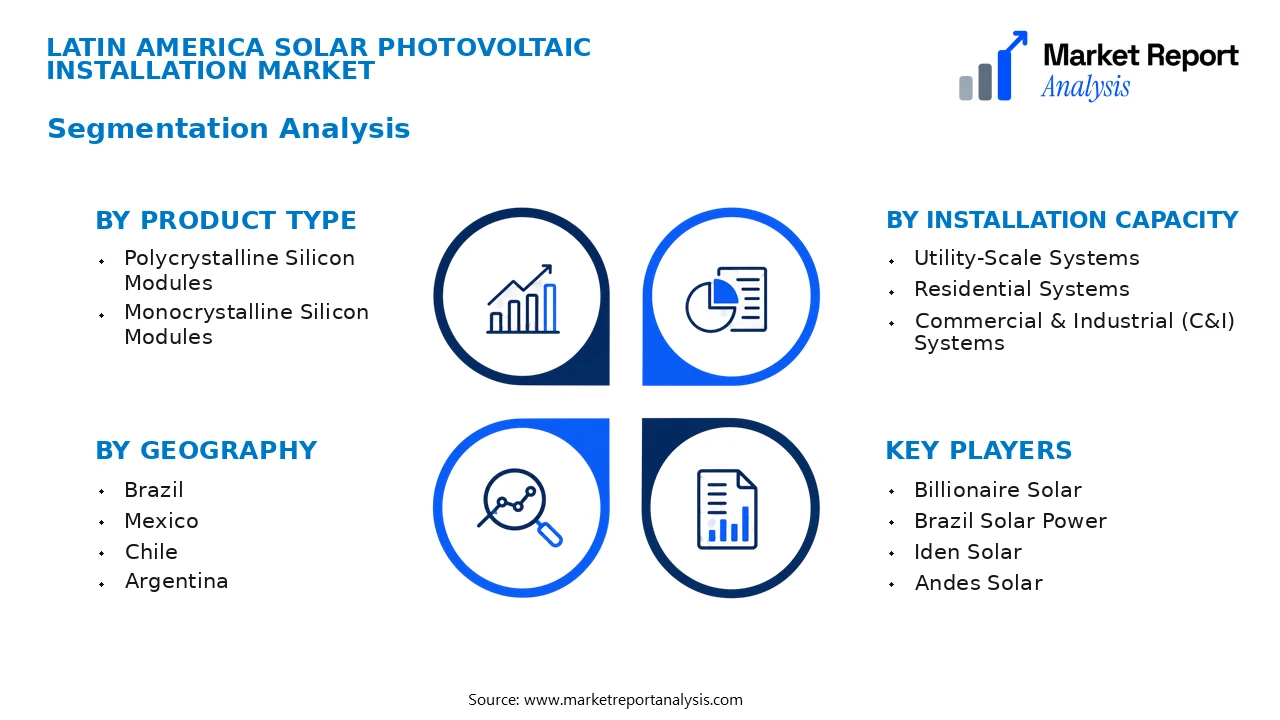
- Product Type
- Polycrystalline Silicon Modules: These modules are widely adopted due to their cost-effective production process and stable efficiency, making them the preferred choice for utility-scale and residential projects in Latin America.
- Monocrystalline Silicon Modules: Known for higher efficiencies and a sleek aesthetic, monocrystalline modules are increasingly used in high-performance applications, especially in regions with space constraints and high energy demands.
- Installation Capacity
- Utility-Scale Systems: These large-scale installations, typically exceeding 1 MW, are dominant in Latin America, driven by government incentives, large land areas, and the need for grid integration to supply energy to urban centers.
- Residential Systems: Smaller in scale, these systems serve individual households and contribute significantly to decentralized energy generation, supported by declining costs of PV modules and favorable financing options.
- Commercial & Industrial (C&I) Systems: Targeted towards corporate energy needs, C&I projects are growing rapidly as businesses seek to reduce operational costs and meet sustainability targets in regions with favorable sunlight exposure.
- Application
- Grid-Connected PV Systems: The majority of solar PV installations in Latin America are grid-connected, providing renewable electricity to national grids and reducing reliance on fossil fuels, especially in countries with established grid infrastructure.
- Off-Grid PV Systems: Primarily used in remote and rural areas lacking grid access, off-grid systems are crucial for increasing electrification rates and supporting sustainable development in underserved communities.
- Geography
- Brazil: As the largest economy in Latin America, Brazil dominates the solar PV market with extensive government initiatives, abundant sunlight, and growing investments in renewable energy infrastructure.
- Mexico: Characterized by a strategic geographic location and supportive regulatory environment, Mexico continues to scale up solar projects, especially in sunny regions like the Sonora desert.
- Chile: Known for its high solar insolation levels, particularly in the Atacama Desert, Chile has become a pivotal market for utility-scale projects and innovative solar technologies.
- Argentina: Despite economic fluctuations, Argentina maintains a resilient solar market driven by international investments and a focus on integrating renewable energy into its national grid.
Competitive Intelligence
The Latin America Solar Photovoltaic Installation Market is characterized by moderate competition with prominent regional players such as Enel, Borrego Solar, and AES Corporation, complemented by international giants like First Solar and SunPower. Market concentration remains relatively dispersed, fostering competitive innovation and strategic collaborations. Key business strategies include aggressive expansion into underserved markets, diversification of product portfolios with high-efficiency bifacial modules, and vertical integration to streamline supply chains. Companies actively pursue partnership models with local governments and utilities to secure long-term contracts, while acquisitions of regional firms facilitate market penetration and capacity enhancement. Expansion initiatives prioritize solar farms in emerging economies like Brazil and Mexico, aiming to leverage government incentives and increasing demand for clean energy. Significant R&D investments focus on improving photovoltaic module efficiency, reducing Levelized Cost of Electricity (LCOE), and developing bifacial and perovskite technologies to maintain a technological edge. Differentiation strategies are centered on offering customized solutions tailored to regional climatic conditions, thus positioning firms uniquely within the dynamic Latin American solar landscape.
Leading Company Profiles
The Latin America solar photovoltaic installation market is characterized by a diverse group of global and regional players, all of whom are innovating and expanding their portfolios to capitalize on regional growth opportunities. These companies leverage advanced technological capabilities and strategic alliances to strengthen their market positions across key Latin American countries.
- Billionaire Solar
- Brazil Solar Power
- Iden Solar
- Andes Solar
- Crescent Energy
Billionaire Solar
Billionaire Solar specializes in large-scale photovoltaic projects, utilizing cutting-edge thin-film and crystalline technology. The company focuses on sustainable development initiatives aligned with regional renewable targets, emphasizing efficient project execution and technological innovation.
Brazil Solar Power
Brazil Solar Power is a prominent regional leader providing integrated solar solutions, including project development and EPC services, with substantial investments in localized manufacturing, aiming at reducing costs and improving deployment speed across Brazil.
Accent Solar offers a broad portfolio of solar modules and balance-of-system components, backed by robust R&D capabilities, enabling tailored installations for commercial and utility-scale projects, with strategic focus on advancing technological efficiency.
Iden Solar
Iden Solar is distinguished by its innovative solar tracker systems and advanced energy storage integrations, boosting the efficiency of solar farms and enhancing grid stability in major Latin American markets.
Andes Solar
Andes Solar primarily develops large utility-scale solar parks, leveraging proprietary project planning software and deep regional expertise to optimize land use and energy outputs across rugged terrains.
Crescent Energy
Crescent Energy is actively expanding its manufacturing footprint in Latin America, focusing on cost-effective module production and supply chain improvements to support rapid project rollouts.
Equator Solar leverages digital twin technology and analytics to improve project design, monitoring, and maintenance, reinforcing its position as an innovator in smart solar solutions for diverse climates.
Monte Verde Renewables attains strategic growth through acquisitions of smaller regional developers, broadening its project pipeline and fostering local partnerships to accelerate market penetration.
Solaris Energia emphasizes vertically integrated solutions, from manufacturing to operation, focusing on delivering high-efficiency photovoltaic modules and comprehensive project management services.
Terra Solar Group invests heavily in R&D for next-generation photovoltaic materials while expanding its EPC services across Latin America, prioritizing sustainability and operational excellence.
Strategic Business Developments

- January 2026 – Billionaire Solar – Launched a new line of high-efficiency bifacial modules – Enhances product competitiveness and energy yield in regional deployments.
- March 2026 – Brazil Solar Power – Announced capacity expansion of its manufacturing plant – Aims to reduce supply chain constraints and lower costs for regional project development.
- April 2026 – Accent Solar – Formed a joint venture with a local logistics firm – Improves supply chain efficiency and project delivery timelines across Latin America.
- June 2026 – Iden Solar – Introduced a new solar tracker technology – Increases energy output and reduces levelized cost of electricity (LCOE) for utility-scale projects.
- August 2026 – Andes Solar – Acquired a regional land developer to secure land rights for upcoming projects – Ensures faster project execution and minimized regulatory delays.
Frequently Asked Questions
What is the Latin America Solar Photovoltaic Installation Market?
The Latin America Solar Photovoltaic Installation Market encompasses the deployment of solar PV systems across Latin American countries, driven by increasing renewable energy adoption, government incentives, and declining costs, aiming to meet sustainable power needs while reducing reliance on fossil fuels.
What is the current market size of Latin America Solar Photovoltaic Installation Market?
As of 2026, the market is valued at approximately USD 18 Billion, reflecting robust growth fueled by regional investments and policy support, with projections indicating continued expansion over the forecast period.
What factors are driving the Latin America Solar Photovoltaic Installation Market?
Market growth is primarily driven by declining solar panel costs, supportive government policies, increasing focus on sustainable energy, and the need to reduce power generation costs, especially in remote areas, making solar PV an economical and environmentally friendly choice.
Which region dominates the Latin America Solar Photovoltaic Installation Market?
Brazil currently leads the region due to its large-scale solar projects and favorable policy landscape, followed by Mexico and Chile, which are rapidly expanding their solar capacities in response to regional demand and sustainability commitments.
Which segment is expected to grow the fastest?
The utility-scale segment is forecasted to experience the highest growth rate, benefiting from large infrastructure projects and competitive pricing, making it the dominant segment in the regional market landscape.
Who are the leading companies operating in the Latin America Solar Photovoltaic Installation Market?
Key players include Enel Green Power, Acciona Energy, Atlas Renewable, and AES Corporation, which are actively implementing solar projects and expanding their regional presence to capitalize on market opportunities.
Analyst Perspective
The Latin America solar photovoltaic installation market is poised for sustained growth through 2034, driven by increasing regional energy demand and declining system costs. Long-term prospects remain favorable as governments and private sectors intensify renewable energy commitments, attracting investments in large-scale projects and decentralized systems alike. Opportunities are particularly pronounced in Brazil and Mexico, where robust solar resources and policy frameworks support expansion. Technological evolution is centered on advances in PV module efficiency, bifacial technology, and integrated energy storage, promising higher yields and grid stability. Investment priorities should focus on scalable utility-scale projects and supply chain resilience to mitigate geopolitical and economic risks. Competitive dynamics are intensifying with the entry of global OEMs and local developers partnering to capitalize on regional incentives. Regions with favorable regulatory environments and population growth will sustain the strongest growth trajectories, ensuring diversified regional contributions to market expansion and long-term industry stability.
