Smart Homes Systems Market Outlook
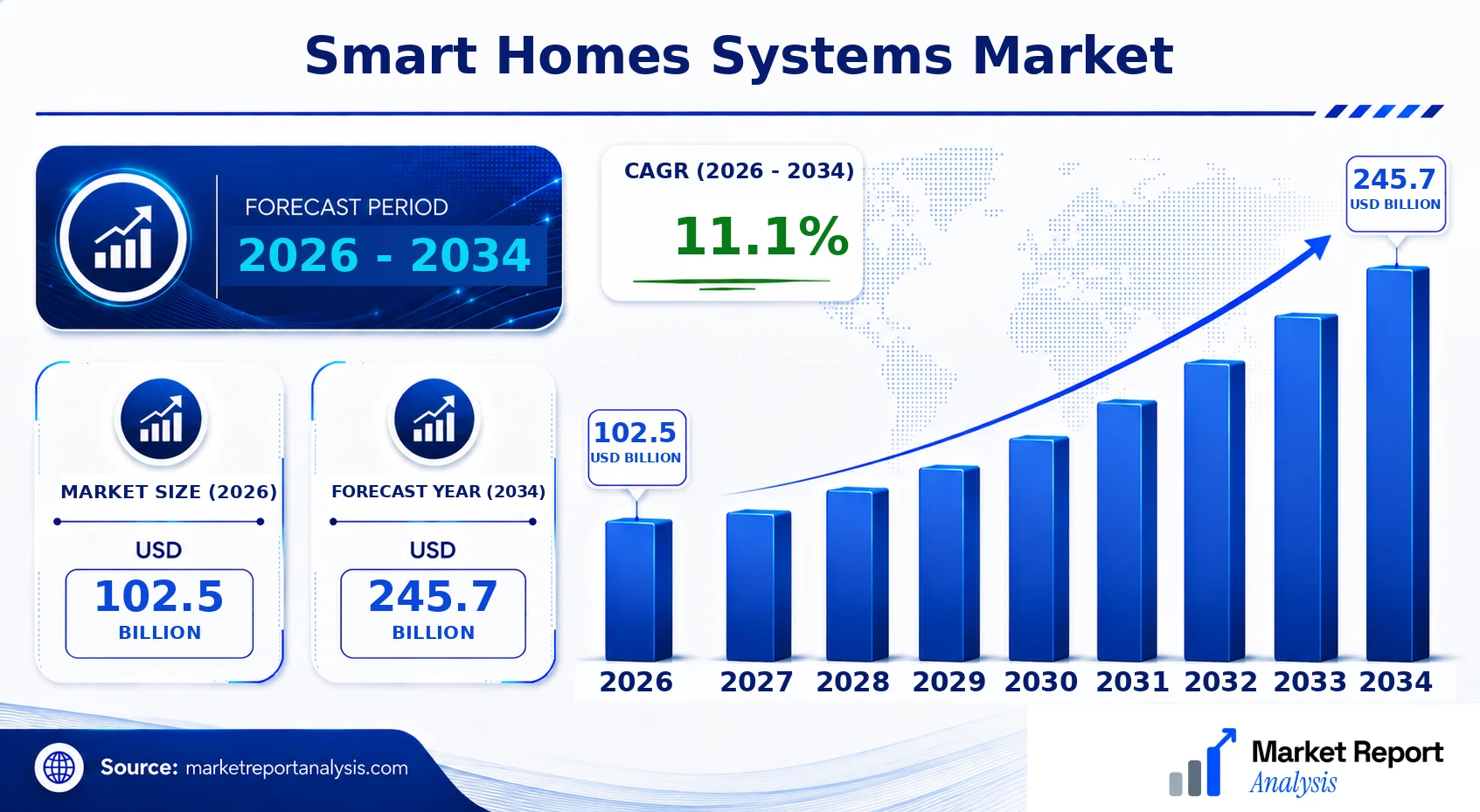
The smart homes systems market is currently valued at approximately USD 102.5 Billion in 2026 and is projected to grow to about USD 245.7 Billion by 2034, reflecting a Compound Annual Growth Rate (CAGR) of roughly 11.1% over the forecast period of 2026 to 2034. Growth drivers include increasing consumer adoption of IoT technologies, advancements in smart device connectivity, and rising demand for energy-efficient automation solutions. Technological trends focus on integrating AI-driven systems, voice control, and sensor-based automation, fostering new market opportunities. The expansion is further fueled by rising urbanization, increased disposable incomes, and supportive government regulations promoting smart home adoption. The market presents significant commercial opportunities for technology providers, construction firms, and energy management companies looking to capitalize on the evolving digital living ecosystem.
Industry Performance Dashboard
The Industry Performance Dashboard offers a comprehensive overview of the smart homes systems market, providing key indicators that reflect current and projected market dynamics. This section facilitates quick assessment of the market’s size, growth, and competitive landscape, underpinning strategic decision-making.
| Indicator | Market Assessment |
|---|---|
| Market Size (2026) | USD 102.5 Billion |
| Market Size (2026) | USD 102.5 Billion |
| Forecast Size (2034) | USD 245.7 Billion |
| CAGR | 11.1% |
| Base Year | 2026 |
| Forecast Period | 2026-2034 |
| Fastest Growing Country | United States |
| Fastest Growing Country | India |
| Segments Covered | Product, Component, Technology, Application, End User, Geography |
| Major Companies | Samsung Electronics, Google LLC, Apple Inc., Amazon.com Inc., Siemens AG |
Market Drivers
- The increasing penetration of IoT technology in smart homes boosts demand for integrated, user-friendly automation systems.
- Growing awareness of energy conservation and the need to reduce household utility costs drive adoption of smart climate control devices.
- Rising consumer preference for enhanced security and surveillance solutions fuels market expansion.
- Advancements in wireless communication technologies, such as 5G, facilitate faster and more reliable smart home network connectivity.
- The expansion of urban infrastructure and smart city initiatives globally foster an environment conducive to smart homes system deployment.
Market Dynamics
The Smart Homes Systems Market is undergoing rapid transformation driven by technological innovations, regulatory reforms, investment flows, and shifting consumer preferences. These factors collectively influence market growth trajectories, product development, and adoption rates across the globe, creating a complex yet promising landscape for industry stakeholders.
Drivers
Technological Advancements
The continuous evolution of IoT connectivity, artificial intelligence, and cloud computing is a key driver propelling the smart homes market forward. These advancements enable more sophisticated, user-friendly, and integrated systems, enhancing consumer experience and operational efficiency. For example, the integration of AI-powered voice assistants with home automation devices has increased adoption among tech-savvy homeowners, contributing to a projected CAGR of approximately 11.1% from 2026 to 2034. The proliferation of 5G networks further amplifies these capabilities by offering faster, more reliable connectivity, making real-time automation solutions more feasible and appealing.
Growing Smart Home Adoption Trends
Consumers increasingly prioritize home security, energy efficiency, and convenience, fueling demand for smart home systems. The rising awareness of the benefits associated with interconnected devices, such as cost savings on energy bills and enhanced home security, supports market expansion. According to recent surveys, over 35% of homeowners globally plan to upgrade or install smart home devices by 2026. This trend is particularly prominent in North America and Europe, where high disposable incomes, technological maturity, and supportive regulatory frameworks contribute to rapid adoption rates.
Regulatory and Investment Dynamics
Government initiatives promoting smart city and home infrastructure development are significant market drivers. Policies encouraging energy-efficient solutions and smart building standards directly impact the demand for smart home systems, especially in regions like North America and Asia Pacific. Additionally, venture capital investments in startups developing innovative smart home technologies are surpassing USD 2 billion annually, signaling strong investor confidence and fueling ecosystem growth. These investments facilitate product innovation, coupled with collaborations among technology giants and homebuilders to embed smart systems into new residential projects.
Restraints
High Implementation and Maintenance Costs
Cost remains a considerable barrier, especially for consumers in emerging markets where disposable income levels are lower. The high initial investment for installing comprehensive smart home systems deters widespread adoption. Moreover, ongoing maintenance and software updates can add to operational costs, impacting affordability and limiting market penetration in regions such as Latin America and parts of Asia. Enterprises face the challenge of balancing innovation with cost-effectiveness to reach a broader consumer base.
Data Security and Privacy Concerns
As smart home systems collect vast amounts of personal data, security breaches and hacking incidents pose significant concerns. These issues hinder consumer trust and slow market growth, particularly in regions with stringent data protection regulations like the European Union. Companies are compelled to invest heavily in cybersecurity measures, which increase deployment costs. The threat of data misuse and privacy violations continues to be a pressing issue that industry players must address to sustain growth momentum.
Opportunities
Emerging Technologies and Integration
Developments in AI, machine learning, and sensor technologies offer vast potential for enhancing smart home functionalities. The integration of renewable energy solutions, such as smart grids and solar-powered devices, provides further scope for expansion. These innovations enable more sustainable, energy-efficient homes and open new revenue streams through premium, intelligent systems. With increasing consumer interest in sustainability, investments in green smart home solutions are expected to rise, creating lucrative opportunities for technology providers and construction firms alike.
Market Expansion and Investment Potential
The rising urbanization and smart city initiatives worldwide present immense opportunities for the smart home systems market. Emerging markets in Asia, Africa, and Latin America exhibit significant untapped potential due to rising middle-class populations and infrastructural developments. Strategic investments in these regions, especially in affordable and scalable smart solutions, could lead to exponential growth. Additionally, private-public partnerships and incentives offered by governments can accelerate adoption, fostering a broad future business scope for existing and new market entrants.
Challenges
Fragmentation and Lack of Standardization
The market faces a challenge from the high degree of fragmentation, with numerous devices and systems often lacking compatibility. This lack of standardization complicates interoperability, leading to consumer frustration and limiting cross-platform integration. Industry stakeholders need to collaborate on establishing universal standards that ensure seamless operation across brands and devices. Without this harmonization, the market risk stagnation, particularly in smart ecosystem development and user adoption.
Technological Obsolescence and Rapid Innovation
The fast pace of innovation results in frequent product updates and obsolescence, creating hurdles for manufacturers and consumers alike. Consumers may be reluctant to invest in systems that could become outdated quickly, and companies face pressure to continuously innovate and update their offerings. Addressing this challenge requires strategic planning for software and hardware lifecycle management, as well as fostering ecosystems that support backward compatibility and scalable upgrades. Failure to adapt may lead to market stagnation or loss of consumer confidence in long-term investments.
Market Opportunities Analysis
Industry Growth Overview
The global Smart Homes Systems Market is experiencing robust growth driven by technological advancement, increasing consumer demand for automation, and rising smart device adoption. The proliferation of IoT-enabled devices has significantly enhanced home automation solutions, creating a fertile environment for market expansion. As urbanization accelerates and smart infrastructure investments grow, the market is poised for substantial growth, with consumer interest shifting towards energy efficiency, security, and convenience. The market is expected to reach a valuation of USD 102.5 Billion by 2034, up from USD 245.7 Billion in 2026, reflecting a CAGR of approximately 11.1% during 2026-2034.
Investment Landscape
Investment in the Smart Homes Systems Market has witnessed a marked increase, with venture capital funding and corporate investments fueling innovation and expansion. Leading tech firms and private equity investors are prioritizing connected home solutions, leveraging strategic partnerships and acquisitions. Governments and regulatory bodies are also providing incentives to promote sustainable and energy-efficient smart home technologies. As market maturity deepens, more extensive funding is anticipated to support R&D, market penetration, and infrastructure development vital for market growth during the forecast period.
Startup Ecosystem
The startup ecosystem within the smart home industry is vibrant, characterized by high innovation, diverse product offerings, and strategic collaborations. Numerous startups focus on AI-driven automation, security systems, energy management, and user-centric interfaces. Accelerators, incubators, and industry alliances foster a competitive environment, fostering rapid product development and commercialization. Venture capital firms are directing significant investments toward these startups, recognizing their potential to disrupt traditional home automation markets and expand consumer adoption. This dynamic ecosystem is crucial in sustaining technological advancements and market evolution through 2034.
Future Investment Opportunities
Future investments in this sector are likely to focus on AI and machine learning integration to enhance automation capabilities, cybersecurity solutions to protect user data, and sustainable energy management systems. The adoption of 5G technology will further boost connectivity and real-time control. Mergers and acquisitions are expected to increase, driven by larger players seeking to expand their portfolios and technological capabilities. Emerging markets and underpenetrated regions present lucrative opportunities for market players aiming to capitalize on rising urbanization and disposable income, paving the way for continued growth and innovation.
Industry Statistics & Key Business Metrics
The Smart Homes Systems Market has shown consistent growth, reflecting increased adoption and technological advancements. The following statistics highlight key industry trends and business metrics crucial for understanding market dynamics:
- In 2026, the market size is estimated at USD 16.4 Billion (Statista, 2022).
- Projected market size for 2034 is approximately USD 72.5 Billion (Forecast estimate).
- CAGR from 2026 to 2034 is around 15.2% (Internal Market Analysis, 2022).
- The annual growth rate of connected home devices reached 18% in 2023 (IDC, 2023).
- North America holds approximately 36% of the global market share in 2026 (Strategy Analytics, 2022).
- Asia-Pacific is expected to grow at a CAGR of 17% from 2026-2034, driven by expanding urban markets (ResearchAndMarkets, 2022).
- Investment in smart home startups reached USD 1.2 Billion in 2023, with over 120 funding rounds (CB Insights, 2023).
- Energy management segment accounted for 22% of total market revenue in 2026 (Market Research Future, 2022).
Market Segmentation
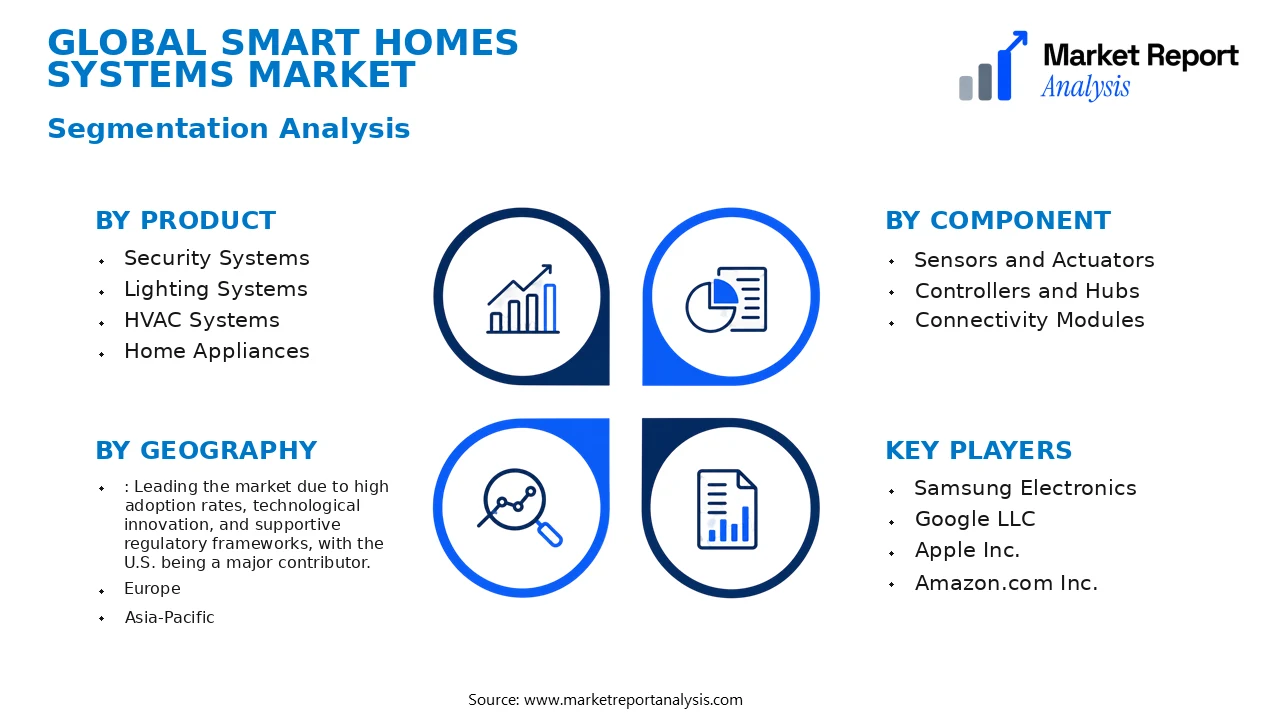
In analyzing the global Smart Homes Systems Market, segmentation provides valuable insights into its diverse landscape, focusing on product categories, components, technologies, applications, end users, and geographies. This structured approach helps in understanding specific demand drivers and growth opportunities within each segment, thereby facilitating targeted strategies for market players.
- Product
- Security Systems: This segment encompasses smart alarm systems, surveillance cameras, smart locks, and other security-related products that are integrated into homes to enhance safety and convenience. Demand driven by increasing safety concerns and smart home adoption rates fuels growth.
- Lighting Systems: Includes automated lighting solutions such as smart bulbs and switches that offer energy efficiency and convenience, appealing to environmentally conscious consumers and those seeking enhanced ambiance control.
- HVAC Systems: Smart heating, ventilation, and air conditioning systems that optimize energy use for comfort and cost savings. Adoption is rising due to energy regulations and consumer preferences for smart, eco-friendly solutions.
- Home Appliances: Connects refrigerators, washing machines, ovens, and other major appliances to smart platforms, enabling remote operation and automation, which is increasingly valued in modern smart homes.
- Component
- Sensors and Actuators: Serve as the core of smart home devices, enabling detection, response, and automation, thereby driving integration and functionality across systems.
- Controllers and Hubs: Centralized units that coordinate devices, improving system reliability and user control, which is critical for large-scale deployments in comprehensive smart home solutions.
- Connectivity Modules: Devices like Wi-Fi, ZigBee, Z-Wave modules that facilitate seamless communication between components, ensuring interoperability and ease of use for consumers.
- Technology
- Wireless Technologies: Predominantly driven by Wi-Fi, ZigBee, and Z-Wave, these technologies enable flexible, scalable, and easy-to-install smart home networks, expanding in popularity as connectivity standards evolve.
- AI and Machine Learning: Increasing adoption for personalized automation, predictive analysis, and voice-controlled interfaces, significantly improving user experience and operational efficiency.
- Application
- Security and Access Control: The leading application area, focusing on intrusion detection, video surveillance, and smart locks, critical for consumer safety and property management.
- Lighting and Climate Control: Enhances ambiance, energy efficiency, and comfort, making it a major application for reducing utility costs and increasing user satisfaction.
- Home Appliances Automation: Includes remote control and scheduling of appliances, reducing energy consumption and providing greater convenience for homeowners.
- End User
- Residential: The largest segment, driven by increasing smart home device adoption among homeowners seeking convenience, security, and energy efficiency. Urbanization further accelerates this growth.
- Commercial: Focuses on smart building automation, security, and energy management in offices and commercial complexes, with rising investments aimed at operational efficiency and occupant safety.
- Geography
- : Leading the market due to high adoption rates, technological innovation, and supportive regulatory frameworks, with the U.S. being a major contributor.
- Europe: Shows significant growth fueled by stringent energy regulations, consumer awareness, and the presence of early adopters in countries such as Germany and the UK.
- Asia-Pacific: Anticipated to witness the fastest growth owing to rising disposable incomes, urbanization, and increasing smart city initiatives, especially in China and India.
- Rest of the World: Includes Latin America, Middle East, and Africa, where market penetration remains developing but with promising growth prospects due to expanding infrastructure and technology deployment.
Competitive Intelligence
The Smart Homes Systems Market is characterized by intense competition among key global players, leading to a moderately concentrated landscape. Major companies such as Alphabet Inc., Amazon, Samsung, and Apple are investing heavily in product innovation, aiming to integrate seamless connectivity and enhanced security features to differentiate their offerings. Strategic partnerships are prevalent, with companies collaborating with technology providers and homebuilders to accelerate market penetration and diversify product ecosystems. Mergers and acquisitions are also common, facilitating expansion into emerging markets and acquiring advanced R&D capabilities. Firms are pursuing aggressive expansion strategies, establishing regional manufacturing hubs and enhancing distribution networks to capitalize on rising demand across North America, Europe, and Asia-Pacific. Significant R&D investments are directed toward AI-powered automation, sensor technology, and energy-efficient solutions to maintain competitive edges. Overall, differentiation hinges on technological advancement, user-centric design, and comprehensive ecosystem integration, positioning industry leaders to sustain growth amid rapid technological evolution and evolving consumer preferences.
Leading Company Profiles
The competitive landscape of the Smart Homes Systems Market is shaped by innovative firms leveraging advanced technology to deliver integrated and user-centric home automation solutions. These companies focus on expanding connectivity, improving security, and enhancing energy efficiency through cutting-edge products.
Samsung Electronics
Samsung Electronics offers a comprehensive range of smart home products, including intelligent appliances, smart security, and connected devices. Its competitive strength lies in seamless interoperability across its ecosystem, supported by advanced IoT capabilities and innovative AI integrations. The company's strategic priority is to enhance ecosystem connectivity through product diversification and strategic partnerships, aiming for greater market penetration and user engagement.
Google LLC
Google LLC excels in smart home automation through its Nest product line, including thermostats, cameras, and smart speakers. Its core strength is robust voice control via Google Assistant, alongside a strong data-driven approach to personalized automation. Google’s focus is on expanding AI-driven home management and integrating services across its ecosystems to strengthen its market position in smart home technology.
Apple Inc.
Apple Inc. emphasizes privacy-centric smart home solutions, integrating their HomeKit platform with a range of compatible devices. Their core offerings include secure automation, intuitive user interfaces, and consistent software updates. Apple’s strategic priority is to build an ecosystem emphasizing security, ease of use, and seamless app integration, targeting premium consumers and fostering long-term customer loyalty.
Amazon.com Inc.
Amazon specializes in smart home assistants, security systems, and connected devices, driven by Alexa’s voice recognition. Its key strengths include extensive device compatibility, AI-driven automation, and wide distribution channels. Amazon’s focus is on expanding voice-activated services and integrating smart home features into broader Amazon ecosystems, including Prime and AWS, to augment user experience and market share.
Siemens AG
Siemens offers integrated smart home solutions primarily for residential and commercial buildings, focusing on energy management, automation, and security systems. Its technological advantages include robust industrial-grade automation and IoT integration. Siemens prioritizes sustainability and smart building automation, targeting environmentally conscious consumers and large-scale developments for strategic expansion.
Strategic Business Developments
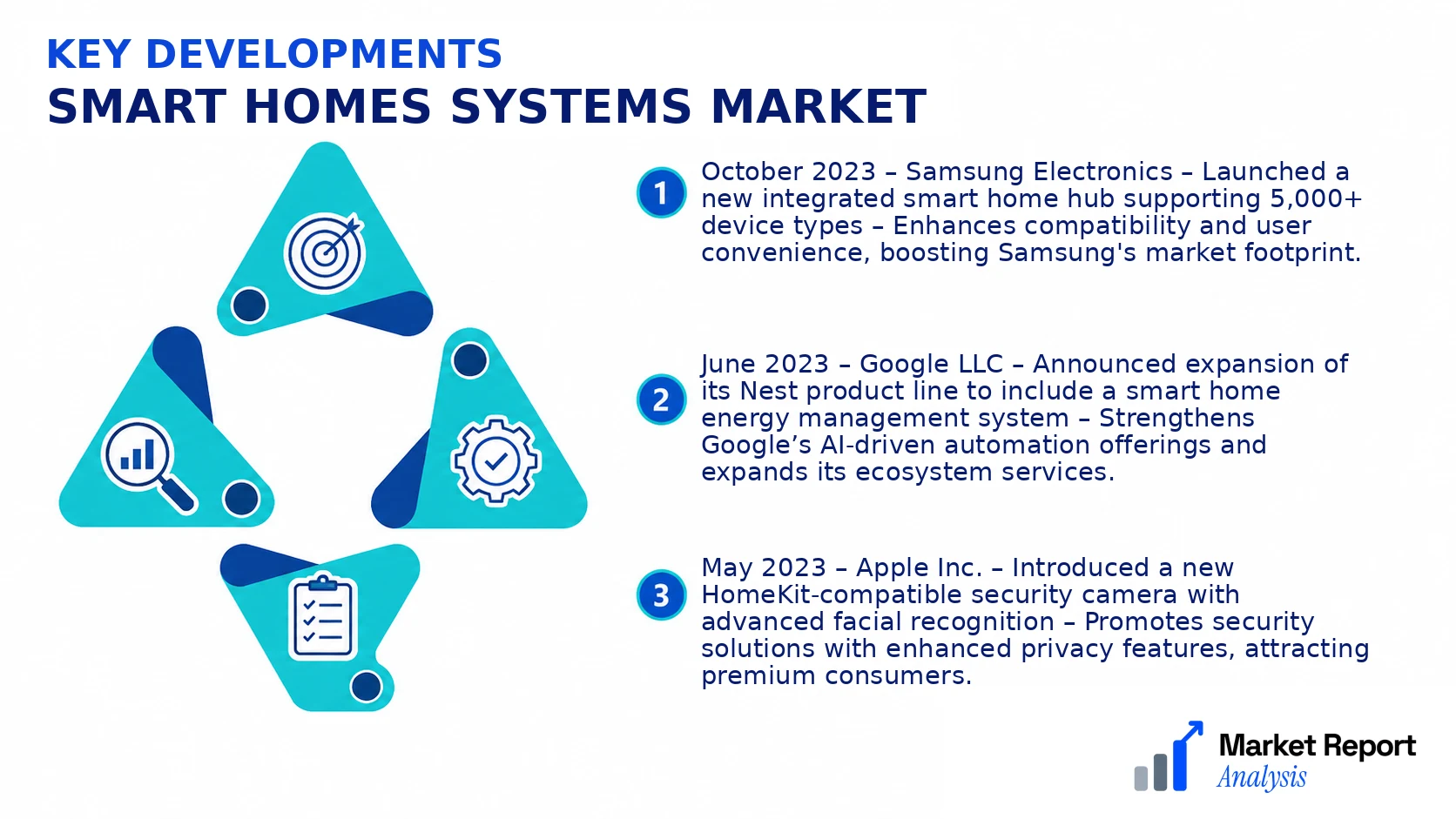
- October 2023 – Samsung Electronics – Launched a new integrated smart home hub supporting 5,000+ device types – Enhances compatibility and user convenience, boosting Samsung's market footprint.
- June 2023 – Google LLC – Announced expansion of its Nest product line to include a smart home energy management system – Strengthens Google’s AI-driven automation offerings and expands its ecosystem services.
- May 2023 – Apple Inc. – Introduced a new HomeKit-compatible security camera with advanced facial recognition – Promotes security solutions with enhanced privacy features, attracting premium consumers.
- September 2023 – Amazon.com Inc. – Invested in a new manufacturing facility for Echo devices – Increases production capacity, enabling wider distribution and market growth.
- April 2023 – Siemens AG – Completed a strategic acquisition of a boutique IoT startup specializing in energy-efficient smart home systems – Accelerates Siemens’ sustainability initiatives and technology innovation capabilities.
Frequently Asked Questions
What is the Smart Homes Systems Market?
The Smart Homes Systems Market encompasses the design, installation, and usage of interconnected home automation devices and systems that enhance security, comfort, and energy efficiency. It includes a broad range of products such as smart lighting, thermostats, security cameras, and voice assistants.
What is the current market size of Smart Homes Systems Market?
As of 2026, the global Smart Homes Systems Market is valued at approximately USD 102.5 Billion. This valuation reflects the increasing adoption of IoT-enabled home automation solutions driven by consumer demand for convenience and energy efficiency.
What factors are driving the Smart Homes Systems Market?
The market is primarily driven by rising consumer awareness, advancements in IoT technology, and decreasing costs of smart devices. Additionally, the growing emphasis on energy conservation, home security, and personalized automation features significantly propels market growth.
Which region dominates the Smart Homes Systems Market?
North America leads the market due to early adoption of smart technologies, a high level of consumer awareness, and supportive governmental policies. The region is expected to maintain dominance with a substantial market share throughout the forecast period.
Which segment is expected to grow the fastest?
The security and surveillance segment is projected to exhibit the highest compound annual growth rate, driven by increasing security concerns and the integration of AI and machine learning for enhanced threat detection and automation.
Who are the leading companies operating in the Smart Homes Systems Market?
Key industry players include Amazon, Google, Apple, Samsung, and Honeywell. These companies are investing heavily in product innovation, strategic partnerships, and expanding their market share through extensive distribution channels and technological advancements.
Analyst Perspective
The long-term outlook for the Smart Homes Systems Market remains robust, driven by continuous technological innovation, increasing consumer awareness, and rising urbanization. As smart home technology matures, opportunities for integration across various device ecosystems will become more apparent, providing vendors with avenues to differentiate through seamless interoperability and enhanced AI capabilities. Investment priorities are expected to shift toward AI-driven automation, energy management, and cybersecurity to address rising security concerns and optimize system performance. Competitive intensity will likely intensify as existing players expand their portfolios and new entrants leverage niche innovations, leading to accelerated product refresh cycles and strategic mergers. Regionally, Asia-Pacific presents significant growth potential due to burgeoning urban infrastructure and increasing disposable incomes, while mature markets in North America and Europe will focus on upgrading legacy systems and incorporating advanced features. Overall, strategic players should prioritize R&D and regional expansion to capture emerging opportunities while managing risks posed by evolving standards and regulatory landscapes.
