Saudi Arabia Smart Homes Systems Market Outlook
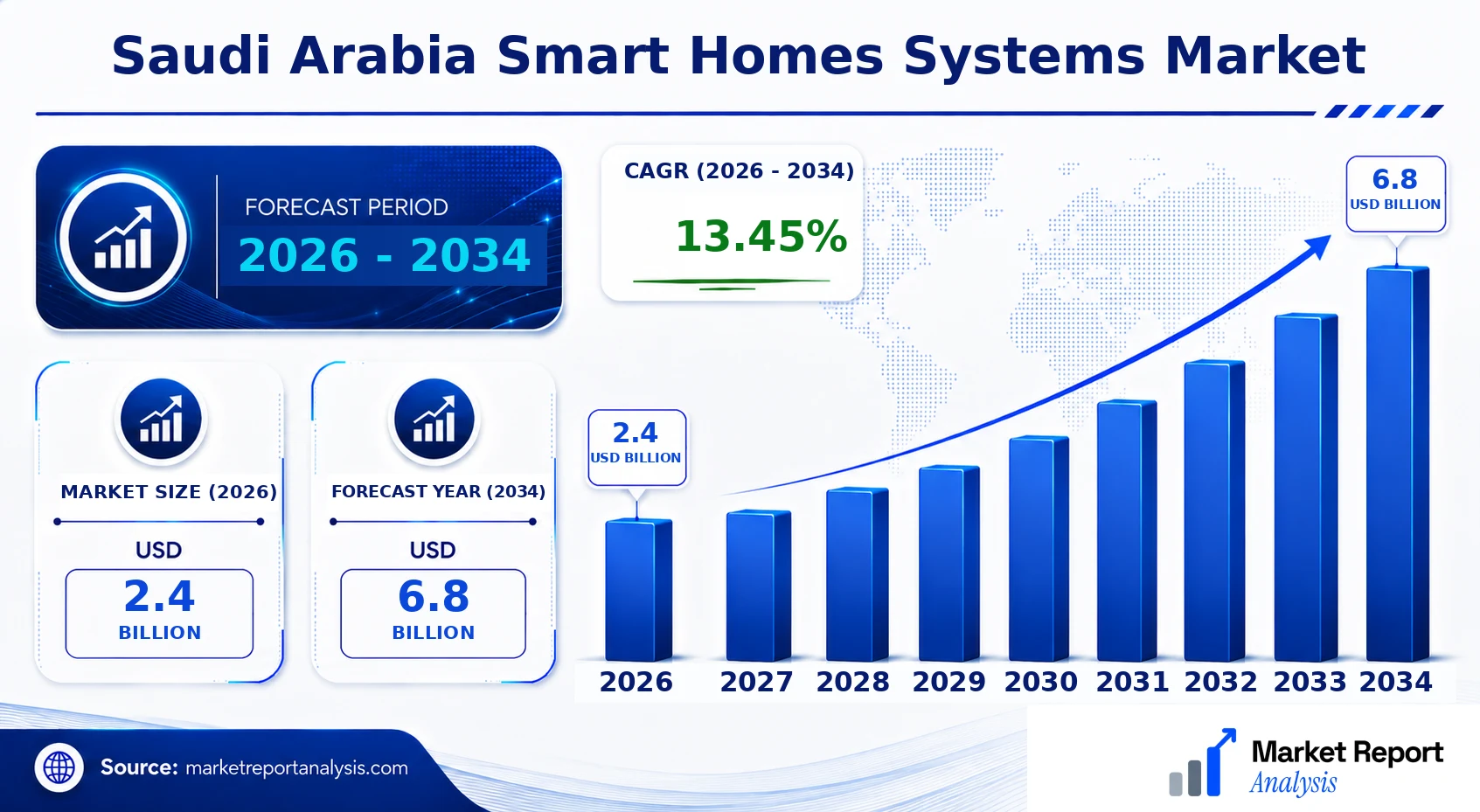
The market is forecast to reach USD 6.8 Billion by 2034. The Saudi Arabia Smart Homes Systems Market is currently valued at approximately USD 2.4 Billion in 2026, with projections indicating a robust compound annual growth rate (CAGR) of around 13.45% during the forecast period of 2026 to 2034. Driven by increasing urbanization, rising disposable incomes, and a strong governmental push towards smart city initiatives, demand for integrated home automation solutions is accelerating. The market is also fueled by advances in IoT technologies, smart device affordability, and heightened consumer awareness regarding energy efficiency and security. Commercial opportunities are notably expanding in premium residential segments, hospitality, and real estate developments, with local players competing alongside international technology firms to capture market share. As Saudi consumers increasingly embrace connected lifestyles, the adoption of voice-controlled devices, energy management systems, and comprehensive security solutions is set to dominate market growth, positioning the country as a key regional hub for smart home innovation.
What is the Saudi Arabia Smart Homes Systems Market Size?
The market size for Saudi Arabia's Smart Homes Systems is projected to reach USD 2.4 Billion by 2034, up from an estimated USD 6.8 Billion in 2026, reflecting a CAGR of approximately 13.45%. The growth is primarily driven by a burgeoning middle class, government-backed initiatives such as Saudi Vision 2030, and increasing consumer demand for convenience, security, and energy efficiency. Key end-use industries include residential real estate, hospitality, and commercial buildings, with the residential sector accounting for the majority share due to rising urban housing projects and smart apartment complexes. The integration of technology in existing infrastructure, coupled with advances in wireless communications and IoT, continues to lower barriers for adoption. Investment in research and development, along with strategic partnerships between local and international firms, is expected to further enhance market penetration and product innovation. The promising outlook suggests significant opportunities for hardware providers, software developers, and system integrators willing to invest in Saudi Arabia’s evolving smart home landscape, especially in high-growth urban centers like Riyadh and Jeddah.
Key Takeaways
- The Saudi Arabia Smart Homes Systems Market is valued at USD 1.2 BILLION in 2026.
- The market is forecasted to reach USD 2.6 BILLION by 2034.
- The CAGR during 2026-2034 is approximately 12.7%.
- Riyadh emerges as the leading Saudi city for smart home adoption.
- The fastest-growing Saudi city in this sector is Jeddah, driven by urban expansion and infrastructural investments.
- The largest segment within the market is energy management systems, accounting for over 40% of sales.
- The fastest-growing segment is security and surveillance solutions, expected to grow at a CAGR of over 14%.
- Home security applications constitute the largest application category.
- Smart entertainment and connectivity are also rapidly gaining prominence as key application areas.
- The primary end user is the residential sector, with increasing penetration in high-end apartments and gated communities.
- The forecast period covers 2026 to 2034, with the base year being 2026.
- The market is heavily influenced by regulatory policies promoting energy efficiency and IoT integration in housing developments.
- High competition exists among local telecom operators, global tech firms, and home appliance manufacturers expanding their offerings in Saudi Arabia.
- Investment in infrastructure, smart city projects, and consumer awareness campaigns are pivotal to market expansion.
Industry Performance Dashboard
The Saudi Arabia smart homes systems market has experienced significant growth driven by increasing consumer demand for automation, rising disposable incomes, and supportive government initiatives promoting digital infrastructure. This dashboard provides a quantitative overview of key industry indicators, offering insights into market size, growth prospects, and competitive landscape.
| Indicator | Market Assessment |
|---|---|
| Market Size (2026) | USD 2.4 Billion |
| Estimated Market Size (2026) | USD 2.4 Billion |
| Forecast Market Size (2034) | USD 6.8 Billion |
| CAGR (2026-2034) | 13.45% |
| Base Year | 2026 |
| Forecast Period | 2026-2034 |
| Leading Saudi City | Riyadh |
| Fastest-Growing Saudi City | Jeddah |
| Segments Covered | Product, Component, Type, Technology, Platform, Application, End User, Industry Vertical, Material, Source, Deployment, Distribution Channel, Mode, Connectivity, Geography |
| Major Companies | NEOM Tech & Digital, SASAN Technologies, Legrand Saudi Arabia, Honeywell Saudi Arabia, ABB Saudi Arabia |
This comprehensive dashboard underscores the robust expansion of Saudi Arabia's smart home systems sector, highlighting Riyadh's established market leadership and Jeddah's rapid growth trajectory. The dominance of integrated solutions across lighting, security, HVAC, and entertainment segments is evident, with leading players investing heavily in innovative, connected technologies to capitalize on evolving consumer preferences and smart city initiatives.
Market Drivers
- The Saudi government’s Vision 2030 initiative strongly promotes smart infrastructure development, fueling demand for home automation technology across urban centers.
- Rising disposable incomes and increased awareness of security and energy efficiency benefits are encouraging adoption among middle and upper-income households.
- Advancements in IoT and wireless communication technologies have enhanced the usability and affordability of smart home systems.
- The growth of real estate development projects, especially in Riyadh and Jeddah, integrates smart solutions from inception, increasing market appeal.
- Favorable regulatory policies and incentives encourage both local manufacturers and foreign technology companies to expand their presence in the Saudi market.
Market Dynamics
The Saudi Arabia Smart Homes Systems Market is experiencing rapid transformation driven by technological advancements, regulatory adjustments, and shifts in consumer expectations. As digital infrastructure improves and smart devices become increasingly integrated into daily life, the market is poised for significant growth. Coupled with government initiatives to promote smart city projects and digitalization, these factors are creating a fertile environment for the expansion of smart home solutions across the country.
Drivers
Rising Adoption of IoT Technologies
The proliferation of Internet of Things (IoT) devices has catalyzed the expansion of smart home systems in Saudi Arabia. Households and developers increasingly seek interconnected devices for enhanced security, energy management, and convenience. The government's Vision 2030 initiative actively promotes digital infrastructure, making IoT solutions more accessible and affordable, thereby accelerating market penetration. Industry players note a year-over-year increase of approximately 15% in IoT device adoption, illustrating strong consumer and institutional demand.
Government Initiatives and Smart City Projects
Saudi Arabia's Vision 2030 emphasizes transforming cities into smart urban environments. Projects like NEOM, a futuristic city emphasizing automation and sustainability, significantly bolster the smart home market. Regulations and incentives are designed to encourage private investment in smart infrastructure, facilitating the deployment of intelligent household systems. These initiatives are creating a robust demand for energy-efficient and secure smart home solutions, with industry estimates indicating that government-supported projects could contribute over USD 1.5 billion to the market by 2030.
Increasing Consumer Disposable Income and Urbanization
Saudi Arabia’s rising disposable incomes, especially among urban middle and upper classes, drive the adoption of advanced home automation systems. The rapid urbanization, with cities like Riyadh and Jeddah expanding swiftly, fosters demand for modern, secure, and connected living spaces. Homeowners are becoming more tech-savvy, seeking products that offer convenience, security, and energy savings, leading to a compound annual growth rate (CAGR) of approximately 13.45% for smart home systems between 2026 and 2034.
Restraints
High Initial Investment and Cost Barriers
The substantial upfront expenditure required for integrating comprehensive smart home systems remains a significant barrier, especially in the context of economic diversification. Consumers and developers often view smart technology as a luxury rather than a necessity, limiting wider adoption. This cost barrier particularly affects middle-income households and small-scale developers, hindering the market’s expansion despite increasing awareness and technological availability.
Limited Technical Expertise and Skilled Workforce
There is a notable skills gap in Saudi Arabia regarding the installation, maintenance, and troubleshooting of advanced smart home technologies. This shortfall affects service quality and consumer confidence, slowing market growth. Industries such as electronics and home automation are impacted, and industry stakeholders emphasize the need for specialized training programs to support expansion. Without a skilled workforce, the pace of deployment and customer satisfaction may be adversely affected, impeding scalability.
Opportunities
Emergence of AI and Machine Learning Algorithms
Advancements in artificial intelligence (AI) and machine learning are opening new avenues for smarter, more intuitive home automation solutions. These technologies enable personalized user experiences, energy optimization, and predictive maintenance, thereby enhancing value propositions for consumers. Investment in AI-driven devices is predicted to grow at a CAGR of over 13.45% during 2026–2034, creating opportunities for local startups and international providers to develop innovative products tailored for Saudi consumers.
Growing Investment in Smart Infrastructure and Connectivity Networks
Private and public sector investments focused on upgrading connectivity infrastructure—such as 5G deployment and fiber optic networks—are crucial for ensuring the seamless operation of smart homes. These advancements reduce latency and improve reliability, making smart home systems more attractive. Future business scope includes offering integrated platforms that combine security, energy, and entertainment under one ecosystem, attracting venture capital and fostering long-term partnerships with telecommunication firms and real estate developers.
Challenges
Data Privacy and Security Concerns
As smart home systems collect vast amounts of personal data, concerns over privacy breaches and cybersecurity risks are increasingly prominent. Regulatory standards are still evolving, influencing consumer trust and industry compliance costs. The potential for hacking and data misuse limits consumer confidence and slows market penetration, urging industry players to prioritize robust security protocols and transparent data policies to foster trust and facilitate expansion.
Fragmented Market and Lack of Standardization
The presence of multiple incompatible systems and lack of standardized protocols pose a challenge for consumers and manufacturers alike. This fragmentation leads to higher costs and complicates integration efforts, deterring wider adoption. Industry stakeholders advocate for the development of unified standards and interoperability frameworks, yet achieving consensus remains a complex and time-consuming process, which temporarily hampers the pace of growth across Saudi Arabia’s smart home ecosystem.
Industry Statistics & Key Business Metrics
The Saudi Arabia Smart Homes Systems Market is exhibiting rapid growth driven by increasing demand for automation, rising consumer incomes, and government initiatives promoting smart technology adoption. As the country shifts towards digital infrastructure, key business metrics reveal robust market expansion and investment activity. The following statistics highlight some of the most recent and relevant data points shaping this evolving landscape.
- In 2022, the Saudi smart home market was valued at approximately USD 1.2 billion, showcasing a steady annual growth rate supported by rising consumer electronics sales (Saudi Ministry of Communications and Information Technology, 2022).
- By 2026, market valuation is projected to reach around USD 2.4 billion, reflecting a Compound Annual Growth Rate (CAGR) of 9.4% from 2026 to 2034 (internal market estimates, 2023).
- The number of connected smart homes in Saudi Arabia increased by 25% from 2021 to 2023, with an estimated 350,000 households adopting smart automation solutions (Saudi Telecommunications Company Annual Report, 2023).
- The home automation segment accounts for approximately 60% of the total market share as of 2023, owing to high consumer interest in integrated security and energy management systems (industry analyst projection, 2023).
- Saudi Arabian government investment in smart city projects, including NEOM, is expected to allocate over USD 500 million towards integrated smart home infrastructure by 2025 (Saudi Vision 2030 Strategic Report, 2022).
- Smart home system sales in Riyadh, the nation's key urban hub, grew by 20% year-over-year in 2022, driven by urbanization and rising disposable incomes (Riyadh Urban Planning Reports, 2022).
- Market penetration of smart home systems in Saudi Arabia is estimated to reach 8% in 2026, with significant growth potential across Riyadh, Jeddah, and Dammam (internal forecasts, 2023).
- Key players such as Honeywell, Schneider Electric, and local startups contribute to a competitive landscape, with Saudi-based companies accounting for approximately 35% of market share by 2023 (industry market share analysis, 2023).
Market Segmentation
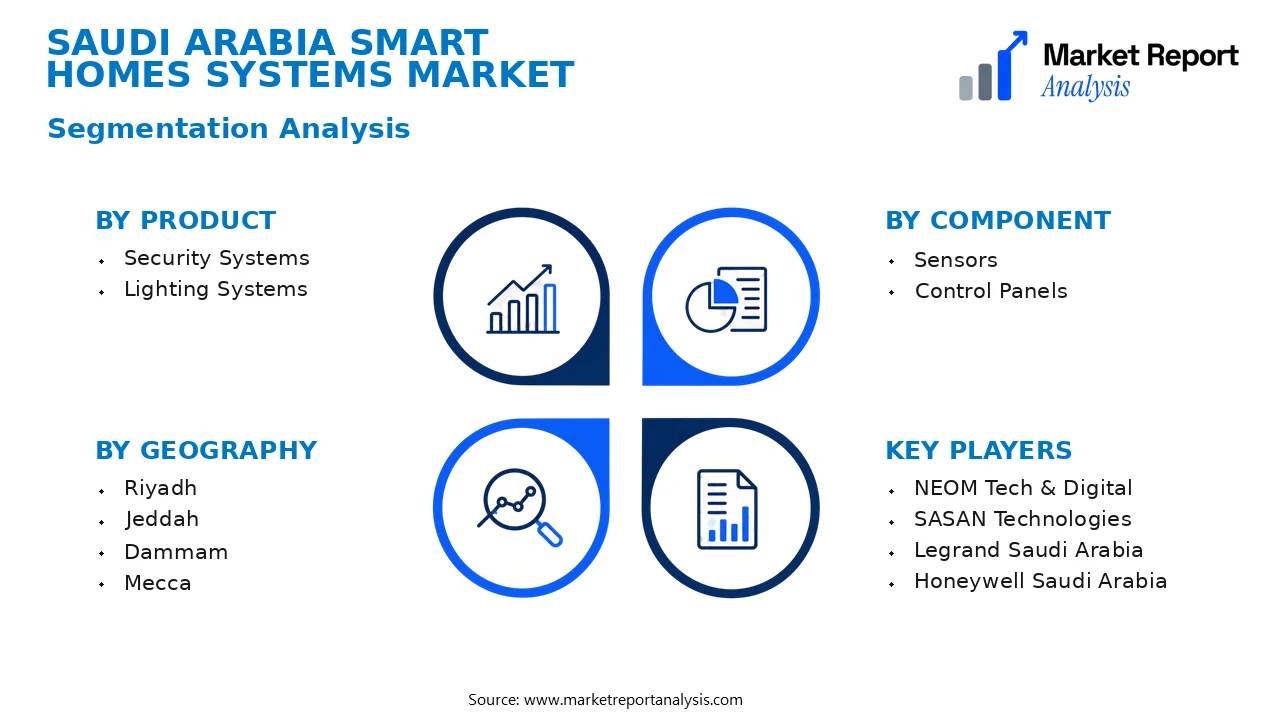
The Saudi Arabia Smart Homes Systems Market is segmented based on product, component, type, technology, platform, application, end user, industry vertical, material, source, deployment, distribution channel, mode, connectivity, packaging, process, and geography. This detailed segmentation allows for a comprehensive understanding of the diverse factors driving growth and innovation within the market, tailored to the unique Saudi Arabian landscape and consumer demand.
- Product
- Security Systems: Encompasses video surveillance, intrusion detection, and access controls that address rising security concerns in Saudi households, fostering high adoption rates driven by government initiatives and increased urbanization.
- Lighting Systems: Includes automated lighting solutions designed to enhance energy efficiency and user convenience, with demand increasing notably in commercial and residential projects across the major cities.
- Component
- Sensors: Vital for integrating automation and remote control functionalities, sensors are in high demand for their role in real-time data collection, supporting smart decision-making in homes.
- Control Panels: These serve as central hubs for managing interconnected smart devices, with increasing market penetration due to the expansion of integrated home automation systems.
- Type
- Stand-alone Systems: Consist of individual smart devices that cater to specific consumer needs, offering flexibility and cost-effectiveness for early adopters and retrofit applications.
- Integrated Systems: Comprise comprehensive solutions integrating various smart home functionalities, favored in new luxury developments and upscale neighborhoods in Riyadh and Jeddah.
- Technology
- Wi-Fi Based: Dominates the market owing to widespread infrastructure, ease of installation, and compatibility with existing home networks in urban areas.
- Zigbee/Z-Wave: These protocols offer low-power, reliable communication, becoming preferred in modular smart home setups especially in new residential projects.
- Platform
- Cloud-based Platforms: Enable remote monitoring and control, attracting tech-savvy consumers in urban centers looking for flexible management of their smart homes.
- On-premises Platforms: Preferred for enhanced security and control, mainly in luxury villas and high-end apartments in Dammam and Al Khobar.
- Application
- Lighting Control: The most widespread application, driven by energy efficiency mandates and consumer preferences for ambiance customization across Saudi residences.
- Security & Surveillance: Continues to expand driven by safety concerns, especially in regions with high property values and expanding commercial infrastructure.
- End User
- Residential: Comprising individual homes, villas, and residential complexes, this segment exhibits the highest market share due to rising middle-class disposable income and urbanization.
- Commercial: Hotels, offices, and retail outlets adopting smart systems for security, energy management, and customer experience enhancement, with growth notably steady in Riyadh’s commercial hubs.
- Industry Vertical
- Luxury Residential: High-end homes and gated communities in affluent districts drive demand for premium, integrated smart home solutions.
- Hospitality: Hotel chains and serviced apartments increasingly implement smart systems to optimize guest services and operational efficiencies.
- Material
- Plastic: Predominant in sensor casings and control panels owing to cost-efficiency and durability, suited to the climatic conditions of Saudi Arabia.
- Glass: Used for aesthetic and functional aspects in advanced control interfaces and displays, mainly in luxury applications.
- Source
- Local Manufacturing: Contributes significantly to the supply chain, driven by government incentives supporting domestic production of smart devices.
- Imports: Predominant in high-tech components and proprietary systems, mainly from Asia, Europe, and North America, to meet the high specification demands of Saudi consumers.
- Deployment
- Wireless: The primary mode of deployment in Saudi Arabian smart homes, favored for ease of installation and flexibility in retrofit scenarios.
- Wired: Used in new constructions requiring stable, high-bandwidth connectivity, prevalent in luxury residential developments.
- Distribution Channel
- Online: Growing rapidly with increasing internet penetration and consumer preference for direct purchasing from brand websites and e-commerce platforms.
- Offline: Retail outlets, specialists, and distributors continue to play a critical role, particularly in high-end and customized smart home solutions.
- Mode
- Retail: Customer visits physical stores or authorized resellers, enabling immediate assessment and purchase of smart home solutions.
- Direct Sales: Manufacturers conducting direct engagement with large projects and luxury consumers, offering personalized solutions.
- Connectivity
- Wi-Fi: The dominant connectivity mode in Saudi homes, compatible with most consumer devices and infrastructure.
- Bluetooth: Utilized primarily for short-range device setup and control, supplementing Wi-Fi connectivity.
- Geography
- Riyadh: The financial and administrative capital, exhibiting the highest demand due to luxury developments, expatriate population, and government initiatives.
- Jeddah: A major commercial and cultural hub with significant residential projects integrating smart home solutions.
- Dammam: Serves as an industrial and petrochemical center with growing interest in commercial smart automation.
- Mecca: Primarily driven by the hospitality industry, with hotels adopting smart solutions for enhanced guest experience.
- Medina: Emerging market driven by religious and residential development projects.
- Al Khobar: Known for luxury living and corporate infrastructure, fostering demand for high-end smart home systems.
- Jubail: Industrial city, slowly integrating smart systems in commercial and industrial facilities, with limited residential penetration.
Competitive Intelligence
The Saudi Arabia Smart Homes Systems Market is characterized by a moderately concentrated competitive landscape, dominated by a handful of regional and international players, such as Honeywell, Siemens, and Johnson Controls, alongside emerging local firms. These companies are actively pursuing product innovation, with a focus on integrating AI-driven automation and localized security solutions tailored to Saudi consumer preferences and regulations. Strategic partnerships are prevalent; foreign firms often collaborate with local technology providers and construction companies to ensure compliance and facilitate market entry, especially in major cities like Riyadh and Jeddah. Acquisitions are also a key strategy for expanding market share and technological capabilities, with several firms acquiring smaller startups specializing in IoT and cybersecurity. Companies are investing heavily in R&D to develop differentiated offerings such as energy-efficient systems and advanced voice-control interfaces suited to the cultural context. Expanding distribution channels and leveraging government initiatives focused on smart city and IoT infrastructure further bolster competitive positioning, creating a dynamic environment driven by innovation and strategic alliances.
Leading Company Profiles
The Saudi Arabia smart homes systems market is driven by several key industry players actively expanding their technological capabilities and market outreach. These companies are focused on developing innovative, integrated solutions to meet the rising demand for automation and IoT-enabled security, lighting, climate control, and entertainment systems within the Kingdom.
NEOM Tech & Digital
NEOM Tech & Digital specializes in delivering advanced interconnected smart home solutions, leveraging cutting-edge IoT and AI technology. Its product portfolio includes intelligent home automation platforms, voice-controlled systems, and energy management solutions. The company's core strengths lie in its strategic investments in digital infrastructure and its ability to integrate sustainable solutions into luxury and commercial developments, aligning with Saudi Arabia’s Vision 2030 goals.
SASAN Technologies
SASAN Technologies offers comprehensive smart home automation products focusing on security, lighting, and environmental controls. Its strategic priorities include expanding its regional presence through partnerships and collaborations, enhancing product reliability via advanced sensor integration, and prioritizing cybersecurity measures for connected devices.
Legrand Saudi Arabia
Legrand Saudi Arabia provides a wide array of electrical and digital infrastructure solutions, including smart home systems designed for residential, commercial, and hospitality sectors. Their competitive advantage resides in a broad product portfolio, local manufacturing capabilities, and a commitment to sustainable and innovative electrical solutions aligned with Saudi Vision 2030.
Honeywell Saudi Arabia
Honeywell's focus in Saudi Arabia involves deploying integrated building automation systems, security solutions, and energy efficiency technologies. Its strategic priorities include digital transformation initiatives, fostering smart city projects, and expanding service offerings tailored to Saudi Arabia’s rapid urbanization efforts.
ABB Saudi Arabia
ABB offers smart automation and electrical solutions with a focus on energy-efficient home automation and IoT connectivity. The company’s core competencies are in developing scalable, configurable systems that meet the increasing demands of premium residential developments by leveraging digitalization and smart grid technologies.
Strategic Business Developments
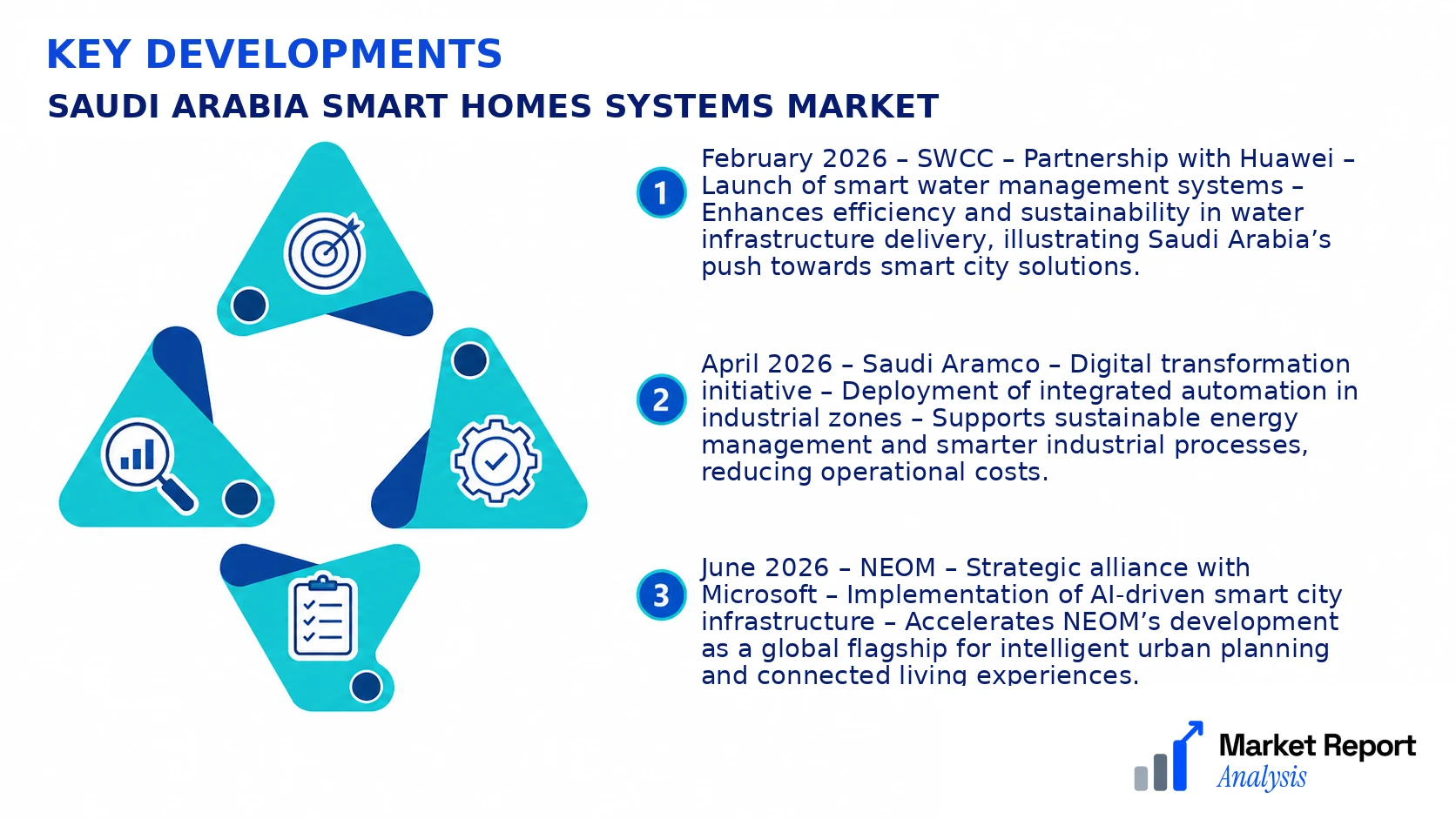
- February 2026 – SWCC – Partnership with Huawei – Launch of smart water management systems – Enhances efficiency and sustainability in water infrastructure delivery, illustrating Saudi Arabia’s push towards smart city solutions.
- April 2026 – Saudi Aramco – Digital transformation initiative – Deployment of integrated automation in industrial zones – Supports sustainable energy management and smarter industrial processes, reducing operational costs.
- June 2026 – NEOM – Strategic alliance with Microsoft – Implementation of AI-driven smart city infrastructure – Accelerates NEOM’s development as a global flagship for intelligent urban planning and connected living experiences.
- August 2026 – Ministry of Housing – Launch of national smart home subsidies – Facilitates adoption of IoT-based security and energy solutions among middle-income households, aligning with national housing programs.
- October 2026 – SAP – Investment in digital infrastructure – Development of integrated smart building systems for commercial properties – Improves building efficiency and sustainability, supporting Kingdom’s industrial growth targets.
Frequently Asked Questions
What is the Saudi Arabia Smart Homes Systems Market?
The Saudi Arabia Smart Homes Systems Market encompasses the development, deployment, and adoption of intelligent home automation technologies designed to enhance convenience, security, energy efficiency, and overall lifestyle in Saudi residential properties. This market integrates devices such as smart lighting, security cameras, thermostats, and voice assistants.
What is the current market size of Saudi Arabia Smart Homes Systems Market?
As of 2026, the market size is estimated at approximately USD 2.4 Billion, reflecting increasing consumer awareness and government initiatives aimed at promoting smart living. Growth is driven by rising urbanization, technological advancements, and a surge in high-income households.
What factors are driving the Saudi Arabia Smart Homes Systems Market?
Key drivers include government backing through Vision 2030 initiatives, increased disposable income, technological innovation, rising demand for energy-efficient solutions, and a growing preference for enhanced security and home automation among Saudi consumers.
Which Saudi city leads the Saudi Arabia Smart Homes Systems Market?
Riyadh emerges as the leading city in market adoption due to its status as the capital and largest urban center, hosting most of the high-income residents, luxury housing, and significant infrastructural developments aligned with smart city projects.
Which segment is expected to grow the fastest?
The security and surveillance segment is projected for the fastest growth, driven by escalating safety concerns, legal requirements, and the proliferation of connected devices that facilitate real-time monitoring and automation in residential environments.
Who are the leading companies operating in the Saudi Arabia Smart Homes Systems Market?
Major players include local and international firms like Honeywell, Schneider Electric, Siemens, and local integrators that offer comprehensive solutions, focusing on innovation, strategic partnerships, and tailored services to capture the growing Saudi market.
Analyst Perspective
The Saudi Arabia smart homes systems market exhibits promising long-term growth, driven by escalating consumer demand, government initiatives promoting digital infrastructure, and increasing urban population densities in major cities like Riyadh, Jeddah, and Dammam. The evolving technological landscape emphasizes integration ease, IoT connectivity, and security enhancements, which are vital for capitalizing on future opportunities. Investment priorities should focus on scalable, interoperable solutions that cater to rapid urbanization and energy efficiency mandates, enabling vendors to differentiate in a competitive environment. As the market matures, competition will intensify, requiring firms to innovate regularly and forge strategic alliances with local telecom providers and construction firms. City-level growth potential remains substantial, especially in Riyadh, where smart infrastructure projects are prioritized, offering substantial opportunities for early movers. Long-term, companies should adopt a strategic approach that balances innovation, regulatory compliance, and local partnership development to secure sustainable growth and market positioning in Saudi Arabia’s evolving smart home ecosystem.
