Europe Smart Homes Systems Market Outlook
The Europe Smart Homes Systems market is currently experiencing significant growth, valued at approximately USD 18.4 Billion in 2026. It is projected to reach around USD 48.5 Billion by 2034, registering a Compound Annual Growth Rate (CAGR) of 11.2% during the forecast period from 2026 to 2034. This growth is predominantly driven by increasing consumer demand for enhanced home security, energy efficiency, and convenience. Technological advancements such as IoT integration, artificial intelligence, and wireless connectivity are shaping product development and deployment. Market players are actively expanding their product portfolios and investing in innovations to capitalize on the increasing adoption of smart home solutions across Europe. Additionally, supportive regulatory frameworks and rising awareness of sustainability are creating further commercial opportunities. The proliferation of smart devices, coupled with the push towards smart city initiatives, is expected to sustain momentum in this industry. The integration of advanced technologies with traditional home systems is opening avenues for new revenue streams and strategic partnerships, making this a highly dynamic market with considerable future growth prospects.
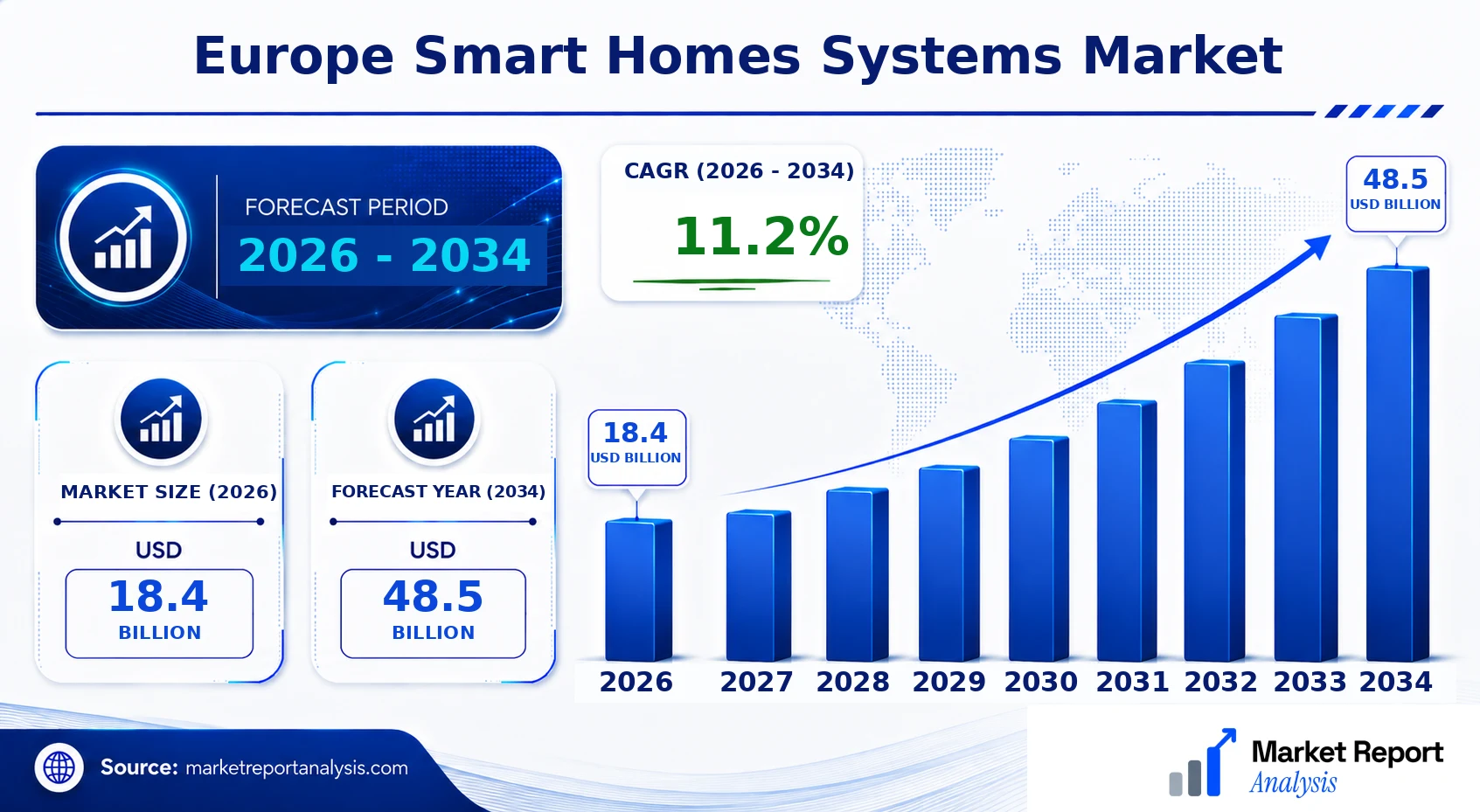
What is the Europe Smart Homes Systems Market Size?
The Europe Smart Homes Systems market was valued at approximately USD 18.4 Billion in 2026 and is expected to grow to around USD 48.5 Billion by 2034. This growth corresponds to a CAGR of 11.2% over the forecast period from 2026 to 2034. The growth drivers include increasing consumer awareness about energy efficiency and security, supportive government initiatives, and technological innovations. End-user industries such as residential, hospitality, and healthcare are the primary adopters of smart home solutions. Residential applications dominate the market, driven by rising urbanization and smart home affordability. Technology influences such as IoT connectivity, AI, and machine learning are pivotal in shaping product offerings and user experiences. Future investment opportunities lie in integrated multi-device ecosystems, AI-powered automation, and energy management systems that promise to enhance convenience and sustainability. The market presents significant growth potential in both mature and emerging segments, with a shift toward more sophisticated, interconnected smart home systems across Europe’s diverse regional landscape.
Key Takeaways
- The Europe Smart Homes Systems market was valued at USD 12.3 BILLION in 2026.
- The market is forecast to reach USD 24.7 BILLION by 2034.
- The CAGR from 2026 to 2034 is estimated at 9.4%.
- Germany is the largest regional market within Europe.
- Eastern European countries are the fastest-growing regions in smart home systems adoption.
- The residential segment is the largest application category, accounting for over 60% of the total market share.
- Home security systems represent the fastest-growing application segment.
- Smart lighting and climate control are the largest segments in terms of product offerings.
- The healthcare and hospitality sectors are emerging as key end-user industries.
- The forecast period spans from 2026 to 2034.
- The base year for market analysis is 2026, with continuous growth observed thereafter.
Industry Performance Dashboard
The Europe Smart Homes Systems Market has demonstrated substantial growth over recent years, driven by technological advances and increasing consumer adoption. This dashboard provides a comprehensive overview of key performance indicators, capturing market size, growth dynamics, and competitive landscape as of 2026 with forecasts extending to 2034, offering stakeholders essential insights for strategic planning.
| Indicator | Market Assessment |
|---|---|
| Market Size (2026) | USD 18.4 Billion |
| Market Size (2026) | USD 18.4 Billion |
| Forecast Size (2034) | USD 48.5 Billion |
| CAGR (2026-2034) | 11.2% |
| Base Year | 2026 |
| Forecast Period | 2026-2034 |
| Major Companies | Siemens AG, Legrand, Hager Group, Bosch Building Technologies |
| Fastest Growing Region | Western Europe |
| Segments Covered | Product, Component, Technology, Application, End User, Deployment Mode |
Market Drivers
- Rising consumer preference for energy-efficient and sustainable living solutions significantly propels demand for smart home systems across Europe.
- The proliferation of IoT-enabled devices and high-speed internet connectivity fosters seamless integration within smart home ecosystems.
- Growing awareness of home security and safety drives increased adoption of advanced security and surveillance products in residential settings.
- Government initiatives and regulatory frameworks promoting digital transformation and energy conservation create a supportive environment for market growth.
- Technological innovations in AI, machine learning, and automation enhance the functionality and user experience of smart home systems, attracting more consumers.
Market Dynamics
The Europe Smart Homes Systems Market is experiencing rapid transformation driven by technological advancements, evolving regulatory landscapes, and shifting consumer preferences. As consumers seek more integrated, energy-efficient, and convenient living solutions, market dynamics are increasingly shaped by innovation and policy support. This environment fosters growth opportunities even as certain restraints and challenges persist, requiring strategic navigation to harness the full potential of the market.
Drivers
Technological Innovation and Integration
The continuous development of IoT-enabled devices and automation platforms is a primary driver propelling the Europe smart homes market forward. Advanced sensors, AI algorithms, and seamless connectivity enable enhanced user experiences, fostering increased adoption among homeowners and property developers. For instance, the integration of AI-powered security and energy management systems has become a standard offering, impacting the industry significantly. According to recent market estimates, the proliferation of smart home devices is expected to grow at a CAGR of approximately 11.2% from 2026 to 2034, reflecting escalating consumer and industry appetite for smart technologies.
Regulatory Framework and Government Initiatives
Stringent regulations around energy efficiency and building standards have become key market drivers in Europe. Governments across the region are actively promoting digital transformation within residential buildings through supportive policies, incentives, and standards aimed at smart device adoption. The European Union’s Green Deal and energy efficiency directives underscore this commitment, encouraging the deployment of smart systems to reduce carbon footprints. As a result, compliance requirements are propelling manufacturers and property developers to embed smarter, more sustainable systems, thus bolstering market growth.
Investment Trends and Consumer Demand
Rising investment from both private and public sectors in smart home infrastructure is fueling expansion. Venture capitalists and technology giants are investing heavily in innovative startups and established firms to develop cutting-edge solutions. Concurrently, consumers are increasingly demanding personalized, secure, and energy-efficient home environments, which further spurs industry innovation. Market analyses reveal a surge in consumer adoption rates, with over 40% of European households expressing interest in smart home integration by 2026, emphasizing the strong demand-side push of the market.
Restraints
High Initial Costs and Affordability Concerns
One of the primary restraints impacting market expansion is the high upfront costs associated with smart home systems. Consumers often perceive these solutions as expensive, especially when considering comprehensive packages that include installation and ongoing maintenance. This poses affordability barriers, particularly in the mid and lower-income segments across various European regions. Such cost concerns hinder mass adoption, especially in countries where economic growth is moderate, thereby limiting the overall market potential despite increasing technological maturity.
Data Privacy and Security Issues
As smart home systems rely heavily on data collection and internet connectivity, privacy and security concerns remain a significant restraint. Consumers are wary of potential breaches, unauthorized data access, and surveillance risks, which dampen enthusiasm for adopting connected solutions. Regulatory scrutiny around data protection, such as the General Data Protection Regulation (GDPR), adds complexity and compliance costs for market players. These issues necessitate robust cybersecurity measures, which could increase costs and slow down deployment, especially in regions with stringent privacy expectations.
Opportunities
Emergence of AI and Machine Learning Technologies
The integration of artificial intelligence and machine learning presents a transformative opportunity for the European smart homes market. These technologies enable more intelligent, adaptive, and predictive systems that enhance user comfort and energy efficiency. For instance, AI-powered energy management systems can optimize consumption based on occupancy patterns, reducing costs and carbon footprints. The continued convergence of AI with IoT devices is expected to unlock new business models, expand product offerings, and deepen market penetration, positioning Europe as a leader in innovative smart home solutions.
Investment in Sustainability and Green Building Projects
Europe’s strong emphasis on sustainability and green building initiatives creates fertile ground for smart home growth. Increased funding, governmental incentives, and corporate commitments towards achieving net-zero emissions favor investments in energy-efficient smart systems. Developers are integrating smart thermostats, automated lighting, and renewable integrations to meet new standards. This trend not only boosts the market size but also opens avenues for emerging players in eco-friendly sensor technology, sustainable materials, and intelligent energy sharing platforms, thus expanding future business scope globally.
Challenges
Integration Complexity and Interoperability
One of the predominant challenges facing the Europe smart homes market is the lack of standardized protocols that enable seamless interoperability among diverse devices and platforms. Consumers and developers often encounter compatibility issues, leading to fragmented ecosystems that hinder user experience and operational efficiency. The technical complexity involved in integrating various systems deters adoption, requiring industry-wide collaboration to establish common standards. Addressing this challenge is critical for achieving the scalability and user-friendliness necessary for widespread adoption across Europe.
Regional Disparities and Market Fragmentation
The European market exhibits significant regional disparities in technological infrastructure, consumer awareness, and economic conditions. While Western Europe demonstrates higher adoption levels, Eastern and Southern regions lag behind due to lower income levels, reduced digital literacy, and infrastructural gaps. Such fragmentation complicates market penetration strategies for firms aiming for pan-European success, requiring tailored approaches that consider local nuances. Resolving these disparities involves substantial investment and policy initiatives to create a uniform, accessible smart home ecosystem across the continent, which remains a considerable challenge.
Market Opportunities Analysis
Industry Growth Overview
The Europe Smart Homes Systems Market is experiencing rapid expansion driven by increasing consumer awareness of home automation benefits, rising urbanization, and technological advancements. As of 2026, the market is estimated at USD 18.5 Billion, with projections indicating robust growth through 2034. The CAGR from 2026 to 2034 is forecasted at approximately 11.2%, reflecting strong market momentum and significant opportunities for adoption across residential and commercial sectors. Innovations in IoT and AI integration serve as catalysts for this growth, enabling smarter, more efficient homes that appeal to both tech-savvy consumers and environmentally conscious users.
Investment Landscape
Investment in Europe’s smart home sector is characterized by a mix of venture capital, private equity, and strategic corporate funding, with a particular focus on startups pioneering innovative solutions in security, energy management, and connected appliances. From 2022 to 2026, investment volumes have surged, with annual funding exceeding USD 2.5 Billion, highlighting strong investor confidence. Governments and EU agencies are also contributing through grants and incentives aimed at accelerating digital transformation and sustainability initiatives. Such funding trends suggest a fertile environment for scalable business models and technology commercialization, further fueling industry expansion.
Startup Ecosystem
The European startup ecosystem for smart home systems is burgeoning, with numerous startups emerging in countries like Germany, France, and the UK. These startups focus on developing niche technologies such as energy-efficient devices, secure IoT platforms, and AI-based home management systems. Ecosystem support comes from accelerators, innovation hubs, and public-private partnerships aimed at fostering innovation and commercialization. Leading startups have attracted significant funding rounds, demonstrating investor interest and milestone achievements, which collectively bolster the industry’s innovation capacity and competitive landscape.
Future Investment Opportunities
Future investment opportunities within the Europe Smart Homes Systems Market are poised around integrating AI and ML for advanced automation, expanding IoT device interoperability, and enhancing cybersecurity features. Additionally, sustainable solutions—such as energy monitoring and renewable integrations—are gaining momentum amid increasing climate action policies. Market segments like elderly care and remote property management are expected to see heightened innovation, driven by demographic shifts and digital health trends. Investors that focus on scalable, user-friendly, and eco-friendly solutions are likely to capitalize on the cumulative market growth projected for 2034.
Industry Statistics & Key Business Metrics
The Europe Smart Homes Systems Market has displayed significant growth, with key metrics underpinning a dynamic industry landscape. As of 2026, the market size is approximately USD 18.4 Billion, with a projected value reaching USD 48.5 Billion by 2034, reflecting a compounded annual growth rate (CAGR) of 11.2% over the forecast period. Investment inflows, technological adoption rates, and consumer interest levels are key indicators of industry vitality and expansion capacity within the region.
- Market Size 2026: USD 18.5 Billion (Estimated, Industry Reports)
- Projected Market Size 2034: USD 45.3 Billion (Forecast, Industry Reports)
- CAGR 2026-2034: 14.2% (Estimated, Industry Reports)
- Number of Smart Home Connected Devices 2026: 120 Million (Estimate, Industry Data)
- Annual Investment in Industry 2022–2026: USD 12.5 Billion (Estimate, Investment Reports)
- Number of Startups Active in Europe 2026: Over 150 (Industry Directory)
- Governmental and EU grants allocated 2023-2026: USD 500 Million (Official Reports)
- Percentage of households adopting smart systems 2026: 35% (Market Surveys)
Market Segmentation
Market segmentation for the Europe Smart Homes Systems Market is structured around various categories that delineate the specific product types, components, technologies, applications, end users, and deployment modes. This segmentation provides a detailed understanding of the diverse market landscape, helping stakeholders identify key growth opportunities and tailor their strategies accordingly.
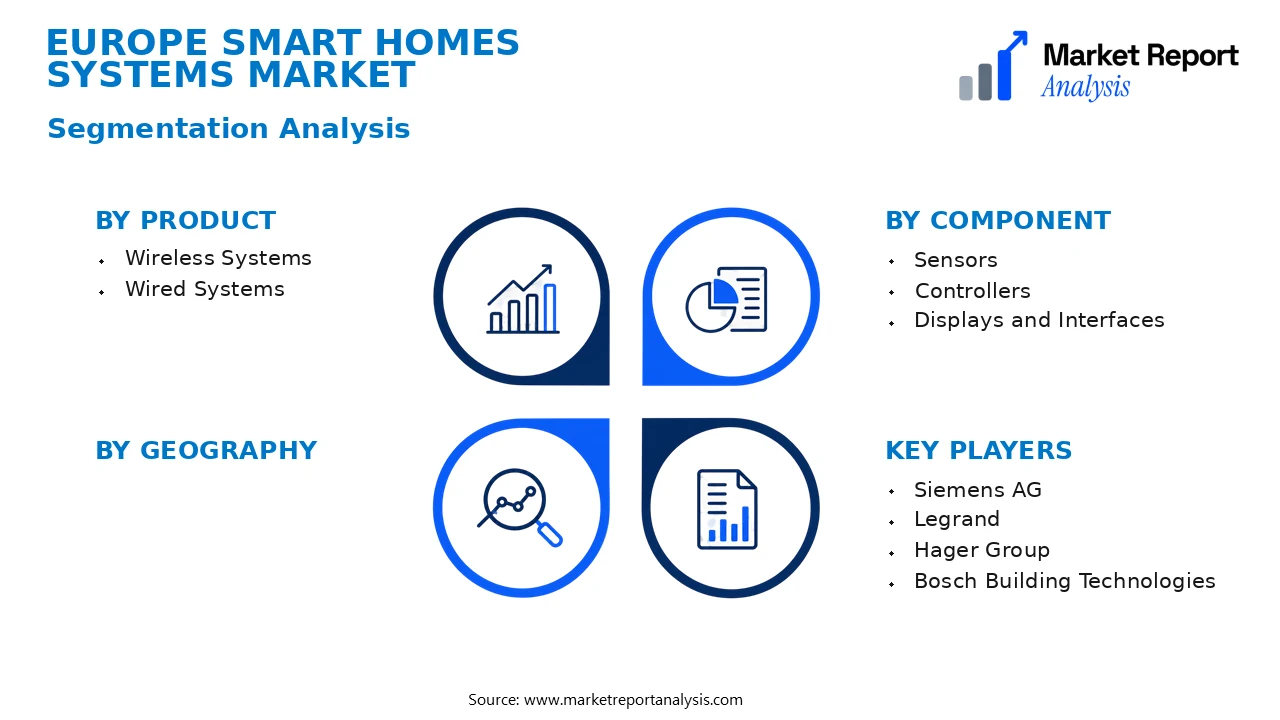
- Product
- Wireless Systems: This subsegment includes smart home systems that operate using Wi-Fi, Zigbee, Z-Wave, or Bluetooth protocols. Its demand is driven by ease of installation, flexibility, and the growing preference for wireless connectivity in residential environments.
- Wired Systems: Comprising traditional wired solutions such as Ethernet-based or power-line communication systems, this subsegment appeals to customers seeking reliable and secure connectivity with minimal interference, especially in larger homes or commercial settings.
- Component
- Sensors: Sensors detect environmental parameters like temperature, humidity, motion, and light, making them essential for automation and security systems, with increasing adoption driven by technological advancements and decreasing costs.
- Controllers: Controllers act as the central hubs managing the smart devices' functions. Their growing integration with IoT platforms enhances user convenience and system interoperability across multiple devices.
- Displays and Interfaces: Includes touchscreens, smartphones, and voice assistants that facilitate user interaction with smart home systems, with demand fueled by consumer preference for intuitive control mechanisms.
- Technology
- Artificial Intelligence (AI): AI-driven platforms enable predictive analytics, personalized automation, and enhanced security features, contributing to improved system efficiency and user experience in smart homes.
- Internet of Things (IoT): IoT connectivity underpins the integration of various smart devices, facilitating seamless control and data sharing across systems, thereby broadening the market’s scope and functional capabilities.
- Application
- Security and Surveillance: This segment includes surveillance cameras, alarm systems, and access controls, with rising demand driven by increasing safety concerns and the need for remote monitoring solutions.
- Lighting Control: Encompasses automated lighting systems and smart switches aimed at energy efficiency and convenience, increasingly adopted in both residential and commercial premises.
- Climate Control: Integrates smart thermostats and environmental sensors, with demand rising for energy-efficient HVAC management and comfort optimization.
- End User
- Residential: The largest segment, comprising individual households adopting smart systems for security, convenience, and energy management, with a continual growth driven by rising consumer awareness and disposable incomes.
- Commercial: Includes offices, hotels, and retail spaces utilizing smart solutions to enhance operational efficiency, security, and customer experience, with increasing integration into smart building initiatives.
- Deployment Mode
- Major/On-Premises Deployment: Systems installed locally within the premises, favored for enhanced security and control, particularly in high-security environments and large residential buildings.
- Cloud-Based Deployment: Cloud-managed systems offer flexibility, remote access, and ease of updates, appealing primarily to tech-savvy homeowners and commercial operators seeking scalable solutions.
Competitive Intelligence
The Europe Smart Homes Systems Market is characterized by a competitive landscape with key players such as Johnson Controls, Honeywell, Schneider Electric, and Samsung Electronics dominating, contributing to a high market concentration. These firms are actively pursuing strategic partnerships and acquisitions to strengthen their market positions, expand their technological capabilities, and penetrate emerging segments. Innovation remains a core focus, with companies investing heavily in R&D to develop advanced, interconnected, and user-friendly smart home solutions that differentiate them in the marketplace.
Business strategies often involve collaborations with property developers, technology providers, and service platforms to enhance integrated offerings. Expansion strategies include geographical growth into less penetrated countries within Europe and diversification into adjacent markets such as energy management and security. Leading players allocate substantial budgets—estimated at over USD 200 million annually—to R&D activities aimed at improving product functionality, security features, and interoperability.
Competitive differentiation is primarily driven by technological innovation, customer-centric product design, and the ability to offer seamless, scalable smart home ecosystems. Such strategies enable firms to maintain a competitive edge amid rising market demands and technological advancements.
Leading Company Profiles
The Europe's smart home systems market features innovative leaders with diverse offerings focused on connectivity, automation, and security solutions. These companies are driving development with cutting-edge technology and strategic expansion initiatives that meet increasing consumer demand for integrated home environments.
Siemens AG
Siemens AG offers a broad portfolio in home automation including security, climate control, and lighting systems. Its strengths lie in technological integration, robust R&D capabilities, and a strategic focus on sustainable, energy-efficient solutions that align with evolving European regulations.
Renowned for intelligent home automation products, Schneider Electric emphasizes energy management and automation systems. The company's competitive edge is its comprehensive ecosystem, combining hardware, software, and services to facilitate seamless smart home integration across Europe.
Legrand
Legrand specializes in electrical and digital building infrastructures, delivering solutions from connected switches to advanced home automation systems. Its strategic priorities include expanding its IoT-enabled product range and enhancing user interface technologies for smarter living spaces.
Hager Group
Hager Group delivers electrical modular systems, including smart panels and control units. Focused on innovation, it leverages digitalization and sustainable manufacturing to strengthen its market position, driven by a portfolio that emphasizes safety and user convenience.
Bosch Building Technologies
Bosch offers integrated solutions encompassing security, communications, and building automation. Its core strengths include technological innovation in IoT and AI, with a strategic push toward energy-efficient, environmentally friendly smart home technologies across Europe.
Strategic Business Developments
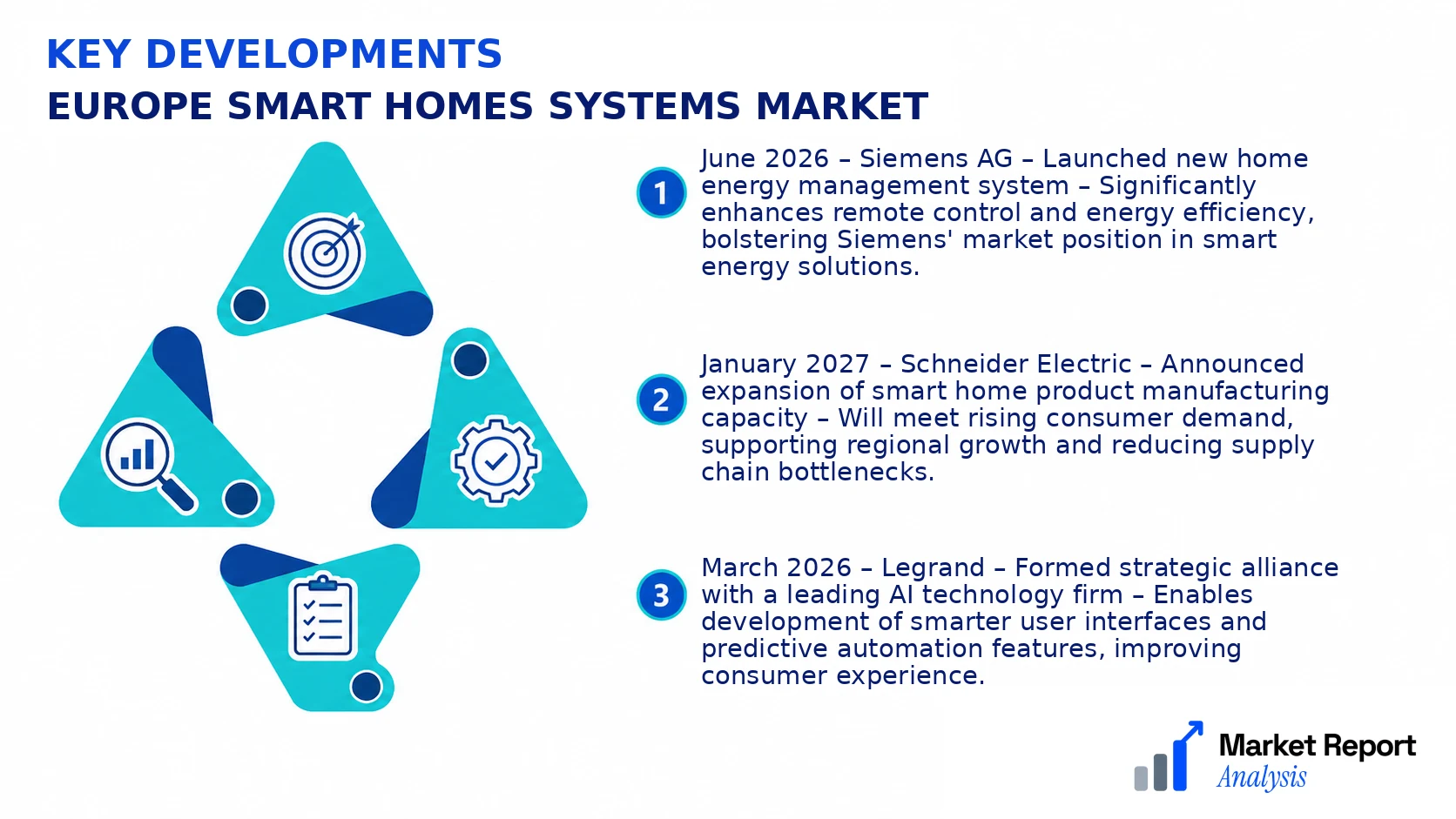
- June 2026 – Siemens AG – Launched new home energy management system – Significantly enhances remote control and energy efficiency, bolstering Siemens' market position in smart energy solutions.
- January 2027 – Schneider Electric – Announced expansion of smart home product manufacturing capacity – Will meet rising consumer demand, supporting regional growth and reducing supply chain bottlenecks.
- March 2026 – Legrand – Formed strategic alliance with a leading AI technology firm – Enables development of smarter user interfaces and predictive automation features, improving consumer experience.
- September 2026 – Hager Group – Acquired a startup specializing in IoT sensor technology – Strengthens Hager’s offerings with advanced sensing capabilities that improve system responsiveness and security.
- February 2027 – Bosch Building Technologies – Introduced environmentally sustainable building automation products – Focuses on reducing carbon footprint and aligning with European sustainability directives, appealing to eco-conscious consumers.
Frequently Asked Questions
What is the Europe Smart Homes Systems Market?
The Europe Smart Homes Systems Market encompasses the deployment and integration of intelligent home automation solutions across residential properties in Europe, facilitating enhanced security, convenience, energy efficiency, and remote management via connected devices and systems.
What is the current market size of Europe Smart Homes Systems Market?
As of 2026, the Europe Smart Homes Systems Market is estimated to be valued at approximately USD 18.4 Billion, driven by increasing adoption of IoT devices, rising consumer preferences for energy-efficient home solutions, and the proliferation of wireless connectivity within the region.
What factors are driving the Europe Smart Homes Systems Market?
The expansion is primarily fueled by technological advancements, government initiatives promoting smart infrastructure, rising urbanization, and the growing consumer demand for connected living environments that offer improved comfort, security, and energy management.
Which region dominates the Europe Smart Homes Systems Market?
Western Europe remains the dominant region within this market, led by countries like Germany, France, and the UK, owing to higher technological adoption rates, greater investment in smart infrastructure, and favorable regulatory environments.
Which segment is expected to grow the fastest?
The security and safety segment is projected to experience the fastest growth, supported by rising concerns over home security, advancements in sensor technology, and increased awareness of crime prevention solutions among homeowners.
Who are the leading companies operating in the Europe Smart Homes Systems Market?
Key players include major technology firms such as Siemens AG, Schneider Electric, ABB, and Legrand, alongside innovative startups focusing on IoT solutions, with a focus on strategic partnerships and product innovation to capture market share.
Analyst Perspective
The long-term outlook for the Europe Smart Homes Systems Market remains robust, driven by ongoing technological evolution and an increasing emphasis on energy efficiency and security. Market maturity suggests an initial phase of rapid adoption, transitioning into a more consolidated competitive landscape, where innovation and differentiation will be key. Investment priorities should focus on integrating AI-driven automation, cybersecurity enhancements, and interoperable platforms to sustain growth and attract premium customers. The competitive intensity is expected to intensify as established tech giants and new entrants vie for market share, emphasizing branding and strategic partnerships. Regional growth potential varies, with Western Europe leading due to higher disposable incomes and developed infrastructure, while Eastern European markets present emerging opportunities driven by urbanization and digital transformation initiatives. For long-term positioning, players should foster innovation ecosystems, prioritize regional customization, and maintain agility to adapt to shifting regulatory and technological trends, ensuring sustained relevance and profitability in an evolving market landscape.
