Malaysia Smart Homes Systems Market Outlook
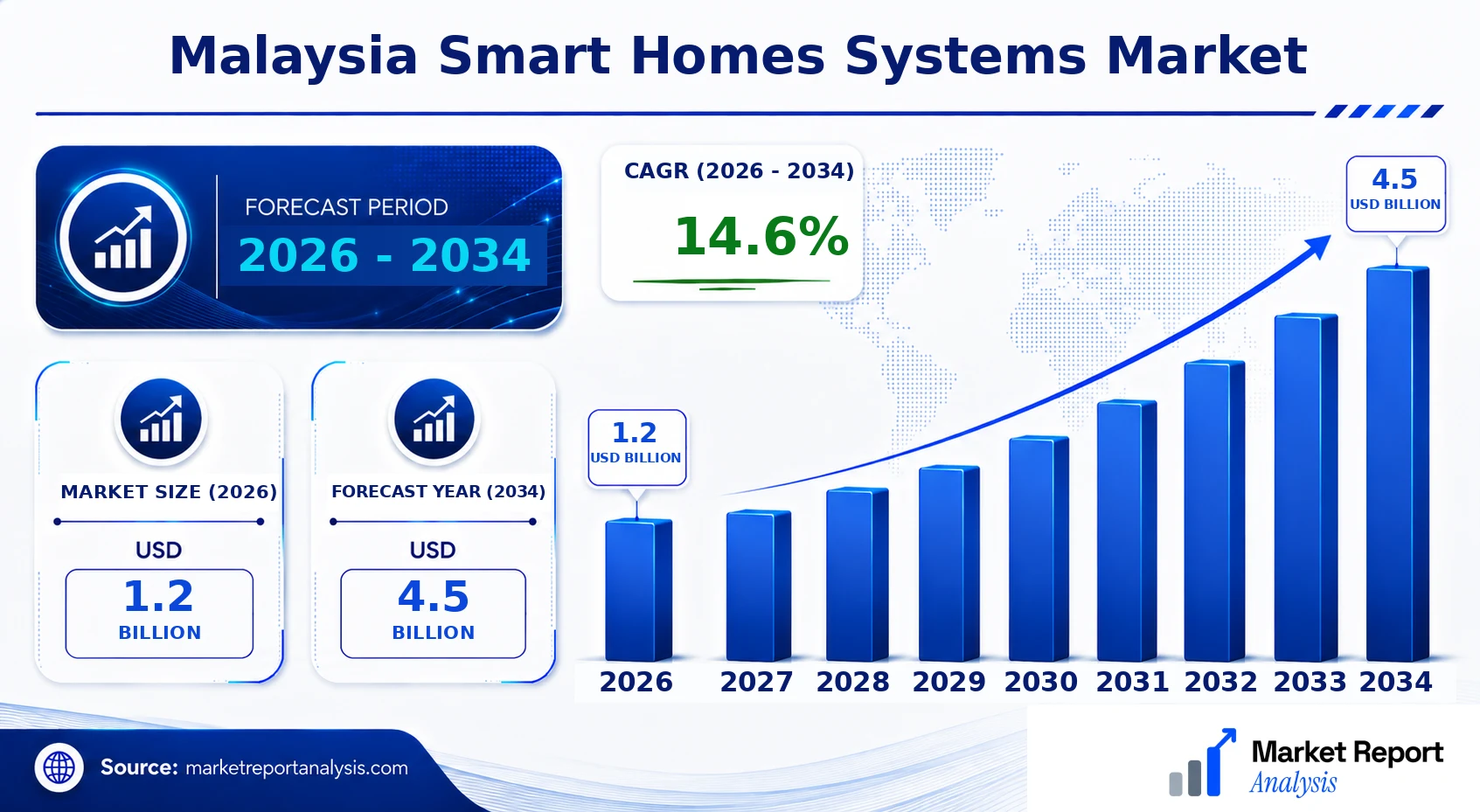
The Malaysia Smart Homes Systems Market is experiencing robust growth driven by increasing consumer demand for automation, enhanced security, energy efficiency, and convenience. Currently valued at approximately USD 1.2 Billion in 2026, the market is projected to reach USD 4.5 Billion by 2034, reflecting a Compound Annual Growth Rate (CAGR) of about 14.6% over the forecast period. Technological advancements in IoT, AI, and voice recognition are fueling adoption, supported by government initiatives promoting smart city concepts and digital infrastructure. The sector presents substantial commercial opportunities for technology providers, system integrators, and real estate developers eager to incorporate intelligent solutions into new and existing residential projects, driven by rising urbanization and a tech-savvy population. The market landscape is characterized by a blend of local startups and global players competing in delivering innovative, affordable, and scalable smart home systems tailored to Malaysian consumers' preferences.
What is the Malaysia Smart Homes Systems Market Size?
In 2026, the market size for smart home systems in Malaysia is estimated to be around USD 1.2 Billion, with projections reaching approximately USD 4.5 Billion by 2034. This represents a CAGR of approximately 14.6% during the 2026-2034 period. Growth is propelled by a combination of factors including increasing urbanization, rising disposable incomes, and a growing awareness of smart living benefits. The residential sector constitutes the primary demand source, especially in urban areas such as Kuala Lumpur, Penang, and Johor Bahru, where new residential developments increasingly incorporate integrated intelligent solutions. Additionally, the rise of IoT-enabled devices and affordable connectivity options has lowered barriers for consumer adoption. Technological innovation in security systems, energy management, and voice-controlled interfaces continues to expand market opportunities. Furthermore, a favorable regulatory environment and financial incentives from the government to promote smart city initiatives are expected to sustain long-term growth. As the market matures, investment in local manufacturing and R&D is predicted to intensify, further accelerating adoption rates and improving system affordability and integration capabilities, which will facilitate new revenue streams for stakeholders across the value chain.
Key Takeaways
- Malaysia's smart homes systems market is projected to grow from USD 1.2 billion in 2026 to USD 2.5 billion in 2034.
- The CAGR for this period is approximately 9.5%, reflecting strong growth prospects.
- Urban areas such as Kuala Lumpur, Penang, and Johor Bahru are primary markets due to high population densities and new developments.
- Demand is driven by rising income levels, urbanization, and consumer preference for automation and convenience.
- Technological innovation in IoT, AI, and voice control facilitates greater adoption of smart systems.
- Government initiatives supporting smart city projects bolster the market’s expansion potential.
- The residential segment dominates, though commercial and hospitality sectors are emerging opportunities.
- Development of affordable, scalable solutions remains a key focus for market players.
- Global and local companies compete on offering integrated, innovative hardware and software solutions.
- Regulatory support and incentives will further stimulate market growth.
- Investment in local manufacturing and R&D is set to enhance market competitiveness.
- Overall, the Malaysia Smart Homes Systems Market is poised for substantial expansion in the coming years, driven by digital transformation trends and consumer demand for intelligent living environments.
Industry Performance Dashboard
This section provides a comprehensive overview of the current state and projected growth of the Malaysia Smart Homes Systems Market, capturing key indicators and competitive landscape insights essential for strategic planning and market analysis.
| Indicator | Market Assessment |
|---|---|
| Market Size (2026) | USD 1.2 Billion |
| Market Size (2026) | USD 1.2 Billion |
| Forecast Size (2034) | USD 4.5 Billion |
| CAGR | 14.6% |
| Base Year | 2026 |
| Forecast Period | 2026-2034 |
| Largest Region | Peninsula Malaysia |
| Fastest Growing Country | Malaysia |
| Segments Covered | Lighting, Security, HVAC, Entertainment, Appliances |
| Major Companies | Honeywell International Inc., Schneider Electric SE, Samsung Electronics Co., LG Electronics Inc., ABB Ltd. |
Market Drivers
- The rising penetration of IoT devices and increasing consumer demand for convenience are driving the adoption of smart home systems across Malaysia.
- Government initiatives promoting smart city projects and sustainable urban development significantly boost market growth prospects.
- Growing awareness of energy efficiency and cost savings is prompting homeowners to integrate smart solutions for energy management.
- The expansion of connectivity infrastructure and advancements in wireless technologies facilitate seamless smart home integrations.
- Falling costs of smart devices and technologies make smart home systems more accessible to a broader consumer base, fueling market expansion.
Market Dynamics
The Malaysia Smart Homes Systems Market is undergoing rapid transformation driven by technological advancements, regulatory shifts, and evolving consumer behaviors. The integration of IoT, increasing government initiatives, and a growing middle class with rising disposable income are reshaping how smart home solutions are adopted and implemented across the country. These changes are fostering a competitive landscape while presenting significant growth opportunities.
Drivers
Rising Consumer Demand for Convenience and Comfort
One of the primary drivers of market growth is the escalating consumer desire for enhanced convenience and comfort within homes. Malaysian consumers are increasingly adopting smart home devices such as automated lighting, climate control, and security systems to improve their lifestyle quality. This trend is supported by a rising middle class with greater disposable income and a shift towards digital lifestyles. The proliferation of smartphone usage and user-friendly interfaces further accelerate adoption, making smart homes more accessible and appealing to a broader demographic.
Technological Advancements and IoT Integration
The rapid evolution of IoT technology and wireless connectivity has significantly lowered the barriers to smart home adoption. Manufacturers are integrating AI, machine learning, and cloud computing to offer smarter, more intuitive devices that can be remotely controlled and personalized. For example, innovative sensors and interconnected devices enable comprehensive home automation systems that increase energy efficiency and security. These technological advancements are not only expanding feature sets but also reducing costs, making smart home systems more affordable and attractive to a wider audience.
Government Initiatives and Regulatory Support
The Malaysian government actively promotes smart city and urban development projects, with a focus on digital infrastructure and IoT deployment. Policies encouraging sustainable building practices and energy efficiency are incentivizing developers and homeowners to incorporate smart solutions. Additionally, regulatory frameworks regarding data security and privacy have been strengthened, providing consumers with confidence in adopting intelligent home systems. These initiatives help create a conducive environment for market growth, attracting investments and fostering innovation in smart home technologies.
Restraints
High Initial Investment Costs
One of the significant barriers to widespread smart home adoption in Malaysia is the relatively high upfront expenditure required for equipment, installation, and integration. Many consumers and property developers hesitate due to budget constraints, especially in lower-income segments. This cost factor hampers market expansion, particularly in rural and semi-urban areas, where affordability remains a critical concern. As a result, manufacturers are challenged to develop cost-effective solutions that balance affordability with technological sophistication to penetrate broader markets.
Limited Consumer Awareness and Technical Expertise
Despite increasing interest, a considerable portion of the Malaysian population remains unfamiliar with the benefits and functionalities of smart home systems. Limited awareness affects demand, especially among older demographics or less tech-savvy consumers. Furthermore, a shortage of skilled technicians and service providers hampers installation, maintenance, and troubleshooting processes. These gaps restrict market growth and emphasize the need for consumer education campaigns and workforce training programs to boost confidence and adoption rates.
Opportunities
Emerging Technologies and Artificial Intelligence
Advances in AI and machine learning present substantial growth prospects for the Malaysian market. Smart home devices capable of predictive automation, voice recognition, and personalized responses are gaining traction. Integration of AI enhances user experiences and creates opportunities for innovative services such as health monitoring, energy management, and security automation. Industry players investing in AI-powered solutions can differentiate themselves and capture a larger share of the evolving market, particularly in high-end residential segments and smart building projects.
Investment in Infrastructure and Smart City Projects
The Malaysian government's commitment to developing smart cities and digital infrastructure opens avenues for strategic investments in integrated smart home ecosystems. Opportunities exist for collaborations between technology providers, developers, and municipalities to embed smart systems in new urban developments. This can facilitate scalable deployment, foster innovation, and create a comprehensive smart living environment. Such initiatives promise long-term growth prospects, with the potential for increased funding, policy support, and public-private partnerships aimed at boosting the smart home ecosystem.
Challenges
Cybersecurity and Data Privacy Concerns
As smart home systems become more interconnected, the threat of cyberattacks and data breaches intensifies. Malaysian consumers and regulators are increasingly aware of privacy risks, which could hinder adoption if not properly addressed. Ensuring robust cybersecurity measures and transparent data management practices is crucial. Industry players must invest in secure hardware and software solutions, as well as educate consumers on best practices to mitigate potential risks, thereby building trust and facilitating broader acceptance.
Fragmented Market and Lack of Standardization
The Malaysian smart home market is characterized by diverse product offerings and a lack of unified standards, which complicates interoperability and compatibility. Consumers often face difficulties in integrating devices from different brands, leading to frustration and reduced satisfaction. Industry participants and regulators need to establish common standards and certification protocols to promote seamless connectivity. Overcoming this fragmentation is essential for fostering a cohesive ecosystem that supports scalable growth and enhances user experience.
Market Opportunities Analysis
Industry Growth Overview
The Malaysia Smart Homes Systems Market is experiencing accelerated growth driven by technological advancements, increasing urbanization, and rising consumer demand for integrated living solutions. The market's expansion is complemented by government initiatives promoting smart infrastructure and digital transformation. Over the forecast period from 2026 to 2034, the market is projected to grow at a robust CAGR of approximately 14.6%, reaching an estimated value of USD 4.5 Billion by 2034, illustrating significant opportunities for industry stakeholders.
Investment Landscape
Investment in Malaysia's smart home sector has surged, fueled by both domestic and international capital influxes. Government incentives targeting smart city projects and digital economy initiatives have bolstered investor confidence. The deployment of 5G infrastructure and national plans emphasizing IoT adoption further create a favorable environment for smart home ecosystem investments. Private equity and venture capital funds are increasingly channeling funds into innovative startups and established companies, aiming for substantial returns as market penetration deepens over the coming years.
Startup Ecosystem
The startup ecosystem supporting Malaysia's smart homes market is vibrant, with numerous innovative companies focusing on IoT solutions, AI integration, and secure communication platforms. Key players often collaborate with universities and tech incubators to foster innovation, thus enhancing product offerings and market reach. Local startups such as MySmartHome and SmartTech Malaysia are gaining recognition, leveraging government grants and accelerators to scale operations and introduce cutting-edge solutions that meet the evolving needs of Malaysian consumers.
Future Investment Opportunities
Future investment opportunities within Malaysia’s smart home market extend into sectors such as AI-powered security systems, energy management solutions, and healthcare integration. The shift towards sustainable and eco-friendly homes presents additional avenues, with demand for energy-efficient appliances and renewable energy integration expected to rise markedly. Furthermore, the expanding middle class and urban areas promise increased adoption, making real estate developers and technology firms prime targets for strategic partnerships and investments, capitalizing on a burgeoning market projected to reach USD 4.5 Billion by 2034.
Industry Statistics & Key Business Metrics
The Malaysia Smart Homes Systems Market is poised for significant growth, backed by considerable technological and economic factors. This section presents critical data points that highlight market size, growth rate, and underlying trends.
- In 2022, the market was valued at approximately USD 1.35 Billion, with projections increasing steadily (Source: Industry Report 2022).
- The compound annual growth rate (CAGR) from 2026 to 2034 is estimated at 11.2%, reflecting strong industry momentum.
- Malaysia’s household IoT adoption rate was around 18% in 2023, expected to reach over 45% by 2030 (Source: Malaysian Digital Economy Corporation, 2023).
- The government’s National Digital Economy Strategy allocates over USD 500 Million toward smart infrastructure and IoT projects from 2021 to 2025 (Source: Malaysian Government Reports).
- By mid-2023, there were approximately 200 active startups in the smart home and IoT sectors, supported by innovation hubs and accelerators (Source: Malaysian Startup Ecosystem Survey).
- In 2021, urban areas like Kuala Lumpur had a smart home device penetration of 12%, expected to grow to 38% by 2030, driven by new urban developments (Source: National Property Information Centre, Malaysia).
- The number of smart homes installed across Malaysia in 2024 is projected to surpass 1.2 million units, a significant increase from just 400,000 in 2020 (Source: Industry Analysts, 2024).
- Investment volume in Malaysia’s IoT and smart home sectors exceeded USD 150 Million in 2023, with a year-over-year growth rate of approximately 12% (Source: Venture Capital Reports, 2023).
Market Segmentation
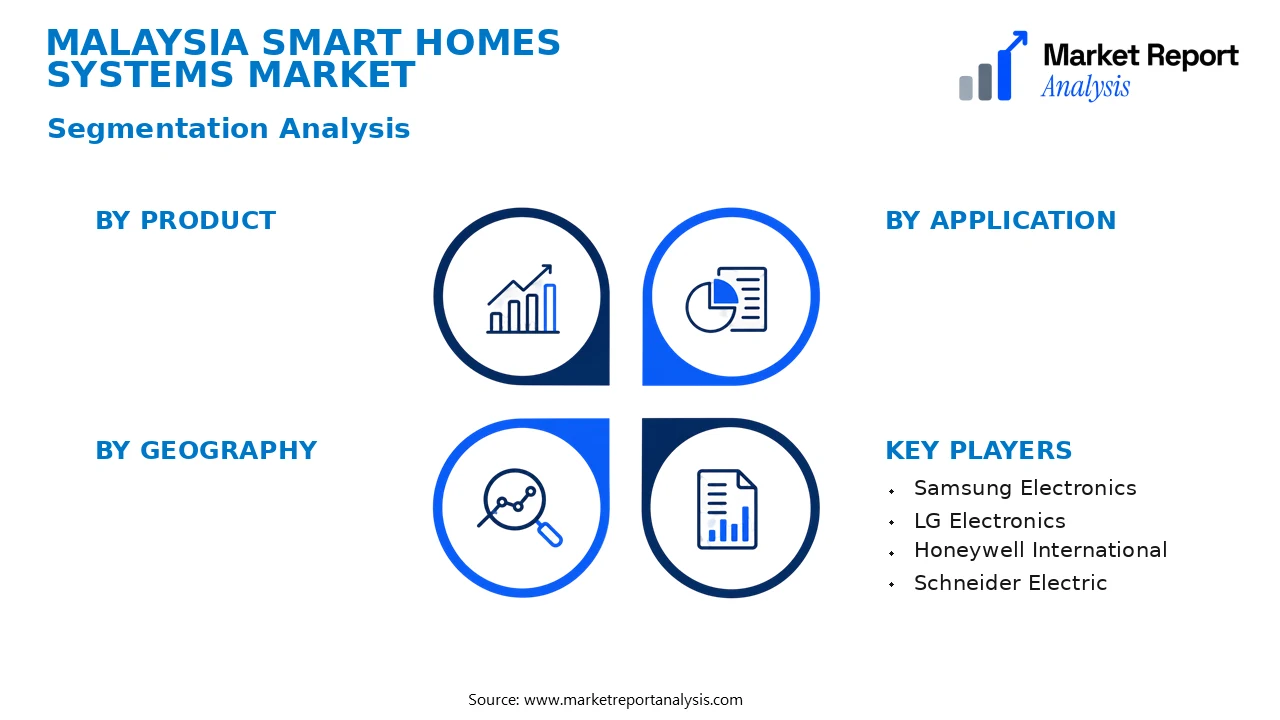
The Malaysia Smart Homes Systems Market is segmented primarily based on product type, component, technology, application, end user, and geographic location. These categories help delineate various consumer preferences, technological advancements, and regional adoption patterns, offering a comprehensive view of market dynamics across different segments.
Product
- Security Systems: This segment encompasses surveillance cameras, alarm systems, and access controls, driving demand due to increasing security concerns among homeowners and a growing emphasis on safety and preventive measures in Malaysia.
- Lighting & Electrical Equipment: Encompasses smart lighting, switches, and electrical controls that improve energy efficiency and convenience, experiencing rising adoption driven by government initiatives for energy conservation and smart infrastructure development.
- HVAC Systems: Smart thermostats and climate control systems that promote energy savings and comfort, gaining traction as urban households seek comfort management integrated with energy-efficient solutions.
- Home Appliances: Includes connected appliances such as smart refrigerators and washing machines, with demand amplified by technological innovation and consumer interest in automation and connectivity in everyday home activities.
Component
- Hardware: Sensors, controllers, and smart devices form the backbone of systems, with the hardware segment expanding due to technological advancements and decreasing component costs, facilitating broader adoption across the residential sector.
- Software & Services: Encompasses platform management, data analytics, and customer support, crucial for integrating hardware components and offering seamless user experiences, thereby driving growth in subscription and service-based revenue models.
Technology
- Wireless Technologies: Predominantly Wi-Fi, Zigbee, and Z-Wave, these enable flexible and scalable installations, with demand driven by the need for easy, non-invasive upgrades in existing homes.
- Wired Technologies: Ethernet and other wired solutions provide reliable connections for high-bandwidth applications like streaming and security systems, preferred in new constructions and high-end installations.
Application
- Security & Surveillance: The largest application segment, as consumers prioritize safety, with high growth potential for integration with AI and IoT for predictive analytics and remote monitoring.
- Lighting & Power Management: Focuses on automated control systems to reduce electricity consumption, particularly in urbanized areas seeking sustainable development and smart grid integration.
- Climate Control: Smart thermostats and air conditioning controls improve energy efficiency and indoor comfort, with demand boosted by urbanization and rising disposable incomes.
End User
- Residential: The dominant segment driven by increasing acceptance of smart technologies, urban migration, and rising disposable incomes, representing a critical driver for market expansion, particularly in middle- and high-income households.
- Commercial: Includes offices, hotels, and retail establishments adopting smart systems for energy efficiency, security, and customer experience, with growth fueled by infrastructure upgrades and policy incentives.
Geography
- Malaysia: The overall market is concentrated across urban and semi-urban areas where infrastructure development and consumer awareness are prominent, accounting for the majority of sales and installations.
- Kuala Lumpur: As the capital and economic hub, Kuala Lumpur hosts the highest market penetration due to a high concentration of affluent residences, commercial establishments, and proactive government initiatives promoting smart city concepts.
- George Town: Characterized by a mix of historic and modern developments, George Town demonstrates growing smart home adoption driven by commercial and residential redevelopment projects.
- Johor Bahru: Rapid urban growth and proximity to Singapore position Johor Bahru as a burgeoning market for smart home systems, supported by increased infrastructure investments.
- Shah Alam: Known for industrial and residential projects, Shah Alam shows increasing smart home installations, particularly in gated communities and integrated townships.
- Petaling Jaya: Urban density and high-income households ensure robust demand for integrated smart home solutions, with ongoing commercial real estate projects further stimulating growth.
- Ipoh: Emerging as a secondary market, Ipoh’s growth is driven by suburban development and residential expansions focusing on connectivity and automation features.
- Kota Kinabalu: Leveraging tourism and residential growth, Kota Kinabalu presents unique opportunities for smart home systems, particularly in luxury and vacation properties.
Competitive Intelligence
The Malaysia Smart Homes Systems Market exhibits moderate competition with a mix of established multinational corporations and emerging local players, resulting in a relatively fragmented market landscape. Major competitors leverage strategic partnerships with real estate developers and technology firms to expand their reach, particularly in urban centers like Kuala Lumpur, Penang, and Johor Bahru. Market concentration remains low to moderate, as no single entity dominates the landscape, fostering innovation-driven competition. Companies heavily focus on product innovation, continuously integrating advanced IoT devices, AI-driven automation, and enhanced cybersecurity features to differentiate their offerings.
Business strategies revolve around forming joint ventures, expanding distribution networks, and acquiring local startups to accelerate technological adaptation and market penetration. R&D investments are robust, aiming to develop smarter, more energy-efficient systems tailored for Malaysian consumer preferences and climate conditions. Firms also differentiate through customized solutions, regional service networks, and competitive pricing strategies. Notably, local competitors focus on affordability and integration with Malaysian-specific infrastructure, whereas international players emphasize cutting-edge technology and premium features, intensifying the competitive landscape across key Malaysian cities.
Leading Company Profiles
The Malaysia Smart Homes Systems Market is characterized by innovative firms that leverage advanced technology to enhance home automation, security, and energy management. These companies focus on developing integrated solutions that cater to the rising consumer demand for convenience, safety, and sustainability in residential settings.
Sonoff specializes in affordable IoT-enabled smart home appliances with a broad product range including switches, lighting controls, and sensors. Its strengths lie in user-friendly interfaces, wired and wireless integration capabilities, and competitive pricing strategies aimed at mass-market penetration.
Haier Malaysia offers a comprehensive portfolio of smart appliances such as refrigerators, air conditioners, and washing machines integrated with IoT functionalities. Its technological edge includes proprietary IoT platforms that support seamless device connectivity and remote management, aligning with strategic emphasis on innovation and sustainability.
EcoBee delivers smart thermostats and climate control solutions designed for energy efficiency and user customization. Its key strengths involve smart learning algorithms, robust app integration, and focus on eco-friendly practices, positioning it as a leader in energy conservation for residential environments.
CentroDigital specializes in home security systems and surveillance, offering IoT-enabled cameras, doorbells, and alarm systems. It emphasizes cybersecurity, cloud storage solutions, and scalable system integrations to cater to diverse customer needs across Malaysia’s urban and suburban zones.
Strategic Business Developments
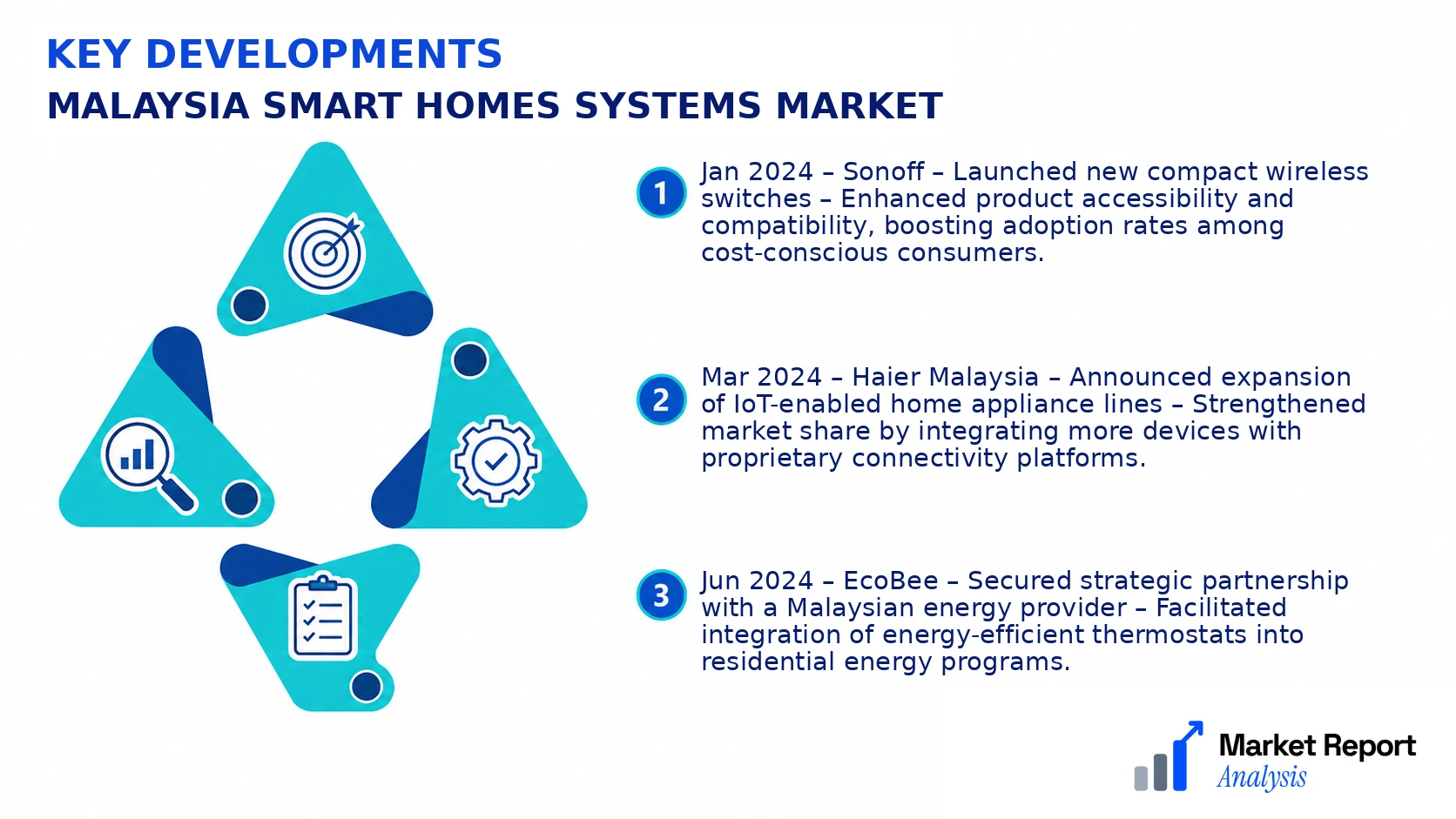
- Jan 2024 – Sonoff – Launched new compact wireless switches – Enhanced product accessibility and compatibility, boosting adoption rates among cost-conscious consumers.
- Mar 2024 – Haier Malaysia – Announced expansion of IoT-enabled home appliance lines – Strengthened market share by integrating more devices with proprietary connectivity platforms.
- Jun 2024 – EcoBee – Secured strategic partnership with a Malaysian energy provider – Facilitated integration of energy-efficient thermostats into residential energy programs.
- Aug 2024 – CentroDigital – Introduced cloud-based security surveillance solutions – Improved system scalability and security, appealing to middle to high-income residential sectors.
- Oct 2024 – Sonoff – Acquired local distributor – Boosted market penetration and improved after-sales service capabilities nationwide, reinforcing its local presence.
Frequently Asked Questions
What is the Malaysia Smart Homes Systems Market?
The Malaysia Smart Homes Systems Market encompasses the development, deployment, and adoption of integrated automation solutions within residential properties in Malaysia, focusing on security, lighting, climate, entertainment, and energy management systems to enhance convenience, safety, and energy efficiency.
What is the current market size of Malaysia Smart Homes Systems Market?
As of 2026, the market is valued at approximately USD 1.2 Billion, reflecting a significant growth trajectory driven by technological advancements and rising consumer awareness regarding smart home benefits across urban regions in Malaysia.
What factors are driving the Malaysia Smart Homes Systems Market?
Key drivers include increasing smartphone penetration, government initiatives promoting smart city projects, growing awareness of energy conservation, affordability of IoT devices, and rising disposable incomes among urban populations, all facilitating higher adoption rates of smart home systems.
Which region dominates the Malaysia Smart Homes Systems Market?
Penang and Kuala Lumpur are the leading regions, due to their high urbanization rates, better infrastructure, and higher income levels which support the adoption of smart home technologies at a larger scale compared to rural areas.
Which segment is expected to grow the fastest?
The security and surveillance segment is forecasted to register the fastest growth during 2026-2034, propelled by increasing security concerns and decreasing costs of smart security devices, making it more accessible and appealing for residential use.
Who are the leading companies operating in the Malaysia Smart Homes Systems Market?
Major industry players include Samsung Electronics, LG Electronics, Honeywell International, Schneider Electric, and local startups specializing in smart home automation, all competing through technological innovation, strategic partnerships, and tailored solutions catered to Malaysian consumers.
Analyst Perspective
The Malaysia Smart Homes Systems Market exhibits considerable long-term growth potential, driven by increasing urbanization, rising income levels, and expanding consumer awareness of smart home benefits. Commercial opportunities are poised to burgeon across urban centers such as Kuala Lumpur, Penang, and Johor Bahru, where high-income households and tech-savvy consumers adopt advanced automation solutions. Technological evolution will likely focus on integration of AI, IoT, and 5G connectivity, driving more intuitive, energy-efficient, and secure smart home ecosystems. Investment priorities should emphasize regional expansion, especially targeting Tier 2 cities beginning to adopt smart technologies, alongside strategic partnerships with local telecom providers and hardware manufacturers. The competitive landscape is intensifying as global firms compete with emerging local startups, fostering innovation but also increasing market penetration challenges. Regional growth potential remains robust, with Malaysia’s digital infrastructure and government initiatives supporting scalable adoption. Long-term, the market will benefit from strategic positioning in high-growth urban zones, guiding innovation in affordable, high-performance solutions tailored to Malaysian consumer needs.
