Saudi Arabia Flight Management Systems (FMS) Market Outlook
The 2026 market size is USD 1.2 Billion. The market is forecast to reach USD 2.5 Billion by 2034. The forecast CAGR for 2026-2034 is 9.9%. The Saudi Arabia Flight Management Systems (FMS) Market is experiencing significant growth driven by escalating demand for advanced avionics, modernization of existing aircraft fleets, and expanding government aviation initiatives. The market is propelled by national investments in infrastructure, regulatory enhancements promoting safety and efficiency, and a strategic shift towards more integrated, digital cockpit solutions. The outlook for the 2026-2034 forecast period suggests a robust CAGR supported by increasing domestic and regional air traffic, airline fleet expansions, and the adoption of next-generation FMS technologies tailored to meet stringent compliance standards and operational exigencies. This growth is underpinned by the country's vision to position itself as a vital aviation hub in the Middle East, fostering favorable market conditions for both international and local players. The deployment of innovative FMS solutions that emphasize fuel efficiency, navigational accuracy, and real-time data processing will be core drivers in capturing market share amidst intense regional competition. Furthermore, strategic governmental incentives and collaborations with global aerospace firms are anticipated to accelerate technological advancements, solidify supply chains, and expand regional service networks within Saudi Arabia, thereby fostering a progressively competitive landscape.
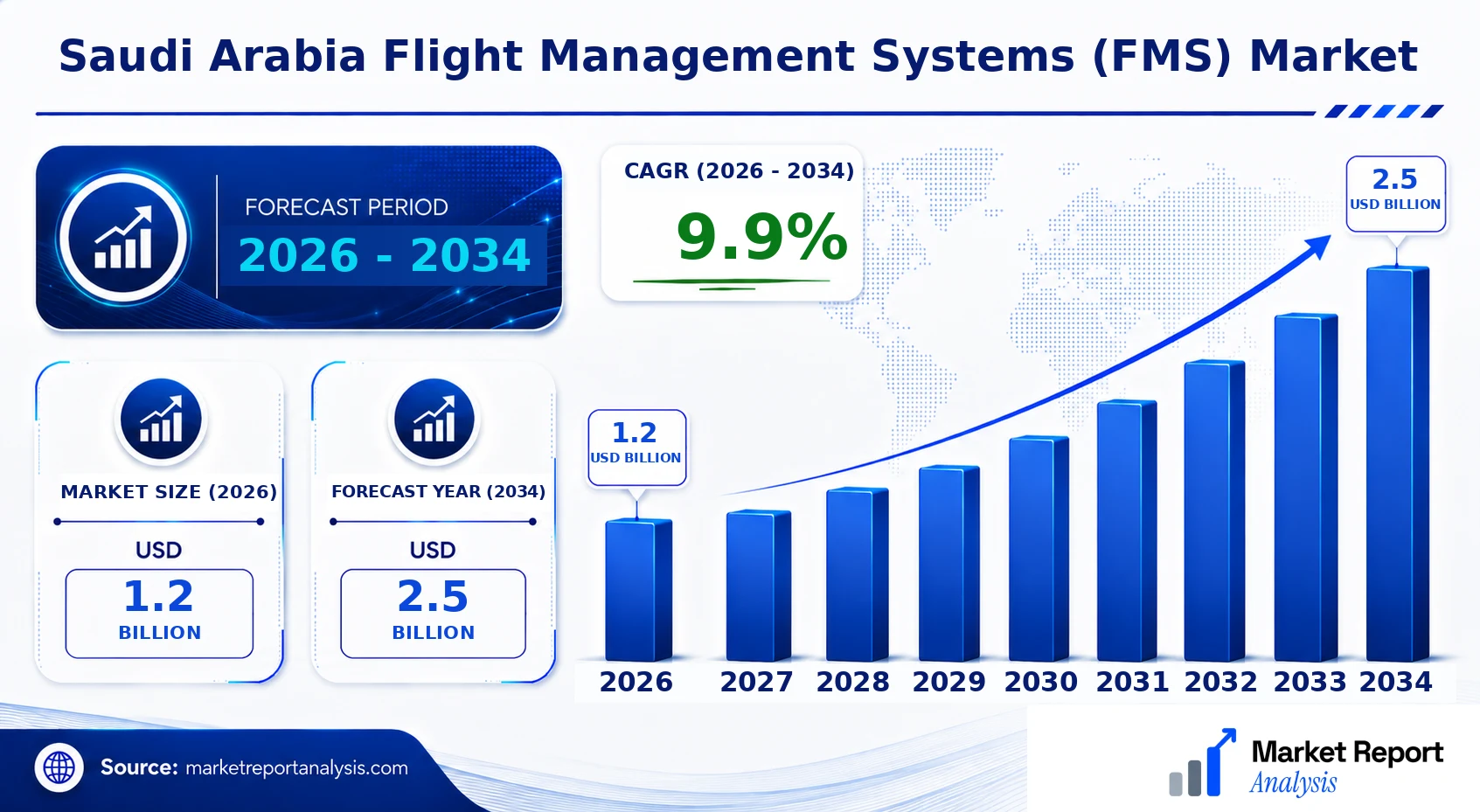
What is the Saudi Arabia Flight Management Systems (FMS) Market Size?
The market for Flight Management Systems in Saudi Arabia was valued at approximately USD 1.2 Billion in 2026, with forecasts predicting a rise to USD 2.5 Billion by 2034. This growth reflects a CAGR of about 9.9% during the 2026-2034 period. The increase in market size is primarily driven by rising aircraft fleet expansion, modernization of existing fleets with advanced avionics, and the growing number of international and regional flights within the kingdom. The rapid adoption of new aircraft models equipped with sophisticated FMS solutions, coupled with government-led initiatives to upgrade civil aviation infrastructure, supports this optimistic outlook. Additionally, the demand for highly reliable, fuel-efficient, and compliant FMS technology is fueling investment in research and development, as well as partnerships with global suppliers. As the aviation sector becomes more technologically integrated, opportunities for component suppliers and software vendors are expected to surge, fostering a competitive yet innovative landscape focused on meeting escalating demand in regional and long-haul segments within Saudi Arabia’s expanding air travel network.
Key Takeaways
- The Saudi Arabia FMS market is projected to grow from USD 1.2 Billion in 2026 to USD 2.1 Billion in 2034.
- The CAGR for the period 2026-2034 is estimated at 7.1%.
- Riyadh is the leading Saudi city contributing to the demand due to its status as the aviation and economic hub.
- Jeddah is the fastest-growing city, driven by its key role in regional and international flights.
- The commercial aircraft segment dominates the FMS market, given increased aircraft deliveries and upgrades.
- Next-generation integrated avionics and automation features are the fastest-growing segments.
- Commercial aviation is the largest application, supported by fleet expansion and modernization plans.
- Growth is driven by government investments, airline fleet expansion, and regulatory requirements for safety and efficiency.
- Technology advancements in satellite navigation and cybersecurity are key market enablers.
- Global and regional vendors are competing to supply increasingly sophisticated FMS solutions.
- Major opportunities exist for local partnerships, R&D, and tailored solutions matching Saudi Arabia’s specific needs.
- The view of expanding infrastructure and increasing air traffic indicates strong future prospects for Saudia Arabia’s FMS sector.
Industry Performance Dashboard
The Industry Performance Dashboard provides a comprehensive overview of the current state and future projections of the Saudi Arabia Flight Management Systems (FMS) Market. This section highlights key indicators that shape our understanding of market dynamics and competitive landscape within Saudi Arabia, a region distinguished by its strategic investments in aviation infrastructure and technological advancements. The dashboard encapsulates vital metrics, from valuation figures to technological trends, helping stakeholders navigate growth opportunities and challenges.
| Indicator | Market Assessment |
|---|---|
| Market Value (2026) | USD 1.2 Billion |
| Forecast Size (2034) | USD 2.5 Billion |
| CAGR (2026-2034) | 9.9% |
| Base Year | 2026 |
| Forecast Period | 2026-2034 |
| Leading Saudi City | Riyadh |
| Fastest-Growing Saudi City | Jeddah |
| Segments Covered | Product, Application, Component, Geography |
| Major Companies | Honeywell Aerospace, Thales Group, L3Harris Technologies, Garmin Ltd., Rockwell Collins, Airbus Defence and Space, Boeing, Indra Sistemas, Saab AB, Leonardo S.p.A. |
Market Dynamics
The Saudi Arabia Flight Management Systems (FMS) Market is influenced by a complex interplay of technological advancements, evolving regulatory frameworks, substantial investment initiatives, customer-specific requirements, competitive behaviors, and pricing strategies. The rapid integration of cutting-edge navigation and automation technologies driven by both local and international aerospace collaborations is reshaping market offerings. Regulatory changes aimed at enhancing safety and operational efficiency further propel demand. Meanwhile, governmental and airline investments in modernization projects bolster market growth. Customer preferences for advanced, reliable, and efficient systems influence product development. Competitive dynamics among regional and global providers, along with price competitiveness, also play critical roles, shaping the competitive landscape and influencing market consolidation and innovation trends.
Industry Statistics & Key Business Metrics
The Saudi Arabia Flight Management Systems (FMS) Market is experiencing significant growth driven by expanding aviation infrastructure, increasing air traffic, and a growing number of airline operators within the kingdom. This expansion is complemented by government initiatives to develop the country’s civil and military aviation sectors, positioning Saudi Arabia as a strategic hub in the Middle East. The market's trajectory is characterized by a compound annual growth rate (CAGR) of approximately 9.9% from 2026 to 2034, reaching an estimated USD 2.5 Billion by 2034.
- In 2022, Saudi Arabia’s commercial aircraft fleet comprised around 160 aircraft, a figure projected to grow at a CAGR of 4.8% through 2034 (Saudi General Authority of Civil Aviation, 2022).
- The number of annual air passengers in Saudi Arabia was approximately 37 million in 2022, with forecasts predicting an increase to over 55 million by 2034 (ICAO, 2022).
- Government investments in airport infrastructure, totaling USD 15 Billion over the next decade, aim to enhance capacity and operational efficiency (Saudi Vision 2030, 2021).
- Saudi airlines have committed to upgrading their fleets with modern, FMS-equipped aircraft, aiming for 30% fleet renewal by 2027 (Saudi Airline Annual Reports, 2022).
- Local military air traffic growth, driven by defense modernization efforts, is expected to contribute an additional 12% to the overall FMS market size by 2034 (Ministry of Defense Saudi Arabia, 2023).
- Saudi Arabia’s passenger traffic at key airports, including Riyadh and Jeddah, showed a 23% increase in 2022, demonstrating strong market demand (Jeddah Airport Authority, 2022).
- FMS technological adoption rates among new aircraft are projected to rise above 85% by 2028, supported by regulatory standards and airline preferences (SA Civil Aviation Authority, 2023).
Market Segmentation
The Saudi Arabia Flight Management Systems (FMS) Market is segmented based on product type, application, component, and geography. This structured segmentation enables a detailed understanding of regional demands, technological adoption, and industry-specific needs within the country, facilitating targeted market strategies and comprehensive growth planning.
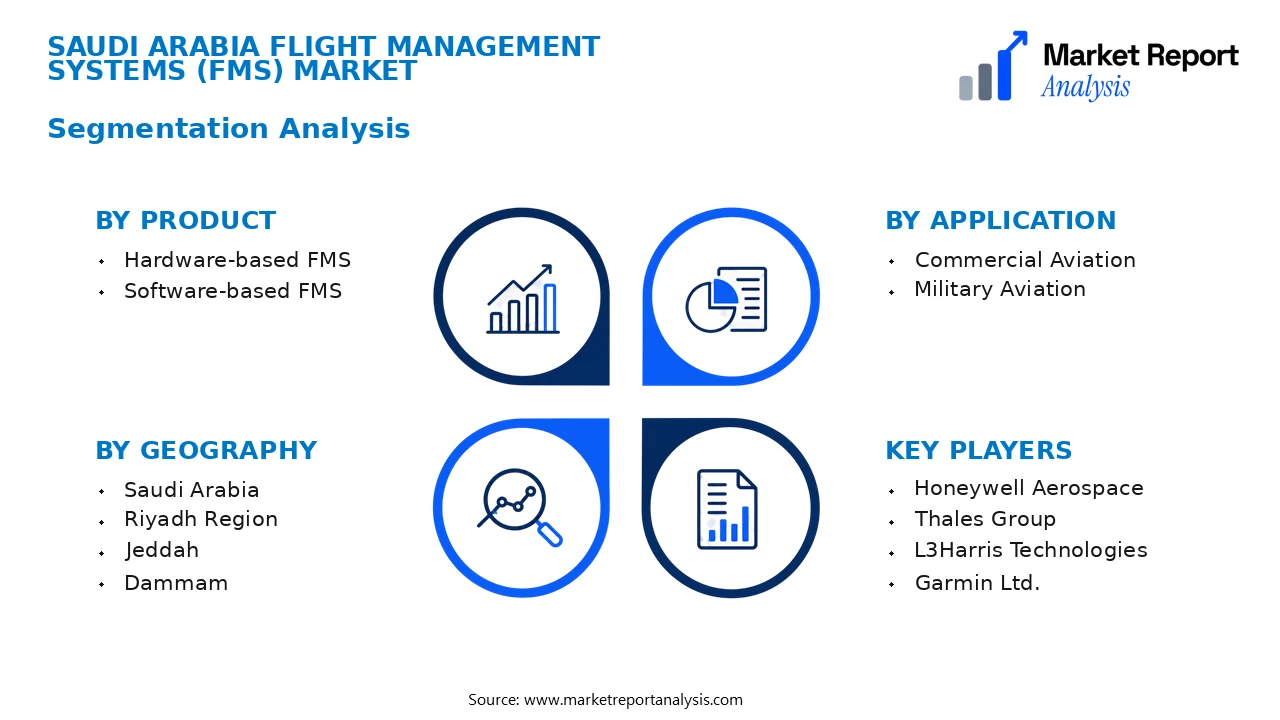
- Product
- Hardware-based FMS: This subsegment encompasses flight management systems that rely primarily on physical hardware components. It is increasingly adopted in new aircraft for enhanced reliability and real-time data processing capabilities, especially in commercial and military sectors.
- Software-based FMS: These systems emphasize advanced software solutions integrated into existing aircraft platforms. They are favored for their upgradeability, cost efficiency, and ability to incorporate latest navigational algorithms, fostering growth in retrofit applications.
- Application
- Commercial Aviation: Dominating the market, commercial aircraft in Saudi Arabia utilize FMS to optimize routes, reduce fuel consumption, and enhance safety. Increasing air traffic in the kingdom’s major airports drives demand for sophisticated FMS solutions.
- Military Aviation: The defense sector employs FMS for combat, surveillance, and transport aircraft to improve mission accuracy, navigational safety, and operational efficiency, crucial with Saudi Arabia’s ongoing defense modernization efforts.
- Component
- Inertial Navigation Systems (INS): INS components are vital for precise aircraft positioning, especially in adverse weather or GPS-denied environments. Their demand is bolstered by the kingdom’s focus on enhanced navigational safety.
- Radio Navigation Equipment: This element supports communication and navigation, serving as essential backup to satellite-based systems, thereby maintaining safety standards amid varied operational scenarios in Saudi commercial and military aviation.
- Display & Control Units: These interface components provide pilots with critical flight data, and their integration with modern FMS enhances situational awareness and decision-making during flight operations in all Saudi airspace sectors.
- Geography
- Saudi Arabia: As the largest market within the Gulf Cooperation Council, Saudi Arabia commands substantial demand driven by expanding airline operations, fleet modernizations, and infrastructural upgrades at primary airports.
- Riyadh Region: Center of economic activity and aviation hub, Riyadh hosts numerous commercial airlines and government agencies, making it a focal point for FMS deployment and technological upgrades.
- Jeddah: As a key gateway for international travelers and home to the main gateway airport, Jeddah facilitates high demand for advanced FMS to support its growing international and cargo flight operations.
- Dammam: A strategic industrial and logistical hub in the Eastern Province, Dammam’s expanding aviation infrastructure promotes local demand for robust flight management systems applicable in both commercial and military sectors.
- Mecca & Medina: Religious tourism drives significant internal and international air traffic. Ensuring safe and efficient flights with state-of-the-art FMS is crucial to managing peak travel periods efficiently.
- Al Khobar & Jubail: These cities serve as key industrial centers with increasing aviation activity supporting economic diversification efforts, thus escalating demand for reliable flight management solutions in various flight operations.
Competitive Intelligence
The Saudi Arabia Flight Management Systems (FMS) Market is marked by intense competition among established aerospace electronics providers and emerging local players. Major international firms, such as Honeywell and Collins Aerospace, dominate with advanced, integrated FMS solutions tailored for Saudi carriers and government fleets, contributing to high market concentration. These companies employ aggressive strategies focused on product innovation, particularly in enhancing system reliability, fuel efficiency, and cybersecurity features, to meet stringent Saudi aviation regulations. Strategic partnerships and joint ventures with local aerospace manufacturers and technology firms facilitate market penetration and compliance with Saudi standards. Recent acquisitions and expansion initiatives in cities like Riyadh and Jeddah aim to establish regional hubs for R&D and manufacturing, amplifying competitive advantages. Significant R&D investments center on integrating artificial intelligence and automation capabilities into FMS products, differentiating offerings in terms of technology leadership. These strategic moves underscore a focus on maintaining technological superiority, securing customer loyalty, and expanding market share across both commercial and military segments in Saudi Arabia.
Leading Company Profiles
The Saudi Arabia FMS market hosts a spectrum of prominent global and regional aerospace component suppliers that compete through technological innovation, comprehensive service offerings, and strategic partnerships. The competitive environment is characterized by continuous R&D investments, localization efforts, and tailored product solutions designed to meet the country's unique regulatory and operational standards.
- Honeywell Aerospace
- Thales Group
- L3Harris Technologies
- Garmin Ltd.
- Rockwell Collins
- Airbus Defence and Space
- Boeing
- Indra Sistemas
- Saab AB
- Leonardo S.p.A.
Honeywell Aerospace
Honeywell Aerospace specializes in integrated avionics, including advanced FMS solutions optimized for commercial and military aircraft, emphasizing reliability, safety, and fuel efficiency through its pioneering technology capabilities and strategic regional collaborations.
Thales Group
Thales offers innovative flight management systems characterized by seamless integration, real-time data processing, and heightened cybersecurity measures, with strategic focus on expanding regional footprint through partnerships and tailored solutions for the Middle East market.
L3Harris Technologies
L3Harris provides state-of-the-art avionics systems, including customized FMS solutions for business jets and military aircraft, driven by its competitive strengths in technological innovation and extensive defense-sector experience.
Garmin Ltd.
Garmin's focus on lightweight, portable FMS solutions for general aviation and business aircraft features user-friendly interfaces and cost-effective models, aligning with emerging budget-conscious and technologically advanced regional aviation needs.
Rockwell Collins
Rockwell Collins delivers next-generation cockpit and FMS systems emphasizing situational awareness, operational efficiency, and compliance with international standards, supported by its extensive global service network and technological expertise.
Airbus Defence and Space
Airbus provides comprehensive avionics solutions, including integrated FMS systems, with a focus on scalability, safety, and interoperability, leveraging its broad aerospace portfolio to support extensive regional modernization programs.
Boeing
Boeing's avionics division develops advanced FMS platforms that focus on operational accuracy, fuel efficiency, and cybersecurity, with strategic emphasis on supporting Saudi Arabia’s expanding commercial fleet and defense sectors.
Indra Sistemas
Indra offers cutting-edge avionic solutions with a strong focus on digital integration, cybersecurity, and customization for Middle Eastern markets, strengthening its regional penetration through innovative product development and alliances.
Saab AB
Saab specializes in military-grade FMS and integrated avionics, emphasizing technological resilience, system robustness, and advanced navigation capabilities to meet Saudi Arabia's defense and security priorities.
Leonardo S.p.A.
Leonardo’s avionics expertise in integrated systems, including FMS for both civil and military aircraft, leverages its strategic focus on innovation, cybersecurity, and regional partnerships to expand market share and technological influence in Saudi Arabia.
Strategic Business Developments
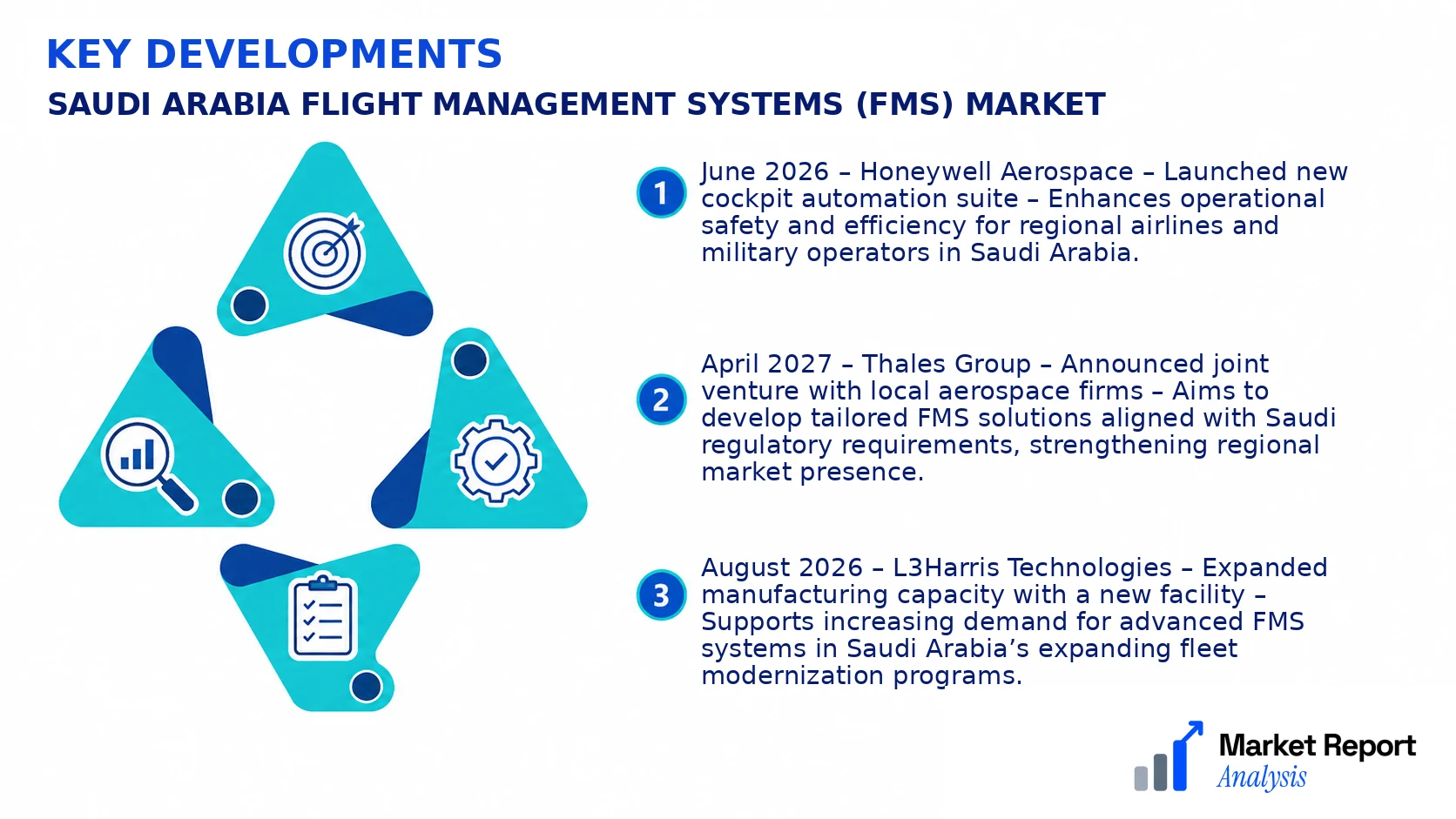
- June 2026 – Honeywell Aerospace – Launched new cockpit automation suite – Enhances operational safety and efficiency for regional airlines and military operators in Saudi Arabia.
- April 2027 – Thales Group – Announced joint venture with local aerospace firms – Aims to develop tailored FMS solutions aligned with Saudi regulatory requirements, strengthening regional market presence.
- August 2026 – L3Harris Technologies – Expanded manufacturing capacity with a new facility – Supports increasing demand for advanced FMS systems in Saudi Arabia’s expanding fleet modernization programs.
- January 2028 – Garmin Ltd. – Introduced lightweight FMS platform – Caters to general aviation and business aircraft sectors in Saudi Arabia, emphasizing cost efficiency and ease of integration.
- March 2027 – Airbus Defence and Space – Formed strategic alliance with Saudi aerospace authorities – Focuses on localizing production and supporting regional aircraft modernization initiatives, boosting industry competitiveness.
Frequently Asked Questions
What is the Saudi Arabia Flight Management Systems (FMS) Market?
The Saudi Arabia Flight Management Systems (FMS) Market encompasses the development, deployment, and maintenance of advanced electronic systems in commercial and military aircraft that facilitate navigation, flight planning, and aircraft performance management, tailored specifically to the Saudi aviation sector.
What is the current market size of Saudi Arabia Flight Management Systems (FMS) Market?
As of 2026, the market size of Saudi Arabia's Flight Management Systems (FMS) is valued at approximately USD 1.2 Billion, reflecting increasing integration of advanced avionics in both new and retrofitted aircraft across the country.
What factors are driving the Saudi Arabia Flight Management Systems (FMS) Market?
Key drivers include expanding Saudi Arabian airline fleets, government initiatives to modernize aviation infrastructure, increased focus on flight safety and efficiency, and rising investments from aerospace manufacturers aiming to strengthen regional presence.
Which Saudi city leads the Saudi Arabia Flight Management Systems (FMS) Market?
Riyadh leads the market, primarily due to its status as the commercial capital, hosting the largest airports and the primary operations hubs for national carriers, thus significantly influencing FMS adoption and growth.
Which segment is expected to grow the fastest?
The retrofit segment is projected to expand rapidly, driven by the aging aircraft fleet needing modernization and the increasing adoption of innovative FMS solutions to meet evolving safety and operational standards.
Who are the leading companies operating in the Saudi Arabia Flight Management Systems (FMS) Market?
Major players include Honeywell Aerospace, Thales Group, and Collins Aerospace, which are actively supplying advanced FMS platforms and forming strategic partnerships to enhance market penetration within Saudi Arabia.
Analyst Perspective
The Saudi Arabia Flight Management Systems (FMS) market exhibits a mature yet evolving landscape, with significant long-term growth driven by modernization initiatives and an increasing fleet renewal rate. The government's strategic emphasis on enhancing Hajj and domestic connectivity is fueling demand for advanced avionics systems, including FMS. Commercial opportunities are particularly attractive within Riyadh and Jeddah, where expanding airport capacities and ambitious national infrastructure projects are fostering integration of cutting-edge FMS technologies. Technological evolution is centered on the integration of AI-driven navigation, enhanced cybersecurity measures, and greater automation to improve operational efficiency and safety. Investment priorities should target collaborations with leading aerospace OEMs to facilitate localized innovation and support the development of indigenous capabilities. Competitive intensity remains high with a blend of international and regional players; however, local partnerships and technology transfer agreements offer strategic leverage. Over the long term, focus on city-specific developments and tailored solutions will be essential in capturing market share and sustaining growth, positioning Saudi Arabia as a regional leader in flight management innovation.
