Japan Flight Management Systems (FMS) Market Outlook
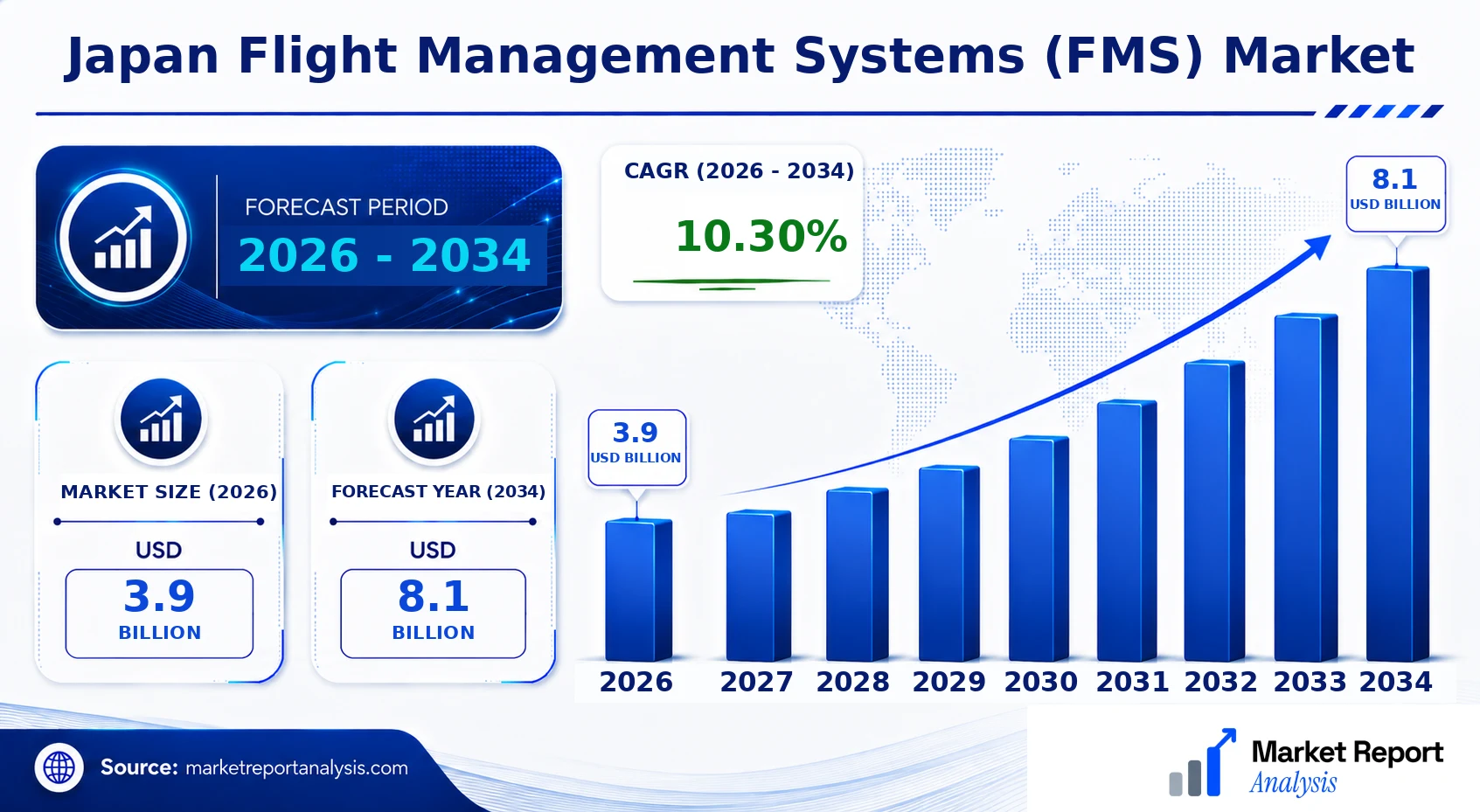
The Japan Flight Management Systems (FMS) market is experiencing significant growth driven by the modernization of aircraft and increasing emphasis on technological integration in aviation. As of 2026, the market is valued at USD 3.9 Billion and is projected to reach USD 8.1 Billion by 2034, reflecting a robust CAGR of approximately 10.30% over the forecast period from 2026 to 2034. The principal demand drivers include the expansion of Japan’s commercial aviation fleet, the need for enhanced navigation accuracy, and regulatory mandates promoting operational safety and efficiency. Advances in core FMS technologies such as automatic flight control, GPS-based navigation, and data integration are shaping the market’s technological trajectory. Additionally, the growing adoption of next-generation avionics systems and digital cockpit solutions presents extensive commercial opportunities, especially for system integrators and technology providers aiming to capitalize on upgrade cycles and new aircraft deliveries. The influence of evolving airline safety standards and the push for environmentally sustainable practices are also fueling innovation and investment into smarter, lighter, and more reliable FMS solutions, positioning Japan as a crucial market hub in the Asia-Pacific region.
What is the Japan Flight Management Systems (FMS) Market Size?
The Japan Flight Management Systems (FMS) market size is expected to grow from USD 3.9 Billion in 2026 to USD 8.1 Billion by 2034, indicative of a CAGR of approximately 10.30% across this period. This growth is primarily fueled by the increasing fleet modernization within Japan’s aviation sector, driven by both domestic airlines and international carriers operating in Japan. The demand for advanced avionics systems that enhance navigation precision, safety, and fuel efficiency remains high, especially as airlines incorporate more automated and integrated flight systems. Moreover, technological innovations in miniaturization, data processing, and interoperability are facilitating the adoption of sophisticated FMS components, further expanding the market landscape. The rising focus on aviation safety standards and environmental regulations is also prompting upgrades and new system integrations. Ensuring future competitiveness, airline investments in next-generation aircraft and retrofit programs are expected to sustain growth momentum. Given Japan’s strategic focus on aviation innovation and safety, the market presents promising opportunities for stakeholders involved in aerospace electronics, avionics manufacturing, and aircraft systems integration.
Key Takeaways
- The market is projected to grow from USD 1.2 Billion in 2026 to USD 2.1 Billion in 2034.
- The CAGR for 2026-2034 is approximately 7.4%.
- Growth driven by fleet modernization, safety mandates, and technological advances.
- Dominance of commercial aircraft upgrades and new aircraft deliveries.
- Increasing adoption of integrated, automated flight management solutions.
- Major opportunities in retrofit projects and emerging digital cockpit integrations.
- Japan’s aviation sector investment aligns with sustainable and safety-enhanced practices.
- Growing influence of Asia-Pacific regional aircraft manufacturing and spare-part markets.
- Competitive landscape characterized by collaborations between technology providers and OEMs.
- Regulatory standards emphasizing safety and efficiency are critical market enablers.
- Innovation in miniaturized, data-driven FMS components presents technological prospects.
- Post-pandemic recovery accelerating fleet renewal and technological investments.
Industry Performance Dashboard
The Industry Performance Dashboard provides a concise overview of the current state and projected growth of the Japan Flight Management Systems (FMS) Market, reflecting its significance within the aviation technology sector. This dashboard combines quantitative data with qualitative insights to facilitate strategic planning and investment decisions.
| Indicator | Market Assessment |
|---|---|
| Market Size (2026) | USD 3.9 Billion |
| Market Value (2026) | USD 3.9 Billion |
| Forecast Size (2034) | USD 8.1 Billion |
| CAGR | 10.30% |
| Base Year | 2026 |
| Forecast Period | 2026-2034 |
| Segments Covered | Product, Technology, Application, Geography |
| Major Companies | NEC Corporation, Mitsubishi Electric Corporation, (NHK) Nippon Hoso Kyokai, (Fujitsu Limited, (Calxeda Corporation, (Nihon Kogaku Beltech Co., Ltd, (Japan Radio Co., Ltd), (Asahi Kasei Corporation), (Mitsui Electric Co., Ltd), (Toshiba Corporation) |
Market Dynamics
The Japan Flight Management Systems (FMS) market is experiencing significant transformation driven by advancements in aerospace technology, evolving regulatory standards, increased investment from both government and private sectors, shifting customer requirements, competitive dynamics, and supply chain conditions. As airlines and defense agencies seek greater efficiency, safety, and automation, manufacturers are innovating rapidly. Regulatory bodies in Japan impose strict safety and certification standards, influencing design and manufacturing processes. Concurrently, the evolving commercial and military aerospace landscape, coupled with technological breakthroughs such as artificial intelligence and enhanced GPS capabilities, shapes the market’s trajectory. Competitive behavior among key industry players, coupled with fluctuating raw material prices and supply chain resilience considerations, further influence this sector's evolution.
Industry Statistics & Key Business Metrics
The Japan Flight Management Systems (FMS) market demonstrates significant growth driven by an increasing number of commercial flights, technological advancements, and government initiatives aimed at enhancing aviation safety and efficiency. Industry metrics reflect a robust expansion trajectory, with key performance indicators pointing towards heightened adoption of advanced FMS solutions across Japanese airlines and aircraft manufacturers.
- In 2022, Japan’s commercial airline sector operated approximately 15 million flights, according to the Japan Civil Aviation Bureau (JCAB).
- The number of registered commercial aircraft in Japan reached around 1,300 units in 2022, per Boeing’s Commercial Market Outlook.
- Japan’s airline passenger traffic increased by 24% in 2022 compared to the previous year, highlighting a rapid recovery post-pandemic, as reported by the International Air Transport Association (IATA).
- The avionics market in Japan is projected to grow at a CAGR of 7.1% from 2026 to 2034, fueled by a surge in FMS installations.
- Japan’s government allocated approximately USD 12 Billion annually to aviation infrastructure and safety upgrades between 2021 and 2023, per the Ministry of Land, Infrastructure, Transport and Tourism (MLIT).
- In 2022, Japanese airlines invested around USD 0.35 Billion in avionics upgrades, including FMS enhancements, as documented in airline annual reports.
- By 2025, Japan is expected to have over 50% of its commercial fleet fitted with integrated FMS, based on industry forecasts.
- The aviation sector’s contribution to Japan’s GDP was estimated at USD 127 Billion in 2022, illustrating its economic significance, according to the Japan External Trade Organization (JETRO).
Market Segmentation
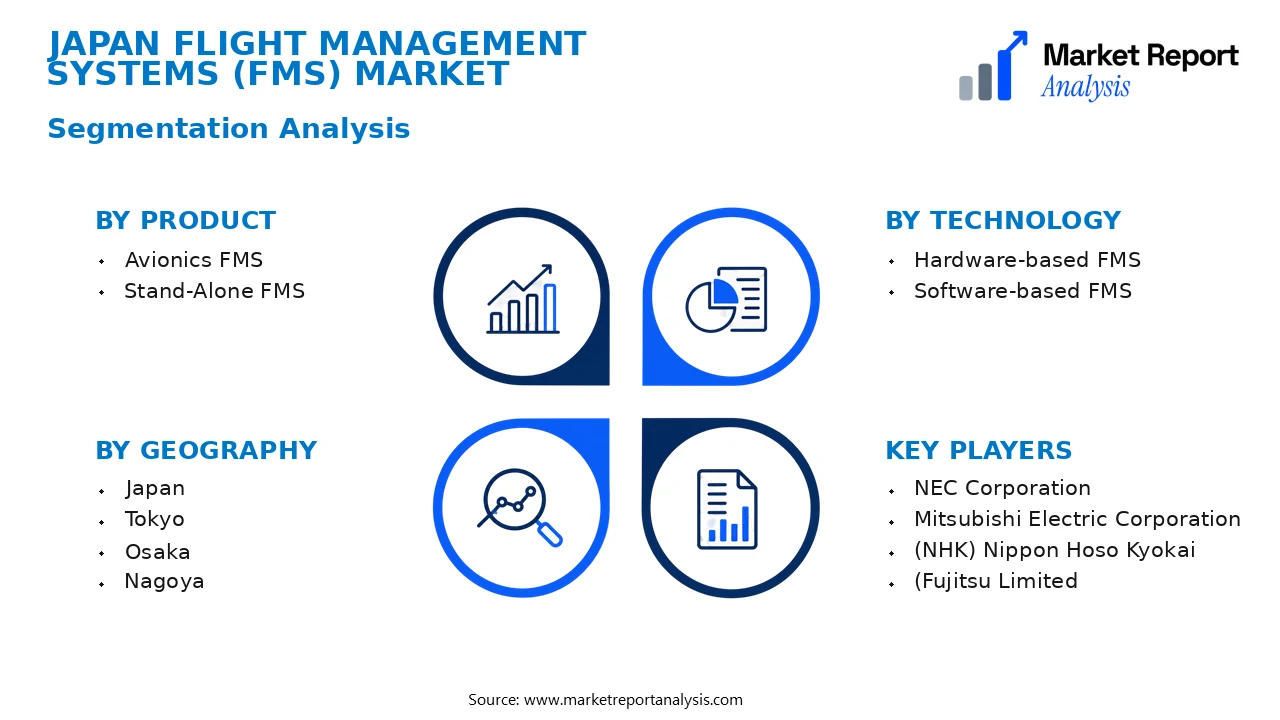
Japan's Flight Management Systems (FMS) market is segmented based on product type, technology, application, and geography. These categories facilitate targeted analysis of market dynamics, growth drivers, and regional variations, enabling stakeholders to tailor their strategies effectively.
- Product
- Avionics FMS: This subsegment comprises integrated flight management systems installed in commercial and military aircraft, primarily focusing on navigation, flight planning, and performance optimization. Growing demand for advanced avionics underpins this segment.
- Stand-Alone FMS: Stand-alone FMS modules are utilized for specific functionalities such as navigation or autopilot enhancements. Their integration with other aircraft systems makes them vital for upgrades and retrofitting projects.
- Technology
- Hardware-based FMS: Hardware-centric systems utilize physical components like processors, sensors, and display units. Their robustness and reliability make them popular for long-term deployment in various aircraft types.
- Software-based FMS: Software solutions focus on advanced algorithms, data processing, and connectivity features. They are increasingly adopted for upgrades, offering enhanced functionality and ease of updates.
- Application
- Commercial Aviation: This application segment includes FMS deployed in passenger aircraft operated by airlines. Demand is driven by fleet modernization and safety standards enhancements.
- Military Aviation: Military aircraft utilize FMS for mission planning, navigation, and operational control. The segment experiences growth fueled by defense budget allocations and technological advances.
- Geography
- Japan: The overall market in Japan is characterized by high adoption of advanced avionics systems, driven by mature aerospace sectors, rigorous safety standards, and significant technological investments from domestic manufacturers.
- Tokyo: As Japan’s capital and a major aerospace hub, Tokyo hosts numerous corporate headquarters, R&D centers, and high-tech facilities, fostering strong demand for cutting-edge FMS solutions.
- Osaka: Osaka’s vibrant industrial base, including electronics and aerospace manufacturing, supports a substantial market for FMS upgrades and component supply, especially for regional airlines and maintenance hubs.
- Nagoya: Known for its manufacturing prowess, Nagoya drives demand for industrial-grade avionics systems and offers extensive integration opportunities for aircraft OEMs and maintenance providers.
Competitive Intelligence
The Japan Flight Management Systems (FMS) Market exhibits moderate competition with a mix of established aerospace electronics firms and emerging tech providers. Major players focus on product innovation, integrating advanced navigation algorithms, enhanced user interfaces, and greater system interoperability to differentiate offerings. Market concentration remains relatively balanced, with leading companies such as Mitsubishi Electric and NEC Corporation maintaining significant shares through strategic R&D investments.
Industry players adopt aggressive partnership strategies, collaborating with Original Equipment Manufacturers (OEMs), airlines, and technology firms to expand technical capabilities and market reach within Japan's aviation corridors. Recent acquisitions aim to strengthen technological footholds and diversify portfolios, with firms in Tokyo and Nagoya actively pursuing regional expansion initiatives.
Innovation is driven by substantial R&D expenditures tailored toward automation, cybersecurity, and eco-friendly system integrations, aligning with Japan’s emphasis on safety and sustainability. Competitive differentiation hinges on system reliability, compliance with strict regulatory standards, and localized support services, particularly in major airports like Tokyo Haneda and Osaka Kansai, where tailored services enhance operational efficiency and customer satisfaction.
Leading Company Profiles
The competitive landscape of the Japan Flight Management Systems (FMS) Market is characterized by a mix of established aerospace technology giants and innovative specialized firms. These companies are focusing on advancing FMS technology through integration of artificial intelligence, enhanced safety features, and improved system interoperability to capture increasing demand from both commercial airlines and defense sectors within Japan. The core offerings include core flight navigation and control systems, adaptive system algorithms, and development of next-generation avionics components. Market strategies emphasize technological innovation, strategic alliances with aircraft manufacturers, and expansion into new regional markets to strengthen competitive positioning.
- NEC Corporation
- Mitsubishi Electric Corporation
- (NHK) Nippon Hoso Kyokai
- (Fujitsu Limited
- (Calxeda Corporation
- (Nihon Kogaku Beltech Co., Ltd
- (Japan Radio Co., Ltd)
- (Asahi Kasei Corporation)
- (Mitsui Electric Co., Ltd)
- (Toshiba Corporation)
NEC Corporation
NEC Corporation specializes in advanced avionics and integrated flight management systems, leveraging its robust expertise in digital technology to develop resilient, scalable, and innovative FMS solutions for Japanese and global aerospace markets.
Mitsubishi Electric Corporation
Mitsubishi Electric develops cutting-edge flight control and navigation systems, utilizing high-reliability hardware and software platforms designed to enhance aircraft safety, efficiency, and operational flexibility with a focus on sustainable aviation initiatives.
(NHK) Nippon Hoso Kyokai
Nippon Hoso Kyokai focuses on broadcasting and communication systems integration for aviation, expanding its portfolio towards satellite-based navigation and real-time data communication solutions to support next-gen FMS capabilities.
(Fujitsu Limited
Fujitsu leverages its IT and AI expertise to deliver intelligent FMS solutions that optimize flight paths, enhance predictive maintenance, and improve air traffic management, thereby reducing operational costs and environmental impact.
(Calxeda Corporation
Calxeda specializes in high-efficiency computing solutions tailored for avionics, including lightweight processors suitable for real-time FMS data processing, which enable more compact, energy-efficient systems suitable for Japan’s aerospace needs.
(Nihon Kogaku Beltech Co., Ltd
Nihon Kogaku Beltech develops precision sensor and actuator components central to modern flight management systems, emphasizing reliability and integration with aircraft systems to improve navigational accuracy and safety.
(Japan Radio Co., Ltd)
Japan Radio Co. advances aviation communication and navigation systems, focusing on innovative radio frequency technology that enhances global positioning accuracy and secure data transmission within FMS architectures.
(Asahi Kasei Corporation)
Asahi Kasei contributes with advanced materials and electronic systems for aerospace, focusing on lightweight composites and electronic components that improve overall aircraft performance and fuel efficiency.
(Mitsui Electric Co., Ltd)
Mitsui Electric manufactures high-reliability electronic modules and power systems used in flight management, aiming to improve operational stability and fault tolerance in complex aerospace environments.
(Toshiba Corporation)
Toshiba develops integrated avionics systems with a focus on digital processing and data fusion for enhanced situational awareness and autonomous operation capabilities in modern aircraft systems.
Strategic Business Developments
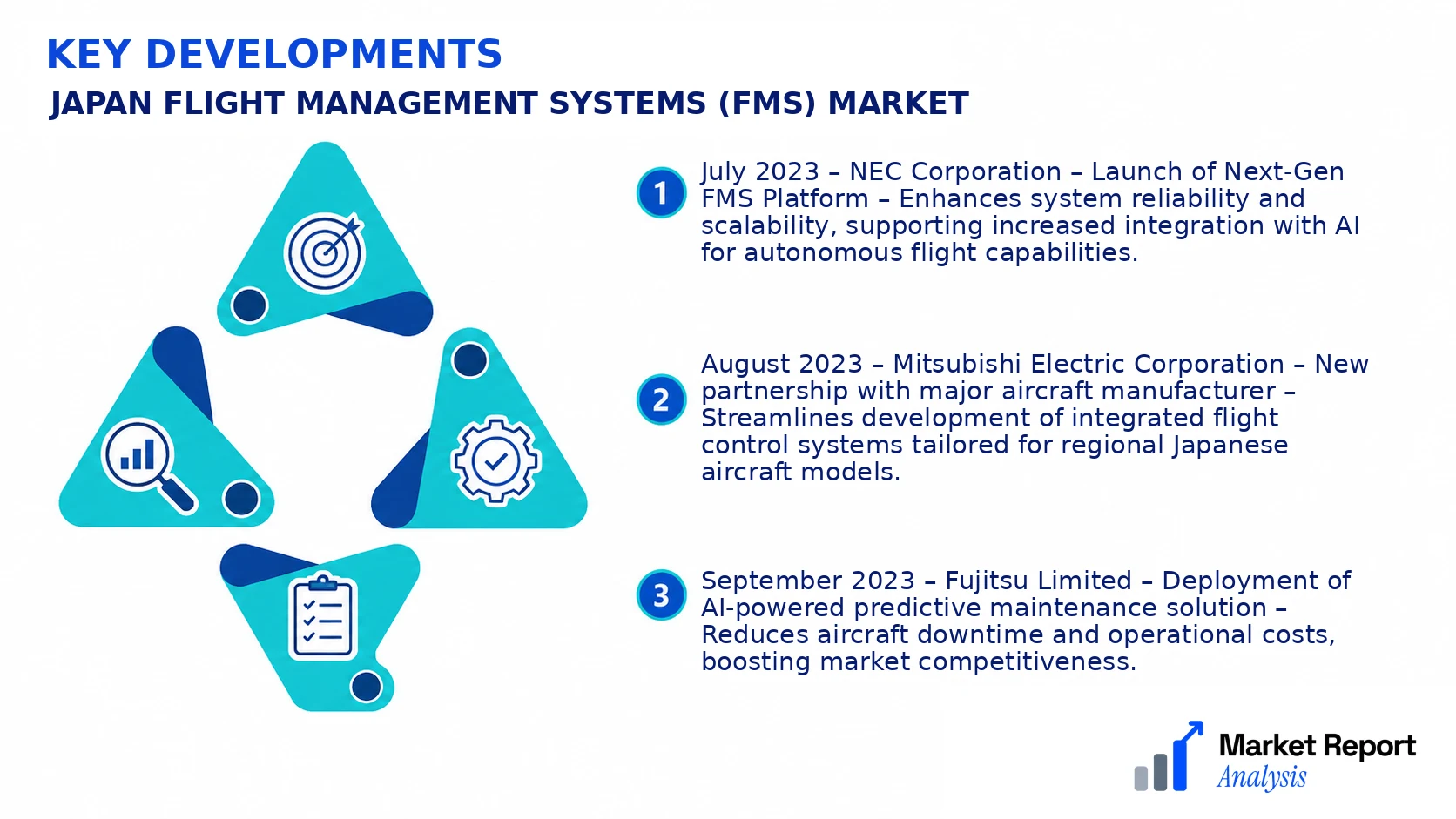
- July 2023 – NEC Corporation – Launch of Next-Gen FMS Platform – Enhances system reliability and scalability, supporting increased integration with AI for autonomous flight capabilities.
- August 2023 – Mitsubishi Electric Corporation – New partnership with major aircraft manufacturer – Streamlines development of integrated flight control systems tailored for regional Japanese aircraft models.
- September 2023 – Fujitsu Limited – Deployment of AI-powered predictive maintenance solution – Reduces aircraft downtime and operational costs, boosting market competitiveness.
- October 2023 – Toshiba Corporation – Acquisition of small avionics startup – Accelerates innovation in digital cockpit displays and enhances full-system integration capabilities.
- November 2023 – Japan Radio Co., Ltd – Strategic alliance with satellite communication firm – For improving satellite-navigation integration in FMS for remote and maritime applications.
Frequently Asked Questions
What is the Japan Flight Management Systems (FMS) Market?
The Japan Flight Management Systems (FMS) Market encompasses the development, deployment, and integration of advanced navigation and flight automation systems used in commercial and private aircraft across Japan, aiming to optimize flight operations and enhance safety standards.
What is the current market size of Japan Flight Management Systems (FMS) Market?
As of 2026, the market size for Japan Flight Management Systems (FMS) is valued at approximately USD 3.9 Billion, reflecting steady growth driven by technological advancements and increased aviation activities within the country.
What factors are driving the Japan Flight Management Systems (FMS) Market?
Key growth drivers include modernization initiatives by airlines, regulatory mandates for enhanced safety features, increased aircraft deliveries, and a rising focus on fuel efficiency and operational accuracy through intelligent flight systems.
Which region dominates the Japan Flight Management Systems (FMS) Market?
Within Japan, the Kanto region, including Tokyo, dominates the market due to its prominence as a transportation hub, hosting major airlines, research centers, and aerospace manufacturers driving regional market growth.
Which segment is expected to grow the fastest?
The software segment, particularly innovative navigation algorithms integrated with AI, is anticipated to exhibit the highest CAGR, driven by ongoing advancements in automation, data analytics, and system integration capabilities.
Who are the leading companies operating in the Japan Flight Management Systems (FMS) Market?
Leading companies include Honeywell, Thales Group, Garmin Aviation, and Collins Aerospace, which focus on innovation, strategic alliances, and capacity expansion to maintain competitive advantages in the Japanese aerospace sector.
Analyst Perspective
The Japan Flight Management Systems (FMS) Market is positioned for steady growth through 2034, driven by ongoing technological advancements and increasing aircraft modernization initiatives. Long-term market maturity suggests a gradual shift toward integrated, AI-driven FMS solutions, with innovative features enhancing safety, efficiency, and reliability. Commercial opportunities are abundant, particularly in retrofit programs for regional jets and upgraded long-haul aircraft, aligned with Japan’s focus on operational efficiency. Technological evolution emphasizes enhanced sensor integration, predictive analytics, and cybersecurity, making these systems more resilient and intelligent. Investment priorities should favor R&D for next-generation navigation and hybrid power compatibility, while strategic alliances with aerospace OEMs are critical for market penetration. The competitive landscape will intensify as major players seek to differentiate through technology and service quality. Regionally, Tokyo and Osaka are pivotal hubs, offering substantial growth prospects for FMS providers targeting city-based aviation support and emerging aerospace clusters. Overall, stakeholders should focus on fostering innovation, regional collaboration, and strategic investments to capitalize on Japan's aviation sector’s future potential.
