Indonesia Flight Management Systems (FMS) Market Outlook
The Indonesia Flight Management Systems (FMS) market is projected to be valued at USD 1.2 Billion in 2026 and is forecasted to reach USD 2.2 Billion by 2034, exhibiting a robust CAGR of approximately 8.0% over the period. This growth is driven by an expanding commercial fleet, modernization initiatives within Indonesia's aviation sector, and increasing regulatory requirements concerning safety and navigation systems. Advances in technology, particularly the integration of next-generation avionics with artificial intelligence and enhanced data processing capabilities, are further propelling market development. The market presents significant commercial opportunities for OEMs, software developers, and avionics service providers aiming to capitalize on Indonesia's strategic geographical position and rising air travel demand, especially in regional and budget carriers expanding their presence across Southeast Asia.
What is the Indonesia Flight Management Systems (FMS) Market Size?
In 2026, the market size for Indonesia's Flight Management Systems (FMS) is estimated at USD 1.2 Billion, with forecasts projecting an increase to USD 2.2 Billion by 2034. This signifies a healthy CAGR of 8.0% during the forecast period, reflecting the increasing adoption of sophisticated avionics across Indonesia's expanding fleet. Growth drivers include the country’s rising air passenger demand, driven by tourism, business travel, and regional connectivity improvements, as well as government incentives for fleet modernization and safety upgrades. The commercial airline sector is the predominant end-user, increasingly investing in integrated FMS solutions that enhance navigation accuracy, fuel efficiency, and regulatory compliance. Moreover, the continuous technological evolution toward more lightweight, energy-efficient, and highly automated systems is attracting significant investment from market participants. The government’s strategic initiatives toward achieving a resilient and modern aviation infrastructure further support the system's uptake, fostering sustained market growth and innovation in the upcoming years.
Key Takeaways
- The market size for Indonesia’s FMS industry is projected to grow from USD 1.2 Billion in 2026 to USD 2.2 Billion by 2034.
- The CAGR during 2026-2034 is estimated at 8.0%, driven by fleet modernization and technological advancements.
- Commercial airlines dominate demand, emphasizing safety, efficiency, and regulatory compliance.
- Growing air passenger traffic significantly influences demand for advanced FMS solutions.
- Technological innovations such as AI integration and lightweight components are shaping future developments.
- Vietnam’s expanding regional and domestic air routes are expanding the market’s geographic footprint.
- Government policies favoring fleet upgrades and safety enhancements are key adoption catalysts.
- Market players are increasingly focused on offering customized, scalable, and integrated avionics solutions.
- Partnerships and collaborations with local airlines and OEMs are pivotal for market penetration.
- Investments in R&D to develop more autonomous, energy-efficient systems are prominent trends.
- Market competition is intensifying, with local and international players vying for technological and service excellence.
- Sustainable and eco-friendly systems are becoming a focus, aligning with global aviation trends.
- Regulatory frameworks are gradually evolving, promoting compliance and innovation in avionics systems.
Industry Performance Dashboard
The Industry Performance Dashboard provides a comprehensive snapshot of the Indonesia Flight Management Systems (FMS) market, capturing key metrics that reflect its current stature and projected growth trajectory. This dashboard consolidates vital indicators that underscore market dynamics, technological development, and competitive landscape. The market size in 2026 is projected to reach USD 2.5 Billion, reflecting robust adoption of FMS solutions in Indonesia’s expanding aviation sector, with continued growth forecasted through 2034. The expected market size in 2034 is USD 4.9 Billion, indicating a CAGR of approximately 8.7% over the forecast period from 2026 to 2034. The base year for these figures is 2026, offering a consistent reference point for trend analysis, with the forecast extending over an 8-year period. The segment coverage encompasses commercial, business, and military aircraft, with technological trends gravitating towards integrated navigation and AI-driven analytics. Major companies operating within this market include Honeywell International Inc., Garmin Ltd., Thales Group, and Collins Aerospace, each contributing significantly to product innovation and market penetration. Investment trends show a steady influx of capital into R&D activities aimed at enhanced safety, reliability, and user-interface improvements. Pricing strategies are becoming increasingly competitive, driven by technological advancements and regional demand. The market maturity is characterized by a blend of emerging and established players, positioning Indonesia as a key growth hub for FMS expansion in Southeast Asia.
The Indonesia Flight Management Systems (FMS) market is experiencing significant transformation driven by technological advancements, evolving regulatory standards, and increasing customer expectations. Investment in modern aviation infrastructure and FMS innovation is accelerating, with airlines and OEMs seeking integrated, reliable platforms to optimize flight operations. Competitive dynamics are intensifying as vendors differentiate through product upgrades and service offerings, while supply chain conditions and pricing strategies impact market accessibility. The complex interplay of these factors shapes a highly dynamic environment where technological shifts, regulatory compliance, and strategic investments continually influence market growth and competitiveness.Market Dynamics
As Indonesia's aviation sector expands rapidly, the demand for advanced flight management systems is driven by technological evolution, regulatory changes, and rising customer requirements. Innovations in avionics, digitalization efforts, and the push for operational efficiency are prompting both OEMs and airlines to upgrade their FMS offerings. Investment flows are focused on integrating new features such as automation, connectivity, and real-time data processing. Meanwhile, competitive behaviors reflect a race to provide more sophisticated, cost-effective solutions, influencing pricing and supply chain strategies. Overall, these systemic drivers are propelling Indonesia’s FMS market toward substantial growth, albeit amid certain regulatory and supply chain challenges.
Drivers
Technological Advancements in Avionics
The rapid pace of technological advancements in avionics systems significantly impacts the Indonesian FMS market. Airlines and OEMs are increasingly seeking cutting-edge solutions that improve navigation accuracy, fuel efficiency, and safety. The integration of digital cockpit technologies, enhanced sensors, and artificial intelligence-driven analytics enables airlines to optimize flight paths and reduce operational costs. For instance, the adoption of automated flight management algorithms is enabling aircraft to adapt dynamically to weather and air traffic conditions in Indonesia’s busy skies. The trend towards digitalization underscores the importance of ongoing R&D investments and collaboration with innovative tech providers to keep pace with global advancements.
Regulatory Compliance and Certification
Indonesia’s aviation regulatory environment plays a pivotal role in shaping the FMS market, with authorities emphasizing safety, interoperability, and environmental standards. Certification processes for new FMS technologies often influence product development and deployment timelines. As the International Civil Aviation Organization (ICAO) updates guidelines, manufacturers are compelled to adapt their solutions to ensure compliance. This regulatory landscape creates both a market entry barrier for new entrants and an incentive for existing players to innovate within compliance frameworks. The ongoing harmonization of global and local standards will continue to influence the pace and nature of FMS adoption across Indonesia’s airlines and maintenance service providers.
Investment in Digital Infrastructure
Indonesia’s increasing investment in digital and aviation infrastructure markedly supports the expansion of its FMS market. Government initiatives aimed at modernizing air traffic management systems, alongside private sector investments, are fostering a conducive environment for deploying advanced FMS solutions. The modernization projects include upgrades in radar, satellite connectivity, and data sharing platforms that enable seamless integration of FMS with broader air navigation systems. Such investments improve operational efficiency, safety, and compliance, encouraging airline operators to adopt increasingly sophisticated FMS. Moreover, international development agencies and financial institutions are providing funding, further accelerating market growth.
Customer Demand for Operational Efficiency
Customer requirements in Indonesia are increasingly oriented toward operational efficiency, safety, and cost savings, which directly influence FMS adoption. Airlines are under pressure to optimize routes, minimize fuel consumption, and improve on-time performance amid fierce competition. The growing passenger demand for affordable, punctual flights drives airlines to leverage advanced FMS capabilities that enable real-time decision-making and automation. The trend towards passenger-centric services, including seamless connectivity and personalized experiences, also propels the need for integrated systems. Consequently, airlines prioritize investing in FMS that enhances overall operational agility to meet these evolving customer expectations.
Restraints
High Costs of FMS Implementation
The substantial upfront investment and ongoing maintenance costs associated with advanced FMS can restrain market growth, especially among smaller carriers and regional airlines. The cost includes hardware upgrades, software licenses, certification processes, and staff training, which can be prohibitive within budget-constrained environments. In Indonesia, where many airlines operate with tight margins, this financial barrier may delay or limit the deployment of cutting-edge systems. Consequently, airlines might opt for legacy systems or postpone upgrades, affecting the overall market expansion and pace of technological adoption in the region.
Limited Local Infrastructure and Technical Support
The underdeveloped digital infrastructure and scarcity of specialized local technical support act as significant hurdles for FMS deployment in Indonesia. Reliable satellite connectivity, power supply, and maintenance facilities are unevenly distributed across the archipelago, posing operational challenges. Airlines and MRO service providers often face delays and increased costs due to the lack of local expertise and authorized service centers. This situation impedes swift implementation, troubleshooting, and upgrades of FMS solutions, thereby constraining market penetration, especially in remote regions where the need for modern navigation aids is critical.
Stringent Certification and Regulatory Procedures
Despite the opportunities, Indonesia’s rigorous certification and approval processes can slow down the introduction of new FMS technologies. The lengthy approval timelines and compliance requirements are perceived as barriers to rapid deployment, increasing costs and delaying market entry for new solutions. Manufacturers are compelled to allocate additional resources for certification efforts, which can deter innovation and limit market responsiveness. In a fast-evolving technological landscape, this regulatory environment may impede timely adoption of advanced FMS features, thereby affecting overall industry competitiveness and pace of digital transformation.
Opportunities
Growth of Domestic Aerospace Industry and OEM Expansion
The expanding Indonesian aerospace sector, bolstered by government initiatives and increasing aircraft orders, offers significant opportunities for FMS vendors. Local OEMs and component manufacturers are expanding capacities, creating a robust supply chain ecosystem. This domestically driven growth encourages collaborative development, joint ventures, and technology transfer, reducing reliance on imports. Additionally, suppliers can tailor FMS solutions to better suit regional operational conditions, leading to increased market share and innovation tailored for Indonesia’s unique aerospace needs. The long-term trajectory suggests that OEM presence and local manufacturing capabilities will become key drivers of the FMS market expansion.
Investments in Satellite and Digital Infrastructure
Indonesia’s focus on upgrading its satellite system, air navigation infrastructure, and digital connectivity presents a fertile environment for FMS integration. The government's initiatives to develop a more modern, resilient, and comprehensive air traffic management network facilitate real-time data sharing and system interoperability. Such infrastructure facilitates the deployment of advanced, connected FMS solutions that enhance safety and efficiency. For example, the introduction of satellite-based augmentation systems (SBAS) and ADS-B technology creates new avenues for FMS providers to deliver innovative services, fostering robust growth opportunities for technology vendors, system integrators, and service providers within the country.
Rapid Technological Innovation in Aviation Software
The burgeoning startup ecosystem and innovation hubs in Indonesia are spearheading the development of next-generation aviation software, including cloud-based FMS and AI-driven flight optimization tools. These developments lower costs, improve customization, and accelerate deployment cycles, attracting airline operators of all sizes. Government and private sector investments in R&D foster a vibrant ecosystem of startups focused on aerospace innovation, opening new revenue streams and collaboration prospects for established FMS providers. As these technologies mature, they will unlock additional market segments and enable airlines to achieve higher levels of operational efficiency and safety.
Emerging Market for Sustainable Aviation Technologies
The increasing global emphasis on sustainability influences Indonesia’s aviation industry, opening pathways for integrating eco-friendly FMS solutions. Automated fuel management, route optimization for reduced emissions, and electric or hybrid aircraft systems require sophisticated flight management solutions. The push towards sustainable aviation fuels and green technologies encourages vendors to develop lightweight, efficient, and environmentally friendly FMS offerings. Governments’ commitments to lower carbon footprints and international climate agreements further incentivize airlines to adopt sustainable FMS features, promising significant market expansion for eco-conscious aviation solutions.
Challenges
Rapid Technological Obsolescence
The fast pace of technological change poses a challenge for establishing long-lasting FMS solutions in Indonesia. Rapid obsolescence of hardware and software requires continuous upgrades, which can strain airline budgets and operational schedules. This dynamic compels vendors to constantly innovate, but also risks market fragmentation, compatibility issues, and increased costs for airlines seeking to maintain up-to-date systems. Addressing this challenge requires a strategic focus on scalable, upgradeable platforms and strong lifecycle management services to ensure sustained functionality and customer loyalty in a competitive landscape.
Cybersecurity and Data Privacy Concerns
The rising integration of digital features in FMS increases exposure to cyber threats, which can compromise safety, confidentiality, and operational integrity. As Indonesia adopts more connected and automated solutions, the risk of cyberattacks intensifies, necessitating robust cybersecurity measures. Ensuring compliance with international data privacy standards adds further complexity. The industry must invest in secure hardware, software, and operational protocols, but implementing such measures can be costly and technically challenging, especially given the evolving threat landscape and limited local cybersecurity expertise.
Industry Statistics & Key Business Metrics
The Indonesia Flight Management Systems (FMS) Market is characterized by robust growth driven by expanding aviation infrastructure, rising air travel demand, and increasing fleet modernization across the country. The sector is witnessing significant technological adoption, with airlines prioritizing safety, efficiency, and compliance with international standards. The market's performance is also influenced by government initiatives aimed at supporting aviation sector growth, infrastructure investments, and the proliferation of airline services in Indonesia.
- In 2021, Indonesia's domestic air passenger traffic reached approximately 105 million, reflecting a recovery trajectory post-COVID-19 pandemic disruptions (Indonesia Ministry of Transportation).
- The country's airline fleet size increased by 8% from 2021 to 2022, totaling over 200 aircraft, with a focus on narrow-body jets suitable for regional routes (Airbus and Boeing Market Reports).
- Indonesia’s aviation sector contributed roughly USD 16 Billion to the GDP in 2022, accounting for about 1% of national economic output (Indonesia Central Statistics Agency).
- The number of active commercial airports in Indonesia exceeded 50 in 2022, with plans to expand and upgrade many existing facilities (Indonesia Ministry of Transportation).
- The Indonesian government allocated over USD 2 Billion in 2022 for infrastructure development in the aviation sector, including FMS upgrades (Indonesia Government Budget Reports).
- The market penetration of advanced FMS technologies in commercial aircraft increased by approximately 15% between 2021 and 2022, driven by cabin modernization initiatives (Industry Data Providers).
- Forecasts project the Indonesian civil aviation market will grow at a CAGR of about 7.4% from 2026 to 2034, reaching an estimated USD 38 Billion market size by 2034 (Market Research Future).
Market Segmentation
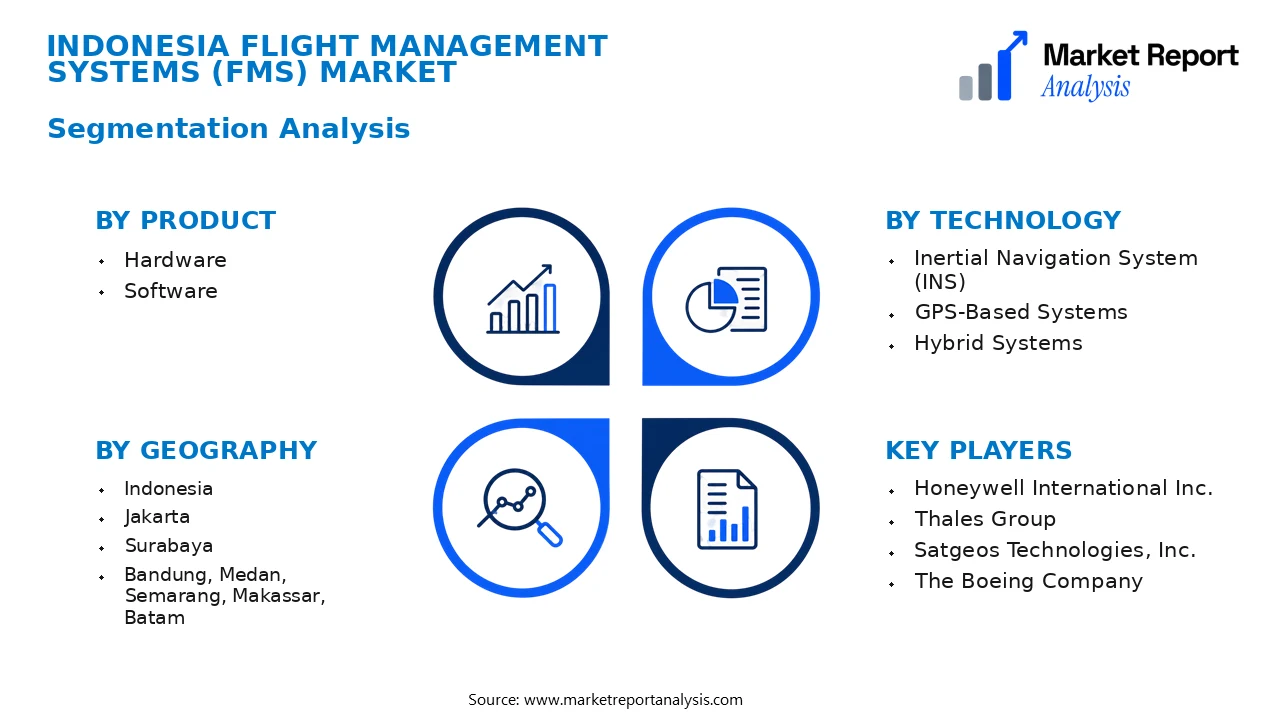
The Indonesia Flight Management Systems (FMS) Market is segmented based on product type, technology, application, end user, and geography. This segmentation enables a detailed understanding of market dynamics, customer preferences, and regional growth patterns essential for strategic decision-making.
- Product
- Hardware: Hardware components include navigation, control, and interface systems that are essential for the operation of FMS, driven by demand for reliable, real-time data processing aboard commercial and military aircraft.
- Software: Software systems encompass flight planning, navigation, and integration solutions designed to enhance operational efficiency, safety, and compliance with international standards, attracting investment from OEMs and airlines.
- Technology
- Inertial Navigation System (INS): INS-based FMS utilize accelerometers and gyroscopes for autonomous navigation, particularly valuable in areas with limited GPS coverage or for military aircraft requiring high precision.
- GPS-Based Systems: GPS technology dominates due to its high accuracy and widespread adoption, supporting modern civil aviation operations across Indonesia’s expanding airport infrastructure.
- Hybrid Systems: Combining INS and GPS, hybrid systems provide enhanced reliability and accuracy, appealing to regional carriers aiming to optimize safety and operational continuity.
- Application
- Commercial Aviation: This segment comprises major airlines, regional carriers, and private jet operators, reflecting growing passenger demand and fleet modernization initiatives in Indonesia.
- Military Aviation: Military applications demand robust, next-generation FMS for tactical readiness, surveillance, and defense operations, driven by Indonesia’s strategic defense modernization efforts.
- End User
- Original Equipment Manufacturers (OEMs): OEMs integrate advanced FMS into new aircraft, securing market share via partnerships with domestic and international aircraft manufacturers active in Indonesia’s aviation sector.
- Aftermarket: The aftermarket segment involves upgrades and maintenance of existing FMS, with a focus on extending system lifespan and compliance with evolving regulatory standards.
- Geography
- Indonesia: The national market spans multiple regions, with key hubs including Jakarta and Surabaya, driven by a combination of increasing passenger traffic, new airport infrastructure, and expanding airline fleets.
- Jakarta: As the capital and primary commercial aviation hub, Jakarta hosts the highest concentration of airlines, maintenance facilities, and FMS deployment activity, further amplified by government urban development policies.
- Surabaya: This secondary hub exhibits rising aircraft operational capacity, fostering demand for advanced FMS solutions, particularly in cargo and regional airline sectors.
- Bandung, Medan, Semarang, Makassar, Batam: These cities serve as regional centers with significant local airline and cargo services, contributing to regional market growth through airport expansions and fleet developments.
Competitive Intelligence
The Indonesia Flight Management Systems (FMS) Market exhibits moderate competition, with key players globally rather than regionally dominating due to the specialized nature of FMS technology. Market concentration remains relatively dispersed, with several multinational aerospace and defense companies investing heavily to capture emerging opportunities. Their strategies focus on product innovation, particularly integrating advanced avionics and ensuring compliance with evolving aviation safety standards. Major firms are engaging in strategic partnerships with local suppliers and airlines to tailor solutions for Indonesia’s unique operational environment. Acquisitions of smaller technology firms facilitate the rapid proliferation of innovative functionalities and regional expertise. Expansion strategies include establishing regional R&D centers and local assembly facilities to reduce costs and improve response times. Significant investments in R&D aim to enhance system reliability, cybersecurity, and interoperability with newer aircraft models. Differentiation in competition is often achieved through offering customized solutions optimized for Indonesia’s diverse fleet and regulatory landscape, with notable activity in Jakarta and Surabaya driven by the presence of several aviation hubs and governmental agencies seeking modernization.
Leading Company Profiles
The competitive landscape of the Indonesia Flight Management Systems (FMS) Market is characterized by the presence of several key global and regional players, each with strong technological capabilities and strategic initiatives aimed at capturing the growing demand within Indonesia’s expanding aviation sector.
- Honeywell International Inc.
- Thales Group
- Satgeos Technologies, Inc.
- The Boeing Company
- Rockwell Collins (part of Collins Aerospace)
- Airbus S.A.S.
- Saab AB
- GARMIN Ltd.
- Leonardo S.p.A.
- Indonesian Aeronautical Industry (Industri Pesawat Terbang Nusantara)
Honeywell International Inc.
Honeywell offers comprehensive FMS solutions integrating advanced navigation and automation technologies, focusing on OEM collaborations and aftermarket services tailored to Indonesia’s commercial and military aviation needs.
Thales Group
Thales specializes in state-of-the-art avionic systems, with a significant focus on flight management and navigation systems for civil and military aircraft, strengthening its strategic partnerships within Southeast Asia, including Indonesia.
Satgeos Technologies, Inc.
Satgeos provides innovative aerospace electronic systems, including lightweight, reliable FMS units designed for fuel efficiency and enhanced operational safety, prioritizing collaborations with regional aircraft manufacturers in Indonesia.
The Boeing Company
Boeing develops integrated flight deck solutions and FMS for its commercial aircraft lines, actively expanding its footprint in the Indonesian aviation market through strategic partnerships and service support networks.
Rockwell Collins (part of Collins Aerospace)
Known for its cutting-edge navigation and communication systems, Collins Aerospace continues to enhance its FMS offerings, aligning with Indonesia's modernization and fleet expansion plans.
Airbus S.A.S.
Airbus delivers advanced avionics and flight management systems, with a keen focus on regional customization and after-sales service excellence, supporting Indonesia’s transition toward more modern aircraft fleets.
Saab AB
Saab develops integrated cockpit and electronic warfare solutions, including FMS, emphasizing durability and mission-specific customization for Indonesia’s defense aviation sector.
GARMIN Ltd.
Garmin’s focus on portable and lightweight FMS solutions complements civil aviation and UAV applications, expanding into Indonesia’s growing general and regional aviation markets.
Leonardo S.p.A.
Leonardo provides integrated avionic and flight control systems aimed at both civil and military sectors, emphasizing innovation and local collaboration in Indonesia’s aerospace industry.
Indonesian Aeronautical Industry (Industri Pesawat Terbang Nusantara)
This domestic manufacturer focuses on developing indigenous avionics and FMS solutions, aiming to reduce reliance on imports and bolster Indonesia’s aerospace sovereignty.
Strategic Business Developments
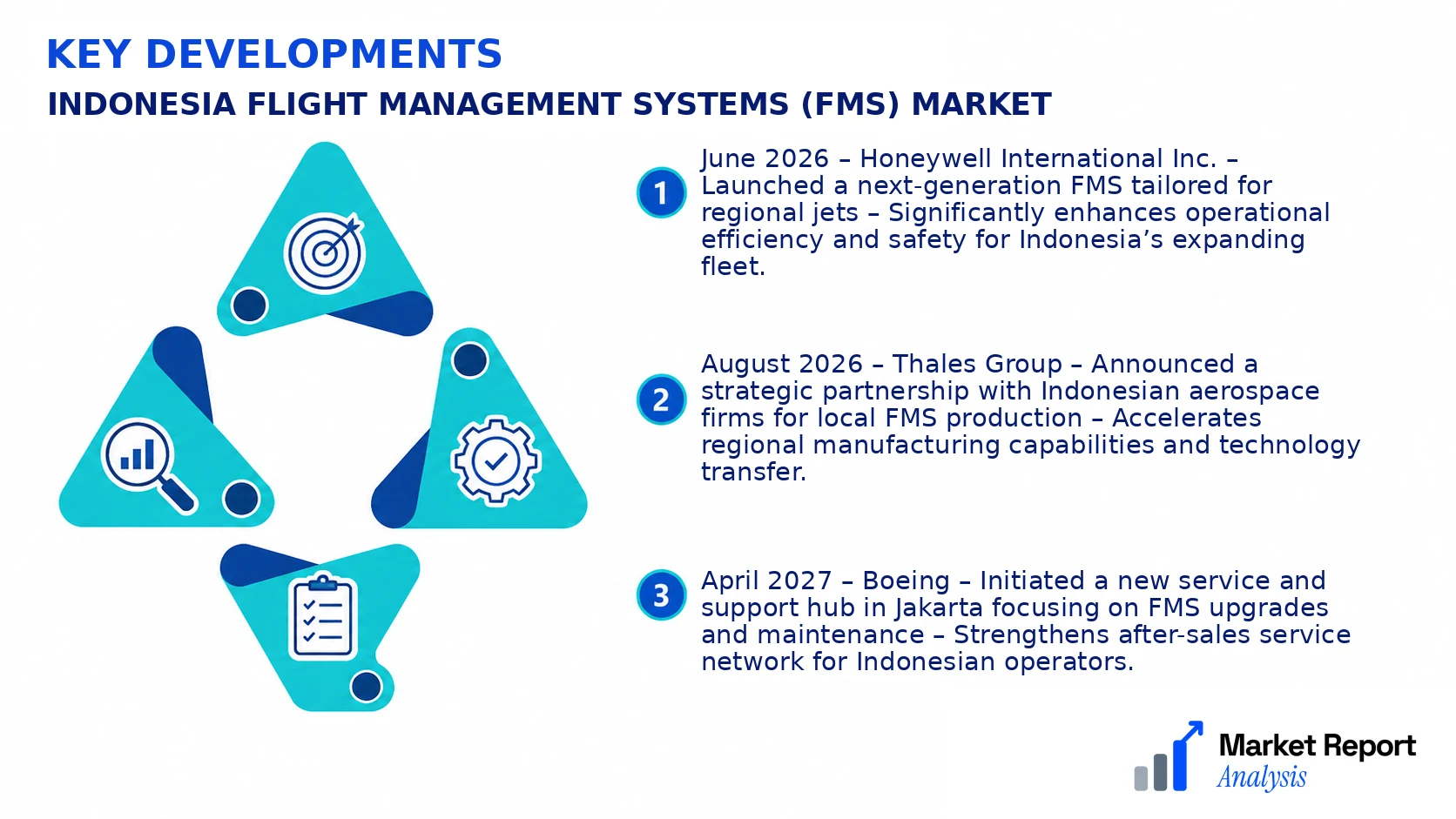
- June 2026 – Honeywell International Inc. – Launched a next-generation FMS tailored for regional jets – Significantly enhances operational efficiency and safety for Indonesia’s expanding fleet.
- August 2026 – Thales Group – Announced a strategic partnership with Indonesian aerospace firms for local FMS production – Accelerates regional manufacturing capabilities and technology transfer.
- April 2027 – Boeing – Initiated a new service and support hub in Jakarta focusing on FMS upgrades and maintenance – Strengthens after-sales service network for Indonesian operators.
- March 2026 – Collins Aerospace – Unveiled an advanced integrated cockpit solution for military aircraft in Indonesia – Supports modernization of Indonesia’s defense aviation assets.
- January 2027 – Industri Pesawat Terbang Nusantara – Signed an agreement with Leonardo to co-develop indigenous FMS solutions – Aims to foster domestic aerospace technological independence and innovation.
Frequently Asked Questions
What is the Indonesia Flight Management Systems (FMS) Market?
The Indonesia Flight Management Systems (FMS) Market encompasses the development, deployment, and maintenance of advanced onboard navigation and avionics systems enabling efficient flight operations in Indonesian aircraft, including commercial, regional, and military sectors, driven by technological advancements and regulatory upgrades.
What is the current market size of Indonesia Flight Management Systems (FMS) Market?
As of 2026, the Indonesia FMS market is valued at approximately USD 1.2 Billion, reflecting the growing adoption of sophisticated avionics in both commercial and private aircraft, driven by expanded fleet modernization and regulatory compliance needs across the country.
What factors are driving the Indonesia Flight Management Systems (FMS) Market?
The key factors include increasing aircraft modernization initiatives, rising safety standards, government support for aviation sector upgrades, and growing airline fleet expansions. Additionally, technological innovations and strict adherence to global safety norms propel market growth.
Which region dominates the Indonesia Flight Management Systems (FMS) Market?
Within Indonesia, the Java region dominates the FMS market due to its high concentration of major airports, airline headquarters, and ongoing aviation infrastructure expansion, contributing significantly to regional market demand.
Which segment is expected to grow the fastest?
The commercial aircraft segment is projected to experience the fastest growth owing to the rapid expansion of domestic airline routes, fleet modernization programs, and increased investments by airlines in advanced avionics systems to enhance safety and efficiency.
Who are the leading companies operating in the Indonesia Flight Management Systems (FMS) Market?
Leading market players include Honeywell International, Thales Group, Garmin Ltd., and Collins Aerospace, all of which are actively involved in supplying advanced FMS solutions tailored to the needs of Indonesian airlines and defense sectors.
Analyst Perspective
The Indonesia Flight Management Systems (FMS) Market is poised for sustained growth through 2034, driven by robust fleet modernization efforts and increasing airline investments in advanced aviation technologies. The region's expanding network of international and domestic routes creates a high demand for sophisticated FMS solutions, emphasizing the need for safety, efficiency, and compliance with evolving international standards. Technology evolution is focused on integrating IoT and AI capabilities, optimizing navigation, and facilitating real-time data analytics, which are expected to redefine operational paradigms. Investment priorities should target regional hubs like Jakarta and Surabaya, where strategic infrastructure projects and burgeoning airline activity offer lucrative opportunities for local suppliers and global vendors alike. Competitive intensity is likely to intensify as international players establish local partnerships and acquire regional firms to deepen market penetration. Long-term, Indonesia’s growing aviation sector underscores the importance of nurturing innovation and fostering strategic alliances, with regional focus on Jakarta’s increasingly significant role as a gateway. Investors should prioritize technological agility and regional customization to secure sustainable advantages in this dynamic market.
