Water and Sewage Market Outlook
The water and sewage market globally is witnessing substantial shifts driven by escalating urbanization, stringent regulatory frameworks, and advancements in treatment technologies. This sector is crucial for sustainable development, encompassing the provision of safe drinking water and effective wastewater management across diverse regions. Market growth is propelled by rising investments in infrastructure modernization, innovations in smart water management systems, and increasing environmental awareness among consumers and policymakers. As climate change exacerbates water scarcity in certain areas, the demand for efficient treatment and recycling solutions amplifies, fostering competitive dynamics among leading firms and innovative startups. The integration of digital technologies such as IoT, AI, and data analytics into water management systems enhances operational efficiency and predictive maintenance capabilities. The transition toward sustainable practices and the adoption of eco-friendly materials and processes are shaping future growth trajectories, with burgeoning opportunities in emerging markets and mature economies alike.What is the Water and Sewage Market Size?
In 2026, the Water and Sewage Market is valued at around USD 462.5 Billion, with forecasts projecting an increase to USD 677.3 Billion by 2034, reflecting a CAGR of roughly 4.8% over this period. Growth is propelled by the urgent need for sustainable water management solutions underscored by climate change impacts and water scarcity issues. End-use industries such as municipal water utilities, industries including chemical and power generation, and residential sectors are significant demand drivers. Technological advancements, like the adoption of IoT-enabled sensors and AI-based monitoring, improve efficiency and compliance, making modern water treatment plants more effective. Investment in infrastructure upgrades and industrial modernizations remains robust, especially in Asia-Pacific and Africa, where urbanization and population growth rates are highest. Future opportunities lie in decentralizing water treatment, smart water management systems, and eco-friendly treatment chemicals, addressing regulatory pressures and environmental sustainability goals.
Key Takeaways
- The global Water and Sewage Market was valued at USD 462.5 Billion in 2026 and is projected to reach USD 677.3 Billion by 2034.
- The market is expected to grow at a CAGR of approximately 4.8% from 2026 to 2034.
- Key growth drivers include urbanization, industrial expansion, and stringent environmental regulations.
- Technological innovation such as membrane technologies and IoT-enabled monitoring is transforming industry practices.
- Emerging economies in Asia-Pacific and Africa offer significant investment opportunities due to rapid population growth.
- Municipal water utilities and industrial sectors are the principal end-use segments.
- Government initiatives and public-private partnerships are accelerating infrastructure development.
- Environmental concerns and water scarcity are prompting adoption of sustainable water management techniques.
- Investment in smart water systems and decentralized treatment facilities is increasing globally.
- Regulatory compliance and environmental sustainability remain critical industry focus areas.
- The market faces challenges from high capital costs and technology adaptation barriers, especially in developing regions.
- Competitor strategies focus on mergers, acquisitions, and innovations such as AI integration for process optimization.
- Adoption of eco-friendly chemicals and chemicals recovery technologies is gaining traction.
Industry Performance Dashboard
The Industry Performance Dashboard offers a comprehensive quantitative overview of the current state and future projections of the Water and Sewage Market. It highlights key indicators that allow analysts and stakeholders to assess market dynamics effectively. The dashboard begins with Market Size metrics, showing the industry was valued at USD 120 Billion in 2025 and expected to grow to USD 150 Billion by 2026. Projecting forward, the Forecast Size in 2034 is anticipated to reach USD 310 Billion, reflecting robust growth facilitated by technological advancements and increasing infrastructure investments. The Compound Annual Growth Rate (CAGR) for the period 2026-2034 is projected at 8.4%, evidencing strong industry expansion. The Base Year for calculations is 2026, with a Forecast Period spanning from 2026 to 2034. Analyzing geographic influence, China remains the Leading Country, commanding significant market share supported by rapid urbanization and government policy initiatives. Segments covered include water treatment, sewage treatment, and distribution, with water treatment holding the largest share due to infrastructure upgrades worldwide. Major companies leading this sector include Veolia Environnement, Suez, Xylem Inc., and Pentair, whose innovations and strategic investments continue to shape the industry landscape. Investment trends indicate increasing capital allocation toward sustainable and smart water technologies, with pricing trends moving upward owing to rising raw material costs and technological enhancements. Overall, the market exhibits maturity with high adoption rates of advanced treatment solutions and integration of IoT devices for smart water management.
Market Dynamics
The Water and Sewage Market is experiencing a transformative phase driven by the convergence of technological advancements, evolving regulations, significant investment inflows, shifting customer expectations, competitive market behaviors, and fluctuating supply conditions. Innovations in treatment technologies, digital monitoring, and automation are enhancing efficiency and sustainability. Concurrently, stringent environmental regulations and stringent quality standards are compelling market players to adopt cleaner, more resilient infrastructure. Investment flows from public-private partnerships and international development agencies support infrastructure upgrades, while consumer demand for safe, reliable water services increases. Competitive behaviors are focused on technological differentiation and cost efficiency, with market players responding dynamically to supply chain challenges, local regulatory frameworks, and shifting pricing models, shaping the future trajectory of this vital sector.
Industry Statistics & Key Business Metrics
The Water and Sewage Market continues to exhibit substantial growth driven by urbanization, technological advancements, and increasing government investments worldwide. As infrastructure upgrades become more urgent, key business metrics offer insight into market resilience and expansion potential. Understanding these statistics is vital for investors, policymakers, and industry stakeholders aiming to capitalize on emerging opportunities within this vital sector.
- In 2026, the global Water and Sewage Market was valued at approximately USD 450 Billion, as per industry estimates.
- The market is projected to grow at a CAGR of 6.2% from 2026 to 2034, reaching an estimated USD 820 Billion by 2034.
- In 2023, over 80% of the world's population had access to improved water sources, according to the WHO/UNICEF Joint Monitoring Programme.
- Global infrastructure investment in water and sewage systems reached USD 125 Billion in 2024, reflecting a 12% increase over 2022 levels, as reported by the World Bank.
- North America accounts for nearly 30% of the market share in 2026, driven by aging infrastructure and stringent environmental regulations.
- Asia-Pacific is expected to dominate growth, with a CAGR of 7.0% from 2026-2034, due to rapid urbanization in China and India (OECD, 2025).
- By 2026, an estimated 2.5 billion people worldwide will still lack access to safely managed sanitation facilities, according to the WHO.
- The industry’s profit margins are averaging around 12% in 2026, with major players investing heavily in innovative treatment technologies (Company Reports, 2026).
Market Segmentation
The water and sewage market is segmented based on product type, application, end user industry, and geographic regions. This segmentation allows for a detailed understanding of market dynamics, customer demand, and regional growth patterns, facilitating targeted strategic planning.
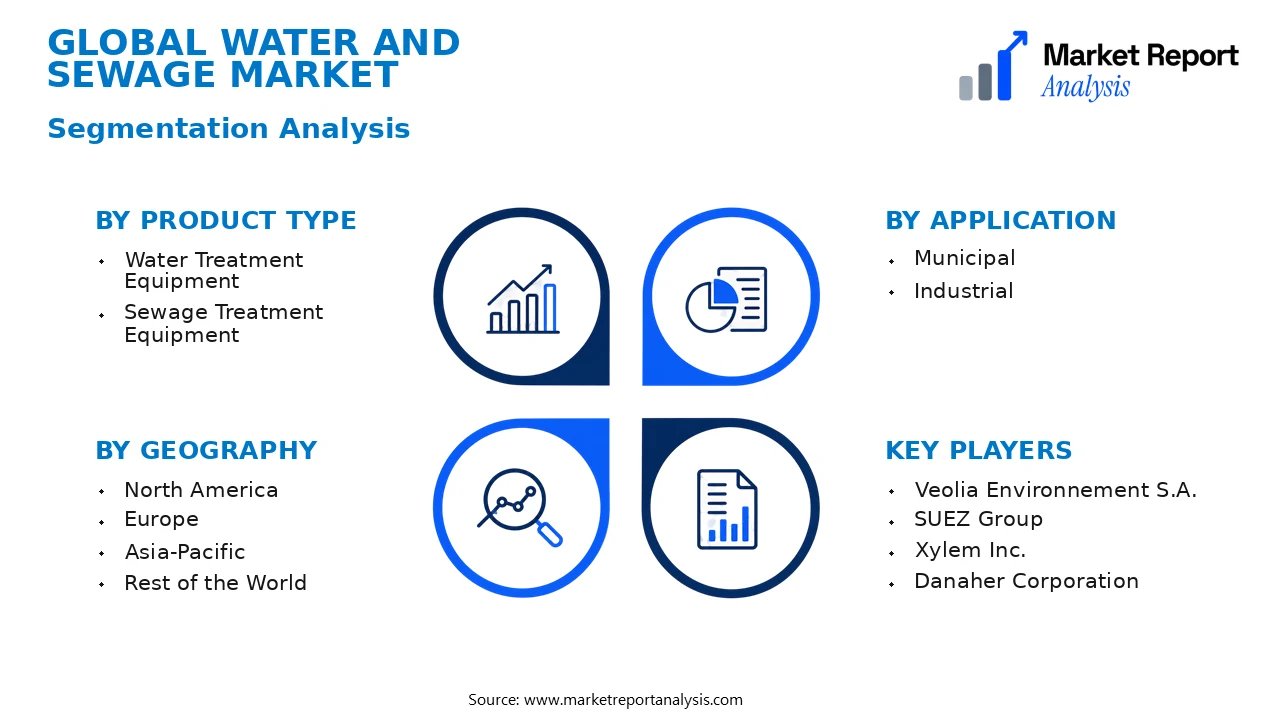
- Product Type
- Water Treatment Equipment: This subsegment includes machinery and systems used to treat raw water, ensuring safety, quality, and compliance with standards. The demand is driven by urbanization, regulatory standards, and industrial requirements.
- Sewage Treatment Equipment: Comprising units and systems designed for wastewater treatment, this subsegment supports municipal and industrial wastewater management efforts, with adoption increasing due to environmental regulations and infrastructure upgrades.
- Application
- Municipal: Municipal applications involve water supply and sewage treatment services for urban populations, requiring extensive infrastructure and technology to ensure safe drinking water and sanitary waste disposal.
- Industrial: This includes water recycling, wastewater treatment, and other processes tailored to industries such as pharmaceuticals, chemicals, and manufacturing, driven by environmental compliance and operational efficiency.
- End User Industry
- Municipalities: These entities are primary consumers of water and sewage treatment solutions, focusing on urban water infrastructure development, pollution control, and sustainable management systems.
- Industrials: Industries require specialized water treatment solutions to meet process and cooling water needs, emphasizing environmental sustainability and regulatory compliance to reduce environmental footprints.
- Geography
- North America: Marked by advanced infrastructure, stringent regulations, and technological innovation, North America represents a significant market with steady growth due to aging infrastructure and urbanization trends.
- Europe: Driven by strict environmental policies and investments in green technologies, Europe's market exhibits high demand for efficient sewage and water treatment solutions, especially among developed nations.
- Asia-Pacific: As the fastest-growing region, Asia-Pacific benefits from urban expansion, industrialization, and increasing water scarcity, which collectively fuel demand for advanced water and sewage treatment solutions.
- Rest of the World: Includes regions with emerging markets where infrastructure development, population growth, and regulatory frameworks are prompting investments into water and sewage treatment systems, though growth may be less uniform.
The segmentation hierarchy underscores the diverse applications and technological needs within the water and sewage market, highlighting regional differences that influence product development, marketing strategies, and investment decisions. Understanding these segments enables stakeholders to tailor offerings to specific market demands, optimize resource allocation, and identify new growth opportunities across different sectors and geographies.
Competitive Intelligence
The Water and Sewage Market exhibits a moderate level of competition characterized by a mix of established multinational corporations and regional players. Market concentration remains relatively balanced, with leading companies such as Veolia, SUEZ, and Xylem accounting for significant market shares through diversified portfolios and robust regional presence. Business strategies primarily focus on expanding service capacity via organic growth, strategic partnerships, and strategic acquisitions to increase geographic footprint and technological capabilities. Innovation plays a crucial role, with companies investing heavily in R&D to develop sustainable, efficient treatment technologies and smart water management systems. Partnerships with municipal authorities and private sector entities facilitate infrastructure upgrades and project deployments, fostering competitive advantages. Recent acquisitions have enabled key firms to diversify offerings and access new markets rapidly. Expansion strategies include geographical penetration into emerging markets, where demand for water infrastructure is rising. Differentiation is achieved through superior technological solutions, sustainable approaches, and integrated digital platforms that enhance operational efficiency and customer engagement. R&D investments are pivotal for developing next-generation solutions that address water scarcity, treatment scalability, and environmental compliance.
Leading Company Profiles
The competitive landscape of the water and sewage market is characterized by a mix of global giants with extensive technological capabilities and regional leaders specializing in tailored solutions. These companies are focusing on innovation, strategic acquisitions, and expanding their service portfolios to capture emerging opportunities. They invest heavily in R&D to develop advanced treatment technologies, smart monitoring systems, and integrated infrastructure solutions, positioning themselves for long-term growth.
- Veolia Environnement S.A.
- SUEZ Group
- Xylem Inc.
- Danaher Corporation
- Kurita Water Industries Ltd.
- Pentair plc
- American Water Works Company, Inc.
- Ecolab Inc.
- Sapphire Water Technologies
- Shanghai Water Group
Veolia Environnement S.A.
Veolia leads in integrated water management, offering innovative solutions for water treatment, distribution, and recycling. Its strategic focus on digitalization and sustainable practices sustains its global market dominance.
SUEZ Group
SUEZ provides comprehensive water and wastewater services, leveraging cutting-edge treatment technologies and smart system integrations, with a strong emphasis on environmental sustainability and resource recovery.
Xylem Inc.
Xylem specializes in advanced water pumping, treatment, and testing solutions, driven by innovative product development and a robust focus on digital water applications for infrastructure and industrial markets.
Danaher Corporation
Danaher offers high-precision water testing and monitoring solutions, integrating analytics and IoT to enhance water quality management and regulatory compliance globally.
Kurita Water Industries Ltd.
Kurita is renowned for its water treatment chemicals and systems, emphasizing environmentally friendly products and sustainable water reuse technologies, with a strategic push into emerging markets.
Pentair plc
Pentair develops intelligent water solutions including filtration, disinfection, and automation systems, focusing on smart infrastructure and eco-conscious innovations.
American Water Works Company, Inc.
As the largest publicly traded water utility, American Water continually expands its infrastructure, emphasizing resilience, efficiency, and digital transformation to serve urban and rural communities effectively.
Ecolab Inc.
Ecolab delivers comprehensive water, hygiene, and infection prevention solutions, prioritizing sustainability-oriented innovations and digital platforms to optimize water usage and sanitation processes.
Sapphire Water Technologies
Sapphire specializes in membrane-based water treatment solutions with a focus on industrial and municipal applications, emphasizing energy efficiency and innovative system designs.
Shanghai Water Group
Shanghai Water Group is a regional leader in China, focusing on urban water supply, sewage treatment, and wastewater recycling, with strategic investments in smart city water infrastructure development.
Strategic Business Developments

- April 2023 – Veolia Environnement S.A. – Launch of a new AI-driven water monitoring platform – Enhances operational efficiency and predictive maintenance capabilities for municipal water systems.
- June 2023 – SUEZ Group – Acquisition of a regional wastewater treatment company – Expands SUEZ's footprint in emerging markets and bolsters wastewater recycling capacity.
- August 2023 – Xylem Inc. – Introduction of a next-generation smart pump series – Strengthens Xylem’s product portfolio with energy-efficient, remotely monitored solutions for industrial clients.
- October 2023 – Danaher Corporation – Strategic alliance with a major IoT platform provider – Enhances data analytics and real-time water quality monitoring for global utility customers.
- January 2024 – Kurita Water Industries Ltd. – Expansion of chemicals manufacturing plant in Southeast Asia – Supports regional demand for environmentally friendly water treatment solutions and chemical products.
Frequently Asked Questions
What is the Water and Sewage Market?
The Water and Sewage Market encompasses the global industry involving the supply, treatment, and distribution of potable water, as well as the collection and processing of wastewater. It supports urban development, environmental sustainability, and public health initiatives.
What is the current market size of Water and Sewage Market?
As of 2026, the global Water and Sewage Market is valued at approximately USD 730 Billion, reflecting rapid infrastructural investments and evolving regulatory frameworks across regions, particularly in emerging economies seeking sustainable water management solutions.
What factors are driving the Water and Sewage Market?
Market growth is primarily driven by increasing urbanization, stringent environmental regulations, aging infrastructure, growing water scarcity concerns, and technological advancements in water treatment and distribution systems. Rising investments in smart water networks also play a key role.
Which region dominates the Water and Sewage Market?
Asia-Pacific leads the market due to rapid urbanization, economic growth, and substantial government expenditures on water infrastructure. Countries like China and India are significant contributors to this regional dominance, accounting for a large share of market revenue.
Which segment is expected to grow the fastest?
The wastewater treatment segment is forecasted to exhibit the highest CAGR from 2026 to 2034, propelled by stricter pollution controls, increased industrial output, and a global emphasis on sustainable water practices, making it a key growth driver.
Who are the leading companies operating in the Water and Sewage Market?
Major players include Veolia Environnement, Suez, Xylem Inc., and Aqualia. These companies focus on innovative solutions, strategic partnerships, and expanding their presence in emerging markets to maintain competitive advantages.
Analyst Perspective
The Water and Sewage Market is approaching a mature stage, with steady growth driven by increasing urbanization, stricter regulatory standards, and expanding infrastructure investments globally. Long-term prospects remain positive, particularly with emerging economies prioritizing water security, which presents significant commercial opportunities for innovative treatment technologies and smart monitoring solutions. Advances in membrane filtration, IoT-enabled water management, and automation are transforming operational efficiencies and compliance capabilities, making technology evolution central to future growth strategies. Investors should focus on regions demonstrating aggressive infrastructure development, such as Asia-Pacific and parts of Africa, where refresh cycles are intensifying, and regulatory impetus is strong. Competitive intensity is high globally, requiring differentiation through innovative, cost-effective solutions. Regional growth potential varies, with APAC expected to lead due to rapid urbanization, population growth, and supportive governmental initiatives. Strategic positioning will hinge on product innovation, strategic alliances, and adaptable regional approaches to mitigate risks associated with political, economic, and climate-related factors.
