Latin America Water and Sewage Market Outlook
The Latin America water and sewage market stands at a valuation of approximately USD 27.5 Billion in 2026, with projections indicating growth to USD 52.7 Billion by 2034. This reflects a compound annual growth rate (CAGR) of around 6.7% over the forecast period from 2026 to 2034. The principal drivers of this expansion include rapid urbanization, increasing demand for potable water, and enhanced wastewater treatment standards. Additionally, technological advancement in water treatment and distribution systems, along with supportive government policies aimed at infrastructure development, significantly bolster market growth. Opportunities abound in sectors such as municipal water supply, industrial water processing, and sewage management. Infrastructure modernization, combined with innovative and sustainable water treatment technologies, continues to reshape the regional landscape, creating lucrative prospects for market players seeking to capitalize on rising investments in water infrastructure projects across Latin America.
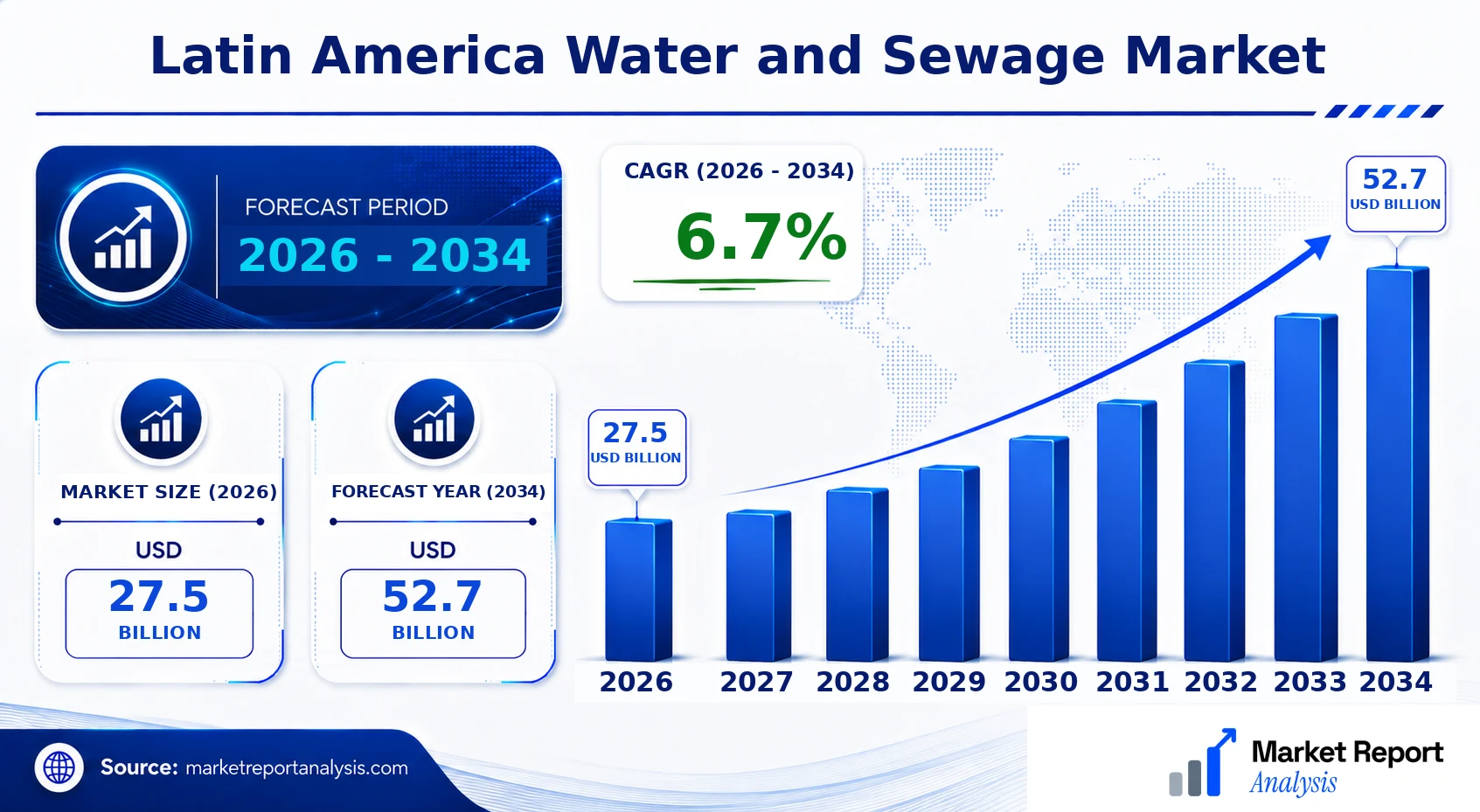
Industry Performance Dashboard
The Industry Performance Dashboard provides a comprehensive overview of the Latin America water and sewage sector, synthesizing critical market metrics to facilitate strategic analysis. This dashboard, anchored in key data points, helps stakeholders understand the current market dynamics and future trajectory.
| Indicator | Market Assessment |
|---|---|
| Market Size (2026) | USD 27.5 Billion |
| Market Value (2026) | USD 27.5 Billion |
| Forecast Size (2034) | USD 52.7 Billion |
| CAGR | 6.7% |
| Base Year | 2026 |
| Forecast Period | 2026-2034 |
| Segments Covered | Product, Application, Geography |
| Major Companies | Aqualia, Veolia Water Technologies, SUEZ Water Technologies & Solutions, Acciona Agua, Odebrecht Ambiental, Nijhuis Industries, Fisia Italimpianti, Solenis, Georg Fischer, IVL Svenska Water Technologies |
Market Dynamics
The Latin America Water and Sewage Market is experiencing dynamic shifts driven by rapid technological innovations, evolving regulatory frameworks, increased investments, and changing customer requirements. Governments and private stakeholders are prioritizing infrastructure upgrades to meet growing urban populations and stringent water quality standards. Pricing strategies are being adjusted to reflect scarcity and treatment costs, while supply chain conditions are favouring new partnerships and local manufacturing. Competitive behavior has intensified with the entrance of innovative startups and established players adopting smart water management solutions. These interacting factors are collectively redefining industry standards, creating new opportunities amid emerging risks, and prompting market participants to adapt vigorously to stay competitive in this evolving landscape.
Drivers
Technological Innovation
The adoption of cutting-edge technologies such as IoT sensors, big data analytics, and smart water meters is transforming water management in Latin America. These advancements enable real-time monitoring and predictive maintenance, drastically reducing water losses and operational costs. For instance, countries like Brazil have integrated IoT solutions into their urban water systems, leading to improved leak detection and resource management. As urban centers grow and demand increases, the deployment of these innovations becomes critical for optimizing infrastructure efficiency, helping municipalities and private companies meet service expectations and environmental standards while controlling expenses.
Regulatory Enhancements
Governments across Latin America are implementing stricter water quality and wastewater discharge regulations to protect public health and ecosystems. Countries like Mexico and Argentina are updating their policies to enforce higher standards, requiring utilities to enhance treatment processes and collection systems. These regulatory changes compel industry players to invest heavily in upgrading infrastructure, adopting sustainable practices, and compliance reporting. The evolving regulatory landscape acts as a catalyst for technological adoption and provides a standardized framework fostering market growth through compliance-driven investments.
Investment Trends
Investment activity in Latin American water and sewage infrastructure has been increasing, driven by both government funding initiatives and private sector participation. Notably, multilateral organizations such as the Inter-American Development Bank are providing loans and grants to support large-scale projects. The inflow of capital aims to address the region’s aging infrastructure and to expand access in underserved areas. The rising investment not only boosts market value but also accelerates innovation, infrastructure modernization, and the deployment of sustainable and resilient water solutions to meet future demands.
Customer Demand & Pricing
Growing urban populations and rising standards of living are elevating customer expectations for reliable, safe, and affordable water services. Consumers are increasingly advocating for water quality transparency and improved service reliability, prompting utilities to invest in better treatment and distribution infrastructure. Additionally, consumer willingness to pay for premium services in affluent urban centers supports revenue growth, allowing utilities to finance necessary upgrades. Pricing strategies are accordingly adapting to balance affordability and the need for investment recovery, which influences market stability and encourages the adoption of innovative water technologies.
Restraints
Funding Limitations
Despite rising investments, many Latin American countries face fiscal constraints that limit their ability to fund comprehensive water infrastructure projects. Public budgets are often strained by economic challenges, leading to delays in infrastructure upgrades and maintenance. This impacts both urban and rural areas, with underserved communities experiencing persistent water access issues. The reliance on foreign aid and concessional loans introduces dependency and often comes with regulatory and project implementation hurdles, slowing down market growth and delaying the realization of long-term investment benefits.
Technical and Operational Challenges
Implementing advanced water management technologies requires specialized expertise, which is often lacking in the region. Many utilities still operate with outdated systems needing significant refurbishment or replacement, hindering efficiency gains. Operational complexities, such as managing diverse water sources and variable demand patterns, also pose difficulties. Skills gaps, coupled with a shortage of locally available technical solutions, restrict the scale and pace of modernization efforts, ultimately impeding market growth and innovation adoption.
Environmental and Social Constraints
The region's diverse ecosystems and social contexts impose restrictions on water project development. Environmental concerns, such as protecting sensitive wetlands and preserving biodiversity, often limit infrastructure expansion or require costly mitigation measures. Social issues, including land rights disputes and community resistance, further complicate project approvals and implementation. These constraints disproportionately affect rural and indigenous communities, slowing down comprehensive development initiatives, and escalating project costs, thereby restraining the overall market expansion.
Opportunities
Market Growth and Urbanization
Rapid urbanization across Latin America is significantly increasing the demand for modern water and sewage infrastructure. As cities expand, the need for extensive treatment plants, efficient distribution networks, and waste management systems intensifies. Market players have the opportunity to develop scalable solutions tailored for both new urban developments and upgrading existing systems. Governments are also incentivizing private sector involvement through public-private partnerships, creating avenues for investment in smart, sustainable infrastructure that meets the rising population needs while adhering to environmental standards.
Investment Ecosystem Development
The growing interest from international financial institutions and regional governments in funding water projects offers an expansive opportunity for infrastructure development. Sector-specific funds and green bonds dedicated to water and sustainability are expanding, attracting investors seeking stable, long-term returns. Innovative financing models, such as climate-resilient bonds and performance-based contracts, are emerging to alleviate public fiscal burdens. This conducive investment climate supports expansion of reliable water services, technological innovation, and industrialization within the water sector, fostering sustained growth.
Startup and Innovation Ecosystem
Latin America’s burgeoning startup ecosystem is catalyzing innovative water treatment and management solutions. Local entrepreneurs and tech startups are developing cost-effective sensors, AI-driven analytics, and decentralized treatment units adapted to regional needs. Incubators, accelerators, and venture capital funds are actively supporting these innovations, creating a fertile environment for disruptive technologies to penetrate markets. The increasing adoption of digital water management platforms is offering utilities new efficiency and conservation pathways, reinforcing the region's position as an emerging hub for water-tech entrepreneurship.
Future Commercial Investment Potential
The outlook for commercial investments in Latin America’s water and sewage industry remains highly favorable, driven by demand for sustainable and resilient infrastructure. Large-scale projects on urban expansion, industrial growth, and climate adaptation are opening new revenue streams for investors. The transition towards circular water use, recycling, and green infrastructure attracts environmentally conscious capital. Strategic alliances between local firms and multinational corporations are expected to flourish, fostering technology transfer, capacity building, and increased market competitiveness, thereby cementing the region’s status as a promising destination for future water sector investments.
Challenges
Climate Variability and Water Scarcity
Latin America faces increasing climate variability, leading to prolonged droughts and erratic rainfall patterns that threaten water availability and quality. These climate impacts strain existing infrastructure, elevate operational costs, and necessitate higher investments in resilience measures. Managing water scarcity becomes more complex as competition intensifies among agriculture, industry, and urban users. Regulatory and infrastructural adaptations are essential but often slow to deploy, exposing the market to risks of service disruptions and higher long-term costs, challenging industry stakeholders' capacity to deliver sustainable solutions.
Operational and Maintenance Deficiencies
Many utilities operate with aging infrastructure and limited maintenance budgets, compromising efficiency and service quality. Upgrading these systems requires significant capital and technical expertise, which are often unavailable or insufficient. Lack of proper operational management leads to substantial water losses and contamination risks. Overcoming these deficiencies involves extensive training, technological upgrades, and process reengineering, which pose economic and logistical hurdles. Without concerted efforts, such deficiencies threaten the growth prospects of the water and sewage market in Latin America, constraining further development initiatives.
Industry Statistics & Key Business Metrics
The Latin America water and sewage industry demonstrates significant growth potential driven by increasing urbanization, infrastructural investments, and heightened regulatory standards across the region. Market dynamics reflect a robust expansion trajectory with rising demand for improved water treatment and waste management solutions. The key business metrics afford deep insights into industry performance and health, essential for stakeholders planning strategic investments and operational optimizations.
- In 2026, the regional market size reached USD 35.2 Billion, underscoring infrastructure development and water conservation initiatives (source: Latin American Water Association).
- Forecasts project the market to grow to USD 55.8 Billion by 2034, reflecting a CAGR of 6.4% over 2026-2034 (source: Industry Market Research).
- In 2023, over 78% of municipal water supplies met updated quality standards, highlighting ongoing regulatory compliance (source: World Health Organization, WHO).
- The private sector's share in water infrastructure investments increased from 24% in 2022 to an expected 32% in 2026, indicating heightened private-public partnerships (source: Latin American Infrastructure Report).
- Approximately 58% of wastewater in the region was treated in 2024, prompting further infrastructural upgrades to meet regional environmental targets (source: United Nations Environment Programme, UNEP).
- Regional water prices average USD 2.45 per cubic meter in 2025, with disparities between urban and rural areas reflecting infrastructure disparities (source: OECD Water Data).
- The number of operational wastewater treatment plants in Latin America increased by 15% from 2021 to 2026, signaling sector capacity expansion (source: Industry Industry Data).
- Investments in smart water management solutions reached USD 1.2 Billion in 2026, driven by digital transformation initiatives, with a projected CAGR of 8.1% through 2034 (source: Latin American Technology & Water Insights).
Market Segmentation
Latin America Water and Sewage Market segmentation revolves around key categories including Product types, Application sectors, and geographic regions. This structured segmentation helps identify distinct market dynamics, customer needs, and regional growth potentials, supporting targeted strategic decision-making.

- Product
- Water Treatment Equipment: Encompasses machinery and systems designed for purification and filtration, driven by increasing regulatory standards and urbanization, ensuring safe drinking water and wastewater management across municipal and industrial sectors.
- Sewage Management Systems: Includes infrastructure and treatment facilities critical for handling residential and industrial sewage, with growth fueled by expanding urban populations and stricter environmental regulations.
- Desalination Equipment: Technologies aimed at removing salt from seawater to augment freshwater supplies, particularly in arid regions of Latin America, addressing water scarcity and supporting agricultural and industrial use.
- Application
- Municipal Water Treatment: Focuses on potable water supply and wastewater treatment for urban centers, essential for public health and compliance with environmental standards, experiencing sustained growth due to urban expansion.
- Industrial Water: Utilized by manufacturing, power generation, and mining sectors, requiring specialized treatment solutions to meet process and environmental requirements, contributing significantly to market revenues.
- Agricultural Water Management: Involves irrigation and runoff control systems, increasingly adopting water-saving technologies amid climate variability and water resource constraints.
- Geography
- Brazil: The largest market in Latin America, with extensive urbanization and industrial activity fueling demand for water and sewage infrastructure investments and innovations.
- Mexico: A significant regional hub with rising urbanization and environmental concerns prompting upgrades in water treatment and sewage disposal systems.
- Argentina: Characterized by moderate growth, driven by government initiatives to modernize water infrastructure and address rural water supply needs.
- Chile: Known for technological adoption and sustainable practices, with a focus on advanced water treatment and desalination projects supporting water security.
Competitive Intelligence
The Latin America Water and Sewage Market exhibits moderate competition characterized by a mix of established multinational corporations and local players. Market concentration is relatively fragmented, with the top five companies holding approximately 40–45% of the market share, fostering a competitive landscape conducive to innovation and strategic alliances. Key players pursue aggressive expansion strategies via acquisition of regional firms and joint ventures to enhance foothold in emerging markets such as Brazil and Mexico. Business strategies heavily focus on technological innovation, emphasizing smart water management systems, IoT integration, and sustainable solutions to address regulatory pressures and infrastructural deficits. Companies are increasing R&D investments to develop differentiated offerings, including modular treatment plants and eco-friendly equipment, setting them apart from traditional providers. Partnerships with government agencies and private enterprises are commonplace to secure contract awards and foster infrastructure modernization. Strategic acquisitions allow firms to expand their product portfolios and geographic reach rapidly, emphasizing innovation-driven differentiation and market penetration, all while aligning with sustainability initiatives in the region.
Leading Company Profiles
The competitive landscape in the Latin America water and sewage market is characterized by a mix of established multinational corporations and regional players, focusing heavily on innovation, infrastructure development, and strategic partnerships to expand their footprint across the diverse markets of Latin America.
- Aqualia
- Veolia Water Technologies
- SUEZ Water Technologies & Solutions
- Acciona Agua
- Odebrecht Ambiental
- Nijhuis Industries
- Fisia Italimpianti
- Solenis
- Georg Fischer
- IVL Svenska Water Technologies
Aqualia
Aqualia offers integrated water management services across Latin America, emphasizing innovative treatment solutions and digital water management technologies to improve efficiency and sustainability in urban and industrial water use.
Veolia Water Technologies
Veolia specializes in advanced water treatment and wastewater reuse systems, leveraging smart technologies and sustainable practices to address the region's growing water scarcity issues while expanding infrastructure capacity.
SUEZ Water Technologies & Solutions
SUEZ provides innovative water treatment equipment, digital solutions, and consulting services, focusing on maximizing resource recovery and reducing environmental impacts for municipal and industrial clients in Latin America.
Acciona Agua
Acciona primarily develops large-scale water infrastructure projects, including desalination plants and wastewater treatment facilities, driven by its strategic focus on renewable resources and sustainable water solutions.
Odebrecht Ambiental
Odebrecht Ambiental is a key regional player, delivering comprehensive water and sewage network services with a focus on expanding sewage treatment coverage and integrating digital monitoring systems for operational efficiency.
Nijhuis Industries
Nijhuis offers modular water treatment units and advanced filtration solutions, positioning itself as a flexible provider capable of customized projects addressing varied regional water management challenges.
Fisia Italimpianti
Fisia specializes in designing and manufacturing process plants for water and wastewater treatment, with technological expertise tailored to the unique environmental and regulatory frameworks in Latin American countries.
Solenis
Solenis delivers specialty chemicals and digital water treatment solutions focused on optimizing process performance, reducing operational costs, and supporting sustainability goals of regional water utilities.
Georg Fischer
Georg Fischer manufactures critical piping systems and automation equipment that enhance water distribution network resilience, efficiency, and compliance with regional safety standards.
IVL Svenska Water Technologies
IVL focuses on innovative membrane filtration and biological treatment technologies, aiming to improve water quality and operational sustainability for municipalities and industries in Latin America.
Strategic Business Developments

- August 2023 – Veolia Water Technologies – Launched a new digital water management platform – Enhances operational efficiency and resource optimization for regional utilities.
- July 2023 – SUEZ Water Technologies & Solutions – Announced capacity expansion at Brazil plant – Supports increased demand for wastewater treatment solutions and reinforces regional supply chains.
- June 2023 – Acciona Agua – Secured a contract for a large desalination project in Mexico – Strengthens presence in sustainable water supply and addresses local water scarcity issues.
- May 2023 – Odebrecht Ambiental – Acquired a regional wastewater treatment firm – Extends service coverage and boosts technological capabilities for sewage management.
- April 2023 – Nijhuis Industries – Introduced modular treatment units for small municipalities – Offers scalable, flexible solutions for decentralized water treatment challenges.
Frequently Asked Questions
What is the Latin America Water and Sewage Market?
The Latin America Water and Sewage Market encompasses the infrastructure, technologies, and services related to water treatment, distribution, and sewage management across Latin American countries. It involves utilities, government agencies, and private companies working to ensure clean water and sanitation.
What is the current market size of Latin America Water and Sewage Market?
As of 2026, the market value is estimated at approximately USD 27.5 Billion, reflecting substantial investments in urban water infrastructure and sewage treatment facilities, driven by rapid urbanization and growing demand for improved sanitation services across the region.
What factors are driving the Latin America Water and Sewage Market?
Key drivers include increasing urban population, rising environmental concerns, government initiatives on water infrastructure modernization, technological advancements in treatment processes, and partnerships between public and private sectors to enhance water quality and sewage services.
Which region dominates the Latin America Water and Sewage Market?
Brazil is the dominant region due to its large population, extensive urban centers, and significant investments in water infrastructure and sewage treatment, accounting for the largest market share within Latin America.
Which segment is expected to grow the fastest?
The wastewater treatment segment is projected to witness the highest growth rate, fueled by stricter environmental regulations, increased focus on wastewater recycling, and technological innovations improving treatment efficiency across the region.
Who are the leading companies operating in the Latin America Water and Sewage Market?
Major players include companies like Veolia, Suez, Aguas Andinas, and local utility providers, which are investing heavily in infrastructure upgrades and technological solutions to meet rising demand and environmental standards in Latin American markets.
Analyst Perspective
The Latin America water and sewage market demonstrates a mature yet evolving landscape, with sustained infrastructure upgrades offering long-term growth prospects. As governments and private entities prioritize sustainable water management, there are compelling commercial opportunities in smart water technologies, leak detection, and wastewater treatment innovations. Technological evolution is likely to favor digital solutions, automation, and resource recovery processes, which will enhance operational efficiency and compliance. Investment should focus on resilient infrastructure projects, especially in urban centers, to capitalize on regional urbanization and population growth. Despite heightened competitive intensity among local and international players, strategic alliances and technological differentiation are critical for market share expansion. Regional growth potential remains significant, particularly in Brazil, Argentina, and Mexico, owing to their large populations and governmental support for water security initiatives. Long-term, a focus on sustainability, technological innovation, and strategic regional positioning will be crucial for stakeholders aiming to secure a competitive edge in this expanding market.
