South Korea Water and Sewage Market Outlook
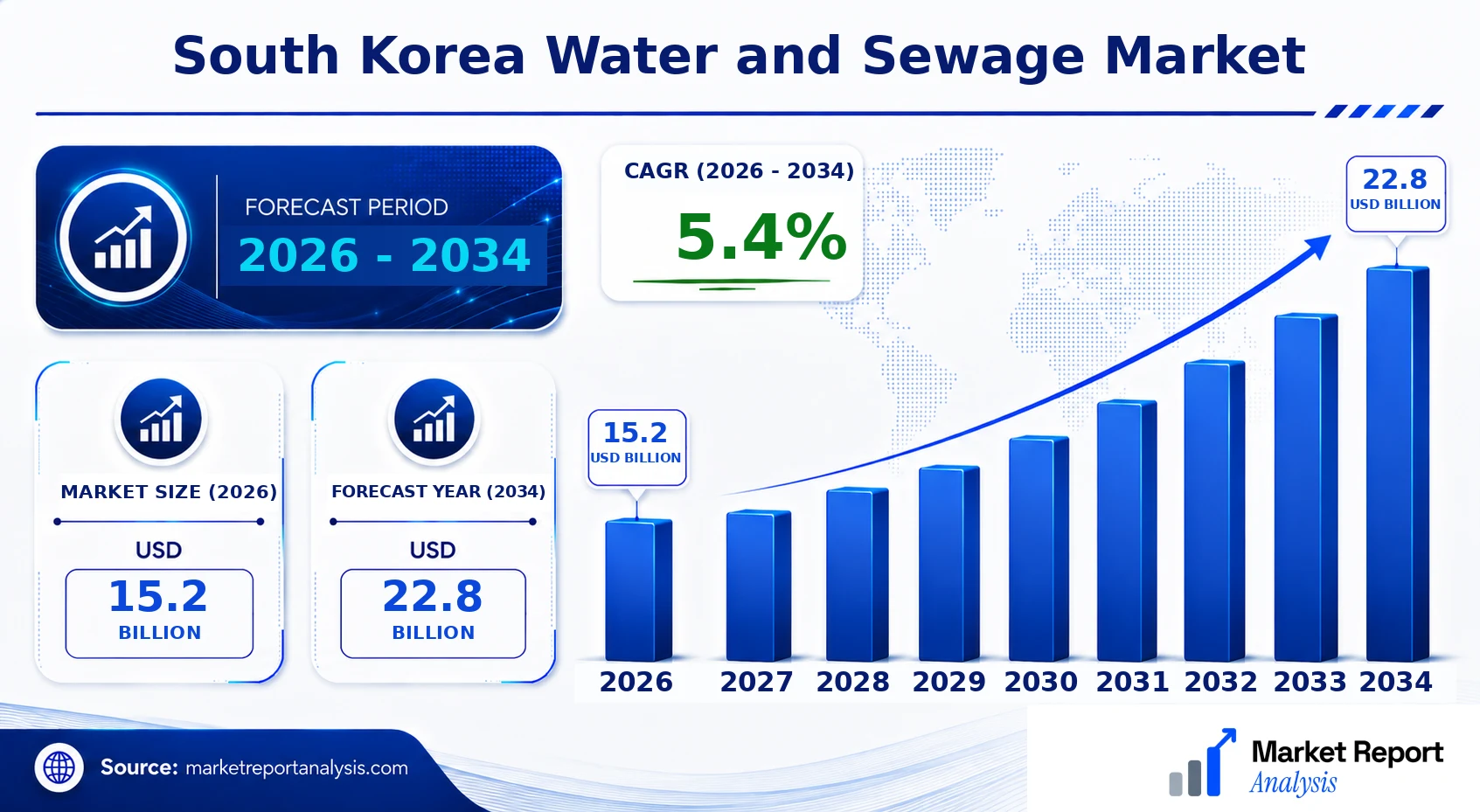
The South Korea water and sewage market is currently valued at approximately USD 15.2 Billion in 2026, with projections indicating a substantial increase to USD 22.8 Billion by 2034. This growth is anticipated to occur at a compound annual growth rate (CAGR) of around 5.4% over the forecast period from 2026 to 2034. The principal demand drivers include urban population expansion, stringent regulatory standards focusing on water quality, investments in smart water infrastructure, and increasing adoption of innovative treatment technologies. Technological innovation, especially in digital water management, membrane filtration, and automation, is shaping the market landscape. The sector presents significant commercial opportunities, notably in large-scale infrastructure upgrades, smart water networks, and sustainable wastewater recycling initiatives. The South Korean government’s strategic focus on water security and environmental sustainability fuels these investments, fostering a competitive environment with both local and international players vying for market share.
What is the South Korea Water and Sewage Market Size?
In 2026, the South Korea water and sewage market is estimated to be worth approximately USD 15.2 Billion, with forecasts indicating a future value of around USD 22.8 Billion in 2034. The market's CAGR of 5.4% from 2026 to 2034 reflects strong growth driven by urbanization, population growth, and regulatory pressures emphasizing water quality and environmental standards. End-use sectors such as municipal water supply, industrial manufacturing including electronics, petrochemical, and automotive industries and residential consumption are the primary contributors to market demand. The adoption of advanced treatment technologies like membrane bioreactors and smart monitoring systems is accelerating, fostering innovation and efficiency improvements. Investment opportunities are abundant in infrastructure upgrades, water reuse projects, and the development of Smart Water Grids, aligned with Korea’s focus on environmental sustainability, climate resilience, and economic development. The ongoing modernization of water and sewage infrastructure, coupled with a rising consumer emphasis on clean water, is poised to sustain robust growth pathways in the coming years, making South Korea an attractive market for stakeholders across the water management value chain.
Key Takeaways
- The South Korea water and sewage market is valued at approximately USD 12.5 Billion in 2026.
- The market is projected to reach USD 19.2 Billion by 2034.
- The CAGR during 2026–2034 is estimated at 6.2%.
- Seoul stands as the leading South Korean city driving market demand.
- Ulsan is the fastest-growing South Korean city in terms of water infrastructure investments.
- Municipal water and wastewater treatment constitute the largest market segment.
- Smart water management systems and membrane filtration are the fastest-growing segments.
- Municipal and industrial applications represent the largest end-user sectors.
- Industrial water reuse and wastewater recycling are the fastest-growing applications.
- The principal end user is the municipal sector.
- The forecast period spans from 2026 to 2034.
- The base year for analysis is 2026.
Industry Performance Dashboard
The South Korea water and sewage market exhibits significant resilience and growth potential driven by stringent environmental regulations, urban infrastructure development, and increasing demand for sustainable water management solutions. The market assessment indicates a robust trajectory over the forecast period, supported by government investments and technological advancements aimed at enhancing water treatment efficiency and sewage management. The leading South Korean city showcases a strong capacity for market penetration owing to its extensive urban infrastructure and environmental policies, serving as a pivotal hub for market dynamics in the country.
| Indicator | Market Assessment |
|---|---|
| Market Value (2026) | USD 15.2 Billion |
| Forecast Size (2034) | USD 22.8 Billion |
| CAGR | 5.4% |
| Base Year | 2026 |
| Forecast Period | 2026-2034 |
| Leading South Korean City | Seoul |
| Fastest-Growing South Korean City | Pusan |
| Segments Covered | Product, Application, Geography |
| Major Companies | K-water, Daewoo Engineering & Construction, Hyundai Engineering & Construction, Samsung Engineering, Hanwha Engineering & Construction, Lotte Engineering & Construction, STX Corporation, KEPCO E & C, GS E&C, Doosan Heavy Industries & Construction |
Market Dynamics
The South Korea Water and Sewage Market is experiencing significant transformation driven by advancements in technology, evolving regulations, augmented investments, and shifts in customer requirements. The country’s focus on sustainable development and environmental protection has led to stringent policies on water management and waste treatment. Meanwhile, innovative solutions such as smart water meters and AI-enabled leak detection are reshaping operational efficiency. Competitive dynamics are intensifying as both local and international firms race to provide cutting-edge infrastructure. Price pressures from regulatory agencies, coupled with rising consumer expectations for high-quality water services, are compelling utilities to adapt swiftly. Supply chain stability and market consolidation are also influencing industry behaviors, fostering both opportunities and complexities in market participation.
Industry Statistics & Key Business Metrics
The South Korea water and sewage market demonstrates robust growth driven by urbanization, stringent government regulations, and ongoing infrastructure investments. As of 2026, the market's total value is estimated at approximately USD 12 Billion, with steady expansion anticipated through 2034. Key performance indicators reflect the sector's resilience amid evolving environmental policies and technological advancements. Market competitiveness is characterized by major players such as Korea Water Resources Corporation and Hyundai Engineering, fueling innovation and efficiency.
- In 2023, South Korea's water consumption was approximately 9.5 billion cubic meters, accounting for urban population needs and industrial use (Korea Water Resources Corporation).
- The country invests over USD 0.85 Billion annually in water infrastructure modernization, aiming for sustainable management by 2025 (Korea Ministry of Environment).
- Approximately 94% of South Korea's households are connected to centralized sewage systems as of 2024, reflecting high urban sanitation standards (OECD); urban areas like Seoul and Busan lead these improvements.
- The market CAGR from 2026 to 2034 is projected at about 4.3%, driven by government mandates and increasing private sector participation (Industry Forecast Report 2023).
- Over 83% of wastewater is treated to secondary standards in 2024, with ongoing upgrades targeting tertiary treatment goals (Korea Environment Corporation).
- The industry is witnessing a shift towards digital water management solutions, with investments reaching USD 0.3 Billion in 2023, aiming to improve efficiency and resilience (South Korea Water Industry Association).
- Major metropolitan areas contribute over 65% of the total market revenue, with Seoul alone accounting for 28% as of 2023 (Seoul Water Supply & Sewerage Authority).
- Projected increases in industrial water demands and environmental regulations position the market for sustained expansion, primarily in Seoul and Gyeonggi Province (Korea Water Agency).
Market Segmentation
The South Korea Water and Sewage Market is segmented based on product type, application, and geography. These categories help elucidate regional demands, technological preferences, and sector-specific trends, providing a comprehensive understanding of market dynamics and growth opportunities within the country.

- Product
- Water Treatment Equipment: This segment involves devices and systems used for purifying, filtering, and treating water to meet safety standards. Demand is driven by municipal infrastructure upgrades and industrial needs, fostering significant market growth.
- Sewage Treatment Equipment: Encompasses the machinery and systems essential for waste water management, crucial for urban sanitation improvement, pollution control, and compliance with environmental regulations, thereby reflecting increasing governmental and private sector investments.
- Application
- Municipal: This application focuses on city-wide water and sewage infrastructure projects, including sewer network expansion, treatment plants, and water recycling facilities. Urbanization and stringent environmental policies are primary growth drivers.
- Industrial: Covers water and sewage management in manufacturing, chemical, and other industrial sectors. The rising emphasis on sustainability and regulatory compliance fuels investment in advanced treatment solutions in this segment.
- Geography
- South Korea:
- Seoul: As the capital and largest metropolis, Seoul has a concentrated demand for water infrastructure upgrades driven by high population density and industrial activity, making it a pivotal market within South Korea.
- Busan: South Korea’s second-largest city, with significant port and industrial activities, requires advanced sewage and water treatment systems to support its economic and environmental sustainability initiatives.
- Incheon: A key industrial and logistics hub, Incheon benefits from ongoing infrastructure development projects, emphasizing water reuse, pollution control, and sewer system modernization.
- Daegu: With rapidly urbanizing districts, Daegu’s investments in water supply and sewage treatment are aimed at improving urban living standards and environmental quality.
- Daejeon: Known for its scientific and research institutions, Daejeon’s water infrastructure projects focus on innovative and sustainable water management solutions.
- Gwangju: As a cultural hub, Gwangju is investing in eco-friendly sewage treatment and water conservation technologies to enhance urban resilience and meet national environmental standards.
- Ulsan: An industrial powerhouse, Ulsan’s market growth is driven by heavy industries requiring advanced water treatment and waste management systems.
- Suwon: As a satellite city with expanding residential and commercial sectors, Suwon’s water infrastructure upgrades are integral to urban development strategies.
- South Korea:
Competitive Intelligence
The South Korea Water and Sewage Market features a concentrated competitive landscape dominated by a few key players, with the government and large conglomerates such as Korea Water Resources Corporation (K-water) playing pivotal roles. These entities adopt aggressive expansion strategies, focusing on upgrading infrastructure and integrating advanced treatment technologies. Innovation is centered on smart water management systems, utilizing IoT and AI to optimize resource utilization and ensure sustainable supply. Strategic partnerships between private firms and municipal governments are common, fostering joint ventures that enhance service efficiency. Acquisitions tend to target regional utilities, aiming to decentralize and modernize water services across major cities including Seoul, Busan, and Incheon. R&D investments are substantial, emphasizing the development of eco-friendly and cost-effective solutions that differentiate leading companies in the market. These firms strive to maintain a competitive edge through differentiation based on technological innovation, operational efficiency, and compliance with stringent regulatory standards. Such dynamics ensure continuous evolution and resilience within South Korea’s water and sewage sector, with competition intensifying around technological advancements and service quality improvements.
Leading Company Profiles
The South Korean water and sewage sector features a robust competitive landscape dominated by established players with strong technological capabilities, strategic partnerships, and comprehensive service portfolios aimed at infrastructure modernization and sustainable water management.
- K-water
- Daewoo Engineering & Construction
- Hyundai Engineering & Construction
- Samsung Engineering
- Hanwha Engineering & Construction
- Lotte Engineering & Construction
- STX Corporation
- KEPCO E & C
- GS E&C
- Doosan Heavy Industries & Construction
K-water
K-water specializes in integrated water resource management, including water supply, wastewater treatment, and desalination projects, emphasizing innovative and sustainable technology to support South Korea’s growing water infrastructure needs.
Daewoo Engineering & Construction
Daewoo E&C focuses on large-scale civil and environmental infrastructure projects, leveraging advanced engineering solutions to enhance urban water systems, wastewater infrastructure, and environmental sustainability initiatives across South Korea.
Hyundai Engineering & Construction
Hyundai E&C is a leader in water infrastructure development with a strategic focus on smart water management systems, hydraulic engineering, and eco-friendly wastewater treatment plants, aligning with Korea’s environmental policies.
Samsung Engineering
Samsung Engineering’s core strengths include high-tech water treatment solutions, process engineering, and digital monitoring systems, supporting South Korea’s push towards innovative and sustainable water infrastructure.
Hanwha Engineering & Construction
Hanwha E&C is rapidly expanding its presence in water and sewage infrastructure, emphasizing cutting-edge desalination and water reuse technologies aligned with the country's sustainability goals.
Lotte Engineering & Construction
Lotte E&C focuses on integrated water resource projects, emphasizing smart water grid systems, environmental conservation, and digitalization to meet the demands of urban growth and eco-regulations.
STX Corporation
STX specializes in water resource development and environmental engineering, delivering innovative solutions to improve water quality, sewage treatment efficiency, and resource recovery, backed by strong R&D investments.
KEPCO E & C
KEPCO E&C leverages its expertise in power and environmental systems, providing integrated water and sewage treatment solutions with a focus on energy-efficient and climate-resilient infrastructure projects.
GS E&C
GS E&C emphasizes sustainable water infrastructure, including eco-friendly wastewater treatment and smart water supply systems, supported by digital technological advancements for optimized performance.
Doosan Heavy Industries & Construction
Doosan Heavy leads in water treatment and desalination technology, focusing on large-scale, environmentally sustainable projects, and integrating digital solutions to enhance water management efficiency across Korea.
Strategic Business Developments

- Aug 2023 – K-water – Launch of a nationwide smart water management platform – Enhances operational efficiency and data-driven decision-making in urban water systems.
- Sep 2023 – Hyundai E&C – Capacity expansion for wastewater treatment plants – Supports South Korea’s increasing demand for sustainable sewage management and environmental compliance.
- Oct 2023 – Samsung Engineering – Deployment of advanced digital twin technology for water treatment facilities – Improves plant safety, maintenance, and process optimization through innovative simulation models.
- Nov 2023 – Daewoo E&C – Investment in desalination facility development – Strengthens Korea’s water security by increasing local fresh water production via state-of-the-art reverse osmosis technology.
- Dec 2023 – Hanwha E&C – Strategic alliance with local tech firms for IoT-enabled water monitoring – Conducts real-time water quality assessment, promoting proactive management and regulatory adherence.
Frequently Asked Questions
What is the South Korea Water and Sewage Market?
The South Korea Water and Sewage Market encompasses the infrastructure, services, and equipment related to water supply and wastewater management across urban and rural areas. It involves treatment, distribution, and sewage disposal to ensure sustainable water resources and environmental compliance.
What is the current market size of South Korea Water and Sewage Market?
As of 2026, the market is valued at approximately USD 15.2 Billion, reflecting ongoing investments in infrastructure modernization, regulatory enhancements, and increasing urbanization, which demand advanced water treatment and sewage solutions across the country.
What factors are driving the South Korea Water and Sewage Market?
Market growth is driven by stringent environmental regulations, a growing emphasis on sustainable water management, urban population expansion, and government initiatives to upgrade aging infrastructure. Technological advancements in treatment processes also contribute significantly to market expansion.
Which South Korean city leads the South Korea Water and Sewage Market?
Seoul leads the market due to its dense population, extensive water infrastructure, and aggressive policies for water conservation and pollution control, making it the primary hub for innovations and investments in water and sewage services.
Which segment is expected to grow the fastest?
The industrial wastewater treatment segment is expected to experience the fastest growth, propelled by stricter environmental policies and increased industrial activities requiring advanced treatment solutions to meet compliance standards.
Who are the leading companies operating in the South Korea Water and Sewage Market?
Major players include Korea Water Resources Corporation, Hansol Engineering, and Samsung C&T, which dominate through large-scale projects, technological innovation, and strategic partnerships to improve water infrastructure and services nationwide.
Analyst Perspective
The South Korea water and sewage market is approaching a mature stage, characterized by high urbanization rates and stringent regulatory standards driving sustained investments. Long-term growth will likely hinge on technological advancements, with smart water management systems and digital integration gaining prominence, offering efficiency gains and operational cost reductions. Commercial opportunities are concentrated in upgrading aging infrastructure, expanding advanced treatment facilities, and deploying innovative leak-detection technologies across key cities such as Seoul, Busan, and Incheon, which exhibit high population density and economic activity. Investment priorities should prioritize resilient infrastructure to withstand climate variability and meet evolving water quality standards, with a focus on public-private partnerships that facilitate innovative project funding. Competitive intensity remains high given the dominance of major firms but presents opportunities for niche players specializing in digital solutions and eco-friendly technologies. City-level growth potential is significant in Seoul’s smart water grid development and Busan’s seawater desalination projects, representing strategic focal points for long-term utility modernization and sustainable water resource management.
