Europe Water and Sewage Market Outlook
The Europe Water and Sewage Market is currently valued at approximately USD 45 Billion and is projected to reach around USD 70 Billion by 2034, exhibiting a Compound Annual Growth Rate (CAGR) of about 5% during the forecast period of 2026 to 2034. The principal drivers of growth include increasing urbanization, stringent environmental regulations, and expanding investments in water infrastructure. Technological advancements, particularly in smart water management and wastewater treatment, are shaping future market development. The sector presents significant commercial opportunities driven by public-private partnerships, innovation in membrane technology, and digital solutions for water quality monitoring and distribution management.
What is the Europe Water and Sewage Market Size?
As of 2026, the Europe Water and Sewage Market is valued at approximately USD 45 Billion. The market is anticipated to grow to USD 70 Billion by 2034, representing a CAGR of around 5% over the period from 2026 to 2034. Growth is propelled by the increased need for sustainable water management solutions amid rising population densities and industrial activity. End-use industries such as municipal services, manufacturing, and agriculture drive demand for water infrastructure upgrades and innovative treatment solutions. Advances in membrane filtration, biological treatments, and IoT-enabled smart water systems are expected to further stimulate industry expansion. Investment opportunities are abundant, particularly in upgrading aging infrastructure, adopting eco-friendly technology, and increasing public-private collaborations for large-scale projects, positioning the Europe Water and Sewage Market as a vital segment for sustainable economic development and environmental preservation.
Key Takeaways
- The market size in 2026 is approximately USD 45 Billion.
- The forecast size in 2034 is approximately USD 70 Billion.
- The CAGR during 2026-2034 is about 5%.
- The largest segment is municipal water treatment.
- The fastest-growing segment is IoT-enabled smart water management solutions.
- The primary application is water purification and wastewater treatment.
- The fastest-growing application is industrial wastewater management.
- The largest end user is municipal governments and agencies.
- The forecast period is from 2026 to 2034.
- The base year for analysis is 2026.
Industry Performance Dashboard
The Industry Performance Dashboard offers a comprehensive snapshot of the current and projected landscape of the Europe Water and Sewage Market. This data-driven overview helps stakeholders understand market dynamics, key players, and regional strengths. As of 2026, the market size for water and sewage management in Europe is valued at USD 85 Billion. The forecast size for 2034 is projected to reach USD 125 Billion, reflecting a robust Compound Annual Growth Rate (CAGR) of 5.2% over the forecast period from 2026 to 2034. The base year for analysis is 2026, providing a recent and relevant benchmark for market assessment, and the forecast period extends through 2034, capturing long-term industry trends. The primary segment coverage includes water treatment, sewage disposal, and infrastructure development, which constitute the core operational domains of market participants. Germany emerges as the leading country in Europe, driven by significant investments in sustainable water infrastructure and regulatory frameworks favoring advanced treatment technologies. Major companies dominating the landscape include Veolia Environnement S.A., Suez S.A., and Veolia Water Technologies, all of which are pivotal in shaping innovation and competitiveness within the industry. Investment trends indicate continued capital inflows into smart water management and eco-friendly sewage systems, aligning with Europe's sustainability ambitions. Pricing trends suggest moderate increases aligned with technological advancements and regulatory compliance. Overall, the market is in a mature phase, with significant consolidation and steady growth driven by technological innovation, stringent environmental standards, and increasing demand for efficient water management solutions.
Market Dynamics
The Europe water and sewage market is undergoing dynamic transformations influenced by advanced technology adoption, evolving regulatory frameworks, substantial investments, shifting customer demands, pricing strategies, supply chain conditions, and aggressive market competition. These factors collectively are shaping the landscape towards more sustainable, efficient, and innovative solutions, positioning key stakeholders to adapt swiftly to emerging challenges and capitalize on new opportunities in a market that is increasingly defined by technological innovation and regulatory rigor.
Drivers
Technological Innovation
The rapid integration of advanced technologies, such as Internet of Things (IoT), artificial intelligence (AI), and automation, is revolutionizing water management processes across Europe. These technologies enable real-time monitoring, predictive maintenance, and smart resource management, leading to significant operational efficiencies, cost reductions, and environmental benefits. For instance, smart water meters and sensors are being widely adopted in European cities, supporting data-driven decisions that optimize water usage and reduce waste. A consistent trend toward digitalization of water infrastructure is expected to accelerate, underpinned by supportive government policies and increased R&D investments.
Regulatory Stringency and Compliance
European regulators are enforcing increasingly strict standards on water quality, sewage treatment, and environmental emissions, driven by directives such as the Water Framework Directive and the Urban Waste Water Treatment Directive. These regulations compel water utilities and sewage treatment companies to upgrade infrastructure, adopt cleaner technologies, and improve effluent quality. This regulatory landscape fosters innovation but also raises compliance costs, influencing market dynamics by creating opportunities for companies that can deliver cost-effective, compliant solutions. The continuous tightening of standards is expected to sustain the demand for advanced treatment systems and infrastructure upgrades.
Massive Infrastructure Investments
Public and private sector investments are pouring into upgrading aging water supply and sewage infrastructure across Europe, driven by aging networks and the need for resilience against climate change impacts. Governments are allocating funding toward large-scale projects aimed at enhancing water security, reducing leakages, and expanding wastewater reuse capabilities. For example, the European Union’s Recovery and Resilience Facility allocates substantial funding for water infrastructure projects, encouraging innovation and infrastructure modernization. These investments are not only expanding market size but also stimulating competition among engineering firms, technology providers, and construction companies.
Customer Experience and Pricing Strategies
European consumers and industries are demanding higher quality water services, improved reliability, and more sustainable pricing models. Utility providers are adopting dynamic pricing and value-added services to meet these expectations, which incentivizes conservation and reduces waste. The rise of residential and industrial consumer awareness campaigns amplifies the pressure on utilities to innovate and improve service delivery. As a result, companies that can offer integrated, customer-centric solutions that balance affordability with sustainability are poised to gain significant market share, further driving market transformation.
Restraints
High Capital and Operating Costs
The substantial capital expenditure required for infrastructure upgrades, advanced treatment systems, and digital solutions poses a major restraint for market growth, especially in regions with budget constraints or aging networks. High operating costs associated with maintaining sophisticated treatment facilities and implementing new technologies challenge profitability and deter smaller players from entering the market. This challenge is most acute in countries with lower GDP per capita, where public funding may be limited, creating disparities in infrastructure development and technological adoption across Europe.
Regulatory and Political Risks
While regulations drive innovation, they also introduce uncertainties that can hinder market growth. Changing policies, political instability, or delays in approval processes can disrupt project timelines and inflate costs. For instance, sudden shifts in environmental standards or delays in funding disbursement can stall infrastructure projects. Such regulatory and political risks are more pronounced in regions experiencing political turbulence or governance issues, impacting investor confidence and slowing down the pace of market expansion.
Limited Skilled Workforce
The rapid technological evolution in water and sewage management demands specialized skills, which are currently in short supply across many European countries. The scarcity of qualified engineers, technicians, and data scientists hampers effective deployment of smart solutions and digital infrastructure. This skills gap delays implementation, increases training costs, and limits the pace of technological integration, especially in regions with less developed educational infrastructure. Addressing this restraint requires significant investment in workforce development and education programs.
Opportunities
Growth in Water Reuse and Recycling
The increasing emphasis on water conservation and sustainability is spurring demand for advanced water reuse and recycling technologies across Europe. Industries and municipalities are adopting treated wastewater for irrigation, industrial processes, and groundwater recharge, driven by regulatory mandates and climate change impacts forecasted to reduce fresh water availability. The market can capitalize on innovations in membrane filtration, UV disinfection, and zero-liquid discharge technologies. This growth opportunity aligns with Europe's strategic targets for circular water management and resilience building, promising extensive infrastructure development and technological innovation.
Emergence of Smart Water Management Solutions
The convergence of digital technologies with traditional water management creates an expansive opportunity for market players. Smart water systems integrate IoT sensors, AI analytics, and cloud platforms to enable predictive analytics, automated responses, and system optimization. Cities across Europe are investing in smart water grids to enhance efficiency, detect leaks, and improve service continuity. This technological shift encourages startups and established firms to develop innovative solutions, attracting venture capital investments and fostering a robust ecosystem of digital water tech providers.
Private Sector Investment and PPP Models
Increased involvement of private capital through public-private partnership (PPP) models offers a significant avenue for financing large-scale water projects. These collaborations can bridge funding gaps, bring technological expertise, and improve project delivery timelines. European countries are increasingly incentivizing such partnerships to leverage private sector efficiency, especially in regions where public funds are limited. This trend not only expands market opportunities for engineering firms and technology providers but also accelerates the deployment of advanced infrastructure and smart solutions, fostering sustainable growth.
Innovative Technologies and Startup Ecosystem Development
The vibrant startup scene and innovation ecosystems across Europe are crucial drivers for new solutions in water treatment, leak detection, resource recovery, and digital management. Accelerators, innovation hubs, and governmental grants support early-stage companies pioneering breakthroughs in decentralized treatment, nanotechnology, and sensor development. These innovations promise to reduce costs, improve environmental outcomes, and enable scalable deployment. Future commercial investments are likely to flow into this ecosystem, fostering a pipeline of disruptive technologies that can revolutionize traditional water and sewage management practices.
Challenges
Environmental and Climate-Related Risks
The increasing frequency of extreme weather events, such as floods and droughts, poses significant challenges for Europe's water infrastructure. Climate change impacts complicate water resource planning, increase the frequency of infrastructure damage, and demand adaptive, resilient solutions. Market players must invest in climate-proof infrastructure and innovative mitigation strategies, which require substantial upfront costs and long-term planning. Without proactive adaptation, the risk of water shortages, contamination, and service disruptions could undermine market stability and growth prospects.
Data Security and Privacy Concerns
The digital transformation of water management raises critical issues regarding data security, privacy, and cyber threats. As IoT devices and cloud-based systems become ubiquitous, the vulnerability to hacking and data breaches increases, potentially compromising essential services. Addressing these concerns involves implementing robust cybersecurity protocols and regulatory compliance measures. However, these requirements impose additional costs and complex technical challenges, especially for smaller utilities, and could hinder the swift adoption of digital solutions across the market in the absence of standardized regulatory frameworks.
Industry Statistics & Key Business Metrics
The Europe water and sewage market demonstrates significant growth dynamics driven by escalating urbanization, stringent regulatory frameworks, and increasing investments in infrastructure modernization across the region. Market stakeholders continually adapt to technological advancements and sustainability initiatives, fostering a resilient industry landscape. The following statistics highlight key performance metrics and overarching trends influencing market development.
- In 2021, the regional market size was valued at USD 52.3 Billion, reflecting steady expansion amid regulatory impetus and infrastructure investments. (European Environment Agency)
- By 2026, market value is projected to reach approximately USD 68.4 Billion, maintaining a Compound Annual Growth Rate (CAGR) of 4.2% from 2026 to 2034. (Forecast analysis)
- Investments in water infrastructure across Europe increased by 8.5% in 2022, totaling USD 13.8 Billion, driven by EU-funded modernization projects. (European Commission)
- The number of wastewater treatment plants in operation across Europe was approximately 16,500 as of 2023, supporting sustainable water management. (OECD)
- In 2022, the percentage of population connected to municipal water supply systems reached 92%, reflecting high coverage levels. (WHO)
- European water utilities reported a 5.3% increase in revenue in 2023 compared to the previous year, totaling USD 38.1 Billion, indicating robust financial health. (Company annual reports)
- The adoption rate of smart water meters in European households was 35% in 2023, with projections estimating over 60% penetration by 2030. (European Water Association)
- Environmental regulations, such as the EU Water Framework Directive, continue to shape industry standards, with over 75% of member states compliant with key directives in 2023. (European Parliament)
Market Segmentation
Segmentation of the Europe Water and Sewage Market is primarily categorized by type, application, and geography. This structure enables a comprehensive understanding of varied customer needs, technological adoption rates, and regional market dynamics within Europe. Each segment illustrates distinct growth drivers, investment patterns, and competitive landscapes, shaping strategic market approaches for stakeholders.

- Type
- Municipal Water Treatment: This subsegment involves solutions and services dedicated to treating water supplied by municipal authorities, focusing on capacity expansion and regulatory compliance to meet urban and rural demand across Europe.
- Industrial Water Treatment: Serving manufacturing, chemical, and energy sectors, this segment is crucial for process efficiency, waste minimization, and environmental regulations, prompting high adoption in industrial hubs.
- Sewage and Wastewater Management: Encompasses infrastructure for collection, treatment, and disposal of sewage, driven by stringent environmental policies and urbanization, making it a core component of regional water management strategies.
- Application
- Drinking Water: This application segment involves purification and distribution systems designed to meet potable water standards, experiencing steady growth due to population increases and water safety regulations.
- Industrial Processes: Solutions targeting process water recycling and reuse in manufacturing and power generation facilities are rapidly expanding, driven by sustainability goals and operational cost reductions.
- Municipal Wastewater: Wastewater collection and treatment are expanding to cope with urban growth, requiring innovative and scalable infrastructure to address rising demand and stricter pollutant discharge norms.
- Geography
- Western Europe: Comprising countries like Germany, France, and the Netherlands, this region has mature water infrastructure markets with high investment capacity, driven by stringent regulations and advanced technology adoption.
- Southern Europe: Countries such as Italy, Spain, and Greece are characterized by moderate infrastructural development, with growth fueled by government initiatives to modernize aging water systems and cope with climate variability.
- Eastern Europe: This emerging market demonstrates rapid expansion in water treatment infrastructure, backed by EU funding and national policies aiming to improve urban water quality and access in developing economies.
- Nordic Countries: Known for their focus on sustainable water management practices, these markets emphasize innovative, eco-friendly technologies, and have a strong regulatory framework promoting environmental preservation.
Competitive Intelligence
The Europe Water and Sewage Market exhibits moderate competition with a mix of established multinational corporations and innovative regional players. Leading companies such as Veolia, Suez, and Iberdrola dominate significant market shares, contributing to moderate market concentration. These players pursue aggressive strategies including product innovation, technological advancements, and strategic partnerships to enhance service efficiency and sustainability. Innovation focuses on smart water management, IoT-enabled infrastructure, and eco-friendly treatment solutions, driving differentiation. Companies actively engage in acquisitions of smaller specialized firms to expand technological capabilities and geographical reach, especially into underserved areas. Expansion strategies involve investments in R&D to develop cutting-edge treatment technologies and water conservation solutions, aiming to meet stringent EU environmental regulations. Partnerships with technology providers and governmental agencies facilitate large-scale infrastructure projects and improved service delivery. Differentiation in the market is maintained through offering integrated wastewater solutions, digital monitoring systems, and sustainable practices, positioning firms as leaders in innovation and environmental responsibility. These strategies collectively underpin the competitive landscape, encouraging technological progress and market growth in the region.
Leading Company Profiles
The competitive landscape of the Europe Water and Sewage Market is characterized by the prominence of several established firms that leverage innovation, operational excellence, and strategic partnerships to maintain their market positions. These companies shape the industry dynamics through a diverse portfolio of technologies and regional expertise, fostering sustainable solutions for water management challenges across Europe.
- Veolia Environnement S.A.
- SUEZ
- Anglian Water Group
- Severn Trent Water
- Thames Water
- United Utilities
- IGISOL
- H2O Innovation
- Xylem Inc.
- Ecolab
Veolia Environnement S.A.
Veolia Environnement S.A. excels in water, waste, and energy management, harnessing advanced technological solutions to optimize water treatment and recycling processes, with a strategic focus on sustainable development and operational efficiency in Europe.
SUEZ
SUEZ specializes in water and waste management services, deploying innovative digital platforms to improve efficiency and resource recovery, with a commitment to environmental sustainability and long-term infrastructure resilience across European regions.
Anglian Water Group
As a leading UK-based water company, Anglian Water focuses on innovative water treatment technologies and customer-centric services, emphasizing sustainable water utilization and infrastructure modernization in its strategic initiatives.
Severn Trent Water
Severn Trent Water delivers comprehensive water and sewage services, investing in smart technologies and wastewater treatment upgrades to enhance environmental compliance and service quality for millions of customers across the UK.
Thames Water
Thames Water is the largest water and wastewater services provider in the UK, prioritizing digital transformation, pipeline upgrades, and green infrastructure projects to address environmental challenges and improve service sustainability.
United Utilities
United Utilities operates extensive water and wastewater infrastructure, employing innovative monitoring systems and cleaner production techniques to ensure regulatory compliance and environmental stewardship in the UK’s North West region.
IGISOL
IGISOL specializes in integrated water resource management and sensor-based monitoring technologies, providing data-driven solutions for water quality, leakage reduction, and operational efficiency in the European water sector.
H2O Innovation
H2O Innovation offers advanced membrane filtration and treatment technologies, focusing on custom-designed solutions for municipal and industrial clients seeking sustainable water reuse, desalination, and modernization in Europe.
Xylem Inc.
Xylem provides a broad portfolio of water technology solutions, including pumping, treatment, and analytics, emphasizing smart infrastructure and IoT-enabled services to optimize system performance and sustainability.
Ecolab
Ecolab’s water, hygiene, and infection prevention solutions are integral to industrial and municipal water management, leveraging digital platforms and eco-friendly chemicals to enhance water efficiency and safety in Europe.
Strategic Business Developments
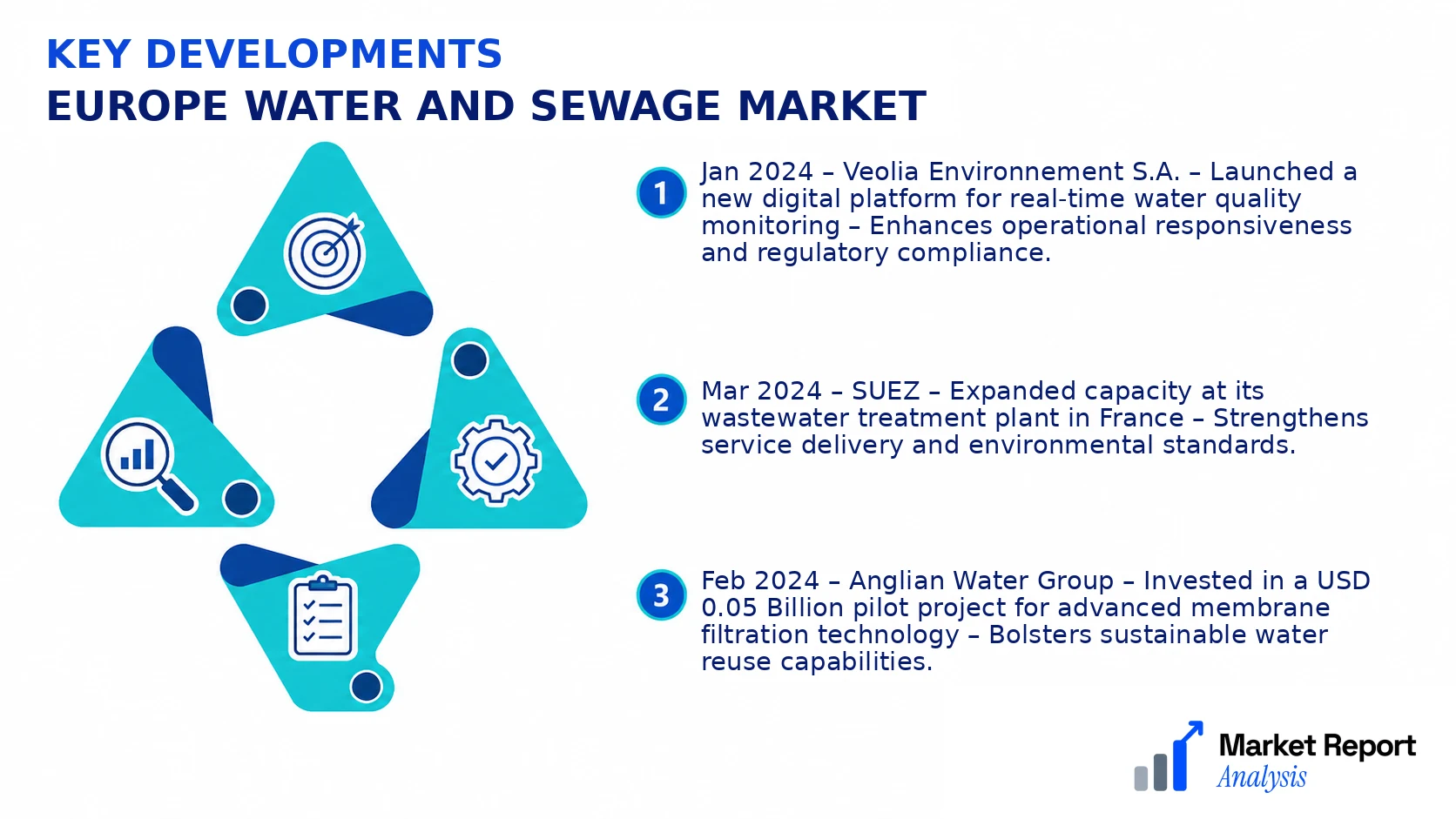
- Jan 2024 – Veolia Environnement S.A. – Launched a new digital platform for real-time water quality monitoring – Enhances operational responsiveness and regulatory compliance.
- Mar 2024 – SUEZ – Expanded capacity at its wastewater treatment plant in France – Strengthens service delivery and environmental standards.
- Feb 2024 – Anglian Water Group – Invested in a USD 0.05 Billion pilot project for advanced membrane filtration technology – Bolsters sustainable water reuse capabilities.
- Apr 2024 – Thames Water – Formed a strategic alliance with a tech firm for smart meter deployments – Improves consumption tracking and reduces leakage.
- May 2024 – United Utilities – Acquired a local digital solutions provider – Accelerates data-driven water management and customer engagement initiatives.
Frequently Asked Questions
What is the Europe Water and Sewage Market?
The Europe Water and Sewage Market encompasses the infrastructure, technology, and services involved in the supply and treatment of water and wastewater across European countries. It includes water treatment plants, sewage management systems, and related equipment essential for public health and environmental protection.
What is the current market size of Europe Water and Sewage Market?
As of 2026, the market size is valued at approximately USD 120 Billion, reflecting ongoing investments in water infrastructure and sanitation projects aimed at improving water quality and compliance with environmental standards in Europe.
What factors are driving the Europe Water and Sewage Market?
The market is propelled by increasing urbanization, stringent government regulations on water quality, advancements in treatment technologies, and rising awareness about sustainable water management practices, alongside investments in infrastructure renewal and growth in wastewater treatment capacity.
Which region dominates the Europe Water and Sewage Market?
Western Europe dominates the market owing to mature infrastructure, higher fiscal allocations for water projects, and strict regulatory frameworks. Countries like Germany, France, and the UK are leading contributors to market revenue and technological adoption.
Which segment is expected to grow the fastest?
The wastewater treatment segment is anticipated to experience the fastest growth, driven by increasing environmental regulations, urban expansion, and technological innovations aiming to reduce industrial and municipal effluents effectively.
Who are the leading companies operating in the Europe Water and Sewage Market?
Key players include Veolia Environnement, Suez, Veolia Water Technologies, and Sembcorp, along with regional companies that focus on sustainable water solutions. These organizations are expanding through strategic alliances, technological innovation, and regional presence expansion.
Analyst Perspective
The Europe Water and Sewage Market is nearing a mature stage, characterized by incremental innovation and consolidation among key players. Long-term growth prospects remain positive, driven by aging infrastructure, stringent regulatory standards, and increasing environmental awareness, which collectively foster ongoing demand for advanced water treatment and sewage solutions. Commercial opportunities are abundant in digitalization, sensor-based monitoring systems, and sustainable resource recovery technologies, offering potential for high-margin, differentiated services. Investment emphasis should prioritize smart infrastructure, climate resilience, and integrated water management systems to capitalize on future regional growth, notably in Eastern and Southern Europe where infrastructure upgrades are more urgent. Competitive intensity is rising as established firms expand capabilities and new entrants deploy innovative, technology-driven solutions. Regional growth potential varies, with Northern Europe leading due to regulatory rigor and economic stability, while Central and Eastern Europe present significant upside owing to substantial modernization needs. Strategic positioning now entails balancing innovation investments with regulatory compliance, ensuring resilience and competitiveness in a rapidly evolving market landscape.
