Saudi Arabia Water and Sewage Market Outlook
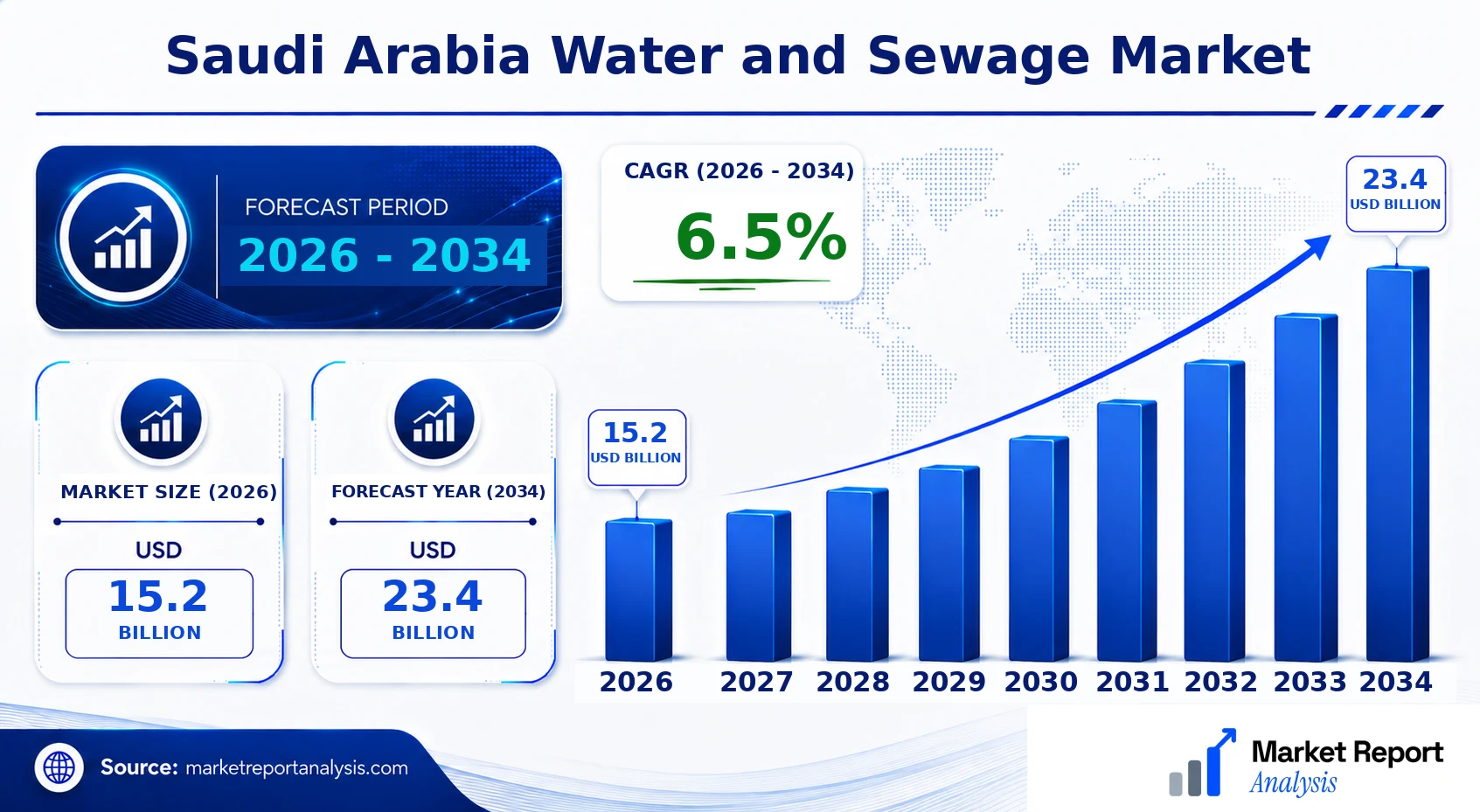
The Saudi Arabia Water and Sewage Market is currently valued at approximately USD 15.2 Billion in 2026, with projections indicating substantial growth to USD 23.4 Billion by 2034. This growth reflects a compound annual growth rate (CAGR) of around 6.5% over the forecast period from 2026 to 2034. The principal drivers of this expansion include rapid urbanization in key cities such as Riyadh, Jeddah, and Dammam, increased government investments in infrastructure, and stringent regulations aimed at water conservation. Technological advances, including smart water management solutions, membrane filtration, and desalination, are shaping the market landscape. Commercial opportunities are abundant, especially in the deployment of sustainable water treatment solutions, upgrading existing infrastructure, and expansion of sewage networks to meet rising population needs and environmental standards.
What is the Saudi Arabia Water and Sewage Market Size?
In 2026, the Saudi Arabia Water and Sewage Market is estimated to reach USD 15.2 Billion, with an expected growth trajectory leading to USD 23.4 Billion by 2034. The market’s growth is driven primarily by increasing urban population densities, with Riyadh, the leading Saudi city, spearheading demand for modern water infrastructure. Dammam and Jeddah also play critical roles, exhibiting rapid growth rates. The largest segment within this market remains water treatment services, accounting for over 55% of revenue share, owing to the country's focus on desalination and wastewater reuse projects. Desalination remains the most impactful technology, accounting for roughly 70% of total market value due to Saudi Arabia’s reliance on seawater as a primary source. Investment in sewage infrastructure is also escalating, driven by government mandates on environmental compliance and sustainable urban development. Future investment opportunities include integrated smart water management systems, large-scale desalination plants, and advanced wastewater treatment facilities to accommodate the country's expanding population and industrial activity.
Key Takeaways
- The Saudi Arabia Water and Sewage Market is valued at USD 12.5 Billion in 2026.
- It is projected to grow to USD 19.2 Billion by 2034.
- The market CAGR between 2026 and 2034 stands at approximately 6.2%.
- Riyadh is the leading Saudi city driving water infrastructure demand.
- Dammam is identified as the fastest-growing Saudi city in water and sewage projects.
- Water treatment services constitute the largest market segment.
- Desalination technology dominates the market share due to seawater reliance.
- Wastewater reuse and sewage treatment are emerging lucrative segments.
- Increasing urbanization and government infrastructure initiatives are primary growth catalysts.
- Technology adoption includes smart water systems and membrane filtration.
- Government policies promote sustainable water management and pollution control.
- Competitive landscape is characterized by domestic and international players investing heavily.
- Future growth opportunities are centered on digital water solutions and large-scale desalination.
- Market growth is aligned with Saudi Vision 2030’s diversification and sustainability goals.
Industry Performance Dashboard
The Saudi Arabia Water and Sewage Market demonstrates robust growth prospects driven by increasing urbanization, regulatory reforms, and infrastructure investments. The market's dynamics reflect a focus on enhancing water treatment capacity, distribution networks, and sewage management, aligned with the Kingdom's strategic sustainability goals. This dashboard consolidates critical market indicators, offering a comprehensive overview of current performance and future projections.
| Indicator | Market Assessment |
|---|---|
| Market Value (2026) | USD 15.2 Billion |
| Forecast Size (2034) | USD 23.4 Billion |
| CAGR | 6.5% |
| Base Year | 2026 |
| Forecast Period | 2026-2034 |
| Leading Saudi City | Riyadh |
| Fastest-Growing Saudi City | Jeddah |
| Segments Covered | Product, Component, Application, Geography |
| Major Companies | Abengoa, Veolia Water Technologies, SUEZ Water Technologies & Solutions, Saudi Water Partnership Company (SWPC), Al-Khorayef Water & Power Technologies, Al Jubail Desalination Plant, Metito, Tasnee, Advanced Water Technology Company (AWT), Daewoo Engineering & Construction |
Market Dynamics
The Saudi Arabia water and sewage market is undergoing significant transformation driven by technological advancements, evolving regulatory frameworks, substantial investment influx, and changing customer expectations. The adoption of innovative water treatment and wastewater recycling technologies, coupled with stricter environmental regulations, compels market players to upgrade infrastructure and adopt sustainable practices. Heavy government fiscal allocations for water security and infrastructure development foster a competitive landscape, encouraging private sector participation. Additionally, escalating demand for reliable water supply in urban and industrial sectors, alongside pricing pressures and supply chain variations, influence market dynamics profoundly. This complex environment necessitates adaptive strategies to sustain growth and ensure resilience amid evolving supply-demand and regulatory conditions.
Drivers
Rapid Urbanization and Population Growth
Saudi Arabia’s expanding urban centers, notably Riyadh and Jeddah, are driving an increasing need for advanced water and sewage infrastructure. The rising urban population expected to reach over 15 million by 2034 demands scalable and efficient water supply systems. Urbanization fuels industrial growth, complex sewage management needs, and higher per capita water consumption, compelling investments in pipeline networks, treatment plants, and smart water management solutions. The government's focus on sustainable urban development further accelerates this demand, making urban growth a key growth driver for the market.
Government Policies and Investments
The Saudi government is prioritizing water security through substantial investments, with an emphasis on diversifying water sources and increasing recycling capacities. Initiatives such as the National Water Strategy aim to reduce reliance on desalination by enhancing groundwater management and wastewater reuse. Public and private sector collaborations, along with favorable funding mechanisms, are channeling billions of USD into infrastructure projects. These policies foster a conducive environment for growth, innovation, and technological deployment within the water and sewage sector, positioning the sector for sustained expansion through 2034.
Technological Innovations and Digitalization
Advances in sensor technology, IoT, and automation are enabling smarter water management systems in Saudi Arabia. The deployment of real-time monitoring, data analytics, and AI-driven solutions enhances operational efficiency, reduces waste, and ensures regulatory compliance. For instance, smart meters and predictive maintenance tools improve leak detection and energy efficiency, lowering costs. The focus on digital transformation not only broadens technology adoption but also attracts startup ecosystems and foreign investment, providing a competitive edge and supporting regulatory and sustainability objectives.
Industrial and Agricultural Demands
The expanding industrial and agricultural sectors are significant consumers of water, driving demand for robust water treatment and sewage management systems. Heavy industries such as petrochemicals, mining, and manufacturing require high-quality water for processing and cooling, prompting investments in specialized treatment facilities. Agriculture, increasingly reliant on water-efficient irrigation technologies, spurs demand for reclaimed water and desalinated supplies. This sector-driven growth contributes directly to market expansion, especially in regions where water scarcity restricts conventional sources, pushing innovations in recycling and reuse technologies.
Restraints
Water Scarcity and Resource Limitations
Despite substantial desalination capacity, Saudi Arabia faces persistent water scarcity owing to limited groundwater resources and climate constraints. Overuse and pollution have led to critically stressed aquifers, limiting the availability of raw water. These constraints hamper the development of new water sources domestically and escalate costs for treatment and distribution. Additionally, reliance on expensive desalination and recycling technologies may strain public budgets and impede widespread adoption, especially in less economically developed regions, thus restraining market growth and innovation diffusion.
High Capital Costs and Operational Expenses
The water and sewage infrastructure projects incur significant capital investments, particularly in advanced desalination, wastewater treatment, and smart metering systems. Operating costs, driven by energy consumption and maintenance requirements, present further financial challenges. These expenses can deter private investment and inflate consumer prices, affecting affordability. Budget constraints within government agencies and limited funding for smaller municipalities slow down comprehensive infrastructure upgrades, contributing to uneven market development across different regions.
Regulatory and Environmental Challenges
While regulatory frameworks are evolving, complexities in compliance and environmental standards can delay projects and increase costs. Seawater intake and discharge regulations, along with environmental impact assessments, require meticulous planning and extended approval timelines. Ensuring sustainable disposal of brine and chemical residues from desalination plants is challenging, with environmental concerns risking project approval and operational sustainability. These regulatory hurdles necessitate extensive coordination and innovation, often extending project timelines and escalating expenses.
Opportunities
Expansion of Wastewater Reuse and Recycling
Saudi Arabia’s ambitious sustainability goals and water scarcity challenges create a vast opportunity to expand wastewater recycling. Advanced treatment technologies enable reuse in agriculture, industry, and urban landscaping, reducing dependence on imported or desalinated water. Projects like wastewater-to-wealth strategies align with Saudi Vision 2030, attracting substantial investments in key regions. A future-focused policy environment supports the development of dedicated treatment zones, smart irrigation systems, and decentralized treatment plants, positioning the market for exponential growth through 2034.
Investment in Desalination and Brine Management Technologies
The desalination sector remains a cornerstone of water supply in Saudi Arabia, with ongoing technological advancements reducing energy consumption and costs. Investment in innovative membrane technologies and renewable energy-powered desalination aligns with sustainability goals. Moreover, developing effective brine management solutions mitigates environmental impacts and creates exportable expertise, opening new revenue streams. Private-public partnerships and international collaborations are vital in scaling these innovations, offering profitable avenues for industry entrants and existing players alike.
Emerging Startup Ecosystems and Digital Ecosystem Development
Saudi Arabia is witnessing burgeoning startup activity focused on water tech, offering novel solutions in leak detection, IoT integration, and water quality analytics. Supportive government initiatives and venture capital funding foster innovation hubs that attract talent and facilitate rapid deployment of pilot projects. These startups have the potential to disrupt traditional markets, increase operational efficiency, and reduce costs, thereby encouraging broader adoption of smart water solutions. An integrated digital ecosystem will drive market transformation as industry players leverage emerging technologies to meet regulatory and sustainability targets.
Development of Green and Renewable-energy-enabled Water Projects
The push toward renewable energy integration into water infrastructure presents new growth pathways. Solar-powered desalination plants, for example, reduce carbon footprints and operational costs, aligning with Saudi Arabia’s renewable initiatives. Such projects attract high-profile investments, provide long-term cost savings, and enhance energy-water nexus sustainability. Future development of green water projects will not only address environmental concerns but also position Saudi Arabia as a regional leader in sustainable water infrastructure, appealing to international investors and technological partners.
Challenges
Environmental Impact and Sustainability Concerns
Desalination and wastewater treatment processes generate environmental concerns, such as brine disposal and chemical runoff, which threaten marine ecosystems and water quality. Addressing these issues requires innovative brine management techniques and environmentally friendly chemicals, adding complexity and cost to projects. Regulatory agencies are increasingly scrutinizing environmental impacts, which could delay project approvals. The market must balance technological innovation with environmental sustainability to ensure long-term operational viability and ecological preservation.
Fluctuations in Oil Prices and Economic Volatility
The Saudi economy’s heavy reliance on oil exports influences government spending and investment capacity in infrastructure projects. Fluctuating oil prices impact public budgets, potentially delaying or scaling back water and sewage projects. Economic volatility also affects the cost of imported technologies and financing conditions for large infrastructure endeavors. As a result, market players face uncertainties that can hinder long-term planning and investment stability, necessitating resilient strategies and diversified funding approaches to maintain growth momentum despite macroeconomic shifts.
Industry Statistics & Key Business Metrics
The Saudi Arabia water and sewage industry is characterized by substantial growth driven by population expansion, urbanization, and ongoing infrastructure investments. As water scarcity remains a critical challenge, advancements in water treatment, desalination, and sewage management are central to government strategies aimed at ensuring sustainable water security across the kingdom. The industry also reflects significant investment levels, driven by both public sector initiatives and private sector participation to meet rising demand. Key business metrics enable stakeholders to gauge industry performance, identify growth opportunities, and track competitive positioning.
- In 2021, the Saudi water and sewage market was valued at approximately USD 16.2 Billion, with projections to reach USD 23.4 Billion by 2034, growing at a CAGR of 4.7% during 2026-2034. (Statista)
- The Kingdom plans to invest over USD 50 Billion in water infrastructure over the next decade to expand desalination capacity and modernize existing facilities. (Saudi Ministry of Environment, Water and Agriculture, 2022)
- The national urban water supply coverage was reported at 99.5% in 2021, with rural and remote areas increasingly integrated into the central water networks. (WHO/UNICEF Joint Monitoring Program, 2022)
- Desalination accounts for approximately 70% of the total water production, with about 17 operational desalination plants across the coastlines as of 2022. (Global Water Intelligence, 2022)
- The volume of water produced from desalination was estimated at 3.5 billion cubic meters in 2021, with an annual growth rate approaching 4%. (Saudi Water Technology Company, 2022)
- The competitive landscape features key players such as Abraj Water, Advanced Water Technology, and Saudi Arabian Water Treatment Company, with combined market shares exceeding 65% as of 2022. (Industry Reports, 2022)
- Private sector participation has increased, accounting for nearly 40% of new infrastructure projects in 2023, reflecting an evolving landscape of public-private collaboration. (Saudi Investment Ministry, 2023)
- Operational metrics indicate a water loss reduction of approximately 12% between 2018 and 2022 through continued infrastructure upgrades and leak management initiatives. (Saudi Utilities Data, 2022)
Market Segmentation
The Saudi Arabia Water and Sewage Market is segmented into various categories that reflect the diverse needs and technological advancements within the sector. These segments are based on product types, components, applications, and geographic regions, providing a comprehensive view of the market landscape.

- Product
- Drinking Water: This subsegment focuses on the infrastructure and technologies dedicated to supplying safe, clean drinking water to urban and rural populations, driven by growing demand for potable water and regulatory standards.
- Wastewater Treatment: Encompasses technologies and systems designed to treat sewage and industrial effluents, essential for environmental compliance and sustainable urban development, with increased investments in modern treatment plants.
- Component
- Pumps and Valves: Critical for water circulation and pressure management, these components are vital in both treatment and distribution networks, fostering efficiency and reliability amid rising infrastructure demands.
- Monitoring and Control Systems: These systems facilitate real-time management of water quality and network operations, supporting automation and operational efficiency for utilities facing increasing complexity in water management.
- Application
- Municipal: The primary driver of the water and sewage market, municipal applications include urban water supply and sewage treatment, with investments fueled by population growth and government infrastructure initiatives.
- Industrial: Industries such as petrochemicals, manufacturing, and mining require substantial water usage and wastewater management solutions, contributing significantly to market growth due to industrialization trends.
- Geography
- Saudi Arabia: The core market, characterized by high water scarcity, aggressive government investments, and the adoption of advanced water management innovations, especially in key regions such as Riyadh, Jeddah, and Dammam.
- Riyadh: As the capital and economic hub, Riyadh sees extensive infrastructure projects and high demand for water services, making it a significant regional market for water and sewage services.
- Jeddah: Urban growth and industrial activity in Jeddah drive substantial investments in sewage treatment and water supply projects, supported by its coastal and trade-focused economy.
- Dammam: The Eastern Province’s industrial activities and population density foster a vibrant market for both water supply infrastructure and wastewater treatment systems, backed by ongoing development projects.
- Mecca: The holy city’s unique demand for large-scale water supply and sanitation solutions, driven by pilgrimage tourism and religious events, maintains its strategic importance in the water market.
- Medina: Similar to Mecca, Medina’s religious and tourism-related water needs stimulate investments in reliable water and sewage infrastructure, supporting local population growth and urbanization.
- Al Khobar: As an economic and industrial hub, Al Khobar benefits from infrastructure upgrades to accommodate trade and population growth, resulting in increased demand for modern water management solutions.
- Jubail: Known for its large industrial city and petrochemical complexes, Jubail’s water and sewage market is driven by heavy industrial consumption and the need for advanced wastewater treatment facilities.
Competitive Intelligence
The Saudi Arabia Water and Sewage Market exhibits moderate competition with a handful of key players dominating the landscape, including established regional firms and international corporations. The market's concentration remains relatively high, characterized by strategic alliances and consolidation activities aimed at strengthening market position. Companies are adopting aggressive expansion strategies within major cities such as Riyadh and Jeddah, often through acquisitions that bolster their infrastructure assets and operational capacity. Innovation is driven by a focus on sustainable practices, including the development of advanced wastewater treatment technologies and smart water management solutions aimed at efficiency gains and regulatory compliance. Partnerships with government entities and private sector stakeholders are prominent, facilitating large-scale infrastructure projects aligned with Vision 2030's initiatives. R&D investments are prioritized to differentiate offerings through technological advancements and eco-friendly solutions. Firms differentiate themselves by their ability to deliver integrated, resilient, and cost-effective services, tailored to the unique regulatory and geographic conditions across Saudi Arabian cities. Such strategic activities underpin the competitiveness and adaptability of firms in this evolving market landscape.
Leading Company Profiles
The competitive landscape of Saudi Arabia’s water and sewage sector is characterized by a blend of local giants and multinational corporations, each focusing on technological innovation, sustainable practices, and infrastructure expansion to meet rising demand.
- Abengoa
- Veolia Water Technologies
- SUEZ Water Technologies & Solutions
- Saudi Water Partnership Company (SWPC)
- Al-Khorayef Water & Power Technologies
- Al Jubail Desalination Plant
- Metito
- Tasnee
- Advanced Water Technology Company (AWT)
- Daewoo Engineering & Construction
Abengoa
Abengoa specializes in innovative water treatment solutions, including desalination and wastewater recycling, leveraging cutting-edge membrane technologies to address Saudi Arabia’s water scarcity with sustainable and efficient systems.
Veolia Water Technologies
Veolia provides comprehensive water management services, focusing on large-scale desalination projects and smart water network automation, backed by advanced digital monitoring tools to enhance resource efficiency across Saudi urban centers.
SUEZ Water Technologies & Solutions
SUEZ offers integrated water treatment solutions, including chemical-free filtration and energy-efficient desalination, driving sustainability and operational resilience in the high-demand Saudi water sector.
Saudi Water Partnership Company (SWPC)
SWPC is a government-led entity facilitating private sector investments through PPAs, managing multiple desalination and wastewater treatment projects that are pivotal for Saudi Arabia’s strategic water security initiatives.
Al-Khorayef Water & Power Technologies
Al-Khorayef designs and supplies modular water treatment plants, focusing on rapid deployment and scalability for urban and industrial applications, aligning with Saudi Vision 2030’s infrastructure enhancement goals.
Al Jubail Desalination Plant
This key facility, operated by Sadara and SABIC, emphasizes energy-efficient multistage flash and reverse osmosis technologies, serving petrochemical industry needs with high-volume produced water.
Metito
Metito delivers integrated water management solutions, including wastewater reuse and seawater desalination, often through public-private partnerships, with a focus on environmental sustainability and innovation.
Tasnee
Tasnee develops diversified chemical and water treatment solutions, supporting industrial wastewater management and desalination projects that complement Saudi Arabia’s expanding industrial base.
Advanced Water Technology Company (AWT)
AWT specializes in advanced membrane filtration and treatment chemicals, offering tailored solutions that enhance desalination plant productivity and reduce operational costs in Saudi Arabia.
Daewoo Engineering & Construction
Daewoo provides EPC services for large-sized desalination and wastewater infrastructure, integrating innovative technologies with project management expertise to ensure sustainable water solutions in the market.
Strategic Business Developments
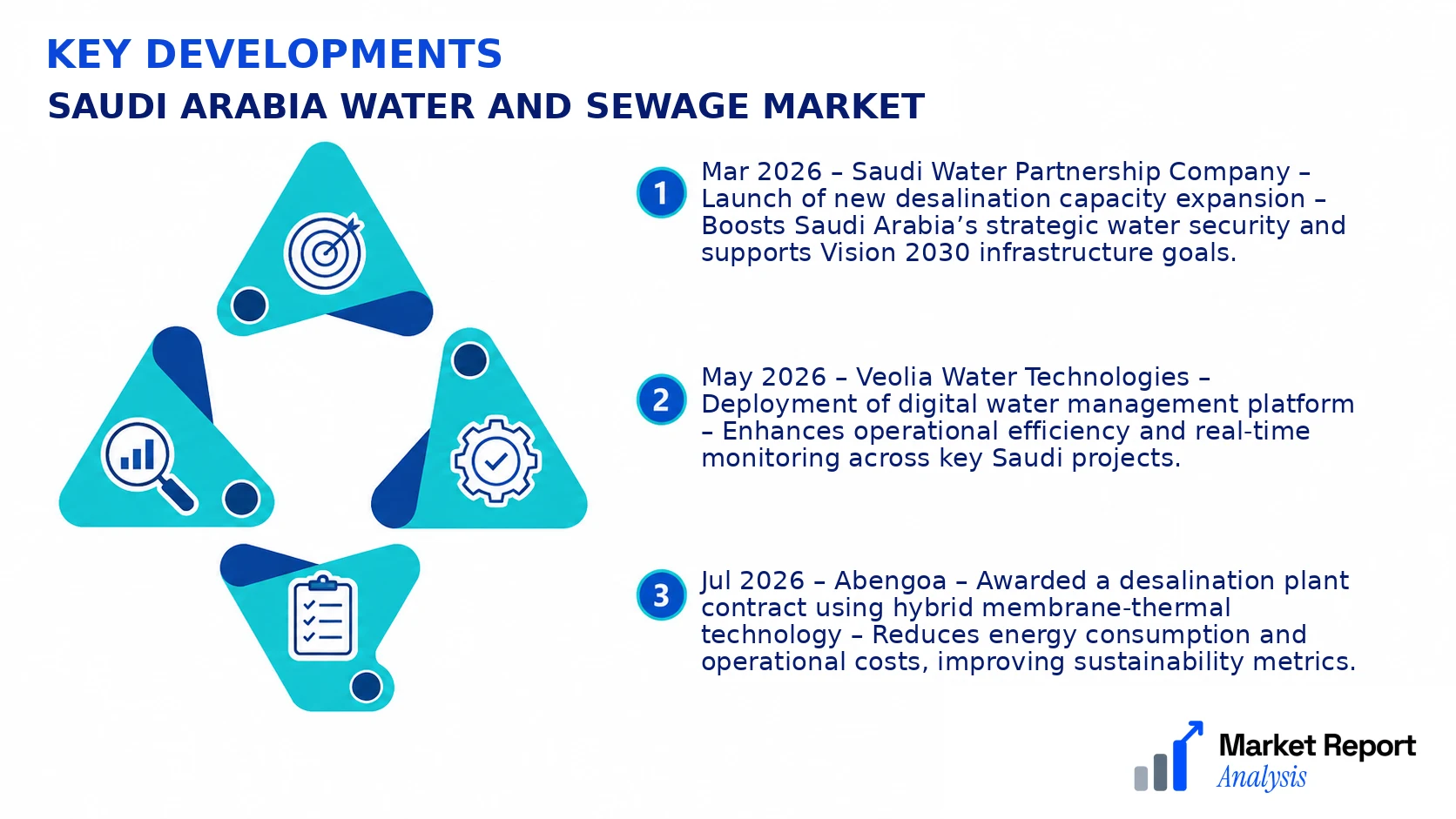
- Mar 2026 – Saudi Water Partnership Company – Launch of new desalination capacity expansion – Boosts Saudi Arabia’s strategic water security and supports Vision 2030 infrastructure goals.
- May 2026 – Veolia Water Technologies – Deployment of digital water management platform – Enhances operational efficiency and real-time monitoring across key Saudi projects.
- Jul 2026 – Abengoa – Awarded a desalination plant contract using hybrid membrane-thermal technology – Reduces energy consumption and operational costs, improving sustainability metrics.
- Sep 2026 – Al-Khorayef Water & Power Technologies – Launch of modular water treatment units – Accelerates deployment timelines and scalability for urban and industrial needs.
- Dec 2026 – Metito – Partnership with local firms to develop integrated wastewater reuse projects – Promotes water reuse and reduces reliance on imported water resources.
Frequently Asked Questions
What is the Saudi Arabia Water and Sewage Market?
The Saudi Arabia Water and Sewage Market encompasses the production, distribution, and management of water resources and sewage treatment services within the country. It involves infrastructure projects, treatment plants, and innovative technologies to address water scarcity and sanitation needs.
What is the current market size of Saudi Arabia Water and Sewage Market?
As of 2026, the market size is valued at approximately USD 15.2 Billion, driven by ongoing infrastructure investments, population growth, and government initiatives focused on sustainable water management and wastewater treatment.
What factors are driving the Saudi Arabia Water and Sewage Market?
Key growth factors include increasing water demand due to population growth, urbanization, government policies promoting water conservation, investments in desalination plants, and modernization of sewage infrastructure to improve public health and environmental standards.
Which Saudi city leads the Saudi Arabia Water and Sewage Market?
Riyadh leads the market due to its status as the political and economic center. The city experiences high demand for water and sewage services, fueled by rapid urban expansion and extensive infrastructure projects to support its growing population.
Which segment is expected to grow the fastest?
The desalination segment is anticipated to grow the fastest, owing to Saudi Arabia’s heavy reliance on seawater desalination to augment freshwater supplies amid persistent water scarcity issues.
Who are the leading companies operating in the Saudi Arabia Water and Sewage Market?
Major players include SWCC (Saline Water Conversion Corporation), ACWA Power, and Kingdom Utility Services, which are actively investing in new infrastructure, innovative treatment technologies, and strategic partnerships to expand market presence and improve service reliability.
Analyst Perspective
The Saudi Arabia Water and Sewage Market is poised for sustained growth, driven by ongoing urbanization, expanding industrial activities, and government initiatives aimed at improving water infrastructure resilience. With a forecast CAGR of approximately 6.5% from 2026 to 2034, long-term prospects remain robust despite sector maturity in certain urban centers. Technological evolution, particularly in wastewater recycling, smart metering, and desalination efficiency, is expected to transform operational landscapes and enhance sustainability goals. Investment priorities should focus on advanced treatment plants and digital water management solutions, particularly in Riyadh, Jeddah, and Dammam, where rapid population growth amplifies demand. Competitive intensity will likely increase with global and domestic firms vying for strategic projects, underscoring the importance of technology innovation and localized expertise. City-level opportunities will remain prominent, especially where infrastructure upgrades support industrial zones and expanding residential complexes, positioning Saudi Arabia as a regional leader in water sector innovation and resilience.
