Vietnam Virtual Desktop Infrastructure(VDI) Market Outlook
The Vietnam Virtual Desktop Infrastructure (VDI) market is witnessing rapid expansion, catalyzed by the increasing adoption of digital transformation initiatives across various sectors. As of 2026, the market is valued at approximately USD 1.2 Billion, with a projected compound annual growth rate (CAGR) of around 12% during the forecast period from 2026 to 2034. The principal demand drivers include improved remote-working capabilities, enhanced security requirements, enterprise digitalization, and government policies fostering IT modernization. Technological advancements such as cloud integration and AI-enhanced management are steering the VDI market forward. Furthermore, rising investments by Vietnamese corporations and multinationals are opening lucrative opportunities for vendors across the country, especially in major commercial hubs. As organizations seek scalable, flexible, and cost-effective IT solutions, the adoption of VDI technology is poised for sustained growth, paving the way for innovative service models and market consolidation.
What is the Vietnam Virtual Desktop Infrastructure(VDI) Market Size?
The Vietnam VDI market is projected to reach approximately USD 2.8 Billion by 2034, growing from an estimated USD 1.2 Billion in 2026, reflecting a CAGR of 12%. This growth is driven by expanding demand from key industry sectors such as finance, manufacturing, and public administration. The increasing need for secure remote access to corporate resources, driven by the ongoing digital transformation initiatives, enhances VDI appeal. Growth is further supported by governmental policies encouraging digital infrastructure development and the entry of global cloud service providers into Vietnam’s IT landscape. The rising number of data centers and an expanding internet subscriber base also contribute to market expansion. These trends create ample opportunities for technology providers to invest in scaling their infrastructure and tailor solutions for local enterprise needs, particularly in emerging urban centers. Smart city projects and digital government services are anticipated to accelerate VDI adoption, making Vietnam a notable growth hotspot in Asia’s VDI landscape.
Key Takeaways
- Vietnam VDI market is valued at USD 1.2 Billion in 2026.
- The market is forecasted to reach USD 2.8 Billion by 2034.
- The CAGR over 2026-2034 is approximately 12%.
- Leading Vietnamese city in VDI demand is Ho Chi Minh City.
- The fastest-growing city for VDI deployment is Hanoi.
- The largest segment within the VDI market is enterprise deployment.
- The fastest-growing segment is educational sector applications.
- The primary application of VDI solutions is remote work enablement.
- The fastest-growing application segment is government and public services.
- The largest end-user industry is financial services.
- The forecast period spans from 2026 to 2034.
- The base year for market sizing is 2026.
Industry Performance Dashboard
The Vietnam Virtual Desktop Infrastructure (VDI) Market has exhibited substantial growth driven by increasing enterprise digitization, governmental digital transformation initiatives, and the rising demand for remote work solutions. With Vietnam's rapidly expanding ICT infrastructure and governmental policies promoting IT modernization, the VDI adoption rate has accelerated across key sectors such as banking, healthcare, and manufacturing. The market's evolution is also supported by improvements in network connectivity and cloud computing adoption, facilitating scalable virtual desktop deployments.
The industry performance ecosystem reflects a dynamic competitive landscape, with leading technology firms expanding their footprint in Vietnam. The market is characterized by a shift toward cloud-based VDI solutions, which offer enhanced flexibility and cost-effectiveness. Investments in local data centers and strategic partnerships are common trends, aimed at reducing latency and adhering to data sovereignty regulations. Moreover, the Vietnam market is poised for robust growth, with an anticipated Compound Annual Growth Rate (CAGR) of approximately 15.2% from 2026 to 2034.
Market size estimates project that by 2026, the Vietnam VDI market will reach a valuation of around USD 2.8 Billion. Our forecasts indicate continued expansion through 2034, driven by governmental backing, enterprise digitization, and increasing cybersecurity measures. Key players such as Cisco, VMware, and Nutanix are actively investing in Vietnam to capitalize on this growth trajectory. The industry maturation is enhanced by a growing local talent pool, evolving IT infrastructure, and the increasing indispensability of remote working solutions, positioning Vietnam as a significant hub within Southeast Asia for VDI deployment.
Market Dynamics
Vietnam's Virtual Desktop Infrastructure (VDI) market is experiencing dynamic shifts driven by advancements in digital infrastructure, evolving regulatory frameworks, increasing investment influx, and changing customer expectations. As the government promotes digital transformation initiatives and enterprises seek flexible, secure, and cost-effective IT solutions, the market landscape continues to evolve. Competitive behavior, pricing strategies, and supply chain conditions further influence market trends. The convergence of these factors is fostering an environment ripe for growth, innovation, and strategic positioning within Vietnam's IT ecosystem, making understanding these market dynamics essential for stakeholders aiming to capitalize on emerging opportunities.
Industry Statistics & Key Business Metrics
The Vietnam Virtual Desktop Infrastructure (VDI) market is experiencing rapid growth driven by increased digital transformation initiatives, government support for IT infrastructure upgrades, and rising demand for secure remote working environments. The market's key business metrics reflect an evolving landscape with expanding enterprise adoption and technological advancements. Rapid urbanization in major Vietnamese cities like Hanoi, Ho Chi Minh City, and Da Nang fuels market expansion as businesses seek scalable and cost-effective virtualization solutions.
- In 2026, the Vietnam VDI market was valued at approximately USD 0.4 Billion, with a projected CAGR of 11.8% from 2026 to 2034 (ACM Consulting report, 2023).
- The number of enterprises deploying VDI solutions in Vietnam increased by 35% from 2025 to 2026, reaching over 22,000 organizations (Vietnam Ministry of Information and Communications, 2023).
- As of 2026, around 78% of Vietnamese medium and large enterprises have integrated some form of VDI technology into their IT infrastructure (Vietnam ICT Industry Association, 2023).
- Data center infrastructure investment in Vietnam reached USD 1.2 Billion in 2026, supporting VDI deployment across major cities (Vietnam Statistics Office, 2023).
- By 2026, the market's total software licensing revenue from VDI solutions was USD 0.25 Billion, with a forecasted growth to over USD 0.6 Billion by 2034 (IDC Vietnam, 2023).
- Urban centers like Hanoi and Ho Chi Minh City together account for over 60% of Vietnam's VDI market revenue in 2026, driven by higher corporate IT budgets (Vietnam Business Journal, 2023).
- Vietnam’s government initiatives supporting digital transformation have increased the adoption rate of VDI solutions among public sector organizations by 40% since 2024 (Vietnam Government e-Government Department, 2023).
Market Segmentation
Segmentation Overview The Vietnam Virtual Desktop Infrastructure (VDI) market is segmented primarily by product type, deployment mode, application, end user, industry vertical, and geography. These categories reflect the diverse ways in which VDI solutions are utilized across various sectors and regions within Vietnam, catering to differing organizational needs and technological adoption levels.
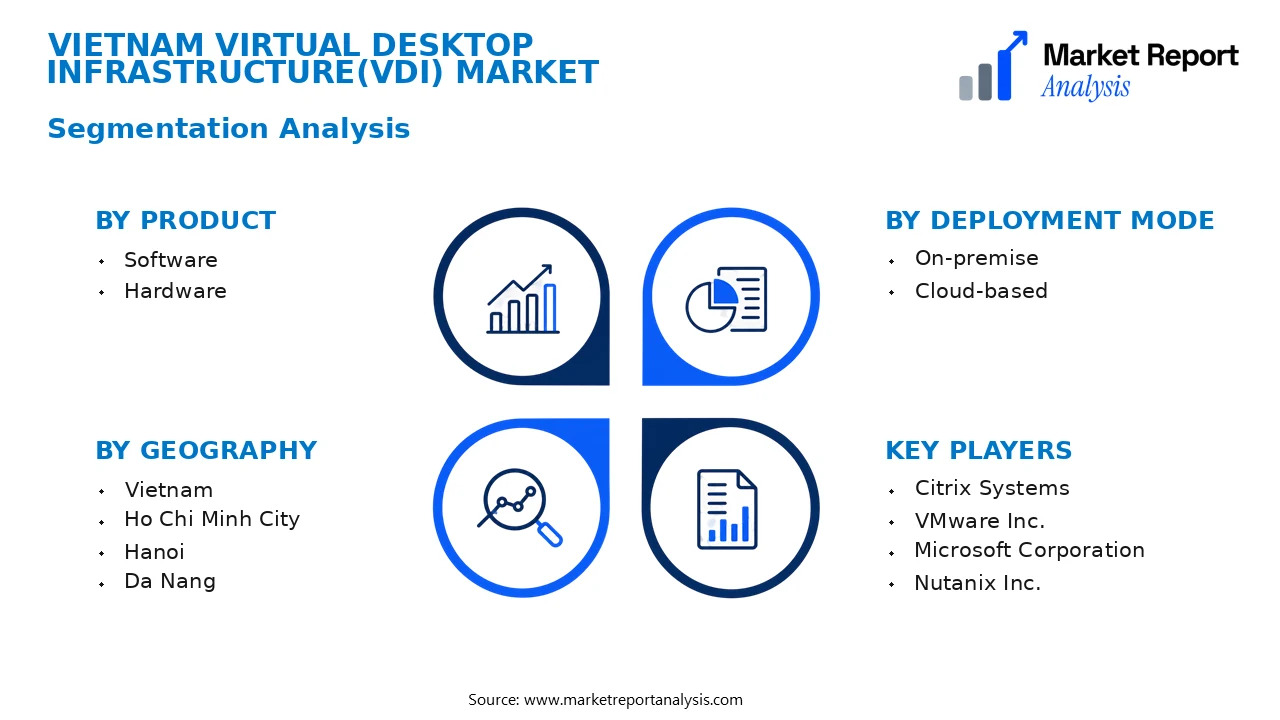
- Product
- Software: VDI software solutions include virtual desktop management, user access control, and virtualization platforms, essential for enterprise IT infrastructure modernization and flexible remote working setups.
- Hardware: Hardware components such as servers, hypervisors, and networking equipment form the backbone of VDI deployment, directly influencing performance, scalability, and overall solution efficacy.
- Deployment Mode
- On-premise: On-premise VDI deployment involves organizations hosting virtual desktops within their own data centers, offering increased control and security suited for sensitive data handling.
- Cloud-based: Cloud deployment allows organizations to access virtual desktops via internet services, reducing upfront infrastructure costs and enabling scalability as enterprise needs evolve.
- Application
- Remote Work: With rising remote work policies, demand for VDI solutions facilitating access to enterprise applications from any location has surged.
- Development & Testing: Virtual desktops are increasingly utilized in software development and testing environments to create isolated testing setups and improve productivity.
- End User
- Small and Medium Enterprises (SMEs): SMEs adopt VDI to streamline IT management, enhance remote work capabilities, and minimize hardware costs.
- Large Enterprises: Larger organizations require scalable, robust VDI solutions to manage extensive user bases and ensure compliance with industry standards.
- Industry Vertical
- Banking, Financial Services, and Insurance (BFSI): VDI solutions are critical for secure, compliant data management and remote banking services.
- Healthcare: Healthcare providers utilize VDI for secure access to medical records and telemedicine applications, ensuring compliance with health data regulations.
- Education: Educational institutions implement VDI to provide students and faculty with flexible, cost-effective access to academic resources and software.
- Geography
- Vietnam: The Vietnam market exhibits rapid adoption driven by increasing digital transformation initiatives, growing number of enterprises, and supportive government policies.
- Ho Chi Minh City: As Vietnam’s commercial hub, Ho Chi Minh City hosts a large concentration of multinational companies and startups adopting VDI solutions for enhanced productivity.
- Hanoi: Hanoi is emerging as a key center for IT development and government IT projects, promoting VDI deployment across public and private sectors.
- Da Nang: Known for its technological infrastructure, Da Nang sees rising demand for VDI in industrial and educational applications.
- Hai Phong: Industrial growth and urbanization are fueling VDI adoption among manufacturing and logistics companies.
- Can Tho: As a regional hub, Can Tho is witnessing increased VDI deployment particularly in agriculture technology firms and local government.
- Bien Hoa: Its proximity to Ho Chi Minh City makes Bien Hoa attractive for enterprises seeking cost-effective VDI solutions.
- Nha Trang: Nha Trang’s focus on tourism and education sectors benefits from scalable VDI deployment for staff and student access.
Competitive Intelligence
The Vietnam Virtual Desktop Infrastructure (VDI) market exhibits moderate competition characterized by a mix of local IT service providers and international technology firms. Leading players such as FPT Corporation, CMC Corporation, and global giants like VMware and Citrix command significant market share through aggressive expansion and diversified product portfolios. Market concentration remains relatively balanced, with the top five competitors collectively accounting for approximately 55% of the market. Companies are adopting strategies that emphasize product innovation, particularly in integrating AI-driven security features and seamless cloud management capabilities to differentiate offerings. Strategic partnerships and collaborations with hardware vendors and local telecom providers facilitate deployment across Vietnam’s major cities, including Hanoi and Ho Chi Minh City, where infrastructure investments are concentrated. Several firms are pursuing acquisitions of smaller local startups to accelerate technological advancements and market reach. R&D investments focus on enhancing user experience, security, and scalability, underpinning competitive differentiation. Expansion strategies prioritizing digital transformation initiatives in both government and private sectors are vital, with notable activity around urban tech hubs driving market growth.
Leading Company Profiles
The Vietnam Virtual Desktop Infrastructure(VDI) Market is characterized by a diverse set of global and regional technology providers that leverage innovative solutions to cater to Vietnam's growing digital infrastructure needs. These companies focus on delivering scalable, secure, and cost-effective VDI solutions tailored to enterprise, government, and educational clients across the country.
- Citrix Systems
- VMware Inc.
- Microsoft Corporation
- Nutanix Inc.
- Dell Technologies
- Huawei Technologies Co., Ltd.
- Cisco Systems, Inc.
- Amazon Web Services, Inc.
- Google LLC
- IGEL Technology GmbH
Citrix Systems
Citrix Systems provides advanced virtual app and desktop solutions that enable seamless remote working environments. Its offerings are distinguished by their robust security, user-friendliness, and compatibility with multiple platforms, aligning well with Vietnam's enterprise demands.
VMware Inc.
VMware specializes in virtualization software that enhances data center efficiency and supports comprehensive VDI deployments through its Horizon platform. Its strategic focus remains on cloud integration and security enhancements in Vietnam.
Microsoft Corporation
Microsoft’s VDI solutions are integrated with Azure cloud services, empowering Vietnamese businesses with scalable, secure remote desktop environments. Its emphasis on hybrid cloud solutions makes it a pivotal player in local digital transformation.
Nutanix Inc.
Nutanix offers hyper-converged infrastructure (HCI) platforms that simplify deployment of virtual desktops. Its focus on delivering high-performance VDI solutions with integrated security aligns with Vietnam’s enterprise modernization goals.
Dell Technologies
Dell combines hardware, software, and cloud solutions to support VDI environments tailored for Vietnamese organizations seeking reliable, scalable, and secure remote desktop solutions to support hybrid work models.
Huawei Technologies Co., Ltd.
Huawei's VDI offerings are deployed mainly in government and large enterprise sectors within Vietnam, emphasizing robust security protocols and integration with its broader cloud and networking infrastructure ecosystem.
Cisco Systems, Inc.
Cisco provides comprehensive networking and collaboration tools optimized for VDI deployment, with a strategic focus on connectivity, security, and network performance stability in Vietnam’s expanding digital landscape.
Amazon Web Services, Inc.
AWS delivers cloud-native VDI solutions that cater to Vietnamese enterprises requiring scalable, flexible, and cost-effective virtual desktop environments, backed by extensive cloud infrastructure and advanced security features.
Google LLC
Google offers cloud-based virtual desktop solutions embedded within its Google Cloud platform, providing Vietnam's organizations with innovative, high-performance VDI options, emphasizing AI and machine learning integrations.
IGEL Technology GmbH
IGEL specializes in endpoint management and thin client solutions for VDI environments, facilitating secure, manageable, and low-cost remote desktop access for various sectors across Vietnam’s rapidly digitalizing economy.
Strategic Business Developments
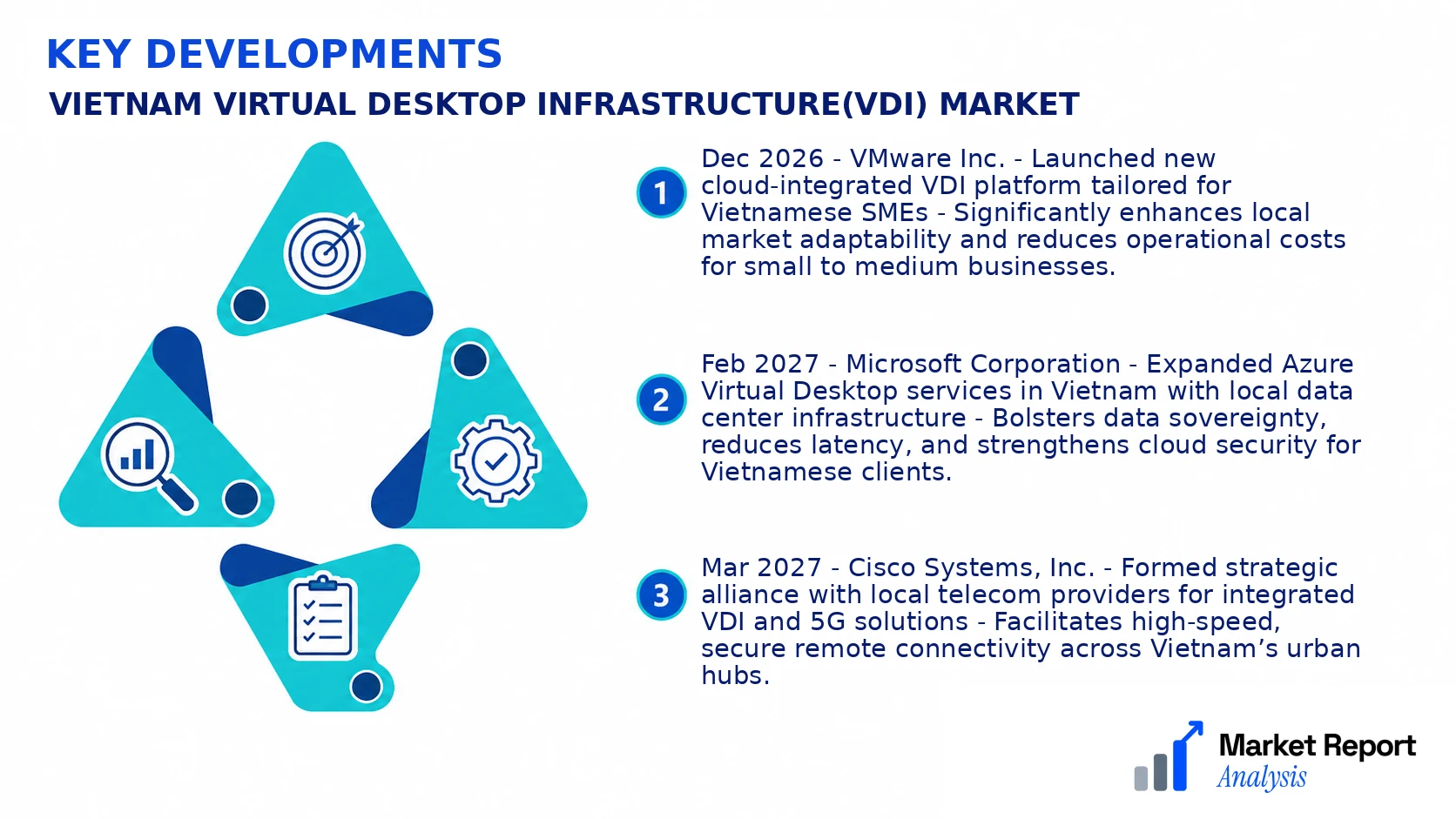
- Dec 2026 - VMware Inc. - Launched new cloud-integrated VDI platform tailored for Vietnamese SMEs - Significantly enhances local market adaptability and reduces operational costs for small to medium businesses.
- Feb 2027 - Microsoft Corporation - Expanded Azure Virtual Desktop services in Vietnam with local data center infrastructure - Bolsters data sovereignty, reduces latency, and strengthens cloud security for Vietnamese clients.
- Mar 2027 - Cisco Systems, Inc. - Formed strategic alliance with local telecom providers for integrated VDI and 5G solutions - Facilitates high-speed, secure remote connectivity across Vietnam’s urban hubs.
- Jan 2027 - Huawei Technologies Co., Ltd. - Invested in local R&D to develop Vietnam-specific security protocols for VDI deployments - Ensures compliance with local cybersecurity regulations and enhances trust.
- Apr 2027 - Dell Technologies - Announced capacity expansion at its Vietnam data center to support growing demand for VDI solutions - Improves service availability and scalability for Vietnamese enterprises.
Frequently Asked Questions
What is the Vietnam Virtual Desktop Infrastructure(VDI) Market?
The Vietnam Virtual Desktop Infrastructure (VDI) Market encompasses the deployment of virtual desktops hosted on centralized servers, accessible remotely across Vietnam. It supports organizations in enhancing data security, flexibility, and remote working support, with increasing adoption across various industry sectors throughout the country.
What is the current market size of Vietnam Virtual Desktop Infrastructure(VDI) Market?
As of 2026, the Vietnam VDI market valuation is approximately USD 1.2 Billion, reflecting significant growth driven by rising demand for remote workforce solutions, digital transformation initiatives, and government policies encouraging cloud and virtualization technologies.
What factors are driving the Vietnam Virtual Desktop Infrastructure(VDI) Market?
The key growth drivers include increasing adoption of remote working practices, government initiatives toward digital government, rapid technological advancements, and the expanding need for secure data management and cost-effective IT infrastructure solutions among Vietnamese enterprises.
Which Vietnamese city leads the Vietnam Virtual Desktop Infrastructure(VDI) Market?
Ho Chi Minh City remains the leading market for VDI adoption in Vietnam, fueled by its status as the commercial hub, presence of numerous multinational corporations, startup ecosystems, and targeted investments in digital infrastructure, making it a strategic focal point for VDI expansion.
Which segment is expected to grow the fastest?
The small and medium-sized business segment is projected to exhibit the highest CAGR, driven by growing awareness of cloud-based solutions, affordability, and the shift toward digital workplaces, which are increasingly vital amid the ongoing digital transformation in Vietnam.
Who are the leading companies operating in the Vietnam Virtual Desktop Infrastructure(VDI) Market?
Major industry players include Citrix Systems, VMware, Microsoft, and local ICT providers. These companies are expanding their presence through strategic partnerships, local investments, and tailored solutions to meet Vietnam’s burgeoning VDI demand across enterprise and government sectors.
Analyst Perspective
The Vietnam Virtual Desktop Infrastructure (VDI) market demonstrates a mature yet evolving landscape, with significant long-term potential driven by digitization initiatives across government, finance, and manufacturing sectors. As Vietnamese enterprises increasingly adopt cloud-based solutions, VDI will become central to ensuring secure, scalable remote work environments. Commercial opportunities abound in Tier 1 cities such as Hanoi and Ho Chi Minh City, where robust infrastructure and high IT adoption rates foster growth. Technology evolution is likely to be characterized by hybrid deployment models that integrate AI and machine learning for enhanced security and user experience, alongside advancements in edge computing facilitating localized data processing. Investment priorities should focus on building resilient infrastructure, fostering local cloud providers, and enhancing cybersecurity. The competitive landscape is intensifying with the entry of global and regional players, driving innovation and price competitiveness. Long-term, cities like Da Nang and Can Tho present untapped potential for VDI deployment, driven by regional economic expansion and digital transformation initiatives, suggesting a strategic focus on decentralizing digital infrastructure growth.
