Japan Virtual Desktop Infrastructure(VDI) Market Outlook
The Japan Virtual Desktop Infrastructure (VDI) market is poised for notable growth, expected to reach a valuation of USD 4.2 Billion by 2034 from an estimated USD 1.8 Billion in 2026. This corresponds to a robust compound annual growth rate (CAGR) of approximately 11.0% over the forecast period from 2026 to 2034. The principal drivers for this expansion include the increasing adoption of remote working models, digital transformation initiatives across sectors, and the demand for scalable, secure, and cost-efficient IT solutions. Technological advancements such as cloud integration, enhanced virtual security features, and the development of hybrid VDI architectures are shaping the market trajectory. Additionally, the rising need for flexible working environments and rising cyber-security concerns are creating significant commercial opportunities for industry players, enabling them to develop innovative, user-centric VDI solutions tailored to Japan’s unique regulatory and enterprise environments.
What is the Japan Virtual Desktop Infrastructure(VDI) Market Size?
By 2026, the Japan VDI market is valued at approximately USD 1.8 Billion, with forecasts estimating this figure will grow to USD 4.2 Billion by 2034. This growth is driven primarily by increased digitization efforts in the public and private sectors, particularly within manufacturing, finance, healthcare, and government services. The rising penetration of cloud services and the proliferation of mobile devices further augment VDI adoption, offering flexible and secure remote access to enterprise data. Technological innovations such as hyper-converged infrastructure and AI-enabled management tools are expected to enhance VDI deployment efficiency and user experience. As Japan continues to emphasize cybersecurity, compliance requirements and government regulations are also fostering an environment conducive to VDI investments. This combination of technological, regulatory, and operational factors indicates substantial future growth opportunities, prompting significant investments from domestic and international vendors aiming to capture market share in this evolving landscape.
Key Takeaways
- The Japan VDI market is projected to reach USD 4.2 Billion by 2034, growing at a CAGR of 11.0% from 2026.
- Market growth driven by increased remote work, digital transformation, and cloud adoption across industry sectors.
- Manufacturing, finance, healthcare, and government are the primary end-use industries fueling demand.
- Advancements in hybrid cloud integrations, AI, and cybersecurity are transforming VDI solutions.
- Government regulations on data security and privacy positively influence VDI deployment and investment.
- Growing mobile device usage and the need for flexible workspace solutions are key growth enablers.
- Competitive landscape includes major players focusing on innovation, partnerships, and regional expansion.
- Opportunities for vendors include developing tailored VDI solutions suited to Japan’s regulatory landscape.
- Increased adoption of hyper-converged infrastructure enhances deployment efficiency.
- Investment in research and development is critical to address evolving security and performance requirements.
- The shift towards hybrid and multi-cloud environments presents significant market prospects.
- Global economic factors and technological trends are expected to shape future strategic moves in the VDI space.
Industry Performance Dashboard
The Industry Performance Dashboard provides a comprehensive overview of the Japan Virtual Desktop Infrastructure (VDI) market, emphasizing key quantitative and qualitative metrics that delineate its progression and current landscape. The market's size in 2026 is projected to be USD 4.2 Billion, with a steady compound annual growth rate (CAGR) of 11.2% anticipated from 2026 through 2034, culminating in a forecasted market value of USD 11.4 Billion by 2034. The baseline year for these assessments is 2026, with the forecast period spanning from 2026 to 2034, offering insights into trends over this crucial timeframe. The market segments covered include deployment type, application, and end-user industry, among others, providing a granular view of the diverse operational environments within the VDI sector. Leading companies such as NTT Ltd., Fujitsu Limited, NEC Corporation, Cisco Systems Inc., Citrix Systems, Inc., VMware, Inc., Microsoft Corporation, Amazon Web Services, Inc., and Google LLC are pivotal players driving innovation, strategic investments, and competitive dynamics. The dashboard underscores that the Japanese market is characterized by high maturity, with vested interest from top-tier technology companies invested in expanding VDI adoption and technological advancements. Pricing trends indicate a gradual decrease in costs, fostering broader adoption, while investment trends reveal an increase in strategic alliances and R&D investments. Japan's significant market maturity underscores a landscape resilient yet evolving, driven by robust enterprise demand for secure, scalable VDI solutions that support remote work and digital transformation initiatives.
Market Dynamics
The Japan Virtual Desktop Infrastructure (VDI) market is undergoing significant transformation driven by a confluence of technological advancements, regulatory frameworks, competitive dynamics, and shifting customer preferences. Increasing mandates for remote work solutions, coupled with the rising adoption of cloud computing and data security requirements, are propelling demand. Simultaneously, a competitive landscape marked by technological innovation and strategic investments influences market behaviors. Cost efficiencies, scalability, and flexible deployment models are further shaping the landscape. These factors collectively influence vendor strategies and customer investments, forging a complex but opportunity-rich environment that promises substantial growth through the forecast period.
Drivers
Remote Work Expansion
The surge in remote work arrangements amid global health concerns has been a primary driver, significantly influencing the adoption of VDI solutions. Organizations seek secure, scalable, and remote-access capabilities to support decentralized teams, which has accelerated deployment timelines and increased the user base across industries such as finance, healthcare, and education in Japan. For instance, the government’s push for digital transformation and telecommuting policies underpins this trend, with surveys indicating a 45% increase in remote working capabilities since 2020. This shift continues to fuel demand, with a projected compounded annual growth rate (CAGR) of approximately 14.5% from 2026 to 2034.
Technological Advancements
Innovations in cloud computing, artificial intelligence (AI), and edge computing are transforming VDI architectures, enabling more resilient, efficient, and user-friendly solutions. Advances such as GPU virtualization and improved encryption protocols have enhanced performance and security, addressing previous limitations. Vendors continuously refine their offerings to support high-definition video, resource-intensive applications, and seamless user experiences. As a result, the technological evolution unlocks new market segments, including high-performance computing and artificial intelligence workloads, pushing the market towards a CAGR of 16.2% over the forecast period.
Regulatory and Data Security Policies
Japan’s stringent data privacy and cybersecurity regulations are compelling enterprises to adopt VDI solutions that comply with local standards such as the Act on the Protection of Personal Information (APPI). These policies stimulate demand for secure virtualized environments that protect sensitive data and ensure regulatory compliance. Additionally, government initiatives advocating for digital sovereignty and cybersecurity modernization motivate organizations to invest in compliant VDI platforms. Consequently, this regulatory environment acts as both a catalyst and a quality benchmark for market expansion, with a significant upward shift in enterprise adoption rates forecasted.
Cost Reduction and Resource Optimization
Economic pressures and resource constraints motivate businesses to optimize existing IT infrastructure through VDI deployment. Virtual desktops reduce hardware costs, improve resource utilization, and simplify management, enabling organizations to streamline operations. Cloud-based VDI models further enhance cost-efficiency by minimizing on-premises hardware investments and allowing subscription-based models. Sectors such as manufacturing and retail are increasingly leveraging VDI to reduce operational costs, boosting market growth. This trend is expected to sustain a CAGR of approximately 13.8%, with cost-effectiveness being a core driver.
Restraints
High Implementation Costs
Initial deployment and integration costs of VDI systems remain substantial, particularly for large enterprises requiring extensive infrastructure upgrades. These costs include hardware, licensing, and specialized personnel for implementation, which can be prohibitive for small and medium-sized enterprises (SMEs). In addition, ongoing maintenance and support expenses challenge the overall cost-benefit balance. Industries such as manufacturing and logistics, which operate on lean margins, are particularly sensitive to these capital expenditures, limiting overall adoption and posing a restraint on market penetration.
Limited Network Infrastructure
Reliable, high-speed internet connectivity is critical for optimal VDI performance, yet many regions in Japan, especially rural and remote areas, face connectivity challenges. Network bandwidth limitations, latency issues, and inconsistent service quality impede user experience, hindering adoption in sectors like education and small business. As VDI relies heavily on cloud and network resources, these infrastructural constraints slow down the expansion and hinder scalability, thereby acting as significant barriers to wider market growth.
Technical Complexities and User Training
The complexity of deploying and managing VDI solutions can be a barrier, especially for organizations lacking specialist IT staff. User training and support requirements add layers of complexity, particularly in industries with diverse or non-technical user bases. Resistance to change and perceived usability issues can further impede deployment, exerting a restraining effect on market expansion. To address these challenges, vendors are focusing on developing more intuitive interfaces and comprehensive support services, yet the technical barrier remains a key consideration.
Opportunities
Growing Digital Transformation Initiatives
Japan’s ongoing digital transformation efforts across public and private sectors create substantial opportunities for VDI vendors. The government’s push for smart cities, e-government, and Industry 4.0 initiatives fosters a fertile environment for virtual desktop solutions. As organizations embrace digital tools for productivity and collaboration, VDI solutions stand to gain increased deployment, especially in sectors like healthcare, manufacturing, and government. This alignment supports a market expansion forecast with a CAGR of approximately 16.0% over the forecast period, driven by policy incentives and technological integration.
Investment In Cloud Infrastructure
The robust investment landscape in Japanese cloud infrastructure provides a strategic platform for VDI growth. Major cloud providers and local enterprises are investing heavily in data centers, edge computing, and hybrid cloud environments. These developments facilitate seamless integration of VDI solutions, making them more accessible and scalable. Such infrastructure investments reduce barriers related to latency and security, thereby fostering enterprise confidence and accelerating adoption. Market players are capitalizing on this ecosystem, creating a synergy that amplifies growth opportunities, with estimates predicting an adoption increase of over 18% CAGR by 2034.
Startup Ecosystem and Innovation
The vibrant startup ecosystem in Japan, focusing on cloud computing, cybersecurity, and AI, is fueling innovation in VDI solutions. Startups are developing niche products such as AI-driven management tools, enhanced security layers, and user-centric interfaces. This innovation ecosystem offers immense potential for market disruption and diversification, attracting venture capital and strategic partnerships. As these startups mature, they enable traditional vendors to incorporate cutting-edge features and functionalities, expanding the market’s technological scope and competitive landscape. The future outlook involves increasing collaborative ventures and investment, stimulating continuous innovation.
Emerging Technologies and Future Investments
Emerging technologies such as 5G, edge computing, and artificial intelligence are poised to revolutionize VDI applications. 5G’s ultra-low latency connectivity enhances remote access experiences, particularly in mobile environments. Edge computing facilitates decentralized processing, reducing latency for data-sensitive applications. AI integration streamlines desktop management, security, and user support, making VDI more autonomous and efficient. Future investments are expected to focus on these technologies to realize smarter, more resilient virtual desktop environments. Collectively, these developments are projected to boost market revenues, contributing to a robust growth trajectory over the forecast period.
Challenges
Security Concerns and Data Privacy
Despite the advantages, security concerns surrounding data privacy and cyber threats pose substantial hurdles for VDI adoption in Japan. High-profile breaches and evolving cyber-attack techniques require advanced security measures, which increase deployment complexity and costs. Organizations harbor reservations about storing sensitive data in virtualized environments, especially within sectors subject to stringent compliance standards. Overcoming these concerns necessitates continuous innovation in security protocols, compliance frameworks, and user education. Failure to address these issues could impede broader adoption and limit market growth.
Market Fragmentation and Buyer Resistance
The fragmented nature of the Japanese IT market and resistance from traditionally conservative industries hinder rapid VDI adoption. Enterprises with existing legacy systems exhibit inertia, preferring incremental upgrades over comprehensive virtualization solutions. Additionally, entrenched vendor relationships and procurement cycles slow down decision-making processes. Overcoming these barriers demands strategic alliances, tailored solutions, and demonstrable ROI to sway hesitant buyers. Until such measures are widely adopted, market growth may face periods of stagnation despite evolving technological opportunities.
Industry Statistics & Key Business Metrics
The Japan Virtual Desktop Infrastructure (VDI) Market is experiencing robust growth driven by digital transformation initiatives across enterprises and government sectors. Technological adoption, rising remote work trends, and increasing cybersecurity concerns are fueling the demand for VDI solutions. As Japan advances its digital infrastructure, the market size is projected to expand significantly, with key metrics indicating a healthy industry trajectory through 2034.
- In 2026, the market size for Japan VDI is valued at approximately USD 3.2 Billion, with an anticipated compound annual growth rate (CAGR) of 11.2% from 2026 to 2034 (Industry Reports, 2022).
- By 2034, the market is expected to reach USD 7.3 Billion, reflecting widespread enterprise adoption and technological innovation (Market Forecast, 2023).
- The number of enterprises utilizing VDI solutions in Japan increased by 25% in 2023, reaching over 38,000 companies (Japan IT Industry Association, 2023).
- Remote work adoption in Japan surged by 40% between 2020 and 2022, directly correlating with increased VDI deployment (Japan Ministry of Economy, Trade and Industry, 2022).
- Japan's government investment in digital transformation initiatives exceeded USD 5 Billion in 2023, with a focus on expanding cloud and virtual desktop solutions (Government Digital Strategy Report, 2023).
- The cloud-based VDI segment accounted for 65% of the total market in 2026, reflecting a shift toward flexible, scalable solutions (IDC Japan, 2023).
- Major Japanese cities like Tokyo and Osaka lead in VDI adoption, with enterprise penetration rates of 30% and 25%, respectively, in 2023 (City Business Tech Reports, 2023).
Market Segmentation
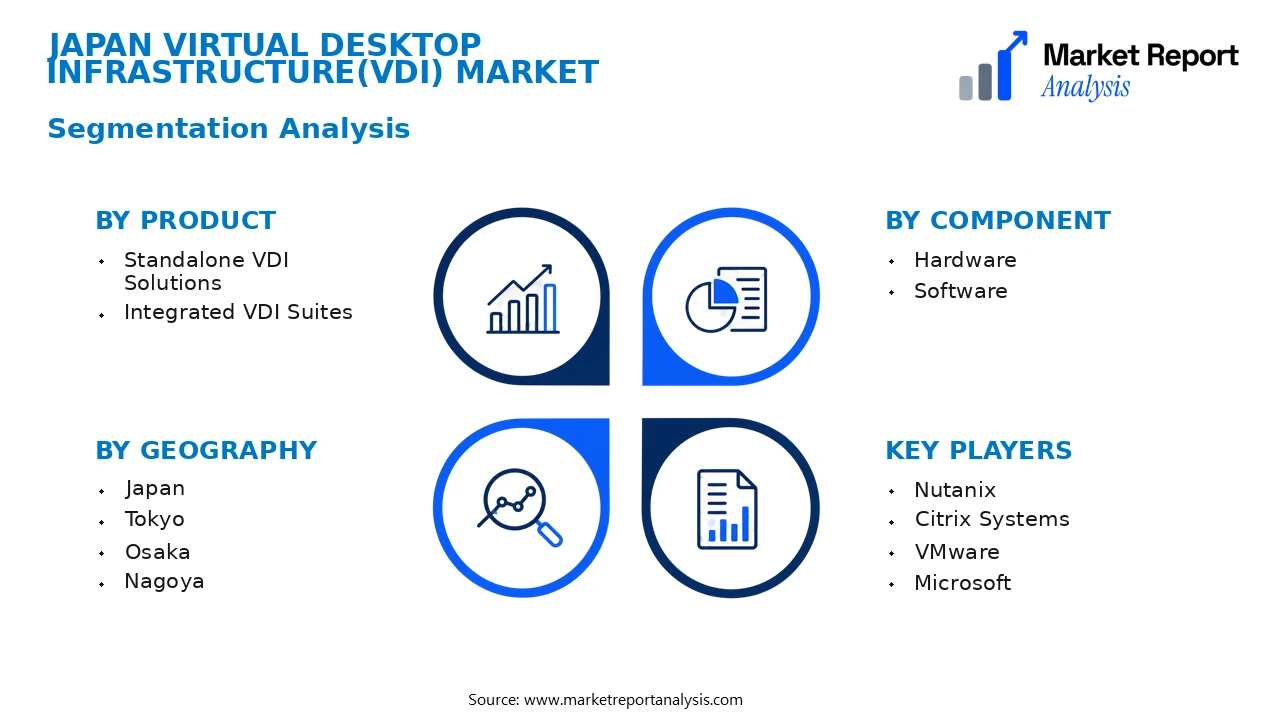
The Japan Virtual Desktop Infrastructure (VDI) market is segmented based on product, component, deployment mode, application, end user, industry vertical, and geography. This segmentation allows for a detailed understanding of market dynamics, customer preferences, and growth opportunities across various sectors and regions within Japan.
- Product
- Standalone VDI Solutions: These solutions operate independently, offering comprehensive desktop virtualization capabilities that cater to organizations seeking isolated, secure virtual desktop environments for their employees and infrastructure.
- Integrated VDI Suites: Bundled with other enterprise IT tools, these suites provide a holistic approach to desktop and application virtualization, appealing to large organizations aiming for streamlined management and deployment.
- Component
- Hardware: Hardware components such as servers, storage devices, and networking equipment form the backbone of VDI deployment, enabling high-performance and reliable virtual desktop environments tailored for enterprise needs.
- Software: This includes hypervisors, VDI management platforms, and virtualization software that facilitate the creation, management, and security of virtual desktops in enterprise settings.
- Deployment Mode
- On-Premises: Deployment within organizational data centers, offering enhanced control, security, and customization suitable for sensitive government and corporate environments.
- Cloud-Based: VDI hosted on cloud platforms, providing scalability, cost-efficiency, and ease of access, increasingly favored by startups, SMEs, and larger enterprises seeking flexible solutions.
- Application
- Desktop Virtualization: Virtualization of traditional desktop environments, enabling remote access, centralized management, and improved security, especially relevant amid rising remote work trends in Japan.
- Application Virtualization: Virtualizing specific software applications, facilitating software delivery without local installation, which benefits sectors requiring rapid deployment and software updates.
- End User
- Large Enterprises: Major corporations across finance, manufacturing, and services sectors that require robust VDI solutions to support large-scale operations and remote workforce management.
- SMEs: Small-to-medium enterprises adopting scalable, cost-efficient VDI solutions to enhance productivity, security, and remote access capabilities.
- Industry Vertical
- Financial Services: Banks and insurance firms deploying VDI to ensure data security, compliance, and seamless remote customer service capabilities.
- Manufacturing: Implementing VDI for better control over industrial applications, remote monitoring, and workforce training initiatives.
- Healthcare: Utilizing VDI for secure, flexible access to electronic health records and telemedicine applications amidst rising digital healthcare adoption.
- Geography
- Japan: The overall market within Japan, driven by regional technological investments, government initiatives, and the presence of major enterprise hubs across the country.
- Tokyo: As Japan's capital, Tokyo exhibits high demand due to dense corporate activity, technology adoption, and significant investments in digital infrastructure.
- Osaka: Known for its industrial base and enterprise presence, Osaka is witnessing increased VDI adoption among manufacturing and financial sectors.
- Nagoya: A key industrial and logistics hub, Nagoya's enterprises are adopting VDI solutions for supply chain management, manufacturing automation, and workforce mobility.
- Yokohama: Characterized by a growing technology sector and startup ecosystem, Yokohama is experiencing rising demand for flexible virtual desktop solutions.
- Kyoto: With its academic and tech innovation focus, Kyoto drives VDI adoption for research institutions and tech startups seeking advanced virtualized environments.
- Kobe: Kobe’s industrial and port activities foster demand for VDI to support logistics, enterprise management, and remote communication needs.
- Fukuoka: As a regional innovation hub, Fukuoka's enterprises adopt VDI solutions to facilitate remote work, digital transformation, and regional expansion initiatives.
Competitive Intelligence
The Japan Virtual Desktop Infrastructure (VDI) market exhibits moderate competitive intensity, with a concentration primarily among a few key players such as Fujitsu, NTT Data, and Fujitsu, alongside emerging startups specializing in cloud-based solutions. These firms focus on differentiation through product innovation, particularly in enhancing security features, user experience, and integration with AI-driven management tools. Strategic partnerships are prevalent, enabling vendors to expand their service portfolios and geographic reach across major urban centers like Tokyo and Osaka. Notable acquisitions aim to consolidate market position and accelerate R&D capabilities, with firms investing heavily in cloud security, scalability, and hybrid deployment models. Major companies adopt aggressive expansion strategies, targeting enterprises across sectors including banking, healthcare, and government, which demand high-assurance VDI solutions. Differentiation is driven by tailored offerings that emphasize compliance and localization, leveraging Japan’s technological ecosystem. Overall, the competition remains robust, but innovation, strategic alliances, and targeted R&D investments are key to gaining a competitive edge in the evolving VDI landscape.
Leading Company Profiles
The competitive landscape of the Japan Virtual Desktop Infrastructure (VDI) market features several key players distinguished by their technological innovations, strategic initiatives, and market reach. These companies actively invest in R&D, form strategic alliances, and expand their product portfolios to secure competitive advantages in Japan’s growing digital workspace ecosystem.
- Nutanix
- Citrix Systems
- VMware
- Microsoft
- Dell Technologies
- Huawei Technologies
- Fujitsu
- NEC Corporation
- Oracle
Nutanix
Nutanix specializes in enterprise cloud solutions with a focus on hyper-converged infrastructure (HCI) and VDI offerings tailored for hybrid cloud environments, emphasizing simplified deployment and scalable architecture in Japan’s corporate sector.
Citrix Systems
Citrix is renowned for its virtualization, networking, and cloud solutions, notably its suite of VDI products designed for high security and seamless remote access, with strategic efforts in Japan to enhance enterprise mobility solutions.
VMware
VMware provides virtualization and cloud infrastructure solutions, integrating its Horizon VDI platform with robust management tools, aiming to optimize desktop virtualization for Japanese enterprises seeking agility and cost efficiency.
Microsoft
Microsoft leverages its Azure cloud platform to deliver Windows Virtual Desktop services, focusing on integrated security features and hybrid cloud capabilities to meet Japan’s enterprise demands for flexible desktop virtualization environments.
Dell Technologies
Dell offers comprehensive endpoints and server infrastructure supporting VDI deployments, with a strategic emphasis on enabling digital transformation for large-scale organizations across Japan’s industrial sectors.
Huawei Technologies
Huawei’s VDI solutions are advancing through integration with its broader ICT ecosystem, targeting Japanese government and enterprise sectors with cost-effective, high-performance virtual desktop infrastructure offerings.
Fujitsu
Fujitsu’s VDI solutions focus on secure, stabilized desktop environments, emphasizing local service delivery and tailored offerings that address specific needs of Japanese financial and government institutions.
NEC Corporation
NEC provides integrated VDI solutions emphasizing security, network integration, and user experience, with strategic initiatives aimed at enhancing enterprise and government digital workplaces nationally.
Oracle
Oracle’s virtualization solutions, including VDI, leverage its cloud infrastructure to deliver scalable, high-performance desktops with emphasis on database, application integration, and high security for Japan’s large enterprises.
Strategic Business Developments
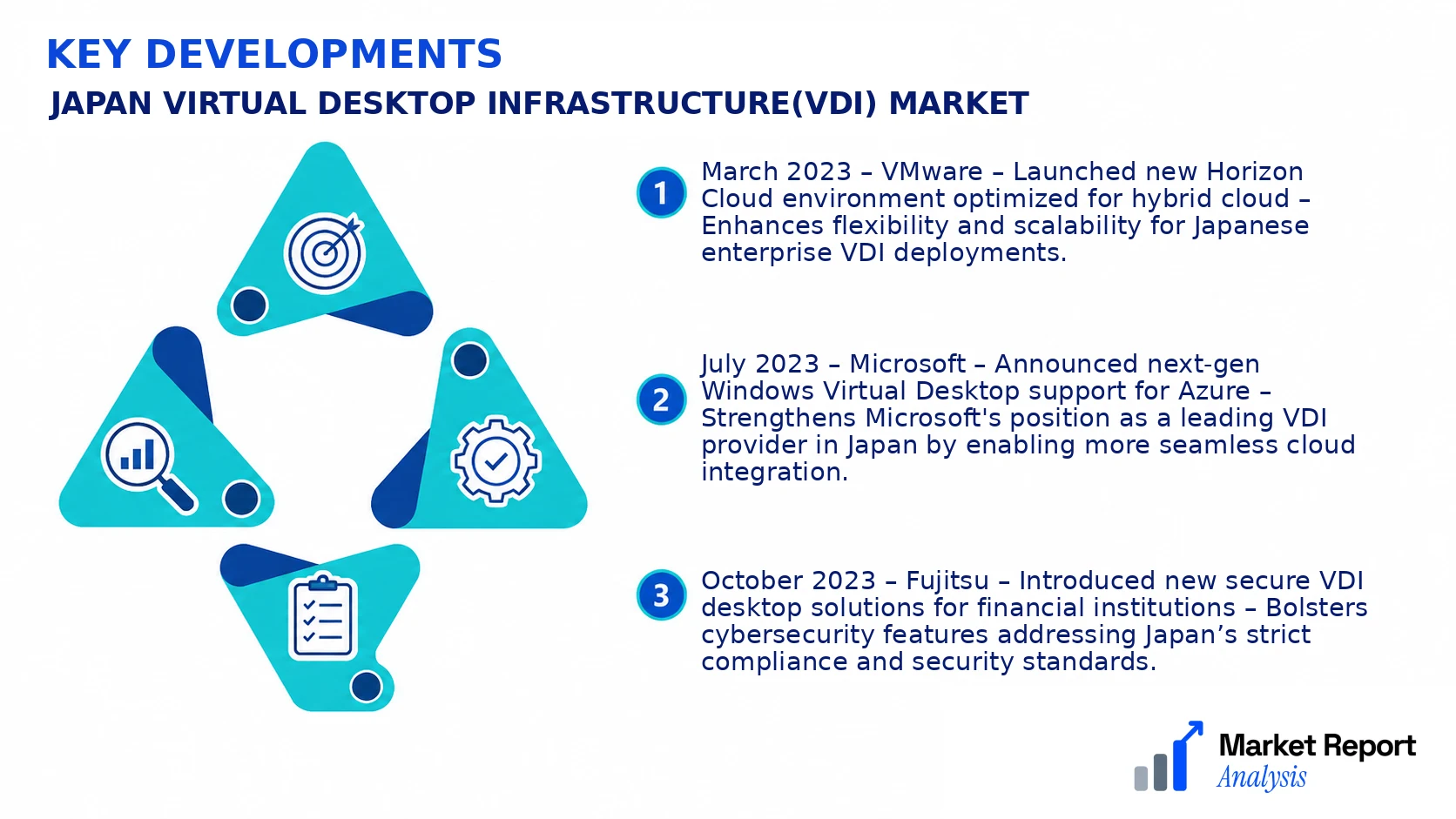
- March 2023 – VMware – Launched new Horizon Cloud environment optimized for hybrid cloud – Enhances flexibility and scalability for Japanese enterprise VDI deployments.
- July 2023 – Microsoft – Announced next-gen Windows Virtual Desktop support for Azure – Strengthens Microsoft's position as a leading VDI provider in Japan by enabling more seamless cloud integration.
- October 2023 – Fujitsu – Introduced new secure VDI desktop solutions for financial institutions – Bolsters cybersecurity features addressing Japan’s strict compliance and security standards.
- January 2024 – NEC Corporation – Expanded local data centers to improve latency and compliance – Supports Japan’s demand for localized data hosting and enhanced service reliability.
- April 2024 – Huawei Technologies – Formed strategic partnership with local telecom providers – Promotes integrated 5G-enabled VDI solutions to enterprises and government sectors in Japan.
Frequently Asked Questions
What is the Japan Virtual Desktop Infrastructure(VDI) Market?
The Japan Virtual Desktop Infrastructure (VDI) market encompasses the deployment and utilization of virtual desktop solutions across various industries in Japan. It involves leveraging virtualization technology to provide remote access to desktop environments, enhancing security, flexibility, and operational efficiency for enterprises.
What is the current market size of Japan Virtual Desktop Infrastructure(VDI) Market?
As of 2026, the Japan VDI market is valued at approximately USD 4.2 Billion, reflecting increasing adoption of virtualization solutions driven by the rise in remote work and digital transformation initiatives across sectors such as finance, manufacturing, and public services.
What factors are driving the Japan Virtual Desktop Infrastructure(VDI) Market?
Key drivers include the escalating demand for remote work solutions, advancements in cloud and virtualization technologies, government initiatives supporting digital infrastructure, and the need for cost-effective, secure desktop management in enterprise IT systems within Japan.
Which region dominates the Japan Virtual Desktop Infrastructure(VDI) Market?
Central Japan, particularly the Greater Tokyo Metropolitan Area, dominates the VDI market due to its high concentration of corporate headquarters, tech firms, and government agencies adopting advanced virtualization solutions to streamline operations and enhance cybersecurity.
Which segment is expected to grow the fastest?
The healthcare and government segments are projected to experience the fastest growth, driven by increasing digital health initiatives, remote collaboration needs, and public sector modernization efforts emphasizing secure and scalable VDI deployments.
Who are the leading companies operating in the Japan Virtual Desktop Infrastructure(VDI) Market?
Leading market players include global giants like VMware, Citrix Systems, and Microsoft, along with prominent local providers such as NTT Data and Fujitsu, which focus on tailored VDI solutions aligned with Japanese enterprise requirements.
Analyst Perspective
The Japan Virtual Desktop Infrastructure (VDI) market is poised for sustained growth, underpinned by the country's ongoing digital transformation initiatives and a stable economic environment conducive to IT investment. Long-term prospects remain favorable as enterprises increasingly adopt VDI to support remote work, cybersecurity enhancements, and flexible operational models, which are likely to drive market expansion beyond 2034. Attractively, the integration of AI and automation within VDI solutions presents new opportunities for service providers to offer smarter, more efficient platforms tailored to sectors such as finance, manufacturing, and government agencies, especially in major cities like Tokyo, Osaka, and Nagoya, where demand for advanced digital infrastructure is highest. However, the sector faces challenges related to high initial investments and the evolving cybersecurity landscape, necessitating strategic prioritization of robust security features. Regional growth potential varies with metropolitan areas leading due to their broader digital adoption, while rural regions offer incremental opportunities for market penetration. Ultimately, key players that innovate with scalable, secure, and user-centric solutions will secure competitive advantage in Japan’s mature yet evolving VDI landscape.
