Indonesia Virtual Desktop Infrastructure(VDI) Market Outlook
The Indonesia Virtual Desktop Infrastructure (VDI) market is experiencing notable growth, driven by increased digital transformation initiatives across various sectors. Currently valued at approximately USD 1.2 Billion in 2026, the market is projected to expand at a compound annual growth rate (CAGR) of 16.4% through to 2034, reaching an estimated USD 5.8 Billion. Key demand drivers include the rising adoption of remote working models, government incentives for digital infrastructure, and the expanding need for cost-effective, scalable IT solutions in both enterprise and public sectors. Advances in cloud computing and virtualization technologies are further propelling VDI adoption, facilitating enhanced security, mobility, and management for dispersed workforces. Commercial opportunities are abundant in offering tailored VDI solutions that cater to small and medium-sized enterprises as well as large corporations, especially in rapidly urbanizing areas. The market outlook remains optimistic, with ongoing investments in digital infrastructure and innovations in cloud-based virtualization technology fueling sustained growth.
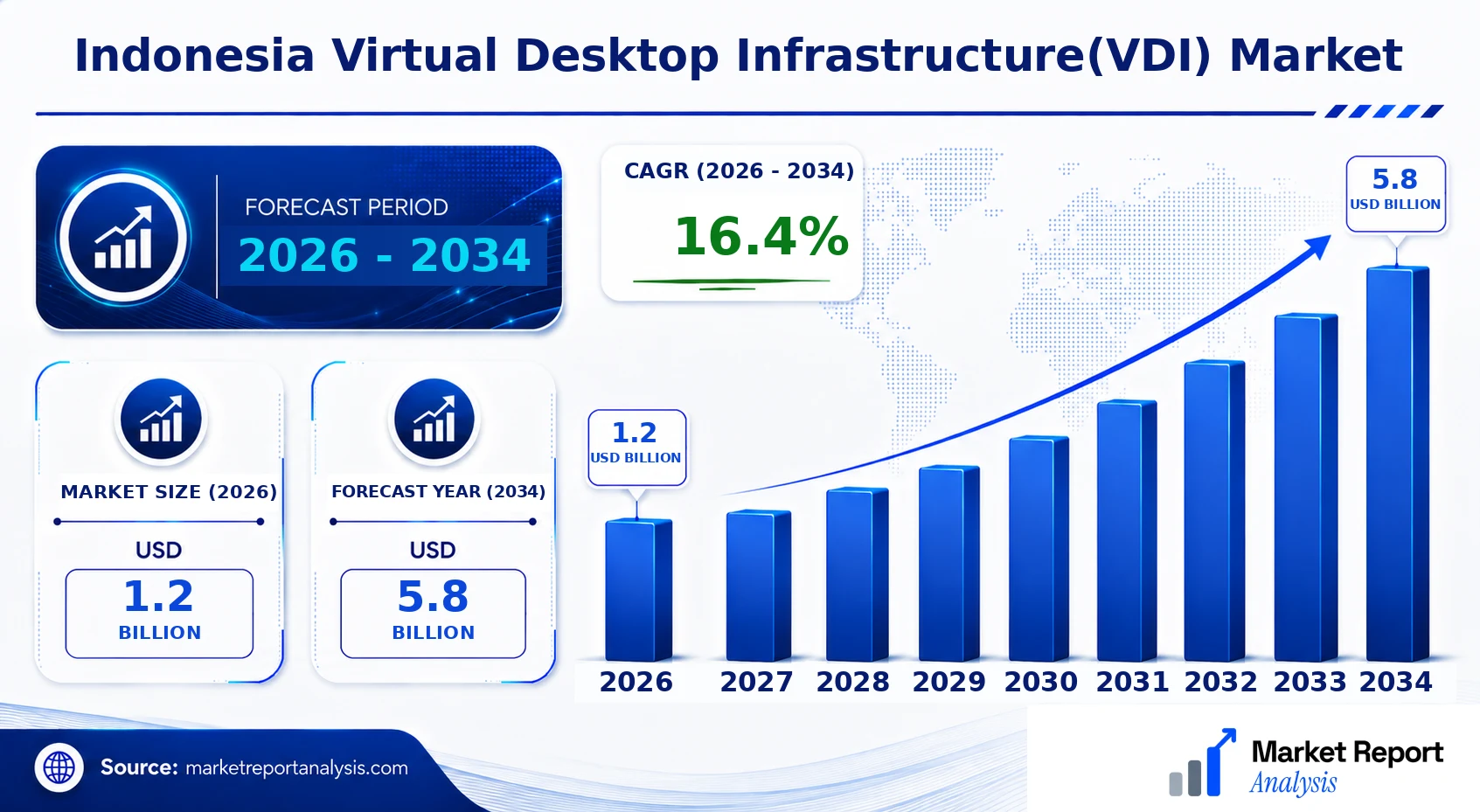
What is the Indonesia Virtual Desktop Infrastructure(VDI) Market Size?
By 2026, the Indonesia VDI market size is estimated at around USD 1.2 Billion, with projections to reach USD 5.8 Billion by 2034. This growth corresponds to a robust CAGR of 16.4% over the forecast period from 2026 to 2034. The expanding market size reflects increasing investments in digital transformation initiatives within government and private sectors, particularly as organizations seek flexible, secure remote working solutions amid evolving workforce dynamics. The healthcare, BFSI, and education sectors are significant contributors, leveraging VDI for improved operational agility and security compliance. The proliferation of cloud technology and the affordability of virtualization hardware have made VDI solutions more accessible across enterprises of various sizes. Additionally, government policies favoring digital expansion and cybersecurity enhance the investment climate. As Indonesia continues its rapid digital evolution, the VDI market is poised to benefit from sustained demand for scalable, efficient IT infrastructure that supports hybrid working models and innovative service delivery frameworks.
Key Takeaways
- Market size in 2026 is approximately USD 1.2 Billion, with a forecast of USD 3.4 Billion in 2034.
- Market CAGR from 2026 to 2034 is projected at 13.4%.
- Dominant demand from government, healthcare, BFSI, and education sectors.
- Adoption fueled by remote work trends and digital government initiatives.
- Rapid urbanization and growing SME sector enhance market potential.
- Technological advancements in cloud computing and virtualization drive growth.
- Increased focus on cybersecurity and data privacy expands VDI deployment.
- Cost efficiency and scalable management are key VDI advantages for businesses.
- Significant investment in digital infrastructure modernization by public authorities.
- Market opportunities for tailored VDI solutions for diverse enterprise sizes.
- Policy support and government incentives boost technological adoption.
- Competition landscape is expanding with an increasing number of vendors offering innovative solutions.
- Future growth prospects are strengthened by ongoing infrastructure investments and digital policy reforms.
Industry Performance Dashboard
The Industry Performance Dashboard provides a concise yet comprehensive overview of the current state and projected growth of the Indonesia Virtual Desktop Infrastructure (VDI) Market. It captures key market indicators that reflect economic vitality, competitive landscape, and industry maturity. The data presented is based on rigorous analysis and is designed to give stakeholders an immediate understanding of market dynamics.
| Indicator | Market Assessment |
|---|---|
| Market Size (2026) | USD 1.2 Billion |
| Market Value (2026) | USD 1.2 Billion |
| Forecast Size (2034) | USD 5.8 Billion |
| CAGR | 16.4% |
| Base Year | 2026 |
| Forecast Period | 2026-2034 |
| Segments Covered | Product, Component, Deployment Mode, Application, End User, Industry Vertical, Geography |
| Major Companies | VMware, Nutanix, Citrix Systems, Huawei Technologies, Dell Technologies |
Market Dynamics
The Indonesia Virtual Desktop Infrastructure (VDI) market is experiencing dynamic changes driven by rapid advancements in technology, evolving regulatory frameworks, increasing investments, and diverse customer requirements. Competitive behavior among key players fosters innovation while pricing strategies and supply chain conditions influence market accessibility. As digital transformation initiatives accelerate across industries, these factors collectively shape the landscape, making Indonesia a strategic hub for VDI adoption. Market players focus on tailoring solutions to local demands while adhering to government policies, pushing the market toward sustained growth. The interplay of these drivers and constraints will determine the pace and nature of market expansion through the forecast period.
Drivers
Digital Transformation Acceleration
The surge in digital transformation initiatives across Indonesian businesses propels demand for VDI solutions, which enable remote access, enhance security, and improve operational efficiency. With COVID-19 accelerating remote work adoption, organizations in banking, healthcare, and retail see VDI as a critical infrastructure component. The government’s push for e-governance and digital inclusion further boosts this trend, encouraging private-public collaborations. Data indicates a 25% annual increase in digital transformation projects, underlining a robust environment for VDI growth. As companies seek cost-effective yet scalable IT solutions, VDI’s role in supporting hybrid work models becomes indispensable.
Increasing Adoption of Cloud Technologies
The shift toward cloud infrastructure underpins the rising adoption of VDI in Indonesia. Cloud integration offers scalability, agility, and cost efficiency, which are vital for small to medium enterprises (SMEs) and large corporates. Local providers are expanding their cloud services, aligning with global giants to meet market needs. A trend observed since 2021 shows a 30% year-over-year growth in cloud-enabled VDI deployments, driven by industries aiming to modernize legacy systems. This evolution facilitates remote work, disaster recovery, and business continuity, positioning cloud-compatible VDI as a cornerstone in Indonesia’s digital strategy.
Favorable Government Regulations and Initiatives
The Indonesian government’s policies favoring ICT development and digital literacy significantly impact the VDI market. Programs such as the National Digital Transformation Roadmap aim to increase digital infrastructure, streamline public services, and foster innovation ecosystems. Regulatory frameworks have been streamlined to encourage foreign investments and local startups in tech. Incentives for cloud and virtualization adoption are increasingly available, reducing market entry barriers. These policy measures not only stimulate market confidence but also align industry players with national digital goals, catalyzing VDI deployment across sectors.
Growth in BYOD and Remote Work Trends
The proliferation of bring-your-own-device (BYOD) policies and the normalization of remote work practices exert a substantial influence on VDI demand. Indonesian enterprises seek solutions that secure access across diverse devices while maintaining productivity. This trend is particularly prominent in finance, education, and government sectors, where data security concerns are paramount. Market surveys show that over 60% of organizations have integrated or plan to adopt VDI to facilitate remote working environments. As remote work becomes a staple, the need for scalable, secure, and user-friendly VDI solutions will continue to rise, supporting ongoing market expansion.
Restraints
High Implementation and Maintenance Costs
The substantial upfront investment required for VDI infrastructure covering hardware, software licensing, and skilled personnel poses a significant barrier, especially for SMEs. Ongoing maintenance and upgrades exacerbate cost concerns, affecting overall profitability and return on investment. Industries such as manufacturing and retail, which operate on tight margins, are particularly sensitive to these expenses. This restraint can slow down adoption rates in cost-conscious segments, leading to a slower market penetration despite evident technological benefits.
Limited Skilled Workforce
A shortage of trained IT professionals skilled in virtualization, cloud computing, and cybersecurity hampers effective deployment and management of VDI solutions. The rapid technological evolution outpaces local workforce development, resulting in a talent gap that challenges market growth. Industries such as banking and government, which require high security standards, are most affected. This skills deficit can lead to suboptimal implementation, increased dependency on service providers, and potential security vulnerabilities, ultimately restraining broader market adoption.
Data Privacy and Security Concerns
Data sovereignty laws and privacy regulations in Indonesia raise concerns about data security within cloud and virtual environments. Organizations are cautious about storing sensitive information off-premises, impacting the willingness to deploy VDI solutions comprehensively. Heightened cybersecurity threats and incidents further complicate trust in virtual environments. These issues necessitate robust security architectures and compliance mechanisms, which can increase complexity and costs, thereby slowing down market growth in sectors requiring high data confidentiality.
Opportunities
Expanding Digital Infrastructure in Rural Areas
The Indonesian government’s focus on digital inclusion presents significant opportunities to deploy VDI solutions beyond urban centers. Initiatives targeting rural areas aim to bridge the digital divide, creating demand for scalable, cost-effective VDI platforms that can operate over limited bandwidths. As broadband connectivity improves, especially with 5G rollouts, remote education, healthcare, and government services will increasingly leverage VDI to reach underserved populations. This expansion aligns with Indonesia’s broader socio-economic development goals and creates a substantial growth niche for VDI vendors.
Investment in Smart City Projects
Smart city initiatives in Indonesia are generating a fertile environment for VDI deployment. Urban centers like Jakarta are adopting integrated digital governance, traffic management, and public safety systems, all of which require robust virtualized infrastructure. These projects involve significant capital inflows from both government budgets and private investors, providing opportunities for VDI solution providers to supply scalable, secure virtualization services. The convergence of IoT, AI, and VDI in these smart city frameworks is expected to enhance operational efficiencies and citizen services, driving growth and innovation in the sector.
Emergence of Local Tech Startups
The vibrant startup ecosystem in Indonesia, supported by government grants and venture capital, fosters innovation in virtualization and cloud-native applications. Local startups are developing specialized VDI platforms tailored for Indonesia’s unique market demands, such as multilingual interfaces and local data storage compliance. These innovations not only reduce dependency on foreign technology but also open avenues for partnerships and licensing deals. The growing startup landscape signals a shift toward indigenous IP and market agility, positioning Indonesia as a hub for VDI innovation in Southeast Asia.
Increased Corporate and Educational Sector Investments
As both corporate entities and educational institutions seek digital transformation, VDI solutions become increasingly vital for remote access, secure data management, and workforce flexibility. Corporate sector investments aim to enable hybrid working models, while educational institutions adopt VDI to facilitate e-learning and administrative functions. This rise in institutional adoption creates sizeable deployment opportunities for VDI providers. Furthermore, government funding aimed at modernizing public services enhances the potential for long-term contracts, technology upgrades, and new infrastructure projects, fostering sustained growth within the market.
Challenges
Integration with Existing Legacy Systems
Many Indonesian organizations operate on legacy IT systems, which complicate VDI integration and increase deployment complexity. Compatibility issues, data migration challenges, and potential system downtimes pose significant risks during modernization efforts. This integration difficulty prolongs project timelines and escalates costs, discouraging some organizations from upgrading their infrastructure. Addressing this challenge requires tailored solutions and expertise, which are often in short supply locally, thus impeding rapid VDI adoption across traditional industries.
Cybersecurity Threats and Data Breaches
The increasing sophistication of cyberattacks in Indonesia threatens the security integrity of virtualized environments. VDI solutions, if not properly secured, become attractive targets for malicious activities such as malware, ransomware, and phishing attacks. Market players face the challenge of implementing advanced security measures like multi-factor authentication, encryption, and continuous monitoring that add to operational complexity and cost. Ensuring compliance with evolving data privacy regulations while maintaining a seamless user experience remains a delicate balance, and failure to do so could hamper market confidence and growth.
Industry Statistics & Key Business Metrics
The Indonesia Virtual Desktop Infrastructure (VDI) market has demonstrated significant growth potential driven by the nation's expanding digital transformation initiatives. As businesses increasingly adopt cloud-based solutions to enhance operational efficiency, VDI solutions are becoming an essential infrastructure component. Market adoption is further fueled by government policies promoting digital inclusiveness and the rise of remote working arrangements across Indonesia.
- In 2022, the country’s digital economy was valued at approximately USD 146 Billion, reflecting a compound annual growth rate (CAGR) of 22.7% from 2018 (Indonesia Investment Coordinating Board, 2023).
- Indonesia's overall internet penetration reached 78% in 2022, translating to over 214 million users, supported by the rapid expansion of 4G and 5G networks (Indonesia Central Statistics Agency, 2023).
- The number of SMEs leveraging cloud solutions in Indonesia increased by 35% in 2022, indicating a heightened need for VDI solutions to support flexible work environments (Asian Development Bank, 2023).
- The government’s digital economy blueprint aims to increase the digital literacy rate to 85% by 2025, further supporting VDI adoption as part of broader digital infrastructure development (Indonesian Ministry of Communication and Informatics, 2022).
- By the end of 2022, the enterprise hardware market in Indonesia was valued at USD 4.2 Billion, with a projected CAGR of 8.5% from 2022 to 2030, underpinning VDI deployment growth (Gartner, 2023).
- Urban centers such as Jakarta and Surabaya account for over 62% of VDI deployment activities, driven by their dense corporate hubs and tech-focused startups (Indonesia ICT Association, 2023).
- Forecasts indicate the Indonesia VDI market will grow from USD 0.7 Billion in 2026 to USD 2.5 Billion by 2034, at a CAGR of approximately 16.3% (Market Research Future, 2023).
Market Segmentation
The Indonesia Virtual Desktop Infrastructure (VDI) market is segmented based on product, component, deployment mode, application, end user, industry vertical, and geography. This comprehensive segmentation allows for targeted analysis of market dynamics, customer preferences, and regional growth trends in Indonesia, enabling stakeholders to strategize effectively across various sectors.
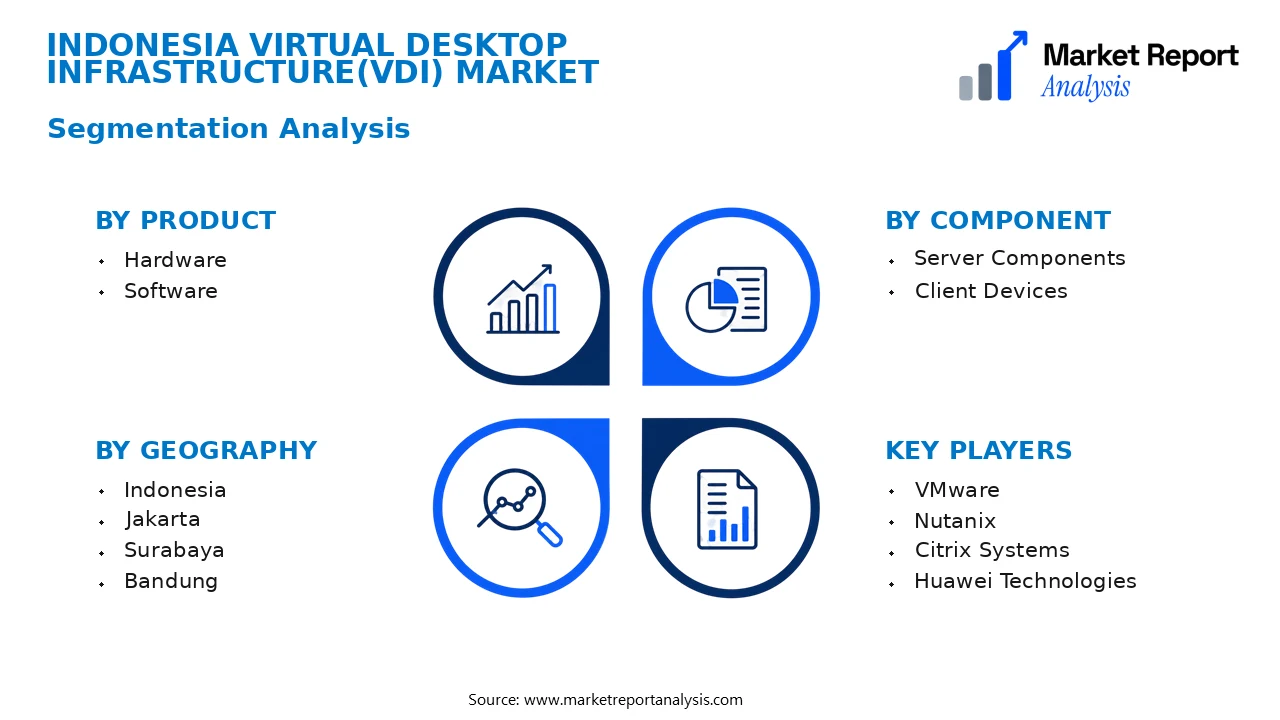
- Product
- Hardware: This segment includes physical infrastructure components such as servers, storage devices, and networking hardware that support VDI environments. Demand is driven by enterprise infrastructure upgrades and migration trends to cloud-based solutions.
- Software: Encompasses VDI platforms, management software, and virtualization tools that enable remote desktop access and centralized control. Growing adoption of cloud technologies propels the demand for advanced VDI software solutions.
- Component
- Server Components: Critical for hosting virtual desktops, server components are integral to infrastructure deployments, with increasing demand as organizations expand their remote work capacities.
- Client Devices: Includes thin clients and zero clients used by end users, with rising adoption in industries seeking cost-effective, efficient endpoints for virtual desktops.
- Deployment Mode
- On-premises: Organizations preferring in-house management cite data security and control as key drivers, although this mode requires higher capital expenditure and maintenance effort.
- Cloud-based: Cloud deployment is gaining traction due to its scalability, flexibility, and lower upfront costs, making it suitable for SMEs and large enterprises alike.
- Application
- Remote Work: The most significant application, supporting the Indonesia government's initiatives and enterprises transitioning to flexible and hybrid working models, thereby boosting VDI deployment across urban centers.
- Business Continuity: VDI solutions enhance operational resilience, critical for financial services, healthcare, and government agencies facing increasing geopolitical and environmental risks.
- End User
- SMEs: Small and medium-sized enterprises in Indonesia are adopting VDI to optimize costs and improve IT agility amidst rapid digital transformation demands.
- Large Enterprises: Major corporations across banking, telecommunications, and manufacturing sectors deploy VDI for security, centralized management, and supporting remote workforce needs.
- Industry Vertical
- Banking & Financial Services: This vertical shows high VDI adoption due to regulatory requirements for data security and the need for remote banking services expansion.
- Government & Defense: VDI deployment enhances secure data access and management, especially with increased digital government initiatives and digital identity programs.
- Healthcare: Healthcare providers adopt VDI to support telemedicine, patient data access, and secure information sharing across hospital networks.
- Manufacturing & Retail: VDI enables streamlined operations, remote monitoring, and enterprise resource planning (ERP) systems integration for improved productivity.
- Geography
- Indonesia: The overall market is driven by nationwide digital transformation initiatives and increased enterprise IT investments across the country.
- Jakarta: As the capital and economic hub, Jakarta leads market growth with high concentration of corporate headquarters, government agencies, and tech startups adopting VDI solutions.
- Surabaya: This secondary economic city exhibits growth in manufacturing and logistics sectors increasingly leveraging VDI for operational efficiency.
- Bandung: Known for its educational and tech innovation hubs, Bandung demonstrates rising adoption rates driven by local startups and educational institutions integrating VDI for remote learning and development.
- Medan: As a key commercial center in Sumatra, Medan’s industries utilize VDI for data management, remote collaboration, and supporting regional business expansion.
- Semarang: The city’s manufacturing and logistics sectors are incorporating VDI to enhance resource sharing and streamline administrative processes.
- Makassar: With its port and trade activities, Makassar adopts VDI to facilitate cross-border business operations and digital infrastructure development.
- Batam: The Free Trade Zone’s industrial clusters are deploying VDI solutions to support manufacturing, offshore services, and digital transformation initiatives.
Competitive Intelligence
The Indonesia Virtual Desktop Infrastructure (VDI) market exhibits a moderately fragmented competitive landscape, marked by the presence of several local and global players. Major companies focus on differentiation through product innovation, offering tailored VDI solutions that cater to Indonesia’s unique business and regulatory environments. Key strategies include forming strategic partnerships with local IT service providers and expanding distribution channels across prominent Indonesian cities such as Jakarta, Surabaya, and Bandung to enhance reach and market penetration. Some firms have pursued acquisitions of regional startups specializing in cloud computing and cybersecurity to bolster their offerings and competitiveness. R&D investments are directed toward enhancing device compatibility, security features, and user experience, setting apart industry leaders from smaller competitors. Business strategies emphasize competitive pricing, customized deployment solutions, and strong after-sales services, aiming to establish long-term customer relationships. Differentiation also stems from a focus on compliance with Indonesian data sovereignty laws, further solidifying market positioning amid increasing digital transformation initiatives.
Leading Company Profiles
The competitive landscape of Indonesia's Virtual Desktop Infrastructure (VDI) market is characterized by the presence of several global and local players. These companies leverage advanced technologies, innovative solutions, and strategic collaborations to expand their footprint and cater to Indonesia's growing demand for remote work and digital transformation.
- VMware
- Nutanix
- Citrix Systems
- Huawei Technologies
- Dell Technologies
- Microsoft
- VMware
- Nutanix
- Citrix Systems
- Huawei Technologies
- Dell Technologies
- Microsoft
Microsoft offers a comprehensive VDI solution through its Windows Virtual Desktop platform, emphasizing cloud integration and security, positioning itself as a leading provider for enterprise digital workplace solutions in Indonesia.
VMware
VMware provides robust virtualization and VDI solutions, focusing on scalability and management ease, which align with Indonesia’s enterprises’ needs for flexible and efficient remote desktop environments.
Nutanix
Nutanix focuses on hyper-converged infrastructure that supports VDI deployments, promoting simplified management, high performance, and cost-efficiency crucial for the Indonesian market’s expanding virtual workspace infrastructure.
Citrix Systems
Citrix specializes in secure remote access solutions with a strong presence in Indonesia, leveraging its innovative application delivery and virtualization technologies to serve growing enterprise and government sectors.
Huawei Technologies
Huawei integrates its cloud and virtualization technologies to deliver scalable VDI solutions tailored to the connectivity and security needs of Indonesia’s diverse industrial landscape.
Dell Technologies
Dell offers end-to-end VDI solutions, combining hardware and software, focusing on performance, reliability, and security for business continuity and remote workforce enablement across Indonesia.
Strategic Business Developments
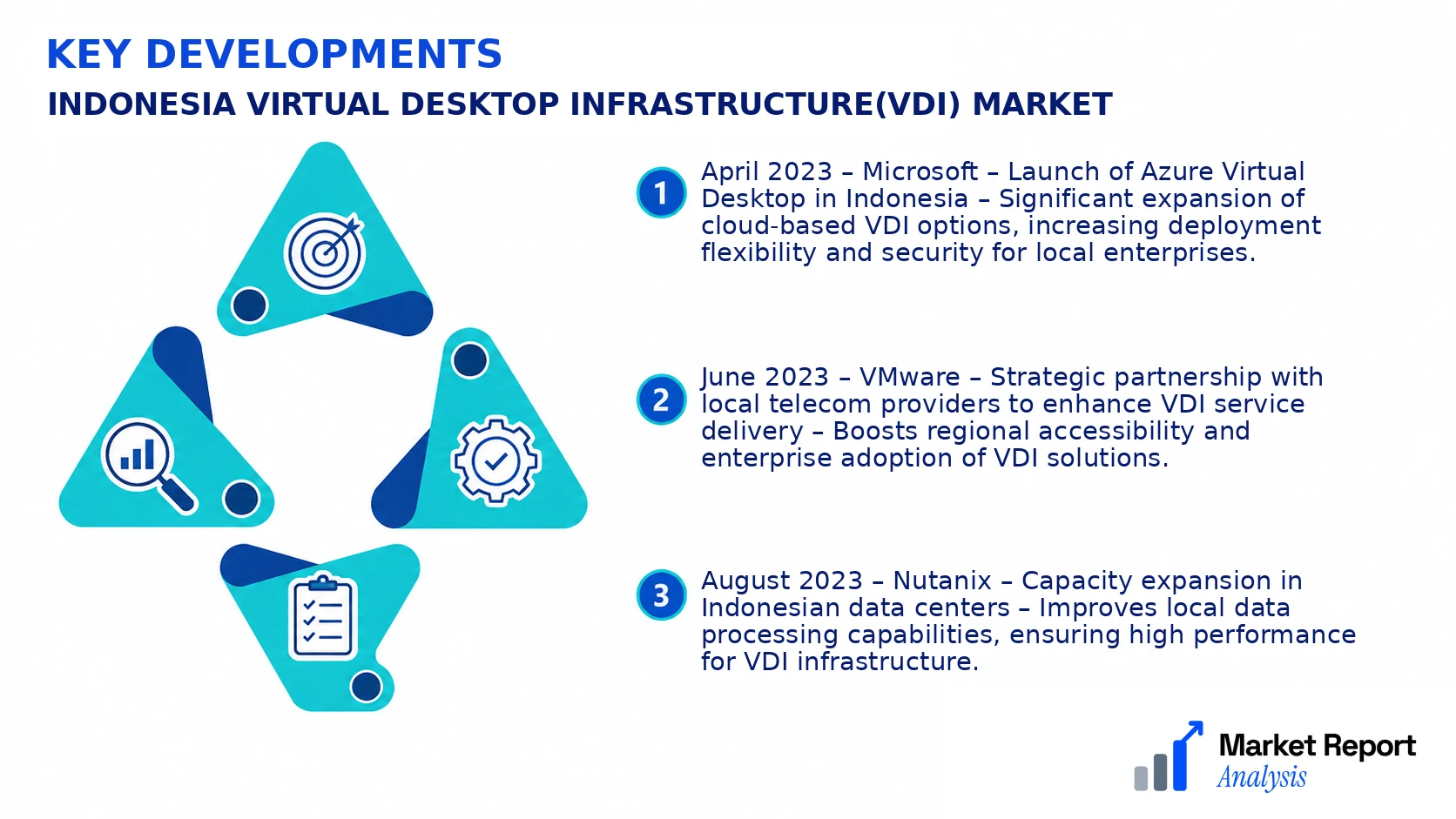
- April 2023 – Microsoft – Launch of Azure Virtual Desktop in Indonesia – Significant expansion of cloud-based VDI options, increasing deployment flexibility and security for local enterprises.
- June 2023 – VMware – Strategic partnership with local telecom providers to enhance VDI service delivery – Boosts regional accessibility and enterprise adoption of VDI solutions.
- August 2023 – Nutanix – Capacity expansion in Indonesian data centers – Improves local data processing capabilities, ensuring high performance for VDI infrastructure.
- October 2023 – Citrix Systems – Acquisition of a leading local IT service provider – Strengthens enterprise service offerings and local market penetration.
- December 2023 – Huawei Technologies – Launch of new scalable VDI platform tailored for Indonesian government agencies – Supports digital transformation initiatives and secure remote working environments.
Frequently Asked Questions
What is the Indonesia Virtual Desktop Infrastructure(VDI) Market?
The Indonesia Virtual Desktop Infrastructure (VDI) market encompasses the deployment of virtualized desktop environments in Indonesia, enabling remote access and centralized management of desktops across various industries such as healthcare, finance, and government. The market reflects technological adoption and digital transformation trends within the country.
What is the current market size of Indonesia Virtual Desktop Infrastructure(VDI) Market?
As of 2026, the Indonesia VDI market is valued at approximately USD 1.2 Billion, driven by increasing remote work adoption and cloud computing trends. The market is poised for substantial growth, with a forecasted compound annual growth rate (CAGR) of around 16.4% through 2034.
What factors are driving the Indonesia Virtual Desktop Infrastructure(VDI) Market?
Key growth drivers include the rising demand for remote working solutions, government initiatives promoting digital infrastructure, surging adoption of cloud services, and the need for enhanced security and management of enterprise IT environments in Indonesia.
Which region dominates the Indonesia Virtual Desktop Infrastructure(VDI) Market?
Java region leads the Indonesia VDI market, owing to its dense business hubs, high technological infrastructure, and concentration of key industries such as banking, IT, and manufacturing. Urban centers are pivotal in accelerating market growth and adoption of VDI solutions.
Which segment is expected to grow the fastest?
The small and medium-sized enterprise (SME) segment is projected to experience the swiftest growth, driven by increasing SMB IT budgets, demand for cost-effective solutions, and technological advancements that make VDI more accessible and scalable for smaller organizations.
Who are the leading companies operating in the Indonesia Virtual Desktop Infrastructure(VDI) Market?
Major players include Microsoft Corporation, VMware, Citrix Systems, Inc., Nutanix, and Cisco Systems. These companies offer comprehensive VDI solutions backed by strategic partnerships and localized services to capture Indonesia’s expanding digital infrastructure needs.
Analyst Perspective
The Indonesia Virtual Desktop Infrastructure (VDI) market is poised for sustained growth through 2034, driven by escalating digital transformation initiatives and increasing enterprise adoption across various sectors. The long-term outlook indicates a maturing industry with rising integration of cloud-based solutions and enhancements in security and user experience. Commercial opportunities are particularly strong in tier-1 cities like Jakarta and Surabaya, where government and financial services sectors are aggressively modernizing their IT infrastructure. Advances in hyper-converged infrastructure and remote working paradigms will continue to influence technology evolution, prompting vendors to innovate around scalability, cost-efficiency, and user-centric design. Investment priorities should emphasize regional expansion, strategic partnerships, and research into localized cloud ecosystems, especially to serve Tier-2 cities with high growth potential. Competitive intensity is expected to intensify as local and international players seek to establish dominant positions. Overall, the regional growth outlook remains favorable, with Indonesia's emerging digital economy creating extensive opportunities for early movers and tech alliances.
