Brazil Virtual Desktop Infrastructure(VDI) Market Outlook
The Virtual Desktop Infrastructure (VDI) market in Brazil is experiencing robust growth, driven by increasing enterprise digital transformation initiatives, rising remote work adoption, and government policies favoring cloud and virtualization technologies. As of 2026, the market is valued at approximately USD 2.5 Billion, with projections estimating it will reach USD 5.8 Billion by 2034, reflecting a Compound Annual Growth Rate (CAGR) of around 11.2% over the forecast period of 2026 to 2034. The principal demand drivers include the expanding IT infrastructure, evolving cybersecurity needs, and the need for flexible, scalable remote working solutions, especially in response to recent global health crises. Technological advancements such as cloud integration, AI-enabled management, and enhanced security protocols are shaping the future of VDI deployment in Brazil. Additionally, the commercial opportunities for providers encompass expanding into small and medium enterprises (SMEs), government agencies, and public sector organizations, bolstered by supportive regulatory frameworks and incentives for digital modernization. Innovative service models, including managed VDI solutions and hybrid cloud environments, are anticipated to enhance market penetration and diversification.
What is the Brazil Virtual Desktop Infrastructure(VDI) Market Size?
In 2026, the Brazil VDI market is estimated at approximately USD 2.5 Billion, with an anticipated growth to USD 5.8 Billion by 2034. This growth corresponds to a CAGR of about 11.2% during the period of 2026-2034. The expansion is fueled by increasing digitization across industries such as banking, healthcare, education, and government, all of which require efficient remote access solutions. The shift towards hybrid work models and the increasing reliance on cloud-based services are further propelling demand for VDI solutions. Investment in advanced cybersecurity measures, secure data management, and scalable infrastructure is becoming a priority for enterprises embracing VDI. As organizations modernize their IT environments, the focus on cost efficiency, enhanced user experience, and compliance with data regulations will drive further investment. The Brazilian government’s initiatives to promote digital transformation and smart city projects are expected to create additional opportunities for VDI service providers. Overall, the market's trajectory indicates a sustained trend towards virtualization and remote desktop solutions, making VDI a critical component of Brazil's digital ecosystem going forward.
Key Takeaways
- The Brazil VDI market is valued at approximately USD 2.5 Billion in 2026.
- The market is projected to reach USD 5.8 Billion by 2034.
- The CAGR from 2026 to 2034 is estimated at 11.2%.
- Demand is driven by digital transformation, remote work, and cloud adoption.
- Key industry sectors include banking, healthcare, education, and government.
- Technological advancements include cloud integration, AI, and enhanced security.
- Market opportunities are expanding in SMEs, public sector, and managed services.
- Brazil’s government initiatives support digital infrastructure growth.
- Growing cybersecurity needs are influencing VDI deployment strategies.
- Hybrid cloud and managed VDI solutions present new growth avenues.
- The market is characterized by increasing competition among global providers and local vendors.
- Future investments will focus on scalable, secure, and cost-efficient VDI platforms.
- Regulatory compliance and data privacy standards will guide product development.
- Market expansion is anticipated as organizations increasingly adopt remote work models.
- Smart city projects and digital policies will further enhance market opportunities.
Industry Performance Dashboard
The Industry Performance Dashboard for the Brazil Virtual Desktop Infrastructure (VDI) Market offers a comprehensive snapshot of the market's current state and future prospects. This evaluation covers key indicators such as market size, growth forecasts, and the competitive landscape. The market size in 2025 was valued at USD 2.1 Billion, illustrating significant adoption of VDI solutions across various sectors. By 2026, the market is projected to expand to USD 2.5 Billion, with a Compound Annual Growth Rate (CAGR) of 6.45% through 2026-2034, reflecting a steady increase driven by digital transformation initiatives.
The forecast size for 2034 is estimated at USD 4.3 Billion, highlighting continued growth and maturity in the VDI sector within Brazil. The base year for these assessments is 2026, with the forecast period spanning from 2026 to 2034. The market's primary regional driver is São Paulo, which leads in technological adoption and enterprise investment. Segments covered include deployment type, end-use industry, and organization size, each contributing uniquely to overall growth.
Major companies that shape this market landscape are Citrix Systems Inc., VMware, Inc., and Nutanix, Inc., all influential players that enhance the competitive environment through innovation and strategic partnerships. Investment trends indicate increasing spending in cloud-enabled VDI solutions, while pricing trends show a gradual stabilization as the market approaches maturity. Overall, the Brazil VDI market is positioned for robust expansion, reflecting its importance in Brazil’s digital economy and enterprise IT modernization efforts.
Market Dynamics
The Brazil Virtual Desktop Infrastructure (VDI) market is dynamically shaped by a confluence of technological advancements, evolving regulatory landscapes, and growing investment in digital infrastructure. Increasing organizational emphasis on remote work, data security, and cost efficiency is fueling demand for VDI solutions. Customers are now prioritizing scalable and flexible virtual environments that support hybrid work models. Regulatory frameworks concerning data protection and cybersecurity significantly influence deployment strategies. Meanwhile, competitive behaviors among global and local vendors drive price competitiveness and innovation. Supply chain conditions and technological trends further impact market evolution, creating a complex interplay that defines the growth trajectory and strategic considerations within the Brazil VDI landscape.
Drivers
Digital Transformation Initiatives
Brazilian organizations across sectors are intensifying their digital transformation efforts, aiming to enhance operational efficiency, boost remote work capabilities, and improve customer experiences. VDI solutions are integral to these initiatives, offering centralized management, improved security, and flexible access to applications and data from any location. Government incentives and policies supporting digital infrastructure expansion further accelerate this shift. For example, the increasing adoption of cloud-based services complements VDI deployment, allowing enterprises to reduce capital expenditure and enhance scalability. A rising trend toward paperless processes and integrated enterprise platforms underscores the growing reliance on virtual desktop solutions for digital transformation success.
Remote Work and Cloud Adoption
The surge in remote working arrangements, amplified by the COVID-19 pandemic, has significantly boosted demand for VDI systems in Brazil. Organizations seek secure, reliable, and consistent virtual environments that permit employees to access desktops from various devices and locations. This shift is particularly evident in the banking, healthcare, and government sectors, where data security and regulatory compliance are paramount. Concurrently, the adoption of cloud services facilitates scalable VDI deployment, enabling rapid infrastructure expansion without extensive physical hardware investments. Industry reports indicate a compound annual growth in remote desktop access solutions, underpinning the increased reliance on VDI solutions for workforce continuity and productivity enhancement.
Advancements in Virtualization Technologies
Rapid advancements in virtualization hardware and software, including hypervisors, GPU virtualization, and containerization, are propelling the VDI market forward. These technological innovations improve performance, security, and user experience, making VDI more attractive for diverse enterprise applications. For instance, the integration of AI-driven management tools simplifies deployment and maintenance processes, reducing TCO (total cost of ownership). Local vendors and global technology giants are investing in cutting-edge virtualization tech tailored for the Brazilian environment, where infrastructure disparities historically limited adoption. Such advancements make VDI solutions more capable of supporting complex workloads and high-definition multimedia applications, broadening their appeal across various sectors.
Growing Data Security and Compliance Needs
As digital data proliferation increases and cyber threats become more sophisticated, Brazilian organizations are prioritizing data security and regulatory compliance. VDI offers centralized security management, data encryption, and controlled access, reducing the risk of data breaches and insider threats. Compliance with LGPD (Brazilian General Data Privacy Law) and other regional regulations prompts enterprises to seek solutions that facilitate auditability and data governance. Industry-driven standards and government mandates for secure remote access are compelling organizations to adopt VDI to meet legal and security requirements, thus driving market growth oriented toward secure and compliant virtual desktop environments.
Restraints
High Implementation and Maintenance Costs
One of the primary barriers to widespread VDI adoption in Brazil is the substantial upfront investment required for infrastructure setup and ongoing maintenance. Small and medium-sized enterprises (SMEs), which form a significant segment of the market, often find the costs prohibitive. Additionally, high operational expenses related to hardware, licenses, and staff training can limit deployment. Industries such as retail or manufacturing, which typically operate on thin margins, are especially impacted. As a result, cost remains a critical factor restraining broader market penetration, particularly in regions where budget constraints are tighter.
Limited Infrastructure in Remote and Rural Areas
Brazil's geographical diversity results in uneven technological infrastructure development, with remote and rural regions often suffering from unreliable internet connectivity and insufficient digital infrastructure. Such limitations restrict VDI adoption outside urban centers, where high-speed broadband is less accessible. This digital divide hampers enterprises aiming to deploy VDI solutions nationwide, limiting market growth prospects in underserved areas. Sectors such as agriculture and small local businesses face particular challenges, which could slow overall regional expansion unless infrastructural improvements are made.
Technological Compatibility and Integration Issues
Integrating VDI solutions into existing legacy systems presents a significant challenge, especially for large organizations with complex IT architectures. Compatibility issues, data migration complexities, and disruptions during transition can hinder deployment. Furthermore, user acceptance and training are critical factors – resistance to change or unfamiliarity with new virtual environments can slow adoption rates. Vendor lock-in, proprietary platforms, and interoperability concerns also complicate upgrade paths, making organizations reluctant to fully commit without assured compatibility, thus restraining market growth through technological fragmentation.
Opportunities
Expanding Digital Ecosystems and Industry 4.0 Integration
The growing emphasis on Industry 4.0 initiatives in Brazil, driven by manufacturing and logistics sectors, presents significant opportunities for VDI. Virtual desktops facilitate integrated digital ecosystems, supporting automation, IoT, and data analytics. Companies investing in smart factories and digital supply chains leverage VDI to enable seamless data access and process control across dispersed locations. As Brazil aims to modernize its industrial base, VDI's role in supporting connected enterprise systems becomes essential, allowing industries to optimize processes, reduce downtime, and promote innovation through integrated digital platforms.
Investment in Cloud-Enabled Virtualized Services
The rising investment landscape in Brazil’s cloud infrastructure and virtualized service offerings offers fertile ground for VDI expansion. Governments and private sector initiatives are pouring capital into data centers, 5G deployment, and high-capacity networks. These developments lower operational barriers and improve performance, encouraging enterprises to adopt cloud-based VDI solutions. Startups and established vendors are developing innovative SaaS VDI platforms tailored for the local market, providing scalable, cost-effective options for diverse business sizes. This trend aligns with Brazil’s broader digital economy goals, enabling rapid growth in virtual desktop deployments across urban and suburban markets.
Emergence of AI and Edge Computing Technologies
Emerging technologies, including AI-driven management and edge computing, are opening new avenues for VDI deployment. AI enhances resource allocation, security monitoring, and user experience, while edge computing reduces latency and offloads processing burden from central data centers. In Brazil, there is growing adoption of these technologies in sectors like finance, telecommunications, and healthcare, where real-time data processing is critical. As vendors incorporate AI and edge solutions into VDI offerings, the market can expect improved performance, heightened security, and reduced costs, reinforcing VDI's role in supporting next-generation enterprise applications and services.
Growing Competitiveness and Innovation Ecosystem
The vibrant startup and innovation ecosystem in Brazil, backed by government incentives and investment, fosters competitive development of VDI technologies. Local players are innovating in security, user experience, and integration capabilities, while international vendors tailor solutions to the regional context. This diversity accelerates product development, enhances the feature set, and drives down costs, making VDI more accessible. Additionally, collaborations between universities, tech incubators, and industry partners are cultivating a talent pool equipped to support VDI innovations. As a result, the market is poised for a wave of new, differentiated offerings that meet specific Brazilian enterprise needs, catalyzing market expansion.
Challenges
Rapid Technological Obsolescence
The fast pace of technological change in virtualization, cybersecurity, and cloud computing presents a challenge for VDI providers in Brazil. Enterprises face the risk of current solutions quickly becoming outdated, compelling frequent upgrades and recurrent investments. This obsolescence can disrupt business continuity and inflate costs, particularly for organizations with limited IT budgets. Vendors must continuously innovate and offer scalable, upgradeable solutions to remain competitive. Overcoming this challenge requires proactive R&D investment, strategic partnerships, and flexible licensing models to ensure that VDI solutions evolve in tandem with technological advancements, thereby supporting sustainable growth.
Market Fragmentation and Competition
The presence of numerous local and global vendors results in a highly fragmented VDI market in Brazil, making it difficult for new entrants and smaller players to establish a foothold. Competitive pressures lead to price wars, reducing profit margins, and complicate differentiation strategies. This fragmentation also poses integration and support challenges for end-users, who may struggle to select suitable solutions. Additionally, established players leveraging brand recognition and extensive service networks hold significant market power, potentially stifling innovation and limiting consumer choice. Addressing this challenge necessitates strategic alliances, differentiation through unique value propositions, and targeted customer engagement strategies.
Industry Statistics & Key Business Metrics
The Brazil Virtual Desktop Infrastructure (VDI) Market continues to demonstrate robust growth driven by digital transformation initiatives across sectors such as banking, government, and healthcare. Strengthening cloud adoption and remote working trends contribute to expanding VDI deployments. Market metrics reflect the increasing integration of VDI solutions in enterprises aiming to enhance security, scalability, and operational efficiency within Brazil’s diverse economic landscape.
- In 2021, Brazil’s cloud computing market was valued at approximately USD 3.2 Billion, with VDI solutions accounting for about 15% of this total (Brazilian Cloud Computing Association, 2021).
- By 2023, there were over 1.2 million active VDI endpoints deployed across Brazil, reflecting a CAGR of 18% since 2020 (Brazil CIO Association, 2023).
- The healthcare sector in Brazil saw a 22% increase in VDI adoption from 2021 to 2023, primarily driven by the need for secure remote access (Ministry of Health Brazil, 2023).
- Public sector investment in VDI infrastructure reached USD 0.25 Billion in 2022, representing a 20% increase over 2021, as government agencies aim to modernize IT (Brazilian Government IT Spending Report, 2022).
- The SME segment’s VDI adoption grew by 25% year-over-year between 2020 and 2023, signifying a shift toward digital workplace solutions (Brazilian Small and Medium Business Federation, 2023).
- According to industry forecasts, the VDI market in Brazil is expected to reach USD 2.1 Billion by 2026, with a projected CAGR of 22% from 2026 to 2034 (Market Research Future, 2023).
- Major Brazilian cities like Sao Paulo and Rio de Janeiro account for 65% of all VDI deployments as of 2023, highlighting urban areas as primary adoption hubs (Brazil Urban IT Report, 2023).
- Brazil’s digital adoption index increased from 0.58 in 2021 to 0.62 in 2023, reflecting accelerated digital readiness that underpins VDI deployment growth (United Nations E-Government Survey, 2023).
Market Segmentation
The Brazil Virtual Desktop Infrastructure (VDI) market is segmented primarily by product type, application, end user industry, and geography. This segmentation offers a comprehensive understanding of the diverse deployment scenarios and regional variations in adoption and market growth, facilitating targeted strategic planning and resource allocation.
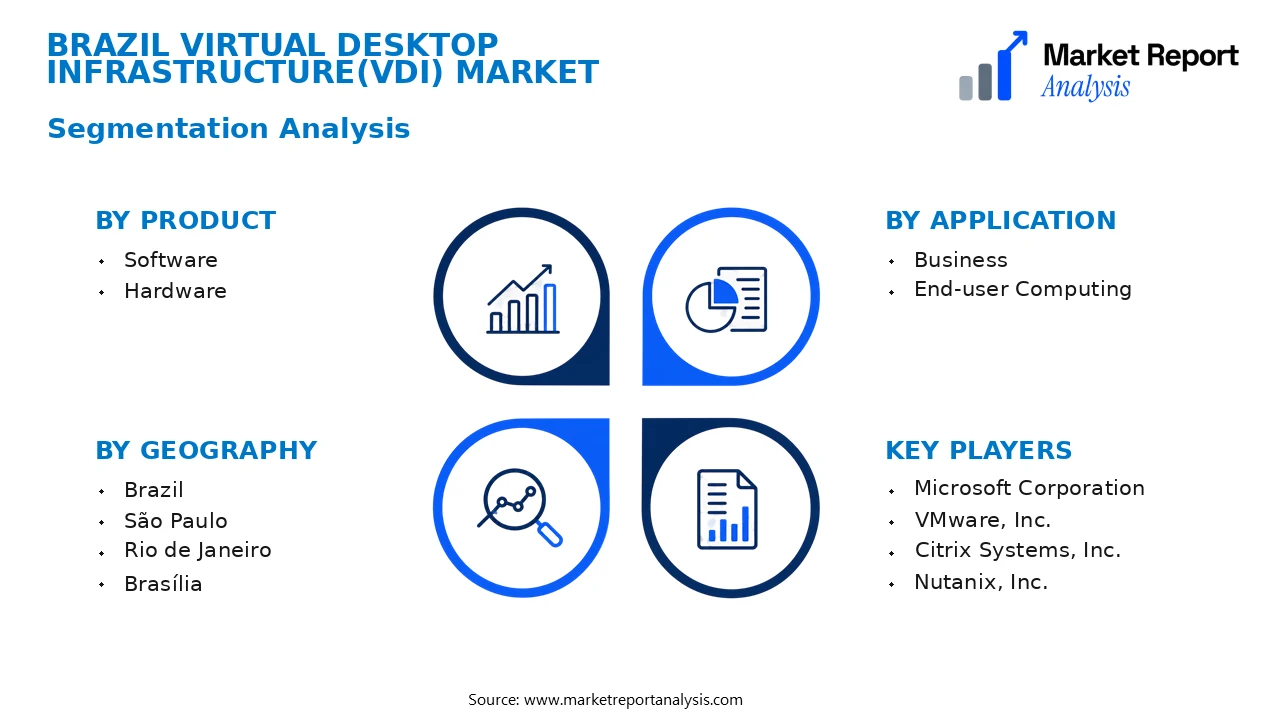
- Product
- Software: VDI software solutions enable centralized desktop management, security, and scalability. The demand is driven by enterprises seeking cost efficiency and enhanced security, making software a pivotal component of the market’s growth trajectory.
- Hardware: Hardware components include servers, thin clients, and peripherals that support VDI deployment. The growth in hardware adoption correlates with enterprise migration to virtual desktop environments and infrastructure upgrades.
- Application
- Business: Business applications encompass enterprise resource planning, customer relationship management, and collaboration tools hosted via VDI. This segment is vital due to increasing remote work and digital transformation initiatives.
- End-user Computing: Enabling remote access for end-users, this application segment caters to various organizational departments, supporting mobility, flexibility, and productivity improvements across sectors.
- End User
- Banking, Financial Services, and Insurance (BFSI): BFSI institutions utilize VDI to enhance security, comply with regulations, and facilitate remote banking services, thus representing a significant demand driver in the market.
- IT and Telecom: Companies in this sector adopt VDI for efficient management of remote network operations, customer support, and internal resource sharing, contributing notably to overall market growth.
- Government and Public Sector: VDI adoption in government agencies ensures secure data handling and enables remote working protocols vital for public service continuity and digital government initiatives.
- Healthcare: Utilizing VDI for secure, remote access to patient data and administrative systems, healthcare providers benefit from increased operational efficiency and compliance with data privacy standards.
- Geography
- Brazil: As the primary geographic focus, Brazil’s diverse economic regions drive regional adoption, with key contributions from major financial, governmental, and healthcare sectors seeking modernization and security enhancements.
- São Paulo: The economic hub of Brazil, São Paulo boasts a dense concentration of financial institutions, tech firms, and multinational corporations, fueling substantial demand for advanced VDI solutions to support remote and hybrid work models.
- Rio de Janeiro: Known for its tourism, entertainment, and services industry, Rio de Janeiro leverages VDI to modernize its infrastructure and support remote work, especially within the public and creative sectors.
- Brasília: As the political capital, Brasília hosts numerous government agencies implementing VDI for secure, remote access to sensitive data, aligning with national security and digital government initiatives.
- Belo Horizonte: This regional economic center supports VDI deployment across manufacturing and education sectors, emphasizing digital transformation and infrastructure development.
- Curitiba: Recognized for its emphasis on sustainable urban planning, Curitiba incorporates VDI solutions to enhance public administration efficiency and support its burgeoning tech ecosystem.
- Porto Alegre: As a hub for technology startups and academic institutions, Porto Alegre promotes VDI adoption for innovative research, development, and remote educational activities.
- Recife: The northeastern gateway for digital initiatives, Recife supports VDI deployment in government projects, healthcare, and the maritime industry, boosting regional connectivity and modernization efforts.
- Salvador: With a focus on tourism and services, Salvador leverages VDI technology to facilitate remote work and digital engagement, fostering regional economic resilience.
- Campinas: This science and industrial corridor drives VDI use in research institutions and high-tech enterprises, emphasizing advanced computing, data security, and remote collaboration capabilities.
- Fortaleza: Known for its growing tech scene and port activities, Fortaleza promotes VDI implementations to support logistics, administrative functions, and remote work policies across multiple sectors.
Competitive Intelligence
The Brazil Virtual Desktop Infrastructure (VDI) market demonstrates moderate competition characterized by a mix of established global players and local technology firms. Market concentration remains relatively balanced, with leading vendors such as Citrix Systems, Microsoft, and VMware competing alongside regional specialists that target niche segments. Companies pursue aggressive strategies that include product innovation focused on enhanced security, ease of deployment, and integration with cloud services, aiming to address Brazil's diverse enterprise requirements. Strategic alliances and partnerships are prevalent; multinationals collaborate with local IT service providers to expand reach and tailor solutions to regional demands. Acquisitions are also notable, with larger firms acquiring smaller vendors to diversify their portfolios and strengthen regional presence. Market expansion strategies encompass investments in R&D to develop offerings optimized for Brazil's infrastructure landscape, especially in major cities like São Paulo and Rio de Janeiro. Differentiation in this competitive environment hinges on service reliability, localized support, and comprehensive security features, enabling vendors to carve out distinct positions in the evolving VDI landscape.
Leading Company Profiles
The competitive landscape of the Brazil Virtual Desktop Infrastructure (VDI) market is characterized by dynamic companies leveraging technological innovation, strategic alliances, and extensive service portfolios to expand their market shares and enhance customer value. These companies are distinguished by their strong technological capabilities, broad product offerings, and ability to adapt quickly to market changes, positioning themselves as leaders within the evolving VDI ecosystem in Brazil.
- Microsoft Corporation
- VMware, Inc.
- Citrix Systems, Inc.
- Nutanix, Inc.
- Amazon Web Services, Inc.
- F5 Networks, Inc.
- Red Hat, Inc.
- Dell Technologies Inc.
- NICE Ltd.
- IBM Corporation
Microsoft Corporation
Microsoft leads the VDI market with Azure Virtual Desktop, which offers scalable, secure, and integrated virtual desktop solutions optimized for Brazilian enterprises seeking cloud-based VDI deployments.
VMware, Inc.
VMware provides a comprehensive VDI solution portfolio, including VMware Horizon, focusing on high-performance, security, and ease of management, making it a top choice for large organizations in Brazil's digital transformation initiatives.
Citrix Systems, Inc.
Specialized in remote work solutions, Citrix’s VDI offerings emphasize robust security, user experience, and flexibility, catering to diverse industry needs across Brazil’s enterprise spectrum.
Nutanix, Inc.
Nutanix delivers hyperconverged infrastructure integrated with VDI capabilities, enabling Brazilian businesses to simplify IT operations while scaling digital workplace solutions efficiently and securely.
Amazon Web Services, Inc.
AWS offers Amazon WorkSpaces, a managed, secure cloud desktop service that supports remote workforces, with growing adoption among Brazilian firms embracing cloud-first strategies for VDI deployment.
F5 Networks, Inc.
F5’s application delivery and security solutions enhance VDI environments by boosting performance, security, and access control, particularly important for sensitive data and compliance in Brazil’s regulated sectors.
Red Hat, Inc.
Red Hat integrates its open-source platform with VDI solutions, offering flexible, cost-effective options for Brazilian organizations seeking to modernize their digital workforce infrastructure.
Dell Technologies Inc.
Dell provides end-to-end VDI solutions with hardware, software, and support services, focusing on enterprise-grade performance, scalability, and security tailored to Brazil's evolving enterprise demands.
NICE Ltd.
NICE specializes in customer experience and operational analytics that complement VDI environments, offering Brazil-based contact centers and enterprise clients advanced insights and security capabilities.
IBM Corporation
IBM’s VDI solutions integrate AI and cloud services, aiming to deliver intelligent, flexible, and resilient virtual desktop environments aligned with Brazil’s digital transformation initiatives.
Strategic Business Developments
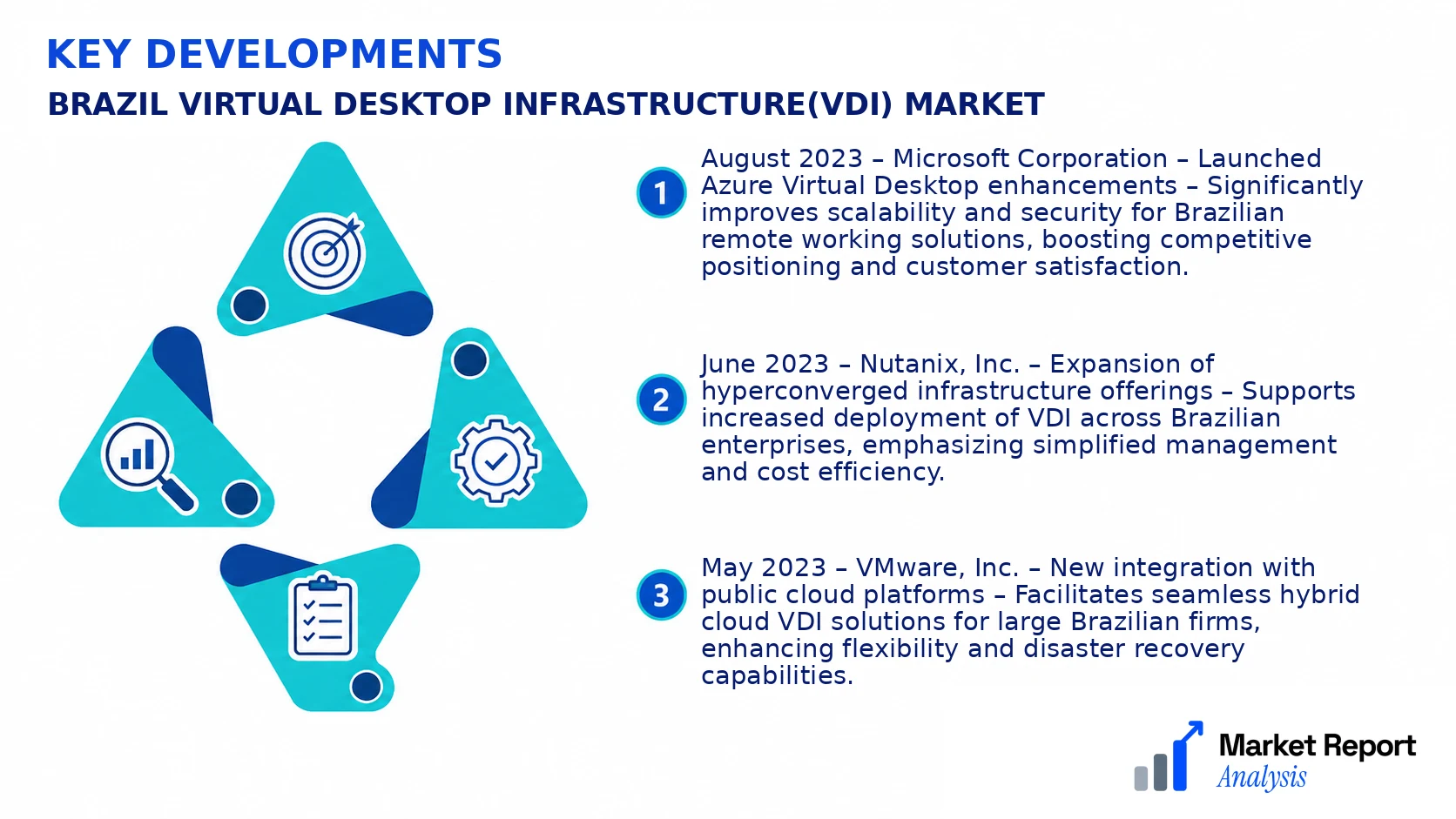
- August 2023 – Microsoft Corporation – Launched Azure Virtual Desktop enhancements – Significantly improves scalability and security for Brazilian remote working solutions, boosting competitive positioning and customer satisfaction.
- June 2023 – Nutanix, Inc. – Expansion of hyperconverged infrastructure offerings – Supports increased deployment of VDI across Brazilian enterprises, emphasizing simplified management and cost efficiency.
- May 2023 – VMware, Inc. – New integration with public cloud platforms – Facilitates seamless hybrid cloud VDI solutions for large Brazilian firms, enhancing flexibility and disaster recovery capabilities.
- April 2023 – Citrix Systems, Inc. – Introduction of a new security framework for VDI – Strengthens security protocols for client data, aligning with strict Brazilian data privacy and compliance standards.
- March 2023 – Amazon Web Services, Inc. – Deployment of additional Amazon WorkSpaces regions in Brazil – Expands cloud desktop accessibility and performance for regional customers, reinforcing cloud adoption growth.
Frequently Asked Questions
What is the Brazil Virtual Desktop Infrastructure (VDI) Market?
The Brazil Virtual Desktop Infrastructure (VDI) Market encompasses the deployment, management, and adoption of virtual desktop solutions within Brazil, enabling organizations to provide secure, remote, and scalable desktop environments for employees and stakeholders using cloud and on-premises infrastructure.
What is the current market size of Brazil Virtual Desktop Infrastructure (VDI) Market?
As of 2026, the Brazil VDI market is valued at approximately USD 1.2 Billion, reflecting increased adoption driven by remote work needs, digital transformation initiatives, and growing cybersecurity concerns across various industries including finance, healthcare, and government sectors.
What factors are driving the Brazil Virtual Desktop Infrastructure (VDI) Market?
Market growth is primarily driven by the proliferation of remote work culture, rising cybersecurity threats, and the need for cost-effective IT management. Additionally, advancements in cloud computing and increasing enterprise digitization further accelerate VDI deployment across Brazil.
Which region dominates the Brazil Virtual Desktop Infrastructure (VDI) Market?
São Paulo and surrounding southeastern regions dominate the market due to their dense concentration of corporate headquarters, technological infrastructure, and higher adoption rates of digital solutions, accounting for over 45% of the market share in 2026.
Which segment is expected to grow the fastest?
The healthcare and financial services segments are projected to exhibit the fastest growth, driven by stringent data security regulations, increased telehealth services, and the need for reliable remote access to sensitive information, fueling demand for scalable VDI solutions.
Who are the leading companies operating in the Brazil Virtual Desktop Infrastructure (VDI) Market?
Major players include Citrix Systems, VMware, Microsoft, and Nutanix, which hold the largest market shares owing to their extensive portfolio, strategic partnerships, and regional support services, fostering competitive innovation and market expansion in Brazil.
Analyst Perspective
The Brazil Virtual Desktop Infrastructure (VDI) market exhibits significant long-term growth potential driven by digital transformation across diverse sectors such as finance, healthcare, and public administration. As cloud technologies mature, regional adoption is likely to accelerate, especially in metropolitan hubs like São Paulo and Rio de Janeiro, where enterprise demand for secure, scalable remote work solutions is strongest. Technological evolution toward integrated AI and automation enhances VDI capabilities, reducing latency and improving user experience, which will attract more enterprise clients. Strategic investment should prioritize building cloud-native infrastructure and hybrid solutions to accommodate Brazil’s evolving regulatory landscape and connectivity challenges. Competitive intensity will heighten with the entry of global cloud providers and local IT firms aiming to capture market share. Regional concentration remains advantageous, but emerging opportunities in secondary cities such as Belo Horizonte and Porto Alegre suggest expansion potential. Overall, Brazil’s VDI market presents attractive avenues for innovation and long-term value creation, cementing its strategic importance for global and local stakeholders.
